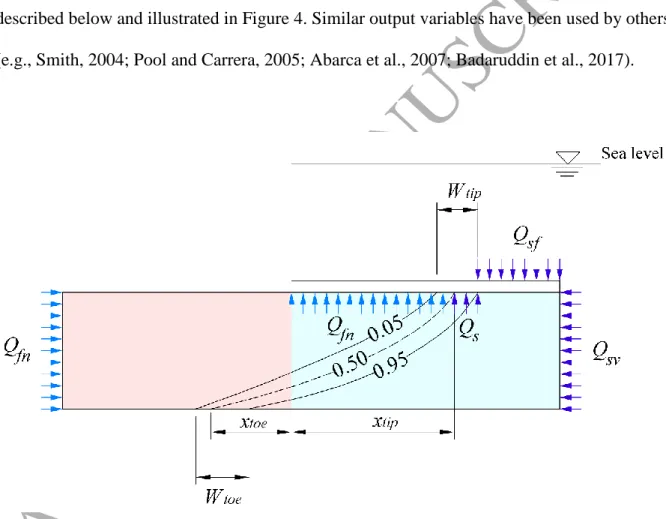
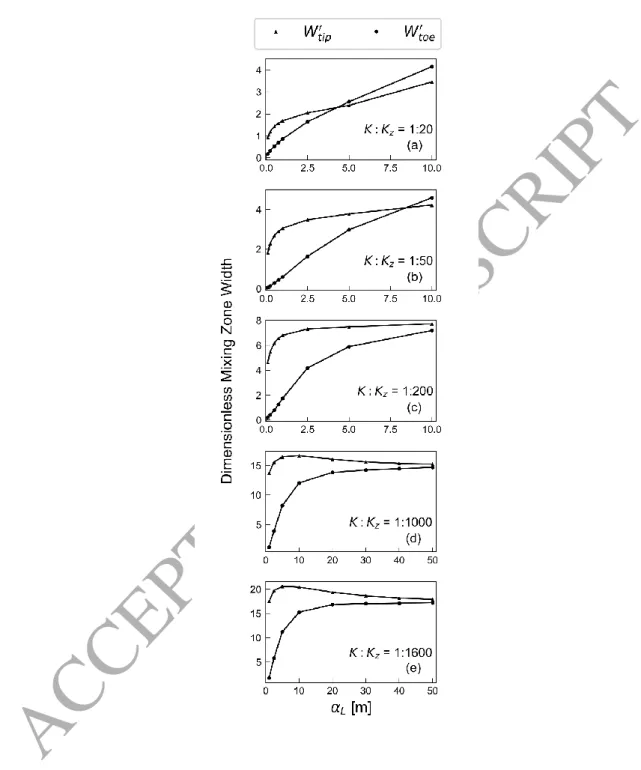
Lc Length of confined aquifer on land Ls Length of semi-confined aquifer in sea. Wtoe Dimensionless width of the mixing zone at the bottom of the aquifer xtip Location of the tip relative to the shoreline. Hill (1988) found that the method of Essaid (1986) caused overestimation of seawater extent, as Mehdizadeh et al.
ACCEPTED MANUSCRIPT
Methods
- Analytical solution
- Numerical methodology
- Output variables
- Mixed convection analysis
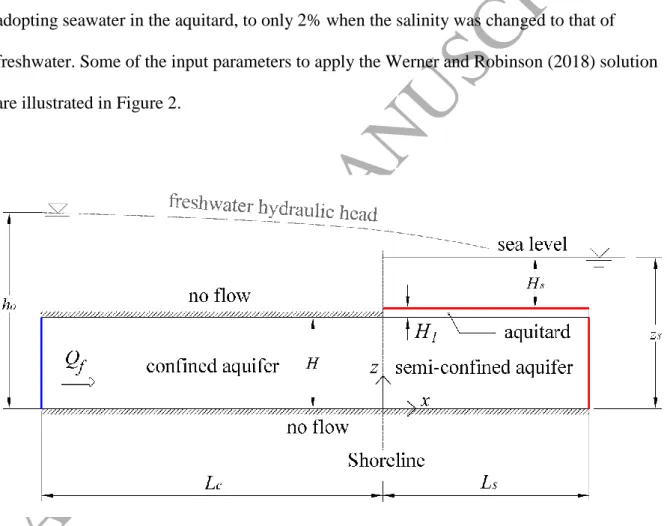
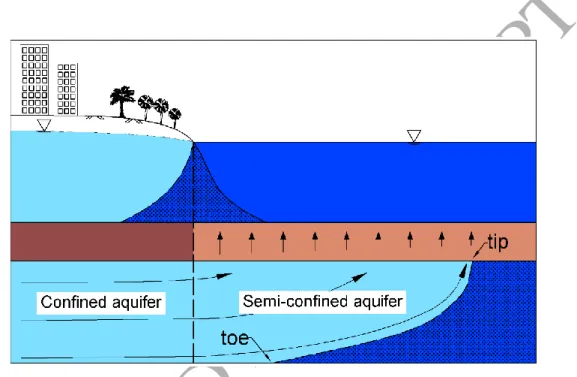
This two-dimensional, cross-sectional conceptual model is based on the assumption of one-dimensional flow (i.e., the Dupuit approximation) within an offshore aquifer that is homogeneous and isotropic. Simplified cross-section of a coastal aquifer extending from the coast to the end of the continental shelf (i.e. the right vertical edge of the diagram) (adapted from Solórzano-Rivas and Werner, 2018). Dark blue represents seawater, where the zone with the pattern represents the saline part of the aquifer, light blue represents fresh water, dark brown is the onshore confining unit, and light brown is the offshore semi-confining unit (i.e. the aquitard).
Some of the input parameters to apply the Werner and Robinson (2018) solution are illustrated in Figure 2. The symbols in Figure 2 are as follows: H is the thickness of the aquifer [L]; H1 is the thickness of the aquitard [L]; Hs is the depth of the sea at the top of the aquitard [L]; zs is the depth of the sea at the bottom of the aquifer [L]; Qf is the freshwater flow (per unit length of coastline) in the offshore aquifer [L2 T]; ho is the onshore hydraulic head [L], Lc is the length of the onshore confined aquifer [L], and Ls is the length of the offshore semi-confined aquifer [L]. It can be specified within the range of 0 to 1, whereby a value of 0 indicates that the aquitard contains seawater (i.e. the assumption of Bakker (2006) and Bakker et al. 2017)), and 1 indicates that the aquitard contains freshwater , which is consistent with the recommendation of Solórzano-Rivas and Werner (2018).
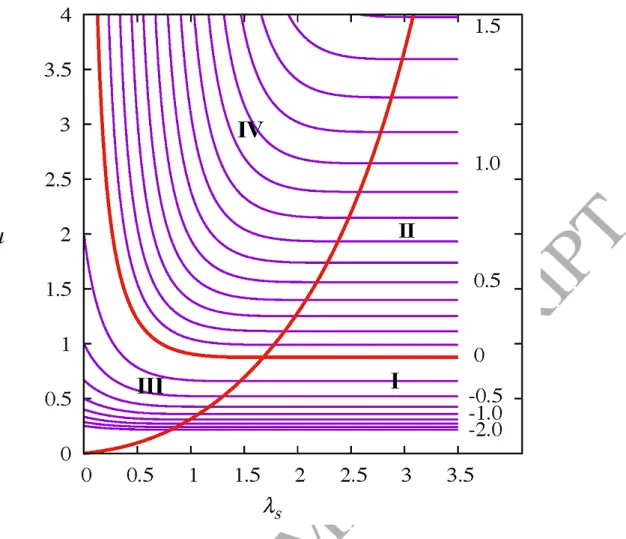
The reader is referred to Werner and Robinson (2018) for a full description of the mathematical solution. The tip position is landward of the vertical sea boundary in cases I and II and is linked to the offshore boundary of the aquifer (e.g. the edge of the continental shelf) in cases III and IV. According to Knight et al. 2018), published situations of significant subsea groundwater involve predominantly landward tips of the offshore aquifer boundary, at
The influence of the ocean on salinity at the aquifer-ocean interface was simulated as follows:. a) The vertical sea boundary represents the boundary of the offshore aquifer, so the concentration condition depends on the direction of flow, so that the release to the sea occurs at the ambient groundwater concentration, while the sea water concentration was assigned to any inflowing water. Given that flow near the mixing zone has a significant vertical component (e.g., Abarca et al., 2007), the maximum value of αL was further limited to the aquifer thickness (i.e., maximum αL ≤ H). To apply the Smith and Turner (2001) formulation to the conceptual model shown in Figure 2, qz at the 0.5-isochlore location at the top of the aquifer (see Equation 4) is taken as a.
Results
- Sensitivity to dispersion
- Effect of the seafloor boundary condition
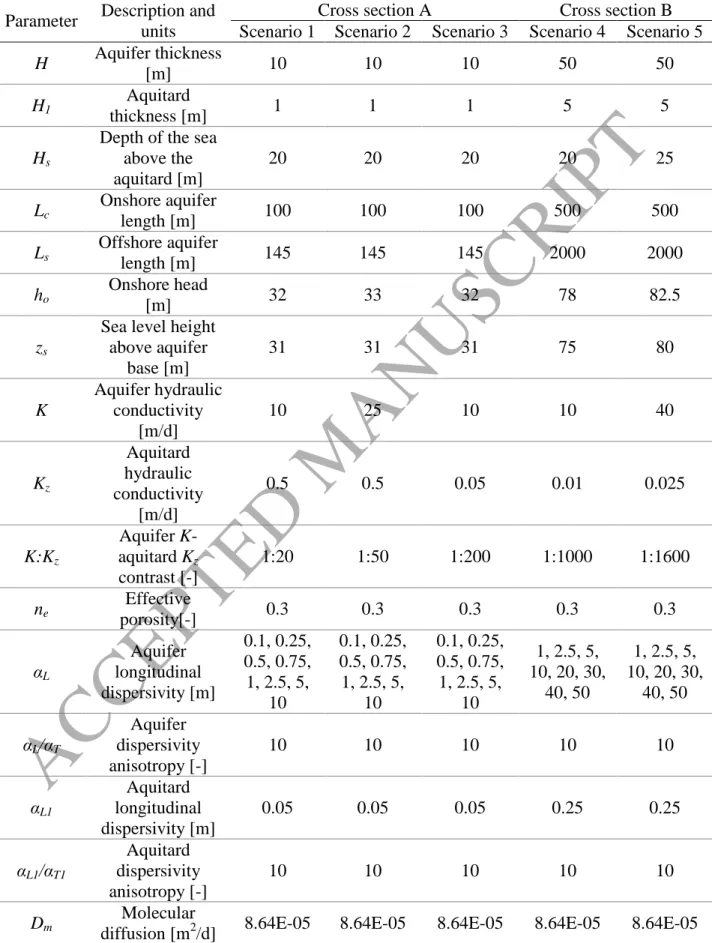
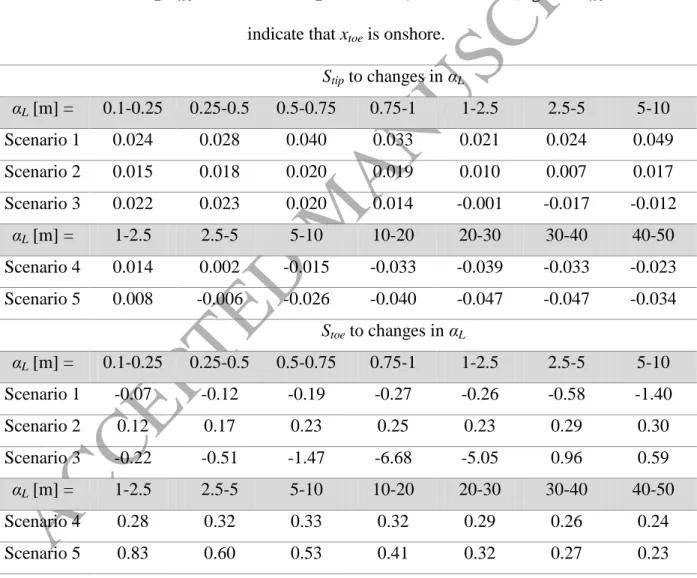
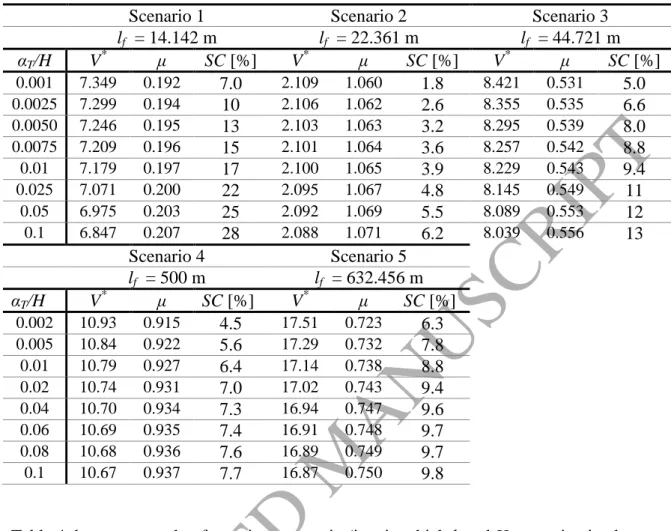
Steady-state locations of 0.5 isochlor (50% seawater salinity) for five scenarios (see Table 1), where panels (a) to (e) are scenarios 1 to 5. This is consistent with studies of dispersion effects on xtoe in terrestrial coastal aquifers (e.g., Volker and Rushton, 1982). Although the relationship between Stip and dispersivity is quite complex, whenever a negative Stip value was obtained (i.e. the tip moved landward), the Stoe value shows a decreasing trend (with increasing αL), although this behavior is based on only three simulations and is difficult to conceptualize in terms of physical causes.
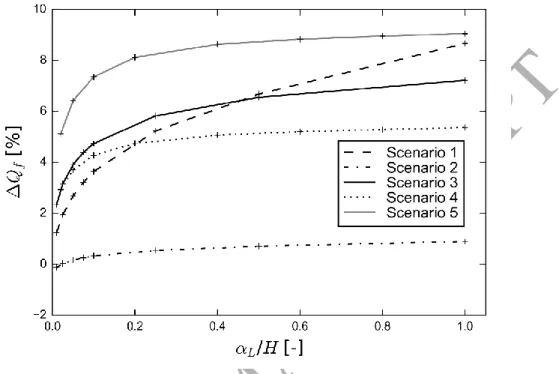
Specifically, Wtip and Wtoe were 255% and 98% greater (respectively) in scenario 3 relative to scenario 1 and were 22% and 24% greater (respectively) in scenario 5 relative to scenario 4 (average across simulations of each scenario). The slope of the scenario 1 curve gradually decreases with αL/H, so we expect asymptotic behavior to be likely at higher values of αL/H. This is inconsistent with the nonmonotonic relationship observed for terrestrial aquifers by Smith (2004) , who adopted similar αL/H and αT/H ranges to those of the current study.
Curves are labeled with the analytical sharp interface value of µ, showing that the vertical sequence of the curves is correlated to µ (ie µ increases from top to bottom). Both forms of the Rayleigh number, Raδ and Ra* (Wooding et al., 1997; Smith and Turner, 2001) were determined from the numerical modeling results corresponding to the position where the 0.5 isochlor crosses the top of the aquifer. However, the effect of the K:Kz contrast on the ratio between Raδ and Ra* and αL/H is different.
In Figure 9, the different curves tend to converge with increasing values of the Rayleigh number (and as αL/H decreases), while at high values of αL/H there is significant dispersion in Raδ. Effects of the seabed boundary condition (where (a) represents flow direction-dependent salt mass flux, and (b) represents fixed concentration; see Section 2.2) on dispersive (αL = 1 m and αL = 20 m) and non-dispersive numerical solutions (αL = 0 m) for. Deviations in xtip, xtoe, Wtip, Wtoe and SC are not higher than 1.7%, while ΔQf is significantly modified, i.e. the difference is equal to 14% in Scenario 2 with αL = 1 m.

Discussion
- Dispersion effects on subsea fluxes
- Mixed convection analysis and boundary condition effects
The different responses of the tip and toe to dispersion, as illustrated in Figure 5, are. A steepening of the interface with increased dispersivity has previously been observed in onshore aquifers (e.g. Shoemaker, 2003; Abarca et al., 2007; Kerrou and Renard, 2009), and therefore the same phenomenon in offshore aquifers is somewhat intuitive. They report rotation (steepening) of the interface as dispersivity (as a surrogate for heterogeneity) increases, leading to seaward motion of the toe.
In the situation of offshore aquifers, rotation of the interface similarly causes a seaward movement of the toe, but there is also a landward movement of the tip in our results. 39. seaward shift) associated with enhanced dispersivity both cause a seaward motion of the toe, leading to the dissimilar behavior of xtoe and xtip. Dispersivity values and the effect of the K:Kz contrast are related because as the interface becomes steeper, the flow lines also become steeper, changing the angle of attack of the flow at the aquifer-aquifer interface.
However, the important role of the K:Kz contrast in interfacial expansion adds to the well-known dispersive phenomena of offshore coastal aquifers. The ΔQf values in scenario 2 are at least 5 times smaller than in any of the other scenarios. This is consistent with the steepness of the interface slope and the generally seaward movement of the interface (at least in terms of the toe) as the dispersion increases, as illustrated in Figure 5 .
This is most likely a consequence of the reduced dispersivity applied to the aquitard, whereas Smith (2004) used uniform dispersivity parameters in his cases.
Conclusions
The finding that the type of seafloor boundary condition affects freshwater discharge to the ocean adds to Smith's (2004) conclusions about boundary condition effects of seawater circulation. Smith (2004) used specified flux conditions at the onshore boundary, whereas in this study we used specified head conditions, which allowed the influence of boundary conditions and other factors on freshwater discharge to be evaluated. For the case where nondispersive solute transport parameters were adopted, the location of the interface toe was hardly affected (i.e., up to 2.1%; see Table 3 ) by the choice of offshore solute boundary condition.
Therefore, the results of Solórzano-Rivas and Werner (2018) are not dependent on their choice of boundary condition (i.e. flow direction-dependent salt mass flux). Given our inland boundary condition (i.e., specified head), it was possible to investigate the dispersion effect on fresh groundwater discharge to the sea (i.e., Qfn), and found that larger dispersion values cause increased Qfn. The results also show that Qfn is related to the type of analytical case (i.e. the four point-to-situations defined by Bakker, 2006), whereby larger changes in Qfn occur when dispersivity is increased if the interface is classified within Analytical Case I ( i.e. the toe is ashore).
This finding suggests that the critical value of dispersion at which the influence of buoyancy forces on seawater circulation rates is reduced differs from that suggested by Smith (2004) for terrestrial settings. This is mainly due to the influence of the aquifer-conduit interface on the dispersion effects affecting the SC. This is because dispersion effects reduce the influence of buoyancy forces driven by density gradients, thus lowering Raδ as dispersity increases.
Furthermore, it has been shown that the type of concentration boundary in submarine aquifers (for model setups similar to ours) is likely to have a negligible effect on salt distribution and seawater circulation rates, but can have a significant impact on estimates of freshwater flux to the sea.
Our attempts to find a dispersive correction factor for estimates of sharp interfaces that can be applied to all five scenarios were unsuccessful. This means that fracture at the aquifer-aquifer boundary plays an important role in controlling the extent of freshwater and freshwater-seawater mixing in the offshore aquifer. Evaluation of analytical solutions for a steady flow interface where an aquifer extends below the sea.
A comparison of coupled freshwater-saltwater flow and Ghyben-Herzberg sharp interface approaches for modeling transient behavior in coastal aquifer systems. Comparison of freshwater-saltwater sharp interface and convective-dissipative models of saltwater intrusion into a layered aquifer system. Discussion of the validity of sharp interface models to deal with seawater intrusion in coastal aquifers.
A correction factor to account for mixing in Ghyben - Herzberg and critical pumping rate approximations of seawater intrusion in coastal aquifers. On the effects of preferential or barrier flow characteristics on solute plumes in permeable porous media. An assessment of the importance of some parameters for seawater intrusion into aquifers and a comparison of dispersive and sharp interface.
Correction factor to account for scattering in sharp-interface models of freshwater terrestrial lenses and active seawater intrusion.