ADMINISTRATORS’ PROFESSIONAL DEVELOPMENT IN A HIGHER EDUCATION ORGANISATION
LAURIE RICHARDSON
A thesis submitted in partial fulfilment of the requirements of the degree of Master of Educational Leadership and
Management
Unitec Institute of Technology
2008
Administrators’ professional development in a higher education organisation
ABSTRACT
This thesis investigates administrators’ engagement in professional development in a higher education organisation where academia is the organisation’s raison d’être.
Using literature from management and non-academic higher education administration, I frame the study on three fronts: administrators; professional development; and higher education organisations. I discuss administrators and professional development. I also discuss how all staff contribute to the achievement of organisational goals. All staff, in higher education, includes those directly involved in academia and those involved indirectly (Szekeres, 2006).
This research establishes that administrators define professional development as both training and education. However, their actual professional development engagement is work-related training courses. Reasons as to why administrators engage in training courses rather than training and education seem to be their perception of low levels of organisational support.
Authors such as Rudman (2002), Woodall and Winstanley (1998), and Argyris and Schön (1996) argue that engaging all staff in meaningful professional development enables all staff to contribute to achieving organisational goals. This research shows that administrators may not be engaging in meaningful professional development.
Accordingly, they may not be contributing to organisational goals. I therefore argue that a dichotomy may exist between the activities of administrators in a higher education organisation and organisational goals.
Case study methods of enquiry, and qualitative methodologies were employed to study administrators’ perceptions of professional development in one higher education organisation. The research employed data gathering tools such as focus group discussions and a questionnaire to gather data from one group of administrators within the organisation.
ACKNOWLEDGEMENTS
I wish to acknowledge the support and encouragement of the following people, whom without, this research project may not have been possible.
Mary and Tanya, my supervisors, who toiled endlessly with me throughout my period of writing;
Fran, my librarian, for her many successful searches for relevant articles;
Anne, Alison, Kathleen who managed the pilot-testing processes of the questionnaire and who provided thoughtful responses and suggestions;
Administrators who completed the questionnaire, who participated in a focus group discussion, and those who engaged in both;
My employer, for their continual support and encouragement;
My wife, Alison, daughter Laura, and son Tim, for their patience and the many sacrifices they have made;
The host of friends and colleagues who have supported me throughout; and Mary and John, whose foresight and intervention thirty years ago began a
journey of personal improvement and credential development which has accumulated in the completion of this thesis.
I dedicate this thesis to Dad, who would have been immensely proud of my
achievements.
TABLE OF CONTENTS
ABSTRACT i
ACKNOWLEDGEMENTS ii
TABLE OF CONTENTS iii
LIST OF TABLES vi
LIST OF FIGURES vi
CHAPTER ONE - ADMINISTRATORS’ PROFESSIONAL DEVELOPMENT: AN INTRODUCTION
Introduction 1
Rationale 1
Research Aims and Questions 2
The Higher Education Organisation 2
Administrators 3
Organisation of the Thesis 4
CHAPTER TWO - PROFESSIONAL DEVELOPMENT AND HIGHER EDUCATION
Introduction 5
Administrators 5
Administrators and Mission Statements 9
Professional Development 10
Administrators’ Professional Development 13
Barriers to Professional Development 15
Conclusion 17
CHAPTER THREE - METHODOLOGIES AND RESEARCH METHODS
Introduction 18
Methodology 18
Case Study 20
Participants 21
The Questionnaire 22
Focus Groups 28
Limitations, Reliability and Validity 30
Ethical Issues 31
Conclusion 32
CHAPTER FOUR - ADMINISTRATORS’ PERCEPTIONS OF PROFESSIONAL DEVELOPMENT
Introduction 33
Participant Details 33
Administrators’ Defined Professional Development 34 Administrators’ Professional Development Engagement 36
Purpose of Professional Development 38
Professional Development Barriers 43
Conclusion 45
CHAPTER FIVE - DISCUSSION: ADMINISTRATORS AND PROFESSIONAL DEVELOPMENT
Introduction 47
Administrators and Professional Development 47
Comparisons between Literature and Professional Development 50
Barriers to Professional Development 51
Conclusion 52
CHAPTER SIX - LOOKING BACK AND MOVING FORWARD
Introduction 53
Administrators and Professional Development 53
Moving Forward 54
Limitations 56
Further Research Opportunities 57
Summary 58
REFERENCES 59
APPENDIX ONE: Programme Administrators Professional
Development Questionnaire 64
APPENDIX TWO: Focus Group Semi-Structured Questioning Guide 72 APPENDIX THREE: Comparison of Research Data and Literature
Review Themes 75
LIST OF TABLES
Table 2.1: Defined terminology of non-academic staff in higher
education 7
Table 4.1: Purpose of professional development: Administrators’
perceived purpose for engagement 39
Table A3.1: Comparison of research data and literature review
themes 76
LIST OF FIGURES
Figure 2.1: Higher education administration role and responsibility
continuum 8
Figure 2.2: Meaningful professional development: The person and
their skills 12
Figure 3.1: A bounded phenomena: Administrators’ professional development in higher education - A multi-foci single
case study. 20
Figure 3.2: Selected ranking question format 25 Figure 4.1: Administrators’ definition of professional development 35 Figure 4.2: Desired professional development for administrators’
career development 42
Figure 4.3: Organisational support for administrators’ professional
development 44
Figure 5.1: Administrators’ professional development 48
CHAPTER ONE
ADMINISTRATORS’ PROFESSIONAL DEVELOPMENT: AN INTRODUCTION
Introduction
This chapter provides an overview of the thesis. I provide a rationale for the study and outline the context of professional development for administrators in higher education organisations. I then provide an overview of the thesis structure.
Rationale
Whereas academic staff members focus on their key role of teaching, learning, assessment and research, administrators ensure that academic activity is integrated into the core business of higher education organisations (Szekeres, 2004; and Conway, 2000b). Furthermore, administrators ensure that the organisational and central government requirements of recording, reporting, and archiving statistics of student achievement are met (Szekeres, 2004).
The argument presented by Conway (2000b) and Szekeres (2004), suggest that administrators’ contribution to higher educational goals is valuable. How then, do administrators in higher education organisations develop themselves so that their contribution to the organisation is meaningful? Furthermore, does the organisation support the development of all staff in higher education by developing their administrators? These questions are the focus of this thesis.
Professional development is a requirement of all staff, as everyone within an organisation should develop their capabilities to enable them to better contribute to achieving organisational goals (Woodall and Winstanley, 1998; and Fielden, 1998).
After all, “choosing to work in a university, and to make a career of it, represents a commitment to the educational mission of universities, their uniqueness as organisations, and to academic values” (Conway, 2000b, p. 201).
According to the South Pacific Higher Education Organisation (SPHEO, a pseudonym for the organisation at the centre of this research) individual and
collective employment contracts, all staff members are expected to engage in professional development. The ‘general staff’ collective and individual employment contracts cover all staff members that are not academics or in a senior management position (South Pacific Higher Education Organisation [SPHEO], 2006a; 2006b).
Academics are employed under an ‘academic’ individual or collective employment contract (SPHEO, 2004; 2005). Here, I would like to highlight that the academic staff contracts provides five times more professional development than that detailed in the general staff contracts. Accordingly, the following aim and research questions underpin this study.
Research Aims and Questions
Research Aim:
The aim of this qualitative study is to examine administrators’ perceptions of their professional development within a higher education organisation.
Research Questions:
1. How do administrators define professional development programmes?
2. What kind of professional development programmes do administrators undertake?
3. How are professional development barriers perceived by administrators?
The Higher Education Organisation
SPHEO is a large higher education organisation attracting approximately 9,000 effective full-time students per annum, which equates to over 50,000 full and part- time students (SPHEO, 2006c). The Annual Report also states that the total full-time equivalent staff population is approximately 1,000. Of these, approximately 45 percent are non-academic.
SPHEO offers academic programmes of study to local, national and international students, ranging from foundation learning to doctoral study. Furthermore, to add to the already diverse range of learning levels, it offers programmes in an applied context ranging from architecture to accountancy, communication to construction, engineering to education, horticulture to health, and technology to tourism (SPHEO, 2007). SPHEO’s mission statement espouses academic success through students’
contribution to their societies with their application of creative and intellectual potential (SPHEO, 2006d).
SPHEO is structured internally into schools. Schools are also a common term used in the compulsory education sector. The term ‘school’ used in the context of this research refers to defined internal sections of SPHEO rather than schools in the compulsory education sector.
In the following section, I define the administrators invited to participate in the study.
Administrators
Administrators in the context of this research work within academic schools in a higher education organisation. Furthermore, they are students’ point of contact for academic programme advice, support and progress reports, individual course lecturers, councillors, financial advisors, IT support, and academic learning support provided for students. They are therefore, administration staff providing academic support to academics, programmes, students, and student learning support systems.
There are three administrator positions within SPHEO that formed the basis for data collection. The three positions are programme administrators, programme managers, and school managers. In relationship with the organisation, administrators in this research make up approximately 22 percent of the total population of all non- academic staff. Anecdotal evidence indicates that these administrators can, and have progressed through the various positions, from programme administrator to school manager.
Programme administrators complete many of the non-academic clerical processes required for the recording and reporting of programme and student information.
Programme managers manage academic support systems for programmes, students, and academics. Some programme managers in larger schools may have added responsibilities, such as a team leader. School managers are responsible for the overview of and accountability for administrative requirements of all academic programmes offered in their respective schools. They are also responsible for the effective management of all administration staff within their school.
Organisation of the Thesis
The thesis contains six chapters including the introduction. The following chapters are summarised below.
Chapter Two examines related literature associated with administrators, their professional development and higher education.
Chapter Three provides an overview of the research methods employed and research tools used to collect data.
Chapter Four analyses data gathered from a questionnaire and focus group discussions.
Chapter Five discusses the disparities and similarities between administrators’
perceptions of professional development and relevant literature.
Chapter Six presents the conclusions and recommendations. This chapter also discusses limitations of the study and proposes areas for further research.
CHAPTER TWO
PROFESSIONAL DEVELOPMENT AND HIGHER EDUCATION
Introduction
This chapter examines literature from New Zealand and Australia, as well as from the United Kingdom (UK) and the United States of America (US) and explores literature from higher education professional organisations. As literature on professional development for higher education administrators seems to be sparse, literature from management and, to a lesser extent, literature from the compulsory education and public service sectors are also explored.
In this chapter I define administrators in relation to higher education organisations and their role in the organisation. I then examine the notion that the development of all staff in organisations is considered important. In a higher education environment, all staff would include administrators and academics alike. Finally, I examine barriers that may detract from administrators engaging in meaningful professional development programmes.
Key words such as leadership, management, professional development, training, management development, and professionalism are explored and applied in context to administrators, their employment contracts, and higher education organisations.
Administrators
There seems to be no one term to define non-academic staff in higher education organisations other than by defining them by what they are not, ‘non-academic’
(Conway, 2000b; Dobson and Conway, 2003). Pickersgill, van Barneveld and Bearfield (1998) and Szekeres (2006) use the terms ‘general staff’ as well as
‘administrators’ to define ‘non-academic’ staff within the higher education sector.
Furthermore, professional organisations such as the Association of University Administrators (AUA) use the term ‘administrator’ (Boswell, 1998). In comparison, the term ‘administration’ or ‘administrator’ can define high leadership or educational governance within the compulsory education sector (Sergiovanni, Burlingame, Coombs, and Thurston, 1999).
The term ‘administrator’ defines one sector of the non-academic staffing in higher education. Not all ‘non-academics’ are administrators. Positions such as technicians, grounds persons, and maintenance staff are non-academic yet they are also non administrative. These positions are sometimes referred to as ‘allied’ staff or ‘general’
staff as well as non-academic. However, administrators can also be defined as general staff or allied staff (Conway, 2000b; and Szekeres, 2006). Therefore, there is further confusion over the correct terminology for staff other than academic staff in higher education.
On line employment search engines such as jobs.co.nz, jseeker.com.au, and seek.co.nz use the term ‘administrator’ to identify data entry operators, office managers, personal assistants and executive assistants, receptionists and secretaries. Although not related to higher education, it nonetheless illustrates the use of this term in a New Zealand and Australian context. The term ‘administrator’ in the job search engines refers to general support staff and general management rather than high-level management and leadership personnel.
Where, then, do administrators fit in higher education where academia is the organisations raison d’être? Do administrators contribute to the development of academically focused mission statements? Johnsrud and Rosser (1999) argue that their contribution supports academic success through student learning support systems, reports, and academic staff support. Therefore, administrators’ contribution is relevant to the success of higher education organisations. Moreover, administrators are employed by the organisation and therefore must, in some way, contribute to the requirements of organisational success. Otherwise, their role in the organisation would seem to be superfluous.
Administrators in higher education organisations can be defined in two distinct groups: specialist administrators; and generalist administrators (Boswell, 1998; and Whitchurch, 2004). Specialist administrators may also be associated with a secondary profession such as human resource management, accountancy, and public relations. Generalist administrators’ profession may be more associated with academic support such as academic support, student advisers, learning support and the like (Johnsrud and Rosser, 1999; Boswell, 1998; and Whitchurch, 2004). The non-academic terms used in this research are defined and clarified in table 2.1 below.
Table 2.1: Defined terminology of non-academic staff in higher education organisations
Term Descriptor
Non-Academic Staff All Staff within higher education organisations that are not academic.
General or allied staff
All staff within higher education organisations that are not academic or managers.
Administration Staff General staff members in higher education organisations whose function is administration.
Generalist
Administrator Administration staff involved with academic administration such as timetable and exam coordinators, student support administrators, and school managers. Higher education administration is their profession.
Specialist
Administrator Administration staff involved with operational organisational administration such as human resource personnel, marketing staff, and information technology technicians. Higher education administration is their secondary profession.
Administrators (In the context of this research)
Generalist administrators who provide programme administrative support in higher education schools and create an interface between students, academic staff, and the organisation. Administrator positions within SPHEO include school mangers, programme managers, and programme administrators.
Administration The non-academic organisational operational requirements of higher education organisations, such as finance, student data management, and the like generally completed by generalist and specialist administrators rather than academics and senior management of the organisation.
School A school in the context of this research is a unit within the higher education organisation which provides education and training to the community in a defined range of disciplines. Academics, administrators and general staff would normally staff a school for the effective delivery of academic programmes.
Specialist administrators contribute to the development of academia in higher education organisations by managing educational resources such as the human resource management of teaching staff, computer lab facilities, buildings such as classrooms, and attracting students to the organisation through marketing strategies.
These are resources of which without, teaching, learning and research would not be possible. Therefore, specialist administrators contribute to the academic operational requirements of higher education and are therefore indirectly involved in achieving academic success.
Administrators such as programme managers and learning support staff have direct contact with students. They help make a student’s journey completing academic programmes successful. Boswell (1988) defines these administrators as generalist administrators. Generalist administrators work in areas such as the library, student support services, programme and regulations development, quality assurance, curriculum development, research support, committee work, admissions administration, examinations and assessment processes, and alumni relations (Boswell, 1998). According to Boswell, they create an interface between academic
programmes, students, academics, and academic support centres within the organisation. Therefore, generalist administrators are also indirectly involved in achieving academic success.
High Generalist Management
Administration Resources Manager
School Manager Student Support
Administrators
Secondary School Liaison Officers
Programme Manager
Specialist Management
Student Affairs Director Finance Manager Human Resource Manager Operations Manager Librarian IT Manager Facilities Manager Marketing Manager Administrative
Staff
Accountability Continuum
Personal Assistants Timetable/Exams
Coordinator Programme
Administrator
Admissions Coordinators Receptionist
Generalist Personnel
IT Support Technician Human Resource Personnel Library Personnel Marketing Personnel Accounts Clerk Copy Centre Technicians
Specialist Personnel Low
Generalist
Administration Specialists
Administration Administrative Staff Role Continuum
Figure 2.1: Higher education administration role and responsibility continuum.
Specialist and generalist administrators are represented in figure 2.1. On one continuum, levels of accountability, on the other, administration roles of purpose from generalist to specialist administration are indicated. Together, they form four distinct quadrants. However, in some cases, I would suggest that the boundaries between them may be blurred. SPHEO administrators who administer academic activity within their school span the generalist administrators’ responsibility continuum.
Administrators are only one small group of non-academic staff within SPHEO. They provide students with administrative (New Zealand and Australian context) support to the academic programme to which they are assigned. They provide academic administrative (US compulsory education context) leadership to systems, procedures, and structures to academic systems and reporting requirements.
However, administrators’ leadership role in higher education systems and reporting
requirements is not high organisational leadership and management levels as the term implies in a US context.
Administrators and Mission Statements
Administrators, according to Conway (2000b) and Szekeres (2004) may not contribute to academic goals directly. Administrators may therefore be ignored where their contribution to higher educational goals are not valued. After all, “University administrators are used to being ignored. They are ignored by government, by the institutions which employ them and by the academics with whom they work on a day- to-day basis” (Conway, 2000b, p. 199).
The implications made by Szekeres (2004) and Conway (2000b) are simple.
Administrators are not academic, and therefore may not contribute to academic goals. SPHEO mission statements espouse academic success through students’
creative and intellectual potential (SPHEO, 2006d). Academia is therefore SPHEO’s raison d’être. Therefore, mission statements and strategic goals of higher education organisations may not be inclusive of all staff (Conway, 2000b; Dobson and Calderon, 2006; and Szekeres, 2004).
One of five values statements espoused in the SPHEO mission statement highlights fairness and justice as organisational values (SPHEO, 2006d). Furthermore, one of over 10 vision statements express the institute’s student-centred focus and state that all services and activities contribute to academic success. Mission statements are an organisation’s statement to their community, stakeholders, and investors who have vested interests in the organisation’s purpose in the community (Samson and Daft, 2003). As argued earlier, all services and activities students engage in while studying in higher education are not delivered by academic staff. However, they are all supported by administration staff (Conway, 2000b). Therefore, academic values statements may not reflect administrators’ contribution to the organisation.
Contradicting the way values statements are used generally, such as by SPHEO, Henderson, Thompson, and Henderson (2006) describe values as “mental constructs that capture and express what is important to us” (p. 19). Furthermore, they describe different ways of defining values. According to Henderson et al. SPHEO’s fairness and justice ‘values’ are defined as morals, principles, and attitudes rather than values. Henderson et al. (2006) describe values as those which an organisation strives to achieve. The ultimate value is an organisation’s ‘goal’ value. In a higher
education context therefore the main goal value may be academic status or academic achievement. A ‘means’ value, Henderson et al. (2006) argue, are values that an organisation may focus on so that the ultimate goal value may be achieved.
When an organisation’s goal value is academic success and achievement, an organisation may implement means values to achieve their ultimate goal. However, if the mean values are so focused on academia, difficulties may arise where non- academic staff in organisations may not see their contribution. In this situation, Henderson et al. (2006) argue, unaligned values may be evident, and therefore, conflicting values within the organisation may detract from the organisation achieving its goal values. Where the dynamics of two values are not managed appropriately they are referred to as a values conflict (Henderson et al., 2006).
The theories of Conway (2000b) and Szekeres (2004) may therefore be appropriate in a higher education administrative context. Administrators may not contribute to organisational goals in higher education. Furthermore, there may exist a values conflict in higher education between administrators and higher education raison d’être.
The following section discusses theories of professional development in organisations from both a management perspective and a higher education perspective.
Professional Development
Professional development is an important aspect of educational life for teachers and non-teachers (Oldroyd and Hall, 1997; and Anderson, 2003). They argue that professional development is an important aspect for all staff in the compulsory education sector. Partington and Stainton (2003) argue a similar theme in higher education. They argue that academics and non-academics alike should be engaged in professional development. Therefore, all staff in higher education organisations, including administrators, should be engaged in professional development.
Before a discussion can continue the term ‘professional development’ should be discussed and clarified. Rudman (2002) defines three distinct themes of professional development: Education, training, and development.
Education, according to Rudman (2002) is the “learning experiences which improves a person’s general knowledge and overall competencies. The orientation of education, therefore, is focused on the person not their job” (Rudman, 2002. p. 473).
Woodall and Winstanley (1998) define education as the development of staff to learn, grow, and effectively develop their skills in a formal process. Woodall and Winstanley further argue that this kind of development may include programmes such as MBA’s, undergraduate business degrees and highly specialist post-graduate qualifications.
Training is the improvement of the person’s performance for a particular job, and focuses on the development of the individual’s ability to reach their full potential (Rudman, 2002). Woodall and Winstanley (1998) define this as ‘in-house’
management development programmes. Furthermore, they also argue that it is these programmes, rather than the educational orientated programmes that build staff skills and capabilities that help an organisation meet their goals.
Development according to Rudman (2002) and Woodall and Winstanley (1998) are a blend of both education and training. Education develops the core skills and abilities required by staff to be effective within their profession. Training develops the link between the core skills and organisational goals.
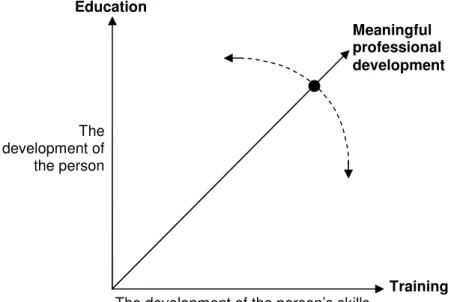
Meaningful professional development, therefore, is a blend of education and training.
Education-based professional development engages the person’s effectiveness within their profession. It develops the core skills that enable the person to strive for excellence and mastery in their field of professionalism (Harrison, 2003). Training develops links between skills required for the profession and skills required for the organisation, as argued by Woodall and Winstanley (1998).
Professional development should therefore be a requirement for both organisational staff and the organisation. Without it, staff may not make the connection between their profession and the organisation. Furthermore, staff may not be able to strive for mastery and excellence, which sustains their profession and their ability to work effectively in the organisation. Similarly, organisations may not develop staff members that contribute effectively to organisational goals (Argyris, 1977; Argyris and Schön, 1996; Osei, 1996; Partington and Stainton, 2003; Fielden, 1998; and Conway, 2000b). Partington and Stainton (2003) further argue that all staff in higher education contribute to the development of academia, and therefore all staff contribute to the development of academic goals in higher education organisations.
Training is not enough, according to Harrison (2003). He explains that professional development is not just about staff members’ active participation within a learning environment to support their immediate job requirements. It also requires an active engagement within an individual’s profession, research, and career. Harrison’s theories suggest that administrators have a responsibility to engage in professional development that focuses on not only their immediate need, but also on the wider context of their profession. A wider context may include the development of skills for the progression in their career (Harrison, 2003; and Johnsrud et al., 2000). To achieve this, Woodall and Winstanley (1998) suggest that a positive attitude and self- motivation is required before any development activity becomes effective.
Figure 2.2: Meaningful professional development: The person and their skills
A relationship between education and training is illustrated in figure 2.2. The pendulum illustrates the engagement in education and training equally as being meaningful professional development (Rudman, 2002; Woodall and Winstanley and Harrison, 2003). However, it may be that some professions require a little more of one aspect of professional development than the other.
Organisational staff members also need to be continual learners (Laske and Maynes, 2002). Laske and Maynes argue, “One of the hallmarks of a learning organisation is the need for employers to be continuous learners who can monitor their own
The development of the person
The development of the person’s skills
Meaningful professional development
Training Education
performance and who recognise what is essential for success in the organisation” (p.
702). However, when the weight of either education or training is greater than the other, effective meaningful and continuing professional development may be compromised (Rudman, 2002; Woodall and Winstanley, 1998; and Laske and Maynes, 2002).
Administrators’ Professional Development
Eraut (1994) explicitly defines professional development as the correct term for the development, or continuing development of professionals. This view is extended by Doney (1998), who argues that continuing professional development is “generally regarded as related to a high-level of education and is not, therefore, applicable to para-professional or very junior staff” (p. 487). These statements imply that professional development is for professionals and their development of professionalism through high-level educational development programmes.
Indicating that there is another view point of staff development, Argyris and Schön (1996), Dick and Dalmau (1999), and Senge (1992) argue that everyone in an organisation should be engaged in professional development. Therefore, professional development is not just for professionals or managers, but it is just as important for non-professionals and junior members of an organisation. However, these arguments are contrary to those expressed by Eraut (1994) and Doney (1998), who explicitly define professional development as for professional or senior management staff only.
Higher education administrators’ professionalism is in an embryonic stage, according to Osei (1996). Beale (2001) describes similar positions as ‘para-professionals’.
Strachan and Duirs (1993) further argue that administrators within higher education organisations should be interpreted as a “pseudo-professionalisation” (p. 463). Osei (1996) argues that administrators demonstrate the following elements of professionalism:
“(1) increase in formal status of administrative positions, (2) increase in the requirements for formal educational qualification to hold administrative positions, (3) emergence of a common cognitive basis, and (4) the growth and formalisation of networks between personnel in administrative positions” (Osei, 1996, p. 462-463).
Contrary to Osei’s (1996) theory for the requirements for formal qualifications, Lauwerys (2002) observes that administrators’ professional development is training focused. He explains that the “achievement of professional competence is very much to do with ‘learning on the job’ with an absolute minimum of formal training and a complete absence for the generalist of professional qualifications” (Lauwerys, 2002, p. 95). However, when suitable formal qualifications were available, he argues that an enthusiastic commitment to engage in such qualifications was not apparent amongst administrators despite encouragement from higher education organisations (Lauwerys, 2002). Therefore, professionalism and professional development for administrators may require support. For administrators, there are at least two professional organisations that offer support for administrators’ professional development and the development of their profession.
Administrators in Australian and New Zealand higher education organisations can choose to belong to the Australasian Association of Tertiary Education Management (ATEM) (Conway, 2000b). ATEM provides pathways to continuing development, and provides support to the administration sector in higher education through the ATEM
‘Journal of Higher Education Policy and Management’. Therefore administrators who belong to ATEM may be supported in their profession. Furthermore, excellence and mastery developed through meaningful professional development supports administrators’ professionalism (Harrison, 2003). An introductory statement in an ATEM journal articulates its members’ professional development and professional practice. It explains:
Tertiary education administration and management is a specialised and developing profession within academic institutions, requiring a commitment to lifelong learning and continuous professional development to the highest standards of professional practice (Dobson and Calderon, 2006, p. iii).
The Association of University Administrators (AUA) also provides support for the development of administration professionalism in the UK (Conway, 2000a; and Whitchurch, 1999). The AUA offers members an academic journal and a professional post-graduate qualification. Furthermore, the AUA expects members to “acquire a generic body of knowledge which is underpinned by its code of professional standards” (Boswell, 1998, para 11). With this framework in place and available to all members, AUA affiliated administrators have access to high-level educational development designed for a profession as described earlier by Doney (1998).
Moreover, the AUA provides a qualification, at post-graduate level, which is available
to any administrator who has an undergraduate degree. According to Gornitzka and Larsen (2004) and Strachan and Duirs (1993) more administrators in higher education have degrees than those in the public sector. Research conducted by Strachan and Duirs (1993) established that twenty-five percent of administrators in their research population had an undergraduate degree level qualification.
Post graduate qualifications have been developed for public servants in Australia to meet the growing requirement for further professional development of public service professionals who have degrees (Dixon, 2006). Furthermore, skills development is specialised in areas to meet the specific professionalism and core competencies required of the profession as argued earlier by Woodall and Winstanley (1998).
Although Dixon’s theories are in the public service sector rather than higher education, it nonetheless illustrates that specific post graduate qualifications are available for related professions. There are specialist post graduate programmes available for administrators from at least two professional organisations, the AUA and the Australian public service. As many administrators may already have degree-level qualifications, post graduate study may be an achievable goal for further study.
It may be that educational qualifications are not appropriate for some, and may be more appropriate for others. Nonetheless, educational professional development in some form may still be required to effectively enable administrators to strive for excellence, develop mastery, and maintain levels of professionalism (Harrison, 2003).
The following section discusses barriers that may detract administrators from engaging in meaningful professional development.
Barriers to Professional Development
Administrators do not have the same provisions for professional development as other staff in higher education (Szekeres, 2004; SPHEO, 2000a; 2006b). The only way administrators can engage in meaningful professional development, other than learning on the job training courses, is by manipulating their employment contracts to suit their own professional development requirements (Szekeres, 2004; and Lauwerys, 2002).
Learning on the job seems to be the predominant kind of professional development that administrators engage in (Lauwerys, 2002). Engaging in training related courses
demonstrates that administrators are engaging in professional development.
Therefore, administrators demonstrate that they as ‘non-academics’ engage in professional development as do academics (Oldroyd and Hall, 1997; Anderson, 2003; and Partington and Stainton, 2003). However, it does not demonstrate that administrators are engaged in a balance of education and training professional development as argued by Rudman (2002) and Woodall and Winstanley (1998).
Administrators not engaged in meaningful professional development may therefore find it difficult to develop the skills for their career growth (Harrison, 2003; and Johnsrud et al. 2000).
Career growth and advancement in the administrative profession may therefore be limited. Administrators may not have the time for the kind of professional development that may enhance their career advancement. Advancement as an administrator in higher education is difficult, argues Johnsrud et al., (2000). They claim that it is easier for an organisation to employ administrators with the requisite skills rather than develop existing administrators. Furthermore, when promotion opportunities arise in higher education, administrators find it difficult gaining the required formal qualifications through professional development due to a lack of time and the availability of suitable programmes of study (Johnsrud, Heck, and Rosser, 2000).
As discussed earlier, 25 percent of administrators have a degree qualification (Strachan and Duirs, 1993). However, Johnsrud, et al. (2000) argues that this may detract from engagement in professional development. Johnsrud et al. discuss the morale of administrators and establish that, despite their relatively high levels of education, they are not respected in higher education organisations. This aspect may manifest in the fact that administrators’ workloads and working hours are higher than those for academics (Anderson, Guido-DiBrito, and Morrell, 2000). They argue that student affairs administrators, US higher education student support administrators, work longer hours and are tied to task and procedural duties (Anderson et al., 2000).
The inequality of working conditions is one factor that may detract administrators from engaging in professional development opportunities, other than ‘on the job’
training (Johnsrud et al., 2000; and Lauwerys, 2002).
Professional development that academics undertake would naturally lead to the development of organisational mission and values statements where mission statements are academically focused. Firstly, it develops their intellectual knowledge
in their area of expertise, and moreover, their professionalism. Secondly, it supports the development of their students’ success in the organisation and achieves academic mission and values statements (Sergiovanni, 2000). The same opportunities for professional development should therefore be available to administrators in higher education (Rosser, 2000). Rosser suggests that administrators who engage in “professional development gain the skills and experience necessary to take on new and more challenging positions” (Rosser, 2000, p. 9).
Conclusion
Professional development, according to authors such as Eraut (1994) and Rudman (2002), is for professionals in a profession. However, other authors, such as Strachan and Duirs (1993) and Beale (2001) define administrators as professionals, even if only emerging. However, to add to the complexity Argyris and Schön (1996), Oldroyd and Hall (1997), and Anderson (2003) argue that all staff within an organisation should be involved in professional development to grow the organisation and the individual regardless of their levels of professionalism.
Other than on the job training, formal professional development appears to be problematic for administrators in higher education organisations. Either suitable professional development programmes are not available or administrators have difficulties finding the time to engage in them.
Effective and meaningful professional development for administrators in higher education organisations seems to be problematic. Some of the issues that create a problematic environment are administrators’ levels of professionalism, their role in higher education, organisational mission statements, and contractual support.
The following chapter outlines how I investigated administrators’ perceptions of professional development in higher education organisations.
CHAPTER THREE
METHODOLOGIES AND RESEARCH METHODS
Introduction
This chapter explores the various methods I employed to gather perceptions of administrators in higher education organisations. Administrators’ perceptions, understanding, and beliefs within an academic organisation may, in some ways, be overlooked in an organisation where academia is the primary focus.
An appropriate method of study for this thesis was qualitative rather than quantitative.
I collected data with a questionnaire and focus group discussions in a phenomenological style and in an interpretive paradigm. The study was a bounded phenomenon, and therefore a case study style of research was appropriate to interpret administrators’ perceptions.
A questionnaire and two focus group discussions were employed to complement each other and provide some validity to the data collected. A questionnaire provides an opportunity for all administrators to participate whereas focus groups provide a limited sample with an opportunity to explore perceptions in more detail.
Methodology
Qualitative research, according to Bryman (2004) is more concerned with the exploration of the “understanding of the social world through an examination of the interpretation of that world by its participants” (p. 266). Therefore, understanding the needs of administrators in higher education is best interpreted through the views of participants themselves (Bryman, 2004). Mertens (2005) more specifically lists approaches that can be employed in qualitative research, including “field notes, interviews, conversations, photographs, recordings and memos to the self” (p. 229).
There are two distinct strands to qualitative study. Both strands attempt to make sense of human activity or social rituals, traditions or relationships (Denscombe, 1998). Denscombe’s first strand description addresses the “concern with meaning and the way people understand things” whereas the second has more of “a concern
with patterns of behaviour” (p. 267). How administrators relate to and undertake professional development within higher education organisations may be of interest to higher education organisations that recognise that all staff contribute to the development of organisational goals. Therefore, this research seeks to understand administrators’ perceptions rather than understanding patterns of behaviour (Denscombe, 1998).
In comparison, quantitative methods are more concerned with numbers and their relationship with theory and with an emphasis on testing scientific theories (Bryman, 2004). Quantitative research is more about fact finding than interpretation (McQueen and Zimmerman, 2006). Furthermore, Bell (1999) argues that quantitative research tests scientifically hypothesis statements rather than understanding the human environment and their behaviours (Bell, 1999; and Denscombe, 1998).
Social science researchers are “united in their common rejection of the belief that human behaviour is governed by general, universal laws and characterised by underlying regularities” (Cohen, Manion and Morrison, 2000, p. 19). Cohen et al.
describe social science as being predominately anti-positivist rather than a quantitative and theory testing positivist research style. However Cohen et al. (2000) also define two different social science research styles: normative and interpretive.
They argue that normative paradigms, being positivist, assume that “human behaviour is essentially rule-governed; and second, that it should be investigated by methods of natural science” (p. 22).
From a different perspective, Fox, Martin and Green (2007) argue that normative research strategy “assumes people will seek to follow whatever feels culturally appropriate; they will go with the flow” (p. 176). Furthermore, they illustrate that normative strategy will “bring about cultural change within the practice area” (Fox et al., p. 176). The kind of professional development administrators engage in is not rule driven. Furthermore, this research study is not attempting to initiate change within the practice area. Rather it aims to understand perceptions of a select group of administrators’ engagement in professional development in a higher education organisation.
In contrast, in an anti-positivist social science paradigm, interpretive research is more concerned with seeing through the eyes of others (Bryman, 2004). Interpretive researchers “begin with individuals and set out to understand their interpretations of the world around them” (Cohen et al., 2000, p. 23). Administrators are the focus of
this study. It is about administrators’ understanding of professional development in the context of their organisation. No attempt has been made to initiate change to administrators’ culture. Therefore, this research is interpretive rather than normative.
Case Study
A case study method of study enabled me to study administrators within SPHEO, their needs, and their perceptions of professional development in an academic environment (Bell, 1999). Stake (1995) defines a case study as a “bounded system”
(p. 2). The object of study, rather than a process, is bounded by working parts.
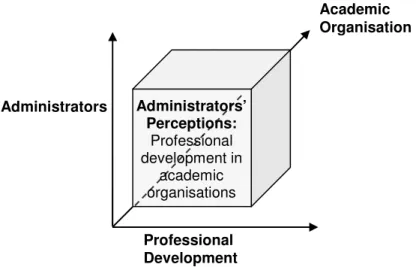
Cohen et al. (2000) suggests that case studies “are set in temporal, geographical, organisational, institutional and other contexts that enable boundaries to be drawn around [a] case” (p. 182). The temporal, geographical, organisational, institutional and other contexts of this study are set within the boundaries of three distinct foci. As illustrated in figure 3.1, these include administrators, professional development, and academic organisations. Furthermore, Bell argues that a case study gives a researcher an opportunity to study one aspect of a phenomenon in some depth and within a set period of time.
Figure 3.1: A bounded phenomena: Administrators’ professional development in higher education - A multi-foci single case study.
Figure 3.1 illustrates the bounded phenomena of this case study. One focus represents the higher education organisation. The second focus represents professional development activity which may be administrators’ training needs or
Administrators
Academic Organisation
Professional Development Administrators’
Perceptions:
Professional development in
academic organisations
professional qualifications. The third focus represents administrators. Tensions between administrators and the first two foci may illustrate a dichotomy administrators’ encounter while engaging in professional development programmes in an academic organisation.
As this research is only studying one organisation, the case study is a single case study rather than a multi-case, or a multiple organisational study (Yin, 2003).
Furthermore, it is only gathering data from one sector of the organisation. Therefore, the case study is classified, according to Yin (2003) as a single and holistic case study.
Both quantitative and qualitative methods can be used effectively within case study research (Yin, 2003; and Denscombe, 1998). Moreover, Yin (2003) clarifies that the
‘why’ and ‘how’ research questions are better answered in a focus group or an interview. The ‘what’ and ‘who’ research questions are better answered in questionnaire surveys. Yin argues that the ‘why’ and ‘how’ questioning methods are more likely to gain an understanding of the behavioural aspects of the research population. Furthermore, the ‘what’ and ‘who’ questioning methods are more likely to gain an understanding of the occurrence of actions and engagement within professional development programmes.
Participants
SPHEO management provided me with permission to contact administrators directly through school managers. I was also granted access to organisational internal documents, such as employment contract templates. Through school managers, 104 administrators were identified and included in a draft list. Emailing all 104, using a blind copy address format, six replies were received indicating that they were not in positions that met my participation criteria, and therefore requested to be removed from my final list.
A final population of administrators was therefore formed, with a total of 98 participants, or 22 percent of SPHEO’s non-academic staff. A population of 98 participants falls slightly below a minimum of one hundred participants in questionnaire studies, as recommend by Cohen et al. (2000). Of the 98 administrators, 17 were school managers, 68 were programme managers, and 13 were programme administrators.
The Questionnaire
To gain administrators’ perceptions of their professional development activity and support, the questionnaire asked ‘why’ and ‘how’ questions (Yin, 2003). Hinds (2000) argues that a questionnaire is “concerned with gathering data from, usually, a large number of people (or respondents), and the data gathered usually focuses on the views, ideas and attitudes” (p. 41). Therefore, the questionnaire was personalised to the administrators own situation, with ‘I’ and ‘me’ contextualised questions and with a selection of correspondingly related ‘I’ responses.
The questionnaire in this thesis is therefore more interpretive in a social science anti- positive environment rather than being normative in a positivist paradigm (Bryman, 2004; Cohen et al., 2000; and Fox et al., 2007). The ‘I’ and ‘me’ statements enable all participants in the questionnaire to be, as Yin (2003) states, “participant observers”
(p. 93). The questionnaire therefore gathers data from each participant as if the questionnaire were the eyes of a single participant observer (Yin, 2003).
The questionnaire, available in appendix one, is structured in three sections. Section one seeks demographic information of the participating population. Section two seeks details of previous and current professional development activity. It also seeks administrators’ perceptions of their professional development experiences, and organisational support. Section three seeks administrators’ perceived requirements for professional development for both their personal and professional requirements.
Questionnaire Design
In designing the questionnaire, I was guided by Anderson’s six-step questionnaire design process (Anderson, 1998). Anderson provides six steps for the design of questionnaires. These being determine your questions, draft the items, sequence the items, design the questionnaire, pilot-test the questionnaire, and develop a strategy for data collection and analysis. My design processes followed these six steps and are discussed in the following sections.
Step One: Determine Your Questions
Questions were determined by three factors: the participants’ demographics; their current professional development; and their future professional development requirements.
Demographic questions were designed to ensure that a wide as possible cross section of the administrator population was represented. Simple ‘tick the appropriate response’ questions were asked. Thomas (1999) states that sub group information help a researcher understand the data. She also argues that demographic information is looking for differences in the questionnaire population. Differences may be existing qualifications, gender, the duration of employment, schools, and position (Statistics New Zealand, 1995).
However, to maintain some anonymity, the questionnaire in appendix one has been amended slightly from what was distributed to participants. Question 1.2, which lists the names of all the schools in SPHEO, has been amended to generic unrelated school names. Which school administrators belonged to was not relevant. I had made assurances in the ‘Invitation to participate’ letter and the focus group consent letter that I would not present data that identified anyone or their school. However, identifying that participants were invited and responded from all schools was of more interest to me for reliability issues (Bell, 1999).
Current professional development was explored in section two. Questions in section two were designed to gain an understanding of administrators’ perceptions of professional development. As discussed earlier, the literature states that professional development could be training, education, or a blend of the two. Furthermore, questions were designed to engage participants in self reflection, and therefore express their perceptions. Participants were asked to reflect on the effectiveness of professional development in areas such as their own employment needs, their personal goals, their career aspirations, or because they were instructed to engage in professional development. Further exploration in this section asked administrators to express how they were supported by the organisation to engage in professional development activity.
Section three asked three questions. Each question was similar in format and wording. However, each was slightly different. Questions asked administrators to reflect on the kind of professional development they would like to participate in for their current career position, their next logical career step or direction, and for their long term career directions.
Step Two: Draft the Items
Questions were drafted at the same time as the questions were determined, as espoused by Gillham (2000). Therefore, a picture of the overall design of the questionnaire was being formed during the question drafting process.
Questions in section one of the questionnaire were all multi-choice questions. Some open ended response opportunities were provided to include participants who did not meet the responses provided. Anderson (1998) articulates that multi-choice questions are familiar to most participants and it therefore eases participants into engaging into the questionnaire. Anderson also explains that this feature provides reliable and valid responses. Cohen et al. (2000) argues that multi-choice questions are quick and easy to use. They also argue that multi-choice questions limit responses available and therefore make coding straight forward.
Section two of the questionnaire employed a range of question styles. Four distinctly different kinds of questions were designed, ranging from multi-choice questions to questions requiring administrators to rank given statements. There were two kinds of multi-choice questions, single response and multiple responses. The responses provided for these questions were based on the theories and arguments within the literature review relevant to administrators in higher education. Multi-choice questions with only one response expected were generally worded as closed questions whereas multiple response questions were open (Hinds, 2000). Multi-choice questions had between four to eight possible response statements, as recommended by Thomas (1999).
Likert rating questions were also used in section two. I employed likert questions in my questionnaire to similarly understand attitudes of administrators to their professional development. Five possible response options were available to each statement made, from ‘very important’ to ‘not important at all’. A middle option was also provided. However, the middle response was a ‘not sure’ option rather than a
‘middle of the road’ choice. A ‘not sure’ response effectively changed a five-step likert scale to a four-step scale, or an even-step scale, such as discussed by Bell (2007).
Therefore, unless the participants did not select the ‘not sure’ response, their final selection had to be either positive or negative rather than a neutral choice (Cohen et al. 2000).
An open-ended question was provided at the end of section two with space for administrators’ comments. Open response sections to a question provided administrators an opportunity to move outside the given responses, and therefore make it more relevant to themselves while still staying inside the boundaries of the question structure (Cohen et al., 2000). “Gems of information that otherwise might not have been caught in the questionnaire” (Cohen et al., 2000, p. 255) were collected in an open-ended question.
Some questions in section two and all questions in section three of the questionnaire requested administrators to rank their three most relevant responses to a given question. From a response statement bank, administrators were asked to select only three, and rank these three in their order of appropriateness to the given statement.
Anderson (1998) argues that ranking questions are more powerful than single or multiple selection response questions, as it forces administrators into some difficult decisions. As with multiple selective multi-choice questions, the stem statement was structured for an open response. Figure 3.2, an excerpt from the questionnaire in appendix one, was provided as an example of how this question format should be answered. However, the example had limited success, as will be discussed.
Rank, in order, three statements in each of the following two questions by
numbering 1 to 3, the three that best describe how they relate to you. (1 being your first choice, 3 being your third choice) See the example below.
Example I like the colour purple because:
Rank 1 to 3 your first three options
a) It makes me feel good 3
b) It reminds me of someone I know
c) It is a blend of my two most favourite primary colours 1
d) It’s the same colour as an Aubergine 2
e) It’s a Royal colour
Figure 3.2: Selected ranking question format
The ranking question format proved to be the most difficult from which to gain a valid and reliable response. Although most participants responded to the questions correctly, fifteen percent of participants found this style of questioning difficult to complete correctly. A range of up to eight possible responses were provided, well within the recommendations by Anderson (1998). An example of how the question should be answered was shown on the questionnaire, as illustrated in figure 3.2.
Instead of ranking just three statements, some ranked all statements from one to three. Therefore, some statements were ranked ‘one’ others ranked ‘two’ and so forth until all statements were ranked either with a one, two, or three. This, in effect, made
this kind of response to the question invalid. Incidentally, this difficulty was not identified during the questionnaire pilot-testing phase.
Step Three: Sequence the Items
Early questions set the tone for the following questions (Cohen et al., 2000). Some questions in section one introduced professional development and qualifications.
Section two and three provided administrators the opportunity to elaborate on their current professional development activity and perceptions.
Sequencing the questions within each section was therefore important to maintain interest and offer structure. Cohen et al. (2000) provided some guidance to sequencing questions. The questionnaire started with non-threatening questions that provided some nominal data. Questions then moved to multi-choice and likert questions in section two. Important at this stage was “eliciting responses that require opinions, attitudes, perceptions, and views” (Cohen et al., 2000, p. 257). Finally questions move into more open questions in section three. These responses requested more personal or sensitive data from administrators (Cohen et al., 2000;
Bell, 1999).
Step Four: Design the Questionnaire
It was apparent in the early design phase of the questionnaire development that it was not going to be short. Anderson (1998) considers a short questionnaire being less than four pages. Administrators are busy people, as argued earlier, and may not have the time to complete a long and difficult questionnaire. Unfortunately, my questionnaire grew to seven pages and therefore, was no longer short.
Bell (1999) argues that there are no firm rules on the layout of questionnaires However she does provide some guidelines such as instructions, words of thanks, statements on anonymity, and details of the research project.
Instructions for the questionnaire were added at the beginning, as well as a statement of thanks at the end. Included in the introduction statement was a declaration that participants were, by returning the questionnaire, a willing and informed participant, as detailed in the ‘Information to Participants’ letter distributed with the questionnaire.