An Urban Verge:
Designing an Adaptable Events Centre
Sam Williams
1 2 2 0 8 9 9
An explanatory document submitted in partial fulfilment of the requirements for the degree of
Master of Architecture (Professional) Unitec New Zealand
2009
Preface & Acknowledgments
I was asked to submit a research proposal at the end of 2008 which would outline the intentions for this 2009 Masters project. At the time I was very interested in the life of cities and especially their ports. Having lived in Auckland and near the coast my entire life, a fascination with the water’s edge seems inherent. I was also interested in how we humans have changed this boundary to suit our needs. To think that some urban centres can have entire city blocks on reclaimed land, and as in the case of Auckland, skyscrapers that sit on what used to be mud flats. My questions in this area drew me to the topic of this project.
I would like to acknowledge my supervisors and the staff at Unitec who contributed to this project by sharing their knowledge, advice and expertise. I would like to thank my family and girlfriend for their support over this past year and years previously.
To all my friends: Who I hope to spend more time with now.
Abstract
Le Corbusier thought of buildings as “machines for living in"1, an architecture that would functionally respond to our needs and work with our lifestyles. The 'machine' paradigm of building is one that is internally driven, self-contained, utilizing artificial systems for cooling and lighting, and using energy resources without regard for environmental consequences. Now, more than eighty years after this analogy, should we still be comparing our buildings to machines?
We seem to be at a turning point.
A new architecture is beginning to emerge that instead envisions buildings as kinetic organisms. This new archetype is able to move and adapt in response to its environment. It is architecture that recognizes that it is actively integrated with its surroundings, while also potentially self powered and 'off the grid'. This new thinking has increased in significance as environmental sustainability is now recognized as a paramount objective in architecture worldwide.
My project balances the interactions between theory, design, and the circumstances of a real brief and site in the area of architecture. The brief chosen is the design of an adaptable events centre on the viaduct waterfront for the client Auckland City Council. There are many design principles that have emerged with this new form of organic architecture; I have focussed on four guiding principles in my design which are; diversified lifetimes, flexible spaces, adaptable design and kinetic architecture. These principles provided a framework in which a process of design was enabled and tested in an urban verge - the design of an adaptable events centre.
1 Le Corbusier, Towards a New Architecture (Dover Publications, 1986), 69, Richard Rogers, Cities for a Small Planet, ed. Philip Gumuchdjian, 1 vols. (London: Faber and Faber, 1997), 163-64.
Contents
000. Introduction ... 2
001. Methodology ... 4
002. Project Analysis ... 6
021. Brief Analysis ... 6
022. Revised Brief ... 7
023. Site Analysis ... 8
003. Design Principles ... 14
031. Diversified Lifetimes ... 14
032. Flexible Spaces ... 17
033. Adaptable Architecture ... 22
034. Adaptive Opportunities ... 24
035. Methods for adaptable design: ... 25
036. Kinetic Architecture ... 27
037. Sustainability ... 31
004. Conclusions ... 32
005. Appendix ... 33
Appendix A ... 33
006. Bibliography ... 34
007. Table of Figures ... 36
000. Introduction
The port and public waterfront were once one and the same. Since the establishment of Auckland’s trading port in the safe waters of the Waitemata harbour, the docks have acted as the growth catalyst for the rest of the city, bringing goods, building supplies and immigrants to the young nation. Nowadays the ports and public waterfront compete for the water and land boundary- The Urban Verge. The distinction between public and private is very clear, which in the case of Auckland is a tall red fence stretches along Quay Street. This came about in part due to the shift towards mechanical methods for loading and unloading standardized cargo containers thereby replacing manual labour. Containerization dramatically changed the landscape of harbours around the world, isolating the ports from the public realm. Global economies and free trading has seen the import/export industry grow substantially in the last 100 years. Singapore for example has found a way to prosper without any form of hinterland. With their reliance on imports it is of no surprise that they have the biggest and busiest port in the world. This economic model that Singapore employs is however not sustainable in the long term as we continue to use up our oil reserves to power the transportation of good across land and sea. A localised approach to the supply and demand of goods needs to be implemented this century if we are to maintain and improve our current life styles.
One of the problems cities now face is that their ports, built up from humble beginnings, are now running out of space. These historic ports cannot reclaim more land to store containers, or increase the size of their berths to accommodate larger ships. Because of this, ports are either moving away from city centres to the hinterland where there is more space, or creating artificial islands for offshore operations. This is a growing area of interest for today’s planners and urban designers. It is only recently that the public have been able to reclaim some of Auckland’s historic port land, an example being Queens’s wharf which Auckland City Council recently acquired. There has been an acknowledgement as to the importance of regaining a link to water in the central business district (CBD), and working towards reinvigorating urban centres.
The marine events centre project was brought to my attention early in the year when I was researching the development of the Ports of Auckland in the documents Draft CBD Waterfront Masterplan, and Auckland Waterfront Vision 204023.
While the port development was what I had set out to research, the marine events centre project related to my initial interest of reclaimed land, specifically space that was once used for marine activities but is now in transition into a new use, and being reintegrated into the city for the benefit of the public. The opportunity to participate in a project that was still in the design and consent process provided invaluable real world experience, and a chance to participate in a conversation between some my ideas as a student and work of the firms Moller Architects and Architectus assigned to the project.
I studied the brief set by the Auckland City Council to establish areas that could be changed and improved. I was then able to formulate my own revised brief for the project. My brief worked within the general framework of the
2 Auckland City Council, "Auckland City Centre Waterfront Masterplan," (2009),
http://www.aucklandcity.govt.nz/council/documents/cbdwaterfront/pdfs/citycentrewatefrontmasterplan.pdf.
3 Auckland City Council, "Auckland Waterfront Vision 2040," (2005), http://www.aucklandcity.govt.nz/council/documents/cbdwaterfront/pdfs/waterfrontvision1.pdf.
council’s brief, but also pushed the boundaries in some cases; extending beyond some of the regulatory codes such as building height and coverage allowances, and looking for a more sustainable and adaptable solution for the site.
The budget for the real project is set at $27million, which in the scope of the size of the work required has had a limiting impact on Moller’s design.4 My brief set out to provide cheap, realistic solutions for the buildings; however quantity surveying was not within the scope of my project and common sense was used to determine affordability.
I am unsure whether the need for a marine events centre came first before the need to redevelop the site, however the Rugby World Cup which we are hosting in 2011 has probably initiated the idea behind an events centre and is now the driver of its completion.
The overall feeling I got from being at the site influenced my approach in the creation of a site specific design with the concept of a kinetic building. The feelings I got from the site were that of movement and change: The movement of the tides, boats, people, sails, buoys, and the rapid changing of the weather from calm to turbulent. Our climate in Auckland is extremely variable compared to many parts of the world, and because of the geographic nature of the region and isthmus of central Auckland, a building needs to change almost as frequently as we sometimes do during the day, adding and removing layers. We have fairly accurate weather forecast prediction technologies, but that does not mean we can change the weather. However this prior knowledge can aid us in harnessing the power of the weather and natural systems for our buildings rather than using power from the grid.
4 Bernard Orsman, "$27m Events Centre Gets a Hurry-Up," The New Zealand Herald, 06/03/2009.
001. Methodology
This project focuses on the design of a large scale building in an important waterfront setting. As such, the key to a successful design comes from choosing the appropriate concepts or principles with which to design. This master’s project is concerned with the architecture of tomorrow and the next generation of urban buildings.
Coincidentally, the kinetic nature of my final design outcome reflects the dynamic process and wide-range of ideas that I explored in choosing the right concepts for the project.
Some of the projects I investigated used complex computer algorithms as methods for design, while others engineered prototypes. My method has largely been design by research, and then testing my designs through drawing and modelling within the context of the site.
The important questions that my project aimed to answer were:
Why have I chosen to design an environmentally sustainable building?
What principles of design would make an events centre on the waterfront more sustainable?
To what extent can these principles be incorporated into a real world brief and site?
How does my project fit within the Auckland CBD currently, and how might the building respond to future changes in climate and context?
Using rough models and sketches initially worked well in exploring different ideas and concepts. I would make ten massing models at an approximate scale and place them on a model of the site. Form and mass were the first design theories that I worked on, while the more complex design ideas of diversified lifetimes, adaptability, flexibility and sustainability brought the modelling and drawing from a 1:1000 scale to 1:1. The site was truly a ‘blank canvas’ for which to design for. Having a strong brief and set of constraints provided a framework for these principles to work in. Finding a balance of interaction between the driving principles and implementing them into the right parts of the building was crucial in their validity in the design.
Due to the fact that the project is for the Auckland City Council and is therefore in the public realm, I was able to access documents provided on the council’s website which outlined the work done by Moller Architects and their consultants. This meant that I was privy to a large amount of data that had already been gathered on the viability of the brief and its impact on the context. While this bank of knowledge provided Moller Architects with the foundation for their own work, I saw a need to dissect and critique it in order to come up with an original design brief to enable me to construct an alternative design solution for the project. The Moller design could otherwise potentially become a barrier for original and creative architectural ideas.
I gathered data about the site by looking at documents showing the historical development of Auckland’s waterfront and the construction of Halsey Street wharf extension. Master plans for the future of Auckland’s waterfront set by the Auckland City Council and the Ports of Auckland were investigated. A familiarity with the site was constructed through site visits at different times of the day and in different weather conditions. The natural forces on the site including tides, wind and sunshine were included in the site analysis. A context study was conducted within a 1kilometre radius of the site and included building massing, building uses, sight lines, and transport routes.
My method for organising and archiving this information was in the form of an internet blog. The online journal kept a record of my research and design ideas as they progressed throughout the year. The hope was that this would become a webpage through which tutors and students could stay updated with my project and also comment on the posts. Perhaps the downfall to this online dialogue was that I was the only one in my class to use this form of media, therefore I did not gain followers. However it still provided a valuable record from which I now reflect on when writing this paper.
002. Project Analysis
021. Brief Analysis
Planning for the marine events centre project began in 2003 when Auckland City Council acquired Team New Zealand’s former America’s cup base for $230,0005. They assigned Moller Architects as the primary firm for the design, and consulted other companies for specific design issues. As a result of this I found a large amount of site and programme research already available on the Auckland City Council website when I began looking at the project in early 2009. Some of the documents relevant in my brief analysis are listed below:
Concept Design Sketches6 Resource Consent Submissions7 Auckland City Events Strategy8 Design Studies by Moller Architects9 Marine Event Precinct Report10 Business Report for the Precinct11
Assessment of Landscape, Urban Amenity & Visual Effects12 Landscape Report by Architectus13
Also included in this document set from the council website are reports on traffic, acoustics, heritage, sustainability, infrastructure, and lighting. The methodology section earlier mentions that I formulated my own brief and criteria based on the evaluation of the documents and my own investigations into the context of the project.
The project site is one of the last to be developed in the viaduct. It has been called the keystone and arrival point for those arriving by boat from afar. It is to be the second major development behind the North Point wharfs and will engage with the Wynyard Quarter development.
5 Bernard Orsman, "$27m Events Centre Gets a Hurry-Up," The New Zealand Herald, 06/03/2009.
6 Moller Architects, "Marine Events Centre," (2007).
7 Moller Architects, "Marine Events Centre- Resource Consent Submission, Architectural Design Statement," (2009).
8 Auckland City Council, "Auckland City Events Strategy," (2005).
9 Moller Architects, "Marine Events Centre Design Studies," (2008).
10 Auckland City Council, "Marine Event Precinct Report," (Auckland: 2005).
11 Howarth Asia Pacific Limited, "Business Case / Regional Economic Impact of Proposed Viaduct Harbour Marine Events Precinct," (2006).
12 Boffa Miskell Limited, "Assessment of Landscape, Urban Amenity & Visual Effects," (Auckland: 2008).
13 Architectus, "Public Realm Plan for Resource Concent," (Auckland: 2009).
022. Revised Brief
My revised brief focussed on areas which the real brief failed to address. I thought that the budget allocated to the project underestimated the importance of the site in the context of Auckland City, and that this was possibly the result of the current economic climate. While Moller architects may yet produce a decent building, their brief focussed on the short term gains of having a functional events space for the Rugby World Cup in 2011. In contrast my brief set out to provide a building with a diversified lifetime, one that could focus on the immediate needs of the public, as well as in the future. The council decided that the project would be a ‘marine events centre’; however there exists no precedents for a building of this name. The marine aspect was ‘watered down’ to make room for a
‘multi-purpose’ events centre that could host a large range of different events both on and off the water. This is where the principle of flexibility stems from in my project. I investigate what this concept actually means and how different programmatic scenarios can be designed into the building, rather than simply saying “this is a flexible space because it is open plan”.
Flexibility of a space is a result of: 1.Highly calculated use scenarios, 2.Effectively organized program arrangement, 3. Building systems to support each changeable spatial property. Flexibility only exists within determinism, not resulted from randomness14.
I also investigate what a building should embody in terms of its behaviour and aesthetic, developing an efficient yet elegant solution through the process of design by research and experimental design. Likening my building to that of an organism provided inspiration for an adaptable design that could change and suit a constantly changing habitat on the waterfront. To achieve an adaptable design that works I have had to prioritise the aspects of flexibility and adaptability that can be incorporated. If everything in the building could move and was flexible then there would be no permanence to the design; like a ship without an anchor the building would drift into nothingness. Some aspects that I prioritised over others include: Size of spaces, flux and movement of people, internal comfort, acoustics and lighting, the generation and conservation of energy, and future building uses.
In my view, the original brief does not include enough ‘green’ features, and does not push the boundaries of innovation in the field of environmentally sustainable design. There was also a lack of research into the environmental effects and carbon costs in running a building that still relied on the national power grid for energy.
My brief proposes that the centre can be run on localised power sources and that capital investment can be safeguarded by building the project in stages and investing in or removing sustainable power sources as the building requires.
A list of specific spaces and features that were included in my revised brief can be found in appendix A.
14 Young-Ju Kim, "Organism of Options: A Design Strategy for Flexible Space" (Massachusetts Intstitute of Technology, 2008), 38.
023. Site Analysis
My chosen site is the Halsey Street wharf extension at corner of Halsey Street and Jellicoe Street in the Viaduct basin of Auckland, New Zealand. The Auckland viaduct underwent a transformation after New Zealand’s yachting team won the America’s cup in 1995 with their boat ‘Black Magic’, requiring that we host the event in 2000 and provide sites for a dozen team bases. The wharf extension was built in 1999 as a platform for these America’s cup bases whilst also providing sheltering break water for the viaduct basin and allowing for safe anchorage. The bases created on the wharf for these events were of a fairly basic design. Timber framed with corrugated tin or plastic cladding and steel beams inside for holding the weight of the boats. The positioning of the bases was such that they provided maximum amount of forecourt space between the building and the water. This meant that they were orientated perpendicular to the water and jammed up hard against Halsey Street. Boats could be moved in and out from the shed and into the water in a straight line efficiently without trespassing into the other team bases.
In the year 2000 Team New Zealand successfully defeated the challenger ‘Luna Rossa’ 5-0 which necessitated in further development of the viaduct precinct. A number of hotels and restaurants were built quickly to capitalize on the next regatta in 2003 at the same location. However this time we did not retain the cup, loosing 5-2 to Swiss team Alinghi. It seems that since this loss to the Swiss team in 2003 and then also in 2007, the Americas cup has lost some support from the general public in New Zealand. The developers and the council are slowly transforming the viaduct into an events hub, but one that does not foresee a future need to host the America’s cup event within its waters.
During a recent Unitec seminar 'Marine Events Centre: Juggling concept with 'concrete' reality' I asked the question to Terry St George of what the councils plans are for accommodating an America’s Cup regatta in the future. Terry St George who is running the project for Moller Architects replied that he did not know what their plans were, but perhaps they would extend the [Halsey Street] wharf. The America’s Cup is now an important part of our country’s history, and yet The ‘Marine Events Centre’ by Moller Architects seemed to ignore this site history and made no provision for its possibility in the future in the viaduct, a place where our nation’s people were joined in the celebration of a great event. The scope of the context investigation can be seen in the images below (site is shown as orange fill):
Figure 1. Site study of positive/negative spaces Figure 2. Three-dimensional site study with shading
Figure 3. Context of site study including Auckland’s Viaduct Harbour and Tank Farms
Figure 4. Computer abstraction of Auckland’s Viaduct Harbour and Tank Farms
Figures 3 and 4 above highlight the area where most in-depth analysis was done. A radius of approximately 1km of context was drawn and modelled on the computer. It provided me with the ability to design in the virtual dimension on a computer, whilst also within a virtual model of the context. Figure 1 illustrates a study on the positive and negative spaces that the buildings created and also the land and sea areas. A physical massing model at a 1:1000 of this area was also constructed to provide me with another way of analysing the site.
Figure 5. Photograph underneath Halsey Street Wharf Extension showing structural dimensions.
The wharf consists of a platform that sits 3000mm above the mean water level on piles shaped like octagons that are 600mm in diameter and at 8000mm centres. Concrete break water panels for high and low tides are located in the areas highlighted below. There are also ramps down to floating pontoons and the Floating Pavilion restaurant.
The openness of the site meant that there was the prospect of achieving good solar gain from any position on the site without shading from neighbouring context. The wharf is also very flat and constant. I was told by an engineer working for Moller Architects that the eastern side had a greater load capacity than the western side after their engineering firm did structural tests on the wharf foundations.
Team bases extend right along the east side of Halsey Street and out along the extension of the wharf. Only 4 sheds remain now of what was 12 team bases. The apartment buildings have taken over the south end of the road, while the wharf extension (my site) still has a considerable amount of yachting activity. Many yachts and masts are repaired in and around the single shed that remains.
Privately owned luxury yachts and launches occupy most of the viaduct’s moorings while the Halsey street wharf extension caters for commercial vessels such as fishing boats and barges.
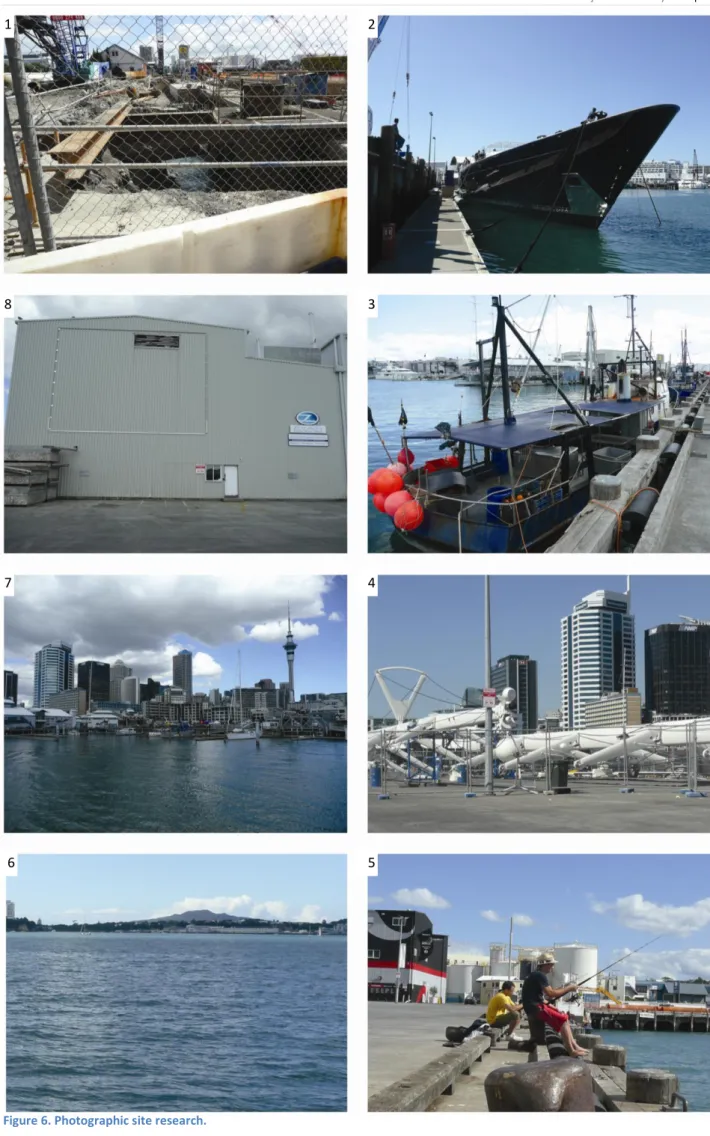
Figure 6. Photographic site research.
1 2
8 3
4 7
5 6
Site activities and things of interest are shown in Figure 6 on the previous page. Clockwise from top left:
1: Construction work is being done for a project on Jellicoe Street called North Wharf. It will be completed before the Rugby World Cup in 2011 and provide restaurants and gallery spaces among others.
2: A super yacht berthed on the viaduct side of Halsey Street Wharf, it is loading up on supplies while having maintenance done on its masts shown two images below.
3: Fishing boats are regular users of both sides of the narrow section of the wharf; future truck access to these boats will be of importance.
4: Large masts being fixed for the super yacht mentioned above. They took up a large part of the wharf for many weeks before being fitted back onto the yacht.
5: People often are seen fishing on the wharf like those pictured here in the bottom right image. People also enjoy activities such as jogging, eating lunch and relaxing on the site.
6: The exposed north edge of the site has a view out to the Waitemata harbour, North Shore City, and Rangitoto Island in the Hauraki Gulf beyond.
7: A view of the central business district of the city occupies the outlook to the east of the site. The activity and bright night lights of this view take your focus as you explore the site.
8: One of the old America’s Cup sheds that still remains on the site. These were built with cost effectiveness in mind and have uninteresting facades and large clear span spaces inside.
Figure 7. Site plan showing where photos in Figure 6 were taken from.
Disconnection between the site and the eastern viaduct means that most people arrive there by car or bicycle.
There is a need for a pedestrian bridge linking the two sides at the entrance of the basin or where the proposed Te Wero Bridge Is planned for. This will increase the usage of the area by the public.
An exploration of the 2009 fashion week found that a temporary movable bridge was used to aid the connection between Te Wero Island and Halsey Street wharf. It used an outboard motor attached to the end which would swing the bridge to close the gap and then open to allow boats into the viaduct harbour. It took approx 4minutes to make the change from closed to open. Another option which seems easier to engineer would be a permanent pedestrian/cycle bridge across the 37m wide entrance to the viaduct basin that could be opened quickly to allow boats through. This would make for a slightly longer route across the viaduct; however it would mean that the site would get more foot or bicycle traffic than if the pedestrian bridge was across from Te Wero Island. However with the redevelopment of the tank farms in the future the extension of Quay Street over Te Wero Island and connecting to Jellicoe Street with vehicle, light rail, pedestrian and cycle access is a good idea because of the direct route from the CBD to the future Wynyard Quarter. The alternate route that I propose (shown as the green dashed line in the figure below) would target people who were not in a hurry, and wanting to experience views out to the Waitemata Harbour from the wharf. Tourists might come across from the maritime museum as well as people jogging or cycling around the waterfront edge to avoid the busy city centre. This bridge would also serve those who work on the Halsey street wharf who may need to get to downtown quicker, rather than going around the entire viaduct.
Figure 8. Potential options for pedestrians and cyclists crossing the viaduct basin.
Purple Route: 1300m (approx. length) – Follows existing pedestrian walkways.
Green Route: 620m (approx. length) – Utilizes my proposed bridge at the entrance of the viaduct.
Blue Route: 450m (approx. length) – Will use the proposed Te Wero bridge to cross the viaduct (year 2014 at the earliest) The routes shown as the dashed lines in Figure 8 apply to pedestrians and cyclists. The route goes from the Information building at the end of Quay Street to the approximate main entrance point of the Events Centre.
003. Design Principles
031. Diversified Lifetimes
The Auckland waterfront has gone through a vast number of changes in terms of the urban verge. Its boundary has been pushed and pulled by land reclamation and the extension and retraction of wharfs. This has also been the case for buildings in the waterfront. Originally the viaduct area was an industrial and commercial trading ground in the early 20th century but has now become a hub for dining, entertainment, events and city apartments. This change in function will soon spread to the Tank farm (Wynyard Quarter) as it converts from a primarily industrial area into a mixed use precinct with a focus on retail, apartments, small/medium sized commercial businesses, and green park areas.
Change is a significant element in architecture today. We cannot afford to invest in architectural solutions that believe that they are permanent. Today’s cities thrive on speed and efficiency, whether it is the speed of data or speed of commuting. This accelerated city that we live in, means that the building industry sometimes struggles to keep up with the needs of users. Buildings are becoming redundant or inefficient before they are even built. It seems an impossible task keeping up to date with innovation; unless you design a building which acknowledges that change is necessary for its survival. This does not require an architect to try and predict future scenarios, only that they provide a range of opportunities for diversified life times, through a range of embedded attributes such as embodied energies, adaptive reuse possibilities, material systems, rearrangement options and durability. The overall intent of diversified lifetime design is to allow for a greater number of present needs, while providing for anticipated and unanticipated future uses15.
The fundamental stages in the life for an organism can be compared to the life stages of a building.
Figure 9. Animate Cycle of an Organism/Building
A: Generation, B: Autonomy, C: Metabolism, D: Termination
15 J. E. Fernandez, "Diversified Longevity - an Architecture of Disengagement and Localized Production," Design and Nature (2002): 1.
Figure 10. Analogous cycle in the construction process
A: Construction, B: Completed Building, C: Operation and Occupation, D: Decommissioning and demolition
As shown in Figure 10, it is during the stages A and C that the designer is most influential in deciding how much flexibility and adaptable possibilities can be accomplished in the architecture. This is shown with the arrows in the figure above around the A and C16.
If buildings worked more similarly to organisms then they would ideally suit a greater range of changes that occur in their ecosystem. Scientists are only now realizing the variety of mechanisms that ecosystems use themselves to adapt to stresses.
At the ends of their lives, animal’s remains are usually eaten or provide compost for the earth. Buildings on the other hand, are usually made from non biodegradable and non renewable materials that often end up in landfills at the end their lifecycle. This is an unsustainable cradle-to-grave approach that we have blindly followed for decades.
One solution to this is an architecture where building components are separated, and can be assembled in numerous new ways at different stages in a building’s diversified lifetimes17. My project has taken this strategy and used it in the design of the structure and facades that are most likely to need reconfiguration over the course of the events centre’s lifetime. The exploded render below illustrates the extent to which the structure is modulated and can be disassembled. It also shows the standardized nature of the facade panels that are fitted onto, but independent of the structure, allowing them to be rearranged accordingly.
The second solution that Fernandez gives to the problem of building waste is what he calls “localized[sic]
production: the ability to reconfigure spaces and assemblies, reprocess materials and reincorporate reclaimed elements through production processes located on-site”18. This seems to be a good way to promote a self sufficient building, one that is both ‘off the grid’ and can repair and reconfigure itself on-site. Some of the benefits of this local approach include the reduction of energy costs in transportation, a greater efficiency of renewal and reconfiguration, and flexible opportunities for users to redefine spaces periodically19.
16 J. E. Fernandez, "Diversified Longevity - an Architecture of Disengagement and Localized Production,", 5.
17 Ibid., 4.
18 Ibid.
19 Ibid.
My events centre does not have a dedicated space for this production process to occur, however the building could segment one of the 6 main sectors and this could be temporarily used to house a workshop. A dedicated space solution would be more suited to a building that has a large basement area for this purpose, and is in an area where land is at less of a premium.
The approaches to adaptability and change discussed above rely on a the complex modelling of hundreds of building parts so that they can be re assembled again and again in a similar fashion to Lego blocks. However a building can have various lifetimes without needing a kit set of parts. A theory called Diversified Longevity is an alternative that suites large-scale buildings that can be divided into sections20. Flexibility is achieved by varying the lifetimes of the different sections based on the needs of the present or future occupants21. If you were to take the environment and look at the lifetimes of various animals and plants, you would find that there are fundamental reasons that some animals life longer than others, thus creating balance in the natural world. As humans we have advanced our standard of living to the point where we now live much longer, and as a result the world is becoming increasingly overcrowded in places. This too can be said for the built environment which continues to fill up our cities with waste from the ‘skeletons’ of discarded architecture, creating a footprint that does not decompose.
What diversified longevity offers, is the opportunity for tenants to reconsider their space demand, at for example 3, 10, and 25 year periods, and then provides a method for acting on that reassessment22. This action could result in the removal or expansion of sections of the building. The aim being that the building becomes more efficient for the task required and saves on running costs, maintenance and energy by removing underutilized sections. As a result the under- or over-utilization of the building and the site would be reduced, and possibly eliminated altogether23. Conversely, sections that had previously been dismantled from an earlier time period could be rebuilt, extending the life of the building. Rather than decommissioned parts of the building ending up in land-fill, the diversified lifetimes approach supports the reintegration of these components back into the building or to support the wider community. In addition the building may become an agile repository of material resources for generations to come.
20 J. E. Fernandez, "Diversified Longevity - an Architecture of Disengagement and Localized Production,", 6.
21 Ibid.
22 Ibid., 7.
23 Ibid., 8.
032. Flexible Spaces
Flexibility in architecture could be described as a type of functionalism, implying that it is designed for many functions. The idea of flexibility took hold during the Modern Movement which entered popular culture in the 1930’s. Traditionally, flexibility was hampered by structural constraints which affected spans and therefore sizes of spaces. Only since the advent of steel and reinforced concrete in construction have architects been able to design with large spans creating “free plan” spaces24.
As mentioned earlier the goal for this new archetype of organic architecture is to make buildings environmentally adaptable so they can be made more specific to particular users. However “providing conditions that are excessively flexible and, though apparently neutral, are actually more difficult to fine-tune sensibly in spatial or environmental terms”25. Merely being an open-plan space is just a necessary condition for flexible space, but not a sufficient condition26. Some architects would say that there is no such thing as flexible space, as every space is implicitly flexible in a way and can be used for hundreds of purposes.
Due to the high public value of the site, my design not only aims for quality indoor spaces, but also focuses on providing quality outdoor spaces, on the wharf and on the water. The nature of urban open space allows more flexible use than the built environment, but resilient city design requires both adaptable landscapes and adaptable buildings.27
I designed a number of outdoor spaces with the aim to provide an urban landscape that was more diverse and interesting than the existing flat wharf. However I ran into the problem that by including a number of landscape features I was decreasing the openness and flexibility of the wharf as an events space. A 14th century Buddhist priest named Yoshida Kenko described the essence of seemingly vacant, unoccupied, open spaces in the ageless line:
Emptiness accommodates everything.28
There is all too frequently the tendency to fill open space with ‘stuff’. This must be resisted not just for adaptability but for meaning as well. It requires a restraint that few designers attain. “Keep open space open. Keep emptiness empty. Fill it only with meaning”29.
24 Kim, "Organism of Options: A Design Strategy for Flexible Space", 12.
25 John E. Fernandez, "Designing Diverse Lifetimes for Evolving Buildings," in Environmental Diversity in Architecture, ed. Koen Steemers and Mary Ann Steane (London
; New York: Spon Press, 2004), 8.
26 Kim, "Organism of Options: A Design Strategy for Flexible Space", 14.
27 Randolph T. Hester, Design for Ecological Democracy (Cambridge, Mass.: MIT Press, 2006), 256.
28 Ibid., 260.
29 Ibid., 259-60.
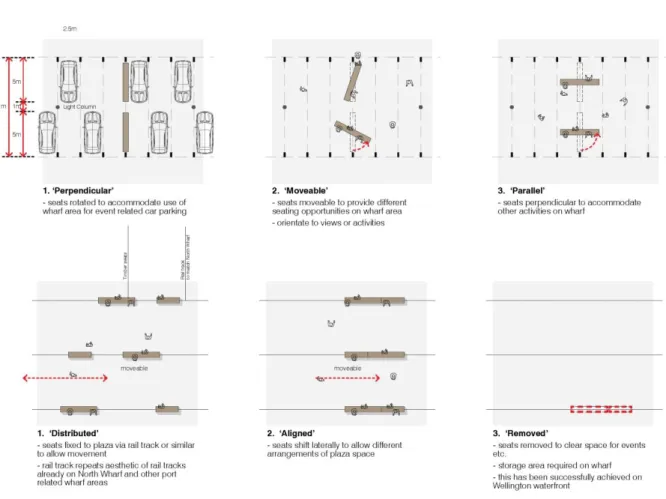
The answer in my project was to be found in temporary or movable features. Architectus who are designing the outdoor spaces for the precinct have realised that providing a flexible landscape is the best solution. They outline in their report under the heading 6.3 Flexibility and Adaptability some of the design solutions for this landscape:
“-providing moveable or demountable furniture elements
- integrating event infrastructure such as power, water and data supply and fixing details for temporary structures and installations
-provide a suite of removable/ re locatable urban elements such as multi function light columns and seating elements”30
This landscape designed by Architectus is shown in Figure 11 below.
Figure 11. Design done by Architectus for the public areas of the site.
30 Architectus, "Marine Events Centre Public Realm Plan for Resource Consent," in Design Report (2009), 9.
My experimentation with landscape design drew me to a surface that could be made up from equilateral triangles which would be modular and of the same size. The adaptable approach to them was that different types of surfaces could be plugged into each triangle, able to change its function over time. I explored ways in which this landscape could move. Essential to this was the ability to completely flatten the landscape to allow for a more flexible space. A mound was created at the northern end of the events centre and a sheltering bank at the south end. I was unable to achieve the adaptable aspect that I had set as criteria for my wharf space with this design, and was asked in a ‘crit’
“why a mound on a wharf, you already have a view?” I was unable to design a system that moved in the way I wanted with the triangulated structure. I concluded that the structure was too rigid and created more problems in terms of a multi-purpose landscape than solutions.
Figure 12. An early design model showing my attempts at adaptable landscapes.
I then explored lightweight structures that could open and be placed at various anchor points on a predetermined grid that references the piles below the wharf.
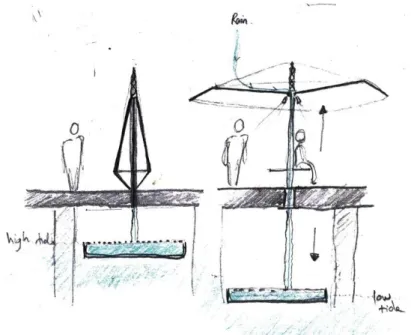
The umbrella structure below (Figure 12) provides the public with shade, lighting, seating, and protection from rain.
When dormant the canvas structure is closed like a cocoon. It captures gravitational potential energy from the tide by collecting a volume of water in the pod below the wharf. Upon doing this it then has enough kinetic energy to open without power by dropping the pod back to the low tide mark. A small wind turbine above powers lights underneath the canopy that can be used at night provided there has been enough wind in the previous days.
Research into landscapes uncovered the suggestion that a nodal landscape is more flexible than a linear one. This philosophy allows structures to be independent and movable between the anchor points on the wharf, able to form a larger canopy that could be used to shelter a Sunday fish market.
Figure 13. System for a public ‘umbrella’ raised using tide energy.
As a whole, a less defined, and more flexible open urban space is a better solution in the creation of a space that will be suitable for any recreational or social purpose that comes along. “Such landscapes can respond to the emerging social values, pleasures, and tastes of a more pluralistic society”31.
As mentioned in my brief analysis a number of activities occur at Halsey Street wharf extension, especially during the weekend or middle of the day when people working nearby frequently visit the wharf to have lunch. However, most casual event activities occur on the Te Wero side of the viaduct where a larger pool of people can be drawn from the downtown area. My site analysis shows the distance and time needed to walk from the end of Quay Street around to the end of Halsey Street is a significant obstacle in the way of having casual events on Halsey Street wharf.
Convenience is important when people have limited breaks from work. My design provides a pedestrian bridge at the mouth of the viaduct until the Te Wero Bridge is built to alleviate this problem. Diverse events and public activities are important in bringing a variety of different people to the site. By staging activities at different times of the day groups can use the same space and form overlapping symbolic ownership of the centre, encouraging shared activities and interaction between people. Public spaces should encourage shared activities, create settings for multiple and flexible outdoor uses, and provide reminders of their purpose when not in use32.
In design a flexible landscape or building should not be dictatorial, rather it should suggest ways in which it can be used and inhabited33. Public furniture should not be so abstract that people do not understand how to relate to it let alone use it. But it should not be predictable either. Something that can be used in a multitude of ways leaves it up to the imagination of users as to how they might interact with the object.
31 Hester, Design for Ecological Democracy, 259.
32 Ibid., 25.
33 Ibid., 255.
An open-ended approach is discussed in the chapter on diverse lifetimes. This theory suggests the use of construction modes that allow for an inconclusive finish to a building or landscape, leaving it up to the user to determine the additional materials and spaces needed for the next evolutionary stage of the project34. Our urban environments could be thought of as design stages that provide a ‘service in time’35.
Flexibility is enhanced by having a large open space surrounded by an intricate permeable rather than one with a hard edge36. My project aims to achieve this. The facades along the south end of the building are made up from precast concrete sections with a moulded seat that flip between inside and outside and glazed in-between. This edge creates a close visual connection between the users on either side of the wall but allows for personal space.
There is also a wrap around deck on the level above which can be occupied by people, contributing to the life and vibrancy of the plaza. On the long western edge the façade varies between 1. Structure, 2. Screens, 3. Screens and glazed louvres, 4. Screens and glazing, 5. Tensile fabric. This would be considered a soft edge because people are able to open the louvres, move the screens to different positions, and alter the structure and entrance points. The façade is however also sometimes a hard edge. It is adaptable in that the louvres and screens can close if needed to shelter the inside from adverse weather.
The events centre’s main space is flexible, but is still specific to different uses. It has been designed for future lifetimes of the building as well as the present daily running of the centre. It can be divided up into any combination of six 16m x 30m zones. The size of these zones each allow for indoor sports such as soccer or netball. Two zones will create an Americas cup base. A 5-1 zone split can accommodate a music concert with an area for backstage. An exhibition show could be divided to provide separate areas for children and adults. Fashion shows and Telethons need different zones for different people.
A critic might argue that flexibility is not gained by changing the variability of a space, but from the change of the relationship between spaces. My events centre achieves flexibility in both these ways by changing the boundaries between spaces and by actively changing the spaces themselves through kinetic operations. The changes made between spaces consist of a series of micro changes such as moving screens 4cm, whereas the change of the events space itself involves a macro operation in the rotation of the roof and the addition of temporary seating.
Another solution in flexible design would be to have functionally specific spaces that have manipulative and adaptable spaces in between. This solution is discussed by Young-Ju Kim in their thesis Organism of Options: A Design Strategy for Flexible Space, and incorporated into Kim’s design for a community-centred school in East Harlem, New York. The approach I have taken to this is slightly reversed. Instead of having solid permanent structures with temporally built spaces in between as in the Harlem school, my design for the events centre has prefabricated ‘pods’ placed or hung in between a semi-permanent structure. The pods are functionally specific in their design but are able to be taken in and out as the structure changes. The current ‘pods’ needed in the event centre are for toilets, changing rooms, and offices. However future ‘pods’ may be needed which could include:
kitchens, meeting rooms, daycare, and bedrooms.
34 Fernandez, "Diversified Longevity - an Architecture of Disengagement and Localized Production," 5.
35 Ibid.
36 Hester, Design for Ecological Democracy, 256.
033. Adaptable Architecture
What is adaptability? The word adaptability comes from the Latin word ‘adaptō’ which means fit, matching.
The general definition of adaptability is an ability to change something or oneself to fit changes taking place in the environment. The term adaptability can be used in many different disciplines. In ecology for example, it has been described as the ability to cope with unexpected disturbances in the environment, with a minimum of stress or expenditure of essential resources3738.Adaptability has a strong connection with survival and in terms of a building this could be seen as its resilience to remain important and useful in society. This is often due to the longevity of the materials used, but in other circumstances, it is the meaning that humans associate with a building that give us a reason to maintain its physicality.
Thinking about buildings as organisms rather than machines, or simply shelters, means that a biological approach to the definition of adaptability should be discussed. Collins Concise Dictionary gives the definition of adaptability in the biological sense as:
…the variability in respect to, or under the influence of, external conditions; susceptibility of an organism to that variation whereby it becomes suited to or fitted for its conditions of environment; the capacity of an organism to be modified by circumstances. A modification in organisms that makes them better suited to survive and reproduce in a particular environment39.
The functionality of a building is also a contributing factor in its endurance. It has been found that buildings are increasingly fulfilling their program or lifetime requirements in shorter spaces of time. The Building Owners and Managers Association (BOMA) of Australia, estimates that various buildings types are increasingly needed now for only 15-20 years40. After this time buildings must either change and adapt to a new use or be demolished.
The impact of accelerating change on the physical form of the city is radical, Institutions have shorter and shorter lives – railway stations are converted into museums, power plants into art galleries, churches into night clubs, warehouses into homes- and it is now commonplace to anticipate that a building will outlive the purpose for which it was built in a matter of a few years. Modern life can no longer be defined in the long term and consequently cannot be contained within a static order of symbolic buildings and spaces…Buildings no longer symbolize a static hierarchical order; instead they have become flexible containers for use by a dynamic society41.
The best scenario would be a design that uses resilient materials while having a strong meaning for the local people.
A building is also more likely to remain in operation if it can adapt to our ever changing definitions of what we value in our environment and in architecture. I discussed previously in the chapter ‘Diversified Lifetimes’, the way in which these short life spans can be incorporated into the design of a building right from the start so that the transition between them can be accomplished efficiently. Adaptability in this case is a long term change of state.
37 Conrad, Michael: Adaptability, the Significance of Variability from Molecule to Ecosystem. Plenum Press, New York, 1983.
38 Hester, Design for Ecological Democracy, 255.
39 Collins Concise Dictionary & Thesaurus, New ed. (Glasgow: HarperCollins, 1995).
40 Fernandez, "Designing Diverse Lifetimes for Evolving Buildings.", 69.
41 Rogers, Cities for a Small Planet, 163-64.
As stated in my introduction, designing buildings as if they were living organisms will take us into the next age of performance based sustainable architecture. Our research and study of our infinity complex natural environment seems to be the driving force behind our some of our latest technological innovations. The earth has been field testing nature and adaptation for millions of years, and we have only studied the tip of the ice berg so to speak.
Biomimicry (also known as bionics), design inspired by nature, uses the principles and behaviours of nature to create man made design strategies42. An example of this is an antenna design by NASA which evolved through countless versions using algorithms taken from genetics. Search algorithms combined and recombined bits of DNA code within a set of criteria to find the best performing antennae43. The benefit of this method of design is that the algorithm tweaks the design in ways that humans would never thought to, resulting in a beautifully efficient design which minimises waste material and maximises function.
A related topic to biomimicry is biomorphism, an approach to design based on natural form and the beauty found in nature. While much of what we see in nature is beautiful, looking past this we often find that the form is also perfect for the job. Buckminster Fuller once said that “when I am working on a problem I never think about beauty. I only think about how to solve the problem. But when I have finished, if the solution is not beautiful, I know it is wrong.”44 There may be a subconscious link between certain buildings and elements found in nature that gives them stronger aesthetics in our minds. Santiago Calatrava’s designs seem to reflect this beauty in an unexplainable way. His new edition to the Milwaukee Art Museum, the Quadracci Pavilion, features a rooftop known as the Burke Brise Soleil made from steel fins. The fins extend outwards like that of a soaring bird in flight, controlling the heat and light in the building45.
Figure 14. Santiago Calatrava’s Quadracci Pavilion which features roof fins that open.
42 Alex Steffen, Worldchanging : A User's Guide for the 21st Century (New York: Abrams, 2006), 5.
43 Ibid., 100, 01.
44 Ibid., 102-03.
45 Ibid., 110.
034. Adaptive Opportunities
Physical adaption can be both reactive and interactive. In reactive adaptation an example would be a person changing their clothing or position in relation to their thermal comfort. Interactive adaptation is slightly different in that people make changes to the environment, things that are causing their discomfort or things that could improve it. Examples of some adaptable objects are: windows which can be opened, an umbrella that can be raised, or a thermostat that can be changed46. The reactive adaptation of changing ones position is highly relevant in the outdoors where climate is more varied than indoors and people have more choice as to their movements. Studies have shown that “…the figure of 25 degrees seems to be the critical point regarding the transition of people from sun to shade, with a mean wind speed of 1m/s”47.
It has been shown that adaptive opportunities are not taken in certain scenarios where a person may feel that their actions would affect others. In places where adaptable features were available such as screens or parasols outside a restaurant, little interaction was noticed from the public. People did not believe that they had authority to interact with their environment, instead approaching staff to facilitate a change48. In the design of public spaces it is thus important to give people both the physical means in which to adapt their environment and also a greater perception of control. The other option would be to use automated systems that can predict the changes that users might need to make, and then act accordingly. There is however a grey line in that everybody’s perception of their environment is different; some people may feel hot while others, too cold. A façade that facilitates a diverse range of interactions between the individual and the building fabric will in turn allow for a better range of internal climates and programmes.
Movement that produces change is paramount for a building or landscape in achieving its goal of adaptation.
Certain flowers open over the course of a day to gain energy from the sun in order to perform photosynthesis, to create energy and pollen for reproduction. A building could emulate this in a biomorphic way and open to provide light and warmth to its inhabitants during the day. It could move to provide a steady amount of sunlight to Photovoltaic’s (PV’s) which convert sunlight into electrical energy. Responsive systems would be needed for this to occur effectively. Living organisms have built in responsive sensory that gives them the capabilities to understand the contextual conditions in which they live in. These tools have been provided in order for organisms to achieve adaptation as a mechanism of auto preservation. Adaptation can be thought about as systems within organisms that initiate when the environment changes.
Many organisms have periods of dormancy (what is called ‘sleep’ in complex creatures) usually during the night in which their physical and nervous activity slows down, saving energy to be used the following day, and for body repair and growth. A building could power down and ‘nest’ during the night. Like humans who sleep in a bed wrapped in blankets, a building could close up its facades and layers conserving warmth and energy. An example of an animal in the wild that changes its outer layer is the Arctic fox. It has a brown/grey coat in the summer but grows a thick white coat in winter to provide warmth and camouflage in its habitat which becomes white with snow. The
46 Marialena Nikolopoulou, "Outdoor Comfort," in Environmental Diversity in Architecture, ed. Koen Steemers and Mary Ann Steane (London ; New York: Spon Press, 2004), 107.
47 Ibid., 108.
48 Ibid., 109.
colour of something effects the amount of heat it can absorb from the sun, black being able to absorb the most and white the least. If facades could change colour between these two at different times of the year then thermal gain could be further optimised. Imagine a floor or wall that in summer is light in colour and cool to touch, then in winter it becomes a dark colour that is warmed from the sun.
035. Methods for adaptable design:
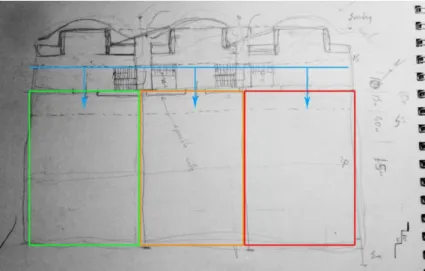
‘Black Magic’ Designing for adaptability became important in my project during the course of the year, and I came to a design method for adaptable architecture before I found research to corroborate my own thoughts. I had been designing sections and plans that were very organic and curved, and then trying to fit flexibility and adaptable designs within aesthetic notions of organic architecture. In the book Design for Ecological Democracy, author Randolph Hester states that you should “start square or conventional, and let the building become unique over time, rather than vice versa”49. Rather than designing one big open space that could be partitioned for different functions I worked out a plan which had a long hallway that could then feed into partitioned spaces. This meant that people had a way to travel through in the building independently of the events occurring in the main spaces. In the simple sense this design consisted of a highly flexible warehouse with a feeder corridor on the side as shown below:
Figure 15. Schematic drawing showing parallel access to different spaces.
The corridor shown as the blue line in Figure 15 and in Figure 16 is very long and directional. I decided to break up this transit space into areas for rest and sitting as well as walking. Randolph Hester states that “a warehouse like space exudes flexibility. Enrich the edges with columns or alcoves or a surrounding gallery’50. In my design, three
‘alcoves’ protrude from the hallway, allowing people to step off the busy ‘internal street’ for a rest, or sit down if they are waiting to be let into the main spaces for an event.
49 Hester, Design for Ecological Democracy, 260.
50 Ibid.
Figure 16. Draft compute render of the main thoroughfare of my events centre.
In structuring this design I worked off the existing grid of the wharf foundations and overlayed my own grid which followed the important lines of support from the foundations. The adaptability of the structure became an important aspect, and Hester writes that you should ‘invest more in the structure than in the finish of the building’51. I did some studies of structures that would relate to the site boundaries of the wharf and its orientation towards north, working on a roof lattice that grew out from vertical wall columns. The structural effect had some similarities to the look of traditional Maori weaving. The process of starting simple, and then allowing the structure to progress into more complex and interesting designs is shown with the progression left to right in the plan and perspective images in Figure 17 below.
51 Hester, Design for Ecological Democracy, 260.
Figure 17. A computer modelling experiment into large span structural efficiencies.
A repetitive system of columns and modular components wrapped around an open warehouse space worked well except that the weaving system above meant that each individual member relied on each of the other members for structural stability. This meant that you could not take apart different sections without taking the whole structure down. I decided to change the design and instead split the main space up into three structurally independent areas, which could be added or removed as discussed in the chapter on diversified lifetimes.
036. Kinetic Architecture
“If architects designed a building like a body, it would have a system of bones and muscles and tendons and a brain that knows how to respond. If a building could change its posture, tighten its muscles and brace itself against the wind, its structural mass could literally be cut in half.”
Guy Nordenson, Structural Engineer, Guy Nordenson and Associates
The quote above by Nordenson embodies a connection between organisms and architecture that has yet to be fully realised to date. The reasons being that most organisms are immensely complex, and trying to recreate even the simplest kinetic system found in nature is a seemingly distant possibility. Organic movements are being replicated as mentioned previously in the topic of biomimicry, however only in smaller scales such as in the fields of robotics or sculpture.
Theo Jansen is a kinetic sculptor who has some interesting creations which resemble skeletal creatures that ‘walk on the wind’ on beaches in the Netherlands (Figure 18). He says that these ‘new forms of life’ will one day be able to roam freely in herds and survive on their own. The sculptures are powered by the wind and can detect when they enter the sea using simple methods of resistance detection in tubes. They are uniquely advanced structures but made from commonly found materials such as plastic electrical tubes and plastic bottles. He began the project with the aim to construct machines that could collect sand from the beach and gather it near the dunes, which are important in protecting Holland from the sea. This could be a ‘good way to fight the rise of the ocean during the coming century’ according to Jansen52.
52 Theo Jansen, "Kinetic Sculptor Theo Jansen," (Netherlands: 2009).
Figure 18. A kinetic sculpture by the artist Theo Jansen on a beach in the Netherlands.
My project is akin to these kinetic sculptures in that my building harnesses the moving energies of nature of the wind and tide to move its structure and power its systems.
From the early site analysis stage in my project, I considered the site as a building platform interconnected within a larger context of natural systems. The water beneath the site changes height with the tide which is affected by the position of the moon. The water above the site (rain) is generated through precipitation of the sea by the sun. Wind which moves above and below the site is generated by the heating and cooling of land and water from the sun, and by the rotation of the planet (Coriolis Effect).
I designed a system to harness energy from the tidal variations below the wharf, shown in figure 19 below. ‘Pods’
hang underneath the wharf structure in between the 8m x 8m grid of wharf piles. They are connected to the wharf with a system of lowering and raising mechanisms controlled by computers. Tides can be predicted all year round, so the system knows how much energy it can harness on any particular day. This energy is gravitational potential energy transferred from the moon, to the tide and then to the pod which floats up with the tide as shown between phase 1 and 2. When it reaches the high tide mark, round openings in the pod’s can release or fill the pod up with water. A mechanical system will hold the now heavy pod at the high tide position of the particular cycle as shown in phase 3. As the tide goes down space is made for filled pod to be lowered using gravity, and hydraulic, kinetic or electrical energy can be harnessed in this action. The wharf can hold a maximum of 220 of these ‘pods’, and they can be added or removed when needed.
Figure 19. Sectional drawings showing how gravitational potential energy can be stored from the tide at the site.
Figure 20. Render of the rainwater catchment tank and the ‘water wall’ which heats the building.
During this project adjustments in the events centre have been thought of in terms of micro or macro changes. The diversified lifetimes changes would be macro changes of the building because they are of a large scale. Micro changes are discussed in adaptive opportunities, and an example might be a person opening of louvres. Early in the project I realised that energy efficiency could be increased if the building could make minor tweaks to its shell and systems during the course of a day, and larger changes over the course of months and years.
I have already discussed how parts of my building’s design can be disassembled and rearranged, which is a form of kinetic architecture, but these parts can also be moved in ways that change the way the wall functions. Originally the connection between the main concourses on the west side of the building was segregated from the main hall by thick concrete walls. The wall was considered in this manner as it would be a load bearing structure for the pivoting roof above. However the solidity of this approach went against the idea of being able to remove sections or bays of the building when not needed. It also reduced the flexibility of the main hall which would receive no light through from the west. The solution was a wall based on the same structure as the west façade but with a different panelling system. The panels I designed needed to fulfil two purposes: Allow the control of light through from the western concourse when needed and provide acoustic sound absorption on both sides of the panels.
Kinetic architecture can actively engage with people close to the building and from a distance. Up close a person can see the micro and macro changes occurring over time and at a distance a person may only see the macro changes.
This visual display of adaptability was important in my project due to the high visibility of the site in Auckland city. It
is in a way a stage upon which events occur within the building and within the architecture. People will initially wonder why the building is behaving in this manner until they learn that the kinetic movements are saving energy by actively controlling the indoor climate, and adapting to the uses required by the inhabitants. Passive design is no longer the only means in which sustainable climate can be maintained. Active design with locally renewable energy sources is what my project embodies and where the future is heading.
037. Sustainability
Performance-based buildings have been around for decades, focussing on improved indoor comforts and greater energy efficiency. Jean Nouvel introduced a new type of performance-based building in 1989 when he designed a kinetic curtain wall for the Institut du Monde Arabe that responded to the position of the sun53. However buildings like this have never entered the mainstream practice of design and construction due to the extra design needed in developing the improved performance of a building. Environmental Sustainable Design is no longer a utopian solution. We have the technologies n