Corneal epithelial stem cell dysfunction can result in painful and blinding diseases of the ocular surface. To examine the ability of the materials to deliver a small drug load, pSi microparticles were loaded with fluorescein diacetate prior to cell attachment. The composite consists of a spun (not woven) PCL fabric with nanostructured pSi microparticles imprinted on the outside of the fibers.
The hot particles caused local melting of the PCL fibers and thus caused the pSi to be partially embedded in the polymer. Loadings of the order of 5-6% pSi by weight were obtained, while preserving the PCL fiber morphology. Improved incorporation of pSi microparticles into PCL was achieved by briefly adding chloroform to the pSi microparticles after removal from the oven, resulting in surface etching/dissolution of the PCL surface and better adhesion of the pSi particles to the PCL matrix.
Loadings on the order of 32–34 mass% pSi were obtained, while preserving the PCL fiber morphology. 96® AQueous One Solution test as described above, using 50 µl of conditioned medium in place of the pSi-PCL composite materials. A piece of the composite material was placed in each pocket and secured with interrupted 10-0 monofilament nylon sutures (Alcon Laboratories, Fort Worth, TX, USA).
In another 3 mice, sham surgery was performed, without biomaterial implantation (suture-only controls).
Results
Using pSi-PCL material A, the feasibility of drug delivery from the charged pSi component of the material to cells was assessed. Transfer of FDA to the cells was confirmed by the detection of fluorescence in all FDA-loaded material, but not in the unloaded control material ( Fig. 3A ). Compared to the material with smaller (<40 µm) microparticles (Fig. 3B), the fluorescent signal was stronger in the material with the larger (150-250 µm) microparticles (Fig. 3C).
Loading of peptide or protein drugs into the pSi composite materials was performed with pSi-PCL prepared by method B, to maximize macromolecular drug loading. Although cell attachment to uncoated pSi-PCL material B was observed at 6 h, there was little evidence of cell growth at 24 h (Fig. 4A, 4C). Improvement of cell attachment to, and growth on, pSi-PCL material B composites loaded with FBS was next assessed.
The functional efficacy of specific biologics loaded into the pSi-PCL B material on attached cells was then evaluated. Cells seeded on the bio-loaded and washed PSi-PCL B material showed significantly more proliferation than cells grown on the non-loaded composite material (Fig 5A). The PCL-only material was not used in this experiment, as the previous experiment had shown that the biologics were loaded only into the pSi component of the composite material.
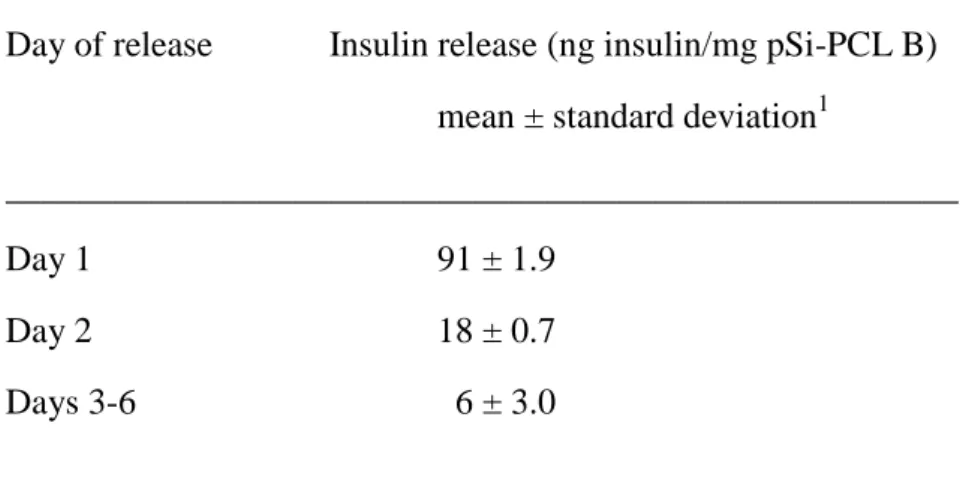
DMEM conditioned by incubation of epidermal growth factor, insulin, transferrin and sodium selenium-loaded pSi-PCL composites induced proliferation in BALB/c 3T3 cells (Fig 5B), compared to medium conditioned with pSi-PCL of without loading. Samples obtained on day 1 of release elicited the greatest proliferative response, indicating that a large amount of the loaded biologic was released on day 1. Taken together, these data suggested an initial release of epidermal growth factor, of insulin, transferrin, and sodium selenite, followed by a slow release as the pSi microparticles dissolve.
The unloaded pSi-PCL B material was implanted under the conjunctiva of adult Sprague-Dawley rats to investigate in vivo biocompatibility. Immediately after implantation, the pSi particles were visible under the operating microscope ( Fig. 6A ), but had dissolved after 8 weeks, at which stage the PCL fabric was still visible ( Fig. 6B ). On endpoint histology, the position of the implant was marked by a thin fibrous capsule, with some neovascularization noted around the area ( Fig. 6C ).
Discussion
The neovascular response to the sutures in the suture-only control rats was similar to the response to the implants. Together, these improvements resulted in increased pSi particle loading compared to previous methods ( Kashanian et al., 2010 ), providing a high drug loading capacity. The PCL fabric base provided some flexibility to the materials, while the addition of nanostructured pSi microparticles enabled the loading of both small drugs, as exemplified by fluorescein diacetate, and peptide or protein biologics, as exemplified by insulin.
The presence of pSi particles did not significantly change the measured mechanical strength of PCL. The observed tensile strength values were in the range of 1.2–1.8 MPa, consistent with literature values for high porosity PCL scaffolds possessing fiber diameters in the micrometer range (Eshraghi & Das, 2010; Sant et al., 2011). Intracellular esterases cleave FDA to the fluorescent product fluorescein, which is stored within living cells (Rotman et al., 1966).
However, more fluorescent cells were observed on materials with larger (150–250 µm) rather than smaller (<40 µm) pSi particles, possibly because such particles could be loaded with more of the model drug. Loaded pSi-PCL was incubated in cell culture medium, which was then used to induce proliferation of the BALB/c 3T3 cells. Such a time frame is likely sufficient for the transfer of epithelial progenitor cells from the cornea to the eye and their subsequent migration to the ocular surface.
Use of the composite as an ocular implant requires that it be biocompatible in the eye. The biocompatibility of both pSi and PCL has previously been demonstrated individually (Low et al., 2009; Ang et al., 2006) and together as a composite material (Kashanian et al., 2010) for use on the front of the eye. Various PCL composites have recently been tested as potential scaffolds for retinal progenitor cell transplantation to the back of the eye (Baranov et al., 2014).
The flexibility of the material enabled easy implantation into pockets created in the subconjunctival space by open dissection. Ex vivo expanded cells must be transferred to the eye on a scaffold (Pellegrini et al., 1997), of which human amniotic membrane is the most commonly used (Tseng et al., 1998). We anticipate that our new composite materials may serve as useful scaffolds for the transfer of cells and growth factors or drugs to the eye in ocular surface diseases.
Conclusions
The funding sources did not in any way influence the results of the research presented in this manuscript. Role of nanostructured mesoporous silicon in in vitro calcification discrimination for electrospun composite tissue engineering scaffolds. McInnes SJP, Turner CT, Al-Bataineh SA, Airaghi Leccardi MJI, Irani Y, Williams KA, et al.
Amniotic membrane transplantation with or without limbal allografts for corneal surface reconstruction in patients with limbal stem cell deficiency. -porous poly(epsilon-caprolactone)/mesoporous silica scaffolds: calcium phosphate deposition and biological response to bone precursor cells. Uptake of fluorescein diacetate (FDA) by SRA01/04 cells attached to pSi-PCL composite materials 6 h after seeding on FDA-loaded pSi-PCL composite materials.
Cell nuclei stained with Hoechst 33342 (blue), cell cytoplasm stained with fluorescence (green), pSi particles (asterisk), scale bars = 50 µm; insets show a high magnification image of the cells, scale bars = 10 µm. A) No green fluorescence was observed in the unloaded material; (B) FDA-loaded composite with <40 µm pSi particles showed faint green fluorescence; (C) FDA-loaded composite with 150–250 µm pSi particles showed bright green fluorescence. Proliferation of BALB/c 3T3 cells in response to EGF-insulin, selenite and transferrin (EGF-ITS) released from pSi-PCL composite materials. Cells seeded on EGF-ITS loaded pSi-PCL showed significantly more proliferation than on unloaded composite material and loaded PCL *p=0.008.
Cells seeded on EGF-ITS loaded PCL did not proliferate more than cells loaded on unloaded PCL, #p=0.095. Medium conditioned with EGF-ITS loaded pSi-PCL composite material induced cell proliferation compared to medium conditioned with unloaded pSi-PCL. The porous silica particles were visible immediately after implantation, but were completely dissolved after 8 weeks; (C) Hematoxylin &.
A foreign body response mediated by macrophages and foreign-type giant cells was observed; (D) Magnified view of the area marked by the red box in (C) showing remnants of composite material (arrow). E) The response to the suture (arrow) was similar to the response of the foreign body to the implant.