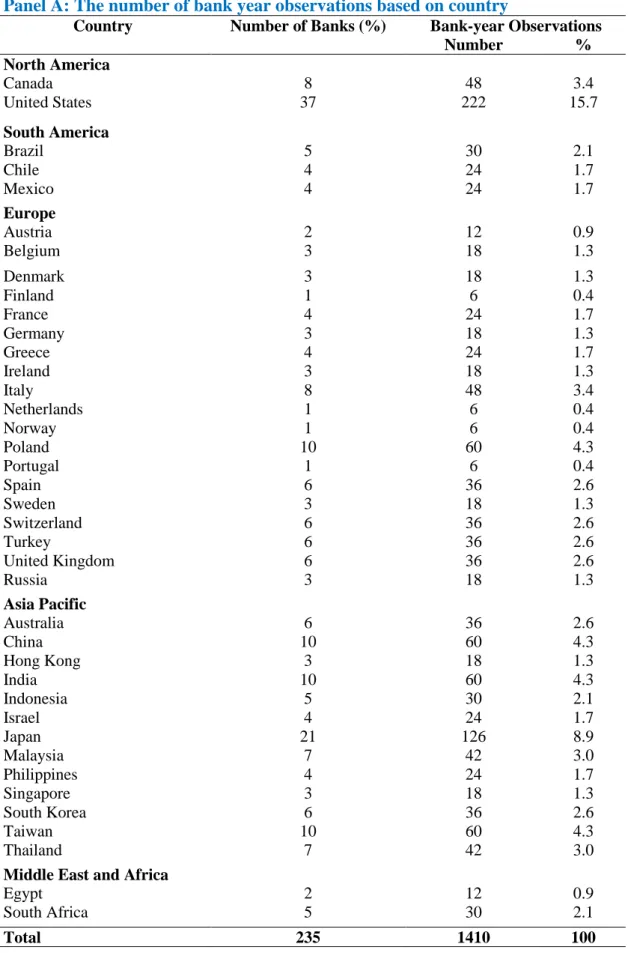
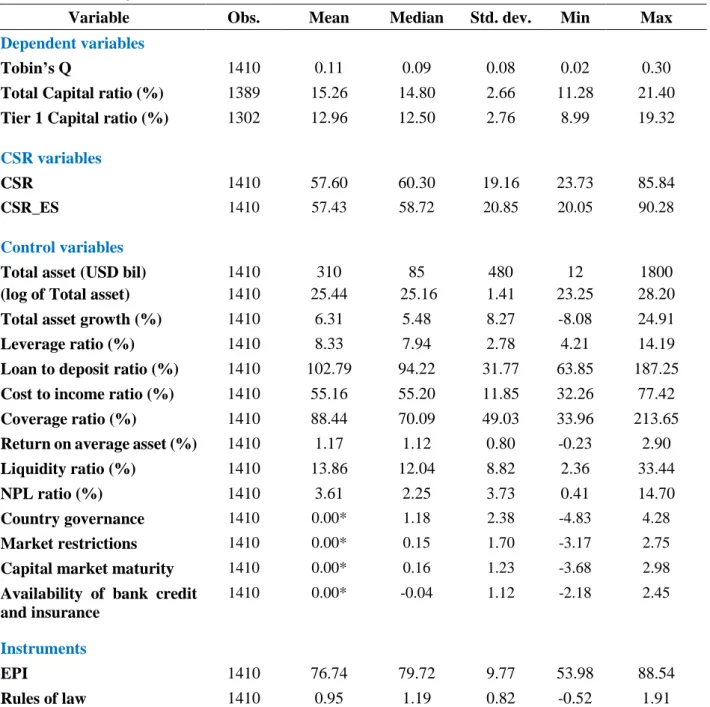
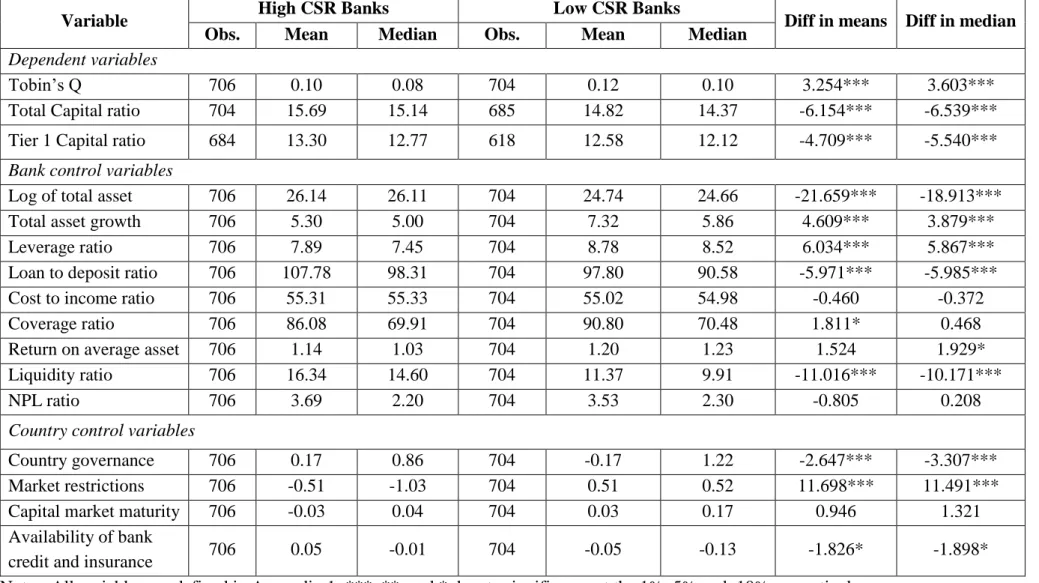
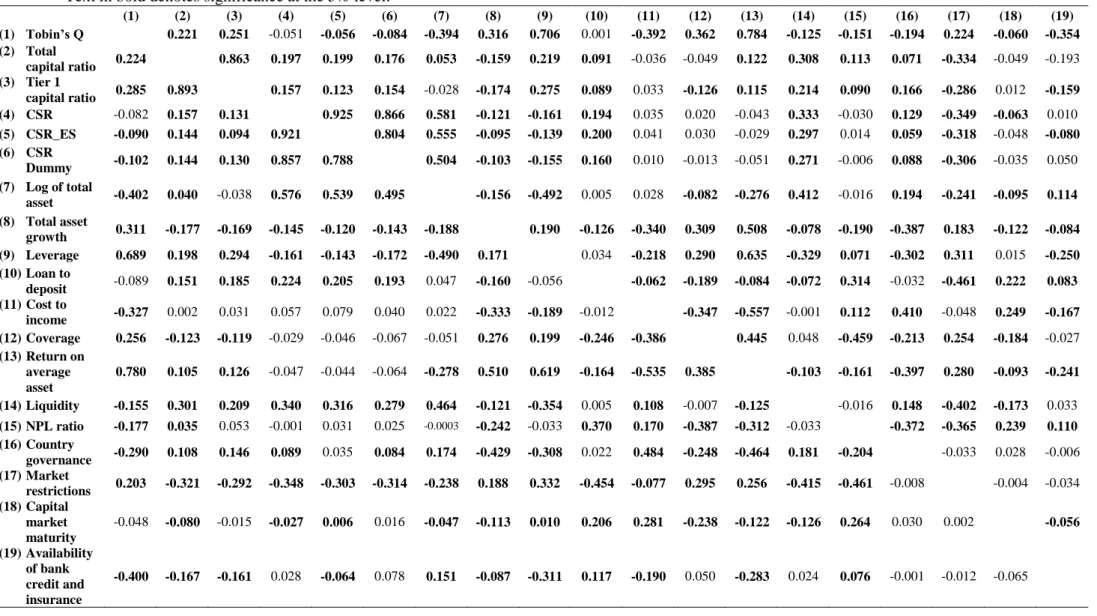
Banks are also motivated to adopt CSR because of the potential benefits, including improved financial performance (Wu and Shen, 2013; Shen et al., 2016). Meta-analyses of studies excluding banks conclude that CSR is positively associated with financial performance (Orlitzky et al., 2003; Margolis et al., 2009). Well-capitalized banks contribute to financial stability as they have a low probability of default (Laeven et al., 2016), which leads to stable economy and society.
Although empirical research on the relationship between CSR and bank financial performance has increased in recent years, the relevant literature on how CSR relates to bank capital and risk is still sparse (Wu and Shen, 2013; Shen et al., 2016; Cornett et al., 2016). Their findings are supported by Shen et al. 2016) who conclude that banks carry out CSR as a long-term strategy to survive. In their robustness tests, Cornett et al. 2016) show that CSR is positively linked to firm value for the US banks in the pre-crisis period.
Well capitalized banks have a low probability of failure, thus low systemic risk (Laeven et al., 2016). Stakeholder maximization theory suggests that bank managers use CSR as strategic tools to satisfy stakeholders' expectations, which improves reputation ( Maden et al. , 2012 ) and shareholders' wealth ( Wu and Shen, 2013 ).
Capital adequacy
Analyzing the effect of bank risk profiles on CSR disclosure, Gambetta et al. 2017) use the first-order capital ratio to measure capital adequacy. We include annual growth in total assets to account for the effect of firm expansion, as banks may encounter increased risks if they expand too aggressively (Altunbas et al., 2017). We control for banking sector concentration, which is closely related to competition, using the three-bank concentration ratio (Wu and Shen, 2013; Beck et al., 2013).
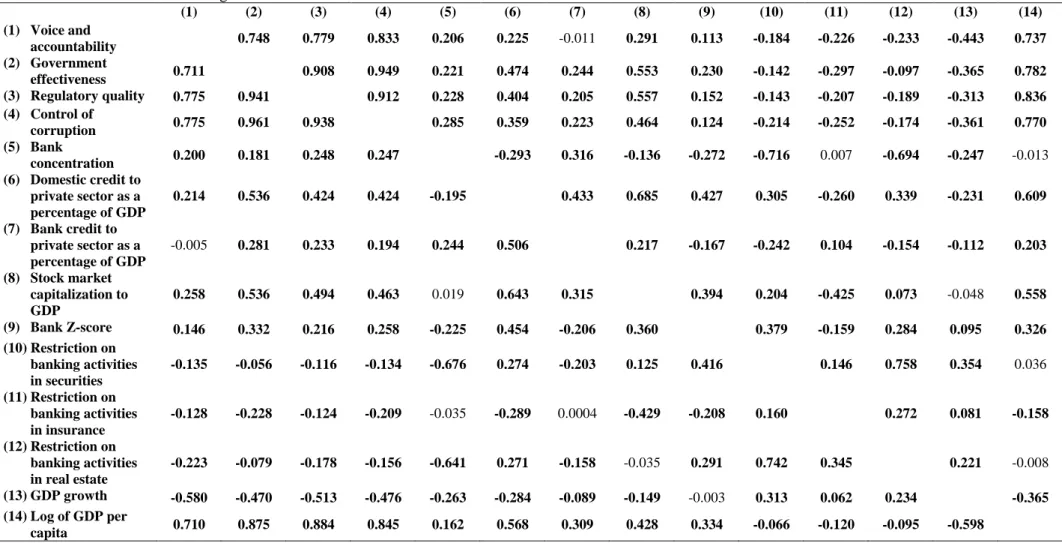
To take into account the availability of bank credit and the structure and maturity of the financial market, we include domestic credit to the private sector as a percentage of gross domestic product (GDP), bank credit to the private sector as a percentage of GDP, and stock market capitalization. relative to GDP (Wu and Shen, 2013; Beck et al., 2013). We check the systemic stability of the banking sector using the Z-score of the banking sector at the national level (Beck et al., 2013). To measure the degree of restrictions imposed by national regulatory authorities in the respective countries, we include three control variables, namely restrictions on banking activities in securities, insurance and real estate ( Wu and Shen, 2013 ; Beck et al ., 2013).
Construction of the empirical model
For the fourth factor, the availability of bank credit and insurance, two factors have large loadings, namely bank credit to the private sector as a percentage of GDP (0.61) and restriction of banking activities in insurance (0.59). As for the exclusion condition, it is required that the instrumental variables have no correlation with the error term. In my setting, the exclusion condition requires that the instrumental variables (EPI and law) affect financial performance and risk only through its effect on the endogenous variable, CSR (Roberts and Whited, 2013).
For example, if a bank is located in a country with strong beliefs about good environmental and social performance, a bank will sensibly improve its social and environmental performance to align with society's expectations to avoid unnecessary social sanctions and improve its overall financial performance. 2019) find that the environmental and social norms and values of a community in which an investment manager lives influence the manager's financial decisions, which affect environmental and social performance. Because companies generally align their social and environmental practices with society's expectations (Dyck et al., 2019), the environmental and social dimensions of the CSR score would have captured the effects of a society's environmental expectations and compliance with norms. Therefore, the regression error term is theoretically expected not to reflect the environmental and social performance at the country level as measured by the instrumental variables.
24The fulfillment of the exclusion condition means that the instrumental variables are not influenced by the dependent variables, the instruments must effect the dependent variables indirectly through the endogenous variable, and the instruments are not correlated with unobservable variables in the model (Jha and Cox, 2015). Firm Value Measureijt = β0 +β1 CSRijt + γBank-Specific Control Variablesjt + δ Country-Specific Control Variablesjt + ɛijt (1) Capital Adequacy Measure = β0 +β1 CSRijt + γBank-Specific Control Variablesjt + δ Country. Bank-specific control variables = natural logarithm of total assets, annual growth of total assets, leverage ratio, loan to deposit ratio, cost to income ratio, coverage ratio, return on average asset ratio, liquidity ratio and non-performing loan ratio.
Country-specific control variables = country governance, market constraints, capital market maturity, and availability of bank credit and insurance. For the sustainability analysis, we replicate equation (1) and (2) using CSR_ES, which is an alternative CSR measure developed using environmental and social data. In addition, we perform additional analysis using excess capital ratios, from which we subtract the Basel III minimum capital ratio requirement of 10.5%25 from the total capital ratio and 8.5% from the Tier 1 capital ratio.
25 Basel III capital ratio requirements for total capital ratio and Tier 1 capital ratio are 10.5% and 8.5%.
Empirical results and discussion
- Descriptive statistics and univariate results
- Multivariate analysis Firm value
- Robustness tests
- CSR_ES (alternative CSR measure)
- Subsample analysis
- Excess Capital Ratios (Above Basel III’s Capital Ratio Requirements)
- Analysis on Capital Growth
Columns (5) to (12) show that the estimated coefficient for CSR is statistically significant and positively related to the total capital ratio and the core capital ratio, both at the 1% level. Regarding the control variables, the coefficient of financial leverage (expandability) is significantly positive for the total capital ratio and the tier one capital ratio, while the coefficient of government governance is negatively related to the total capital ratio and the tier one capital ratio. For the coefficients of total capital and Tier 1 capital, column (8) and column (12) show that the estimated coefficient for CSR_ES is positively significant at 1%.
In terms of economic significance, a one-standard deviation increase in CSR is associated with an improvement of 0.09 and 0.11 in Total Capital and Tier 1 Capital ratios respectively, in line with the increase of 0.08 and 0, 10 using CSR Score (Column (5) to (12) of Table 3). To derive the excess capital ratios, we subtract 10.5% from each bank's Total Capital Ratio and 8.5% from Tier 1 Capital Ratio. Based on Basel III, the minimum capital ratio requirements are 8.0% for Total Capital Ratio and 6.0% for Tier 1 Capital Ratio.
In addition to the minimum requirements, we subtract a 2.5% savings buffer from the total capital and Tier 1 capital ratios in our database. Columns (4) and (8) of Table 4 (Panel C) show that the estimated coefficients for CSR are statistically significant and positively related to the coefficient of excess total capital and excess Tier 1 capital, both at the 1% level. The effect of CSR on banks' ability to attract capital is significant, as a one standard deviation increase in the level of CSR leads to a 0.08 and 0.10 improvement in total capital and Tier 1 capital ratios, respectively.
We analyze the relationships between CSR and annual growth in total capital and Tier 1 capital. The estimated coefficients for CSR are significantly positive at the 1% level for total capital growth. Translated into economic size, a one standard deviation improvement in CSR leads to 0.18% and 0.15% annual growth in total capital and Tier 1 capital respectively.
Among the control variables, total asset growth and leverage ratio are significantly and positively related to both total capital growth and Tier 1 capital growth.
Conclusion
The results are in line with expectations, as banks will require more capital as they grow in size (total asset growth) and expand their business (leverage). First, although we have included many control variables, we acknowledge that unobserved firm-specific variables may still explain our results. Using instrumental variable analysis and fixed effects corrections, which address both omitted variables and reverse causality biases, we believe our results are robust.
Because Refinitiv assigns ESG data to large and publicly traded banks, our sample mainly includes large and publicly traded banks in a country rather than all banks in a country regardless of its size. Future research into the possible channels leading to the capital adequacy results may be interesting and will be useful in furthering our understanding of the issue.
Variable definitions, measurement, and sources
Rule of Law "Perceptions of the extent to which agents trust and abide by the rules of society, and in particular the quality of contract enforcement, property rights, the police and courts, and the likelihood of crime and violence." World Bank's World Governance Indicators database Individual country-level measures included in Principal Component Analysis Voa Voice and Accountability "Reflects perceptions of the extent to which a country's citizens are able to participate in the selection of their government, as well as freedom of speech, association, and a free media."
The World Bank's World Governance Indicators database Gef Government effectiveness "Reflects perceptions of the quality of public services, the quality of the civil service and the degree of its independence from political pressure, the quality of policy formulation and implementation, and the credibility of government's commitment to such policies.” World Bank's World Governance Indicators database Req Regulatory quality “Reflects perceptions of the government's ability to formulate and. implement sound policies and regulations that allow and promote private sector development.” The World Bank's World Governance Indicators Database Corrupt Control of Corruption "Reflects perceptions of the extent to which public power is exercised for. private gain, including both petty and grand forms of corruption, as well as the 'capture' of the state by elites and private interests."
The balance sheet total of the three largest commercial banks as a share of total commercial banking assets. GDP is the sum of the gross value added of all resident producers in the economy, plus all taxes on products and minus any subsidies that are not included in the value of products. Greed or good deeds: Examining the relationship between corporate social responsibility and US financial performance
Voluntary non-financial disclosure and the cost of equity capital: The initiation of corporate social responsibility reporting. Corporate social performance and its relationship with corporate financial performance: international evidence from the banking sector. Social capital, trust and firm performance: The value of corporate social responsibility during the financial crisis.
To engage or not to engage in corporate social responsibility: empirical evidence from the global banking sector. This table presents the results of the two-stage least squares test to examine the relationship between CSR and firm value, as well as between CSR and capital adequacy (column (5) to column (12)). Robust to heteroskedasticity Yes Yes Yes Yes Yes Yes. Robustness analysis – Sub-sample analysis using the CSR score.