Licence
Environmental Protection Act 1986, Part V
Licensee:
St Ives Gold Mining Company Pty Ltd Licence: L8485/2010/2
Registered office: Level 5 50 Colin Street
WEST PERTH WA 6005
ACN: 098 386 273
Premises address: St Ives Gold Mine
Mining Tenements described in Schedule 1 KAMBALDA WEST WA 6442
Issue date: Thursday, 3 October 2013 Commencement date: Monday, 7 October 2013 Expiry date: Wednesday, 6 October 2021 Prescribed premises category
Schedule 1 of the Environmental Protection Regulations 1987 Category
number Category description
Category production or design capacity
Approved premises production or design capacity
05 Processing or beneficiation of metallic or non- metallic ore
50 000 tonnes or more per year
9 000 000 tonnes per annual period
06 Mine dewatering 50 000 tonnes or more
per year
30 000 000 tonnes per annual period
07 Vat or in situ leaching of metal 5 000 tonnes or more per year
3 000 000 tonnes per annual period
54 Sewage facility 100 cubic metres or
more per day
220 cubic metres per day
64 Class II or II putrescible landfill site 20 tonnes or more per year
1 000 tonnes per annual period
Conditions
This Licence is subject to the conditions set out in the attached pages.
Date signed: 14 October 2016 ...
Tim Gentle
Manager Licensing – Industry Regulation (Resources Industries) Officer delegated under section 20
of the Environmental Protection Act 1986
Contents
Licence 1
Contents 2
Introduction 2
Licence conditions 5
1 General 5
2 Emissions 11
3 Monitoring 14
4 Information 18
Schedule 1: Maps 20
Schedule 2: Reporting and notification forms 30
Introduction
This Introduction is not part of the Licence conditions.
DER’s industry licensing role
The Department of Environment Regulation (DER) is a government department for the state of Western Australia in the portfolio of the Minister for Environment. DER’s purpose is to advise on and implement strategies for a healthy environment for the benefit of all current and future Western Australians.
DER has responsibilities under Part V of the Environmental Protection Act 1986 (the Act) for the licensing of prescribed premises. Through this process DER regulates to prevent, control and abate pollution and environmental harm to conserve and protect the environment. DER also monitors and audits compliance with works approvals and licence conditions, takes enforcement action as appropriate and develops and implements licensing and industry regulation policy.
Licence requirements
This Licence is issued under Part V of the Act. Conditions contained within the Licence relate to the prevention, reduction or control of emissions and discharges to the environment and to the monitoring and reporting of them.
Where other statutory instruments impose obligations on the Premises/Licensee the intention is not to replicate them in the licence conditions. You should therefore ensure that you are aware of all your statutory obligations under the Act and any other statutory instrument. Legislation can be accessed through the State Law Publisher website using the following link:
http://www.slp.wa.gov.au/legislation/statutes.nsf/default.html
For your Premises relevant statutory instruments include but are not limited to obligations under the:
Environmental Protection (Unauthorised Discharges) Regulations 2004 – these Regulations make it an offence to discharge certain materials such as contaminated stormwater into the
environment other than in the circumstances set out in the Regulations.
Environmental Protection (Controlled Waste) Regulations 2004 - these Regulations place obligations on you if you produce, accept, transport or dispose of controlled waste.
Environmental Protection (Noise) Regulations 1997 – these Regulations require noise emissions from the Premises to comply with the assigned noise levels set out in the Regulations.
You must comply with your licence. Non-compliance with your licence is an offence and strict penalties exist for those who do not comply.
Licence holders are also reminded of the requirements of section 53 of the Act which places
restrictions on making certain changes to prescribed premises unless the changes are in accordance with a works approval, licence, closure notice or environmental protection notice.
Licence fees
If you have a licence that is issued for more than one year, you are required to pay an annual licence fee prior to the anniversary date of issue of your licence. Non payment of annual licence fees will result in your licence ceasing to have effect meaning that it will no longer be valid and you will need to apply for a new licence for your Premises.
Ministerial conditions
If your Premises has been assessed under Part IV of the Act you may have had conditions imposed by the Minister for Environment. You are required to comply with any conditions imposed by the Minister.
Premises description and Licence summary
The St Ives Gold Mine (SIGM) is located approximately 8 km south of Kambalda and operated by St Ives Gold Mining Company Pty Ltd (St Ives). Mining operations on Lake Lefroy are licenced under L8485/2010/2 and approved under Ministerial Statement 879. SIGM ore is currently mined from four underground mines, three open pits and 10 surface stockpiles and processed at the Lefroy Mill.
Groundwater in the area is in the range of 50,000 to 300,000 mg/L total dissolved salts (TDS) with groundwater quality in the vicinity of Lake Lefroy ranging between 274,000 to 423,000 mg/L TDS and metal levels reflective of the mineralogy in the region. Mining operations are both land and lake based, where the latter operations are based on Lake Lefroy, a salt lake covering an area of 544 km2. Playa lakes such as Lake Lefroy are prominent within the Salinaland Division and occur as dendritic and partly interconnected chains that outline fossil drainage systems (Dames & Moore 1999).
Dewatering activities at SIGM have previously been assessed by DER as presenting a low risk to the environment as groundwater mineralogy presents similar characteristics to the lake bed. The OEPA noted that Lake Lefroy is a hypersaline salt lake that generally has low levels of aquatic life and does not experience a freshwater phase. However, it is considered that the riparian zone, playas and clay pans that surround the lake are important in terms of providing habitat for aquatic biota and
supporting the ecological function of the area. To minimise any further disturbance to the lake, dewatering pipelines are not bunded and telemetry and trigger alarms are used to assist in detecting leaks.
The main impacts associated SIGM are associated with discharges to land from tailings storage facilities (TSFs). Due to the high salinity of groundwater, mounding around TSFs presents a significant risk to native vegetation. Standing water levels around TSF4 have the potential to rise above the root zone of nearby native vegetation as a result of a recent 2.5 m lift authorised under Works Approval W5795/2015/1, which is expected to increase the hydraulic pressure on entrained water within TSF4 when further tailings are discharged to the facility. Therefore DER has made changes to the Licence to allow for the implementation of further seepage management measures to recover rising groundwater. The use of TSF4 as a primary tailings disposal option is only expected to continue for a short duration until the Leviathan In-pit TSF comes online in the third quarter of 2016.
An amendment was issued in June 2016 to improve conditions relating to mine dewater discharges to surface water and groundwater within Lake Lefroy in a bid to reduce the regulatory requirement for St
Ives to apply for future Licence amendments where the environmental risks of similar dewatering proposals have already been assessed as low. This coincides with St Ives application to relocate North Orchin In-Pit TSF decant water from Thunderer Pit to Bellerophon Pit to allow for the safe mining of Neptune Pit, directly adjacent to Thunderer Pit.
Approval to commence mining/dewatering at Delta Island South is required from the Office of Environmental Protection Authority with an amendment to Ministerial Statement 879. Therefore the current amendment does not authorise the dewatering of Delta Island South and the premises boundary remains unchanged.
The current amendment is to include the Leviathan in-pit TSF which was assessed under Works Approval W5858/2015/1. Before the final amendment for the Leviathan in-pit TSF was issued, SIGM submitted a second application for an amendment to dispose of some asbestos containing material (ACM) within the South Delta Open Pit. This matter is also addressed in the current amendment.
The licences and works approvals issued for the Premises since 01/10/2013 are:
Instrument log
Instrument Issued Description
W5724/2014/1 15/09/2014 Mine dewatering at Invincible Project W5583/2014/1 03/04/2014 Construction of TSF3
W5547/2013/1 06/02/2014 Mine dewatering at Idough Project Area W5558/2013/1 30/01/2014 Mine dewatering at Swiftsure Project W5557/2013/1 27/01/2014 Mine dewatering at Redback Project Area
W5497/2013/1 14/11/2013 Mine dewatering at Argo/Athena/Hamlet Complex L8485/2010/2 03/10/2013 Licence re-issue
L8485/2010/2 08/01/2015 Licence amendment to new format and to extend dewatering operations to Invincible Pit
L8485/2010/2 06/08/2015 Licence amendment to expand the dewatering network
L8485/2010/2 11/02/2016 Licence amendment to reduce WWTP monitoring requirements and to authorise the discharge of tailings and return water to the newly lifted TSF4.
L8485/2010/2 17/03/2016 Licence amendment to change the dewatering configuration L8485/2010/2 16/06/2016 Licence amendment to relocate North Orchin In-Pit TSF decant
water from Thunderer Pit to Bellorophon Pit and to improve conditions relating to mine dewater discharges to surface water and ground water within Lake Lefroy.
L8485/2010/2 13/10/2016 Licence amendment to include the Leviathan in-pit TSF following compliance with works approval W5858/2015/1.
Severance
It is the intent of these Licence conditions that they shall operate so that, if a condition or a part of a condition is beyond the power of this Licence to impose, or is otherwise ultra vires or invalid, that condition or part of a condition shall be severed and the remainder of these conditions shall nevertheless be valid to the extent that they are within the power of this Licence to impose and are not otherwise ultra vires or invalid.
END OF INTRODUCTION
Licence conditions
1 General
1.1 Interpretation
1.1.1 In the Licence, definitions from the Environmental Protection Act 1986 apply unless the contrary intention appears.
1.1.2 For the purposes of this Licence, unless the contrary intention appears:
‘Act’ means the Environmental Protection Act 1986;
‘anniversary date’ means 31 December of each year;
‘annual audit compliance report’ means a report in a format approved by the CEO as presented by the Licensee or as specified by the CEO from time to time and published on the Department’s website;
‘annual period’ means a 12 month period commencing from 1 January until 31 December in the same year;
‘asbestos’ means the asbestiform variety of mineral silicates belonging to the serpentine or amphibole groups of rock-forming minerals and includes actinolite, amosite, anthophyllite, chrysolite, crocidolite, tremolite and any mixture containing 2 or more of those;
‘asbestos fibres’ has the meaning defined in the Guideline for Assessment, Remediation and Management of Asbestos Contaminated Sites, Western Australian, (DOH 2009);
‘AS/NZS 2031’ means the Australian Standard AS/NZS 2031 Selection of containers and preservation of water samples for microbiological analysis;
‘AS/NZS 5667.1’ means the Australian Standard AS/NZS 5667.1 Water Quality – Sampling – Guidance of the Design of sampling programs, sampling techniques and the preservation and handling of samples;
‘AS/NZS 5667.4’ means the Australian Standard AS/NZS 5667.4 Water Quality – Sampling – Guidance on sampling from lakes, natural and man-made;
‘AS/NZS 5667.10’ means the Australian Standard AS/NZS 5667.10 Water Quality – Sampling – Guidance on sampling of waste waters;
‘AS/NZS 5667.11’ means the Australian Standard AS/NZS 5667.11 Water Quality – Sampling – Guidance on sampling of groundwaters;
‘AS/NZS 5667.12’ means the Australian Standard AS/NZS 5667.12 Water Quality – Sampling – Guidance on sampling of bottom sediments;
‘averaging period’ means the time over which a limit is measured or a monitoring result is obtained;
‘CEO’ means Chief Executive Officer of the Department of Environment Regulation;
‘CEO’ for the purpose of correspondence means;
Chief Executive Officer
Department Div. 3 Pt. V EP Act Locked Bag 33 Cloisters Square PERTH WA 6850
Email: [email protected];
‘cfu/100 mL’ means colony forming units per 100 millilitres;
‘clean fill’ has the meaning defined in Landfill Definitions;
‘department’ means the department established under s.35 of the Public Sector Management Act and designated as responsible for the administration of Division 3 Part V of the Environmental Protection Act 1986.
‘freeboard’ means the distance between the maximum water surface elevations and the top of retaining banks or structures at their lowest point;
‘Hazardous waste’ has the meaning defined in Landfill Definitions;
‘Inert Waste Type 1’ has the meaning defined in Landfill Definitions;
‘Inert Waste Type 2’ has the meaning defined in Landfill Definitions;
‘Landfill Definitions’ means the document titled “Landfill Waste Classification and Waste Definitions 1996” published by the Chief Executive Officer of the Department of Environment as amended from time to time;
‘Licence’ means this Licence numbered L8485/2010/2 and issued under the Act;
‘Licensee’ means the person or organisation named as Licensee on page 1 of the Licence;
‘mbgl’ means metres below ground level;
‘mRL’ means metres Relative Level or, height above a standardised 'mean sea level' datum;
‘NATA’ means the National Association of Testing Authorities, Australia;
‘NATA accredited’ means in relation to the analysis of a sample that the laboratory is NATA accredited for the specified analysis at the time of the analysis;
‘Premises’ means the area defined in the Premises Map in Schedule 1 and listed as the Premises address on page 1 of the Licence;
‘quarterly’ means the 4 inclusive periods from 1 January to 31 March, 1 April to 30 June, 1 July to 30 September and 1 October to 31 December;
‘Schedule 1’ means Schedule 1 of this Licence unless otherwise stated;
‘Schedule 2’ means Schedule 2 of this Licence unless otherwise stated;
‘six monthly’ means the 2 inclusive periods from 1 January to 30 June and 1 July to 31 December in the following year;
‘Special Waste Type 1’ has the meaning defined in Landfill Definitions;
‘spot sample’ means a discrete sample representative at the time and place at which the sample is taken;
‘Stage 1’ means construction of dewatering infrastructure for Temeraire Pit;
‘Stage 2’ means construction of dewatering infrastructure for Intrepide Pit;
‘Stage 3’ means construction of dewatering infrastructure for A5 Pit;
‘Stage 4’ means construction of the turkeys nest and connecting dewatering pipeline infrastructure from Foster Shaft;
‘tipping area’ means the area of the landfill in which waste other than cover material is being deposited;
‘TSF’ means tailings storage facility;
‘turkey’s nest’ means a settlement dam that receives dewater and is lined with a geotextile fabric that allows dewater to permeate through to Lake Lefroy;
‘USEPA’ means United States (of America) Environmental Protection Agency;
‘usual working day’ means 0800 – 1700 hours, Monday to Friday excluding public holidays in Western Australia;
‘WWTP’ means the wastewater treatment plants located at Cave Rocks (P1) and Lefroy Admin (P2), Leviathan (P3), Argo (P4) and Athena Paste (P5) sites as depicted in Schedule 1; and
‘zone of influence’ means the area of a receiving environment with the potential to be altered or changed as a result of an emission or discharge.
1.1.3 Any reference to an Australian or other standard in the Licence means the relevant parts of the standard in force from time to time during the term of this Licence.
1.1.4 Any reference to a guideline or code of practice in the Licence means the version of that guideline or code of practice in force from time to time, and shall include any amendments or replacements to that guideline or code of practice made during the term of this Licence.
1.2 Premises operation
1.2.1 The Licensee shall ensure that all pipelines containing saline dewatering effluent, tailings or return water are either:
(a) equipped with telemetry systems and pressure sensors along pipelines to allow for the detection of leaks and failures; or
(b) equipped with automatic cut-outs in the event of a pipe failure; or
(c) provided with secondary containment sufficient to contain any spill for a period equal to the time between routine inspections.
1.2.2 The Licensee shall ensure that any saline dewatering effluent shall only be managed in the following manner:
(a) used for dust suppression in a manner that minimises damage to surrounding vegetation;
(b) discharged to previously mined pits; or
(c) discharged to Lake Lefroy at discharge points defined in Schedule 1.
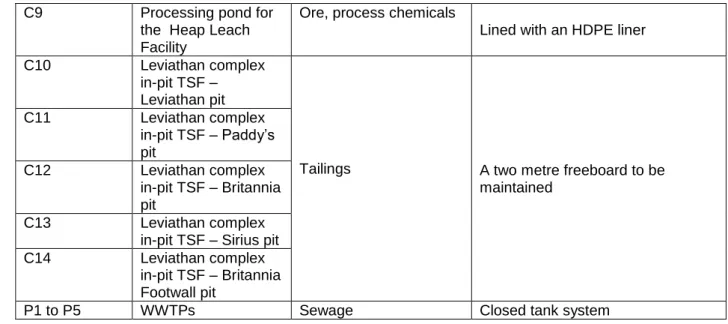
1.2.3 The Licensee shall ensure that tailings, decant water, dewater effluent and sewage are only discharged into containment cells, ponds and enclosed tanks with the relevant infrastructure requirements and at the locations specified in Table 1.2.1 and identified in Schedule 1.
Table 1.2.1: Containment infrastructure Containment
point reference
Containment cell or dam number(s)
Material Infrastructure requirements
C1 TSF2 Tailings Lined with low permeability
materials to limit seepage to groundwater
C2 TSF3
C3 TSF4 Tailings Lined with low permeability
materials to limit seepage to groundwater
TSF built to a height no greater than 311.5 mRL
C4 TSF3 Decant Water
Pond
Decant Water
Lined with at least 0.5m of clay with a permeability of <10-7 m/s or equivalent
C5 TSF1 Decant Water
Pond
C6 TSF4 Decant Water
Pond
Decant Water and recovered water from TSF4-11A, TSF-11B, TSF12A, TSF12B, TSF4-16, TSF4-20A, TSF4-21, TSF4-22A and TSF4-24
C7 and C8 Processing pond for Lefroy Mill
Ore, TSF decant water, process chemicals
Lined with a geotextile liner to limit seepage to groundwater
C9 Processing pond for the Heap Leach Facility
Ore, process chemicals
Lined with an HDPE liner
C10 Leviathan complex
in-pit TSF – Leviathan pit
Tailings A two metre freeboard to be maintained
C11 Leviathan complex
in-pit TSF – Paddy’s pit
C12 Leviathan complex
in-pit TSF – Britannia pit
C13 Leviathan complex
in-pit TSF – Sirius pit
C14 Leviathan complex
in-pit TSF – Britannia Footwall pit
P1 to P5 WWTPs Sewage Closed tank system
1.2.4 The Licensee shall manage containment cells in Table 1.2.1 such that:
(a) a minimum top of embankment freeboard of 300 mm (except for C10 – C14) or a 1 in 100 year/72 hour storm event (whichever is greater) is maintained; and (b) methods of operation minimise the likelihood of erosion of the embankments by
wave action.
1.2.5 The Licensee shall manage TSFs such that:
(a) a seepage collection and recovery system is provided and used to capture seepage from the TSF;
(b) seepage is returned to the TSF or re-used in process;
(c) the supernatant pond on the TSF is minimised as far as practicable.
1.2.6 The Licensee shall:
(a) undertake inspections as detailed in Table 1.2.2;
(b) where any inspection identifies that an appropriate level of environmental protection is not being maintained, take corrective action to mitigate adverse environmental consequences as soon as practicable; and
(c) maintain a record of all inspections undertaken.
Table 1.2.2: Inspection of infrastructure
Scope of inspection Type of inspection Frequency of inspection
Tailings pipelines Visual integrity 8 hourly
Return water lines Visual integrity 8 hourly
Embankment freeboard Visual to confirm required freeboard
capacity is available 8 hourly
Tailings deposition Visual to confirm that tailings are
deposited evenly around the TSF Daily Ponding on the surface
of the TSF
Visual to confirm ponding is not concentrated on TSF internal
embankments Daily
External walls of TSF Visual to confirm no visible seepage is
apparent Daily
Borefield pipelines and
pump stations Visual integrity
Every two days 1.2.7 The Licensee shall undertake an annual assessment of vegetation within the zone of
influence of TSF 4. The assessment shall:
(a) photograph and record the presence and condition of key vegetation features within the zone of influence;
(b) compare the results of the assessment against previous years assessments and identify whether any deterioration in the presence and/or quality of vegetation has taken place; and
(c) be undertaken by a person suitably qualified in vegetation identification and sampling.
1.2.8 The Licensee shall undertake an annual water balance for TSF 4. The water balance shall as a minimum consider the following:
(a) site rainfall;
(b) evaporation;
(c) decant water recovery volumes;
(d) seepage recovery volumes; and (e) volumes of tailings deposited.
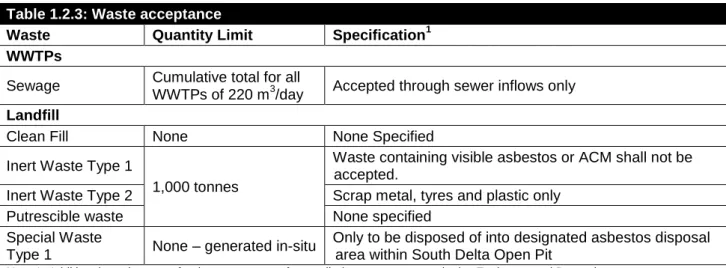
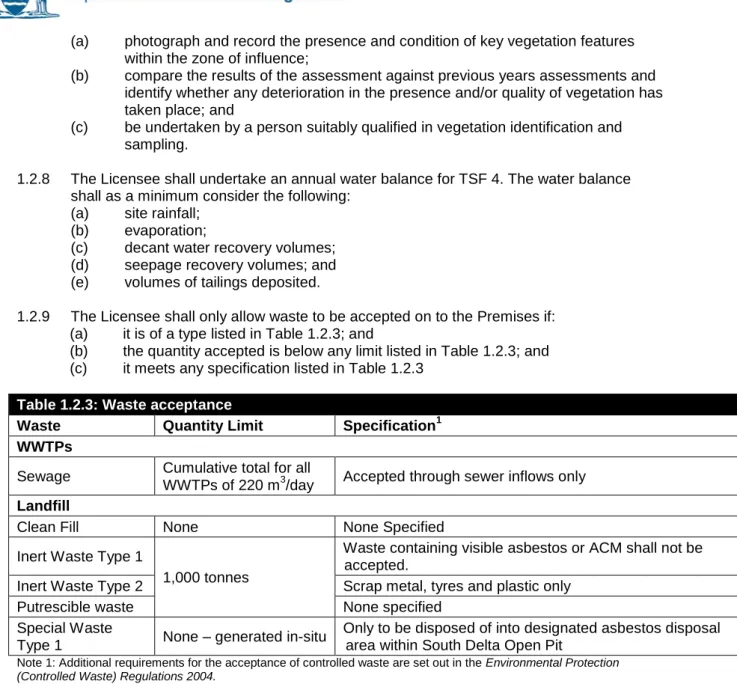
1.2.9 The Licensee shall only allow waste to be accepted on to the Premises if:
(a) it is of a type listed in Table 1.2.3; and
(b) the quantity accepted is below any limit listed in Table 1.2.3; and (c) it meets any specification listed in Table 1.2.3
Table 1.2.3: Waste acceptance
Waste Quantity Limit Specification1 WWTPs
Sewage Cumulative total for all
WWTPs of 220 m3/day Accepted through sewer inflows only Landfill
Clean Fill None None Specified
Inert Waste Type 1
1,000 tonnes
Waste containing visible asbestos or ACM shall not be accepted.
Inert Waste Type 2 Scrap metal, tyres and plastic only
Putrescible waste None specified
Special Waste
Type 1 None – generated in-situ Only to be disposed of into designated asbestos disposal area within South Delta Open Pit
Note 1: Additional requirements for the acceptance of controlled waste are set out in the Environmental Protection (Controlled Waste) Regulations 2004.
1.2.10 The Licensee shall ensure that where waste does not meet the waste acceptance criteria set out in condition 1.2.9 it is removed from the Premises by the delivery vehicle or, where that is not possible, the Licensee shall contact the CEO to agree a course of action in relation to the waste.
1.2.11 The Licensee shall ensure that the wastes accepted onto the Premises are only subjected to the process(es) set out in Table 1.2.4 and in accordance with any process
requirements described in that table.
Table 1.2.4: Waste processing
Waste type Process Process requirements Sewage
Physical, biological
and chemical treatment Treatment of sewage waste shall not exceed 200 m3/day cumulative volume.
Sewage
sludge Disposal Removed by a licensed controlled waste carrier All Disposal of waste by
landfilling
The separation distance between the base of the landfill and the highest groundwater level shall not be less than 2m.
Clean Fill
Receipt, handling and storage prior to disposal
Stockpile clean fill to allow for the covering of waste for at least two weeks.
Inert Waste
Type 1 Placed into landfill trenches
Inert Waste
Type 2 Tyres to be incorporated into waste rock material.
Putrescibles
waste Disposal Covered with a minimum of 200 mm clean fill at least weekly.
Hazardous waste
Receipt, handling and storage prior to disposal
Must be stored in a bunded area/container prior to disposal offsite.
Special Waste
Type 1 Disposal Asbestos or ACM is covered with a layer of dense, inert and incombustible material at least 1 metre thick.
1.2.12 The Licensee shall manage the landfilling activities to ensure:
(a) the size of the tipping face is kept to a minimum and not larger than 30 m by 30 m;
(b) waste is levelled and compacted to ensure all faces are stable and capable of retaining rehabilitation material;
(c) waste is covered as soon as possible after it is discharged and not later than by the end of the working day; and
(d) rehabilitation of a cell or phase takes place within 6 months after disposal in that cell or phase has been completed.
1.2.13 The Licensee shall take all reasonable and practical measures to ensure that no
windblown waste escapes from the Premises and that windblown waste is collected on at least a weekly basis and appropriately contained.
1.2.14 The Licensee shall ensure that no waste is burnt on the Premises.
1.2.15 The Licensee shall manage the irrigation of treated wastewater such that:
(a) treated wastewater is evenly distributed over the irrigation area;
(b) no soil erosion occurs;
(c) irrigation does not occur on land that is waterlogged; and (d) vegetation cover is maintained over the irrigation area.
1.2.16 The Licensee shall manage the wastewater treatment vessels such that there is no discernible seepage loss from the vessels.
1.2.17 The Licensee shall construct and/or relocate dewatering infrastructure within the licenced premises as operational demands require in accordance with conditions of this Licence.
2 Emissions
2.1 General
2.1.1 The Licensee shall record and investigate the exceedance of any descriptive or numerical limit specified in any part of section 2 of this Licence.
2.2 Point source emissions to air
2.2.1 The Licensee shall ensure that where waste is emitted to air from the emission points in Table 2.2.1 and identified on the map of emission points in Schedule 1 it is done so in accordance with the conditions of this Licence.
Table 2.2.1: Emission points to air Emission point
reference and location on Map of emission points
Emission Point Emission point height (m)
Source, including any abatement
A1 Stack 1 2.69 Carbon regeneration stack
A2 Stack 2 13.28 Gold smelting furnace stack
2.3 Point source emissions to surface water
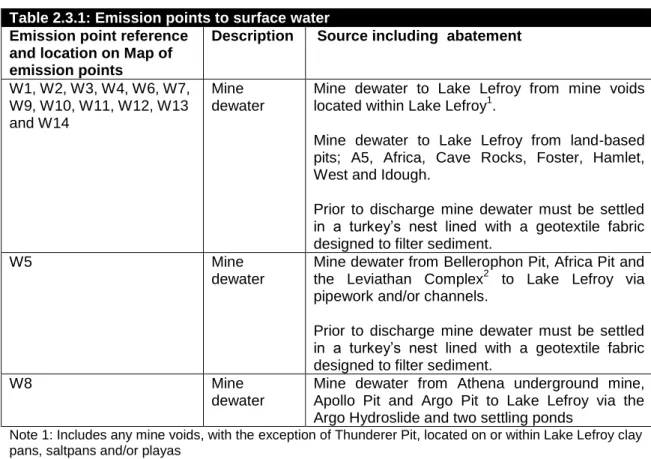
2.3.1 The Licensee is permitted, subject to conditions in the Licence, to emit wastes to water from the emissions points listed in Table 2.3.1 and identified in the Map of emission points in Schedule 1.
Table 2.3.1: Emission points to surface water Emission point reference
and location on Map of emission points
Description Source including abatement
W1, W2, W3, W4, W6, W7, W9, W10, W11, W12, W13 and W14
Mine dewater
Mine dewater to Lake Lefroy from mine voids located within Lake Lefroy1.
Mine dewater to Lake Lefroy from land-based pits; A5, Africa, Cave Rocks, Foster, Hamlet, West and Idough.
Prior to discharge mine dewater must be settled in a turkey’s nest lined with a geotextile fabric designed to filter sediment.
W5 Mine
dewater
Mine dewater from Bellerophon Pit, Africa Pit and the Leviathan Complex2 to Lake Lefroy via pipework and/or channels.
Prior to discharge mine dewater must be settled in a turkey’s nest lined with a geotextile fabric designed to filter sediment.
W8 Mine
dewater
Mine dewater from Athena underground mine, Apollo Pit and Argo Pit to Lake Lefroy via the Argo Hydroslide and two settling ponds
Note 1: Includes any mine voids, with the exception of Thunderer Pit, located on or within Lake Lefroy clay pans, saltpans and/or playas
Note 2: The Leviathan Complex consists of Leviathan Pit, Paddys Pit, Sirius Pit, Sirius/Orion Pit, Britannia Pit and Britannia Footwall Pit
2.3.2 The Licensee must cease the dewatering of Bellerophon Pit to Lake Lefroy upon the receipt of decant water from Thunderer Pit.
2.3.3 The Licensee shall not cause or allow point source emissions to surface water that do not meet the limits listed in Table 2.3.2.
Table 2.3.2: Point source emission limits to surface water Emission point
reference
Parameter Limit
(including units)
Averaging period W1, W2, W3, W4, W5, W6,
W7, W8, W9, W10 W11, W12, W13 and W14
pH1 Between 6.0 and
8.0
N/A
2.4 Point source emissions to groundwater
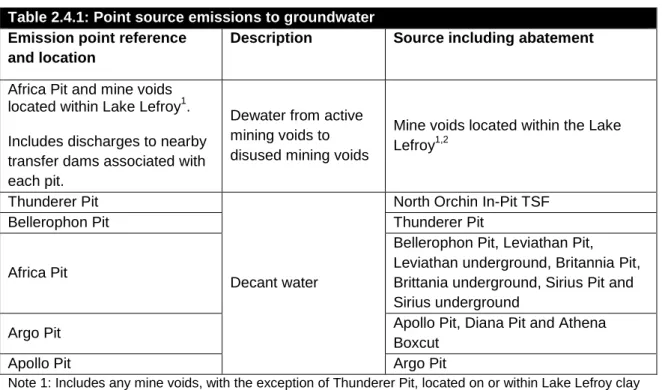
2.4.1 The Licensee shall ensure that where waste is emitted to groundwater from the emission points in Table 2.4.1 and identified on the map of emission points in Schedule 1 it is done so in accordance with the conditions of this Licence.
Table 2.4.1: Point source emissions to groundwater Emission point reference
and location
Description Source including abatement
Africa Pit and mine voids located within Lake Lefroy1. Includes discharges to nearby transfer dams associated with each pit.
Dewater from active mining voids to disused mining voids
Mine voids located within the Lake Lefroy1,2
Thunderer Pit
Decant water
North Orchin In-Pit TSF
Bellerophon Pit Thunderer Pit
Africa Pit
Bellerophon Pit, Leviathan Pit, Leviathan underground, Britannia Pit, Brittania underground, Sirius Pit and Sirius underground
Argo Pit Apollo Pit, Diana Pit and Athena
Boxcut
Apollo Pit Argo Pit
Note 1: Includes any mine voids, with the exception of Thunderer Pit, located on or within Lake Lefroy clay pans, saltpans and/or playas
Note 2: Dewatering of Bellerophon Pit to Lake Lefroy must cease after the receipt of decant water from Thunderer Pit.
2.5 Emissions to land
2.5.1 The Licensee shall ensure that where waste is emitted to land from the emission points in Table 2.5.1 and identified on the map of emission points in Schedule 1 it is done so in accordance with the conditions of this Licence.
Table 2.5.1: Emissions to land Emission point
reference and location on Map of emission points
Description Source including abatement
P1, P2, P3, P4 and P5 Discharge from irrigation pump station to on-site irrigation areas
Treated wastewater from Cave Rocks, Lefroy Admin, Leviathan, Argo and Athena Paste Sewage Treatment Plants.
2.6 Fugitive emissions
2.6.1 The Licensee shall ensure that fugitive emissions are managed in accordance with the documents, or parts of documents, specified in Table 2.6.1.
Table 2.6.1: Dust Management Plan Management Plan
Reference
Parts Date of
Document St Ives Gold Mine Dust
Environmental Procedure (SIG-ENV-PR029
Section 3 01/06/2005
3 Monitoring
3.1 General monitoring
3.1.1 The licensee shall ensure that:
(a) all water samples are collected and preserved in accordance with AS/NZS 5667.1;
(b) all wastewater sampling is conducted in accordance with AS/NZS 5667.10;
(c) all surface water sampling is conducted in accordance with AS/NZS 5667.4, AS/NZS 5667.6 or AS/NZS 5667.9 as relevant;
(d) all groundwater sampling is conducted in accordance with AS/NZS 5667.11;
(e) all sediment sampling is conducted in accordance with AS/NZS 5667.12;
(f) all microbiological samples are collected and preserved in accordance with AS/NZS 2031; and
(g) all laboratory samples are submitted to and tested by a laboratory with current NATA accreditation for the parameters being measured unless indicated otherwise in the relevant table.
3.1.2 The Licensee shall ensure that :
(a) monthly monitoring is undertaken at least 15 days apart;
(b) quarterly monitoring is undertaken at least 45 days apart;
(c) six monthly monitoring is undertaken at least 5 months apart; and (d) annual monitoring is undertaken at least 9 months apart.
3.1.3 The Licensee shall, where the requirements for calibration cannot be practicably met, or a discrepancy exists in the interpretation of the requirements, bring these issues to the attention of the CEO accompanied with a report comprising details of any modifications to the methods.
3.2 Monitoring of point source emissions to surface water
3.2.1 The Licensee shall undertake the monitoring in Table 3.2.1 according to the specifications in that table and record and investigate results that do not meet any limit specified.
Table 3.2.1: Monitoring of point source emissions to surface water Emission point reference Parameter Units Averaging
Period
Frequency
W1, W2, W3, W4, W5, W6, W7, W8, W9, W10, W11, W12, W13 and W14
Volumetric flow rate (cumulative)
L/s
m3/day Monthly Continuous
pH1 N/A Spot sample Quarterly
Note 1: In-field non-NATA accredited analysis permitted.
3.3 Monitoring of emissions to land
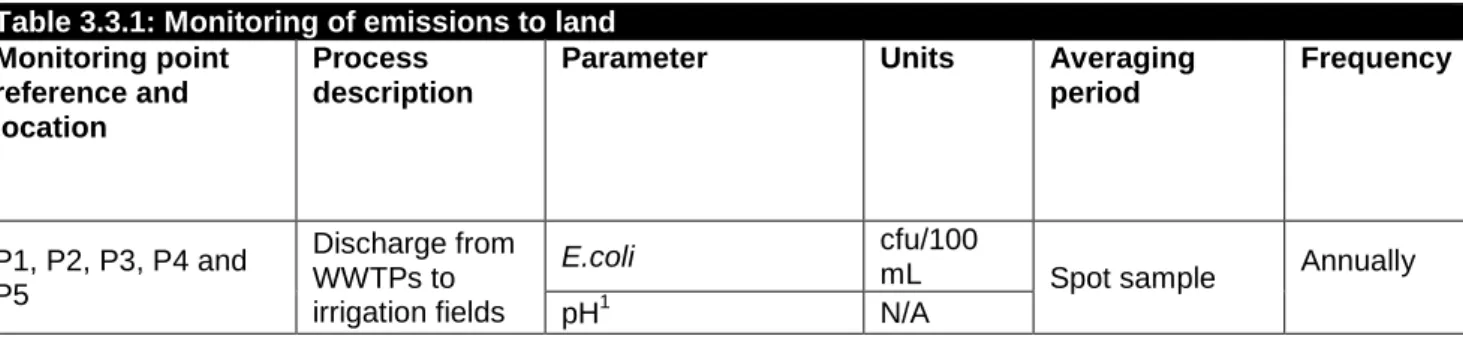
3.3.1 The Licensee shall undertake the monitoring in Table 3.3.1 according to the specifications in that table.
Table 3.3.1: Monitoring of emissions to land Monitoring point
reference and location
Process description
Parameter Units Averaging
period
Frequency
P1, P2, P3, P4 and P5
Discharge from WWTPs to irrigation fields
E.coli cfu/100
mL Spot sample Annually
pH1 N/A
Biochemical Oxygen Demand
mg/L Total Nitrogen
Total Phosphorus Total Suspended Solids
Total Dissolved Solids
Ammonium-nitrogen Nitrate+nitrate- nitrogen Note 1: In-field non-NATA accredited analysis permitted.
3.4 Monitoring of inputs and outputs
3.4.1 The Licensee shall undertake the monitoring in Table 3.4.1 according to the specifications in that table.
Table 3.4.1: Monitoring of inputs and outputs Input/Output Monitoring
point reference
Parameter Units Averaging period
Frequency Sewage - Inlet
Flow
Inflow meter at P1, P2, P3, P4 and P5
Volumetric flow rate (cumulative)
m3/day Monthly Continuous
Waste Inputs N/A Inert Waste
Type 1, Inert Waste Type 2
m3 (where no
weighbridge is present)
Annual Each load arriving at the Premises
Waste Outputs N/A Waste type
as defined in the Landfill Definitions
Each load leaving or rejected from the Premises 3.5 Ambient environmental quality monitoring
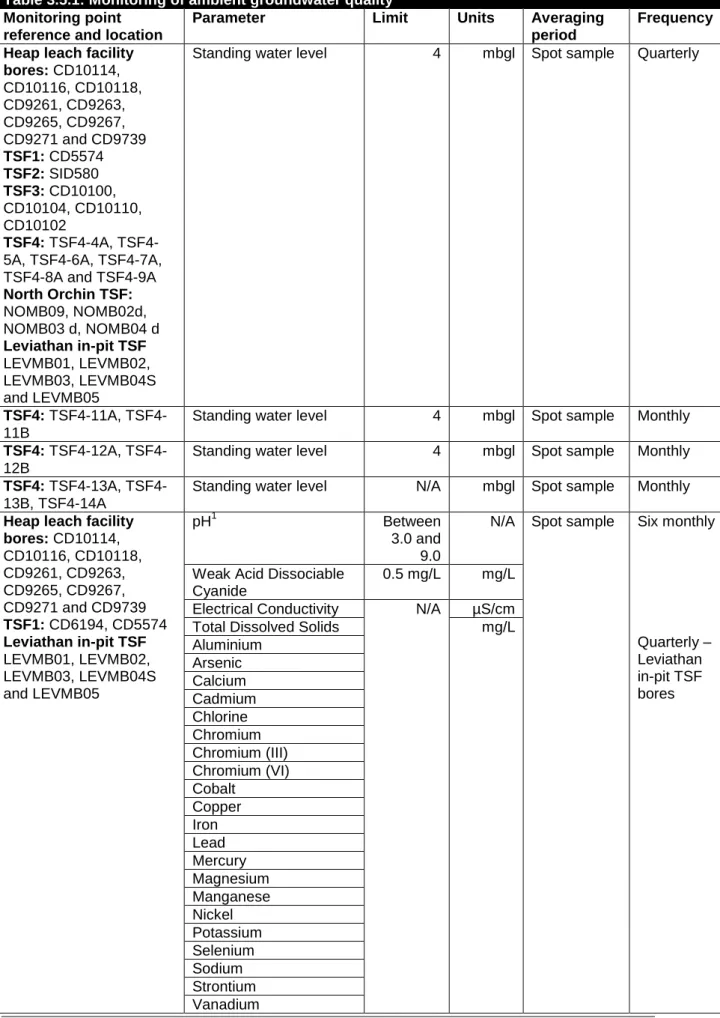
3.5.1 The Licensee shall undertake the monitoring in Tables 3.5.1 and 3.5.2 according to the specifications in those tables and record and investigate results that do not meet any limit specified.
Table 3.5.1: Monitoring of ambient groundwater quality Monitoring point
reference and location
Parameter Limit Units Averaging
period
Frequency Heap leach facility
bores: CD10114, CD10116, CD10118, CD9261, CD9263, CD9265, CD9267, CD9271 and CD9739 TSF1: CD5574 TSF2: SID580 TSF3: CD10100, CD10104, CD10110, CD10102
TSF4: TSF4-4A, TSF4- 5A, TSF4-6A, TSF4-7A, TSF4-8A and TSF4-9A North Orchin TSF:
NOMB09, NOMB02d, NOMB03 d, NOMB04 d Leviathan in-pit TSF LEVMB01, LEVMB02, LEVMB03, LEVMB04S and LEVMB05
Standing water level 4 mbgl Spot sample Quarterly
TSF4: TSF4-11A, TSF4- 11B
Standing water level 4 mbgl Spot sample Monthly TSF4: TSF4-12A, TSF4-
12B
Standing water level 4 mbgl Spot sample Monthly TSF4: TSF4-13A, TSF4-
13B, TSF4-14A
Standing water level N/A mbgl Spot sample Monthly Heap leach facility
bores: CD10114, CD10116, CD10118, CD9261, CD9263, CD9265, CD9267, CD9271 and CD9739 TSF1: CD6194, CD5574 Leviathan in-pit TSF LEVMB01, LEVMB02, LEVMB03, LEVMB04S and LEVMB05
pH1 Between
3.0 and 9.0
N/A Spot sample Six monthly
Quarterly – Leviathan in-pit TSF bores Weak Acid Dissociable
Cyanide
0.5 mg/L mg/L Electrical Conductivity N/A µS/cm
Total Dissolved Solids mg/L
Aluminium Arsenic Calcium Cadmium Chlorine Chromium Chromium (III) Chromium (VI) Cobalt
Copper Iron Lead Mercury Magnesium Manganese Nickel Potassium Selenium Sodium Strontium Vanadium
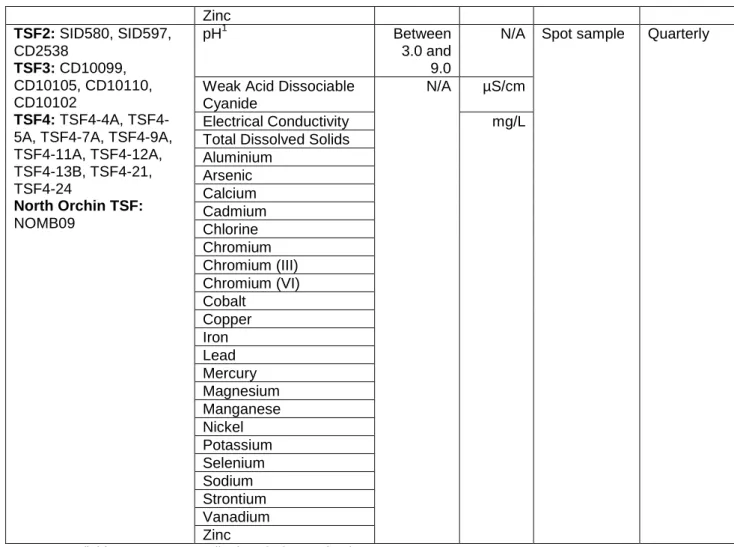
Zinc TSF2: SID580, SID597,
CD2538
TSF3: CD10099, CD10105, CD10110, CD10102
TSF4: TSF4-4A, TSF4- 5A, TSF4-7A, TSF4-9A, TSF4-11A, TSF4-12A, TSF4-13B, TSF4-21, TSF4-24
North Orchin TSF:
NOMB09
pH1 Between
3.0 and 9.0
N/A Spot sample Quarterly
Weak Acid Dissociable Cyanide
N/A µS/cm
Electrical Conductivity mg/L
Total Dissolved Solids Aluminium
Arsenic Calcium Cadmium Chlorine Chromium Chromium (III) Chromium (VI) Cobalt
Copper Iron Lead Mercury Magnesium Manganese Nickel Potassium Selenium Sodium Strontium Vanadium Zinc
Note 1: In-field non-NATA accredited analysis permitted.
Table 3.5.2: Monitoring of ambient sediment quality Monitoring point
reference and location
Parameter Units Averaging
Period
Frequency
W1, W2, W3, W4, W5, W6, W7, W8, W9, W10, W11, W12, W13 and W14
pH1 N/A
Spot sample Annually in the same month Aluminium
mg/L Arsenic
Beryllium Cadmium Copper Chromium Cobalt Iron Lead Mercury Manganese Nickel Selenium Vanadium Zinc
Note 1: In-field non-NATA accredited analysis permitted.
4 Information
4.1 Records
4.1.1 All information and records required by the Licence shall:
(a) be legible;
(b) if amended, be amended in such a way that the original and subsequent amendments remain legible or are capable of retrieval;
(c) except for records listed in 5.1.1(d) be retained for at least 6 years from the date the records were made or until the expiry of the Licence or any subsequent licence; and
(d) for those following records, be retained until the expiry of the Licence and any subsequent licence:
(i) off-site environmental effects; or
(ii) matters which affect the condition of the land or waters.
4.1.2 The Licensee shall ensure that:
(a) any person left in charge of the Premises is aware of the conditions of the Licence and has access at all times to the Licence or copies thereof; and (b) any person who performs tasks on the Premises is informed of all of the
conditions of the Licence that relate to the tasks which that person is performing.
4.1.3 The Licensee must submit to the CEO within 90 days after the Anniversary Date, an Annual Audit Compliance Report indicating the extent to which the Licensee has complied with the Conditions in this Licence for the Annual Period.
4.1.4 The Licensee shall implement a complaints management system that as a minimum records the number and details of complaints received concerning the environmental impact of the activities undertaken at the Premises and any action taken in response to the complaint.
4.2 Reporting
4.2.1 The Licensee shall submit to the CEO an Annual Environmental Report within 90
calendar days after the end of the annual period. The report shall contain the information listed in Table 4.2.1 in the format or form specified in that table.
Table 4.2.1: Annual Environmental Report Condition or table
(if relevant)
Parameter Format or form1
- Summary of any failure or malfunction of any pollution control equipment and any environmental incidents that have occurred during the annual period and any action taken
None specified
4.1.4 Complaints summary None specified
1.2.7 Borefield pipeline log of seepage, spills or leaks 1.2.8 Annual vegetation monitoring around TSF4 1.2.9 Annual water balance for TSF4
2.6.1 Measures taken to suppress dust
Table 3.2.1 Monitoring of point source emissions to surface waters WR1
Table 3.3.1 Monitoring of emissions to land LR1
Contaminant loading (total annual loading kg/yr and kg/ha/yr) to land of parameters monitored in Table 3.3.1 (except pH and E.coli)
None specified
Table 3.4.1 Monitoring of inputs and outputs None specified Table 3.5.1 Monitoring of ambient groundwater quality AGWQ1 Table 3.5.2 Monitoring of ambient sediment quality None specified
Note 1: Forms are in Schedule 2
4.2.1 The Licensee shall ensure that the Annual Environmental Report also contains:
(a) an assessment of the information contained within the report against previous monitoring results and Licence limits; and
(b) a Dewatering Discharge Report.
4.2.2 The Dewatering Discharge Report required by condition 4.2.2 (b) shall address the environmental effects of mine dewater discharge to the Lake Lefroy environment and include but not limited to:
(a) cumulative discharge volumes;
(b) a map depicting dewater source locations and discharge points to Lake Lefroy; and (c) methods/infrastructure used to prevent environmental impacts at each discharge
location 4.3 Notification
4.3.1 The Licensee shall ensure that the parameters listed in Table 5.3.1 are notified to the CEO in accordance with the notification requirements of the table.
Table 5.3.1: Notification requirements Condition
or table (if relevant)
Parameter Notification requirement1 Format or
form2 2.1.1 Breach of any limit specified in
the Licence
Part A: As soon as practicable but no later than 5pm of the next usual working day.
Part B: As soon as practicable
N1
3.1.5 Calibration report As soon as practicable. None
specified Note 1: Notification requirements in the Licence shall not negate the requirement to comply with s72 of the
Act
Note 2: Forms are in Schedule 2
4.3.2 The Licencee shall submit a compliance document to the CEO, following the construction of each of Stage 1, Stage 2, Stage 3 and Stage 4 of the works and prior to commissioning of the same.
4.3.3 The compliance document shall:
(a) certify that the works were constructed in accordance with the conditions of the Licence;
(b) be signed by a person authorised to represent the Licensee and contain the printed name and position of that person within the company.
Schedule 1: Maps
Premises map
The Premises is shown in the map below. The blue line depicts the Premises boundary.
Premises tenement list
The Premises boundary is defined by the tenements listed in the table below:
St Ives Gold Mining Pty Ltd
L15/214 M15/1544 M15/1579 M15/1629 M15/1695
M15/300 M15/1546 M15/1580 M15/1630 M15/1698
M15/476 M15/1549 M15/1581 M15/1631 M15/1699
M15/1226 M15/1550 M15/1590 M15/1632 M15/1702
M15/1495 M15/1556 M15/1591 M15/1633 M15/1703
M15/1496 M15/1559 M15/1593 M15/1634 M15/1802
M15/1503 M15/1560 M15/1594 M15/1657
M15/1509 M15/1561 M15/1607 M15/1658
M15/1513 M15/1562 M15/1608 M15/1659
M15/1516 M15/1564 M15/1610 M15/1664
M15/1517 M15/1565 M15/1611 M15/1668
M15/1518 M15/1566 M15/1612 M15/1669
M15/1527 M15/1567 M15/1614 M15/1670
M15/1531 M15/1568 M15/1615 M15/1673
M15/1532 M15/1570 M15/1618 M15/1675
M15/1537 M15/1572 M15/1619 M15/1687
M15/1540 M15/1573 M15/1622 M15/1690
M15/1541 M15/1575 M15/1623 M15/1692
M15/1542 M15/1576 M15/1627 M15/1693
M15/1543 M15/1578 M15/1628 M15/1694
Map of emission and monitoring points
The locations of the emission points defined in Table 2.2.1 are shown below.
A1
A2
The locations of the emission points defined in Tables 2.3.1, 2.3.2 and 2.4.1 are shown below.
These locations also indicate the monitoring points defined in Table 3.5.2.
W1
W8
W7 W6
W4 W5
W3 W2
W10 W11 W9
W13
W12
A5
W14
Foster
The locations of the emission points defined in Tables 1.2.4, 2.5.1 and 3.4.1 are shown below.
P1
P4 P5 P3 P2
Map of monitoring locations
The locations of the monitoring points defined in Tables 3.5.1 are shown below. Dual monitoring and recovery bores TSF4-21 and TSF4-24 shown below are also defined in Table 1.2.1
Map of recovery bores
The locations of the seepage recovery bores defined in Table 1.2.1 are shown below.
Map of monitoring locations
The locations of the monitoring points defined in Tables 3.5.1 are shown below.
Map of storage locations
The location of the storage areas defined in Table 1.2.1 is shown below.
C6
C3
C4
C1
C5 C2
C7, C8 and C9
C10
C11 C12
C13 C14
Schedule 2: Reporting and notification forms
These forms are provided for the proponent to report monitoring and other data required by the Licence. They can be requested in an electronic format.
The Annual Audit Compliance Report template is available on the Department’s website.
Licence: L8485/2010/2 Licensee: St Ives Gold Mining Company Pty Ltd
Form: WR1 Period:
Name: Monitoring of point source emissions to surface water Form WR1: Monitoring of point source emissions to surface water
Emission point Parameter Limit Result1 Averaging
Periods Method Sample date & times W1, W2, W3, W4,
W5, W6, W7, W8, W9, W10 and W11
Volumetric flow
rate N/A m3/s Spot sample
pH Between 6.0
and 8.0 Spot sample
Signed on behalf of St Ives Gold Mining Company Pty Ltd: ………..
Date: ……….
Licence: L8485/2010/2 Licensee: St Ives Gold Mining Company Pty Ltd
Form: LR1 Period:
Name: Monitoring of emissions to land Form LR1: Monitoring of emissions to land
Emission
point Parameter Result Load
(kg/d)
Averaging
Periods Method Sample date & times
P1 to P5
Volumetric flow rate kL Continuous
E.coli cfu/100mL Spot sample
pH1 N/A Spot sample
Biochemical Oxygen
Demand mg/L kg/d Spot sample
Total Nitrogen mg/L kg/d Spot sample Total Phosphorus mg/L kg/d Spot sample
Total Suspended
Solids mg/L kg/d Spot sample
Total Dissolved
Solids mg/L kg/d Spot sample
Ammonium-nitrogen mg/L kg/d Spot sample Nitrate+nitrate-
nitrogen
mg/L
kg/d Spot sample
Signed on behalf of St Ives Gold Mining Company Pty Ltd: ………..
Date: ……….
Licence: L8485/2010/2 Licensee: St Ives Gold Mining Company Pty Ltd
Form: AGWQ Period :
Name: Ambient groundwater quality monitoring Form AGQW1: Monitoring of ambient groundwater quality Monitoring
point
Parameter Limit Result Result Averaging period
Method Sample date & times
Standing water level mbgl
pH1 N/A
Electrical
Conductivity µS/cm
Total Dissolved
Solids mg/L
Aluminium mg/L
Arsenic mg/L
Calcium mg/L
Cadmium mg/L
Chlorine mg/L
Chromium mg/L
Chromium (III) mg/L
Chromium (VI) mg/L
Cobalt mg/L
Copper mg/L
Iron mg/L
Lead mg/L
Mercury mg/L
Magnesium mg/L
Manganese mg/L
Nickel mg/L
Potassium mg/L
Selenium mg/L
Sodium mg/L
Strontium mg/L
Vanadium mg/L
Signed on behalf of St Ives Gold Mining Company Pty Ltd: ………..
Date: ……….
Licence: L8485/2010/2 Licensee: St Ives Gold Mining Company Pty Ltd
Form: N1 Date of breach:
Notification of detection of the breach of a limit.
These pages outline the information that the operator must provide.
Units of measurement used in information supplied under Part A and B requirements shall be appropriate to the circumstances of the emission. Where appropriate, a comparison should be made of actual emissions and authorised emission limits.
Part A
Licence Number Name of operator Location of Premises
Time and date of the detection
Notification requirements for the breach of a limit Emission point reference/ source
Parameter(s) Limit
Measured value
Date and time of monitoring Measures taken, or intended to be taken, to stop the emission
Part B
Any more accurate information on the matters for notification under Part A.
Measures taken, or intended to be taken, to prevent a recurrence of the incident.
Measures taken, or intended to be taken, to rectify, limit or prevent any pollution of the environment which has been or may be caused by the emission.
The dates of any previous N1 notifications for the Premises in the preceding 24 months.
Name Post
Signature on behalf of
St Ives Gold Mining Company Pty Ltd Date
Decision Document
Environmental Protection Act 1986, Part V
Proponent: St Ives Gold Mining Company Pty Ltd Licence: L8485/2010/2
Registered office: Level 5, 50 Colin Street WEST PERTH WA 6005
ACN: 098 386 273
Premises address: St Ives Gold Mine
Mining tenements as described in Schedule 1 KAMBALDA WA 6442
Issue date: Thursday, 3 October 2013 Commencement date: Monday, 7 October 2013 Expiry date: Wednesday, 6 October 2021
Decision
Based on the assessment detailed in this document the Department of Environment Regulation (DER), has decided to issue an amended licence. DER considers that in reaching this decision, it has taken into account all relevant considerations and legal requirements and that the Licence and its conditions will ensure that an appropriate level of environmental protection is provided.
Decision Document prepared by: Fiona Sharpe Licensing Officer
Decision Document authorised by: Tim Gentle Delegated Officer
Contents
Decision Document 1
Contents 2
1 Purpose of this Document 2
2 Administrative summary 2
3 Executive summary of proposal and assessment 3
4 Decision table 5
5 Advertisement and consultation table 10
6 Risk Assessment 11
Appendix A 12
Appendix B 14
1 Purpose of this Document
This decision document explains how DER has assessed and determined the application and provides a record of DER’s decision-making process and how relevant factors have been taken into account. Stakeholders should note that this document is limited to DER’s assessment and decision making under Part V of the Environmental Protection Act 1986. Other approvals may be required for the proposal, and it is the proponent’s responsibility to ensure they have all relevant approvals for their Premises.
2 Administrative summary
Administrative details
Application type
Works Approval New Licence Licence amendment
Works Approval amendment
Activities that cause the premises to become prescribed premises
Category number(s) Assessed design capacity
5 9,000,000 tonnes per
annual period
6 30,000,000 tonnes per
annual period
7 3,000,000 tonnes per
annual period
54 220 cubic metres per day
64 1,000 tonnes per annual
period Application verified
Application fee paid
Date: 16 August 2016 Date: 5 October 2016 Works Approval has been complied with
Compliance Certificate received
Yes No N/A
Yes No N/A
Commercial-in-confidence claim Yes No
Commercial-in-confidence claim outcome
Is the proposal a Major Resource Project? Yes No Was the proposal referred to the Environmental
Protection Authority (EPA) under Part IV of the Environmental Protection Act 1986?
Yes No
Referral decision No:
Managed under Part V Assessed under Part IV
Is the proposal subject to Ministerial Conditions? Yes No
Ministerial statement No: 879 EPA Report No: 1493
Does the proposal involve a discharge of waste into a designated area (as defined in section 57 of the Environmental Protection Act 1986)?
Yes No
Department of Water consulted Yes No Is the Premises within an Environmental Protection Policy (EPP) Area Yes No
If Yes include details of which EPP(s) here.
Is the Premises subject to any EPP requirements? Yes No
If Yes, include details here, eg Site is subject to SO2 requirements of Kwinana EPP.
3 Executive summary of proposal and assessment
The St Ives Gold Mine (SIGM) is located approximately 8 km south of Kambalda and operated by St Ives Gold Mining Company Pty Ltd (St Ives). Mining operations on Lake Lefroy are licenced under L8485/2010/2 and approved under Ministerial Statement 879. SIGM ore is currently mined from both underground mines and open pits with surface stockpiles processed via both mill/Carbon-In-Pulp (CIP) and heap leach plants.
Groundwater in the area is in the range of 50,000 to 300,000 mg/L total dissolved salts (TDS) with groundwater quality in the vicinity of Lake Lefroy ranging between 274,000 to 423,000 mg/L TDS and metal levels reflective of the mineralogy in the region. Mining operations are both land and lake based, where the latter operations are based on Lake Lefroy, a salt lake covering an area of 544 km2. Playa lakes such as Lake Lefroy are prominent within the Salinaland Division and occur as dendritic and partly interconnected chains that outline fossil drainage systems (Dames & Moore 1999).
W5858/2015/1 was issued in September 2015 for the development of Leviathan complex as a tailings storage facility (TSF) for the Lefroy Mill. The Leviathan complex consists of the current open-cut pits Leviathan, Paddy’s, Britannia, Sirius and Britannia Footwall. The currently active TSF, TSF4, has shown signs of seepage with rising groundwater exceeding trigger levels on the Licence. The high salinity of rising groundwater around the facility presents a risk to surrounding native vegetation should groundwater intercept the root zone. It is estimated that Leviathan has 36,500,000 m3 of capacity which would accommodate 10 years of tailings disposal and reduce the risk to vegetation.
The Project includes the following aspects:
Construction of new monitoring bores around the Leviathan complex.
Installation and commissioning of piping and pumping system for discharging tailings from the Lefroy Mill to the Leviathan complex.
Installation and commissioning of piping and pumping system for recovering tailings supernatant (return water) from the Leviathan complex to mill process water tanks or mill return dams.
An amendment application to include the Leviathan in-pit TSF within the licence was submitted to DER in July 2016 with the compliance certificate for works approval W5858/2015/1 submitted to DER on 29 September 2016.
Before the final amendment for the Leviathan in-pit TSF was issued, SIGM submitted a second application for an amendment to dispose of some asbestos containing material (ACM) within the South Delta Open Pit. The two amendment applications have been combined in the current licence amendment.
4 Decision table
All applications are assessed in line with the Environmental Protection Act 1986, the Environmental Protection Regulations 1987 and DER’s Operational Procedure on Assessing Emissions and Discharges from Prescribed Premises. Where other references have been used in making the decision they are detailed in the decision document.
DECISION TABLE
Licence section Condition number
W = works approval L= licence
Justification (including risk description & decision methodology where relevant)
Reference documents
Premises operation
L1.2.1, 1.2.3 – 1.2.6
L1.2.9
Operation
Premises operation conditions on the existing Licence will be retained to manage tailings delivery pipelines, return pipelines and discharges to the TSF. Regular inspections, bunding and telemetry systems will ensure that any unintentional and unauthorised discharge is quickly identified to minimise impacts to the environment.
Operation
DER’s assessment and decision making are detailed in Appendix A.
Application supporting documentation
General provisions of the Environmental Protection Act 1986
Emissions general
L2.1.1 Operation
The continued recording and investigation of limit exceedances will remain a requirement of the Licence.
General provisions of the Environmental Protection Act 1986
Point source emissions to air including monitoring
N/A Operation
No point source emissions to air are anticipated during the operation of the Leviathan In-pit TSF.
General provisions of the Environmental Protection Act 1986
Point source emissions to surface water including monitoring
N/A Operation
There are no anticipated point source emissions to surface water as a result of operation of the Leviathan In-pit TSF.
Application supporting documentation
General provisions of the Environmental Protection Act 1986
DECISION TABLE
Licence section Condition number
W = works approval L= licence
Justification (including risk description & decision methodology where relevant)
Reference documents
Environmental Protection (Unauthorised Discharges Regulations, 2004).
Point source emissions to groundwater including monitoring
L2.4.1 and L3.5.1 Operation
DER’s assessment and decision making are detailed in Appendix A.
General provisions of the Environmental Protection Act 1986
Emissions to land including monitoring
L1.3.1 Operation
The disposal of tailings to an in-pit TSF is not assessed as an emission to land. See section on point source emissions to groundwater.
Emission Risk Assessment – Pipeline leak or failure Emission Description
Emission: Discharge to the land of tailings or return water from a leaking/ruptured pipeline. Tailings and return water is characterised as alkaline, hypersaline with total dissolved solids ranging between 35,000 and 80,000 mg/L and having elevated weak acid dissociable cyanide
concentrations (10 to 110 mg/L).
Impact: Elevated salt and cyanide may cause land contamination and may damage or kill native vegetation. However the area between the Lefroy Mill and Leviathan In-pit TSF is heavily disturbed with little vegetation remaining.
In addition, no known priority species or ecological communities have been identified in the vicinity of the proposed works.
Controls: Leak detection telemetry will be installed on the pipeline to trigger an alarm should a variation in flow rates by more than 5% for 10 minutes or more than 10% for two minutes be detected. In addition, St Ives proposes to construct bunding around all pipelines and regularly inspect the pipeline route for leaks.
Environmental Protection (Unauthorised Discharges Regulations, 2004).
DECISION TABLE
Licence section Condition number
W = works approval L= licence
Justification (including risk description & decision methodology where relevant)
Reference documents
Risk Assessment Consequence: Minor Likelihood: Unlikely Risk Rating: Moderate Regulatory Controls
Existing Licence conditions requiring regular inspections of pipelines and the operation of telemetry systems/bunding adequately control all pipelines transporting environmentally hazardous materials at SIGM. No further conditions are proposed for the Licence and therefore the residual risk remains unchanged.
Fugitive emissions
L2.6.1 Operation
Dust conditions have already been applied to the Licence to require St Ives to operate in accordance with the SIGM Dust Management Procedure (SIG- ENV-PR029), which is expected to adequately manage the generation of dust at SIGM.
In addition, the proponent proposes to move a quantity of asbestos-
containing materials currently stored on site and to dispose of the materials at the bottom of a disused mine pit. If not carried out correctly, moving and disposing of these materials could release asbestos fibres into the air. DER’s assessment and decision making on this matter are detailed in Appendix B.
General provisions of the Environmental Protection Act 1986
Odour N/A Operation
The deposition of tailings is not expected to generate significant odours and therefore no additional odour conditions will be added to the Licence.
General provisions of the Environmental Protection Act 1986
Noise N/A Operation
Noise is likely to be generated by increased vehicle movements and earth
Environmental Protection (Noise) Regulations 1997
DECISION TABLE
Licence section Condition number
W = works approval L= licence
Justification (including risk description & decision methodology where relevant)
Reference documents
moving. However, noise is not anticipated to interfere with the amenity of the nearest human receptor during operation as they are located approximately 14 km away. No noise conditions have been applied to the Licence.
Monitoring general
N/A Operation
General monitoring condition 3.1.1 will remain on the Licence to ensure that all samples are collected in accordance to the relevant Australian Standards and are submitted to a laboratory with NATA accreditation.
N/A
Monitoring of inputs and outputs
N/A Operation
No input or output monitoring will be included on the Licence as a result of the Leviathan In-pit TSF.
N/A
Process monitoring
N/A Operation
There are no specified conditions relating to process monitoring.
N/A Ambient quality
monitoring
L3.5.1 Operation
Local groundwater contains elevated levels of TDS in the range of 150,000 to 250,000 mg/L. It is anticipated that the operation of the Leviathan In-pit TSF will result in some seepage. Although groundwater uses are limited as a result of high salinities, groundwater mounding has the potential to result in vegetation death in the event that mounding intercepts the root zone.
Therefore groundwater monitoring conditions (including standing water level limits and notification requirements) will be applied to the five proposed monitoring bores situated around the Leviathan In-pit TSF.
Australian Standard AS/NZS 5667.1 – Water Quality Sampling – Guidance on the Design of sampling, programs, sampling techniques and the preservation and handling of sample.
Meteorological monitoring
N/A Operation
There are no meteorological monitoring requirements under this Licence.
N/A Improvements N/A No improvements are required for the Licence in relation to the Leviathan In-
pit TSF.
N/A Information L5.3.2 Table 5.2.3 will be updated to include the Leviathan In-pit TSF monitoring
bores, requiring the notification of standing water levels rising above the limit of 6 metres below ground level.
N/A
DECISION TABLE
Licence section Condition number
W = works approval L= licence
Justification (including risk description & decision methodology where relevant)
Reference documents
Works Approval Duration
N/A The licence is valid until 6 October 2021. This has not been re-assessed during this amendment.
N/A