Introduction
Rationale
The key ideas about making and responding identified in the Australian Curriculum P–10: Art are continued in senior school curricula across the Arts subject area. Prior experience in any or all arts subjects will enable students to understand creation and response as learning and assessment in film, television and new media. Through making, students “learn and apply knowledge, skills, techniques, processes, materials and technologies to explore artistic practices and create works of art that communicate ideas and purposes” (Australian Curriculum 2017).
Film, Television and New Media is a general subject suitable for students interested in pathways out of school leading to tertiary studies, vocational training or work. A study course in Film, Television & New Media can provide a basis for further training and. The processes and practices of Film, Television and New Media, such as project-based learning and creative problem-solving, develop transferable 21st-century skills that are highly valued in many areas of employment.
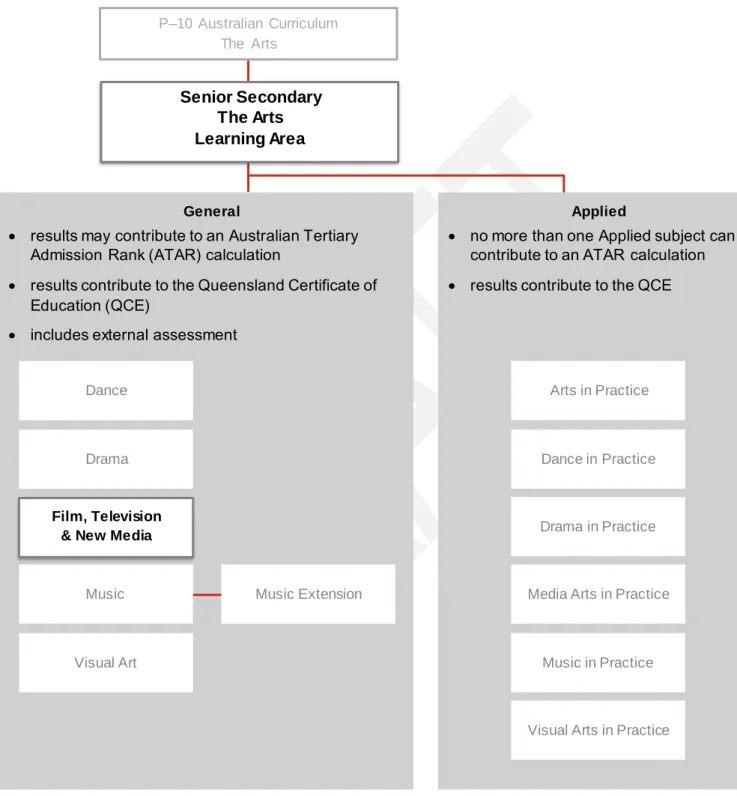
Learning area structure
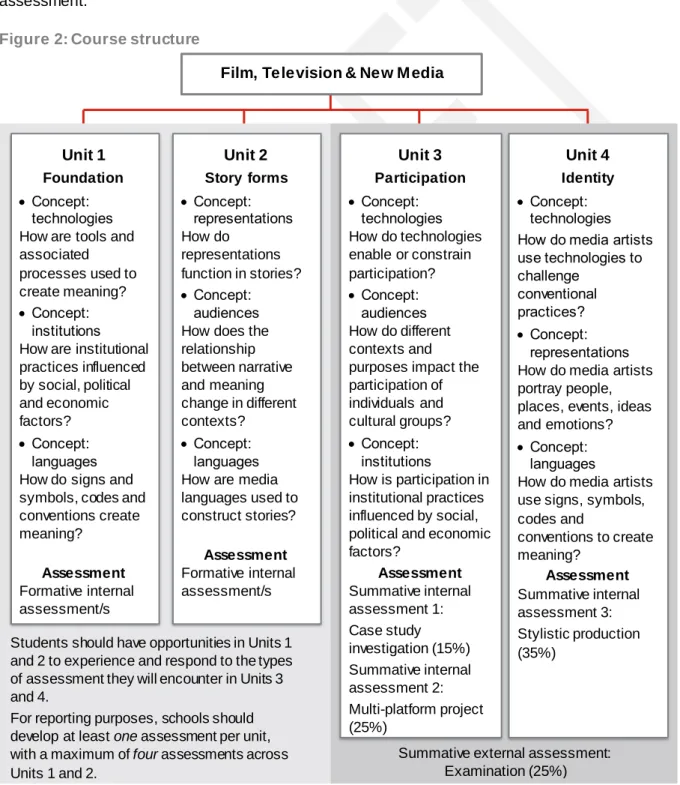
Course structure
Teaching and learning
- Syllabus objectives
- Underpinning factors
- Aboriginal perspectives and Torres Strait Islander perspectives
- Pedagogical and conceptual frameworks
- Subject matter
When students describe, they demonstrate knowledge and understanding of the features of film, television, and new media. Continuous systematic teaching and learning focused on knowledge and literacy skills specific to film, television and new media is essential to student achievement. Students must learn and use reading, viewing and listening knowledge and skills to understand and learn Film, Television and New Media content.
These aspects of literacy knowledge and skills are embedded in curriculum objectives, unit and subject objectives, and instrument-specific grading guides (ISMGs) for film, television, and new media. These aspects of numeracy knowledge and skills are embedded in curriculum objectives, unit and subject objectives, and ISMGs for film, television and new media. Curriculum objectives in Film, Television and New Media reflect this interrelationship by integrating knowledge, understanding and skills gained through both creation and response.
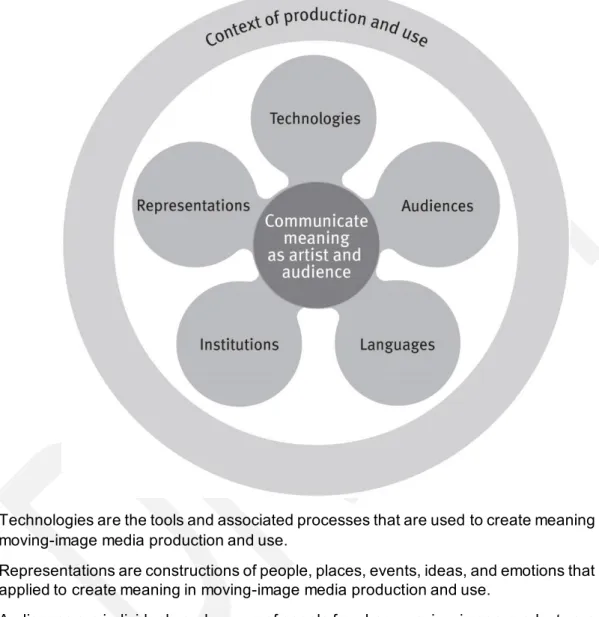
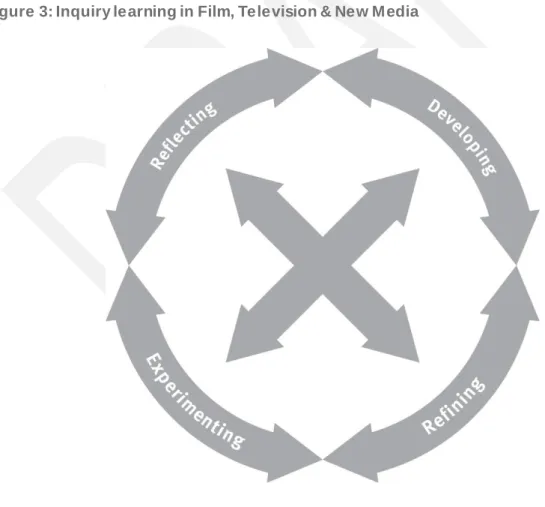
In film, television and new media, inquiry learning includes four processes: develop, reflect, experiment and refine. The subject matter in film, television and new media is organized according to key terms and guiding inquiry questions. Students will develop mental processes, skills and critical literacy in film, television and new media through the five key concepts operating in contexts of production and use.
Teaching and learning in film, television and new media involves immersing students in collaborative and authentic media practices.
Assessment — general information
Formative assessments — Units 1 and 2
When selecting texts for the study of film, television and new media, teachers consider the needs and interests of individuals and class groups to determine which texts will best meet the learning needs of their students. Educators have an ethical responsibility to approach the subject of film, television, and new media in ways that are age-appropriate and respectful of the values of their students and the values of their families and communities. To fulfill this responsibility, teachers carefully consider the choice of texts for study and the ways in which the chosen texts can be perceived, interpreted and addressed in the classroom.
Summative assessments — Units 3 and 4
ISMGs describe characteristics evident in student responses and match the identified assessment objectives. Assessment objectives are derived from unit objectives and are contextualized to the requirements of the assessment instrument. An assessment objective can appear in several criteria or in a single assessment criterion.
Assessment evidence of students' performance on each criterion is linked to a performance level descriptor, which describes the typical characteristics of students' work. If a student's response has characteristics of more than one performance level, a best-fit approach is used. When a performance level has a two-point range, a decision must be made as to whether the highest or lowest number of the range is the best fit.
Schools and teachers should have strategies in place to ensure that work submitted for internal summative assessment is the student's own.
Reporting standards
The student documents in making simple proposals for moving image media products; arrange media elements to create components of moving image media products; and provide links between film, television and new media elements connected with purpose. In response, the student identifies characteristics of key concepts and/or contexts of production and use; explain characteristics of moving image media products; and draw conclusions about film, television and/or new media products. The student, in the making, describes ideas for moving-image media products; use equipment to record or create visual or audio material; and provides production elements for moving image media products.
In response, the student identifies characteristics of moving image media products and expresses opinions about film, television and/or new media. In Unit 1, students develop their understanding of the fundamental concepts and processes used in Film, Television and New Media by learning to use available technology to select, construct, manipulate and structure moving image media. They learn about technical, symbolic and narrative codes and conventions used in the construction of moving image media products and must be able to demonstrate an understanding of signs and symbols that indicate and connote meaning in specific contexts of production and use .
Students should realize that moving image media languages depend on the shared understanding of producers and users. They learn about technologies that can be used to create, access, and interact with moving image media products. By studying moving image media genres, styles, and forms, such as music videos, animation, digital games, advertisements, films, or television programs, students become aware of social, political, economic, legal, cultural, historical, and institutional factors that can cause. have influenced the context of the production and use of moving images.
Unit objectives
Area of study: Technologies
Area of study: Institutions
Area of study: Languages
Assessment guidance
In Unit 2, students explore the ways in which stories take different forms in different contexts on moving image media platforms. Students analyze, evaluate and manipulate the technical and symbolic codes used in the construction of stories, and examine the structure of stories in a range of contexts and moving image media platforms. By exploring the use of stories in narrative and non-narrative formats, students learn that different social and cultural groups can use stories in different ways.
Audiences create meaning and form cultural identity from the consumption of story elements in moving image productions; and producers intentionally position audiences by creating representations of people, places, events, and ideas.
Unit objectives
Area of study: Representations
Area of study: Audiences
Area of study: Languages
Assessment guidance
Unit description
Unit objectives
Area of study: Technologies
Area of study: Audiences
Area of study: Institutions
Assessment
Summative internal assessment 1: Case study investigation — written
The table below summarizes the criteria, assessment objectives and mark allocation for the case study investigation.
Summative internal assessment 2: Project — multi-platform content
The following table summarizes the criteria, assessment objectives and grading department for the multiplatform project.
Summative external assessment: Examination — extended response
In Unit 4, students will use moving image media technologies, representations and language to express, explore and question their artistic identity. Students will examine and recognize the historical events, cultural contexts, ideas and aesthetic traditions that have influenced styles and approaches in moving image media, in a range of local, national and global contexts. They will consider how technologies, stylistic trends, ideas and issues have inspired artists in their historical and cultural contexts to explore ways of making and responding to moving media.
Students should examine historical forms, practices, cultures, and ideas to understand contemporary moving image media.
Unit objectives
Area of study: Technologies
Area of study: Representations
Area of study: Languages
Assessment
Summative internal assessment 3: Stylistic production (35%)
The table below summarizes the criteria, assessment objectives and grading for the stylistic project.
Summative external assessment: Examination — extended response
ISMG; an assessment tool that describes the characteristics evident in student responses and matches the identified assessment objectives. Key concepts that draw on a range of contemporary media theories are technologies, representations, audiences, institutions and languages. Australia Council for the Arts, 2007, Protocols for the Production of Indigenous Australian Visual Arts www.australiacouncil.gov.au.