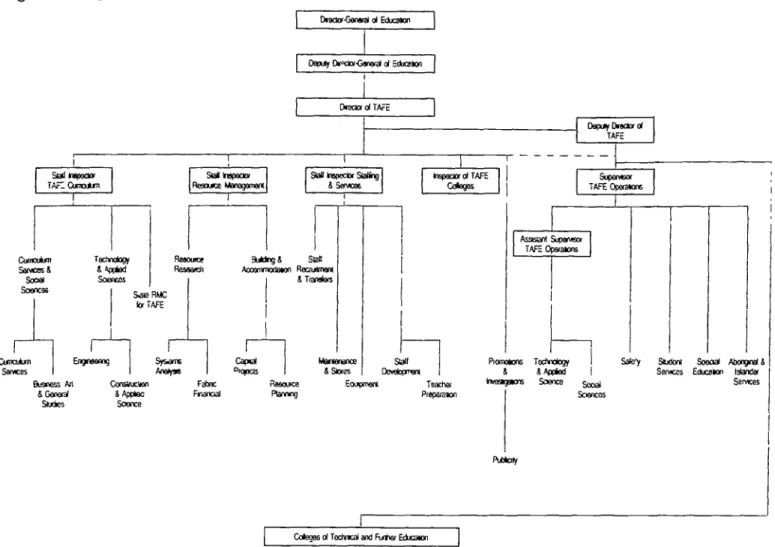
This history has been prepared in chronological order, with each of the six chapters dealing with significant events in the administration and organization of technical and further education in Queensland (A chronology of these events is shown as Appendix 1). The Central Administration Department provided all clerical support to the Director and head office professionals s t a f f2 5 .
Expansion once more
Adult education had begun in 1944 under the control of the Adult Education Council, which was responsible to the Minister of Education. The main purpose of the adult education was. A main goal of the merger was better utilization of resources - personnel, equipment and buildings. The Supervisor of Adult Education subsequently became Supervisor TAFE operations, and district organizers of adult education were redesignated officers-m-charge, Extension Programs and became officers of TAFE Many of the courses continued to be offered at external locations 3 7.
Courses
In 1987, as a result of an initiative by the Commonwealth Tertiary Education Commission designed to provide greater access to higher education, thirty student places at the Cairns College of TAFE were allocated to students studying first-year programs from James Cook University. awarded 20 student places at Mackay College of TAFE to students studying the first year of a degree from the Capricornia Institute of Advanced Education. This scheme was subsequently extended to other tertiary institutions and colleges in TAFE 4 9. While many of the apprenticeship requirements of the 1964 Act were retained (eg the system of minimum standards for entry into various occupations and the various sanctions), the new Act was more flexible in some of its provisions. The commission could prescribe the deadlines for attending classes and provide full-time pre-vocational training for any unskilled, semi-skilled or skilled occupation and full-time apprenticeship training in any trade as an alternative to the existing system. An advisory committee had the power to reduce apprenticeships by up to seven months for those apprentices who achieved an overall average of 75 per cent. at annual tests. Attempts to resolve old problems One problem the apprenticeship system had faced since the establishment of the colony of Queensland was that the annual intake of apprentices reflected the prevailing state of the economy, rather than the long-term need for skilled workers.
The courses were piloted at Eagle Farm, Bundaberg and Cairns Colleges and later expanded to other colleges. This initiative from Queensland was followed by other countries5 3 Courses were designed to give students, in addition to technical knowledge and skills relevant to a group of occupations Preference was given to students who left at the end of Year 10 and achieved a set minimum standard. At the end of the course, the student's technical skills in the chosen profession matched those of a student who completed a year of apprenticeship. The first part of the course (module 1) consisted of communication skills, living skills, health, practical calculations and the study of metals and other materials. The TAFE branch provided special programs for disadvantaged groups with the help of Commonwealth funding. Special attention was paid to those who have difficulty finding a job. The following programs are some of the more important ones that have been offered.
In 1984, TAFE introduced retraining programs which aimed to retrain people for specific occupations facing labor shortages. Under these programmes, TAFE offered special courses for concrete workers, garment and hospitality workers, office workers and station workers. Another form of retraining. was made available when staff displaced by the closure of the General Motors Holden Acacia Ridge plant were given courses in employable skdls 6 1.
Students
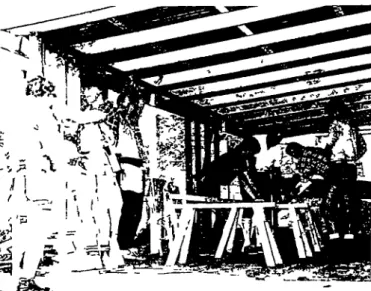
A South Brisbane College of TAFE student attends a course on accessing non-traditional careers for women.
A time of constant change 1987-1990
Source Annual Report of the Department of Employment, Vocational Education and Training page 8 responsible for the advice of the Minister for Employment. Training and Industrial Affairs on industry training needs, the promotion of vocational education, and administration of training arrangements, including apprenticeships The membership of the council is drawn from representatives of industry, trade unions and both the State and Commonwealth Governments Commonwealth sponsored Industrial Training Boards. replace Industry and Trade Advisory Committees, and College Community Councils replace Regional Advisory Committees The Employment, Vocational Education and Training Act 1988 formally introduced Q E V E T3 (see Figure 7). Operating Philosophy DEVET's main purpose was to promote and provide high quality vocational education and training for life to meet the needs of all Queenslanders.
UTVIKLING supported private companies and endeavored to develop the private supply of vocational training, both internally and through private providers. The institute recognized the relationship between vocational training and economic development. It also supported the relationship between vocational education and quality of life by providing opportunities for personal development. Source Annual report from the Department of Employment, Vocational Training and Vocational Training p 8 The most important clients were perceived as students.
Program 4, Advanced Vocational Education and Training, included responsibility for education and training courses that provided entry into occupations at the paraprofessional and professional levels or that provided advanced or enhanced skills based on prior education, training or experience.
College administration
In 1990, pre-school and apprentice students and agency staff from various colleges of TAFE visited Charleville for week-long shifts to help clean up and rebuild the town after a catastrophic flood. They used their skdls to perform tasks such as repairing crooked doors, raised windows and broken floorboards, repairing washing machines, refrigerators and other household appliances and repairing clogged pipes1 6 In the same year, North Stradbroke Island Learning Centre, a campus of Redland Community College, built by campus students. Be the one. As a result of the collaboration between Ithaca College of TAFE in Brisbane and Preston College of TAFE in Melbourne, in 1988 D E V E T launched the Energy Technology Unit and Advanced Certificate of Energy Technology, both of which were unique in Australia at the time. The course trained technicians in renewable energy systems. In the same year Toowoomba College of TAFE developed a highly regarded program designed to meet the needs of the racing/breeding industry1 8 By 1990 special programs were being run for the visually -impaired had turned the Annerley Campus of Yeronga TAFE into a major supplier of coastal shark netting and hospital pads1 9 Also in 1990, a vineyard was planted on the Bundamba Campus of Ipswich TAFE as an initial step to establish Ipswich College of TAFE as a learning center for winemaking2 0. An analysis of the history of technical and higher education in Queensland reveals some persistent questions and problems, that have confronted successive administrators.
One of TAFE's main aims has been to supply skilled labor for the state's industrial needs. However, a recurring problem has been that both the types of technical courses offered and the number of student enrollments in certain courses have reflected the prevailing economic situation rather than future needs. Over the years, this has often led to an imbalance between the supply and demand of qualified labor. A parallel to this has been the importation of skilled labor and the lack of technical training for Queensland youth. Who should pay for technical education has been a recurring issue for successive administrations. The answers to this question have varied. At first, the beneficiaries paid, assisted by grants to the secondary schools. Then, from 1908, the state government gradually assumed the heavy financial burden, with student fees covering only a small part of the total cost. Since 1964 the Commonwealth Government has become a major contributor to the funding of technical education Previously employers have made some contribution by giving apprentices paid time off to attend colleges In 1977 some of this burden was lifted from their shoulders Now the Commonwealth requires However, the government requires that large employers allocate a percentage of their total payroll to the training of their staff. This training includes technical training. In addition, for the past few years TAFE and its successors have implemented a fee-for-service policy where possible. Originally, society saw technical education as the responsibility of the local community. The government then put a board in control for a very short period from 1902 to 1905, and then transferred control to the Ministry of Education. In 1987 the control of TAFE passed. first to a Department of Employment and Vocational Training and then, in 1990, to an Office of Employment, Vocational Training and Higher Education, which came.
1980s when colleges of TAFE became the venue for technical courses integrated with secondary and tertiary courses.
Appendixes
Technical and further education in Queensland
A chronology
College opening and closing dates
Separation of college from high school Existing or newly attached high school The date when the institution began operating earlier than an annex of another college.
Technical education syllabus, 1919
Technical education courses, 1960
Associate Diploma, Diploma, and Certificate Courses
Head Office staff, 1987
- Early developments, 1860-1900
- The Government takes control, 1901-1918
- Gradual expansion, 1919-1943
- The Cinderella image, 1944-1973
- New concepts — TAFE, 1974-1987
- A time of constant change, 1987-1990
2 W Ross Johnston, op at, pp 188-90 Survey of Needs for Technical Education in Queensland Department of Education, Queensland, Technical Education Branch, May 1972, Appendix The information in this survey subsequently appeared in A Submission to ACOTAFE, Australian Committee on Technical and Further Education, Department of Education, Queensland. 9 The Education Times, Special Issue, December 30, 1983, Education History Unit, Department of Education 10 This is evidenced by recollections of TAFE officers. 12 Memories of Clyde Gilmour and Phil Hack 13 T E A C files held by QSA and the Department of Education.
20 Reminiscences of Leo Talty in M e r v y n D Taylor, An Outline History of the Building Teaching Staff of the Central Technical College, Brisbane, unpublished manuscript. 21 Reminiscences of John Baxter, Leslie Greenhill 22 Reminiscences of Jack Gibney (Other references - Reminiscences of Colin Marsh and Ray MacDougall) 23 Overview of education in Australia ACER,. 43 This perception and the specific expressions were a common feature of many of the memories of retired technical education officers, as recorded by Brian McKeenng. It is also referred to in Harry Hauenschild's memoirs.
58 Report, 1965, p. 9 'The Present Situation', in a submission to ACOTAFE, Australian Technical and Further Education Committee, Department of Education, Queensland 1974, p. 16, 18. 78 Leslie G Greenhill, Promise and Performance The impact of the Kangan recommendations on access to education in Queensland TAFE M Pub Admin Dissertation, University of Queens Land, 1985, p. 101 Memories of Peter Tait, Harry Hauenschild, Harry Ruddy. 46 Proposed topics for the Department's submission to the Committee of Inquiry on Education and Training, Managerial Services Division, TAFE Division, Ministry of Education, March.