ISSN 2209-0916
© 2023 ACTA
Jennifer Smith (corresponding author) Queensland University of Technology
Lynn Downes Queensland University of Technology
Abstract: With a rising percentage of English as an Additional Language or Dialect (EAL/D) learners in Australian schools and recent policy changes, increasingly these students find themselves learning curriculum content in mainstream classes without appropriate language learning support. Professional standards for teachers in Australia require graduates to demonstrate knowledge of teaching strategies that are responsive to the learning strengths and needs of students from diverse linguistic, cultural, religious, and socioeconomic backgrounds, including Indigenous learners. However, teachers report being ill-prepared for teaching in culturally and linguistically diverse classrooms. It seems that Initial Teacher Education (ITE) courses may not be consistently equipping preservice teachers with the necessary knowledge, dispositions, skills, and expertise to be responsive to EAL/D learners’ needs. This study analysed audio-transcripts of five practising EAL/D teachers responding to questions posed by ITE students from an Australian university. Using Fairclough’s (2003) Critical Discourse Analysis (CDA), research results offer insights into specialist knowledge and skills necessary for successful EAL/D student engagement in mainstream classrooms. This timely research presents five recommendations that will inform higher education institutions when developing ITE courses for preparing preservice teachers for culturally and linguistically diverse classrooms. Insights are shared for already practising mainstream classroom teachers.
Implications for Initial Teacher Education (ITE) programs in
preparing mainstream teachers
for culturally and linguistically
diverse classrooms
Introduction
Queensland Department of Education (DoE) policy changes related to inclusion have devolved decisions about the type of support provided to English as an Additional Language or Dialect (EAL/D) learners to the individual school level (DoE, 2022), prompting the closure of many EAL/D units in schools and the redeployment of many specialist EAL/D teachers (Creagh et al., 2022). Current state education policy requires EAL/D students to be taught in a mainstream classroom, “alongside their similar- aged peers, supported by reasonable adjustments and teaching strategies tailored to meet their individual needs” (DoE, 2021, p.
1). Consequently, generalist classroom teachers who may not have sufficient specialist training and assistance have become responsible for supporting the language learning of EAL/D learners in their classrooms. These changes have been mirrored in other jurisdictions around Australia and the world, resulting in concern that ITE programs are not equipping teachers with the necessary knowledge, skills, and dispositions to take on this challenge.
Australia is a culturally and linguistically diverse country with the proportion of residents born overseas or having a parent born overseas now at over half the population at 51.5% (Australian Bureau of Statistics [ABS], 2021). Accordingly, over 25% of young people grow up speaking a language other than English at home.
Notably, this figure does not include the 9.5% of Aboriginal and Torres Strait Islanders that speak a traditional Aboriginal language or Kriol or an Aboriginal dialect of English at home (ABS, 2021).
In addition to the challenges of participating in the classroom in a new language, many EAL/D learners are underperforming in comparison to their English proficient peers academically (Creagh et al., 2019). Alongside the policy changes regarding the provision of EAL/D support, this growing cultural and linguistic diversity has implications for schooling and Initial Teacher Education (ITE) programs because it means that all teachers need to be adequately prepared for teaching students whose first language is not English.
A review of ITE courses by the Australian Council of TESOL Association (2022) uncovered that only two ITE programs in Australia included mandatory basic EAL/D content. It seems that there is little consistency across ITE programs as to how these units are taught and the content that is delivered. Therefore, in the following section this paper will review the literature in relation to what is already known about EAL/D learners in Australia, the specialised knowledge needed by teachers working
with EAL/D learners, and then highlight some of the gaps and issues arising in ITE EAL/D education at present. This paper then looks at addressing these gaps by sharing research focused in the area with commentary from five expert teachers in the field.
Critical Discourse Analysis (CDA) is used to analyse the responses of five expert EAL/D teachers talking about how to successfully support EAL/D learners in schools. Fairclough’s CDA will be explained in more detail and finally, the findings are discussed before presenting five recommendations for ITE courses.
Literature review Who are EAL/D learners?
In Australia, EAL/D learners constitute 25% of students in classrooms (ACARA, 2023; Gibbons, 2015). EAL/D students speak a language or dialect other than Standard Australian English (SAE) and need support with the English language to access the school curriculum. These students can include newly arrived immigrants and refugee background students, international students, or Australians who have lived for extended periods of time in countries where their schooling was not in English.
EAL/D students can also be born in Australia but grow up speaking a language or dialect other than English in the home such as some Aboriginal and Torres Strait Islander or migrant families (ACARA, 2023). Stemming from this diversity of linguistic, ethnic and cultural backgrounds are varying levels of English proficiency which further contributes to the complexity of teaching EAL/D learners in mainstream contexts (Flockton &
Cunningham, 2021).
Needs of EAL/D learners
The Australian Curriculum states that “EAL/D students require specific support to learn and build on the English language skills needed to access the curriculum, in addition to learning area- specific language structures and vocabulary” (ACARA, 2023). This requires a teacher knowing how to analyse and teach texts relevant to schooling, including a nuanced understanding of how different text structures are used in particular learning areas; therefore, knowledge about paragraph organisation, cohesion, sentence grammar, and relevant metalanguage (Coleman, 2015; Hammond, 2014; Schleppegrell, 2020). It has been argued that ‘good teaching’
is insufficient for EAL/D learners and that teachers require specialised knowledge and skills about language and culture (de
Jong & Harper, 2005; Gibbons, 2015). Recent studies call for more explicit coursework in ITE programs to address this need by including topics such as, how to teach reading to EAL/D learners, specialised linguistic knowledge of each discipline and ways to teach language, and knowledge about student cultural backgrounds and how this affects learning (Wissink & Starks, 2019).
While EAL/D learners need consistent and ongoing support with language learning to develop skills in listening, speaking, reading and viewing, and writing across the curriculum and across all levels of schooling (Gibbons, 2015), teachers should also be attuned to the different cultural background knowledge of learners, assisting them to understand taken-for-granted cultural practices (Willenberg, 2015). Lucas and Villegas (2013) assert that it is necessary for teachers to value and understand the connections between language, culture, and identity while also acknowledging the power and privilege associated with the speakers of certain languages. However, most EAL/D learners are being taught by non-specialist mainstream teachers who are overwhelmingly monolingual and have no personal experiences with language learning as a reference (Ellis, 2013; de Jong, 2019). If this monolingual and monocultural orientation is left untroubled, students’ linguistic and cultural diversity can be overlooked.
When faced with newly arrived culturally and linguistically diverse students, Dobinson and Buchori (2016) found that teachers had few strategies available to them, leading to the recommendation that ITE programs should include practical language teaching strategies and develop language awareness, in particular, the skills and knowledge necessary to implement a translanguaging approach. A translanguaging approach recognises that language practices are complex and interrelated through viewing other languages as resources for learning a new language (de Jong, 2019; García, 2008). Translanguaging strategies focus on using the learner’s home language and culture as a resource for learning an additional language, in this case SAE, and challenges the traditional approach in classrooms where languages are kept separate (Willenberg, 2015).
ITE programs not preparing teachers to work with EAL/D learners Worldwide teacher training programs are not adequately preparing teachers to teach culturally and linguistically diverse learners
(Dobinson & Buchori, 2016; Flockton & Cunningham, 2021;
O’Neal et al., 2018; Sugimoto et al., 2017; Wissink & Starks 2019).
As previously mentioned, recent policy changes have resulted in responsibility for EAL/D learners being devolved to schools and mainstream classroom teachers. However, it is unclear how university ITE programs have responded to these policy changes.
According to O’Neal et al. (2018) teacher training programs have not prepared teachers for working with EAL/D learners. Despite this, teachers reported managing but emphasised their lack of training, resulting in schools responding by trying to ‘fix’ teachers with professional development. This gap in ITE training has created a void which has further intensified the commercialisation of EAL/D services to schools (Creagh et al. 2022).
A lack of professional experience working with EAL/D learners during ITE programs has also been noted as an area of concern (Wissink & Starks 2019; Flockton & Cunningham, 2021).
More placement experience working with EAL/D learners is needed. However, the success of these programs is often dependent on the ITE institution’s school partnerships and the quality of the supervising teachers (Flockton & Cunningham, 2021). Examining how field-based experiences shaped 49 preservice teachers’
dispositions towards EAL/D learners, Sugimoto et al. (2017) found that not all classrooms modelled positive dispositions or pedagogical practices towards EAL/D learners. They found some preservice teachers developed deficit discourses about EAL/D learners by viewing them as problems to be solved rather than as learners with vast cultural and linguistic resources. These findings suggest that ITE programs should look for ways to develop positive teacher orientations towards EAL/D learners (Ellis, 2013).
In summary, the literature shows that teacher education programs are grappling with ways to prepare preservice teachers to work in increasingly culturally and linguistically diverse classrooms (de Jong, 2019; Foley et al., 2022; Ollerhead, 2018).
While government and school policies are undergoing rapid change, it appears that ITE programs have been slow to respond.
Therefore, this research looks to address this gap by analysing the responses of five expert EAL/D teachers to understand the knowledge and skills needed to work effectively with EAL/D learners and make timely recommendations for inclusion to ITE programs.
Research Design and Methodology
Keeping the above-mentioned literature and focus in mind, we outline the design of the research study. Critical Discourse Analysis (CDA) was used with a sociocultural lens to analyse and investigate:
1. What practising EAL/D specialist teachers view as necessary for EAL/D student classroom engagement and success and,
2. What the practical implications for ITE programs are in preparing all subject teachers for diverse classrooms.
Research Context
In 2021, as part of the planning and development of specific EAL/D units structured for the bachelor’s and master’s degrees of education at a large university in Queensland, five expert EAL/D teachers were approached to assist with creating a series of videos to be used as a teaching and learning resource. Students currently enrolled in ITE courses were asked what they would like to know from practising EAL/D teachers. These questions were collated and themed, resulting in 13 final questions, such as how to differentiate for EAL/D learners. These questions were provided to the expert teachers prior to each of them being videoed individually answering the questions in a recording studio without an audience present. Six short videos of approximately 8 minutes duration each were produced. These videos have since been used as part of the teaching and learning resources at the University. After gaining additional ethical clearance (Ethical Clearance Number 6806) and permission from the expert teachers to use the audio transcripts of the videos for research purposes, the audio transcripts were prepared by the researchers for analysis.
Participants
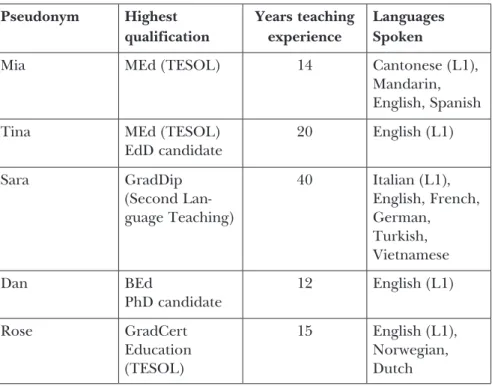
Table 1 presents the relevant information about the five expert EAL/D specialists including their pseudonyms, highest qualification, years of teaching experience, and languages spoken.
In summary, all the participants have considerable years of teaching experience and most of them are multilingual and have Teaching English to Speakers of Other Languages (TESOL) qualifications.
Table 1. Participant Information Pseudonym Highest
qualification
Years teaching experience
Languages Spoken
Mia MEd (TESOL) 14 Cantonese (L1),
Mandarin, English, Spanish
Tina MEd (TESOL)
EdD candidate
20 English (L1)
Sara GradDip
(Second Lan- guage Teaching)
40 Italian (L1), English, French, German, Turkish, Vietnamese
Dan BEd
PhD candidate
12 English (L1)
Rose GradCert
Education (TESOL)
15 English (L1), Norwegian, Dutch
Methodology
As a detailed linguistic analysis of texts, Fairclough’s (2003) CDA was used when analysing the transcripts from our five expert EAL/D teachers. CDA was chosen to analyse the data because it allows the critical examination of the teacher responses in the transcripts with a view to power inequities including the sociocultural and political context in which these responses occurred. CDA investigates the linguistic features of a text as well as the connections with social impacts, ideology, and changes in language, culture and social change which is especially pertinent when focusing on culturally and linguistically diverse students learning and using language (Fairclough, 1992).
Analysis
Fairclough (2003) differentiates between three dimensions of meaning in text – Action or Genres, Identification or Style, and Representation or Discourses – and guides analysts to use a range of textual analysis markers that highlight these three dimensions.
Ways of interacting or acting within a social event – Action or Genres – demonstrate how a text contributes to and situates within social interaction and social action. Instances of Action/
Genre in this context include the specialist knowledge required by our teacher experts and the disruptions and inadequacies of the curriculum requirements, the context and understandings behind assumed SAE knowledges, student ability and the assumption of understanding from stakeholders, including preservice teachers.
The Identification or Style dimension connects identities and how people use language and speak – the ways of being. Here the analyst looks at the use of modality, mood, predictions, evaluation, exchange types, and phonological features such as pronunciation, stress, rhythm, intonation, and vocabulary choice.
The Representation or Discourses dimension are ways of representing the world and its different perspectives using language. Here the analyst focuses on features of vocabulary such as hyponymy (meaning inclusion), antonymy (meaning exclusion), and synonymy, (meaning identity) because vocabulary choices
“lexicalize” the world in particular ways (Fairclough, 2003).
Discourses are also determined with the use of patterns of co-occurrence of words, collocations, words that precede or follow, metaphor use, assumptions or presuppositions that are present in the text, and the representation of social actors, time, and place. For the sake of brevity in this paper, the main findings below focus on the discourses found in the data.
Findings
Three main discourses are evident in the data, namely knowledge, skills and dispositions deemed necessary for working with EAL/D learners. Following below, each of these discourses are detailed with excerpts from the data.
1. Knowledge deemed necessary for working with EAL/D learners ITE programs aim to build foundational knowledge. That is, facts and information about EAL/D learners and how to work with them effectively, including an understanding of who EAL/D learners are, how to create supportive learning environments, how additional languages are learnt, and how language is used within different curriculum areas. It is well-established that the domains of knowledge needed by mainstream teachers working with EAL/D learners include a knowledge of language, literacy, and language development; knowledge of the curriculum; and knowledge of how to plan high-challenge and high-support programs (Hammond, 2014).
The participants demonstrated this discourse of knowledge in several areas: (a) establishing the right conditions for EAL/D
learners in the classroom, (b) how and why to connect with students, (c) defining differentiation and the objective of using differentiation in the classroom, (d) using and sourcing appropriate resources, (e) scaffolding language learning for EAL/D students, (f) assessing, providing feedback to, and reporting on student outcomes for EAL/D students, and (g) the affordances and challenges of teaching EAL/D students. Two specific examples of knowledge from participants’ transcripts are discussed below.
First, regarding establishing the right conditions in the classroom, the expert teachers emphasised the importance of safety and a relaxed environment in the classroom. For example, Rose highlights: “For all EAL/D learners to succeed in the classroom, you need to create a positive, safe environment … ask lots and lots of questions. There are no silly questions in the classroom”. Sara agrees stating: “Is your classroom a safe space?
Do your students feel that they can talk without fear of being laughed at or made to feel different?” Similarly, connecting with the safe environment, we hear from Dan who says, “First of all, it’s incredibly important to have a welcoming classroom”.
The expert teachers explain that safe, welcoming classrooms provide the necessary conditions for EAL/D learners to take risks with their language learning. Risk-taking is an inevitable part of learning a new language as learners trial the new language and learn from making mistakes by applying feedback. With surveys confirming that around one-third of students feel moderately to mildly anxious about language learning (Horwitz, 2013), our expert teachers know to normalise making mistakes as part of the learning process. Rose explains: “We love making mistakes. That’s the most important thing, is that a messy workbook or a messy worksheet shows how you’ve been thinking”. In talking about the importance of making mistakes and accepting that making mistakes is all about the language learning process, Rose demonstrates her knowledge of affective support. Affective support includes the promotion of self-confidence, feelings of competence and positive affective attitudes which helps to establish a supportive community feel in the classroom through quality tasks and interactions (Mariani, 1997).
Second, relating to pedagogical knowledge of how to scaffold language and content learning for EAL/D learners, the expert teachers shared their knowledge of the teaching and learning cycle. Dan explains: “So, we use what’s called the teaching and learning cycle, which is a way of making the expected
outcome, that genre or the texts that you’re trying to create, really explicit and obvious to the students”. Mia reiterates this with
“break it down and build it up”. The teaching and learning cycle mentioned by Dan and Mia, acknowledges that the language of schooling is different to the language of home (Cummins, 2008;
Derewianka, 2015). It outlines how a teacher can scaffold academic writing using real tasks with relevant, authentic texts, based on the sociocultural view of learning where interaction with more knowledgeable others helps to support learning (Derewianka, 2015; Gibbons, 2015; Hertzberg, 2012). This requires teachers having knowledge of the genres or text types used in their teaching areas and knowing how to break-down and explicitly teach the language used in those genres. This sociocultural perspective of scaffolding spoken about by the teachers demonstrates their expert content and pedagogical knowledge of how to teach EAL/D learners.
2. Essential skills and strategies for working with EAL/D learners The expert teachers mention many skills and strategies used in classrooms with EAL/D students. Skills are an assemblage of effective practices and strategies an educator must draw from, such as contextualising new language using visuals, hands-on activities and experiences, activating prior knowledge of content and associated language, and building relevant background knowledge as necessary (de Jong & Harper, 2005; Hertzberg, 2012). What connects many of these skills for our participants are:
(a) ways to know your students and show interest in their culture/
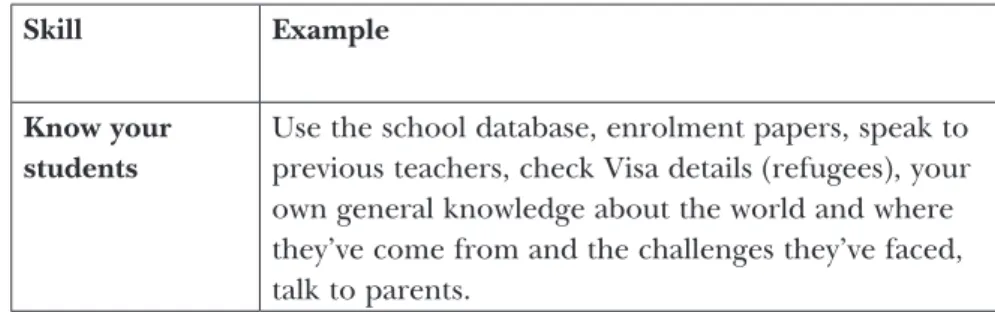
background/language, (b) advice on choosing appropriate resources, (c) ways to teach EAL/D students, (d) ways to be culturally and linguistically aware, and (e) advice on how to show humanity. Examples from the data are provided in Table 2.
Table 2. Skills Deemed Necessary by Expert EAL/D Teachers
Skill Example
Know your students
Use the school database, enrolment papers, speak to previous teachers, check Visa details (refugees), your own general knowledge about the world and where they’ve come from and the challenges they’ve faced, talk to parents.
Be interested in their culture, background, language
Ask questions and learn about their culture and country, family background, favourite things, invest time, little steps, use translator, cultural liaison officer, personal likes and dislikes, what makes them laugh, interests.
Use the correct resources
Create or use resources that reflect cultures/interests of your students e.g., world map.
Good resources = language is explicit, visuals to support meaning-making, provide comprehensible input, not too wordy, simple, clear.
Understand how to teach EAL/D
Use different modes, a survey, help them navigate the school grounds, teach rehearsed phrases, make things explicit, break up the task and the language, bridge the gaps, modelling, think alouds, exemplars, drafting, informal practice, group work, modify texts Be culturally
aware
Be aware of cultural norms about sharing personal/
family information, be patient, supportive, natural, culturally inclusive, learn about the world.
Show humanity Patience, empathy, tolerance, things take time, caring, being flexible, integrating different ideas, making adjustments, acknowledging different ways of doing and knowing, and being sensitive.
Translanguaging is the use of all a person’s linguistic repertoires to communicate and make-meaning (García & Wei, 2014). It is one of the more important skills discussed by our expert teachers and how the welcoming of other languages in the classroom empowers EAL/D learners to reach their full potential.
Dan and Rose elaborate,
There’s emerging research on translanguaging, … which is a way of getting the student’s language, their first or second language into the classroom … that can make the students feel welcome … make those students feel valued as learners and as contributors to the classroom. (Dan)
They may choose something about their culture or their country or language … and that’s a wonderful place to start to have a conversation … they have new ideas about the world … they might have concepts and vocabulary in their language that we don’t have in English. That brings a richness to the understanding of the students in the classroom and to yourself as a teacher. (Rose)
Through including the pedagogic aspects of translanguaging, the participants become accepting of other languages in their classroom space. They know that using the home language to learn new content and/or concepts reduces the cognitive load on the learner and have developed effective practices and strategies to incorporate translanguaging into the classroom. Furthermore, these expert teachers recognise the strong connection between a person’s language and culture. By including the EAL/D student language into the classroom, translanguaging allows for the student to include parts of their culture and draw on their other languages to make meaning. This in turn apportions the opportunity for other students (and teachers) in the classroom to expand their knowledge about different cultures and languages in the world, thus developing a culturally responsive pedagogy (Morrison et al., 2019; Willenberg, 2015).
3. Fundamental attitudes and dispositions for working with EAL/D learners
We define dispositions in education, and in particular, in EAL/D educational contexts as closely aligned with John Dewey’s early work, referring to ‘underline motivators’ and ‘organisers’ for behaviour (Dewey, 1922) that grow from our experiences (Dewey, 1938). Specifically, we favour Katz and Raths’ definition, “an attributed characteristic of a teacher, one that summarizes the trend of a teacher’s actions in particular contexts” (Katz & Raths, 1985, p. 306).
Dispositions are noted by the expert teacher’s underlying responses to the dominant monolingual culture and Anglo-centric worldview in western cultures. Intertwined throughout their discussions about theories and pedagogies, their attitudes and views of themselves as teachers of language and cultural facilitators shines through. Participants expressed the view that educators should refrain from the Anglo-centric discourse in classrooms, that is, thinking the Anglo-centric way is the only (and correct) way of doing and being. Sara and Rose comment on this.
Integrate language and culture when appropriate, not just as a tokenistic gesture... do not create an atmosphere or an attitude that an Anglo-centric approach or perspective is the only way of understanding
… there are other ways of thinking and understanding which are just as valid. (Sara)
“There’s no one right way to do anything or to say anything or to think anything” (Rose) and “different cultures have different ways” (Sara).
Another aspect of the disposition or attitude of teaching EAL/D students is the knowledge of the learner and steering away from dominant discourses about difference and deficit. Dan begins by focusing on alternative experiences and points of view by sharing:
EAL/D learners are not illiterate. It’s likely that they are literate in their first language so that’s not to say that literacy teaching is not helpful … any sort of language teaching is beneficial to EAL/D students … we don’t make assumptions because everybody is different.
Tina adds to the conversation with, “… acknowledging that my classroom will have students who learn in different ways and that I develop lessons that cater for those diverse needs”.
Aligning with the direction of alternative perspectives and difference, the participants highlight one of the more dominant discourses of deficit, for example.
It isn’t just about dumbing it down or making it easier.
All of those language demands of a subject area need to be taught … do not think of EAL/D students from a deficit point of view, students from other cultures bring so much to the classroom. (Dan)
Dan shares that the EAL/D student brings with them a different set of experiences, cultures, and languages and teachers need to find ways to bring that into the classrooms and make those children feel valued as learners and contributors to the classroom. Sara too acknowledges the deficit discussion with “An unsuitable resource is one in which both the language and content are dumbed down … treat them [EAL/D learners] like everyone else, not as different or other, it can be tokenistic”. Sara furthers this with her personal reflection of being a second language learner:
I saw first-hand the power that language plays in social participation and social acceptance. I learned early on about assumptions and stereotyping and racism and about feeling other … EAL/D learners have made me aware of the transformative nature of language, of the power that language use holds in society.
Our expert teachers know the value of integrating cultures, histories, language, and understanding to make for a richer teaching and learning experience, both for the students and the teachers. The expert teachers recognise the theories, pedagogies, and attitudes required to teach in EAL/D contexts, including (a) the importance of making mistakes and receiving feedback in a safe and welcoming environment, (b) the teaching and learning cycle as a way of teaching subject-specific genres through principled scaffolded support, and (c) demonstrating the value of other languages and cultures through implementing a translanguaging approach.
Teacher professional dispositions, as discussed above, can be difficult to quantify and test. Dispositions are not static states but are malleable and can be shaped (Diez, 2007). Importantly, when viewed from a sociocultural perspective, dispositions are learnt and developed through social experiences, therefore teacher education programs become crucial to cultivating professional dispositions in tandem with knowledge and skills.
This can be done through the careful choice of learning experiences throughout ITE programs to help build and refine these dispositional skills (Cummins & Asempapa, 2013).
Discussion
In relation to the above analysis, we note two areas of social concern, namely the tacit belief that English, and the ability to speak and work in English, is the default ‘privilege’ and the only correct way; and second, that anyone speaking a language other than English suffers a deficit in their life and learning space. We detail these two social areas of concern below and follow with a solution-driven approach supplied by our teacher participants.
The paper then concludes with recommendations for ITE programs that substantiated from this data.
The Anglo-centric approach
When sharing the discourses of skills and dispositions deemed necessary for working with EAL/D learners, participants highlight the ever-present Anglo-centric approach within our Australian classrooms. The essence of this approach is “a tacit belief in the natural and neutral status of English words and meanings … where English words have become the default linguistic-conceptual (and dominant) [authors addition] currency” (Levisen, 2019, p. 2).
This Anglo-centric approach manifests itself in relation to language
and culture. The dominant western worldview is assumed in educational settings through the curriculum, choice of classroom resources, and in the decisions teachers make regarding how teaching and learning will occur. Due partly to a lack of cultural diversity within the teaching profession in Australia (only 17% of the teacher workforce was born outside of Australia; AITSL, 2021, p. 8), classrooms are by default largely monolingual and monocultural. The expert teachers challenge this dominant discourse through integrating different languages and cultures into their classrooms in authentic ways, seeking out alternative perspectives and valuing all contributions and experiences in the classroom.
The deficit approach
The ubiquitous deficit discourse mentioned by the participants is normalised and often directed by those in power, positioning the EAL/D learner as “lacking” in some way (Dooley, 2012). Many teachers, even well-meaning teachers (Lam, 2006), find themselves inducted into this way of thinking. The deficit discourse establishes itself within the narrative of “difference”, referring to social and biological variations among people, be that gender, sexual orientation, sex, ethnicity, race, socio-economic status, geographical location, (dis)ability, and other large-scale demographic categories (Kalantzis & Cope, 2005). The deficit discourse highlights how EAL/D students are “different from”, or separate from, the dominant norm (Alford, 2014). Participants reveal within the discourse of knowledge deemed necessary when working with EAL/D learners that the deficit view is not acceptable when teaching EAL/D students and that the EAL/D student can contribute to the classroom environment with alternative points of view and ways of knowing, being, and doing and should not be positioned as “empty buckets” (Gannaway, 2022, p. 233).
Translanguaging approach
By accepting and incorporating translanguaging opportunities into classroom contexts the authors posit that the Anglo-centric approach and deficit discourses will be challenged. While acceptance of translanguaging in the classroom as the normal practice of bilingual people is important (Scarino, 2022), of greater consequence is the promotion of translanguaging strategies by teachers as a legitimate and attested way to learn a new language. The linguistic and cultural diversity within Australian
classrooms is viewed as a valuable resource by our expert teachers which is often left untapped (Alford & Kettle, 2020). Therefore, the teacher’s role is preeminent in setting up and guiding EAL/D learners to use their other languages and cultural knowledge as a scaffold for their learning of SAE alongside content learning. The expert teachers acknowledge language is powerful and that having access to the dominant form of language in society and knowing how to use it effectively can be transformative.
With the abovementioned insights from our participants in mind we forward five recommendations for future ITE programs in Australia below.
Recommendations
The knowledge that linguistic and cultural diversity exists within our classrooms is understood by most preservice teachers.
However, the discourses of the expert EAL/D teachers in this study highlights the specialist knowledge, skills and dispositions necessary for working with EAL/D learners. These are the teachers who work with EAL/D learners on a daily basis and have had to adjust to recent policy changes relating to inclusion in schools. From listening to their expertise about their everyday practices, key components that need to be better addressed by ITE programs can be identified. Therefore, we make the following recommendations for ITE programs.
1. We advocate for specialist EAL/D units within ITE degrees so that specialist knowledge that is currently demonstrated by the five expert teachers is not watered down or lost.
2. Within these specialist EAL/D units develop pedagogical practices and teach culturally responsive pedagogies that challenge the Anglo-centric world view and deficit discourses that were highlighted by the participants. A practical way to achieve this could include a provocation such as a language immersion experience and reflection.
Further to this, normalise multilingualism by providing opportunities for multilingual preservice teachers to share their personal experiences as second language learners, and create teaching resources such as videos of expert teachers working with EAL/D learners for classroom observation and discussion.
3. To improve the responsiveness of ITE programs to policy changes within schools, ongoing relationships between ITE program academics and expert EAL/D teachers should be developed to identify the practical skills, knowledge, and dispositions needed to work successfully with EAL/D learners based on current, real- life teaching situations, and then incorporate this into ITE teaching units.
4. To address the current lack of professional experience, build-in professional experience opportunities working with EAL/D learners in mainstream contexts as part of EAL/D units and possibly as part of assessment. To ensure that the current Anglo-centric approach and deficit discourse is challenged this needs to be structured to include time for reflection and to capitalise on teachable moments.
5. By practising the skills, knowledge, and dispositions of EAL/D teaching and learning over time, expertise is built. Providing opportunities for further study and professional development will increase the numbers of expert EAL/D teachers which in turn will improve the quality of teaching and learning in our schools.
Conclusion
Of interest to the authors during this study were the interconnections between knowledge, skills, and dispositions of the expert teachers. During analysis, the linkages between the three discourses (as can be seen in the example of translanguaging) were revealed. It became clear that to better prepare preservice teachers, a crucial response by ITE programs would be to cultivate the professional dispositions of trainee teachers by developing their responsiveness towards linguistic and cultural diversity in the classroom. This can be achieved through carefully curated learning experiences that establish the knowledge and skills necessary to enact a culturally responsive pedagogy, thereby leveraging the linguistic and cultural capital of diverse classrooms for the benefit of all.
References
Alford, J. & Kettle, M. (2020). Defining bilingualism, multilingualism and plurilingualism in education: Innovations in teaching for diversity in mainstream classrooms. In R. Arber, M.
Weinmann, & J. Blackmore (Eds.), Rethinking languages education: Directions, challenges and innovations (1st ed., pp.167–177). Routledge. https://doi.org/10.4324/
9781315107974-10
Alford, J. H. (2014). “Well, hang on, they’re actually much better than that!”: Disrupting dominant discourses of a deficit about English language learners in senior high school English. English Teaching: Practice & Critique, 13(3), 71-88.
https://eprints.qut.edu.au/236400/
Australian Bureau of Statistics (ABS). (2021). Snapshot of Australia:
A picture of the economic, social and cultural make-up of Australia on census night, 10 August 2021. https://www.abs.gov.au/
statistics/people/people-and-communities/snapshot- australia/2021#culturally-and-linguistically-diverse- communities
Australian Council of TESOL Associations (ACTA). (2022).
National roadmap for English as an additional language or dialect (EAL/D) education in schools. https://tesol.org.au/
acta-calls-for-national-reform-and-revitalisation-of-eal-d-in- schools/
Australian Curriculum, Assessment and Reporting Authority (ACARA). (2023). The Australian Curriculum Ver 9.0: EAL/D students. https://v9.australiancurriculum.edu.au/student- diversity/eal-d-students#accordion-47609c6685-item- f14878fc30
Australian Institute for Teaching and School Leadership (AITSL).
(2021). Australian teacher workforce data: National teacher workforce characteristics report December 2021 (ATWD Teacher Workforce Report). Education Services Australia. https://
www.aitsl.edu.au/docs/default-source/atwd/atwd-teacher- workforce-report-2021.pdf?sfvrsn=126ba53c_2
Coleman, J. (2015). Accessing the linguistic ‘funds of knowledge’
of students in teacher education programmes. English in Australia, 50(1), 29–37. https://web.s.ebscohost.com/
ehost/pdfviewer/pdfviewer?vid=0&sid=230b4e15-74f2- 46dd-b868-e486002aaa7f%40redis
Creagh, S., Hogan, A., Lingard, B., & Choi, T. (2022). The
‘everywhere and nowhere’ English language policy in Queensland government schools: A license for commercialisation. Journal of Education Policy, 1–20. https://
doi.org/10.1080/02680939.2022.2037721
Creagh, S., Kettle, M., Alford, J., Comber, B., & Shield, P. (2019).
How long does it take to achieve academically in a second language? Comparing the trajectories of EAL students and
first language peers in Queensland schools. The Australian Journal of Language and Literacy, 42(3), 145–155. https://doi.
org/10.1007/BF03652034
Cummins, J. (2008). BICS and CALP: Empirical and theoretical status of the distinction. In N. H. Hornberger (Ed.), Encyclopedia of language and education (2nd ed., pp. 487–499).
Springer. https://doi.org/10.1007/978-0-387-30424-3_36 Cummins, L. L., & Asempapa, B. (2013). Fostering teacher
candidate dispositions in teacher education programs.
Journal of the Scholarship of Teaching and Learning, 13(3), 99-119. https://www.proquest.com/scholarly-journals/
f o s t e r i n g - t e a c h e r - c a n d i d a t e - d i s p o s i t i o n s / docview/2387858805/se-2
de Jong, E. J. (2019). Expanding EAL expertise: Taking a multilingual stance. TESOL in Context, 28(1), 5–20. https://
doi.org/10.21153/tesol2019vol28no1art907
de Jong, E. J., & Harper, C. A. (2005). Preparing mainstream teachers for English-language learners: is being a good teacher good enough? Teacher Education Quarterly, 32(2), 101. https://link.gale.com/apps/doc/A133566590/
AONE?u=qut&sid=bookmark-AONE&xid=02548a5e
Department of Education (DoE). (2021, August 10). Inclusive education policy, Ver 1.3. Queensland Government. https://
ppr.qed.qld.gov.au/pp/inclusive-education-policy
Department of Education (DoE). (2022, October 13). English language support in Queensland state schools. Queensland Government. https://education.qld.gov.au/students/
inclusive-education/english-language-support
Derewianka, B. M. (2015). The contribution of genre theory to literacy education in Australia. In J. Turbill, G. Barton, & C.
Brock (Eds.), Teaching writing in today’s classrooms: Looking back to look forward (pp. 69–86). Australian Literary Educators’
Association. https://ro.uow.edu.au/cgi/viewcontent.cgi?art icle=2620&context=sspapers
Dewey, J. (1922). Human nature and conduct: An introduction to social psychology. New York, NY: Henry Holt. https://doi.
org/10.1037/14663-000
Dewey, J. (1938). Experience and education. New York, NY: Collier.
Diez, M. E. (2007). Looking back and moving forward: Three tensions in the teacher dispositions discourse. Journal of Teacher Education, 58(5), 388–396. https://doi.
org/10.1177/0022487107308418
Dobinson, T., & Buchori, S. (2016). Catering for EAL/D students’
language needs in mainstream classes: Early childhood
teachers’ perspectives and practices in one Australian setting. The Australian Journal of Teacher Education, 41(2), 32–52. https://doi.org/10.14221/ajte.2016v41n2.3
Dooley, K. (2012). Positioning refugee students as intellectual class members. In F. E. McCarthy & M. H. Vickers (Eds.), Refugee and immigrant students: Achieving equity in education (pp. 3-20). Information Age Publishing. https://eprints.qut.
edu.au/38621/
Ellis, E. (2013). The ESL teacher as plurilingual: An Australian perspective. TESOL Quarterly, 47(3), 446–471. https://doi.
org/10.1002/tesq.120
Fairclough, N. (1992). Discourse and social change. Polity Press.
Fairclough, N. (2003). Analysing discourse: Textual analysis for social research (1st ed.). Routledge. https://www.academia.edu/
download/32494531/Fairclough_Analysing_Discourse_
Textual_Analysis_for_Social_Research__2003.pdf
Flockton, G. & Cunningham, C. (2021). Teacher educators’
perspectives on preparing student teachers to work with pupils who speak languages beyond English, Journal of Education for Teaching, 47(2), 220-233. DOI:
10.1080/02607476.2020.1855942
Foley, Y., Anderson, C., Hancock, J., & Conteh, J. (2022).
Exploring the professional identity and agency of student teachers in multilingual classrooms. Language and Education, 36(2), 106–121. https://doi.org/10.1080/09500782.2021.1 991369
Gannaway, J. M. (2022). Honouring student repertoires:
Connecting oracy to “ways of being”. Literacy, 56(3), 225–
233. https://doi.org/10.1111/lit.12301
García, O. (2008). Bilingual education in the 21st century: A global perspective. John Wiley & Sons.
García, O., & Wei, L. (2014). Language, languaging and bilingualism. In Translanguaging: Language, bilingualism and education (pp. 5–18). Palgrave Pivot. https://doi.
org/10.1057/9781137385765_2
Gibbons, P. (2015). Scaffolding language, scaffolding learning:
Teaching English language learners in the mainstream classroom (2nd ed.). Heinemann. https://www.academia.edu/
download/60105773/Scaffolding_Language__Scaffolding_
Learning_201420190724-88771-f0v3pr.pdf
Hammond, J. (2014). An Australian perspective on standards- based education, teacher knowledge, and students of English as an additional language. TESOL Quarterly, 48(3), 507–532.
https://doi.org/10.1002/tesq.173
Hertzberg, M. L. (2012). Chapter 3: Pedagogical conditions for learning a language. In Teaching English language learners in mainstream classes (pp. 29–47). Primary English Teaching Association Australia (PETAA). http://handle.uws.edu.au:8 081/1959.7/520800
Horwitz, E. K. (2013). What should I know about language learners and language teaching settings? In Becoming a language teacher: A practical guide to second language learning and teaching (2nd ed., pp. 3–24). Pearson Education.
Kalantzis, M., & Cope, B. (2005). Learning by design. Victorian Schools Innovation Commission & Common Ground Publishing.
Katz, L.G., & Raths, J. D. (1985). Dispositions as goals for teacher education. Teacher and Teacher Education, 1(4), 301-307.
https://doi.org/10.1016/0742-051X(85)90018-6Kemmis Lam, W. S. E. (2006). Chapter 6: Culture and learning in the
context of globalization: Research directions. Review of Research in Education, 30(1), 213–237. https://doi.
org/10.3102/0091732X030001213
Levisen, C. (2019). Biases we live by: Anglocentrism in linguistics and cognitive sciences. Language Sciences, 76, 101173-101186.
https://doi.org/10.1016/j.langsci.2018.05.010
Lucas, T., & Villegas, A. M. (2013). Preparing linguistically responsive teachers: Laying the foundation in preservice teacher education. Theory Into Practice, 52(2), 98–109.
https://doi.org/10.1080/00405841.2013.770327
Mariani, L. (1997). Teacher support and teacher challenge in promoting learner autonomy. Perspectives: A Journal of TESOL Italy, XXIII(2). http://www.learningpaths.org/
papers/papersupport.htm
Morrison, A., Rigney, L.-I., Hattam, R., & Diplock, A. (2019).
Toward an Australian culturally responsive pedagogy: A narrative review of the literature. University of South Australia. https://
search.informit.org/doi/10.3316/apo.262951
Ollerhead, S. (2018). Pedagogical language knowledge: Preparing Australian pre-service teachers to support English language learners. Asia-Pacific Journal of Teacher Education, 46(3), 256–266. https://doi.org/10.1080/1359866X.2016.1246651 O’Neal, D. D., Ringler, M., & Rodriguez, D. (2008). Teachers’
perceptions of their preparation for teaching linguistically and culturally diverse learners in rural Eastern North Carolina. The Rural Educator, 5-13. https://link.gale.com/
apps/doc/A219632599/AONE?u=qut&sid=bookmark- AONE&xid=ae839953
Scarino, A. (2022). Language teacher education in diversity – a consideration of the mediating role of languages and cultures in student learning. Language and Education, 36(2), 152-169. https://doi.org/10.1080/09500782.2021.1991370 Schleppegrell, M. J. (2020). The knowledge base for language
teaching: What is the English to be taught as content?
Language Teaching Research, 24(1), 17–27. https://doi.
org/10.1177/1362168818777519
Sugimoto, A. T., Carter, K., & Stoehr, K. J. (2017). Teaching “in their best interest”: Preservice teachers’ narratives regarding English Learners. Teaching and Teacher Education, 67, 179–
188. https://doi.org/10.1016/j.tate.2017.06.010
Willenberg, I. (2015). Working with bilingual learners: An introduction. English in Australia, 50(1), 86-96. https://
s e a r c h . i n f o r m i t . o r g / d o i / a b s / 1 0 . 3 3 1 6 / i n f o r m i t . 249145589109123
Wissink, B., & Starks, S. (2019). Elementary teachers’ perceptions of preparedness to teach English language learners.
Educational Research and Reviews, 14(10), 349–357. https://
doi.org/10.5897/ERR2019-3734
Jennifer Smith is a lecturer in the School of Teacher Education and Leadership at the Queensland University of Technology. She is an applied linguist and qualitative researcher in the area of second language teaching and learning. Her teaching experience includes teaching undergraduate students how to teach EAL/D learners in the mainstream classroom and developing TESOL specialists in the Master of Education course. ORCID ID: https://orcid.
org/0000-0002-9547-2005 [email protected]
Lynn Downes is a lecturer in the School of Teacher Education and Leadership at the Queensland University of Technology. Her research interests focus on language, specifically language variation and change and sociolinguistics. Lynn’s interests also include Critical Discourse Analysis and English language and literacy in the primary school context. At present Lynn is researching oral language practices and skills of young people from birth to 8 years. ORCID ID: https://orcid.org/0000-0002-4393-620X