An analytical investigation into materiality
in contemporary abstract painting
Linda Cook
A dissertation submitted in partial fulfilment of the degree of Master of Fine Arts at Dunedin School of Art at Otago Polytechnic, Dunedin, New Zealand
Submission date December 2022
Abstract
This project began by considering abstract painting across the twentieth century, from Malevich to Nozkowski, and subsequently looked at
contemporary New Zealand practice. This analysis secured my work within the genres of neo-casualism and new materiality.
New materiality accepts that all matter, whether substance or object, has agency and presence. Materials are full of surprises; I celebrate the messy vitality of uncontrollable materials and rejoice at the random slippage of an edge.
Quirky, off kilter, seemingly unrefined forms, are characteristic of neo-
casualism. Humour is combined with an anti-heroic style. All these elements have been central to my practice. A curious and unexpected body of work has emerged from blending new materiality and neo-casualism, and synchronising discordant elements with waste materials. In working with raw,
unpredictable materials and embracing the random ooze or slip, each painting has developed its own personality.
The surface and the edge rise to the fore in this body of work. I use the value and vitality of the edge to enliven the centre of the picture plane. The
expansive picture plane begins as a sheet of cardboard. By combining textural surface with carefully chosen colours, the cardboard sheds its humble
beginning to become an art object. This is no mean feat. The surface
eventuates from layers of sealants, gesso, and paint to which texture is added –straw, hair, paper, whatever is at hand. Onto this, layers of colour and clay are pasted and secured as the paintings are built up. These constructions begin to register as objects which have moved beyond representation and into the realm of real form.
This praxis has opened broader discussions for my practice, opening avenues for continued rumination on materiality, rhythms and making.
Acknowledgements
I would like to express gratitude to my supervisors Ed Hanfling, Michael Greaves and Graham Fletcher for their constant, patient support and encouragement throughout this master’s Project. Thank you also to
interviewees Adrienne Vaughan, Rebecca Wallis, and Saskia Leek for sharing their time and words throughout this endeavour. Finally, thank you to my partner Ian Cook along with my whole whanau: Thomas Cook, Emma Harris, Matthew Harris and mokopuna. I also acknowledge the mentoring and encouragement received from my friend Bridie Lonie. All of these humans have strengthened and supported me throughout this intense project.
TABLE OF CONTENTS
Abstract i
Acknowledgements iii
Table of contents iv
List of figures vi
Introduction ix
Chapter One: Re-Ordering Time
Craft and Materiality 1
Technology and Painting’s Lazarus Effect 2
Resonant Memory and Atemporality 4
Painters and Abstraction in the Twentieth Century
Kazimir Malevich 7
Callum Innes 10
Thomas Scheibitz 13
Blinky Palermo 16
Back to the Future 19
Chapter Two: New Zealand Abstraction, Now Not Then
Unmade Love 21
Thomas Nozkowski and New Casualism 23
Anything Goes 25
Sex and Drugs and Rock and Roll 25
Aw-kward 27
Aotearoa Mahi
Adrienne Vaughan 30
Saskia Leek 35
Bringing it Home 38
Chapter 3: Rage Against the Machine
The Studio Floor 42
The Hand as Tool 43
Matter Over Mind 48
Rhythm and Matter 49
Rebecca Wallis 50
Edging Beyond the Surface 55
Cat Fooks 62
Conclusion 66
LIST OF FIGURES
Figure 1. Stefano di Giovanni di Consolo (Sassetta). The Blessed Ranieri Frees the Poor from a Prison in Florence, circa 1440, tempera and gold on wood panel, 430 x 630 mm.
The Louvre, Paris, France.
Figure 2. Katheryn Madill. Aaroo 5/35, 1987. Ink on paper, 340 x 570 mm.
Figure 3. Kazimir Malevich. Black Square, 1915, oil on linen, 795 x 795 mm.
State Tretyakov Gallery in Moscow.
Figure 4. Kazimir Malevich. White on White, 1918, oil on linen, 795 x 795 mm.
MoMA, New York.
Figure 5. Callum Innes. Exposed Painting Charcoal Black Violet Red Oxide, 2004, oil on Linen, 1746 x 1645 mm.
Figure 6. Linda Cook. Untitled, 2019, oil, wax and glue on unstretched linen, 250 x 500mm.
Figure 7. Thomas Scheibitz. Essay, 2008, Oil, lacquer and vinyl on canvas.
Figure 8. Linda Cook. Blue Window, 2019, oil on unstretched canvas, 350 x 450 mm.
Figure 9. Blinky Palermo. Composition with 8 Red Rectangles, 1964, oil and graphite on canvas, 960 x 1110 mm.
Figure 10. Blinky Palermo. The Points of the Compass, Himmelsrichtungen, 1976, oil on glass and steel, 2048 × 1536 mm.
Figure 11. Kazimir Malevich. Black Square, 1915, oil on linen, 795 x 795 mm.
Tretyakov Gallery in Moscow.
Figure 12. Cat Fooks. Impromptu Crab Apple, 2020, oil and mixed media on board, 605 x 530mm.
Anna Miles Gallery, Auckland.
Figure 13. Thomas Nozkowski. Untitled T-92, 1996, oil on linen on panel, 508 x 406mm.
Kerry Ryan McFate/Courtesy of Pace Gallery, New York.
Figure 14. Andy Warhol. The Velvet Underground and Nico, album design, 1967.
Figure 15. Jacques-Louis David. The Oath of the Horatii, 1784, oil on canvas, 3.3 x 4.25 m.
The Louvre Museum, Paris, France.
Figure 16. Adrienne Vaughan. . Untitled drawing 202, ink, oil, and collage on paper, 425 x 520.
Anna Miles Gallery, Auckland.
Figure 17. Adrienne Vaughan. Flug, 2013, oil and enamel on canvas, 502 x 655 mm.
Anna Miles Gallery, Auckland.
Figure 18. Thomas Nozkowski. Untitled 6-113, 1991, oil on canvas board, 406 x 508 mm.
Courtesy of Pace Gallery, New York
Figure 19. Adrienne Vaughan. Ringer, 2016, oil on canvas 300 x 250 mm.
Anna Miles Gallery, Auckland.
Figure 20. Linda Cook. Building of Surface detail, 2022.
Figure 21. Saskia Leek. Slopes, 2017, oil on board, 590 x 470 mm.
Christchurch Art Gallery.
Figure 22. Linda Cook. Studio Book, 2021 – 2022.
Figure 23. Linda Cook. Inquisitive but not Smiling, 2021, layered cardboard, paper and DIY fillers with oil and powder clays, 1450 x 1200 mm.
Figure 24. Dunedin School of Art - Studio Floor, Jan – March 2022.
Figure 25. Linda Cook. Pinging from the Underside, 2021, layered cardboard, paper and DIY fillers with oil and powder clays. 570 x 410 mm.
Figure 26. Linda Cook. Total Derangement, 2021, layered cardboard, paper and DIY fillers with oil and powder clays, 880 x 650 mm.
Figure 27. Linda Cook, Photograph: Frederick Tomkinson, 1956.
Figure 28. Rebecca Wallis. Leaking Attachments, 2021, acrylic on silk over Cedar Bars, 1900 x 1300 x 35 mm.
Scott Lawrie Gallery, Auckland.
Figure 29. Linda Cook. Incandescent Molecules, 2021, layered cardboard, paper and DIY fillers with oil and powder clays, 600 x 490 mm.
Figure 30. Linda Cook. Detailed edge of work. No Longer Making Epigrams, 2022, layered cardboard, paper and DIY fillers with oil and powder clays.
Figure 31. Linda Cook. Plunging Down the Edges, 2021, layered cardboard, paper and DIY fillers with oil and powder clays, 1200 x 1450mm.
Figure 32. Robert Ryman. Guild, 1982, enamel on fibreglass panel with aluminium fasteners, 982 x 918 x 38 mm.
The Tate Collection, London.
Figure 33. Jules Olitski. Sunset, 1968, acrylic on canvas, 533 x 241mm.
Hacket Mill San Francisco.
Figure 34. John Hoyland. Orlo, 1976, acrylic on canvas. 2285 × 1500 mm.
Figure 35. Linda Cook. Translucent as Jello, 2021, layered cardboard, paper and DIY fillers with oil and powder clays, 470 x 570 mm.
.
Figure 36. Cat Fooks. Wild Horses, 2019, oil and mixed media on board, 765 x 400 mm.
Anna Miles Gallery, Auckland.
Figure 37. Henri Matisse. Interior Aubergines, 1911, oil on canvas, 1162 x 892 mm.
Figure 38. Linda Cook. Before I Was Born. But I Remember You, 2021, layered cardboard, paper and DIY fillers with oil and powder clays, , 1200 x 1450 mm.
Introduction:
The start of this inquiry was driven by my to desire to explore abstraction over other modes of painting. I reflected on abstract painters across the twentieth century, delving into their practice and viewing them as imaginary mentors; by investigating these artists my methodology was extended and I became aware of my own position as an abstract painter .
As a child growing up in the 1960s and ‘70s I was impacted by the big questions on life, being and the world, aware of political currents and global threats. This was a time when post-war(s) promised hope was dissipating; mayhem was still hovering at the door. I witnessed the surge of growing realisations within society as the distrust of authorities and rulers grew. This period of political challenge became integral to the time and to my humanness and creative consciousness. I am a painter, not a philosopher nor a politician, yet these key areas of thinking are relevant motivators and inspirational factors for my work.
I began my research while working by distance in Te Tai Tokerau, a complex arrangement simplified by moving to Ōtepoti, albeit during the pandemic in 2020. This move shifted my practice from suitcase-scaled works on linen to larger more solid formats, thus freeing up my studio investigation. Being on site brought with it another factor of change. The collegial community is hugely beneficial, feeding one’s practice via conversations, debates, and Thursday evening beers. The works evolved over this time and the realisation that surface and technique are key to my making increased as the fluidity of paint and matter took precedence in the rhythm and flow of my inquiry.
The first chapter of this dissertation engages with memory. I recall standing in the Louvre and falling in love with a small Sienese School painting. This deeply ingrained memory reveals basic key cyclical factors which painters continually pursue. Visual language has changed little over 500 years of painterly practice.
Method may have altered, but the need to explore a flat surface to construct a dynamic space by using coloured mud persists. While, upon reflection, it seems obvious, the awareness that we construct with the same tools and explore the surface in the same way, using colour, line and space, fascinated me, and aroused an interest in the atemporal practices of painters. Then, as now, the persistent and motivational focus in painting is on the spatial
dynamics which these compositional tools may bring to the canvas. On a good day, this divvying up of surface may infer tension which in turn engages and intrigues the eye; this is the goal. Informing my inquiry with this realisation led to a twofold methodology: 1. Consider the history of abstractionists
throughout the twentieth century. 2. Embrace the fluidity and malleability of materials. In this second point I began exploring and exploiting matter with surface to construct visual intrigue and engagement.
Within the second chapter of my inquiry, I transition closer to home, in both location and time, by considering the works of contemporary New Zealand abstractionists. Interviews were carried out with painters Adrienne Vaughan, Saskia Leek, and Rebecca Wallis. This section also begins a focus of practice within a genre of painting referred to as neo-casualism, carrying on to consider new materiality as my primary mode of studio practice.
By the third chapter, I secure my painterly practice within new materiality, drawing from texts by Jane Bennett, Barbara Bolt and Gregory Minissale alongside those of Julia Kristeva and the founder of “the Thing”, Martin
Heidegger. My making has always involved mind-wandering. My mother said I was “away with the fairies” as I daubed in mud or spent time hand-painting
cars with my father. The immersive practice of new materiality, cooperating with material and environment, surfaced and connected with me. During the final Covid lockdown I found myself stuck at home with few materials. I began experimenting with cardboard, in plentiful supply at the supermarket. A long journey began, to secure this porous, pliable surface, and learn what it could and could not do. The edges seemed of vital importance as they reached out and the surfaces invited daubing. This investigative practice eventuated in the body of work and research inquiry that is submitted in conclusion of this project.
Chapter One: Re-Ordering Time
Craft and Materiality
The beginning of this inquiry was a simple question: why am I constantly moved by abstraction above all other forms of painting? To untangle this quandary, I set about considering my focus on the alchemy of practice;1 the time spent preparing surfaces and refining my knowledge, finding the right linen, making my own gesso, and sizing, using glue and slacked plaster. This initial step proved valuable as these rudimentary practices pulled me into the realm of matter and making, which focused my interest on the
potential offered by prime matter and the craft of painting. I favour this mode of practice, the desire being to offer the material the opportunity to supersede explicit narratives. Working with such organic elements awakens a respect for the new thing which emerges. In the process, I become mindful of my place at the table, and drawn to theories associated with new materiality.2
Uncovering the vast amount of research on new materiality and identifying those theorists of most relevance to my inquiry, I began with Susan Luckman’s writing in Craft and the Creative Economy.3 Of particular interest was Luckman’s acknowledgment of Jane Bennett’s discussions on vital materialism, and the inference that matter has life and as such has its own role alongside the maker. In her own book, Vibrant Matter: A Political Ecology of Things, Bennett’s main focus is on valuing matter and environment in ways that challenge the humancentric practices that have dominated post-Enlightenment Western societies.4 Bennett favours working with the life, or vibrance, of non-human things, engaging them as agents, or actants.
1 JamesElkins, What Painting Is (New York: Routledge, 2019), 145.
2 In this dissertation I will cite books by Barbara Bolt and Estelle Barrett, Jane Bennett and Gregory Minissale, and new research addressing the material turn; the collaboration of material/human affect.
3SusanLuckman, Craft and the Creative Economy (Basingstoke, England: Palgrave Macmillan Publishers 2015).
4 Jane Bennett, Vibrant Matter: A Political Economy of Things (Durham, USA: Duke University Press, 2010).
Actant … is Bruno Latour’s term for a source of action; an actant can be human or not, or, most likely, a combination of both. Latour defines it as “something that acts or to which activity is granted by others. It implies no special
motivation of human individual actors, nor of humans in general.” An actant is neither an object nor a subject but an “intervener”.5
Bennett is also indebted to philosophers Gilles Deleuze and Felix Guattari, who, in A Thousand Plateaus,6 cite the maker as a prospector in the field of making, suggesting that the moment of enchantment already exists within the matter, and produces an element of surprise as it is revealed by the craftsperson in the work.
Technology and Painting’s Lazarus Effect
The attraction of painting perpetuates, constantly resurfacing regardless of those who would have dumped it. Since the advent of early photography, painting has been said to be dead or dying by many. This includes painter of heroic scenes, Paul Delaroche, who on seeing Daguerre’s 1839 invention is rumoured to have felt challenged by the then contemporary technology, but like most, saw the potential of the scientific process of picture making. More recently, critics Yve-Alain Bois and Arthur Danto have stated that the advent of “current technologies ... eclipsed the act of painting”.7 These days we are aware that technology has enhanced the painter’s practice; artists embrace a myriad of ways to create two-dimensional imagery including photography and computer
generation. However, for many painters, manipulating fluid colour on flat surfaces is a basic, primordial need; to get down and get dirty. Humankind messes with matter on many levels, whether with clay, mud or paint. For painters, nothing quite matches that search for those magical moments of discovery more than the immediacy and fluidity of paint.
5 Ibid, 9.
6 Gilles Deleuze, and Felix Guattari, A Thousand Plateaus (Minnesota, United States: University of Minnesota Press, 1987), 409.
7 Rachel Thomas, Welcome to the Jungle: About 90 Element (London: Dublin and Camden Arts Centre, Irish Museum of Modern Art, 2008), 194.
My own practice is centred on the engagement with matter. I find satisfaction in
collaborating with the creamy texture of paint, found material and colour. As I push, pull, and spread the viscous substance over the surface, I watch for the element of surprise.
This may be delayed and not immediately obvious, walking away can be my best tool, as returning to the studio hours later I see more clearly and am grateful that I took a break and gave it time to emerge.
The painter’s practice has expanded, adopting all manner of techniques and processes, and rather than being engulfed by the perceived enemy, photography, the practice of painting embraces the brave new world of technology. The studio now incorporates electronic computer processes; Clouds hold our digital images; we glaze, crop and collage with digital tools; all without getting messy. The act of painting is an integral need within the maker, something which must be done, even at 2am. And with the advent of Bob Ross and video tutorials it appears that everyone can paint. As New Zealand artist Ian Scott once said: “everyone is a fucking painter”.8 Indeed, anyone can paint, to a degree of satisfaction, just as everyone thinks they can sing; paint is an accessible medium.
However, not everyone is prepared to give painting time and passion. By focusing this inquiry on the practice of painting, I intend to emerge from a Master’s programme with greater resilience, refined technique and a depth of knowledge which will sustain and satisfy years of professional arts practice.
8 Ian Scott, in conversation with the author, 2002.
Resonant Memory and Atemporality
While wandering through a gallery, there are moments when one painting connects, that sliver of time when the work has something to say in the bustle of people and crowded walls. Pausing before a painting, we may look with particular care and begin to separate the various points of interest – composition, colour, scale – but also the layers and facture of the paint. We connect with the work and the maker.
Here, I recall a visit to of The Louvre, around the year 2000. I was overwhelmed; walls hung with paintings from floor to ceiling representing all manner of periods and genres;
slightly disappointing, too much information and far too many people. A month is
required to do it justice; to really look and see. Yet one work still resonates with me over all this time. A small, Sienese School painting, sandwiched into a corner of a room, low down, almost on the floor. This painting radiated with gold, as an icon, but its grandeur was in the simplicity of the composition, not the gilded surface.
The Blessed Ranieri Frees the Poor from a Prison in Florence (fig. 1) was painted by Stefano di Giovanni di Consolo, also known as il Sassetta, circa 1440. I have pondered this work over time, recalling and analysing the visual tension within this pictorial space.
Figure 1
Stefano di Giovanni di Consolo (Sassetta)
The Blessed Ranieri Frees the Poor
from a Prison in Florence circa 1440
Tempera and gold on wood panel
430 x 630 mm
(copy in public domain)
The artist made no attempt to fill in the gaps with trees, flowers, or clouds in the golden sky. The flat colour-field, onto which geometric blocks are applied, contains abstract suggestions of architectural structures. Figures flee, exiting stage left, while an angelic form with rocket-like propulsion hovers in the centre; simple, yet powerful.
For some time, I had no visual reference and relied on memory to recall the small painting. I filtered this through other visual influences, such as the work by Katherine Madill, Aaroo, 1987 (fig. 2).
Madill’s print utilises a flat colour field, onto which she places a thin arched line,
suggestive of an architectural form; figurative elements create drama in the composition.
I can identify that the important factor for my eye lay in the composition and how the eye travels across the surface of the work. On reconsidering these works I can see that both reveal and acknowledge our inescapable, atemporal world of inspiration and influences.
These works may have five hundred years of separation, but they contain similar visual tension – flat space, flying figures and geometric forms, which successfully capture and
Figure 2
Katheryn Madill Aaroo 5/35, 1987 Ink on paper 340 x 570 mm REDACTED
transport the eye around the painting surface. Influences on a working practice abound, affecting works across all stylistic outputs. Latent memories reside and resurface from book images to gallery walls, but also from timeless, visual stimuli, available on the world- wide-web.
Therefore, painting is not only thriving, but painted images are constantly resurfacing across contemporary painting practice. In The Forever Now, Laura Hoptman writes of Amy Sillman, “by her own admission, some of her paintings might contain a hundred other paintings”.9 This illustrates the point that as contemporary makers we filter art historical imagery through memory, and that visual imagery has the ability to resurrect in contemporary practice as successfully as Lazarus exiting the tomb.
That residual memory of Stefano di Giovanni’s work influences my own work in studio on a daily basis, and assists in my analysis of Kazimir Malevich, Thomas Scheibitz and Callum Innes’ works. Each of these painters uses reductive composition as a pictorial device. In some works, there is a planar flatness to the composition, and Malevich in particular has the ability to suggest vast emptiness within his spatial void. Each empty space creates a tension in his work, which, according to Malevich, is “full of the absence of any object, [yet] pregnant with meaning.”10
9 Laura Hoptman, The Forever Now (New York: The Museum of Modern Art, 2014), 33.
10 Aaron Scharf, Concepts of Modern Art: Suprematism (London: Thames and Hudson, 1981), 139.
Painters and Abstraction in the Twentieth Century
Kazimir Malevich
Continuing my discussion on abstraction and paint, I will first consider the works of Kazimir Malevich. Rising from turbulent years of political upheaval, Malevich sought a sense of purity in paint, “a final disengagement of painting from reality and marked its entry into the exalted realm of pure thought”11. This set his works outside the disparate engagements between the Bolsheviks and upper-class society of early twentieth-
century Russia.
In 1913, Malevich began his own revolution which he named Suprematism; it was almost a one-man movement. He sought to move painting away from representational forms, challenging statements that all art should reference nature. Malevich favoured the square. For him the square stood apart from nature and could not be translated into naturally existing form. He sought “the metallic culture of our time”,12 looking to the rise of industry, the machine and the imminent threat of war.
Some artists, at this time, were making political propaganda, perceived by Malevich as popularist painting. Art, he felt, should not seek the State’s approval: “the artist must always remain free ... the state creates a structure of reality which becomes the
11 Robert Hughes, The Shock of the New (London: Thames & Hudson, 1996), 85. “represented a final disengagement of painting from reality and marked its entry into the exalted realm of pure thought”
12 Aaron Scharf, Suprematism: Concepts of Modern Art (London: Thames and Hudson, 1994), 138.
consciousness of the masses”.13 For him, art should be useless, non-utilitarian, satisfying no material need.
Malevich’s iconic Black Square, 1915 (fig. 3) was his representation of new beginnings in art, an eradication of any sense of the past or the figurative. Black Square is the concrete manifestation of the artist’s desire for empty voids, which are in fact loaded with suggestive implications, yet steer clear of obvious illustration. He intended his geometric abstractions to
be seen as celebrations of modern life: “Black Square is a bare and frameless icon for our time, arise comrades, free yourself from the tyranny of objects”.14 Artists of the early twentieth century were changing and challenging the viewer’s perception on art, politics and life. Malevich’s pursuit of pure geometric abstraction is also illustrated in White on White, 1918 (fig. 4). The “flag” for Suprematism, “it represented a final
13 Ibid, 139
14 Zaha Hadid, “Malevich: Secret Knowledge”, https://www.youtube.com/watch?v=yye33DucQvw (accessed September 2020).
Figure 3
Kazimir Malevich Black Square 1915 Oil on linen 795 x 795 mm (copy in public domain)
disengagement of painting from reality and marked its entry into the exalted realm of pure thought”.15 Purity, in this sense of the word, was the abandonment of mimesis or illusion and the praise of paint as an authentic material.
The expansive white ground of White on White reaches beyond the edge of the canvas, taking the eye into infinity and space, opening the way for abstraction, yet also moving forward into Constructivism. The floating white square creates a sense of tension in the composition, suggestive of a floating monolith, indicative of a vision for concrete
constructions of a new state – solid, tangible, strong and authoritarian.
Malevich’s recognition of spatial values, within his ostensibly flat shapes, enriched the abstract painter’s vocabulary. Although at first glance we see in White on White a minimalist geometric composition, closer consideration reveals the slightly off kilter square with apparent brush strokes which speak of the moment of making, reaching beyond the mechanism and engaging the viewer with the surface. With resolute determination, Malevich opened a challenge to painters to look beyond mimesis and
15 Hughes, The Shock of the New, 85.
Figure 4
Kazimir Malevich White on White 1918 Oil on linen 795 x 795 mm
(copy in public domain)
think outside the box, to move beyond the restrictions of frame and flat surface.
Today’s painter is unrestricted. Making may take the form of digging, weaving, carving or spreading matter over the surface. There is the possibility of an open-ended
approach which moves beyond pictorial copies to a synthesis of self with matter on the bare surface, evoking a sense of energy and unity; a hylomorphic16 fusion of matter eventuating as a whole thing.
Callum Innes
When contemplating the spatial concerns in composing a work, I consider Callum Innes’
abstractions and his use of void space. The emptiness in Innes’ paintings illuminates their surroundings, offering a radiating glow from within. By building layers of colour,
sometimes gouache, sometimes inks on paper and often oils on board, Innes builds up a surface, which is then vigorously stripped or scrubbed back, lathering the paint with turpentine or water, so as to lift the residual surface off. After this torturous procedure, the end-product looks far from beaten; it is both serene and beautiful. Innes’ subtraction technique reveals soft, flowing glows which surface from within the work. Innes says:
Chance is involved, but then it’s organised chance … I can direct the way the turpentine drips. I'm actually subtracting the whole time – some lines will take 15 or 20 repetitions of turps. There is a process involved in my painting –the vertical is a process – but I can and do manipulate each line.17
In adding and subtracting paint, Innes allows the materials to reinvent themselves over time. This eventuates in thin veil-like skins of colour which evoke a profound, haptic experience, as in Exposed Painting Charcoal Black Violet Red Oxide, 2004 (fig. 5).
16 Edward N. Zalta, Stanford Encyclopedia of Philosophy: Form vs Matter. “Aristotle famously contends that every physical object is a compound of matter and form. This doctrine has been dubbed “hylomorphism”, a portmanteau of the Greek words for matter (hulê) and form (eidos or morphê),” https://plato.stanford.edu/entries/form-
matter/#:~:text=Aristotle%20famously%20contends%20that%20every,form%20(eidos%20or%20morph%C3%AA).
March 2020.
17Ian Davenport, “Callum Innes”, Frieze (20 Aug 1991), https://www.frieze.com/article/callum-innes, 20 Aug 1991.
Innes’ methods inform my own paintings. Building up, painting over and editing out have all become part of my process. I agree with Innes that there is a degree of chance, though I would view this more as a period of waiting for the materials to adjust, move and review; it’s a slow process. Time is my friend, and respect for materials my strength.
For some artists, simplified colour fields are a way of effacing the personal or subjective – an absence of presence. Yet Innes embraces the evidence of self in his paintings and believes that the works speak of the human hand and not mechanised productions: “I actually enjoy it when people realise that there's some of you in it, and that it's not just a process painting”.18 Works do carry history on the surface – brush
18 Ibid.
Figure 5 Callum Innes
Exposed Painting Charcoal Black Violet Red Oxide 2004
1746 x 1645 mm REDACTED
marks, the odd hair, or evidence of a thumb. These transport the viewer across time and space, from gallery wall and into the work. As Jean-Luc Nancy states, it’s the acknowledgement of that first handprint on a cave wall, “the first imager”,19 identifying that grubby mark as the trace of a maker from long-ago.
While working by distance in 2019 I painted on unstretched linen. This enabled me to fit the works into a carry-on for my flight between Te Tai Tokerau and Ōtepoti to meet with my supervisors. Untitled (fig. 6), 2019, evidences my exploration of spatial constraints and tensions proffered in the works of the artists I had considered to that point, such as Thomas Scheibitz. I used colour and materials with a view to creating complex surfaces and compositions. In a process of application and reduction, I
19 Stephen Melville, Painting: Ontology and Experience. Contemporary Painting in Context (University of Copenhagen:
Museum of Tusculum Press, 2010), 87.
Figure 6 Linda Cook Untitled 2019
Oil, wax and glue on unstretched linen 250 x 350 mm
© Linda Cook. All rights reserved.
experimented with oils, wax and glues, pushing the pigments into the woven surface of the linen. I then worked over these colour fields with angular forms, which connected with my recollection of Stefano di Giovanni di Consolo’s painting (fig. 1). I began to interrogate the composition and tensions in that painting and found that slicing up the composition with geometric lines allowed me to exploit the spatial tensions on the flat field. A single line could change and affect a simple, small piece of canvas. This analysis of composition assisted in informing my studio investigation and overall praxis.
Thomas Scheibitz
According to Charles Harrison, “Abstraction refers to the critical business of some aspect of ... the perceived world – be it a single plane or an illuminated surface”.20 This
statement accommodates the illuminated surfaces of Innes, but also leads me to consider the reconstructed planes in German artist Thomas Scheibitz’s paintings.
Scheibitz translates everyday reality by reinventing things already in existence, deconstructing and reconstructing forms, skewing angles, and directing space within his picture plane. His works reference something vaguely familiar but avoid obvious identification. Scheibitz’ process begins by drawing. He synthesises an idea with the physicality of painting: “it’s an intermediary step, the development of a roughly outlined idea, drawing, is in fact almost the most important connecting link between the idea and its execution.”21 The notion, or idea, begins as a thought which then evolves into a concrete thing. This is then translated from the head of the artist onto paper, going on to become a painting.
20CharlesHarrison, “Impressionism, Modernism and Originality: Cezanne,” Modernity and Modernism, (New Haven:
Yale University Press, 1993), 213.
21 Hans Ulrich Obrist, Conversation, About 90 Elements. (Dublin and Camden Arts Centre London: Irish Museum of Modern Art. Düsseldorf: Richter, 1968), 127.
In Essay, 2008 (fig. 7), Scheibitz, creates blocks of colour, suggesting concrete blocks or structures interweaving and propping up a floating, dishevelled roof-like structure. His discordant colours shock the eye, and vision is pulled back and forth across the picture plane defying conventional perspective. These strong, geometric forms slice across the canvas as if glass shards had fallen onto the surface. Often architectural or monumental, Scheibitz’s paintings are reminiscent in scale of Colin McCahon’s Walk Series or the macho-heroic works of Jackson Pollock. But these confrontational, theatrical linear forms are not just paintings to pass by, they engage with our physicality. They transport us into other worlds, possibly industrial or post-apocalyptic bolt holes, thresholds to futuristic realms. Scheibitz states that he is “not all that interested in architecture”,22 but he does acknowledge that his paintings are “tectonic or monolithic”.23 Use of grand scale, whether sculptural or painted, challenges the viewer’s perception of place, as forms within the works weave rhythmically through voids and hollow spaces.24 Standing before his work, we question our place within time and space, a moment reminiscent of the
22 Ibid, 125
23 Isabelle Graw, “A conversation with Thomas Scheibitz”, https://www.thomasscheibitz.de/wp- content/uploads/2019/04/scheibitz-1462975141_2.pdf.
24 Ibid.
Figure 7
Thomas Scheibitz Essay 2008
Oil, lacquer, and vinyl on canvas
1900 x 1600 mm REDACTED
monolith in 2001 A Space Odyssey.25 Art challenges our perception of “dasein”, life, the universe and all. After all, abstraction, says Theodor Adorno, “is the tool of
enlightenment.”26
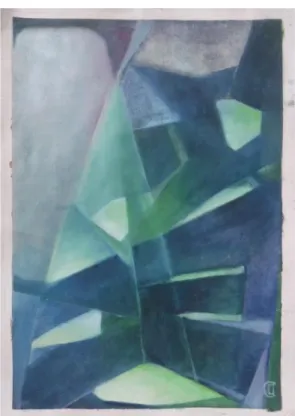
While reflecting on Scheibitz’s work, I continued toying with geometric angles, layering colour and form to slice up the picture plane. In painting Blue Window, 2019 (fig. 8), cutting through the composition with form and colour, the surface moved into the realm of layered geometric lines; a sense of depth and a new order emerged. By reconstructing a composition, artists are offered a momentary respite from the chaos and anxiety of the everyday. Within Blue Window, as the blue and green palette shifts and the geometric scaffold structure moves, light is revealed, and an element of hope is suggested. There is a deep sense of satisfaction in reordering the overwhelming chaos of global reality on the surface of a painting.
25 Stanley Kubrick, A 2001 Space Odyssey. Based on science fiction novels by the writer Arthur C. Clarke 1968.
26 Obrist, Thomas Scheibitz About 90 Elements, 195.
Figure 8 Linda Cook
Blue Window 2019 Oil on unstretched canvas 350 x 450 mm
© Linda Cook. All rights reserved.
At this time, I was dissatisfied with studio and sought more from the works. While accepting that the artists I had considered were influencing me and allowing me to explore, I sought more. Scheibitz acknowledges his influences, which include some of painting’s historic greats such as Henri Matisse, Mondrian, and Picasso, alongside the colour and line of contemporary graphics. Another major influence on his practice was the work of Blinky Palermo.27
Blinky Palermo
German artist Blinky Palermo was born Peter Schwarze and lived most of his life by the surname Heisterkamp before finally becoming Blinky Palermo. He had a short life, dying in 1977 at the age of thirty-three. His career successes could be down to having studied under the guidance of Joseph Beuys, Gerhardt Richter and Sigmar Polke,28 or maybe it was his intellectual brilliance or prolific output. His professional life was influenced by painters Robert Ryman and Barnett Newman, but his most prominent influences came from Mondrian and Malevich,29 as is evident in Composition with 8 Red Rectangles, 1964 (fig. 9). In this painting Palermo references Malevich’s Suprematism with Eight Red Rectangles, 1915, both in title and execution.
27 Rachel Thomas, Welcome to the Jungle: About 90 Element (London: Dublin and Camden Arts Centre, Irish Museum of Modern Art, 2008), 194.
28 “Blink Palermo”, Artnet, http://www.artnet.com/artists/blinky-palermo/.
29 Roberta Smith, “Blinky Palermo: Retrospective” (Arts Section, New York Times, 27 April 2011)
https://www.nytimes.com/2011/04/27/arts/design/blinky-palermo-retrospective-1964-1977-review.html.
Palermo worked with all kinds of matter – traditional oils on canvas alongside less conventional materials. David Duncan tells of how Palermo would build sculptural paintings which were known as “objects”: “the stitched together Stoffbilder (Cloth Pictures); the in-situ wall drawings and the acrylic-on-aluminium, Metallbilder (Metal Pictures)”.30 He would construct art with whatever material was available, working unconventionally with “the notion of painting without paint, in short, to the
experimental possibilities of painting”.31
Scheibitz sees in Palermo’s work an interpretation of rudimentary, everyday images, “the translation of things, such as times of the day, calendar days or cardinal points, things that appear to be quite fundamental or simple things.”32 Both Scheibitz and Palermo are
30 David Duncan, “Blinky Palermo”, Art in America (Aug 27, 2011), https://www.artinamericamagazine.com/news- features/magazines/blinky-palermo/.
31 Bob Nickas, Hybrid Pictures. Painting Abstraction, New Elements in Abstract Painting (New York: Phaidon. 2009), 67.
32 Thomas, Welcome to the Jungle: About 90 Element, 194.
Figure 9 Blinky Palermo
Composition with 8 Red Rectangles 1964, Oil and graphite on canvas, 960 x 1110 mm
Oil on canvas REDACTED
interested in position and place within time and space, considering the vastness of the universe and our microcosmic presence in a beautiful, yet ominous and dark world.
Palermo’s minimalist installation of 1976, The Points of the Compass, Himmelsrichtungen (fig. 10), exhibited in the Venice Biennale, referenced global positioning, in title and presentation. Palermo configured four rectangular forms of differing colours, which were suspended in relation to one another, as with a compass, the intention being to
reference the four corners of the globe.
There is another association, this one hangs within the suspension of the works. The physical presence of these four paintings, high in the corner of the gallery, refers to Malevich, specifically his iconic Black Square, 1915, which in turn referenced religious icons.
Figure 10 Blinky Palermo
The Points of the Compass, Himmelsrichtungen, 1976 Installation
REDACTED
Both Scheibitz’s and Palermo’s abstractions are difficult to categorise, but, as with Malevich, they are situated within the realm of the object, reaching beyond wall art.
These artists all avoid narrative, though with due consideration associations will surface which are located within our own consciousness and history.
Back to the Future
Identifying Palermo’s link to Malevich, and then Scheibitz’s acknowledgement of Palermo, reinforces Laura Hoptman’s concept of atemporality. In The Forever Now, Hoptman quotes William Gibson, who in 2003 described atemporality as the “new and strange state of the world in which, courtesy of the Internet, all eras seem to exist at once.”33 This then returns me to Stefano de Giovanni’s painting, and his use of flat, geometric blocks colour. That small, historical work with its complex composition has resided within me for 20 years, and I acknowledge that from time to time it has and will resurface in my own paintings.
33 Hoptman, The Forever Now, 13.
Figure 11
Kazimir Malevich Black Square 1915 795 x 795 mm Oil on linen
REDACTED
On reflection, I see that working with all manner of materials to build up complex surfaces keeps me engaged. This, and moving the eye across the picture plane, is the painting territory which anchors my practice. In the absence of narrative painting or recognisable form, I utilise such visual devices as surface, colour, and texture to fascinate and to enliven the pictorial plane.
Chapter Two: New Zealand Abstraction Now Not Then
Un-made Love
Having considered twentieth century abstraction, I now look to abstract painters, primarily, working in Aotearoa today, and relevant to my praxis. This chapter centres on discussions and interviews with a selection of contemporary painters. My objective is to analyse primary research material looking for commonalities, key factors and
considerations applied by a group of painters whose work informs and aligns with my own field of practice as an abstract, female painter in New Zealand. This primary
research proffers a voice direct from these artists and considers process, motivation, and methodology. I further position my own work within an approach defined as neo-
casualist, “provisional” and “messy” with regard to process and materiality.
This chapter is structured around the interviews with, and words of, Saskia Leek, Adrienne Vaughan, Rebecca Wallis and to some extent Cat Fooks. Though informed by these artists, my inquiry will not be limited to them; I will refer to other makers within the multifarious arena of abstraction including Thomas Nozkowski, exponent of small works and neo-casualism.
Of the “tribe” of painters I refer to, many acknowledge a preference for the “unfinished”
or “amateur”, a deliberate abandoning of the grandiose masterpiece and an avoidance of obvious contrivance; their works appear unforced, organic or “natural”. By way of
explanation, let us briefly consider the similarities between Nozkowski’s small scale paintings – “paint at a size that was scaled to my friends’ apartment”34 – and those of
34 Dylan Kerr, “Thomas Nozkowski, Meet the Artist”, Artspace, 2015, https://www.artspace.com/magazine/interviews.
Fooks. Fooks builds and constructs her paintings by plastering the surface with handy- man filler prior to layering them with paint. This sense of free abandon with textural materials is apparent in Impromptu Crab Apple, 2020 (fig. 12). An impromptu element exists withing Fooks’ works, a magical moment of not quite knowing where the work is going; I wish to explore this with my own paintings. Though modest in scale, Fooks’ work explodes with colour and texture. Both Fooks and Nozkowski forgo large scale in favour of the small and intimate and exude a seemingly unforced love of painting.
Figure 12 Cat Fooks
Impromptu Crab Apple 2020
Oil and mixed media on board 605 x 530 mm REDACTED
Thomas Nozkowski and Neo-Casualism
Preference for painting on modest formats and domestic scale35 is characteristic of neo- casualism.36 Untitled T-92, 1996 (fig. 13) substantiates Nozkowski’s use of quirky, unrefined forms, which he layers, working over repeatedly, to leave traces of former marks apparent. His use of abstract motifs records mundane daily routines, which often included a walk. Nozkowski was an artist, educator and mentor, whose practice was pivotal for his time. Having trained under the tutelage of second-generation New York abstract expressionists, he chose to reject mid-twentieth-century formal values
associated with critic Clement Greenberg. His work is indicative of a similar shift within contemporary painting’s move away from modernism; I see a tendency towards an unconventional, unexpected and intuitive output, alongside a rejection of the grandiose.
The macho heroic mid-twentieth-century painter is replaced by a group of painters whose works synthesise unconventional materials and reference the mundane scenario of routine, domestic occurrence.
35 John Yau, Thomas Nozkowski (London: Lund Humphries, 2017), 26.
36 Thomas Micchelli, “Painting on the cusp: Abstraction of the 1980s”, 6 July 1980, Hyperallergic, https://hyperallergic.com/74885/painting-on-the-cusp-abstraction-of-the-1980s/.
Figure 13
Thomas Nozkowski Untitled T-92 1996 Oil on linen on panel 406 x 508 mm REDACTED
Painting categories are often referred to as tropes, genres, followings or schools of; these phrases are synonymous and infer stylistic groups. A profusion of painterly tribes or languages exists. For this investigation I will consider those works which appear fresh, intuitive, uncomplicated, unfinished, or incomplete; neo-casualist or provisional.37 Although these painters embrace the off kilter and shonky,38 their works are deeply considered and critically well received. This sense of consideration suggests an innate intelligence. The use of solidified matter and crude colours is neither naive nor
accidental and sets the works apart from those which are purely decorative,
ornamental, or even overtly political. Therefore, the nonconformist motivations of the provisional painter, who rejects popularist painting, are futile; their refusal to comply gains attention: “To put it another way: provisional painting is major painting
masquerading as minor painting”.39
The mode of painterly practice in discussion here employs rough editing, unfinished marks, coarse textures, and non-harmonious colours, yet the works eventuate as joyous and free. As with all good things, this painterly methodology requires time which results in compositions and marks blissfully coalescing on the surface. The outcomes are pleasing; what at first appeared as anarchic disorder, now stirs a haptic experience, delighting both the body and the eye.
37 Ibid. Provisional, or new-casualist painting, is defined as unfinished, or incomplete.
38 John Waters, “The Aesthetics of Awkwardness”. Dundee Contemporary Arts, Feb 2018.
https://www.dca.org.uk/stories/article/events-programme-for-shonky-the-aesthetics-of-awkwardness-announced.
39 Raphael Rubinstein, “Provisional Painting”, Art in America (May 2008).
Anything Goes
Looking at the broad range of abstractions employed by painters in New Zealand today, one can see that, true to Danto’s perception, “The Historical Future” is upon us, and that just about anything and everything goes.40 Current trends see painters utilising all manner of studio methodologies, including pouring, spraying, rolling, printing, reminiscent of mid-twentieth century Jackson Pollock, dancing over his canvas whilst dripping and pouring paint. Is this a leap forward or a step back to a 1950s New York studio, a moment of deja vu? This sheer love of paint continues as makers absorbed by practice and flow41 engage with their painting materials; the love of fluid matter absorbs the mind. A cultural change has occurred over the last sixty years. We see contemporary makers respecting the materials of practice and the personification of agency in the field of making. This contrasts with many past painters who saw the material as a means to an end and themselves as “masters” of the canvas.
Sex and Drugs and Rock and Roll
The post-war society of the mid twentieth century was disillusioned, recognising the hopeful promises of a utopian world, as political propaganda. The creative sectors began to reconsider order and precise tropes; the patriarchal constructs were under scrutiny.
The 1960s saw artists shaking off the Quaker-like restrictions of formalism and its disciplined works of purity and quality. An evolution of thought and approach occurred, and in Western society alternate modes of thinking, a counterculture, emerged to question authoritarian structures; the promised post-war utopia of the 1950s was fast fizzling. So began a social revolution which moved away from subservient obedience to anarchic questioning of governance: feminism, civil rights, war protests, calls for gay rights and racial equality. The arts saw a multitude of movements erupt, including
40 Arthur Danto, The Work of Art and the Historical Future (California US: The Regents of the University of California and the Doreen B. Townsend Centre for the Humanities, 1998).
41 Mihaly Robert Csikszentmihalyi, Finding Flow (New York: Basic Books 1997).
Informe, Brutalism and proto-punk, later Punk. There was a merging of disciplines in the creative sector, each influencing the other.
The iconic banana album cover (fig. 14), produced for Velvet Underground by Andy Warhol,42 was a proto-punk emblem that resounded visually and became a united flag of the time; the album was loaded with discordant anthems of sex and drugs and rock and roll. The associative link with Warhol, who was a known successful name, brought attention to the album and the punk movement. Punk music was a proclamation of contemporary culture’s distrust of failed despotic governance. This anarchic vibration permeated the creative world; it flourished and grew; we saw it and we heard it.
Growing up at this time, I witnessed an array of disruption and disorder. A creative wave emerged, fit to adorn a dystopian-punk underworld. The sounds were dissonant,
challenging our minds and stimulating our subconscious – Hawkwind, The Social Deviants and later The Sex Pistols, quite a contrast to earlier melodies of Buddy Holly and Elvis Presley. The film world provoked and promoted a stochastic social rebellion with movies such as Stanley Kubrick’s rendition of A Clockwork Orange.43 All of this overflowed into photography, fashion, and of course fine art. This cultural rebellion is an undercurrent still present in the arts today. Whether contemporary abstraction is categorised as post- formal, neo-casualist or provisional, it can be seen as a distillation of a persistent refusal to conform. Though the abstract artists discussed here are not political dissidents, their way of working does raise questions by way of materials and presentation. This is considered here in regard to the works of the painters interviewed, and ultimately my own practice
42 Zuzzana Stanska, “The Story of Velvet Underground & Nico Album Cover by Andy Warhol”, Daily Art Magazine (15 April 2022). https://www.dailyartmagazine.com/the-story-velvet-underground-warhol-cover/.
43 Stanley Kubrick, “A Clockwork Orange”, 1971. Based on a novel, “A Clockwork Orange”, author: Anthony
Burgess (London U.K: William Heinemann, 1962).
Awk-Ward
In 2015, Natasha Conland curated an exhibition of abstract painting at Auckland Art Gallery Toi o Tāmaki titled “A Necessary Distraction”. Conland’s initial intention was to curate a selection of paintings which would discuss the concept of painting. The works were installed on unfinished gib-stopped walls in an attempt to locate the works in an unconventional, unruly setting. The curatorial focus was on “the shock effect of seeing painting isolated for its material conditions … Was there a coherent subject in an exhibition of just painting?”44 This suggests doubt in the exhibition’s intention even before it was adorning the gallery walls. The opening statement in Conland’s catalogue essay reads: “To be distracted is to have trouble – trouble with the present.”45 Is the curator suggesting that contemporary painting can be a distraction from the worrisome world and the standard, ornamental pictures for interior decor? Are today’s paintings a distraction, diverting the viewer from the “dominant narratives of our neo-liberal geo- political crisis”?46 I would suggest that the contemporary painters under consideration
44 Natasha Conland, Necessary Distraction (Toi o Tamaki, Auckland Art Gallery, 2016), 29.
45 Ibid.
46 Natasha Conland, Necessary Distraction (Toi o Tamaki, Auckland Art Gallery, 2016), 31.
Figure 14 Andy Warhol
The Velvet Underground and Nico
Album design 1967
REDACTED
here are motivated by a passion for paint and process, thus avoiding the perpetuation of decorative images comparable to those in Harvey Norman. These paintings suggest a disinterestedness in the production or manufacture of commercial products and put awkward objects into a world of readily assimilated commodities.
Noticeable, in A Necessary Distraction, were those artists who disregard the mammoth scaled works that only white walls of a museum can accommodate. Evident within this group of New Zealand abstractionists is a similar modus operandi as Nozkowski: small scale works with quirky marks on wobbly frames. These painters abandon monumental works in favour of the shonky; “the aesthetics of awkwardness”47. The masterpiece once depicted grandiose displays of heroic scenes – think Jacques-Louis David’s The Oath of Horatii, 1784 (fig. 15), or the macho celebrity artist, think Pollock, spurting his liquid at the world in reckless abandon.
Today canvases are more likely to be inspired by the domestic, everyday, mundane drudge of life. A Necessary Distraction featured small scale supports, bedecked with the
47 John Waters, “The Aesthetics of Awkwardness”. Dundee Contemporary Arts, Feb 2018,
https://www.dca.org.uk/stories/article/events-programme-for-shonky-the-aesthetics-of-awkwardness-announced.
Figure 15
Jacques-Louis David The Oath of Horatii 1784 3298 × 4248 mm
Oil on canvas
(copy in public domain)
subtle awkwardness of off kilter marks, yet with colours plucked from a mid-twentieth century kitchen, capable of transporting us to a former, safer, warmer, homely life. They tug at our heartstrings, we are engaged, and as the works beg enquiry, they arouse curiosity and investigation. At first glance they may appear unrefined, unfinished, or even humorous. However, I suggest that these surfaces warrant serious attention, and that they are capable of teleporting the viewer from the realms of social media and headline horrors into an alternate reality, reminiscent of Lewis Carroll’s liminal world
“through the looking glass”.48 If this is the case, is Conland’s opening statement spot on?
Can today’s abstract paintings distract us sufficiently to escape current global scenarios of viruses, war, and environmental collapse? Could this be our “Momentary Lapse of
Reason”,49 as we drift into someone else’s dream realm? Or am I being a hopeless romantic?
Certainly, when engaged with the studio process, the anxiety of resolving a painting’s puzzle displaces the major and mundane issues of the world, giving licence to focus on a
“thing” for a moment in time. As our mind wanders, it transports us to the realm of in- between-ness; a chill space of productive flow follows. However, once the work is on the wall in the white cube, whether that existential moment of making penetrates and communicates beyond the painting’s skin is an unknown factor. Sadly, A Necessary Distraction may have missed the mark in some ways. Though the walls were rip-shod and bare, referencing the Kiwi handyperson, the works were not quite as fresh and risky as the curator had intended. All the exhibited pieces were gleaned from prominent art dealers’ stables, thus leaning on safe recommendations and a certain polished pool of makers. Nonetheless, amongst them were painters who do take risks and resist the confines of formulaic uniformity, such as Adrienne Vaughan and Saskia Leek.
48Lewis Carroll, Alice Through the Looking Glass (New York: Macmillan Publishers, 1871).
49 Pink Floyd, “A Momentary Lapse of Reason”, EMI, Columbia, 7 September 1987.
Aotearoa Mahi
Adrienne Vaughan
My primary research begins with two painters, Adrienne Vaughan and Saskia Leek. I have known both for a number of years and respect their consistent professional approach to studio production. On discussing painting and life with these practitioners, the following flow occurred.
New Zealand painter Adrienne Vaughan sees her works as having an independent presence; she avoids evidence of self and wishes to “not over explain things”.50 Her approach as a painter is to disregard, or put aside, the weighty art world to focus on the problem of painting: “Let the critics argue the worth of the discipline, as a student I learned to forget the art world”.51 Avoidance of personal reference or narrative is a common factor for both Vaughan and Saskia Leek, who I will discuss later. Every effort may be made to side-step the personal, yet subtle slivers of reality occasionally slip in and evoke a sense of domestic nostalgia. The patterned grounds reference textiles, as John Hurrell states: “compressed tweedy textures, hint of a certain Edwardian masculinity”,52 and as such a simple pattern suggests something familiar which is lodged in our memory.
These subtle insertions trigger a sense of nostalgia53 and may cause us to ache for the comfort of a thing long gone.
Vaughan’s works have, by her own admission, evolved over time. Her use of scale and media have changed to accommodate altered circumstances such as family, children and personal responsibilities which steer her available space and time for work. Untitled
50 Adrienne Vaughan, in conversation with the author, March 2020.
51 Ibid.
52 John Hurrell, Eye Contact, New Zealand, March 2012, https://eyecontactmagazine.com/2012/03/unusual-pairing-at- miles.
53Peter Schwenger, The Tears of Things (London: University of Minnesota Press, 2006).
Drawing, 2020 (fig. 16), is a clear example of this methodology; started on the kitchen table using wet media and collage, these paintings pull together various components in one composition as time and responsibilities becomes available.
Vaughan’s consistent mark making practice remains, and these days with more
confidence. She has developed a dedicated habit of drawing on paper by maintaining a sound eye-hand connection which overflows into her painting practice. She states,
“paper is cheap and ubiquitous and requires little preparation. Up to fifty drawings may be made in preparation for works on canvas”.54 Vaughan’s attention to details evidences a keen eye. Allan Smith states that “her various patterns with various checks, stitches, herringbones, and loose threads evoke the textile of life.”55 Patient rendering of those familiar fibre patterns is apparent in her “slowly worked finishes”.56 Her detailed objects and patterns are complex, non-confrontational, even comfortable, and the carefully drawn designs frontroom-ish. However, soothing as the colour, tonality and patterns may be, the compositional structures keep the eye and mind busy; we are suitably
54 Vaughan, in conversation with the author.
55 Allan Smith, Necessary Distraction (Auckland: Auckland Art Gallery, 2016), 35.
56 Ibid, 36.
Figure 16
Adrienne Vaughan Untitled drawing 2020 Ink, oil and collage on paper, 425 x 520 mm
REDACTED
distracted, there is little time to relax. These small paintings traverse our mind carrying us to a personal memory or past association.
In Vaughan’s work, Flug, 2013 (fig 17), we see detailed attention to the handmade, with considered planes and repeat patterns which support abstract forms. These planes hold the forms in a structured composition, as scaffolding holding them in an abstract
dimension. Vaughan openly discusses her love of Nozkowski’s works, referring to them as “quirky abstractions, where figure/field relationships are uneasy, the distinctions between the figure-ground are disturbed.”57
The connection between Vaughan and Nozkowski’s nondescript abstract figures appears in the use of their meticulously rendered, patterned fields. Both painters work and rework their surface, engaging the technique of “distressed surfaces; dry, fresco-like coatings and multiple layers, evidence passing of time and change.”58 Vaughan’s use of a limited palette unifies her composition, and the layered pictorial field builds an intriguing
57Vaughan, in conversation with the author.
58 John Yau, Thomas Nozkowski (London: Lund Humphreys, 2017), 67.
Figure 17
Adrienne Vaughan Flug 2013
Oil and enamel on canvas 502 x 655 mm REDACTED
surface, revealing ghost-like traces of her former mark-making. This well worked platform references the painting’s history, enticing us to ask, what came first?
Nozkowski’s works reveal a similar approach. Using veils of transparent glazes as an editing technique he covers earlier marks, pushing back the underpainting to allow the flimsiest trace of the former to be evident. His works are a statement that nothing is so precious as to avoid erasure. These technical practices and use of pictorial compositional structures are seen in both Vaughan’s work Ringer (fig. 19) and Thomas Nozkowski’s maze-like shape, untitled 6-113 (fig. 18). The working of the surface ground is a method I took to the studio to explore and exploit further.
Figure 18
Thomas Nozkowski Untitled 6-113 1991 Oil on canvas board 406 x 508 mm REDACTED
Figure 19
Adrienne Vaughan Ringer 2016 Oil on canvas 300 x 250 mm REDACTED
Adopting the process of addition and reduction, I started experimenting with various materials to exploit the potential of surface texture. Areas were built and sanded back.
The works on cardboard emerged as a result of Lockdown 3. All my materials were at the Art School and being stuck for resources I located a stash of cardboard tucked away at home, a material I could easily source from the supermarket. This began my relationship with the flexible, porous, and malleable surface of cardboard. At first, the former box seemed a challenge; it was easy to cut but difficult to seal and very unpredictable. I would gesso and glue the surface only to return a few hours later to find it warped and twisted. Many trials ensued to find a way to work with this newfound material.
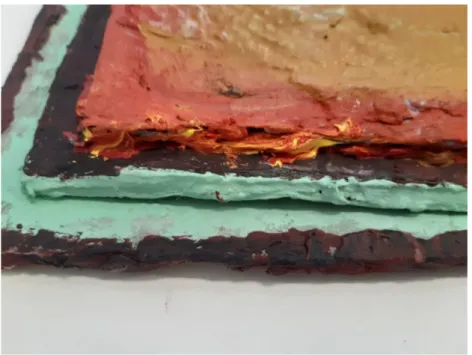
Once the construction was realized I considered the formal values of texture, colour and scale. A variety of textured waste matter was added to the surface, such as paper, card, dog hair, textile and so forth. Builders’ compounds and glues were also incorporated to build and reduce as needed. This is somewhat evident in Building of Surface Detail (fig.
20). With the surface at a satisfactory point, I began adding powder clays to oil paints and pigments to extend the viscous structure of the fluid. The building of layers, texture