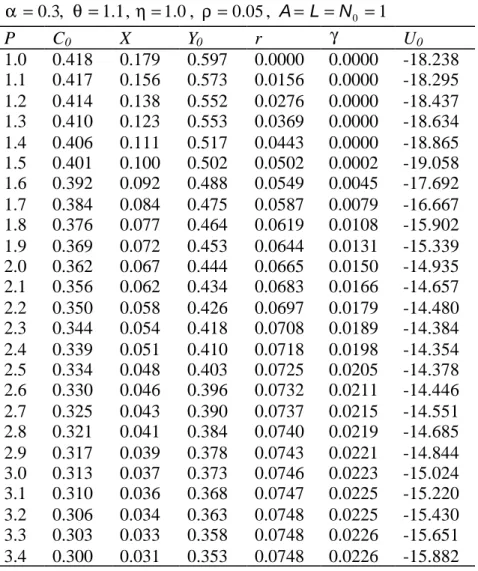
First, some macroeconomic growth models link dynamic efficiency to the economy's long-run growth rate. In our model, the sector of the economy that produces consumer goods is competitive, and innovation occurs exclusively in the production of the intermediate goods required for the production of those consumer goods. The intermediate producers get monopoly rights over the production and sale of the products they have invented.
Pareto optimality can be achieved by imposing essentially flat taxes to subsidize the production of final goods or the purchase of intermediate goods at. First, given the prices of intermediate goods set by the government, firms' demand for intermediate goods in the final goods sector and investment in projects to supply the intermediate goods are calculated as a function of controlled prices. Since regulated prices affect the demand and supply of intermediate goods, changes in the prices of intermediate goods have welfare implications.
Given the decisions of firms and households, the government can then maximize the households' welfare by choosing an order of the price of the intermediate goods. The cost of a project (for creating/adopting a new type of intermediate goods) is fixed at η units of the final good Y. From (6) and (9), the present value of the profits of project j . 10) When there is free entry in the intermediate goods sector, the net profit of project j is zero.
Indeed, the production growth of the final good is determined by the rate of investment in projects that produce intermediate goods.
3 Empirical Studies of Dynamic Efficiency
- Introduction
- Telecommunications
- Banking
- Industry Arrangements and Industry Structure
- Conclusion
Because of the structure of the telecommunications network, public policy has always played a large role in its production and regulation. A comparable analysis is followed to estimate the loss due to the regulatory delay in the introduction of mobile phones. Banks were subject to extremely heavy entry barriers in the form of branch restrictions at a relatively early stage of the industry's development.
When these restrictions were lifted, better banks expanded at the expense of their poorly managed rivals, improving the efficiency of average bank assets. The case of the Dutch construction cartel was used as a warning to the Dutch government to reform its tradition of publicly sanctioned cartels. In the New Zealand context, examples of empirical work that can provide a measure of the costs of dynamic inefficiency are most easily provided by reference to public versus private sector investment.
In the past, a large proportion of infrastructure investment decisions in New Zealand have been made by the public sector. Before the advent of state-owned enterprises in 1986, investment and regulation were influenced by multiple objectives stemming from the political demands of the day and discrete changes in pricing and investment policies (in the case of telecommunications see Evans 1996 on pricing, and Mason-Morris 1985 for investment). This would require a study of the welfare losses over time that resulted from excess supply (actually the present value of the operating cost of excess generating capacity and the opportunity cost of invested capital).
The wholesale price is the weighted effect of the component prices - day, night, etc. - of the bulk. The importance of pricing and managing capital to create dynamic efficiency is also illustrated by the electricity distribution industry. While pricing capital fully in all its uses should improve dynamic efficiency through its impact on the choice of investment, in the case of electricity distribution companies there is a trade-off between this effect and the effect of any local monopoly power in aspects of the distribution business.
It follows that the present value of negative economic surplus can also be used as an empirical measure of dynamic inefficiency. 19. This approach relies on assumptions about asset valuation and cost of capital that will be key to the result, but has the advantage of simplicity and utility as an indirect measure of the reduction in social welfare arising from dynamic inefficiency. These profits act as an incentive to develop innovations that drive the rate of economic growth.
Consideration of similar public policy initiatives will benefit from a careful analysis of the dynamic efficiency implications of the proposed interventions or regulations. This is partly due to the impact on consumer welfare and the pace of economic growth resulting from the slower development and introduction of innovations. The losses also stem from the very high costs associated with inappropriate investment decisions (e.g. poorly located power stations and overinvestment in rail lines), the existence of which can continue to affect the efficiency of the market for long periods after initial construction.
The subsidy may lead to entry taking place with a level of sunk investment that is sub-optimal, with clear implications for the incumbents' incentives and potential to then reach a viable operating position in the absence of the subsidy.