
The Chief Executive Officer of the Department of Primary Industries and Regional Development and the State of Western Australia disclaim any liability, whether negligent or otherwise, arising out of the use or disclosure of this information or any part thereof. Harvesting strategies for aquatic resources managed by the Department of Primary Industries and Regional Development (the Department) are formal documents established on the basis of a formal policy (Department of Fisheries 2015) to support decision-making processes and ensure consistency with the principles of Environmentally sustainable development (ESD; the objectives of ESD are reflected in the objectives of the Fish Resources Management Act 1994 (FRMA), section 3, and the Aquatic Resources Management Act 2016 (ARMA), clause 9, which will one day replace the FRMA issued.
These strategies provide guidance for decision-makers but do not derogate from or limit the exercise of discretion required for independent decision-making under the FRMA by the Minister for Fisheries, the Director-General (as Chief Executive Officer) of the Department for Primary Industries and Regional Development or other authorized bodies decision-making in order to meet the objectives of the FRMA.
Review Process
Monitoring and assessment of the marine aquarium resource is carried out via a risk-based approach that calculates the current or likely future 'sustainability risk' of the marine aquarium species. This document has been developed via a consultation process with industry members and must be approved by the department's Director General and the Minister for Fisheries. 2 As defined in Schedule 7 of the Fish Resource Management Regulations 1995: Family Corallinaceae; Classes Polychaeta, Crinoidea, Ascidiacea and Ophiuroidea; Phyla Bryozoa and Porifera; and dead fish of the Classes Anthozoa and Hydrozoa.
3 By-catch is described as that part of the catch that is returned to the sea (commonly referred to as unretained or discarded) either because it has no commercial value or because legislative requirements prevent its retention.
Environmental Context
Retained Species
- Finfish
- Syngnathiformes
- Hard corals
- Tridacnid Clams
The MAF is permitted to catch species of the Order Syngnathiformes (i.e. seahorses, sea dragons and pipefish) listed in Part 13 of the Environmental Protection and Biodiversity Conservation Act 1999 (EPBC Act) only from state waters (within 3 nautical miles ). ). Most of the coral species targeted by the MAF occur in turbid 'off reef' environments, as opposed to 'blue water' reef environments on which most of the research and scientific literature is based (Pers. Comm., MAF- fishermen). Only a small portion of the tridacnid clam population is targeted by the MAF based on size (up to 30 cm across) and color to meet market demand.
Live rock' also forms an important part of the filtration system in marine aquariums, providing a natural refuge for denitrifying bacteria.
Fishing Activities
- Governance
- Commercial Fishing
- Aquaculture Broodstock Collection
- Public Benefit and Other Commercial Purposes
- Recreational Fishing
- Customary Fishing
In 1986, the number of commercial licenses approved to operate in the MAF was limited to 20, however, this number increased to 25 following a review of the MAF in 1991. With the introduction of the FRMA, the authority to take marine aquarium species under a PFL endorsement was converted to a Commercial Fishing License (CFL) condition. In 1995, the marine fish component of the fish was formally managed through the introduction of the 1995 Marine Aquarium Fish Management Plan.
Fourteen Managed Fishery Licenses (MFLs) were subsequently issued in accordance with the access criteria set out in Fisheries Management Paper 63 'Management of the Marine Aquarium Fishery'. Catching of all other invertebrate species was managed via CFL condition until 2005 when a ministerial exemption was granted under Section 7 of the FRMA. In 2010, the number of licenses in the MAF was reduced from 13 to 12 when one MFL was surrendered due to the expansion of the Ningaloo Marine Park.
In the same year, the TACC for 'live rock' was increased on a trial basis to 5,000 kg per MFL (TACC of 60,000 kg) on the basis of research advice on the productivity of the marine environment in production. A comprehensive review of the fishery was completed in 2017, resulting in the existing legislative framework (ie the management plan, exemption, executive order and license conditions). Several commercial aquaculture licenses have been issued in WA under section 92 of the FRMA, authorizing the cultivation of marine aquarium fish species (e.g.
Applications to obtain broodstock via a Ministerial Exemption were considered on a case-by-case basis and approved on the basis that there is no increase in risk category of the species concerned. Each year small volumes of marine aquarium species are collected for public benefit and other commercial purposes via Ministerial Exemptions issued under section 7 of the FRMA on the basis that there is no increase in risk category of the species concerned.
Catch-Share Allocations
Long-Term Objectives
Ecological Sustainability
Economic and Social Benefits
Operational Objectives
Overview of Management Approach
Performance Indicators, Reference Points and Control Rules
Identifying Performance Indicators and Reference Levels
Each new species will then be formally assessed as part of the next regular risk assessment. Applications for exemptions for the harvesting of marine aquarium fish species for aquaculture purposes for propagation, public benefit or other commercial purposes outside the scope of MAF management will be considered on a case-by-case basis. Exemptions may be granted subject to the condition that the total catch of each target species (ie by MAF and exemption holders) is managed within the limit value.
Other ecological assets included in this harvesting strategy include bycatch and ETP species, habitats and ecosystem processes. Only the effects of MAF on these ecological components are currently assessed within this harvest strategy. Reference levels used to monitor MAF's performance against management objectives for these assets have been established to differentiate acceptable fishing impacts from unacceptable fishing impacts according to the levels of risk defined in Fletcher (2012).
In line with ESD principles, this harvesting strategy also includes objectives and performance indicators for the economic and social benefits of fishing. It is important to note that management actions related to these objectives are carried out within the constraints of environmental sustainability. The economic and social objectives currently have no explicit performance measures within this harvesting strategy.
Where possible, and taking into account ecological sustainability, fisheries management arrangements can be adjusted or reformed to help meet these objectives. Once appropriate and measurable indicators for monitoring performance against economic and social objectives have been identified, these will be included in future revisions of this harvesting strategy.
Control Rules
Threshold: The impacts of fishing are considered to generate an undesirable level of risk to any population of the species kept, i.e. Limit: Fishing impacts are considered to generate an unacceptable level of risk to any population of the species kept, i.e. To ensure that fishing impacts do not result in serious or irreversible damage to populations of bycatch species.
Limitation: Fishing impacts are considered to create an unacceptable level of risk to populations of any by-catch species, i.e. Limitation: Fishing impacts are considered to create an unacceptable level of risk to populations of any ETP species, ie. Objective: Fishing impacts are considered to create an acceptable level of risk to all benthic habitats, ie.
Threshold: Fishing impacts are considered to generate an undesirable level of risk to all benthic habitats, i.e. Threshold: Fishing impacts are considered to generate an unacceptable level of risk to all benthic habitats, i.e. Objective: Fishing impacts are considered to generate an acceptable level of risk to ecological processes within the ecosystem, i.e.
Threshold: Effects of fishing are considered to generate an undesirable level of risk to ecological processes within the ecosystem, i.e. Limit: Effects of fishing are considered to generate an unacceptable level of risk to ecological processes within the ecosystem, i.e.
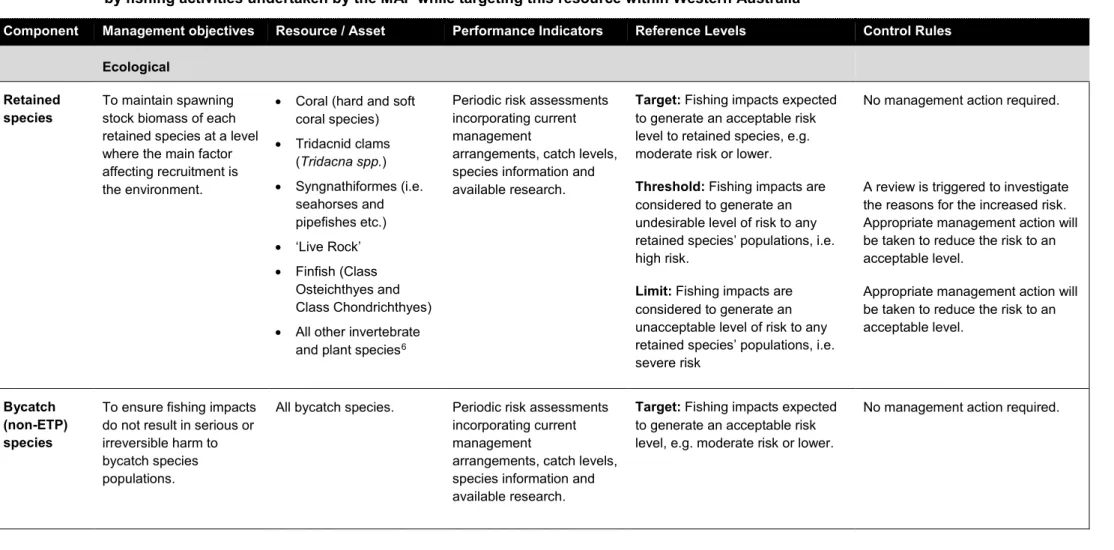
Monitoring and Assessment Procedures
Information and Monitoring
Assessment Procedures
Reports and Publications
No more than one nominated operator and three nominated collectors may operate under the authority of one license at any one time. Species Restrictions Species specifically covered by another managed fishery (eg western reef lobster) and fully protected species (eg weed sea dragon) cannot be taken. Fishing is excluded from operating in Marine Park protected areas and taking corals and live reefs from some Marine Parks.
Implementing Changes to the Management Arrangements
Consultation
Management changes are usually implemented through legislative changes, such as the commercial fisheries management plan, regulations and decrees. The peak bodies are funded by the government under Service Level Agreements (SLAs) to take on their representative/advisory and advisory role. Under the SLA with the department, WAFIC has been funded to perform regulatory consultation functions related to fisheries management plans and to facilitate management meetings (MMs) for licensed fisheries.
FRMA requires the Minister to consult with affected parties when changes to the Part 6 management plan are being considered. MoUs between the Department, WAFIC and license holders are used as the main forum to consult with stakeholders and license holders on fisheries management. During these meetings current and future management issues that may have arisen during the previous fishing season and any proposed changes to the management plan are discussed.
Under the SLA with Recfishwest, the Department is required to consult with Recfishwest as the recognized peak body for recreational fishing in Western Australia. Recfishwest is expected to engage and consult with recreational fishers as necessary to meet its obligations. Consultation with non-fishermen stakeholders, including government agencies, conservation sector non-governmental organisations, customary fishers, statutory advisory committees and other affected/interested parties is undertaken by the Department in accordance with the Department's Stakeholder Engagement Guideline (Department of Fisheries, 2016).
The Department's approach to stakeholder engagement is based on a framework designed to help select the appropriate level of engagement for different stakeholder groups. Key fisheries-specific documents such as harvest strategies, recovery plans and bycatch action plans are subject to both formal stakeholder consultation and public consultation processes.
Compliance and Enforcement
Operational Compliance Plan
Evidence of large, local variations in recruitment and mortality in the small giant clam, Tridacna maxima, at Ningaloo Marine Park, Western Australia. Policy for the Implementation of Ecologically Sustainable Development for Fisheries and Aquaculture within Western Australia. Review and refinement of an existing qualitative risk assessment method for application within an ecosystem-based management framework.
An ecosystem-based fisheries management framework: the effective regional-level planning tool for management agencies. Improving harvest strategies to enable effective implementation of ecosystem-based fisheries management for multi-sector, multi-species fisheries in Western Australia. A new widespread cryptic species and phylogeographic patterns within several giant clam species (Cardiidae: Tridacna) from the Indo-Pacific.
