MINERALOGYA NDSTABLEISOTOPE COMPOSITION OF RECENT C ARBONATE SEDIMENTS AND WATER S FROM FIVE SMALL L AKES, SOUTH-EASTERN SOUTH AU STRALI A.
Timothy Henderson B.Sc.
November 1997
The University of Adelaide
The Department of Geology and Geophysics
This thesis is submitted in partial fulfilment for the Honours Degree of Bachelor of Science, Geology, University of Adelaide
Australian National Grid reference Robe 6823-1 &PTIV
Beachport 6823-2
1:50 000
1. Introduction
The aim of this study on five lakes in the southeast of South Australia was to:
1. determine the variation in the stable isotopic composition of the modern carbonate precipitate;
2. determine the variation in the stable isotopic composition of the dissolved inorganic carbonate (DIC) of the lake waters;
3. monitor the variation in the composition of the precipitating carbonate for each lake;
4. compare and contrast each lake studied.
The Robe-Naracoorte coastal plain of southeast South Australia is characterised by a series of low ridges. They generally increase in age landward (Sprigg 1952). These ridges are predominantly composed of bioclastic carbonates of varying degrees of lithification. The elevation averages
15m (Cann et al. in submiss. 1997). The Robe and Woakwine Ranges run roughly parallel to each other and the current shoreline between Robe and Beachport (Fig. 1), forming the Robe-Woakwine corridor. This flat lying corridor is characterised by a scattering of lakes of various sizes. The series of lakes of concern to this study, Lakes Woolley, Old Man, Fresh Dip, Amy and Ghost, are amongst the smallest within the corridor and are situated either within hollows in the eastern (landward) side of the Robe Range (Amy &
Ghost) or within the corridor, at the foot of the Robe Range (Woolley, Old Man, Fresh Dip). The lakes are therefore regarded as simply groundwater windows or alternatively as an outcrop of the local watertable. But to consider these lakes as simply an outcrop of the local watertable neglects to take into consideration many important factors which influence the lake's mineralogy, stable isotopic composition, biological activity, salinity, lake level etc.
The study of oxygen isotopic composition of biogenically and inorganically precipitated calcium-magnesium carbonate minerals is an important field of study in sedimentary geochemistry for both economic and scientific reasons. The fractionation of 180 between the aqueous and solid phases is temperature dependent. Thus it can be used to determine global environmental change from calculations of palaeotemperature.
The use of oxygeri stable isotopic values in lake carbonates is relatively widespread and shows interesting and systematic variations (Talbot 1990), but studies that have calculated the stable isotopic variability of the precipitated carbonate over an experimental period using the measured stable isotopic composition of the lake water from concurrently measured saline conditions are rare (Rosen et al. 1994). Many studies have monitored the monthly 8180 of lake
3.2 DIC stable isotopes 3.2.1 Introduction
The water samples taken on a monthly basis from each lake were analysed to determine their 8180 and 813C stable isotopic composition and to monitor any subsequent seasonal variation. Any variation in the 8180 and 813C of the lake waters will ultimately cause variability in the composition of these stable isotopes in any precipitation occurring within the lake. The stable isotopic composition of the water samples is determined from the dissolved inorganic carbon (DIC) in the lake water. All 8180 and 813C stable isotope values are expressed in permil (%0) relative to PDB standards. All quoted stable isotopic enrichment or depletion refer to 8180 and 813C.
3.2.2 DIC stable isotopic equilibrium
( Waters entering the lakes are derived from two sources;
a) rainfall, direct input or as a result of surface or vadose zone run-off.
b) inflow of groundwaters from adjacent aquifers, from either direct percolation or from surface run-off.
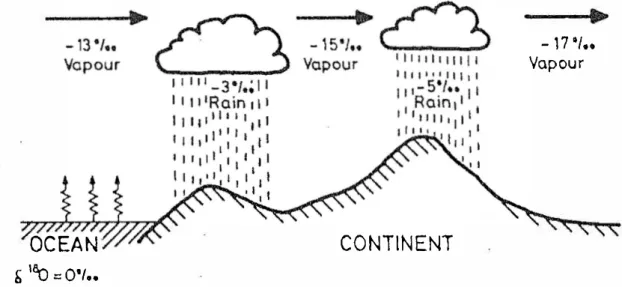
Waters from these two sources are typically in disequilibrium with surface atmospheric conditions. As a result their isotopic signature reflects this disequilibrium with atmospheric conditions. Typically, groundwaters and rainfall exhibit depleted stable isotopic signatures (Fig. 9).
Figure 9. Rain H2O fractionation (Arthur et al. 1983).
OCEAN
CONTINENT&
'8a
= 0'/,.- 17 ., ••
Vapour
19
4.3 Sediment stable isotopes
4.3.1 Carbonate sediment stable isotopic equilibrium
The process of carbonate precipitation results in stable isotopic fractionation, with the precipitated carbonate undergoing enrichment with respect to the DIC of the parent waters, major influences are listed below.
Biogenically precipitated carbonate displays a differing 0180 fractionation value to inorganically precipitating carbonate at a rate which is determined primarily by temperature (Arthur et al 1983). The difference is only exhibited below -10°C, and since water temperature generally remained above this, fractionation due to temperature can be ignored. As with enrichment values for DIC atmospheric equilibrium stated previously, there is a wide range of values quoted for enrichment associated with carbonate precipitation. o13C enrichment during precipitation displays a wide range of values as fractionation is affected by the rate of precipitation, with slow precipitation exhibiting greater enrichment than carbonates precipitating quickly (Turner 1982). Some typical values are listed below.
13C fractionation (%0)
-2.4 Turner(1982)
fast ppt rate Turner(l982) slow ppt rate Turner(1982) Emrich(l970) -0.55
-4.0-1.27 -0.4-3.4 -2.26
fast ppt rate Grossman et al. (1986) slow ppt rate Grossman et al. (1986)
Rahimpour-Bonab( 1997)
£ calcite -aragonite 13C fractionation (%0)
-1.6 Turner(1982)
-1.8-1.7 -1.2
180 fractionation (%0) -1.3-0.6
Rubinson & Clayton (1969) MacConnaughey et al. (1996) Gonzales & Lohmann ( 1985)
Turner(1982)
Tarutani et al. ( 1969)
39
6.0 Conclusions
The DIC stable isotopic composition of the lakes surface water varied from lake to lake and each lakes DIC stable isotopic signature varied on a monthly basis.
Monthly variations in the DIC stable isotopic signature of the lake water represent the stable isotopic effects of differing rates, and sources of water inflow, evaporation, biological activity, decomposition of biological material and respiration. The DIC stable isotopic signatures of the lake waters reflect waters that have originated primarily from highly depleted groundwater and rainwater. The water has undergone isotopic fractionation and subsequent enrichment on equilibrating with atmospheric CO2• Variations in the DIC stable isotopic signature observed between lakes reflect the varying nature of the lake environments.
The stable isotopic composition of the lake sediments also varied between lakes. Sediments displayed precipitation at disequilibrium with the DIC of the lake waters, reflecting inorganic precipitation at an intermediate rate. Calculated equilibrium stable isotopic values of the sediments compared poorly with the observed trends. This reflects the varying nature of each lake environment, indicating a limitation in applying generalised modelling techniques to such variable systems.
The mineralogy of each lake is a unique assemblage of LMC, IMC, HMC, aragonite and MHC. Variations in the mineral percentages indicate conditions favourable for the precipitation ofLMC and aragonite, and MHC in the case of the Lake Amy, prevailing over the winter months. The high percentages of HMC present in each lake ( except Fresh Dip) indicate that the majority of the carbonate precipitation occurs during the summer months. The occurrence of MHC in Lake Amy, which has a high level of microbialite activity, is strong evidence for the biologically aided precipitation of MHC. This is reflected in the high stable isotopic fractionation values of the precipitating carbonate. The increase in the concentration of Mg-rich carbonates to the north of the region is possible evidence for a decreasing interface angle between dense seawater and groundwater in the north. This results in a seawater/groundwater mixing zone closer to the surface in the north of the Robe-Woakwine corridor.
48
8
6
4
2 -t
" f
.a
.!l 0
i
ril-2
-4
-6
OLD MAN LAKE ISOTOPIC DATA PLOT
,..
-�---·-
\
may
/'
...
july aug
-8
1---
month
-
I --+-13Csed surf-lll-180sed surf 13Csed 5cm ....-1sosed 5cm
sept
--
-¼- 13C h20 180 h20'ifi'Fi
=
r
i:,, (l) :;;
r
LAKE AMY-NORTH ISOTOPIC DATA PLOT
8-,---
6
2f �
·---·-
.!
0�I
��s �
f
aril may j� � .._ �.!!!
-2
-4
-6
-8 _,_ _______________ _
month
-+-13Csed surf --180sed surf 13Csed 5cm --180sed 5cm --,;Jf,- 13Ch20
-+- 18Oh20
r =
:;:;- '-< =
�
LAKE AMY-SOUTH ISOTOPIC DATA PLOT
8 ---·---
6
r- � . � =
4 ::::::.::
!oJ
� a ril .. 27"k ---" � � X-._ ' � �
june ,!!!
-2
-6
-8-'---
month
--13Csed surf --180sed surf 13Csed5cm --180sed 5cm -- 13Ch20 -- 180h20
t'"
�
>
s
c.
o
13C & 0
180 stable isotope equilibrium values
Ghost Lake Old Man Lake Fresh Dip Lake
DATE 013
C calc.equl 6180 ca!c.equl Q13C calc.equi 8180 calc.equi 613C calc.equ! 6180 calc.equi
April -0.97 -2.39 0.09 2.35 2.23 1.70
May 2.97 2.37 0.34 -2.08 1.70 2.00
June 3.08 2.26 0.69 0.91 2.53 2.17
July 1.96 1.34 0.75 2.13 1.77 2.28
Aug 0.64 -1.53 0.49 0.75 2.79 2.48
Sept 1.96 -0.39 0.68 1.91 2.30 1.57
Lake Amy Nth LakeAmySth Ghost Lake
DATE 613C calc.equJ ◊180 calc.equl 613C cafc.equl ◊180 calc.equl ◊13C calc.equi 0180 calc.equ!
April 1.83 -0.38 0.46 0.64 1.17 2.34
May 1.18 0.61 0.88 1.16 -0.72 -0.31
June 0.86 0.98 0.57 1.13 0.15 0.94
July 0.60 0.71 0.72 1.86 0.07 1.10
Aug 0.33 0.45 0.64 0.45 0.56 -0.14
Sept 0.54 0.71 1.01 1.35 0.77 -0.36
i
1
Old Man Lake sediment equilibrium
6 -,---·---
---··---··---·---
4
2
0 ai\ril
-2
-4
-6
________________ ., ______ _,
-···<>···
may
,-
·--- ---·----·�---�·
month
. . . - . . - :';.... - -□ . . . - � -<> -- ... _ _ · . ___
. .. ....
july aug �pt
·••n4,.,;,.Jiiii;;;;;;;;a-.u;:.1,
i. gifl
- 13Csed surf ---11-- 180sed surf
,.__
13C h20-
18Oh20• • .c,. • · 13Ccalc eql
• • D • · 1SOcalc eqi
=
r
is, :;,:;'
�
Lake Amy-North sediment equilibrium
5 4 3
2
:a 1
I
-□· ...l
s o0 ai!li1 • may
.lll
.... ·.✓ - cs·.g: :·.·:_·::::::.-.·.·_•ij::: :: ;; ::::::: '. :g; :: :: :: ....
•�pt -1
-2 -3
4;t:__ ______________ n_fu _________ _
- 13Csed surf - 18Osed surf
-
� 18Oh20 13C h20· · <>- · · 13Ccalc eqi
• • 0- • · 1 BOcalc eql
>
�"-< 8
�
z
i
·,
6 5 4 3 2
·S.
0-�
-1-2 -3 -4 -5
Lake Amy-South sediment equilibrium
: : : : : �: : : : : : : : : : : _ - - " - -o- . " -" -- - - -- -� - - " -- ": -..• ,::
8:::::
_._-y-·-month
july '-. •�� / s,jpt
13Csed surf - 180sed surf -.1r- 13C h20
- 18Oh20
- - <> - · 13Ccalc eqi - • D • · 18Ocalc eql
>
'<
9
r.r.i
.•.• ,.,._,_.1;4_M>fr&�,<>
a. Temperature, pH & TDS values Lake Woolley
TEMPERATURE deg Celcius pH
DATE H, 0 'C sed 1cm sed 2cm sed 10cm pH H, 0 pH sed 2cm TDS (g/L)
april 17.0 15.0 14,0 12.5 7.58 7.42 8.12
may 12.5 12.5 12.0 12.5 8.75 7.21 79.92
june 13.5 13.0 12.5 12.0 7.62 7.93 40.40
july 16.0 16.5 15.5 14.5 7.99 7.73 29.10
august 16.5 16.0 16.0 14.5 8.38 8.28 21.30
sept 16,5 15,5 15.0 14.5 8.53 7.87 21.99
Old Man Lake
TEMPERATURE deg Celcius pH
DATE H,O'C sed 1cm sed 2cm sect 10cm pH H, 0 pH sed 2cm TDS (g/L)
april 19,5 19,5 18.0 16.5 7.97 7.8 38,85
may 16.5 16.5 16,0 15.0 8.24 8.15 35.25
june 11.5 11.5 12.0 12.0 8.56 8,3 28,95
july 14.7 14.7 14.5 13,5 8.08 7.96 25.05
august 15.0 14.5 14,5 14.0 8.2 7.98 23,61
sept 16.0 15.5 15.5 15.0 7.81 7.6 20.40
Fresh Dip Lake
TEMPERATURE deg Celcius pH
DATE H,0°C sed 1cm sed 2cm sed 10cm pH H,O pH sed 2cm TDS (g/L)
april 17,0 16.0 16,0 15.5 8.49 8.1 4.29
may 14.5 14.0 14.0 13,5 7.84 8,65 4.35
june 11.5 11.5 11,5 12.0 8.34 7.61 3.96
july 12.5 12.0 11.7 11.0 8.45 8.25 3.75
august 13.0 13.5 13.5 13,0 8,5 7,85 3.72
sept 16.5 15.5 15.0 14.5 8.53 7,87 2.97
Lake Amy Nth
TEMPERATURE deg Celcius pH
DATE H,O'C sed 1cm sect 2cm sed 10cm pH H,O pH sed 2cm TDS(g/L)
april 17,5 17.5 17.0 17.0 8.06 7.63 86.85
may 15.0 15.5 15.5 16.0 7.89 8.13 77.20
june 10.5 11.0 11.0 11.5 8,01 8.05 58.45
july 11.5 11.5 11.0 11.0 8.12 7,84 53,04
august 13.5 14.0 13.5 13.5 8.17 8.28 56.64
sept 17.5 16,5 16.0 15.5 7.65 7,7 45.45
r
,"b. Temperature, pH & TDS trends a. Lake Woolley: tempi p!i I TDS
20 90
18 80 --+- H20oC
16 70 -- sed1cmoC
,: "- 14 60 _
-
1250 � --- sed 2cmoC
10 --sed 10cmoC
.!?,
""
8 40g
-¼- pH H2oE 6 30 I-
20 -.Jl} .. ,. pH lllld 2cm
2 4 10 ---lDS (g/L)
0 0
april ITTJY June july august sept
month
b. Old Man Lake: temp I pH I TDS
20 40
18 35
--
H20oC16 30 -II- sed 1cm oC
'§. - 1214 25 ..,_. -A-sed2cmoC
20i 4E-sed 10cm-0C e 10
j
"- 8 6 15,,,
i:! _.,_ pH H20 .. -@-pH mud 2cm4 10 -¼-TOS(g/L)
2 5
0 0
aprll may june July august sept
monlh
c, Fresh Dip Lake: temp I pff I TDS
20 5
18
--
H20oC16 4 -- sed1cmoc
1i_ 14
:::, 12 3 ;:, -+-sed2cmoc
� 10 � -•ed 10cmoC
t
6 2 igle: -!ii- pH H20m
64 .. 4- pH lllld 2cm2 -¼-- lDS(g/L)
0 0
aprll ITBY June jUly august sept
month
d, Lake Ano' Nth: temp Ip.HI TDS
20 90
18 80
--
H20oC16 70
:,:
"'
14 60 -,. -- sed1cmoc- 12 50 � ...._,sed2cmoC
� 10 "" -�-sed 10cmoC
"- 8 40
i3
--lll- pH H20E 6 30 >-
20 --pHm.id2cm
2 10 -,t,-- TDS {g/L)
0 0
april rray june july august sept
month
e. AmySth: temp I pH I TDS
20 90
18 80
--
H20oC16 70 -- sedicmoc
:,: "- 14 60 ..,_
12 -.1--sed2cmoc
10 50 � "- --•ed 1ocmoc
-
a. E 86 40 30!Ii
"' ·-!!I- pH H2 020 •-111-pH rmd 2cm
2 10 _,.._TDS{g/L)
0 0
april rray June July august sept
month
£ Ghost Lake: temp I pH I TDS
22 50
2018 45 40
---
-- sed1cmoC H20oC1£. 16 35
� 14 30 ;f -,1,-sed2cmoC
� 12 25 -1:l -x-sed 10cm oC
- 10� 8 20 e -·- pH H20
S 6 15
4 10 --¾--pH rmd 2cm
2 5 -.i.-TDS(g/L)
0 0
aprll rmy June July august sept
month
e. Robe--Beachport rainfall
120 100
80
I 'e so
40 20
month march april june may july aug sept
Robe
raln97(mm) 17 7
2
115 74 49 78 87
Beacl,port
rain ave (mm) rain 97 (mm) rain ave (mm)
3
26 16 29
47 13 53
75 83 80
96 42 108
105 58 118
4
85 66 95
80 72 93
5 6 1
month
IIIRobe rain 97 (mm) IIRobe rain ave (mm) IIBeachpo,t rain 97 (mm) IIIIBeachport rain ave (mm)