Abstract
Scientific and technological advances are important for any industry to ensure continued improvement in productivity – achieving more output of value per unit of input. Since the majority of New Zealand’s pastoral produce is traded internationally we need to ensure that we are the most efficient at growing and producing this produce, whether it is traded as a commodity or as a value added product. The requirement for continued R &
D investment in our agricultural knowledge economy is a prerequisite for continued improvements in pastoral agricultural productivity. In reflection, the major scientific and technological advances that have improved on-farm productivity over the last 75 years are described and the challenge is given to determine how this might continue into the future.
Keywords: pastoral agriculture, research and development, technologies
Introduction
Pastoral agriculture continues to be the major driver of new wealth creation for New Zealand. This is despite the enthusiasm from decision makers and politicians of the 1990s who suggested we should ‘surf the knowledge wave’ to prosperity. The point they missed was that pastoral agriculture has always been New Zealand’s knowledge industry. Our success in international markets has been due to the rapid and effective use of new technologies and innovations by farmers. Over the past 75 years the synergistic interaction between researchers, extension specialists, rural professionals, and innovative farmers has ensured that New Zealand pastoral agriculture production is world leading. Some of this innovation has been lead by farmers but often researchers provided the insight to ensure the most effective use of new technologies.
A recent working paper published by New Zealand Treasury underscores not only the importance of the agricultural sector to overall growth and productivity in New Zealand, but also demonstrates that investment in domestic agricultural R & D has generated an annual rate of return of 17% over the past 75 years (Hall & Scobie
75 years of scientific and technological advances in pastoral agriculture – what will it take to continue to deliver?
J.R. CARADUS Grasslanz Technology Ltd, PB 11008, Palmerston North [email protected]
2006). They conclude that “our findings typically support the argument that the stocks of domestic knowledge are positively associated with productivity growth. The very existence of foreign knowledge may be a necessary condition for achieving productivity growth in a small open economy. However, in no way could it be argued that it is sufficient. Having a domestic capability that can receive and process the spill-ins from foreign knowledge is vital to capturing the benefits.”
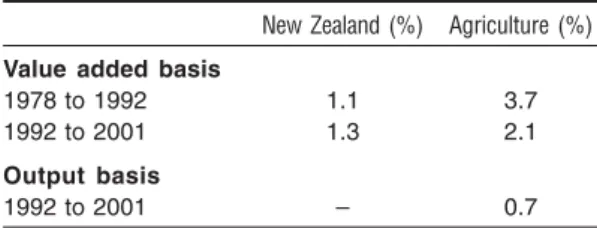
While there is no single, widely-accepted measure of innovation, growth of Multi-Factor Productivity (MFP) provides a broad indication.1 Table 1 shows that the agricultural sector has outperformed the rest of the New Zealand in terms of productivity growth over the past quarter century (1978 – 2001).
Agriculture – New Zealand’s Knowledge Industry
New Zealand’s international competitive advantage in producing agricultural products will be maintained through the ongoing application of innovative technologies and smart business practices leading to increased on-farm efficiencies, productivity, and added value. Much of this accumulated knowledge and technological advance has occurred over the last 75 years.
Proceedings of the New Zealand Grassland Association provide a valuable resource that captures advances both great and small in acquired and applied knowledge and technologies that have ensured that New Zealand agriculture is world leading. The Proceedings also show that the industry has continually sought to improve its productivity. These are detailed in Appendix 1.
1MFP measures the increase in output not accounted for by increases in measured inputs such as labour and capital. For national economies, MFP is usually measured on a value-add basis (defined as the net returns to labour and capital after deducting the cost of other inputs), whereas industry-level comparisons across time are often based on output produced. The economics literature notes that MFP measures not only the rate of technological change but also the associated “free lunches” arising from scale economies and externalities between firms, industries and countries.
Table 1 Compound growth rates in Multi-Factor Productivity.
New Zealand (%) Agriculture (%) Value added basis
1978 to 1992 1.1 3.7
1992 to 2001 1.3 2.1
Output basis
1992 to 2001 – 0.7
Source – Statistics NZ, NZ Treasury
The following are some of the more significant advances (details of advances since 1930 are given in Appendix 1):
• Understanding of pasture grazing management
• Animal improvement – high fertility sheep, improved feed conversion efficiency in dairy, development of the first full “New Zealand” breed of dairy cattle based on elite animal genetics
• Plant improvement – use of non-toxic grass endo- phytes, effective rhizobium strains, improved cultivars
• Subdivision – including the use of electric fencing
• Product harvesting technologies – herringbone and rotary dairies, and electric sheep shears
• Understanding of plant nutrition and the use of fertilisers – aided by aerial topdressing
• Identification of nutrient deficiencies affecting animal health
• Use and adoption of H1 short rotation ryegrass by farmers
• Use of mineral nitrogen
• Nitrification inhibitors
• Animal vaccines
• DNA testing to simplify calf identification
• Electronic identification (ID) ear tags on cows to automate audio alerts, automatically draft cows
• Software for predicting soil response to a range of fertiliser applications so as to minimise nitrate runoff
• Indirect pasture measurement techniques – plate meters, satellite images
The dairy sector
In the dairy industry, labour productivity measured as cows managed per labour unit has increased by 45%
over the last decade and, when measured as milksolids harvested per labour unit by 65% (Table 2). Over the last decade the dairy industry has substantially increased milksolids produced per ha and per cow (Table 2).
In the 1940s, the leading dairy farmers were achieving 250-300 lb milkfat/acre. This is equivalent to about 500 kg milksolids/ha. The average was approximately 140 lb milkfat/acre (Hunger 1951), compared with the average now of 860 kg milksolids/ha. This is approximately a two-fold increase over 60 years. Today some leading farmers are achieving close to 2000 kg milksolids/ha.
The Lincoln University dairy farm which uses little supplementary feed achieves approximately 1700 kg milksolids/ha; this is a three- to four-fold increase on what was possible 60 years ago.
The meat and wool sectors
In the sheep industry there has been increased production occurring at a time when labour numbers have decreased (Bray 2004). Sheep farming performance, based on lamb and mutton carcass weights, lambing percentages and wool weights, has improved 35-55% per labour unit/1000 stock units. This indicates improvements in efficiency of labour through increased use of technology.
The substantial growth in financial returns from sheep in recent years has occurred in spite of the large drop in sheep numbers. It is due not only to increased market demand but to impressive increases in sheep performances that have offset the impact of declining sheep numbers. Remarkable gains that have been made include:
• A 25% increase in lambing percentage and carcass weight since the 1980s.
• Increased lamb meat production with carcasses which are more suited to high value markets, despite sheep numbers decreasing. Furthermore, this has happened without changes in stocking rate, lambing date, or use of new pastures and only a small change in seasonal slaughter pattern.
• An increase in lamb growth rates by 50 g/d since the 1980s – a major change that has not been identified before.
• An outstanding achievement of a 3.5 kg increase in carcass weight without an increase in fatness.
Grassland Improvement and Management – Our Legacy
Before 1930, there were no certified cultivars of ryegrass or white clover; fertiliser topdressing was ineffective because of the absence of a good pasture legume; expansion of grassland into difficult areas and soils was impeded by lack of knowledge and know how (Saxby 1954).
A meeting was called by A.H. Cockayne (Assistant DG of Agriculture) on the 19/20 January 1931 with the Table 2 Changes in on-farm productivity (using both partial and total measures) over the last decade (Caradus
2005).
Criteria 1994/95 2003/04 Change (%)
Cows per ha 2.48 2.75 +10.9
Milksolids per hectare (kg/ha) 671 889 +32.4
Milksolids per cow (kg/cow) 271 322 +18.8
Cows per labour unit 96 140 +45.8
Milksolids per labour unit 26 016 42 981 +65.2
aim of “the betterment of research, investigation, demonstration or instruction in grassland management generally”. Twenty one people attended from the Department of Agriculture, Canterbury Agricultural College (now Lincoln University), Massey University, Cawthron Institute and the fertiliser industry (Saxby 1954). In his address, Cockayne called for “a grassland caucus which will dominate grassland research and improvement”. This lead to the establishment of the New Zealand Grassland Association and the first meeting was held in Palmerston North on 5 August 1931. It was attended by 28 people.
The Association had a faltering beginning. The depression meant that meetings were planned and then cancelled, and finances were strained; the second meeting did not occur until April 1933. This was a conference in which the President made his address by radio broadcast from his hospital bed, and where there was acrimonious debate over seed certification and the formation of the seed industry. At this conference the first farmer paper was presented and, other than during the war years (1940 to 1946), we have held successful conferences annually ever since. By 1954 we had 784 full members and 127 conference members, a total of 911 which is not very different from today. Interestingly, farmers made up about half the membership (Saxby 1954) then as they do today.
Over the past 75 years the New Zealand Grassland Association has been a focal point for introducing new knowledge and technologies, providing an opportunity for debate and refinement of knowledge, and then uptake by consultants and farmers to improve the productivity of our grassland farming operations. Many of these are summarised in Appendix 1.
Perusal of NZGA conference proceedings indicates that many of the challenges and opportunities facing us today are not new. For example:
• Effective technology transfer and adoption of new knowledge and technologies has always been a challenge. In 1933, Connell commented that there was a need for the social science research to be used to assist with increasing the uptake and adoption of new knowledge and technologies. Callaghan (1935) and Hamblyn (1947) also expressed concerns about extension methodology. Robertson (1980) suggested that the language used by scientist in communicating their results was not conducive to rapid understanding. The effectiveness of discussion groups in raising on-farm production was described by McKenzie (1980). The recurring theme of improving uptake of technologies by farmers was reiterated by Webby & Sheath (1991), McRae (1992), Garland (1993), MacClean et al. (1997), Manson (1999), Webby (2002), van der Geest (2002), Prewer
& van Bysterveldt (2004), and Savage & Lewis (2005).
• National production targets are not new. In 1947 there was an espoused target to “double our production in the immediate future” (Levy 1948). And again in the early 1960s a target to increase dairy production by 40 to 50% was articulated (Smith 1964).
• The need to manage a farm as both a cash flow and capital asset business was identified by Candy in 1934
• The use of fertiliser nitrogen as a means of getting better growth from ryegrass pastures was first proposed by Holford (1934) and mentioned as a passing trend by Harris (1968), Ball (1969), O’Connor & Gregg (1971), Sherlock & O’Connor (1973), Ball et al. (1975), Luscombe (1979), Luscombe & Fletcher (1981), and Thomson &
Roberts (1981). Buxton (1981) noted that use of more than 80 kg N/ha would be uneconomic on dairy farms and suggested its best use was in late autumn to allow more on-farm wintering of cows. Again it was reported that N use on dairy farms in the Waikato (Bryant et al. 1981) and Taranaki (Thomson et al.
1991) would not be economic; Morris & McRae (1990) also suggested that N use in beef production would not be economic. Further reporting indicated that winter N applications did not give economic returns for early lambing systems (Sheath et al.
1991). However, since the mid-1990s many papers have demonstrated the benefits of N use. This change has been due more to the increase in returns for dairy (1990 onwards) and for sheep/beef (2000 onwards) than a reduction in the cost of N and its application.
Management decisions to lift annual feed demand (and hence production) above what can traditionally be supplied even from a well fertilised (P, K, S) grass/
clover pasture heavily favours the use of N as the most cost effective feed source.
• The importance of pasture quality over simply the quantity of dry matter was first mentioned by Riddet (1938)
• Rates of pasture re-sowing have been low for decades. Connell (1938) estimated that at the pasture renewal rates then, it would take 35 to 40 years to re- sow the farmland being used. Today it is little better with a 30 year timeframe required for re-sowing all farmland. Lancashire (1985) also challenged the industry to enlarge and diversify the demand for New Zealand bred cultivars.
• Quality feed supply was identified as being of equal importance with cow pedigree (Hunger 1951).
• That labour supply limits pastoral agricultural production was indicated by Moore (1953).
• Illegible slide presentations were identified as a
challenge from the start. Saxby (1954) commented that “a scheme had been devised whereby the bane of all audiences, the illegible slide can be banished forever”.
• Debate on the appropriate level of phosphatic fertilisation of productive dairy pasture began in the 1950s (Elliott & Karlovsky 1954).
• That having reliable and consistent measures of pasture production is a challenge has been a repeated theme (e.g. Lynch 1959; Wallace 1961; Devantier et al. 1998).
• Growing more grass per hectare, that is then efficiently utilised, as a means of continuing to improve animal production was identified by Wallace in 1961.
• In 1968 it was acknowledged that the ability of the New Zealand farmer to remain economically viable in the face of the continuous decline in his terms of trade has been based on technical and management progress (Stewart 1968).
• Adoption of basic management techniques as a requirement for effective pasture establishment was reported by Brougham (1969), Baker (1969), Cullen (1969), and Brock & Kane (2003).
• Difficulty in translating large differences in herbage production levels (caused by grazing management) into differences in animal production was indicated by Brougham (1970).
• Ceiling pasture yields have challenged agronomists, and yet increases in animal production per unit area were reported by Brougham (1976).
• The use of satellites to measure pasture growth appeared in the 1970s (Cochrane 1976; Ellis 1977)
• The knowledge wave was heralded under the guise of information to continue to improve New Zealand’s competitiveness by Trim (1980)
• The development of a large range of models for understanding farm systems and to assist with decision making on-farm began to occur in the 1980s (e.g. McCall et al. 1986; Baars 1990; Marshall et al.
1991; Lewis & Garrity 1993; Barker & Baars 1993;
Rollo et al. 1996; Metherell et al. 1997; Barioni et al.
1997; Martins da Silva et al. 1997; Wheeler &
Thorrold 1997; Davis et al. 1998; Barker et al. 1998;
Ledgard et al. 1999; Woodward et al. 2000; Ogle et al. 2000; Ogle & Tither 2000; Ridler et al. 2001;
Fiorelli et al. 2001; Webby 2002; Wheeler et al. 2003;
Thorrold et al. 2004; Monaghan et al. 2004; Zhang et al. 2004; Beukes et al. 2005).
• The potential impact of plant genomic technologies on pastoral agriculture has been discussed since the 1980s (e.g. White 1988; Woodfield & White 1996;
Scott et al. 1996; Willocks 1999; Barrett et al. 2001;
Bryan 2001; Flaville et al. 2003; Barrett et al. 2004).
An interesting commentary on labour productivity was made in the early 1950s – that “the New Zealand farm worker produces 50% more than his opposite number in Australia, twice that in Argentina, five times as much as in Britain, and 20 times as much as in Japan”
(Moore 1953). Does the same still apply?
At a number of conferences we had speakers from overseas updating us on technologies and information from their pastoral systems, e.g. 1956 (South Africa, UK, USA and the Netherlands), and 1970 (UK, USA and South Africa).
Primary Sector Targets 2015
Both the dairy (Anon. 2005a), and meat and wool (Anon. 2005b) sectors have identified goals and targets for their industry to be achieved in the next decade.
For the dairy sector the goal is:
The dairy industry will increase dairy farmer profit and create wealth for the New Zealand economy, through achieving by 2015:
• 50% total productivity2 gain (4% per year)
• 35% growth of milksolids (3% per year)
• Continued ‘freedom to operate’ through embracing the following imperatives
- growth and productivity goals must not compromise economic, environmental and animal welfare imperatives
For the meat and wool sector the goal is:
The sheep, beef, and goat industries to increase progressively until 2015 farmer profit and wealth for the New Zealand economy by:
• A 35% total productivity2 gain (3% per year)
• Successfully addressing industry imperatives and ensuring that society increases its recognition of the meat and fibre sector as a driver of economic national well-being
Each has a specific objective for Feed:
For dairy it is –
1. To profitably increase the metabolisable energy utilised per ha by 50% from grazed forage
2. To improve pasture feed quality
3. To develop and apply measurements and systems so that supplementary feed is profitably used on dairy farms
For meat and wool it is –
1. To cost effectively and sustainably increase by 35%
2 Productivity is defined as the level of production (output) per unit of effort (input)
the metabolisable energy available from grazed pasture
2. To develop and apply measurements and systems to ensure optimal on-farm use of supplementary feed The challenge for the research, extension/consultant and farming communities is how to achieve these targets. Can we identify the knowledge and technologies required to achieve either a 50% or 35% increase in metabolisable energy available from grazed forage or pasture?
R & D priorities
Both the dairy and meat and wool sectors have endorsed Strategic Frameworks to provide direction for future on- farm research, development, extension and education.
Both sectors have identified similar priorities for increased R & D effort based on these Frameworks – they are:
• Supply of high metabolisable energy forage (includes pasture)
• Environmental integrity and sustainability
• Technology integration to deliver improved farm systems
• Improved adoption of current technologies and knowledge
• Biosecurity – pre-border, post-border and traceability
• Labour supply – quality and capacity
What must be done to ensure our pastoral research community is positioned and resourced to deliver these priorities? This question remains to be answered.
New Zealand’s R & D innovation system
Continued advances in on-farm productivity will rely on both Government and industry supported R & D. In conjunction with this, to continue to ensure innovation is delivered we need:
• Acknowledged and respected leaders who can inspire a vision for the future of pastoral agriculture in New Zealand, and provide a unified voice into Wellington
• Practitioners who can deliver that vision
• An infrastructure that permits researchers to respond efficiently to farmer issues
• A process for attracting the best and brightest of our young people into pastoral agricultural research and the innovation cycle
• A consolidated and unified approach to solving problems and developing new technologies where industry, R & D providers and investors are equal partners, and each is respected for their contribution in working towards common and agreed goals
• An enlightened regulatory process that allows facts to overcome emotion and opinion; and common sense to prevail over political agendas
Funding of R & D has always been an issue. Even back in 1931, Hudson commented that “something like 6d to 1/- per £100 value (i.e. 0.05%) of our grassland exports is being spent in grassland research. When the importance of grassland is considered and the small amount compared with what is being spent on research into other primary industries, it is obvious that there is enormous scope for development of grassland research.”
Today the R & D investment is somewhat larger, but over the past 15 years, the Government has reduced the proportion of its on-farm pastoral R & D investment aimed at ‘sustaining and extending competitive and comparative advantage’ (FRST 2004). Table 3 shows that dairy farmers contribute significantly to R & D in their sector, with on-farm R & D funded by industry and industry levy organisations (totalling 1.5% of sector GDP). This is about three times higher than the average business investment in R & D for NZ as a whole (estimated at 0.44% of GDP). Public funding of on- farm R & D is only 65% of business-funded R & D, considerably less than the 1.7:1 ratio applying at the aggregate level.
The Future
The pastoral sectors have been working hard to ensure that decision makers in Wellington understand that pastoral agriculture is New Zealand’s knowledge economy and is the major existing and new wealth creator for our economy.
Furthermore the pastoral sectors have set ambitious productivity goals – these are efficiency goals, rather than value propositions. Achieving these goals will mean that we continue to seek ways to produce more output, primarily milk and meat, for less effort or input.
Should this really be the way forward? New Zealand’s Table 3 The funding of on-farm and pastoral R&D relative to comparators
R&D investment Government Dairy industry
On-farm dairy RD&E* NZD 31m NZD 49m
– as % of farmer revenue (i.e. payout)* 0.59% 0.92%
– as % of direct contribution to GDP* 0.98% 1.5%
NZ overall R&D investment as % of GDP** 0.76% 0.44%
* 2003/04 ** 2005 Economic Development Indicators Report
wealth is created from exporting products that others will buy. The New Zealand Institute published a report (2006), “Dancing with the Stars”, which states that over the period 1971 to 2002 New Zealand’s exports grew 7.8% in value compared with the world trade growth of 9.5% a year. This means that our economic well being is declining relative to the rest of the world.
Environment
As production and productivity increases are sought, continued and improved environmental sustainability will be needed. Pastoral sector leaders are committed to improving the environment and taking a proactive stance, on the basis that:
• It is the ‘right’ and responsible action to take for the country
• It ensures ‘freedom to operate’ for the industry
• Resources are finite and must be used effectively and efficiently.
This will also require assistance from the research community and will simply not be a case of isolated technologies but rather a more integrated solution that seeks new systems and ways of managing waste and utilising inputs.
Environmental issues may be the biggest threat to future productivity targets. The 4% p.a. productivity target is legitimate and needed, but it is not the sole answer. The industry strategies equate these productivity targets to increases in pasture production rather than in the value of each kg of dry matter produced. The proposed increases in pasture production will, without a management change, cause unacceptable environmental damage. Despite some success with the Clean Streams Accord, nutrient management aspects appear to be seriously lagging. At a conference this year, ‘Good for Growing ‘, organised by NZIAHS in Napier, a 10 person representative panel of environmentalists, dairy sector, farmers, MAF policy makers, and fertiliser industry agreed that current farming practices do not meet the needs of current and future generations of New Zealanders. A middle path is going to be very difficult to achieve because, as land values continue their inexorable rise, a viable return is only possible by using more and more unsustainable practices, without a radical change in approach.
Added value
More added value products have been proposed as the answer to provide adequate returns for on-farm investment for many years. Yet very little changes.
Fonterra’s shareholders council recently voiced their displeasure with the company’s performance in this area. So is it just too hard? Do the strategies of maintaining our competitive international selling position through processing efficiencies simply lead to
continued commodity production rather than adding value? Is there a lack of appropriate research and have we completely failed to improve “quality’” in pasture feeding and thus raise the value of each kg of dry matter On the basis of what has happened over the past 25 years it cannot simply be more of the same. We must find ways to increase the value of what we export. Much of this must be market lead innovation and not simply science and research driven innovation. The issue is that the research community is not receiving clear messages that would inspire them to provide innovative value added products for our major exporting companies. This is unlikely to be resolved until exporters and scientists agree on common goals. However, when resolution is reached, the legacy we have achieved in supporting our pastoral export industries to create value through commodities will continue to play out through increased value added products.
There is much before us to do. Our legacy as grassland researchers, extension specialists and farmers is impressive, but opportunities to improve our performance, and that of the industry, exist. The future of grassland farming will require continued innovation and knowledge creation to remain not just competitive but also capable of creating new wealth.
REFERENCES
Anon. 2005a. Strategic Framework for New Zealand’s Future Dairy Farming and Industry 2005-2015.
Anon. 2005b. Strategic Framework for New Zealand’s Future Meat and Fibre Production Research 2005- 2015.
Baars, J.A. 1990. A rational approach to feed planning on farm. Proceedings of the New Zealand Grassland Association 51: 75–78.
Baker, C.J. 1969. The present methods of pasture establishment. Proceedings of the New Zealand Grassland Association 31: 52–59.
Ball, R. 1969. Legume and fertiliser nitrogen in New Zealand pastoral farming. Proceedings of the New Zealand Grassland Association 31: 117–126.
Ball, R.; Inglis, J.A.H.; Mauger, J.H. 1975. Tactical application of fertiliser nitrogen to offset a season feed shortage on a heavily stocked sheep farm in southern Hawke’s Bay. Proceedings of the New Zealand Grassland Association 37: 166–181.
Barioni, L.G.; Dake, C.J.; Parker, W.J. 1997. A stochastic model to study the control of grazing systems.
Proceedings of the New Zealand Grassland Association 59: 73–78.
Barker, D.J.; Baars, J.A. 1993. Comparing the seasonal productivity of cocksfoot and resident pastures in hill country farms using a system model. Proceedings of the New Zealand Grassland Association 55: 81–85.
Barker, D.J.; Clark, D.A.; Thom, E. R.; Couchman, J.N.;
Burton, R.N.; Dymock, N. 1998. Pasture species and drought impacts on milk yield 2. Predicted farm milk yield at four sites. Proceedings of the New Zealand Grassland Association 60: 45–50.
Barrett, B.A.; Griffiths, A.; Mercer, C.; Ellison, N.;
Faville, M.; Easton, S.; Woodfield, D.R. 2001. Marker- assisted selection to accelerate forage improvement.
Proceedings of the New Zealand Grassland Association 63: 241–245.
Barrett, B.A.; Baird, I.J.; Woodfield, D.R. 2004. Genetic tools for increased white clover seed production.
Proceedings of the New Zealand Grassland Association 66: 119-126.
Beukes, P.C.; Palliser, C.C.; Prewer, W.E.; Levy, G.;
Folkers, C.; Meal, M.; Wastney, M.E.; Thorrold, B.S.
2005. Comparing risk for different dairy farm management systems in Taranaki using the Dexcel Whole Farm Model. Proceedings of the New Zealand Grassland Association 67: 103–107.
Bray, A. 2004. More lamb from less. Journal of Primary Industry Management 7: 32–33.
Brock, J.L.; Kane, G.J. 2003. Variability in establishing white clover in pastures on farm. Proceedings of the New Zealand Grassland Association 65: 223–228.
Brougham, R.W. 1969. Present position of pasture establishment research in New Zealand. Proceedings of the New Zealand Grassland Association 31: 43–
51.
Brougham, R.W. 1970. Frequency and intensity of grazing and their effects on pasture. Proceedings of the New Zealand Grassland Association 32: 137–144.
Brougham, R.W. 1976. Some aspects of pasture development and management in New Zealand.
Proceedings of the New Zealand Grassland Association 38: 38–46.
Bryan, G.T. 2001. Biotechnology in forage crops – capturing our potential. Proceedings of the New Zealand Grassland Association 63: 235–239.
Bryant, A.M.; MacDonald, K.A.; Clayton, D.G. 1981.
Effects of nitrogen fertiliser on production of milk solids from grazed pasture. Proceedings of the New Zealand Grassland Association 43: 58–63.
Buxton, D.A.L. 1981. Economics of nitrogen use in dairying. Proceedings of the New Zealand Grassland Association 43: 70–75.
Callaghan, F.R. 1935. The probable utilisation of New Zealand grassland. Proceedings of the New Zealand Grassland Association 4: 78-83.
Candy, R.A. 1934. The economic use of pastures in dairying. Proceedings of the New Zealand Grassland Association 3: Paper 18.
Caradus, J. R. 2005. Productivity – What is it? Pp 110–
112 In: Proceedings of 2nd International Large Herds
Conference – Dairying towards 2020..
Cochrane, G.R. 1976. Remote sensing applications in pasture analysis. Proceedings of the New Zealand Grassland Association 38: 226–245.
Connell, R.P. 1933. Some aspects of problems relative to increased application of knowledge of grassland farming. Proceedings of the New Zealand Grassland Association 2: Paper 9.
Connell, R.P. 1938. Some features of current land use.
Proceedings of the New Zealand Grassland Association 7: Paper 5.
Cullen, N.A. 1969. Oversowing grasses and clovers.
Proceedings of the New Zealand Grassland Association 31: 110–116.
Davis, K.L.; Thomson, N.A.; McLean, N.R.; McCallum, D.A.; Hainsworth, R.J.; Wards, A.J.; Barton, R.G.
1998. Pasture growth on dairy farms in the Golden Bay and West Coast of the South Island. Proceedings of the New Zealand Grassland Association 60: 9-4.
Devantier, B.P.; Lambert, M.G.; Brookes, I.M.;
Hawkins, C.L. 1998. Measuring production of continuously grazed hill pasture. Proceedings of the New Zealand Grassland Association 60: 157–160.
Elliott, I.L.; Karlovsky, J. 1954. The use of phosphates on some major Waikato soil types. Proceedings of the New Zealand Grassland Association 16: 176–185.
Ellis, P.J. 1977. Remote sensing data from spacecraft and aircraft: their processing and application.
Proceedings of the New Zealand Grassland Association 39: 174–189.
Fiorelli, C.F.; Woodward, S.J.R.; Wasteny, M.E.; Thom, E.R.; Bahmani, I. 2001. Modelling factors affecting reproductive development of perennial ryegrass in Waikato dairy pastures. Proceedings of the New Zealand Grassland Association 63: 165–170.
Flaville, M.; Barrett, B.; Griffiths, A.; Schreiber, M.;
Mercer, C.; Baird, I.; Ellison, N.; Bryan, G.; Woodfield, D.; Forster, J.; Ong, B.; Sawbridge, T.; Spangenberg, G.; Easton, H.S. 2003. Implementing molecular marker technology in forage improvement. Proceedings of the New Zealand Grassland Association 65: 229–
238.
FRST 2004. Investing in Our Future, Progress and Achievements Report, FRST, 2004, Table 2.2, p.23.
Garland, C. 1993. Technology transfer: systems used by a Wairarapa farm consultancy firm. Proceedings of the New Zealand Grassland Association 55: 7–9.
Hall, J.; Scobie, G.M. 2006. The role of R & D in productivity growth: the case of agriculture in New Zealand: 1927 to 2001. New Zealand Treasury Working Paper 06/01.
Hamblyn, C.J. 1947. A critical review of present day trends in grasslands farming. Proceedings of the New Zealand Grassland Association 9: 28-30.
Harris, W. 1968. Pasture seeds mixtures, competition and productivity. Proceedings of the New Zealand Grassland Association 30: 143–153.
Holford, G.H. 1934. Five years’ experience in the use of nitrogen on pastures in New Zealand. Proceedings of the New Zealand Grassland Association 3: Paper 22.
Hudson, A.W. 1931. The use of fertilizers on grassland and the technique and scope of experimental work.
Proceedings of the New Zealand Grassland Association 1: 21–23.
Hunger, W.C. 1951. Higher production on dairy farms.
Proceedings of the New Zealand Grassland Association 13: 98 – 100.
Lancashire, J.A. 1985. Some factors affecting the rate of adoption of new herbage cultivars. Using Herbage Cultivars. Grassland Research and Practice Series 3: 79-87.
Ledgard, S.F.; Edgecombe, G.A.; Roberts, A.H.C. 1999.
Application of the nutrient budgeting model OVERSEER™ to assess management options and regional council consent requirements on a Hawke’s Bay dairy farm. Proceedings of the New Zealand Grassland Association 61: 227–231.
Levy, E.B. 1948. Developments in grassland farming.
Proceedings of the New Zealand Grassland Association 10: 35–44.
Lewis, C.A.; Garrity, B. 1993. Application of a computer dairy model on farm. Proceedings of the New Zealand Grassland Association 55: 217–218.
Luscombe, P.C. 1979. Nitrogen fertilizer responses on hill country pastures. Proceedings of the New Zealand Grassland Association 41: 155–162.
Luscombe, P.C.; Fletcher, R.H. 1981. Nitrogen fertiliser on grazed hill pasture. Proceedings of the New Zealand Grassland Association 43: 171–181.
Lynch, P.B. 1959. Pasture production estimates by measures other than cutting. Proceedings of the New Zealand Grassland Association 21: 99–107.
MacClean, J.; Penno, J.; Howse, S. 1997. Current information and technology priorities of dairy farmers.
A challenge for agricultural researchers. Proceedings of the New Zealand Grassland Association 59: 215–
220.
Manson, P. 1999. The McRae Trust sustainable land management project: A community based approach to sustainable hill country farming. Proceedings of the New Zealand Grassland Association 61: 185–188.
Marshall, P.R.; McCall, D.G.; Johns, K.L. 1991.
STOCKPOL: A decision support model for livestock farms. Proceedings of the New Zealand Grassland Association 53: 137–140.
Martins da Silva, J.A.; Parker, W.J.; Shadbolt, N.M.;
Dake, C.K. 1997. Pasture development revisited: A model to analyse the physical and financial risk of
developing pastures on sheep and beef cattle farms.
Proceedings of the New Zealand Grassland Association 59: 67–72.
McCall, D.G.; Townsley, R.J.; Bircham, J.S.; Sheath, G.W. 1986. The interdependence of animal intake, pre- and post-grazing pasture mass ad stocking density.
Proceedings of the New Zealand Grassland Association 47: 255–261.
McKenzie, S.A. 1980. The changing pattern of advisory work. Proceedings of the New Zealand Grassland Association 42: 191–193.
McRae, A.F. 1992. Farmers’ needs for management, research and extension, and policy - findings of a farmers’ workshop and their implications. Proceedings of the New Zealand Grassland Association 54: 7–10.
Metherell, A.K.; Thorrold, B.S.; Woodward, S.J.R.;
McCall, D.G.; Marshall, J.D.; Morton, J.D.; Johns, K.L. 1997. A decision support model for fertiliser recommendations for grazed pasture. Proceedings of the New Zealand Grassland Association 59: 137–140.
Monaghan, R.M.; Smeaton, D.; Hyslop, M.G.; Stevens, D.R.; de Klein, C.A.M.; Smith, L.C.; Drewry, J.J.;
Thorrold, B.S. 2004. A desktop evaluation of the environmental and economic performance of model dairy farming systems within four New Zealand catchments. Proceedings of the New Zealand Grassland Association 66: 57–67.
Moore, A.B. 1953. Increasing production from Northland hill country. Proceedings of the New Zealand Grassland Association 15: 68–78.
Morris, S.T.; McRae, A.F. 1990. Evaluation of nitrogen fertiliser in a beef production system. Proceedings of the New Zealand Grassland Association 51: 89–92.
O’Connor, M.B.; Gregg, P.E.H. 1971. Nitrogen fertilizer trials on pastures. Proceedings of the New Zealand Grassland Association 33: 26-34.
Ogle, G.I.; Tither, P. 2000. An analysis of the risks and benefits of beef intensification. Proceedings of the New Zealand Grassland Association 62: 25–29.
Ogle, G.I.; Allan, B.E.; Campbell, A.; Bates, J.R. 2000.
Financial analysis of pasture improvement on Earnscleugh Station. Proceedings of the New Zealand Grassland Association 62: 167–172.
Prewer, W.E.; van Bysterveldt, A. 2004. The Pasture Quality Poster – a learning tool for farmers.
Proceedings of the New Zealand Grassland Association 66: 183–186.
Riddet, W. 1938. The relation of pasture species to quantity and quality of milk. Proceedings of the New Zealand Grassland Association 7: Paper 11.
Ridler, B.J.; Rendel, J.M.; Baker, A. 2001. Driving innovation: Application of linear programming to improving farm systems. Proceedings of the New Zealand Grassland Association 63: 295–298.
Robertson, B.T. 1980. The effective publication of grassland research. Proceedings of the New Zealand Grassland Association 42: 194–200.
Rollo, M.D.; McCall, D.G.; Boom, C.J.; Sheath, G.W.
1996. Evaluation of a beef growth model for use in beef finishing decisions. Proceedings of the New Zealand Grassland Association 57: 95–99.
Savage, J.; Lewis, C. 2005. Applying science as a tool for dairy farmers. Proceedings of the New Zealand Grassland Association 67: 61–66.
Saxby, S.H. 1954. The New Zealand Grassland Association. Proceedings of the New Zealand Grassland Association 16: 24 – 34.
Scott, A.; Woodfield, D.R.; Allan, A.; Maher, D.; White D.W.R. 1996. Inheritance and expression of transgenes in white clover. White Clover: New Zealand’s Competitive Edge. Agronomy Society of New Zealand Special Publication 11/ Grassland Research and Practice Series 6: 131-135.
Sheath, G.W.; Boom, C.J.; Webby, R.W. 1991. Nitrogen fertiliser use in early lambing systems. Proceedings of the New Zealand Grassland Association 53: 123–128.
Sherlock, R.R.; O’Connor, M.B. 1973. The use of nitrogen on hill country. Proceedings of the New Zealand Grassland Association 35: 52–62.
Smith, B.A.J. 1964. Pasture management for high production on dairy farms. Proceedings of the New Zealand Grassland Association 26: 129–136.
Stewart, J.D. 1968. Profitability and economics of cropping. Proceedings of the New Zealand Grassland Association 30: 72–80.
Thomson, N.A.; Roberts, A.H.C. 1981. Response to nitrogen fertiliser applied to dairy pastures in autumn and spring in Taranaki. Proceedings of the New Zealand Grassland Association 43: 44–52.
Thomson, N.A.; Roberts, A.H.C.; Judd, T.G.; Clough, J.S. 1991. Maximising dairy production by using nitrogen fertiliser and calving early. Proceedings of the New Zealand Grassland Association 53: 85–90.
Thorrold, B.S.; Bright, K.P.; Palmer, C.A.; Wastney, M.E. 2004. Modelling the effects of irrigation reliability on pasture growth in a dairy system in Canterbury.
Proceedings of the New Zealand Grassland Association 66: 31–34.
Trim, P.N. 1980. Agricultural information: New Zealand’s forgotten fuel. Proceedings of the New
Zealand Grassland Association 42: 201–204.
van der Geest, C. 2002. Sources and uses of information on a West Coast dairy farm. Proceedings of the New Zealand Grassland Association 64: 31–32.
Wallace, L.R. 1961. Modern trends in grassland farming.
Proceedings of the New Zealand Grassland Association 23: 75–84.
Webby, R.W. 2002. The value of decision support models for farmer learning. Proceedings of the New Zealand Grassland Association 64: 45-47.
Webby, R.W.; Sheath, G.W. 1991. Group monitoring, a basis for decision making and technology transfer on sheep and beef farms. Proceedings of the New Zealand Grassland Association 53: 13–16.
Wheeler, D.M.; Thorrold, B.S. 1997. Pasture yield response to different sulphur fertiliser strategies and its application to modelling. Proceedings of the New Zealand Grassland Association 59: 39–43.
Wheeler, D.M.; Ledgard, S.F.; de Klein, C.A.M.;
Monaghan, R.M.; Carey, P.L.; McDowell, R.W.;
Johns, K.L. 2003. OVERSEER® nutrient budgets – moving towards on-farm resource accounting.
Proceedings of the New Zealand Grassland Association 65: 191–194.
White, D.W.R. 1988. Use of cell and molecular genetic manipulation to improve pasture plants. Proceedings of the New Zealand Grassland Association 49: 67–
72.
Willocks, M.J. 1999. Commercialisation of genetically modified crops in New Zealand. Proceedings of the New Zealand Grassland Association 61: 117–119.
Woodfield, D.R.; White, D.W.R. 1996. Breeding strategies for developing transgenic white clover cultivars. White Clover: New Zealand’s Competitive Edge. Agronomy Society of New Zealand Special Publication 11/ Grassland Research and Practice Series 6: 125-130.
Woodward, S.J.R.; Webby, R.W.; Johnstone, L.J.C. 2000.
A decision tool for calculating herbage mass and metabolisable energy requirements of growing cattle and sheep. Proceedings of the New Zealand Grassland Association 62: 13–18.
Zhang, B.S.; Valentine, I.; Kemp, P.D. 2004. Modelling hill country pasture production: a decision tree approach. Proceedings of the New Zealand Grassland Association 66: 195–201.
APPENDIX 1
Technological advances impacting on grassland farming
Technology/advance Impact/significance Date – NZGA Proceedings Strain development in
herbage plants
Elite cultivars Levy 1931 – NZGA Vol. 1 Economic value of
phosphatic fertilisers
Improved productivity and production
Hudson 1931 – NZGA Vol. 1 Grazing management
systems – rotational grazing for dairy farms
Better utilisation of grown pasture
Connell 1931 – NZGA Vol. 1
Seed certification Quality seeds assurance Hadfield 1933 - NZGA Vol. 2 Use of irrigation Increase the area of
economically viable agricultural land
Tennent 1933 - NZGA Vol. 2
Using social sciences to improve uptake and adoption of new knowledge
Use of best knowledge and technologies by farmers
Connell 1933 – NZGA Vol. 2
Improved grazing
management of hill country
Reduce reversion back to weeds and scrub – maintain or improve productivity
McCulloch 1933 - NZGA Vol. 2
Importance of trace elements in animal nutrition
Stopped “bush sickness” Riggs & Askew 1933 - NZGA Vol. 2
Concept of grass as a crop Better utilisation of pasture Callaghan 1933 - NZGA Vol. 2 Aligning production to
market needs, including the need for diversification
Improved profitability Williams 1933 - NZGA Vol. 2
Use of heterosis in forage plant breeding
Improved pasture production Frankel 1934 - NZGA Vol. 3 Soil surveys Understanding soil impacts on
pasture production
Grand & Taylor 1934 - NZGA Vol. 3
Interaction between pasture nutritional value and animal metabolism
Realisation that not all pasture feed is equal
Franklin 1934 - NZGA Vol. 3
Differing palatability of pasture species
Animals have different
preferences for different pasture types
Cunningham 1934 - NZGA Vol.
3 Adapting farm business to
economic adversity
Balancing farming as a cash flow business and land asset business
Candy 1934 - NZGA Vol. 3
Impact of stocking rate on pasture composition and production
Improved productivity Levy 1934 - NZGA Vol. 3
Use of N fertiliser to improve pasture production
Improved productivity Holford 1934 - NZGA Vol. 3 Use of lime Improved pasture production and
seasonality of production
Woodcock 1935 - NZGA Vol. 4 Supplementary feed crops Aid to pasture improvement and
management
Connell 1935 - NZGA Vol. 4 Need for better extension
methods for adopting knowledge
Improved productivity Callaghan 1935 - NZGA Vol. 4
Use of fluorescents and Uniform seed lines Foy & Hyde 1935 - NZGA Vol.
Technology/advance Impact/significance Date – NZGA Proceedings cyanogenesis to identify
germplasm types
4 Lucerne breeding for NZ
begins
Lucerne cultivars Calder 1935 - NZGA Vol. 4 White and red clover cause
feed flavour effects in milk
Understanding of impact of feed on milk flavour and probably composition
Riddet et al. 1936 - NZGA Vol.
5 Indication of mineral
deficiencies in NZ pasture on animal health and production
Importance of Co, I, and Fe Hopkirk 1936 - NZGA Vol. 5
Investigation of paspalum as a forage
Impact of C4 grasses in NZ pasture
Hamblyn 1936 - NZGA Vol. 5 Investigation of the use of
subterranean clover cultivars in pasture
Impact of annual clovers in NZ pastures
Levy & Gorman 1936 - NZGA Vol. 5
Identification of excessive protein levels in NZ pastures
Impact on animal fertility Webster 1936 - NZGA Vol. 5 Lack of demonstration and
research stations in the South Island
Missed opportunities to adopt advances in the South Island
Macassey 1936 - NZGA Vol. 5
Acknowledgement of seed mixture differences for wet and dry areas of NZ
Seed mixtures tailored to need and climate
Stuart 1937;
Flay 1937 - NZGA Vol. 6 Seed sold to legislated
standard in Australia, but not NZ
Free market alive in NZ Foy 1937 - NZGA Vol. 6
Irrigation expands in the South Island
Improved production and productivity
Stafford 1937 - NZGA Vol. 6 Link of root health and
vigour to leaf growth in pasture
Acknowledgment of importance of root systems
Jacques 1937 - NZGA Vol. 6
Link between condition of grassland and internal parasite prevalence
Management of internal
parasites through management of pastures
Cole 1937 - NZGA Vol. 6
I deficiency in domesticated animals grazing on alluvial soils
Need for supplementation Day-us 1937 - NZGA Vol. 6
Critical analysis of phosphate fertiliser use and place of rock phosphate
Understand the long term impacts of phosphate
fertilisation and technologies for using rock phosphate
Hudson & Woodcock 1937 - NZGA Vol. 6
Impact of shelter trees on farm production
Concerns about shelter belt removal, particularly on the South Island. Recognition of importance of on-farm shelter for animal production
Dolamore 1937 - NZGA Vol. 6
Understanding the link between forest removal and increased erosion
Impact of replacing forest with grassland on soil erosion
Taylor 1938 - NZGA Vol. 7
The importance of feed value rather than feed amount
Impact of feed quality on animal product quality and composition
Riddet 1938 - NZGA Vol. 7 Pasture re-sowing rates are
too low
At rates used it would take 35 to 40 years to re-sow the farmland
Connell 1938 - NZGA Vol. 7
Technology/advance Impact/significance Date – NZGA Proceedings being used
Seed certification and purity assurance schemes
Farmers are assured of getting a quality seed product
Gorman 1947 - NZGA Vol. 9 Pasture management affects
on sward composition
Importance of managing pastures to keep white clover content high
Long 1947 - NZGA Vol. 9
Importance of mechanisation to increase on-farm
productivity, e.g. replacing horses with tractors, aerial topdressing
Improved on-farm productivity- more output per effort of input
Saxby 1947 - NZGA Vol. 9
Replacing set stocking with mob grazing on hill country
Improved sward composition and production
Linklater 1947 - NZGA Vol. 9 Importance of effective
technology transfer
Realisation that uptake of current knowledge on pasture development and utilisation by farmers is slow
Hamblyn 1947 - NZGA Vol. 9
Subdivision Improved control of stock grazing pasture to improve pasture yield and utilisation
Levy 1948 - NZGA Vol. 10
Development of short rotation (H1) ryegrass
Increased palatability, production and early spring growth
Corkill 1949 - NZGA Vol. 11
Use of lucerne grass mixtures Improved seasonality of production on ‘light’ land
Bevan 1949 - NZGA Vol. 11 Survival of hard white clover
seed through the rumen
Opportunity to use the animal to disseminate clover around the farm
Suckling 1950 - NZGA Vol. 12
Use of electric fencing to vary paddock size and improve pasture utilisation –
“break grazing”
Better pasture utilisation Allo 1951 - NZGA Vol. 13
Special purpose pastures and seasonal spread of production
Improved seasonal spread of feed
Smallfield 1951 - NZGA Vol.
13 A well bred cow is only half
the story – pasturage must equal pedigree
Quality feed supply is as important as cow pedigree
Hunger 1951 - NZGA Vol. 13
The importance of draining land
Improved production Hudson 1951 - NZGA Vol. 13 Integration of forage crops
into pastoral agriculture
Improved winter and summer feed and process for re-sowing pasture
Bevin 1951 - NZGA Vol. 13
Earthworms appear beneficial to pasture growth
Improved ryegrass production Water 1951 - NZGA Vol. 13 The need for Mo as a trace
element in fertiliser
Improved N-fixation and fodder crop growth
Davies 1952 - NZGA Vol. 14 Adams 1952 - NZGA Vol. 14 Understanding of the role of
statistics in pasture trials
Reliable results and analysis Glenday 1952 - NZGA Vol. 14 Development of the roller
drill
Better contact between seed and fertiliser at a constant sowing depth
Blackmore 1952 - NZGA Vol.
14 Need to attract people back
to farming
Labour limiting pastoral farming productivity
Moore 1953 - NZGA Vol. 15
Technology/advance Impact/significance Date – NZGA Proceedings Methods for managing C4
grasses in northern NZ
Improved seasonal pasture production
Ballinger 1953 – NZGA Vol. 15 Mechanisation for draining
land
Improved productivity Scott 1953 - NZGA Vol. 15 19 t DM/ha produced Upper limit of pasture
production measured in NZ – at Dargaville Demonstration Farm
Lynch 1953 - NZGA Vol. 15
Surface drains Used to drain land not suitable for underground drains, e.g.
Hauraki Plains
Banfield 1953 - NZGA Vol. 15
Identification of temperature optima for our major pasture species
Better understanding of temperature limitations to pasture growth
Mitchell 1954 - NZGA Vol. 16
Soil and water conservation Realisation of the importance of protecting natural resources that drive agricultural production
Wilkie 1954 - NZGA Vol. 16
Importance of maintaining soil phosphorus levels – heavy reliance of NZ pastoral agriculture on fertiliser inputs
The need for discrimination to be exercised when
recommending fertiliser inputs, but in general NZ soils need increased levels of P and K and possibly N inputs
Elliott & Karlovsky 1954 - NZGA Vol. 16
Use of selective chemical herbicides to manage pasture weed
Improved sward composition and production
Matthews 1954 - NZGA Vol. 16
Pasture spelling Increased stocking rate and production
Hamblyn 1954 - NZGA Vol. 16 Bloat caused by foam from
natural fermentation of feed in the rumen – use of anti- foaming agents
Management of bloat using emulsifiers
Reid 1955 - NZGA Vol. 17
Ovine rickets in winter due to green feed (cereals) diet
Mitigated using an appropriate drench
Grant 1955 - NZGA Vol. 17 Soils deficient in cobalt
characterised; use of vitamin B12 testing to determine Co deficiency in sheep
Appropriate management of soils and reduction in severity and incidence of Co deficiency in sheep
Andrews 1955 - NZGA Vol. 17
Over drilling of pastures Sward rejuvenation Blackmore 1955 - NZGA Vol.
17 Use of effective rhizobium
strains to nodulate clovers
Improved white clover survival, growth and N-fixation
Sears & Greenwood 1955 - NZGA Vol. 17
Trace element deficiencies limited to defined soil types – deficiencies of major elements are more widespread for P,K and S
Appropriate use of trace and major elements as fertilisers
During 1955 - NZGA Vol. 17
Link between grazing behaviour and production
Individuality of cows in relation to selectivity of diet from pasture
Brumby 1955 - NZGA Vol. 17 Nutrition related disorders Understanding causes for hypo-
magnesaemia
Allcroft 1956 - NZGA Vol. 18 Economics of irrigation of
“light land” in Canterbury
Improved production and profitability, but at a cost – irrigation schemes are expensive
Scott & Stuart 1956; Hilgendorf 1956 - NZGA Vol. 18
Technology/advance Impact/significance Date – NZGA Proceedings to implement
Deterioration of quality and quantity in NZ tussock grasslands
Loss of production Hercus 1956 - NZGA Vol. 18
Sowing rates for pasture seed mixtures
40 lb/ac was unnecessary; 20 lb/ac was all that was needed
Allo & Jordan 1957 - NZGA Vol. 19
Use of herbicides in pasture re-sowing
Direct drilling into herbicide treated pasture
Matthews 1957 - NZGA Vol. 19 Impact of treading damage
on pasture growth
Treading reduced pasture yield irrespective of soil condition – exacerbated by wet conditions
Edmond 1957 - NZGA Vol. 19
S deficiency in the South Island
Need for a range of fertiliser with varying ratios of S and P
Walker 1957 - NZGA Vol. 19 Early example of gauging
uptake of technology by farmers – use of H1 short rotation ryegrass
Over 90% of farmers in some regions (Otago and Southland) were using H1
Scott 1957 - NZGA Vol. 19
Breeding of Lotus uliginosus Lead to the production of Maku lotus
Barclay 1957 - NZGA Vol. 19 Impact of light into pastures
on growth rate
Influence of defoliation height on net assimilation rate and therefore ability of plants to
‘harvest’ light energy
Brougham 1957 - NZGA Vol.
19
Commercialisation of legume seed coating with rhizobia
Improved nodulation of pasture legumes
Callaghan 1958 - NZGA Vol. 20 Sowing rates of perennial
ryegrass pastures are generally too high, suppressing the
establishment of other sown species
Sowing rates can be reduced with negative effects on pasture establishment
Cullen 1958 - NZGA Vol. 20
Residual effect of applied phosphatic fertilisers
Residual effects can last many years, but they can vary with soil type and fertiliser type. Fresh applications are more effective,
Karlovsky 1959 - NZGA Vol.
21
Reviewing plant breeding targets
Identified seasonality of production, water use efficiency, competitive ability, and quality as the main breeding targets
Barclay 1959 - NZGA Vol. 21
Increased incidence of animal disorders on improved pasture and incidence of Se deficiency
Awareness of cause of some animal disorders and need for Se administration
Hartley 1959 - NZGA Vol. 21
Use of the forage harvester to cut and collect silage
Improved productivity – labour efficiency
Hopewell 1960 - NZGA Vol. 22 Use of Se, Cu, Co and I as
micronutrients for sheep health in Southland
Improved production and profitability
Andrews 1960 - NZGA Vol. 22
Depletion and erosion of pastoral tussock country – remediation measures
Improved sustainability of production
Sly 1960 - NZGA Vol. 22
Discovery (1959) of Argentine stem weevil and
Prairie grass suggested as an alternative
Pantall 1961 - NZGA Vol. 23
Technology/advance Impact/significance Date – NZGA Proceedings its impact on ryegrass
survival
Leaching loss from high concentrations of N and K in sheep urine
Use plant species that are productive and can utilise these nutrients
Dale 1961 - NZGA Vol. 23
Controlled versus
uncontrolled grazing in dairy (McMeekan trials)
Better pasture utilisation and per cow production
Wallace 1961 - NZGA Vol. 23
Sheep electric fence More flexible and cheaper subdivision
Currie 1961 - NZGA Vol. 23 Integrating topdressing of
fertiliser with appropriate subdivision
More efficient use of additional grass produced by fertiliser
Currie 1961 - NZGA Vol. 23
Bulldozed tracks onto farms Allowed vehicles into otherwise inaccessible parts of the farm – improved subdivision and management
Currie 1961 - NZGA Vol. 23
Mg deficiency of some NZ pasture soils
Improved production Moody 1962 - NZGA Vol. 24 Use of Yorkshire Fog on hill
country
Breeding programme began at Massey
Jacques 1962 - NZGA Vol. 24 On pumice soils lucerne
nodulation only occurred with liming
Improved N-fixation and yield Parle 1962 - NZGA Vol. 24
Significance of lucerne in dry land areas for hay and grazing
Higher feed production in dry land areas
Flay 1962 - NZGA Vol. 24
Integration of sheep and cattle grazing on hill country
Improved productivity from sheep
Ward 1962 - NZGA Vol. 24 Herbicide alone will not
control weed problems
Need for improved fertiliser inputs ad pasture management – also mentioned possible impact of biocontrol
Leonard 1962 - NZGA Vol. 24
Complementary nutrient status of clovers and grass in pasture
Need to keep an appropriately balanced grass:clover ratio
Johns 1963 - NZGA Vol. 25
Widespread use of DDT to control grass grub
Potential residue issues mentioned
Cottier 1963 - NZGA Vol. 25 Integration of pasture
management and animal husbandry for improved pasture utilisation
Improved pasture utilisation and yield per hectare
Campbell 1963 - NZGA Vol. 25
Release of Ariki – the new long rotation ryegrass or hybrid ryegrass
Improved seasonal growth, particularly in summer
Barclay 1963 - NZGA Vol. 25
Improved pelleting of clover seed with rhizobium
Improved nodulation and establishment of clover
Hastings 1964 - NZGA Vol. 26 Rhizobium strain specificity
among pasture legume species
Requirement to use the right rhizobium strain with the appropriate legume species
Greenwood 1964 - NZGA Vol.
26 Discovery of Pithomyces
chartarum fungus as the cause of facial eczema
Methods for reducing dead matter in pasture for the fungus to grow on
Lancashire & Keogh 1964 - NZGA Vol. 26
Technology/advance Impact/significance Date – NZGA Proceedings (Thornton and Percival 1959)
through production of sporidesmin
Identification of cellulose content and leaf strength as an important component of pasture quality
Indicates need for breeding targets for increased grass feed quality
Bailey 1964 - NZGA Vol. 26
Management strategy for high production from hill country
Maintained improved production Suckling 1964 - NZGA Vol. 26
Use of popular trees to stabilise steep land
Soil conservation Hogg 1965 – NZGA Vol. 27 Use of brassicas and cereals
as feed (in the North Island)
Increased production Smith 1965 - NZGA Vol. 27 Sulphurised superphosphate Improved nutrition of pasture
grasses and legumes
Ludecke 1965 - NZGA Vol. 27 Vacuum silage Better silage conservation and
more efficient meat and wool production
Monteath 1966 - NZGA Vol. 28
Use of computers signalled in keeping farm records and decision making
Improved productivity Banfield 1966 - NZGA Vol. 28
Grasslands 4707 tetraploid Westerwolds ryegrass
Improved annual ryegrass Barclay & Vartha 1966 - NZGA Vol. 28
The importance of earthworms in maintaining good soil structure
Improved production Stockdill 1966 - NZGA Vol. 28
Lime pelleting of legume seed
Improved nodulation on acid soil Cullen & Ludecke 1966 - NZGA Vol. 28
Use of non-toxic tall fescue in NZ
A safe alternative to toxic fescue All & Southon 1967 - NZGA Vol. 29
Demonstration of differing nutritive value of ryegrass cultivars
Higher milk yields associated with low crude fibre content and high organic matter digestibility of ryegrass cultivars
Wilson 1967 - NZGA Vol. 29
Importance of pasture utilisation
Increased productivity per hectare
Edmond 1967 - NZGA Vol. 29 Economic success of NZ
pasture seed industry reliant on export sales
Need to get cultivars adopted to overseas markets and improve seed yields to improve efficiency
Shillito 1968 - NZGA Vol. 30
Crown rust limiting pasture production
Need for cultivars selected for rust resistance
Lancashire & Latch 1968 - NZGA Vol. 30
Improved technology for inoculating clover seed with rhizobia
Improved nodulation Taylor & Lloyd 1968 - NZGA Vol. 30
Mangere ecotype of ryegrass identified
Higher production and drought tolerance
Rumball 1969 - NZGA Vol. 31 Grasslands 4700 (Pitau)
white clover
Improved winter growth Barclay 1969 - NZGA Vol. 31 Light rates of paraquat
spraying onto pasture
Improved clover content Williams & Palmer 1969 - NZGA Vol. 31
Length of recovery period more important than cutting
Improved yields and persistence from lucerne
Langer & Keoghan 1970 - NZGA Vol. 32
Technology/advance Impact/significance Date – NZGA Proceedings height for lucerne survival
Researchers encouraged to evaluate the cost of maximising production, not just the likely return
Importance of economics in introducing new technologies to increase production
Campbell 1970 - NZGA Vol. 32
Over-drilling annual ryegrasses into lucerne
Improved total and seasonal forage yields
Vartha 1971 - NZGA Vol. 33 Using fertiliser N to
overcome seasonal shortages in N supply from N-fixation
Improved seasonal forage yields O’Connor 1971 - NZGA Vol. 33
Lucerne identified as a valuable crop in the humid North Island
Highly value feed Robinson & Abbott 1971 - NZGA Vol. 33
Electronic capacitance meter Measurement of pasture yields – although reliability was an issue
Bryant et al. 1971;
Stephen & Revfeim 1971 - NZGA Vol. 33
Weighted disc grass meter Measurement of pasture yields Phillips & Clarke 1971 - NZGA Vol. 33
All grass wintering in Southland
Overcame dissatisfaction with swedes
Brown & Harris 1972; Miller 1972; Halford 1972 - NZGA Vol. 34
Feed budgeting on dairy farms
Improved feeding, productivity and production leading increased economic returns
Parker 1972 - NZGA Vol. 34
Use of cereal forage with annual ryegrass
Improved forage yield on summer dry areas
Vartha & Rae 1972 - NZGA Vol. 34
“Block” or “long rotation”
wintering
Improved winter production Parker & Willis 1972 - NZGA Vol. 34
Grasses are more effective in obtaining soil P than white clover
Better understanding of nutrition requirements of white clover
Jackman & Mouat 1973 - NZGA Vol. 35
Lax grazing can cause browntop to be suppressed
Means of managing browntop ingress
Harris 1973 - NZGA Vol. 35 Use of mineral N on hill
country
Identified as an economic option Sherlock & O’Connor 1973 - NZGA Vol. 35
Mangere ecotype ryegrass identified as superior to certified strains
Improved pasture production Ellett 1973 - NZGA Vol. 35
Spring grazing management of lucerne
Improved lucerne growth on light soils
Janson 1974 - NZGA Vol. 36 Browse shrubs Increase production on low
producing hill country
Hill 1974 - NZGA Vol. 36 Irrigated lucerne Improved feed in spring/summer
on irrigated light soils
Janson 1974 - NZGA Vol. 36 Tall fescue in dryland Improved production Watkins 1974 - NZGA Vol. 36 Tall fescue as a companion
grass to lucerne
Improved production Allen & Cullen 1974 - NZGA Vol. 36
Release G4710 tall fescue (Grasslands Roa)
Better adapted tall fescue germplasm
Anderson 1974 - NZGA Vol. 36 Establishment of alkali and
leafcutter bees in NZ
Improved pollination of lucerne Donovan 1974 - NZGA Vol. 36 Plant Breeders Rights Intellectual property protection
of bred cultivars
Lancashire 1976 - NZGA Vol.
37