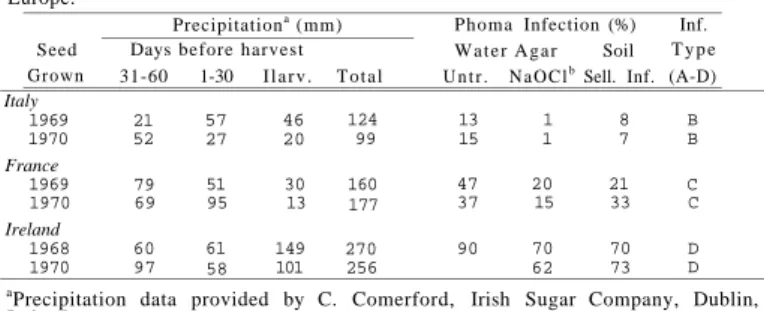
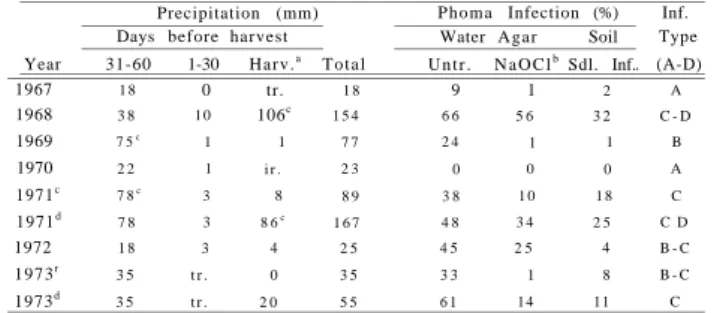
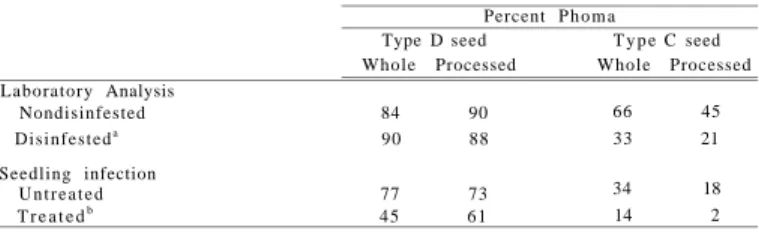
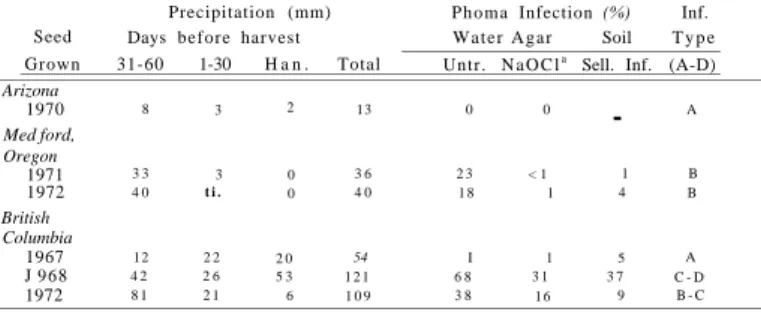
Several incidents should be examined in light of their significance for the future of the industry. In 1972, most of the rain fell early in June and very little during the harvest period. The seed lots produced in 1972 showed a surprisingly high percentage of Phoma infection in view of the very low rainfall 60 days before and during harvest.
Feeding Preference and Reproduction of the Beet Leafhopper on Two Russian Thistle
Plant Species
To study the food or choice preferences of the canine jumper, we designed a box with glass sides and four 9 cm holes in the bottom. To determine the breeding characteristics of the beet weevil, plants of each species of Russian thistle were placed in a standard weevil cage with 50 healthy beet weevil females at 30 °C. In contrast, no differences were found in reproduction of the beet weevil on these two species of Russian thistle (Table 2).
Sugarbeet Storage Rot in the Red River Valley, 1974-75
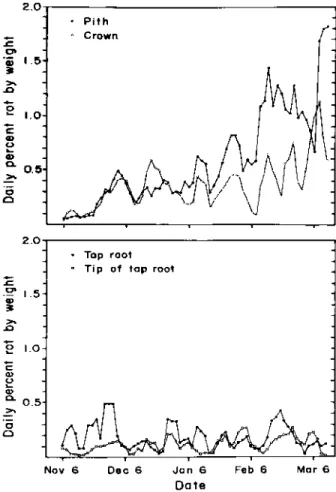
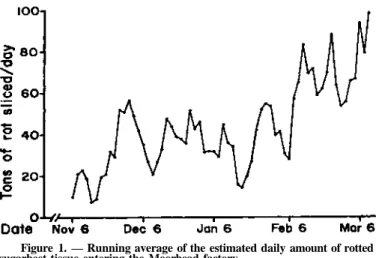
Running average of estimated daily amount of rotten sugar beet tissue entering the Moorhead plant. Running average of the daily amount of rot occurring in the crown, core, root, and root tail of the Moorhead plant. Rot in the crown region developed slowly but eventually represented the largest proportion of rotted tissue compared to the root or root tip.
Breeding Sugarbeet for Resistance to Yellow Wilt 1
The selection and digging of plants in the 1972-73 field plots at La Platina was postponed until September 1 973 (ie around the end of the winter season). Most of the remainder developed yellow wilt symptoms during the winter or spring and died prematurely. Another highlight of the 1972-73 results at La Platina was the performance of one of the three introductions by B.
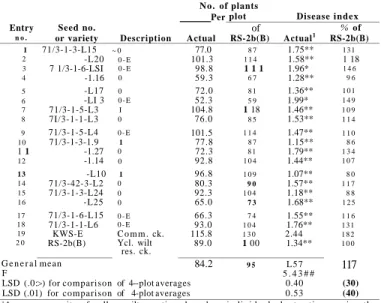
Yellow wilt damage in sugar beet, typical of that occurring in commercial sugar beet varieties in Chile in areas where the incidence of the vector is high. In the description column of each table: 1 indicates that the female plant had developed yellow wilt symptoms around the end of the vein. Visual comparisons of the two lines in May 1974 (Figure 3) were consistent with the tabulated results, showing a distinctly lower severity of yellow wilt attack in RS-2b(B).
Second, although none of the individual plant progeny was significantly lower than RS-2b(B) in disease index, the range of these progeny, especially those derived from source 3 (RS-2b), strongly indicated , that lines superior to RS-2b(B) in resistance can be developed. A similar result was experienced one year later from such plants of RS-2b(B) and from the best individual plant progeny listed in Tables 3, 4 and 5, cared for in the same manner. As mentioned earlier in this report, early experience in Argentina and Chile led to the conclusion that although yellow wilt conditions were severe in the selection fields, plants without symptoms of the disease at the end of the growing season were of little if any value in breeding for resistance.
Furthermore, we must remember that RS-2b(B), apparently the most resistant of the breeding lines repeatedly tested to date, is the product of several female plants, none of which showed wilting symptoms. yellow until late in the spring of the year. the period of reproductive development. A strong annual trend was observed in many of the lines developed in the breeding program (eg, see Table 2). Consequently, in the past, sugar beet plants were infected with some evidence of resistance, as assessed at the end of vegetative growth.
The Effect of Sterile Cytoplasm on Curly Top Disease Resistance 1
Seeds from eight pollinators and their cytoplasmic male sterile equivalent inbreds were germinated in vermiculite in the greenhouse. Viruliferous leaf funnels were placed in small cages on each plant, and standard inoculation techniques and evaluation procedures described by Schneider et al. Each plant was graded visually on a 0–9 scale, where 0 represented a plant showing no curled top symptoms and 9, a dead plant.
Repeated field tests were also carried out in 1971 and 1972 with twelve inbred sugar beets and their cytoplasmic male sterile equivalents. The method used for assessing the curled top in the field was previously described by Mumford (5). In the greenhouse, three fertile lines were slightly more sensitive to tip curl than their male sterile equivalent, and four other inbred lines showed the opposite relationship (Table 1).

Effects of Early Terminal Irrigation and Late Nitrogen Application on Yield and
A herbicide, Roneet4, was applied with the irrigation water at 3.5 kg/ha during the last part of irrigation. The irrigation treatment was applied to another three or four rows on each side of the N plots. 4The mention of a trademark or proprietary product does not constitute a warranty of the product by the US.
Warm April and May temperatures promoted rapid plant uptake and utilization of the late-applied N. Mean petiole NO3-N concentrations were below 800 ppm in unfertilized plots and above 7000 ppm in the fertilized plots on April 17, 2 weeks after the late N application (Table 2). At harvest, leaves covered about rds of the soil surface for the late terminal irrigation and about ½ for the early terminal irrigation, regardless of whether they received the late N fertilization.
Average weight, sucrose content and nitrate content of harvested roots were equal for all treatments (Table 2). The incidence of root rot was negligible, although there was an early stage of crown rot in about 20% of harvested roots, regardless of treatment. Favorable warm temperatures promoted excellent and rapid seedling emergence and growth, rapid uptake and utilization of late-applied N, and high root and total sucrose yields.
In each of the 2-week periods, average total sucrose production was relatively constant at 113 to 131 kg/ha/day.
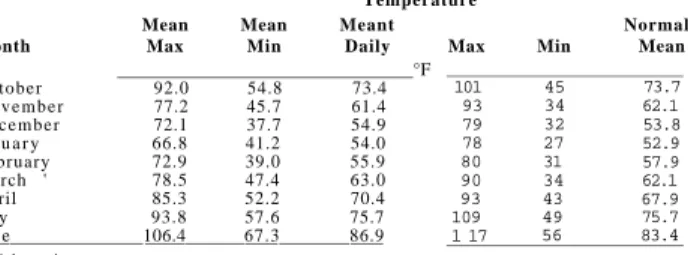
Climatic Periods and Thresholds Important To Sugarbeet Production
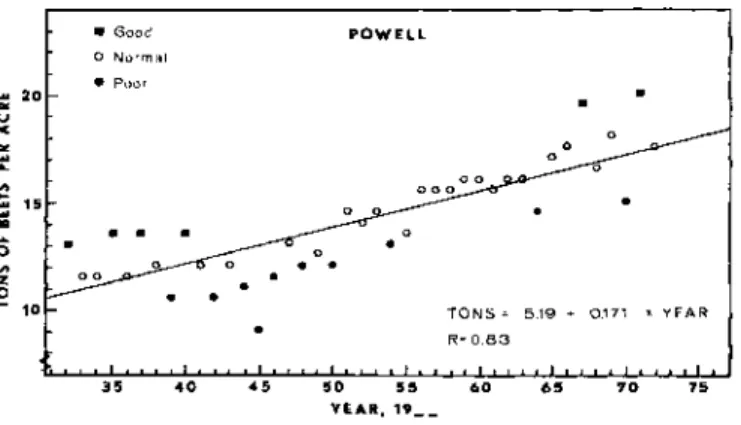
The yield in tonnes of beet and sugar percentage as a function of year for Powell are shown in Figures 1 and 2 respectively. The trend line parameters and categorized yield years to identify climatic periods for each of the three stations are given in Table 1. Good yields of tonnes of beet are obtained when there is an excess of maximum temperatures below 90°F in July and August and less than 70°F in September.
Weak o 55°F in July. Good sugar percentages are obtained when there is an excess of maximum temperatures of less than 70°F in October and less than 48°F in November and when there is an excess of minimum temperatures greater than 50°F in August and less than 30°F . In October. Poor sugar percentages are obtained when there is an excess of maximum temperatures below 80°F in late May and early June, below 90°F in August and below 48°F in November and when there is an excess of minimum temperatures are. less than 45°F in August.
This is not an attempt to obtain a growth model for sugar beets, but rather an attempt to distinguish between good and poor yield years for specific locations based on climatic differences for those areas. Most of the temperature periods that depressed yields were excesses of warm temperatures, especially for tons of beets per hectare. Good sugar % Good sugar % Poor yield Bad yield Bad sugar % Bad sugar % Poor yield Poor yield Poor yield Poor yield Good yield Bad sugar % Good sugar % Good sugar % Good sugar %.
Good crop Good sugar % Good crop Bad sugar % Bad sugar % Good crop Bad crop Bad crop Bad crop Bad crop Bad sugar % Good crop Good sugar.
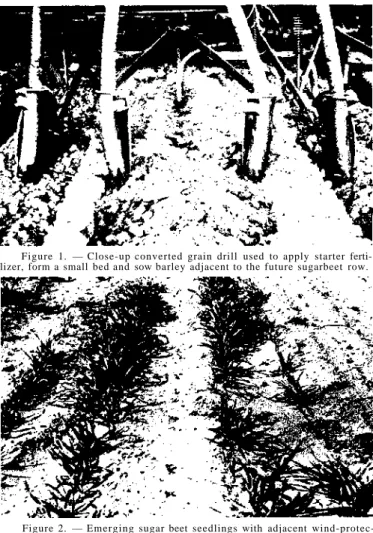
A Growing Mulch Tillage System To Reduce Wind Erosion Losses of Sugar Beets 1
Wind erosion was severe enough that the beet in about 25% of the adjacent conventionally tilled field was lost. One conventionally cultivated beet plot had about 907c of area, which was destroyed by wind erosion in 1974. Another conventionally tilled plot was not destroyed due to its small size, while the barley mulch provided protection for the mulched plots.
The barley-mulch system will prevent wind erosion losses as shown in 1974, but careful management of barley as well as beet is required. In connection with the development of the barley-mulch method, Settemcyer (5) studied the water requirements for conventional and mulch systems. Its objective was to correlate the water requirements of conventional and mulch systems to determine the competition between sugar beet and barley for available water.
Due to the energy shortage, it was interesting to find out the energy requirements of the mulching system. For the sprinkler system used in this study, 975 hp-hour/A was required to apply the average water requirement (6). However, more research on the system needs to be done to define the management decisions required to practically implement the system.
If adequate control of the mulch with herbicides was shown, fall seed crops would be practical.
Cultivar Blends for Buffering Against Curly Top and Leafspot Diseases of Sugarbeet 1
These responses were considered to be slightly overcompensating as most of the observed disease readings for the mixtures were below what was expected. He has served the ASSBT as Chairman of the Section on Entomology and Plant Pathology at the 1 3th and 1 7th General Assemblies and as a member of the Publications Committee for the 1964-65 Biennium. Oldemeyer has been a member of the Society since 1952 and has served three bienniums on the Prize Committee, twice as its chairman.
He chaired the Nominating Committee and received the Forty-Year Veteran Award. Dickenson has been a member of the Society since 1956, has served one biennium as director, one biennium on the Nominating Committee, was program chair for the 8th General Assembly, and authored or co-authored three articles in the ASSBT Journal. He is a member of the American Society of Agronomy, Crop Science Society of America, Genetics Society of America and American Phytopathological Society.
Hartmann has been a member of the Association since 1956 and has served two years as a member of the Board of Directors, representing the West Coast. Hartmann retired in January 1973, but has remained active in the industry as an instructor at the Beet Sugar Institute and as an impartial member of the acceptance panel for the Renville, Minnesota, plant. He has been a member of the Alpha Chi Sigma chemical fraternity since 1935 and of the American Chemical Society since 1939.
He has served as a subject judge for the United States National Committee for the International Committee on Uniform Methods of Sugar Analysis and as an associate judge for ICUMSA.