O NLINE D ISPUTE R ESOLUTION FOR
S MALL C IVIL C LAIMS IN V ICTORIA : A N EW P ARADIGM IN C IVIL J USTICE
V
IVIT
ANThis article seeks to explore some of the implications of integrating information and communications technology into judicial processes to resolve small civil claims. It argues that, as ODR moves from individual private-sector initiatives to widespread public sector institutionalisation, governance and value questions will need to be seriously considered. This is because questions regarding the appropriateness of the use of certain ODR systems in the resolution of small claims and consumer disputes persist, especially in relation to the use of systems which are fully autonomous. For example, how are fundamental due process requirements to be balanced against the economic constraints of resolving low value disputes? What are the limits to the evolution of civil justice to make it more accessible? It is argued that, while ODR holds vast potential for increasing access to justice, attention needs to be given to the dispute system design to ensure that it achieves that goal and does not result in the erosion of fundamental values of civil justice, including accessibility, transparency, legal validity and accountability.
I INTRODUCTION
In September 2018, as part of a new digital strategy to enhance online services and improve efficiency, the Victorian Civil and Administrative Tribunal (‘VCAT’) implemented an online dispute resolution (‘ODR’) pilot.1 Parties were able to have their matters heard and resolved by a VCAT member in real
Vivi Tan is an Honorary Fellow at the University of Melbourne Law School where she is completing her PhD. She would like to thank her supervisors, Professor Jeannie Paterson and Professor Julian Webb, for their advice and guidance.
1 ‘Sharing VCAT’s Online Dispute Resolution Experience’, VCAT (21 November 2018) (‘VCAT’s Online Dispute Resolution Experience’) <https://www.vcat.vic.gov.au/news/sharing -vcats-online-dispute-resolution-experience>.
time using video and file sharing technology on their own devices as an alternative to attending a hearing in person.
This pilot was in line with one of the recommendations from the 2016 Victorian Government Access to Justice Review.2 The Review recommended that the Victorian Government provide pilot funding and, subject to evaluation, ongoing funding for the development and the implementation of a new online system for the resolution of small civil claims.3
This article will seek to explore some of the implications of integrating information and communications technology into judicial processes to resolve small civil claims. Many jurisdictions, including the province of British Columbia in Canada,4 China,5 the United States,6 Mexico7 and the United Kingdom,8 are seizing the opportunities offered by new technologies to modernise dispute resolution systems. They have adopted systems that attempt to provide support, intake, advisory and determinative processes. These are designed to increase access to justice for consumers who traditionally would not bring their claims before a tribunal or a court due to constraints such as costs, location, time, and information asymmetry. Consumers are provided with more avenues to resolve disputes in a speedy and flexible manner, without reliance on traditional court processes which can be slow, inflexible and costly.
However, despite these benefits, questions regarding the appropriateness of the use of certain ODR systems in the resolution of small claims and consumer disputes persist, especially in relation to the use of systems which are fully autonomous. This article contends that, while ODR holds vast potential for increasing access to justice, care needs to be given to the dispute system design to ensure that it achieves that goal. Furthermore, as ODR moves from individual private-sector initiatives to widespread public sector institutionalisation, governance and value questions will undoubtedly come to the fore. For
2 Victoria State Government, Access to Justice Review: Volume 1 Report and Recommendations, (Report, August 2016) Recommendation 5.2, 281 (‘Access to Justice Review’) <https://s3.ap- southeast-2.amazonaws.com/hdp.au.prod.app.vic-engage.files/3314/8601/7221/Access_to_
Justice_Review_-_Report_and_recommendations_Volume_1.PDF>.
3 Ibid.
4 Civil Resolution Tribunal [British Columbia] (Web Page) <https://civilresolutionbc.ca/>.
5 ‘The Litigation Platform of Hangshou Internet Court’, Hangzhou Internet Court (Web Page)
<https://www.netcourt.gov.cn/portal/main/en/index.htm>.
6 Deno Himonas, ‘Utah’s Online Dispute Resolution Program’ (2018) 122(3) Dickinson Law Review 875.
7 Concilianet (Web Page) <http://concilianet.profeco.gob.mx/Concilianet/inicio.jsp>.
8 ‘Make a Court Claim for Money’, GOV.UK (Web Page) <https://www.gov.uk/make-court- claim-for-money>.
example, how are fundamental due process requirements to be balanced against the economic constraints of resolving low value disputes? What are the limits to the evolving accessibility of civil justice? And how will an ODR system impact the existing alternative dispute resolution (‘ADR’) processes in tribunals such as VCAT?
Further and more broadly, to what extent should technology be relied upon to provide dispute resolution services for consumers, considering the risk of sacrificing certain values — accessibility, legal validity, transparency and accountability — that are vital to the due administration of civil justice. This article will both inform and contribute to the debate on these questions and on the implications for consumer dispute regulation and practice. It will do this by defining ODR systems in Part II, and distinguishing examples of non-ODR systems. ODR systems will be classified by reference both to their platform and their level of automation or intelligent capability. In connection with its main argument, this article will contend that a discussion of the potential for ODR systems to increase efficiency in the resolution of small civil claims must begin with an adequate analysis of the different classifications of such systems.
Part III analyses how other jurisdictions have adopted different types of ODR systems to illustrate the various system designs which can potentially be adopted by a tribunal such as VCAT. Part IV will in turn focus on the judicial resolution of small claims in VCAT and the potential implications of the integration of an ODR system into VCAT’s dispute resolution systems. Part V will contain an analysis of some of the potential benefits of ODR and a discussion of juridical values such as legal validity, transparency and accountability in ODR. Ultimately, it is submitted that a discourse on ODR must necessarily include an integrated assessment of efficiency-oriented factors as well as of the fundamental values of civil justice.
II DEFINING ODR
A Non-ODR Systems
Various names, such as Electronic Dispute Resolution (‘EDR’), Internet Dispute Resolution (‘IDR’) and Online Alternative Dispute Resolution (‘OADR’) have been used interchangeably to describe ODR.9 It is also common
9 Haitham A Haloush, ‘The Liberty of Participation in Online Alternative Dispute Resolution Schemes’ (2008) 36(1) International Journal of Legal Information 102, 103; Beatrice Baumann, ‘Electronic Dispute Resolution (EDR) and the Development of Internet Activities’
(2002) 52 Syracuse Law Review 1227, 1228; Richard Michael Victorio, ‘Internet Dispute
for the term ‘ODR’ to be used to describe online communication facilities which allow parties or customers to lodge their complaints and to be connected with the other party to the dispute but without a dispute resolution mechanism operating alongside this facility.10
ODR has also been defined exclusively as the use of alternative dispute resolution methods, such as negotiation, mediation and arbitration which are assisted by information communication tools.11 To further complicate the matter, some online ADR concepts such as online mediation have been used to describe a large number of systems from automated blind-bidding processes and e-mediators to online mediation platforms with human facilitators and case management functionalities. Terms have often been used interchangeably.12 The resulting lack of clear definition and specificity unfortunately impedes clear analysis of the ODR concept and the potential of ODR to be a system that can allow parties to resolve their disputes by using a neutral facilitator or a neutral decision maker, or even through the use of algorithms or artificial intelligence.
This Part argues that a true ODR system should be defined as a system that allows parties to resolve their disputes from beginning to end, that is, from the making of the claim to the resolution of the dispute, in an online forum. There are three main groups of systems that should be distinguished from a true ODR system at the outset. These include: 1) systems which enable electronic filing (‘eFiling’) or online management of cases and hearings and electronic discovery, 2) online information platforms, and 3) online documents storage and retrieval platforms.
Some examples of an eFiling system include the VCAT Residential Tenancies Hub that allows tenants and landlords to create notices, apply to VCAT, pay
Resolution (IDR): Bringing ADR into the 21st Century’ (2001) 1(2) Pepperdine Dispute Resolution Law Journal 279, 280; Michael Legg, ‘The Future of Dispute Resolution: Online ADR and Online Courts’ (2016) 27 Australasian Dispute Resolution Journal 227, 227; Julia Hörnle, ‘Online Dispute Resolution in the EU and Beyond: Keeping Costs Low or Standards High?’ in Christopher Hodges and Astrid Stadler (eds), Resolving Mass Disputes ADR and Settlement of Mass Claims (Edward Elgar, 2013) 293, 294.
10 David Carneiro et al, ‘Online Dispute Resolution: An Artificial Intelligence Perspective’
(2014) 41(2) Artificial Intelligence Review 211, 215 (‘Online Dispute Resolution’).
11 See for example, Aashit Shah, ‘Using ADR to Resolve Online Disputes’ (2004) 10(3) Richmond Journal of Law and Technology 1; Gabrielle Kaufmann-Kohler and Thomas Schultz, Online Dispute Resolution: Challenges for Contemporary Justice (Kluwer, 2004) 5; David Spencer and Samantha Hardy, Dispute Resolution in Australia: Cases, Commentary and Materials (Thomson Reuters, 2014) 648.
12 Kaufmann-Kohler and Schultz (n 11) 6.
fees and search for previous notices and applications online.13 Similarly, eFiling or eLodgment platforms such as the Redcrest eFiling platform utilised by the Supreme Court of Victoria14 or the eLodgment and eCourtroom facilities available in the Federal Court15 are facilitative online systems which are not ODR systems. The Federal Court eCourtroom was developed as early as 2001.
It is an online courtroom that can be used by judges and registrars to assist with the case management and hearing of certain matters before the Federal Court or the Federal Circuit Court of Australia. Such matters include the giving of directions, ex parte applications for substituted service in bankruptcy proceedings, applications for examination summonses and other orders in general federal law matters. The eCourtroom is integrated with eLodgment, thereby facilitating the electronic filing of documents. It is an efficient online facilitative system which not only allows for an exchange of documents, but also for the making of submissions in a protected and confidential environment.
The second group of non-ODR systems comprises online information platforms which focus on dispute resolution but do not provide processes or facilities which allow parties to resolve their disputes thereby. An example is the online information package provided by the Dispute Settlement Centre of Victoria directed at disputants in neighbourhood conflicts. Another example is the Family Relationship Services Online.16 This service provides all families, including partners who are separated, with information about family relationship issues. The information ranges from how to build a better relationship to dispute resolution, including, for example, information about Family Dispute Resolution and links to accredited Family Dispute Resolution Providers.
Finally, an example of an online storage platform is the Commonwealth Courts Portal. This portal is a joint initiative of the Family Court of Australia, the Federal Court of Australia and the Federal Circuit Court of Australia.17 It provides web-based services for authorised users, such as a lawyers, judges,
13 ‘How to Register for the Residential Tenancies Hub’, VCAT (Web Page)
<https://www.vcat.vic.gov.au/get-started/renting-a-home/how-to-register-for-the-residential- tenancies-hub>.
14 Supreme Court of Victoria — Electronic Filing (Web Page) <https://www.redcrest.
com.au/eservices/home.page.2>.
15 ‘eLodgment’, Federal Court of Australia (Web Page) <http://www.fedcourt.gov.au/online- services/elodgment>; ‘eCourtroom’, Federal Court of Australia (Web Page)
<http://www.fedcourt.gov.au/online-services/ecourtroom>.
16Family Relationships Online (Web Page) <https://www.familyrelationships.gov.au/>.
17Commonwealth Courts Portal (Web Page) <https://www.comcourts.gov.au/>; ‘Federal Law Search’, Federal Court of Australia (Web Page) <http://www.fedcourt.gov.au/online- services/federal-law-search>.
litigants and journalists, so that they can immediately access information on cases before the courts, including a list of the court files or files of interest to the user. Like eCourtroom and eLodgment, this type of data management, storage and retrieval system is not an ODR system. Discussion will now turn to the different types of true ODR system based on their level of automation.
B Level of Automation Spectrum
1 Automation of Offline Interactions
ODR systems are various types of dispute resolution procedures facilitated by different technological tools. They can be differentiated through their level of automation and function. This classification based on the level of automation focuses on the functionality of the ODR system. At one end of the spectrum, ODR can include technology-based substitution or automation of offline interactions and activities. For example, ADR processes such as mediation and arbitration might be conducted online by a human mediator or arbitrator and might be synchronous, that is, attended by the disputing parties in real time using video-conferencing tools. Some commentators have referred to this type of system as the ‘first generation’ ODR system.18
Central to such a system is the involvement of human actions in the planning, managing and decision-making processes. The use of information and communications technology is facilitative or supportive in this regard.
Communication between the parties, as well as between the parties and the ODR provider, can occur both synchronously and asynchronously, using e- mails, instant messaging, video and phone calls. Software such as Skype or the web-based video-conferencing platform Zoom can be used to facilitate the online hearing. Moreover, the dispute and all associated files can be managed and stored online in a secured database.
In some cases, the first generation ODR systems can be used in conjunction with automated negotiation software to enable a tiered dispute resolution process. Some of these examples will be discussed in the following segment of the article.
2 Online Conciliation
The Australian Financial Complaints Authority (‘AFCA’) assists consumers and small businesses to reach agreements with financial firms in settlement of
18 Carneiro et al (n 10) 214–5.
complaints about financial services, including credit, finance, insurance, banking and investment, as well as superannuation. These complaints were previously handled by three different bodies — the Financial Ombudsman Service, the Credit and Investments Ombudsman and the Superannuation Complaints Tribunal. AFCA now provides both formal and informal methods to resolve consumer complaints, including a telephone conciliation conference.19
Overseas, the Concilianet platform in Mexico is both hosted and supported by the Office of the Federal Attorney for the Consumer (‘PROFECO’) and it offers an entirely free online conciliation system for dispute resolution.20 Suppliers of goods and services that have entered into collaboration agreements with PROFECO can utilise this online conciliation hearing platform should a customer file a complaint against them. These suppliers range from airline companies, entertainment suppliers, e-commerce sites, restaurants and telecommunication providers, to real estate companies.21 Suppliers which are not registered can have claims filed against them, but the filing must be done in person at a local satellite office.22 The use of this platform is voluntary, and it does not prevent the consumer from bringing their claim to the court.23
3 Online Negotiation and Mediation
In addition to online conciliation, the rapid growth of online negotiation and mediation can be seen in both judicial and extra-judicial resolution of disputes.24 For instance, the British Columbia Civil Resolution Tribunal (‘CRT’) offers ODR for strata property disputes (with no maximum value) and small claims disputes to the value of CAD 5000. The dispute resolution process involves four steps: 1) use of an information platform, 2) party-to-party negotiation, 3) online conciliation facilitated by mediators and 4) in cases where parties do not reach a negotiated agreement, adjudication by the tribunal member. This illustrates the ability of an ODR system to integrate both traditional and ADR processes to encourage parties to resolve their disputes
19Australian Financial Complaints Authority (Web Page) <https://www.afca.org.au/what-to- expect/the-process-we-follow/>.
20 Concilianet (n 7).
21 ‘Participating Providers’, PROFECO (Web Page) <https://concilianet.profeco.gob.mx/
Concilianet/proveedores_que_concilian.jsp>.
22 ‘Frequently Asked Questions’, PROFECO (Web Page) <https://concilianet.profeco.
gob.mx/Concilianet/faq.jsp>.
23 Ibid.
24 Pablo Cortés, Online Dispute Resolution for Consumers in the European Union (Taylor &
Francis, 2011) 144–5 <http://www.oapen.org/search?identifier=391038>.
early in the resolution process. It is highly likely that similar systems will be more commonplace in the near future due to the increasing annexation of ADR processes by court and tribunal systems.
One early dominant player on the extra-judicial online negotiation and mediation scene was SquareTrade.25 From 1996 to 2008, it assisted eBay users worldwide in resolving their small value disputes using online mediation. It attempted to leverage concepts used in offline ADR to create the largest ODR system at the time. Thus, the model deployed processes of assisted negotiation, conciliation and mediation, and users had the option of choosing mediators or a recommended resolution. These could be utilised both as facilitated services and through the use of automatic negotiation software that matched solutions to problems. In other words, SquareTrade used the combination of an online mediation and a negotiation software.
SquareTrade was self-contained as it dealt only with disputes arising online.
Parties who failed to resolve their disputes through direct negotiation would be referred to SquareTrade. The system was used to settle disputes in a number of online market places, including eBay. Disputants repeatedly presented disputes involving the same issues, and thus it was possible to divide these disputes into different categories. The main categories of dispute involved delivery delays, bad or incorrect descriptions of goods and negative feedback.26 It is not surprising that dispute resolution on a platform such as eBay is a necessity. The platform advertises a large number of items for sale, it facilitates a large number of transactions, and eBay Inc itself assumes little responsibility for the transaction. The availability of a dispute resolution process and the use of credit card chargebacks has thus turned platforms such as eBay into online marketplaces where buyers and sellers can transact on almost anything without a high degree of risk.
The first element in the SquareTrade system was a triage mechanism. When a buyer or a seller filed a complaint, they would be asked to fill out a web-based standard claim form that identified the type of dispute.27 They would then be presented with a list of common solutions that they could agree to. The other party to the dispute would be contacted by e-mail and informed about the process. They were asked to confirm their agreement to participate. This first step can best be described as an assisted negotiation process that employs
25 Thomas Schultz, ‘Does Online Dispute Resolution Need Governmental Intervention: The Case for Architectures of Control and Trust’ (2004) 6(1) North Carolina Journal of Law and Technology 71, 74.
26 Cortés (n 24) 68.
27 Ibid 67.
negotiation support systems. The process was designed to interpret the parties’
claims, match their potential interests in the outcome of the dispute and offer a solution. The negotiation technology helped convert the parties’ claims into constructive and clear language. If both parties agreed on the same solutions, the dispute would be considered resolved. However, if they did not come to an agreement, the next stage of the resolution would be triggered.28
This next stage mimicked a negotiation environment and used software tools to promote constructive negotiation between the two parties. Using the web interface, parties were allowed to formulate and reformulate the problem and the desired solution. The aim of this procedure has been described as working
‘toward the goal of Pareto efficiency in negotiation’.29 Parties were limited in the number of texts they could insert. This was to prevent parties from introducing other less relevant elements into the negotiation which might have the effect of escalating the dispute. Parties were also encouraged to propose an agreement and set deadlines. As a result, parties were encouraged to move from a problem or disputing mode to a solution stance.30 Disputes which were not settled during the first two stages proceeded to the next stage which involved assisted mediation by a mediator acting as expert evaluator or conciliator.31 SquareTrade utilised mediators from over 15 different countries.32 In managing the process, they would carry out responsibilities similar to those of offline mediators, uncovering the parties’ interests and directing them toward a mutually acceptable resolution. If the parties reached an agreement, the mediator would draft the memorandum of understanding for them to accept.33 The mediator would communicate in writing (through asynchronous e-mail and web communication) with each party separately in trying to lead them toward a resolution. No video communication technology was used, something which could have introduced another facet to online mediation.
28 Ibid.
29 Ernest M Thiessen and Joseph P McMahon, ‘Beyond Win-Win in Cyberspace’ (2000) 15(3) Ohio State Journal on Dispute Resolution 643, 666. A transaction is Pareto-efficient if it satisfies the preferences of at least one party and does not cause a violation of the preferences of anyone else. For example, in a negotiation between A and B, A has a preference for a claim which it values at $5 and which B values at $10. The negotiation is Pareto efficient if B in fact fully compensates A for the value of its claim ($5) and is nevertheless content because it has parted with less than $10, and if no one else is made worse off because of the negotiation.
30 Orna Rabinovich-Einy, ‘Technology’s Impact: The Quest for a New Paradigm for Accountability in Mediation’ (2006) 11 Harvard Negotiation Law Review 253, 258.
31 Cortés (n 24) 67.
32 Ibid 149.
33 Ibid.
Approximately 80% of disputes handled by SquareTrade were resolved in the first two stages, involving efficient automatic processes that enhanced online negotiation.34 Cortés contends that the simplicity and the convenience of the system led to its high level of success in resolving eBay disputes for over eight years.35 Further, he argues that factors such as the ‘nature of the dispute, the accuracy of information provided and the capability of the software or the neutral third party in assessing and evaluating the facts and evidence’ could influence the success of the consensual and automated processes.36 And, perhaps more importantly, the parties who were involved in the dispute — sellers who wanted to obtain positive feedback from their customers and buyers who wanted redress — often had incentives to participate.37 The feedback or reputation management system played an important role in the success of the ODR process. However, after eight years of success, eBay Inc made the decision to bring ODR in-house and continues to provide such services through its Resolution Centre. It has been said that the demise of SquareTrade was brought about by its inability, as a third-party service provider outside of the eBay network, to resolve many non-feedback related disputes.38 PayPal and other large online marketplaces such as Alibaba now also offer their own internal Resolution Centres, with Alibaba going as far as introducing a User Dispute Resolution Centre which enables Taobao (Alibaba’s consumer-to- consumer online marketplace) users to play judge and jury in disputed e- commerce transactions.39
One of the benefits of submitting to a self-contained ODR platform is that the community or marketplace itself has in-built enforceability mechanisms that can respond to parties that fail to comply with the outcomes of a dispute resolution process. For example, eBay Inc can act against non-compliant parties through suspension of accounts or it can institute a delay in payment or even reverse charges and allow money to be refunded to the customer. Such a chargeback facility is an important tool in such a platform. This, combined with the internal trust mark system, allows for a wholly internal system of dispute resolution that binds parties who have indirectly submitted themselves to the
34 Ethan Katsh and Janet Rifkin, Online Dispute Resolution: Resolving Conflicts in Cyberspace (John Wiley, 2001) 142.
35 Cortés (n 24) 68.
36 Ibid.
37 Ibid.
38 SquareTrade’s original dispute resolution service as well as its merchant verification service have since been discontinued.
39 ‘Managing Customer Concerns’, PayPal Australia (Web Page) <https://www.paypal.
com/au/webapps/mpp/customer-concerns>; Alibaba Public Jury (Web Page) <http://pan.
taobao.com/>.
dispute resolution mechanisms when voluntarily entering into the agreement to use the marketplace and to become a member of the community. The coercive nature of the system is justified on the basis of the parties’ voluntary agreement to join the marketplace.
Similarly, Amazon Pay offers a Buyer Dispute Program which will apply if a customer has used Amazon payment to purchase a physical item and the item does not arrive or is materially different from the description. In such a case the customer is eligible to receive up to USD 2,500 of the purchase price including shipping charges.40 Customers who use their credit cards through Amazon payments can also elect to dispute any charge with their issuing banks. In cases where buyers abuse the Buyer Dispute Program or chargeback rights, their access to their accounts can be restricted or terminated. Similarly, any merchant who fails to cooperate in good faith in trying to resolve its buyers’ complaints may face the consequence of having its account privileges restricted or terminated.41
Ultimately, these providers act as neutral third parties which encourage business and consumers to first reach amicable agreements through automated negotiation and, in cases where such agreements are not formed, these providers can also adjudicate the disputes. However, despite the many benefits provided, these private platforms are unregulated and unmonitored for fundamental fairness and due process protections. This being the case, arguments can be made for the development of a regulatory framework to govern these platforms to ensure that fundamental values of civil justice, as well as other important values such as privacy protection, are upheld by any ODR platform regardless of its public/private categorisation.42
Another example of automated negotiation which can utilise both online mediation and automated software is blind bidding.43 It can be effectively used
40 For all other items and services, Amazon Pay will assist the customer to resolve the dispute with the merchant but the customer will not be eligible to receive a refund of any part of the purchase price.
41 ‘Buyer Dispute Program’, Amazon Pay (Web Page) <https://pay.amazon.com/us/help/20175 1580>.
42 This is an area which merits further research. See, for example, Anjanette H Raymond, ‘A Meeting of the Minds: Online Dispute Resolution Regulations Should Be Opportunity Focused’
(2015) 16 University of California Davis Business Law Journal 189, 198; Stefan RM Lancy,
‘ADR and Technology’ (2016) 27 Australasian Dispute Resolution Journal 168, 173; Kananke Chinthaka Liyanage, ‘The Regulation of Online Dispute Resolution: Effectiveness of Online Consumer Protection Guidelines’ (2012) 17(2) Deakin University Law Review 251.
43 Cybersettle (Web Page) <http://www.cybersettle.com/>.
in cases where initially several issues have been at stake but, subsequent to online mediation, the only contention between the parties is monetary.
This type of automated bidding and settlement is suitable for the settling of monetary claims where the liability is no longer disputed. Companies such as Cybersettle in the US have been successful in implementing this technology.44 The parties are required to make successive blind bids which remain confidential so as not to prejudice future negotiations. This can overcome parties’ fear of revealing bottom lines during the negotiation. Once the bids fall within a certain range, settlement will be proposed for the median amount. This is driven by software and does not require human involvement. Communication applications such as e-mail and web-based platforms are used to support the resolution process. Such a system is cost-effective and prevents escalation of conflicts over small amounts during the negotiation process. Essentially the process involves positional negotiation rather than lengthy interest-based negotiation which could open up a Pandora’s Box of conflicting interests and issues which could in turn escalate and further entrench the dispute between the parties.45 Despite this, further research should be undertaken to investigate the impacts of power imbalance between parties which can result from differences in financial resources and negotiation skills, as well as online digital literacy.46 In summary, the integration of information and communications technologies into ADR processes such as conciliation, negotiation and mediation can augment many of the benefits of traditional offline ADR processes by enabling a quicker, more cost-efficient, flexible and satisfactory process that can produce long-lasting solutions for parties. ‘Justice in many rooms’, including online ones, is a possibility.
4 Online Arbitration
The ability to enforce an agreement reached between the disputing parties can provide incentives to participation in the dispute resolution process. Hence it has been argued by Schwarzenbacher that, unlike other ODR methods, online arbitration could provide the parties with a binding solution which could be
44 Cortés (n 24) 65.
45 Positional negotiation focuses on linear concession-making whereby parties move from opening positions in ever-decreasing increments toward a compromise. Negotiations often involve a combination of positional and interest-based negotiation strategy. The latter allows the parties to explore and satisfy interests rather than competing over positions. For this reason negotiation is not a zero sum game.
46 Frequent users of the system may be able exploit the imbalance of power when bidding against an infrequent user.
enforced in the offline world.47 He argues that, under article VII of the Convention on the Recognition and Enforcement of Foreign Arbitral Awards, the enforcement of online arbitration agreements and the resulting awards are possible in cases where a national law or international treaty or convention permits the recognition and enforcement of arbitration agreements concluded and signed electronically.48 Further, given the principle of party autonomy, parties can tailor the proceedings to their specific needs. For example, the parties can agree to adopt a particular set of procedural rules that allow for the use of novel technologies in the resolution process to reduce prohibitive costs, especially in cross-border disputes.
However, despite these potential benefits, online arbitration has experienced a slow growth. There could be several reasons for this. First, offline judicial enforcement arguably defeats the purpose of an online resolution. For this reason Baert has argued that online arbitration awards must be enforced in other ways than through the traditional court system.49 Second, there are uncertainties surrounding the enforcement of online arbitration agreements and the resulting online arbitral awards.50 For example, the terms and conditions of an agreement might require a consumer to submit to a specific ODR procedure as an exclusive means of resolving a dispute, thereby waiving the right to litigate. Such terms and conditions might not be enforceable, especially where the consumer has had little notice of such terms and has given little meaningful consent to them.51 Such pre-dispute arbitration agreements can be refused enforcement, especially in cases involving consumer and electronic contracts. For example, ‘in the European Union, electronic merchants (‘e-merchants’) cannot require the buyer to resolve a dispute through online arbitration, although they are permitted to propose this as an option’.52
47 Paul Schwarzenbacher, ‘Online Arbitration: A European and US Perspective’ (2018) 10 Bocconi Legal Papers 387, 412. See also Philippe R Baert, ‘The Potential of Online Arbitration (OARB) in Resolving Disputes at the Lower End of Value: Justice without the State, or State of Injustice’ (Master of Laws Thesis, University of Ghent, 2017) 11 <https://lib.ugent.
be/fulltxt/RUG01/002/349/376/RUG01-002349376_2017_0001_AC.pdf>.
48 Schwarzenbacher (n 47).
49 Baert (n 47) 24.
50 Cortés (n 24) 69 and Baert (n 47) 13.
51 Lucille M Ponte, ‘Getting a Bad Rap? Unconscionability in Clickwrap Dispute Resolution Clauses and a Proposal for Improving the Quality of These Online Consumer “Products”’
(2011) 26 Ohio State Journal on Dispute Resolution 119, 123.
52 Schwarzenbacher (n 47) 422.
In addition, there are ‘no universally accepted rules directly governing online arbitration procedures’53 and it is also unclear whether the Convention on the Recognition and Enforcement of Foreign Arbitral Awards applies to awards made through online arbitration.54
Many of the ODR examples mentioned thus far utilise what Sourdin has termed
‘supportive’ and ‘replacement’ technologies.55 The central feature of such ODR systems is the involvement of human beings and human intelligence in the planning, managing and decision-making processes. The VCAT’s ODR pilot can be viewed in the same light. The online hearing was designed to be the same as an in-person hearing. Parties were able to log into the online platform from their own device at a location which was convenient to them. In addition, documentation could be securely uploaded, stored and made accessible to all parties to the case through the same online portal. The portal also allowed for other parties, such as witnesses, to attend a hearing by logging into the portal.
The use of information communication technology is facilitative or supportive in this regard. Offline activities are replicated online to enhance access and allow for flexibility.
The discussion will now turn to ODR systems which are capable of full automation.
C Autonomous and Fully Automated
Although not directly relevant to the VCAT’s pilot, there exist more complex automated ODR systems which have the potential to resolve consumer disputes. Autonomous ODR systems might be able to offer problem diagnosis and resolution capabilities that are fully automated using algorithms, legal data analytics and predictors as well as legal artificial intelligence techniques. Such techniques can include, ‘text mining, knowledge based self-learning, machine learning and natural language processing’.56 They can be used to analyse a large amount of ‘data with descriptive, diagnostic, predictive and prescriptive analytics tools’.57 Technology in recent years has been increasing in
53 Ibid 387.
54 Ibid 412–15.
55 Tania Sourdin, ‘Justice and Technological Innovation’ (2015) 25 Journal of Judicial Administration 96, 96.
56 Judith Bennett et al, ‘Current State of Automated Legal Advice Tools: Discussion Paper 1’, University of Melbourne, Networked Society Institute (Discussion Paper, 2018) 11
<https://networkedsociety.unimelb.edu.au/__data/assets/pdf_file/0020/2761013/2018-NSI- CurrentStateofALAT.pdf>.
57 Ibid.
sophistication, with ‘technologies such as neural networks, natural language generation and social intelligence solutions’ being developed, as well as the blockchain technology which allows for transactions to occur with no intermediaries and human involvement.58
One significant feature of these more advanced automated technologies is the ability for the machine learning technology to recommend decisions which are not explicitly programmed by a human. Instead, the machines have the capacity to self-learn from data, using statistical reasoning. In such cases, technology supersedes human interaction and artificial intelligence is used to present available alternatives to disputing parties, thus narrowing the issues in the dispute and the differences between the parties.59 The systems would be able to identify ‘concepts and patterns in the data, form and test hypotheses, and develop recommendations’ as a result of their analysis.60
The use of such technologies could have a major impact on our justice system, especially if they could be integrated within existing adjudicatory or non- adjudicatory processes. Such systems could allow for a large number of claims to be processed, thus providing access to avenues of dispute resolution for conflicts with similar characteristics. Sourdin argues that the most significant impact is likely to be seen in cases where determinative processes are used.61 In addition, the use of pre-designed algorithmic options may eliminate the predispositions associated with human decision making62 and potentially result in fairer outcomes for parties.63 The data obtained from the systems can be used in three ways: 1) to further monitor the quality of processes and outcomes, 2) to uncover biases and problems in the operation of the algorithms, and 3) in some cases, to allow for dispute prevention altogether.64
58 Ibid 12.
59 National Alternative Dispute Resolution Advisory Council, The Resolve to Resolve:
Embracing ADR to Improve Access to Justice in the Federal Jurisdiction (Report, September 2009) 73 (‘The Resolve to Resolve’) <https://www.ag.gov.au/LegalSystem/Alternate DisputeResolution/Documents/NADRAC%20Publications/the-resolve-to-resolve-embracing- adr-improve-access-to-justice-september2009.pdf>.
60 Bennett et al (n 56) 13.
61 Sourdin (n 55) 101.
62 For example, Sourdin has mentioned a range of factors that can influence a human judge including: personal values, unconscious assumptions, reliance on intuition, the attractiveness of the individuals involved, and emotion. See Tania Sourdin, ‘Judge v Robot? Artificial Intelligence and Judicial Decision-Making’ (2018) 41(4) UNSW Law Journal 1114, 1128–9.
63 Orna Rabinovich-Einy and Ethan Katsh, ‘Access to Digital Justice: Fair and Efficient Processes for the Modern Age’ (2017) 18(3) Cardozo Journal of Conflict Resolution 637, 648.
64 Ibid.
III LESSONS FROM OTHER JURISDICTIONS
The ODR model which has been recommended by the 2016 Victorian government Access to Justice Review for adoption by VCAT has many similarities with the model used by the British Columbia Civil Resolution Tribunal. First of all, it encourages early dispute resolution by empowering members of the public by giving them relevant information on their rights and obligations. It then allows parties to resolve their disputes, facilitated by qualified ADR specialists.65 The evident desire to imitate traditional ADR methods is perhaps grounded on the assumption that such methods would be appropriate for small value claims where the lack of face-to-face communication would be of minor importance and where legally sound and fair court-based decisions may seem impractical or unsatisfactory for parties.
A British Columbia
The CRT offers ODR for strata property disputes (with no maximum value) and small claims disputes to the value of CAD 5000.66 Such disputes can concern debt or damages claims, recovery of personal property, personal injury and specific performance of agreements involving personal property or services.67 This online tribunal is one rare example of a permanent, publicly administered ODR system which resolves offline disputes. The ODR process begins with provision of information and problem diagnosis. Subsequently, it progresses to party-to-party negotiation and, where that fails, the process turns into a facilitated ADR. If parties are still unable to reach an agreement, adjudication will take place.68
The first stage involves an expert system called Solution Explorer. An expert system is computer software that uses some amount of AI in the form of causal and defined logic codes to simulate the judgment and behaviour of a human69 or an organisation with expert knowledge and experience in a particular field.70 This AI is also often referred to as simple or rules-based AI. System designers
65 Access to Justice Review (n 2) 277.
66 Civil Resolution Tribunal [British Columbia] (n 4).
67 ‘Fees’, Civil Resolution Tribunal (Web Page, 2019) <https://civilresolutionbc.ca/resources/crt- fees/>.
68 Shannon Salter, ‘Online Dispute Resolution and Justice System Integration: British Columbia’s Civil Resolution Tribunal’ (2017) 34 Windsor Yearbook of Access to Justice 112, 114.
69 Philip Leith, ‘The Rise and Fall of the Legal Expert System’ (2010) 1(1) European Journal of Law and Technology <http://ejlt.org/article/view/14>.
70 Bennett et al (n 56) 13.
will obtain expert knowledge from human experts and encode that knowledge into rules which can be applied based on the information obtained from the users.71 The systems will prompt the users to answer several questions before responses are produced, based on a decision-tree analysis.
In the context of ODR, an expert system such as the Solution Explorer is used to encourage early dispute resolution by providing useful information for the parties regarding the nature of their dispute to help them make informed choices about how to resolve it. For example, such a system can determine the eligibility of claims under certain legislation. Any effective ODR platform should include such a first-line dispute avoidance process. According to the CRT’s snapshot for October 2018, a total of 48,574 Solution Explorer explorations were carried out, with 29,593 explorations concerning small claims and 18,981 concerning strata property.72
In practical terms, the Solution Explorer system uses interactive questions and guided pathways to provide potential disputants with free, tailored legal information. It also provides tools and resources to enable self-help, such as template letters (for example, to ask for a hearing or to send to the disputants’
owners’ corporations) to help disputants resolve disputes consensually.
If a person is unable to resolve their dispute consensually after accessing Solution Explorer, the next step is to start a claim. This is the second stage in the ODR process. The parties are not required to re-enter all the relevant information as the system carries the information initially entered through to the subsequent stages. Moreover, the ODR process ‘incorporates relevant parts of the Tribunal’s rules on an as-needed, when-needed basis, to avoid overwhelming parties with inapplicable rules’.73
Once a claim is commenced, facilitators will attempt to facilitate consensual resolution of the dispute. This is the third stage of the ODR Process. This stage is intended to be flexible and responsive.74 The facilitators can use a variety of tools to help parties settle their claims. The facilitators are required to have strong mediation experience and skills to ensure that they can help parties reach a consensual agreement, wherever possible. All settlement communications are confidential and are not disclosed to the Tribunal members. If the parties reach an agreement, the Tribunal member can convert the agreement into a binding
71 Ibid.
72 ‘CRT Statistics Snapshot: October 2018’, Civil Resolution Tribunal (Web Page)
<https://civilresolutionbc.ca/crt-statistics-snapshot-september-2018-2/>.
73 Salter (n 68) 120.
74 Ibid 121.
order which can be enforced in court.75 If the parties reach an agreement, the facilitator can ask a tribunal member to convert the agreement into a binding order of the tribunal, which can be enforced in court, without the parties having to sue for a breach of the agreement. The Tribunal ‘anticipates that the facilitation stage could resolve up to 70 percent of disputes’.76
If the parties are unable to reach an agreement, the dispute can progress to the adjudication stage. The facilitator will continue to play a neutral role in preparing the parties for this stage, for example through narrowing issues and organising their claims. During the adjudication stage, a Tribunal member with relevant expertise will hear the parties’ evidence and submissions and make a binding decision. Participants can seek legal assistance throughout the process and, if a hearing becomes necessary, a party will be able to request permission to have a lawyer to represent them. Hearings will generally take place via telephone or videoconferencing.
The end-to-end process is intended to take around ninety days for most cases and the average total cost to the parties is about CAD 200.77 The fees are staged and hence parties may not have to pay the full fees if they are able to resolve their disputes early in the process. More importantly, the fees are set at a level which will arguably deter frivolous claims.78 Salter observes that, by leveraging technology, the Tribunal ‘democratizes access to dispute resolution services by connecting the public, wherever they may live, with expert facilitators and tribunal members’.79 If VCAT is to implement a similar system, then adequate funding must be made available through the design, implementation and evaluation stages.
B The United Kingdom
In the United Kingdom, Lord Justice Briggs’s ‘Civil Courts Structure Review’
recommends an online court for claims up to £25,000.80 This will arguably be a most radical and important structural change to the civil courts system which
75 Ibid.
76 Ibid.
77 Ibid.
78 Ibid.
79 Ibid 120–1.
80 Lord Justice Briggs, ‘Civil Courts Structure Review’, Courts and Tribunals Judiciary (Web Page, 27 July 2016) <https://www.judiciary.gov.uk/civil-courts-structure-review/>.
will enable disputes of small value and complexity to be resolved online. It will aim to improve access to justice for people and small businesses.
It is recommended by Lord Briggs that the online court should offer three stages of dispute resolution.81 Stage 0 would provide parties with vital information about treating litigation as a last resort and the sources of affordable or free advice; it could also provide summaries of the essential legal principles. Stage 0.5 would allow parties to discuss their matters with each other to determine the nature of the dispute which the court needs to resolve.
Stage 1 triage would involve a largely automated and interactive online process which would enable the identification of the issues and the requirements for provision of documentary evidence. The online portal would assist the parties to develop a simplified pleading that would be capable of being understood by their opponent and by the court.82 In many undisputed civil claims, the court is resorted to for enforcement rather than for dispute resolution. In such cases, the system would allow represented parties to by-pass the full Stage 1 triage.83 This would save the parties time and costs.
If Stage 1 were not by-passed, the subsequent step would be likely to involve the use of ADR methods such as mediation. This would be Stage 2 of the process. If parties were unable to reach an agreement at this stage, they could proceed to Stage 3 and obtain resolution by judges. The court might choose to resolve the matter based on the documents submitted or after communicating with the parties via telephone or video. Face-to-face hearings, if used, would be restricted to resolving particular issues in the dispute.84
Menashe argues that the introduction of such an online court would act as ‘the first step toward accommodating the court system to the innovative reality of the Internet Age, in a manner which is both systematic and controlled’.85
81 Lord Justice Briggs, Civil Courts Structure Review: Final Report (July 2016) 1, 58–60
<https://www.judiciary.uk/wp-content/uploads/2016/07/civil-courts-structure-review-final- report-jul-16-final-1.pdf>.
82 Ibid 59.
83 Ibid.
84 Ibid.
85 Doron Menashe, ‘A Critical Analysis of the Online Court’ (2018) 39(4) University of Pennsylvania Journal of International Law 921, 922.
C The United States
In the United States, a relevant example is Modria’s86 property tax assessment dispute settlement service which has been adopted by several local government jurisdictions including Durham County, Fulton County, North Carolina, Alachua County, Florida, Orleans Parish, Louisiana and Davidson County, Tennessee.87 It provides services which enable property owners appealing property tax assessment to have their cases reviewed and resolved through a combination of online and offline procedures. This tax assessment appeals process goes beyond internalising online dispute resolution for organisational communication and interaction, and constitutes the first case of institutionalisation of ODR as a significant means of providing government services to the public.
In addition, Utah pioneered the adoption of an ODR system in its small claims court in September 2018.88 The court has jurisdiction over claims of USD 11,000 or less, and the parties are almost always both unrepresented.
Typically, only two parties are involved and the majority of the cases are debt collection cases.89 The system is capable of handling an entire dispute online, as opposed to only a discrete part of a dispute.90 According to the Utah Supreme Court Justice, Deno Himonas, the introduction of this system is grounded in the Court’s commitment to access to justice and its desire to remain relevant in a changing world.91 According to his Honour, the goals that have been set and against which the success of the ODR system will be measured include:
access to justice … simple, quick, inexpensive and easily accessible justice;
individualized assistance and information that is accessible across a multitude of electronic platforms; [the ability of] parties to participate whenever they want …[the lowering of] costs associated with resolving our small claims disputes and [encouragement and assistance] in the settlement and resolution of those disputes.92
86 Modria (Web Page) <https://www.tylertech.com/products/modria>. Modria is a purpose-built ODR platform which can be adapted to the needs of the particular private or public dispute resolution bodies.
87 For example, Fulton County Board of Assessors Resolution Center (Web Page)
<https://fultoncounty.modria.com/>; Ohio Board of Tax Appeals Resolution Center (Web Page) <https://ohio-bta.modria.com/>.
88 Himonas (n 6).
89 Ibid 881.
90 Ibid.
91 Ibid.
92 Ibid.
In addition, the statutes and the rules of procedure will be amended as necessary to allow for the ODR system to operate.93
The complete ODR model which was developed in Utah includes three stages:
1) education and information (utilising an expert system), 2) facilitated self- resolution through mediation, and 3) adjudication with the choice of online or live hearing. The parties also retain a complete de novo right of appeal to the District Court.
The design of the system is similar in nature to that of the British Columbia Civil Resolution Tribunal. At the front end, an expert system will provide useful information and self-help resources for parties, as well as evaluate the nature of the claims. This encourages early dispute resolution between the parties and reduces information asymmetry. The parties will be able to communicate using the online communication platform where all parties interact in real time to resolve their dispute without intervention from the Court. In addition, there will be trained facilitators who are able to mediate and answer basic questions as well as provide, in Justice Deno Himonas’s view, some limited legal advice on the process.94 They will also be able to help parties to build a settlement document if the parties choose not to do this themselves.95
If, after facilitation, the parties are still unable to reach a settlement, the facilitator will assist them with trial preparation.96 For example, the facilitators can provide a trial preparation document which will narrow the issues based on parties’ description of what they have been able to solve and what remains unresolved. The parties can upload documents they think are appropriate with the guidance of the facilitator. The judge will have the discretion to hear the matter live or to simply make the decision based on what the parties have submitted electronically.97
It is anticipated that collection capabilities will be available through the same platform in the second stage.98 It is also anticipated that an evaluation of the project will be undertaken to measure the success of the system against its
93 Ibid.
94 Ibid 882.
95 Ibid 893.
96 Ibid 894.
97 Ibid.
98 Ibid.
goals. If the evaluation produces a positive result, the system will be rolled out across the State in all small claims cases.99
IV SMALL CIVIL CLAIMS AND VCAT
Having discussed the different types of ODR system and how different jurisdictions have adopted them, this article will now analyse the system which has been recommended by the Access to Justice Review for adoption in VCAT.
As a modern tribunal, VCAT was established to provide efficient and cost- effective dispute resolution processes. It can hear matters of low monetary value, such as small claims (a claim of AUD 15,000 or less) and owners corporation matters as well as multi-party disputes with complex facts and high monetary value, such as planning, local government and professional disciplinary disputes. In addition, it can hear disputes that can have significant non-monetary consequences for the parties, such as residential tenancy, anti- discrimination and guardianship matters.
According to VCAT’s Annual Report 2016–2017, since 1 July 2016, there had been a 29% overall increase in civil claims over the year. Of relevance to this article is VCAT’s role in resolving small civil claims. The report listed a 28%
increase in the lodgment of small civil claims from 5,555 applications in 2015–
2016 to 7,138 in 2016–2017.100 In the resolution of such claims, VCAT seeks to enforce consumer rights and provide redress, as well as deterring against violation of those rights. It seeks to do so in a manner that is affordable and timely for the consumers.101 As noted in the 2016 Victorian government Access to Justice Review, the introduction of an ODR system can help promote these objectives.102 It will serve as an introduction of ODR in Victoria. Significant funding announcements have since been made by the Victorian government, including an AUD 4.55 million investment in VCAT’s digital strategy to help modernise its systems and deliver better online services to its customers.103
99 Ibid.
100 VCAT, Annual Report 2016–2017: Embedding Change and Efficiencies (30 November 2017) 90, 53–4 (‘VCAT Annual Report 2016–2017’) <https://www.vcat.vic.gov.au/resources/annual- report-2016-17>.
101 Access to Justice Review (n 2) 245.
102 Ibid.
103 VCAT Annual Report 2016–2017 (n 100) 11.
A Integration of Information and Communications Technology in VCAT
The introduction of an ODR system in VCAT is aligned with VCAT’s new four-year digital strategy, set in 2017, to deliver more and better online services.
In its 2016–2017 Annual Report, VCAT stated that ‘[t]he starting point for any VCAT service is that people want to interact with [VCAT] by digital methods
— online and by email’.104
Some relevant examples of the expansion of the use of information and communication technology are the development of online forms and the progressive rolling out of the e-lodgment capability.105 The Report mentions that more people than ever chose to lodge applications online in the year 2016–
2017 but that functionality issues with the processes emerged.106 For example, 65 online lodgments of civil claims took place in 2016–2017 as compared to 38 in the previous year.107 However, due to the functionality issues, VCAT concluded that efficiency gains were limited.108 Similarly, the Report reveals that some benefits and efficiencies were realised from the introduction of e- lodgment for active Transport Accident Commission cases but that uptake was low from legal firms as the system did not fully integrate with their systems and preferred payment methods.109 VCAT is continuing to develop an online system to help people manage guardianship applications.110
VCAT has also introduced an online platform for the Residential Tenancies List. The Residential Tenancies Hub is accessible to tenants, landlords and estate agents via the VCAT website.111 It can be used to create notices, make applications to VCAT, pay fees and search for previous notices and applications.112
104 Ibid 24.
105 Ibid 25.
106 Ibid.
107 Ibid.
108 Ibid.
109 Ibid.
110 Ibid.
111 Ibid.
112Ibid.
B Recommended ODR System for VCAT
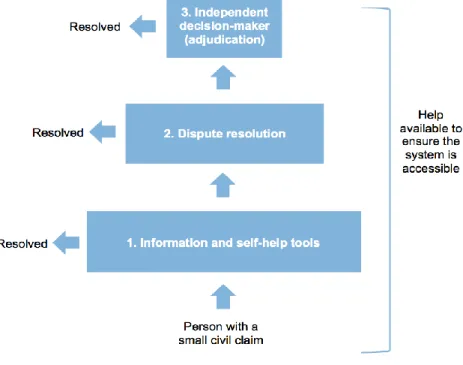
The Access to Justice Review proposed a three-stage ODR system as illustrated in the following diagram.
Figure 1: Potential Stages of an Online Dispute Resolution System113
The different stages closely resemble those currently utilised by the British Columbia Civil Resolution Tribunal. The Review proposed that Stage 1 should provide general information and identify potential next steps in relation to resolving a small civil dispute.114 In addition, it was recommended that this stage should include some of the following:
113 Access to Justice Review (n 2) 278. The Figure is reproduced pursuant to a Creative Commons Licence: <creativecommons.org/licenses/by/3.0/au>. Attribution of authorship is hereby made to the State of Victoria. The present author has made no changes to the Figure.
114 Ibid 277.