Full Terms & Conditions of access and use can be found at
https://www.tandfonline.com/action/journalInformation?journalCode=cjms20
Journal of Ethnic and Migration Studies
ISSN: (Print) (Online) Journal homepage: https://www.tandfonline.com/loi/cjms20
‘Having a good friend, a good neighbour, can help you find yourself’: social capital and integration for people from refugee and asylum-seeking backgrounds in Australia
Anna Ziersch, Moira Walsh & Clemence Due
To cite this article: Anna Ziersch, Moira Walsh & Clemence Due (2023) ‘Having a good friend, a good neighbour, can help you find yourself’: social capital and integration for people from refugee and asylum-seeking backgrounds in Australia, Journal of Ethnic and Migration Studies, 49:15, 3877-3899, DOI: 10.1080/1369183X.2023.2177628
To link to this article: https://doi.org/10.1080/1369183X.2023.2177628
© 2023 The Author(s). Published by Informa UK Limited, trading as Taylor & Francis Group
Published online: 22 Mar 2023.
Submit your article to this journal
Article views: 1618
View related articles
View Crossmark data
Citing articles: 2 View citing articles
‘ Having a good friend, a good neighbour, can help you fi nd yourself ’ : social capital and integration for people from refugee and asylum-seeking backgrounds in Australia
Anna Ziersch a, Moira Walsh aand Clemence Due a,b
aCollege of Medicine and Public Health, Flinders University, Adelaide, Australia;bSchool of Psychology, University of Adelaide, Adelaide, Australia
ABSTRACT
Social networks and access to resources are important to refugee integration but there is limited research with people from refugee and asylum-seeking backgrounds. This mixed methods paper reports on the social capital of refugees and asylum seekers and relevance to settlement satisfaction and integration. Surveys were completed by 423 adult refugees and asylum seekers living in South Australia. Additionally, semi-structured interviews were conducted with 65 participants, purposively sampled from the survey, and analysed thematically. The survey indicated that satisfaction with social networks (neighbourhood, ethnic/cultural and general) was associated with satisfaction with social support, which were in turn associated with a sense of belonging and overall happiness with life in Australia. The interviews illustrated how bonding and bridging ties facilitated access to resources by providing emotional support, a sense of belonging and hope, and safety and security through friendship and connection, and the provision of practical support. However, there were limited linking ties and differing access to social capital across characteristics such as region of origin, immigration status,financial situation, English skills, and time in Australia, which can contribute to inequities over time. Overall, ourfindings highlight the importance of facilitating access to social capital to assist with resettlement and integration.
ARTICLE HISTORY Received 11 May 2022 Accepted 31 January 2023
KEYWORDS
Refugee; asylum seeker;
social capital; integration;
support; resettlement
Introduction
Refugee and asylum seeker experiences present a particular context for exploring social capital. War, displacement, persecution, and associated trauma disrupt social networks, social cohesion and norms, undermining trust in authority and outsiders (McMichael and Manderson2004; Fiddian-Qasmiyeh et al.2014). Rebuilding social networks in a reset- tlement context is important for facilitating access to resources important for resettlement and integration (i.e. employment, education, and housing); however, disrupted networks are not easily rebuilt (Woolcock and Narayan2000; Ager and Strang2008). While migration
© 2023 The Author(s). Published by Informa UK Limited, trading as Taylor & Francis Group CONTACT Anna Ziersch anna.ziersch@flinders.edu.au
This is an Open Access article distributed under the terms of the Creative Commons Attribution-NonCommercial-NoDerivatives License (http://creativecommons.org/licenses/by-nc-nd/4.0/), which permits non-commercial re-use, distribution, and reproduction in any medium, provided the original work is properly cited, and is not altered, transformed, or built upon in any way. The terms on which this article has been published allow the posting of the Accepted Manuscript in a repository by the author(s) or with their consent.
2023, VOL. 49, NO. 15, 3877–3899
https://doi.org/10.1080/1369183X.2023.2177628
scholars have sought to examine the role of migrants’social networks and norms of trust and reciprocity in resettlement and community formation (Portes 1995; Li2004; Ryan et al.
2008; Lancee 2010; Ryan 2011; Phillimore, Humphris, and Khan 2018; Ryan and D’Angelo 2018), the ways in which refugees rebuild their social networks following forced displacement is less well theorised, particularly in an Australian context. This paper thus builds on this body of work to examine the social networks of asylum seekers and refugees in South Australia, the mechanisms by which these networks provide access to resources helpful for integration, and the barriers to social capital accumulation.
A note on terminology
‘Refugee’and ‘asylum seeker’: From a legal standpoint, refugees are defined as people
who meet the criteria for refugee status (UNHCR), but at times defined by particular cri- teria outlined by specific countries. Asylum seekers are defined as those awaiting their claims to refugee status to be determined (Türk, Edwards, and Wouters 2017). We acknowledge that the terms‘refugee’and ‘asylum seeker’are unable to distil complex and diverse identities and lived experiences into single categories and that after resettle- ment, individuals may no longer feel these terms apply to them. Nevertheless these terms capture unique experiences of forced migration and are used for brevity in this paper.
Furthermore, we view race, ethnicity, and culture to be distinct but analogous constructs, which are often conflated (Paradies2006). We use race/ethnicity to show a person’s con- nection to a particular ethnic group, most often associated with country of origin, and we consider culture to refer to shared systems of meaning making, which are learnt and shared generationally, at times including religious affiliation (Betancourt & López,1993).
Background Social capital
The potential role of social capital in alleviating structural disadvantage and pursuing social advancement has been the subject of sustained debate amongst key social capital scholars (Putnam1995; Portes1998; Lin2001; Siisiainen2003). Social capital is under- stood here as the resources available to individuals and groups through their social net- works (the array of social ties an individual has at any given time) (Bourdieu1986). This definition takes account of the infrastructure of social capital (the formal and informal networks a person may have as well as cognitive elements such as trust and reciprocity) and how this infrastructure is used to gain access to resources (Lin2001; Ziersch2005).
Importantly, this definition pays attention to the unequal distribution of social capital resources based on access to power (Bourdieu1986).
Social ties and the social networks that they can form have been further distinguished as bonding, bridging, and linking. Bonding social capital refers to the resources that come from ties between members who share similarities in some way or another (family, race/
ethnicity, education level, socio-economic status), bridging social capital is the resources from ties between people who are dissimilar in an evident way (Putnam 2000), and linking social capital refers to resources that come from vertical ties (i.e. between individ- uals where there is a clear power differential or between community organisations/individ- uals and institutions/government departments) (Szreter2002). The value across a person’s
networks differs in the resources they facilitate access to. For example, bonding social capital has been described as assisting‘getting by,’whereas bridging social capital provides assists one to‘get ahead’(Putnam2000). Linking ties, moreover, although the weakest relationship can have the most valuable outcome; namely in providing access to institutions and structures of power (Woolcock and Narayan2000; Szreter and Woolcock2004).
Importantly, access to social networks and resources is related to stocks of other capital such as economic capital (material assets immediately and directly convertible to money) and cultural capital (cultural knowledge or familiarity with the dominant culture–e.g. language, qualifications), where different forms of capital can be exchanged for another, meaning that particular groups of people can be advantaged or disadvan- taged in their access to social capital by their stocks of other capitals (Bourdieu1986).
Forced displacement can place refugees and asylum seekers at a disadvantage for all forms of capital (Li2004; Fiddian-Qasmiyeh et al.2014).
In addition, while ties themselves can be distinguished as bonding, bridging and linking, the resources they ultimately give rise to, the capital, are contextually contingent (Ryan2011; Strang and Quinn2019). As such while we use the terms bonding, bridging, and linking to assist in framing thefindings and discussion, we recognise that rather than being one or the other, ties exist on a continuum which is impacted by power relations, access to other forms of capital, social location and temporal factors.
Social capital and refugee integration
Emerging research has highlighted the importance of social capital to the integration process for refugees and asylum seeker populations (Elliott and Yusuf2014; Im and Rosen- berg2016; Pittaway, Bartolomei, and Doney2016). Like social capital‘integration’is also a contested concept but is understood here as a two way process of mutual accommodation between new arrivals and receiving communities (Ndofor-Tah et al.2019).‘Social connec- tions’are a feature of Ager and Strang’s (2008) frequently cited model of integration, which outlines a range of indicators of integration, organised into four domains representing important objective functional markers and subjective variables. The ‘Foundation’
domain deals with rights and citizenship and‘Facilitators’includes language and cultural knowledge, and safety and stability. The domain of ‘Social Connection’ draws on Putnam’s dimensions of social capital (Putnam2000)–social bonds (within own commu- nity), bridges (to other communities) and linkages (to wider social institutions). The last domain ‘Means and Markers’ includes employment, education, and health as well as housing, which are seen both as indicators of successful integration as well as an avenue to integration. The existing literature largely utilises Ager and Strang’s (2008) conceptual- isation of social capital in integration. In this paper, we too engage Ager and Strang’s model;
however, as noted above, we particularly examine how experiences of social networks and resources can be shaped by multiple, intersecting socially constructed categories (e.g. race/
ethnicity, migration status, religion, gender, age), see (Crenshaw1989; Collins2000).
The existing body of largely qualitative literature has highlighted the way that new arrivals can build bonding and bridging networks, particularly along the pathway of resettlement (Lamba and Krahn2003; Cheung and Phillimore 2013; Elliott and Yusuf 2014). Social networks have been linked to resources important for integration such as financial assistance, accommodation, legal advice, education, employment, and health- care and other services (Lamba and Krahn 2003; D’Addario, Hiebert, and Sherrell
2007; Goodson and Phillimore2008; Allen2010; Wells2011; Phillimore, Humphris, and Khan2014; Im and Rosenberg2016; Gericke et al. 2018; Kingsbury et al.2018; Almo- hamed and Vyas2019; Ziersch et al.2020).
A number of studies have highlighted the different ways that social networks are built and used by refugees, for example, based on factors such as education, qualifications and employment history (Cheung and Phillimore2013), gender (Goodson and Phillimore 2008; Cheung and Phillimore 2013; Elliott and Yusuf 2014), and immigration status and length of residency (Rose and Ray2001; Cheung and Phillimore2013). Moreover, Phillimore and colleagues (2018) engage Mauss and Hall’s (1954) notion of resource exchange to explore how the resources new migrants arrive with (e.g. education, English language skills, close kin) can be used to engage in forms of reciprocation in developing and maintaining social networks and accessing new resources, which have the potential to buffer migratory stress and are important for integration. Forced migrants, moreover, possess the least amount of resources on arrival and with limited rights to study or work were less able to build networks based on reciprocity.
Pittaway and colleagues (2016) have also argued that in addition to individuals’
capacity to access social capital through social networks, community capacities (cultural capital, culturalfluency, and effective community leadership), and socio-political factors (cultural validation, formal and social recognition of the skills, qualifications, and experi- ence of people from refugee backgrounds, appropriate and responsive settlement ser- vices, and family reunion) influence access to social capital. Other authors have similarly highlighted the significance of the socio-political environment of host countries, arguing that policies designed to deter asylum seekers and inimical media coverage, and other experiences of racism and discrimination, act as significant barriers to accessing social capital for refugees and asylum seekers (Pittaway, Muli, and Shteir 2009; Strang and Ager2010; Spaaij2012; Ziersch, Due, and Walsh2020).
Overall, while the literature points to some key factors both in relation to the types of social networks refugees and asylum seekers may have, as well as the resources that devel- oping these may lead to, the bulk of these studies focus on decreet elements of integration (e.g. employment, healthcare, and so on). The existing body of work is also largely quali- tative with relatively few quantitative and very few mixed methods studies. In this paper we bring together mixed methods data to unpack how refugees and asylum seekers build social networks, how these networks are helpful in accessing resources important in the settlement process and what barriers and facilitators exist for new arrivals to building social networks and access social capital.
Materials and methods
This paper draws onfindings from a larger study on the relationship between housing, neighbourhood, and social inclusion and health for refugees and asylum seekers (Ziersch, Due, Arthurson et al.2017).
Context
Over the last decade Australia has resettled over 170,000 refugees through the Humani- tarian‘offshore’program (Refugee Council of Australia2017). Through this program, the
Australian government provides a range of housing, income, education, health supports and services to refugees. In addition, those who claim asylum on arrival, are given a tem- porary‘bridging’visa and since 2014 many have been subject to a range of policies of deterrence including ineligibility for permanent protection regardless of whether they are determined to be refugees, reduced settlement supports and other entitlements and protections (Reilly 2018). In 2016/17, when data was collected for this study more than 30,000 asylum seekers and refugees Australia were living in the community on brid- ging or temporary protection visas (Hirsch and Maylea2016).
Procedure
Ethics approval was obtained from Flinders University Human Research Ethics Commit- tee and particular attention was given to potential issues of coercion, power imbalances between researchers and participants, as well as concerns about confidentiality and anon- ymity (Block, Riggs, and Haslam2013; Ziersch, Due, Walsh et al.2017). Project docu- mentation was translated into key languages, and interpreters were available. The project was conducted in partnership with a reference group and a refugee and asylum seeker advisory group. Informed consent was gained from all participants prior to par- ticipation. Data was collected from June 2015–January 2017.
Participants were refugees and asylum seekers aged 18 and above, living in Australia for 7 years or less, currently resident in South Australia. Data collection involved a survey, with closed and open-ended questions, and semi-structured in-depth interviews.
Survey participants (N = 423) were recruited through refugee-focused organisations, community groups, and passive snowball sampling. Interviews were conducted with a subset of 65 survey participants who in the survey indicated their interest in participating in an interview, purposively sampled for cultural background, visa status, and gender.
The interviews took place at a venue of the participants’ choosing and lasted up to 70 min (M= 32 min), with an interpreter if the participant elected. Interviews were con- ducted by four non-refugee white Australian women researchers. Pseudonyms were given to all participants.
Measures and data analysis
The survey included several questions relevant to social capital: how often people socia- lised (every day, several times a week, once a week, several times a month and once a month or less); how happy people were with their social networks (with three aspects:
neighbourhood where you live, the people in your own ethnic/cultural community and people in general with a Likert scale of five smiley faces ranging from very unhappy to very happy); and; how happy people were with the help and support they got from people that they knew (response categories the same smiley face scale). For bi-variate analysis, socialisation was dichotomised to once a week vs. less than once a week and happiness with social networks and social support dichotomised to unhappy/unhappy/neutral vs. happy/very happy. Happiness with life in Australia was measured using the same smiley face question and dichotomisation. Sense of belonging was measured with a question asking,‘To what extent do you have a sense of belonging in Australia’(not at all/only slightly versus to a moderate extent/to a great extent).
The survey data was analysed with IBM SPSS Version 27. Univariate analysis was undertaken using frequencies and chi-square tests.
The interview schedule covered a range of topics including questions about housing, neighbourhood and health, social and civic participation, and supports in Australia.
There were several explicit questions about social networks, the supports available through these networks and satisfaction with those networks and supports. These topics also came up unprompted throughout the interviews.
The interview data were thematically analysed using the 5 stage framework approach (Ritchie and Spencer1994): data familiarisation through close readings of the transcripts;
iterative development of a thematic framework; indexing and double coding by the research team (using NVivo Version 10); charting each participant’s interview data against the emergent themes; and mapping and interpretation of the final themes (with a focus on social capital). Thefindings were discussed with the project reference and advisory groups (member-checking).
Participants
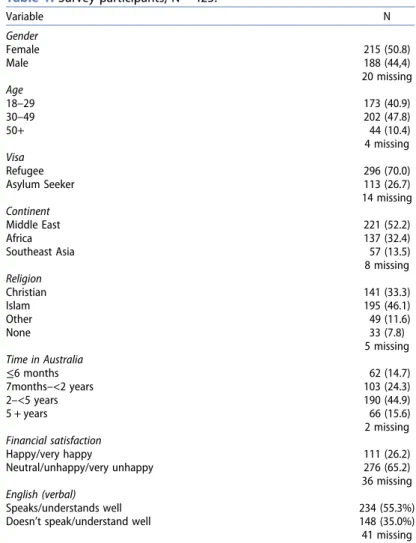
423 people completed the survey (Table 1) and there were slightly more women than men, and the age was skewed towards younger participants. More than 70% of par- ticipants were refugees, over half were from the Middle East, and Islam was the largest religious affiliation. Most participants had lived in Australia between 2 and 5 years, just over a quarter reported being happy or very happy with their financial situation and over half reported speaking and/or understanding English well or very well.
In-depth interviews were conducted with 65 people (28 women and 37 men). Thirty- four had permanent protection visas (PV) (15 women and 19 men; 12 from Africa, 12 from the Middle East and 10 from SE Asia) and 31 were asylum seekers with temporary visas (TV) (13 women and 18 men, 30 from the Middle East and one from SE Asia, reflecting the profile of asylum seekers in Australia).
Results
Quantitativefindings
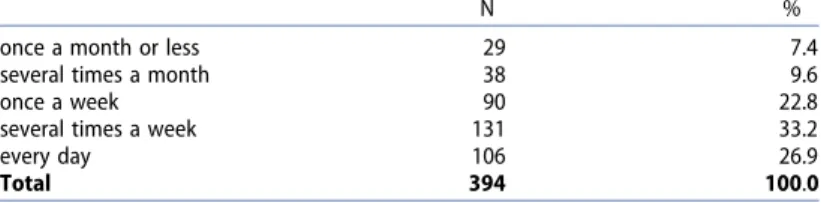
The majority of participants (over 80%) socialised at least once a week (Table 2).
Around two thirds (64.1%) of participants were happy with their neighbourhood net- works, 72.9% were happy with their ethnic/cultural community networks and 75.6% were happy with their social networks in general. Overall people were happy with their social support, with 71.2% happy or very happy (Table 3).
The links between social networks and social support were also considered, to examine the extent to which social networks might to facilitate social support (Table 4). While there was no significant link between regularity of socialising and satisfaction with social support, there were significant links between the three measures of social net- works and support, with greater numbers of those who were satisfied with their social networks in each case also happy with the level of support they had through social networks.
We examined if there were any demographic differences in socialising, happiness with the three types of social networks, and happiness with social support (Table 5). There were no demographic differences for regularity of socialising and no differences in any of the network variables by age or gender. Visa status was associated with happiness with each of the social networks as well as social support, with refugees happier than asylum seekers, however there was no difference in regularity of socialisation. Likewise, region of origin was associated with networks at all levels and support satisfaction – in each
Table 2.Regularity of socialising (total N = 394, missing 29 responses).
N %
once a month or less 29 7.4
several times a month 38 9.6
once a week 90 22.8
several times a week 131 33.2
every day 106 26.9
Total 394 100.0
Table 1.Survey participants, N = 423.
Variable N
Gender Female Male
215 (50.8) 188 (44,4) 20 missing Age
18–29 30–49 50+
173 (40.9) 202 (47.8) 44 (10.4) 4 missing Visa
Refugee Asylum Seeker
296 (70.0) 113 (26.7) 14 missing Continent
Middle East Africa Southeast Asia
221 (52.2) 137 (32.4) 57 (13.5) 8 missing Religion
Christian Islam Other None
141 (33.3) 195 (46.1) 49 (11.6) 33 (7.8) 5 missing Time in Australia
≤6 months 7months–<2 years 2–<5 years 5 + years
62 (14.7) 103 (24.3) 190 (44.9) 66 (15.6) 2 missing Financial satisfaction
Happy/very happy
Neutral/unhappy/very unhappy
111 (26.2) 276 (65.2) 36 missing English (verbal)
Speaks/understands well Doesn’t speak/understand well
234 (55.3%) 148 (35.0%) 41 missing
case those from SE Asia were happiest, followed by those from Africa, with those from the Middle East the least satisfied, however again there was no difference in regularity of socia- lisation. Religion was associated with regularity of socialisation, as well as satisfaction with cultural/ethnic networks, networks in general and social support, but not with happiness with neighbourhood networks (potentially indicating that places of worship were outside local neighbourhoods). Moreover, those from‘other’(i.e. non-Christian or non-Islamic religions) were the most satisfied in each case, followed by those reporting Christian affiliation and those with Islamic affiliation. Those reporting no religion were less satisfied with their networks and their support. Financial satisfaction was significantly associated with all the variables except socialising, with those more satisfied with their financial situation also happier with their social networks and support. Spoken English level was only significantly associated with happiness with social support.
Next, we examined the links between social networks and social support, and happiness with a sense of belonging and overall life in Australia, proxies for integration (Table 6). We found in each case that greater proportions of those who were happy with their social networks and level of social support, were more likely to report a sense of belonging and being happy with life in Australia compared to those who were not happy. There was no significant link between socialising and sense of belonging or hap- piness with life in Australia.
Thus, the quantitative analysis found generally high satisfaction with social networks and support, though with some demographic differences, in particular in relation to Table 3.Happiness with social networks and support.
Neighbourhood networks
Cultural/ethnic
networks General networks Social support
N % N % N % N %
1 (very unhappy) 11 2.7 7 1.8 4 1.0 5 1.3
2 25 6.2 20 5.0 14 3.5 24 6.1
3 109 27.0 81 20.3 81 20.0 84 21.4
4 164 40.6 169 42.4 187 46.2 161 41.1
5 (very happy) 95 23.5 122 30.6 119 29.4 118 30.1
Total 404 100 399 100 405 100 392 100
Missing 19 24 18 31
Table 4.Happiness with support, by socialising and happiness with social networks.
Happy with social support N (%) Socialising
At least once a week Less than once a week
230 (73.0%) 41 (63.0%) Neighbourhood ties
Happy Not happy
211 (83.7%) 66 (48.2%)**
Cultural/ethnic ties Happy
Not happy
229 (80.9%) 47 (46.1%)**
Social ties in general Happy
Not happy
251 (83.9%) 27 (29.7%)***
* =p< .05, ** =p< .01, *** =p< .001.
immigration status, region of origin, religion andfinancial status. Those who were happy with their social networks and support were more likely to report a sense of belonging and feel happier with their life in Australia.
Qualitativefindings
The quantitative analysis above provided an overview of the extent to which people felt that they have social networks and support. In the following sections we build on these findings through in-depth interviews with 65 survey participants exploring in more detail the kinds of networks people have, the sites where these networks were formed and facilitators and barriers to building networks, and the mechanisms through which social networks facilitated access to resources important for integration.
The analysis revealed bonding and bridging networks formed throughfive key sites:
refugee and asylum seeker-focused non-government organisations (NGOs), ethnic/cul- tural groups, religious settings, neighbourhoods, and educational settings. Few people had linking ties in their social networks other than through government provided sup- ports, which were available through settlement services. In addition, particularly for asylum seekers who had less eligibility for settlement services, NGOs and community Table 5.Socialising, social networks and social support by demographic variables.
Socialise at least once a
week
Happy with neighbourhood
networks
Happy with cultural/ethnic
networks
Happy with networks in general
Happy with social support Gender
Female Male
160 (80.4%) 155 (87.1%)
137 (66.2%) 111 (62.0%)
153 (74.3%) 123 (70.3%)
157 (75.5%) 135 (75.4%)
144 (71.3%) 121 (70.3%) Age
18–29 30–49 50+
128 (82.1%) 161 (83.0%) 36 (85.7%)
106 (66.7%) 122 (61.6%) 30 (69.8%)
124 (78.5%) 134 (68.4%) 31 (73.8%)
118 (74.2%) 155 (77.9%) 32 (74.4%)
108 (71.5%) 141 (72.7%) 29 (67.4%) Visa
Refugee Asylum Seeker
227 (82.5%) 89 (83.2%)
194 (68.8%) 60 (55.0%)**
224 (79.4%) 62 (58.5%)***
225 (79.5%) 74 (67.9%)*
206 (75.2%) 67 (62.6%)*
Continent Middle East Africa SE Asia
165 (80.1%) 112 (86.8%) 44 (86.3%)
128 (60.4%) 86 (65.2%) 42 (80.8%)*
137 (65.6%) 100 (76.9%) 49 (94.2%)***
151 (71.2%) 102 (76.7%) 48 (92.3%)**
134 (66.3%) 94 (72.3%) 46 (88.5%)**
Religion Christian Islam Other None
122 (91.0%) 147 (80.3%) 35 (81.4%) 23 (71.9%)*
86 (63.2%) 122 (64.6%) 33 (73.3%) 16 (50.0%)
104 (77.0%) 136 (73.5%) 39 (86.7%) 11 (34.4%)***
109 (80.1%) 143 (75.3%) 38 (84.4%) 16 (50.0%)**
98 (74.2%) 124 (67.4%) 39 (88.6%) 16 (53.3%)**
Time in Australia
≤6 months 7months–<2 years 2–<5 years 5 + years
48 (82.8%) 82 (85.4%) 140 (97.5%) 56 (88.9%)
31 (51.7%) 66 (67.3%) 115 (63.5) 46 (71.9%)
40 (66.7%) 69 (71.9%) 130 (72.2%) 52 (82.5%)
44 (73.3%) 79 (80.6%) 131 (72.0%) 51 (79.7%)
40 (71.4%) 72 (75.0%) 121 (68.4%) 45 (72.6%) Financial satisfaction
Happy Unhappy
214 (82.3%) 92 (86.0%)
90 (83.3%) 152 (56.5%)***
95 (88.0%) 178 (67.2%)***
99 (91.7%) 188 (69.6%)***
93 (89.4%) 166 (62.9%)***
Spoken English Well/very well Not well/not at all
185 (84.1%) 115 (82.7%)
149 (66.8%) 92 (64.8%)
171 (78.1%) 98 (69.0%)
175 (78.5%) 105 (73.4%)
163 (76.2%) 89 (63.1%)**
* =p< .05, ** =p< .01, *** =p< .001.
organisations provided a range of important supports. As discussed further below some of the most isolated/disadvantaged people relied on what we refer to as‘non-traditional’ linking ties through social networks within settlement services, NGOs and community organisations to help them access important integration resources. In other words, linking ties not with states or governments but with settlement services, NGOs, and com- munity organisations–much like a linking tie that links to the linking tie. Most partici- pants were unemployed (57/65) therefore, employment as a site of social network formation featured only in a few examples. Social networks offered access to a range of integration resources through the mechanisms of practical support and friendship and connection. The qualitative analysis further identified complexities and challenges in the development and maintenance of social networks and related resources across a range of demographic characteristics. We discuss these interrelated elements of social capital below and implications for integration.
Provision of practical support and access to material resources
In interviews, participants discussed accessing a range of material resources through their networks via the mechanisms of practical support, such as provision of information, references, ‘vouching’ for people (particularly in relation to housing) and assistance with accessing government departments and services, particularly financial, housing, English language, and health services.
Participants discussed practical support gained through bonding and bridging ties, including assistance with housing and accommodation and learning English. In relation to housing, this included providing temporary housing, information about accommo- dation options, or providing referrals and referee reports. These resources – and the importance of bonding and bridging ties in gaining them – were more prevalent in the accounts of asylum seekers given the limited settlement supports available for asylum seeker arrivals in Australia. For example, arriving in Australia with limited paper- work, no rental or credit history, on a temporary visa and without work meant that some asylum seeker participants had to rely on family and other co-ethnic bonding ties to
Table 6.Socialising, social networks and social support, by belonging and happiness with life in Australia.
Sense of belonging Happy with life in Australia Socialising
At least once a week Less than once a week
249 (80.3%) 46 (75.4%)
241 (76.8%) 46 (75.4%) Neighbourhood ties
Happy Not happy
203 (83.5%) 96 (70.1%)**
215 (87.0%) 76 (55.5%)***
Cultural/ethnic ties Happy
Not happy
224 (82.1%) 71 (68.9%)**
235 (85.5%) 54 (51.4%)***
Social ties generally Happy
Not happy
242 (83.7%) 57 (62.0%)***
254 (87.0%) 37 (39.8%)***
Social support Happy Not happy
214 (81.7%) 78 (70.3%)*
226 (85.6%) 59 (52.7%)***
* =p< .05, ** =p< .01, *** =p< .001.
‘vouch’for them as Naime highlights:‘My sister lives there and she called the agent and she beg […], then [the agent] said‘okay, no worries, I give to you’’.
Practical support with developing English language skills was also considered an important resource for most participants through bonding and bridging ties, particularly since government-funded English language classes were spoken of as producing mixed results. Instead, refugee and asylum seeker participants indicated a desire to improve their English and develop skills needed to navigate the community by connecting with members of the host community, as in the case of Middle Eastern asylum seeker Dariush:‘I’ve always been interested in the culture and everything so as soon as I got to Australia, I started making friends, Australians only.’
In turn, improvements in English language skills could also lead to the development of further bridging ties, which then led to further resources. For example, Farhad a refugee from the Middle East, was highly motivated to further develop his English language skills through networks with members of the host community and expressed disinterest in developing co-ethnic networks. With a range of skills and proficiencies, Farhad was able to exchange resources with his Australian neighbour:
My neighbour, I help her twice for her laptop‘you have the [good] computer language; why you are not opening your–why you are not running your own business?’it’s cool […] she [also] helps me with my English, especially with my writing.
Farhad recognised the significance of this connection in saying:‘[h]aving a good friend, having a good neighbour, can help you to find yourself’.This relationship provides an example of how bridging ties with members of the host community can develop into bonding networks over time.
Importantly, in addition to the distinctions between refugees and asylum seekers dis- cussed above, there were demographic differences in the availability of practical support through co-ethnic bonding networks. In particular, participants from SE Asian and Africa reported stronger co-ethnic bonding networks than those from the Middle East.
As an example, young refugee Jaysha, who was newly arrived described the availability of reciprocal support through his co-ethnic bonding ties in the SE Asian community:
We have [family in the neighbourhood] that will help when we’re getting in trouble Yeah, we are very happy because we […] have neighbours, good neighbours who help each other when we are in trouble. Yeah, they are really good (Jaysha, man).
African refugee Angelina also spoke of the reciprocal support she and her co-ethnic bonding ties or‘sisters’provide each other:‘we are very close. We see each other a lot.
We look after the kids together.’
As highlighted in the quantitative analysis, those from SE Asia and Africa were the happiest with their networks and the support they receive, which speaks to the strong bonding networks amongst the SE Asian and African participants–particularly in neigh- bourhood settings for those from SE Asia.
Participants also discussed accessing material resources through the mechanisms of practical support provided by settlement services, NGOs, and educational settings;
including assistance accessing government provided resources, particularly financial, housing, English language, and health services. This was particularly the case for refugee participants who were eligible for a range of supports. Asylum seekers on the
other hand often had limited access to resources through government-funded settlement services meaning that NGOs and community organisations were more important for this group. For example, Nafisa, an asylum seeker woman from the Middle East discussed how practical support from NGOs was especially critical for her when it came to immi- gration matters and connecting to government departments:
The most supportive place for us is [NGO]. For example, somebody going to send us letter, government going to send us letter and maybe we have forms tofill out. We just bring it here. They read for us, theyfill out the form for us; they do everything for us.
As such, NGOs and community organisations acted as key sites of ties that were‘non- traditional’, providing mechanisms through which participants could access practical support. While less common than NGOs, some participants gave accounts of non-tra- ditional linking ties with teachers that assisted with access to government and NGO ser- vices and provided other support. An example of this is Georgieta a young refugee from Africa who was experiencing multiple difficulties associated with strained family and community relations, experiences of sexual assault, and significant mental health pro- blems. One of Georgieta’s teachers connected her to accommodation and mental health services:
When I went to high school, there was a really nice teacher, that I really, really liked, and we were really close, so I started like telling her about bullying and stuff, and yeah, so then I go with her to different services and stuff, and I’m still working with some of the services and stuff.
For new arrivals, the distinction between linking ties and service provision was not clear- cut; rather as these excerpts suggest, relations developed through NGOs, community organisations, and educational settings can result in the development of non-traditional linking ties where individuals and organisations go above and beyond their remit and make possible access to social capital outside of a narrow service provision framework.
Friendship, connection and access to social and emotional resources
Friendship and connection through bonding and bridging networks were key mechan- isms by which refugee and asylum seeker participants reported accessing social and emotional resources such as emotional support, sense of belonging and hope, and safety and security.
Emotional support
Bonding ties with co-ethnic members were particularly discussed by women participants and were developed through cultural/ethnic groups. These co-ethnic networks were criti- cal in assisting participants to cope with issues such as grief, family stress, and poor mental health. For example, through her daughter, who was interpreting, Naeva– an African refugee and single mother–said:
She feels connected with our community because our community–like if you have any problem they can – will come together and we share the problem together. Like a few months ago she lost her mum and [they] was here for like a week.
Middle Eastern asylum seekers Mojdeh and Kiana, both single mothers (four children and one child with a disability respectively), described the emotional support they receive through co-ethnic bonding ties with other women. Suffering from poor mental health, Mojdeh shared: ‘that’s just like I have some friends and they come, they talk with me so I come back happy.’ Kiana also indicated the importance of friends for emotional support, and spoke of how that support could come from co-ethnic bonding networks as well as bonding and bridging networks with members of the host community:
If I have any issues or something I’m happy to talk to someone. Rather than to keep in myself –I think it’s not good for you. I’m happy with the sharing. Like I don’t mind if they are [Australian friends] or any community people.
Co-ethnic ties did not, however, automatically translate to emotionally supportive bonding social capital. For example, Angelina an African refugee, mentioned issues with domestic violence and her access to support from which she was able to draw strength from the close relationships she had with other women from her cultural back- ground,‘I have a lot of support–from women you know. This is the most important thing– women.’However, she intimated that not everyone in her community was supportive, speaking to the stigma women can face in patriarchal cultures in relation to family and domestic violence.
Sense of belonging and hope
As noted in the quantitative analysis, asylum seekers reported less happiness with their social networks. Interviews also identified that asylum seekers often experienced iso- lation. For example, Eskandar a single Middle Eastern asylum seeker describes having very poor mental health because of his exposure to persecution and a range of post settle- ment challenges. After 8 years of separation from his family, he said of the difficulties he faces in developing networks and a feelings of belonging:
It’s always…really hard. I have no support, no friends, no job […] I’m not really happy, I’m always alone with no one…No other family, nothing […] I’m very depressed now.
This isolation and a lack of a sense of belonging was exacerbated by temporary visas, with Middle Eastern asylum seeker Shameer saying:‘from the visa point I don’t know whether I belong to this society or not or part of this society’(Shameer, man).
However, participants also generally noted that a key source of support and pathway to belonging, was in the development of bonding networks through initial bridging net- works. Initial bridging networks were largely developed through religious organisations or NGOs, often with members of the host community who were volunteering and members of staff, which in many cases developed into bonding networks. This was par- ticularly the case for asylum seekers, with associated positive impacts on their emotional wellbeing and sense of belonging. Nikta from the Middle East, for example, who had no existing networks or formal support when she and her husband arrived in Australia, described feeling‘scared’ and‘isolated’in theirfirst weeks. However, Nikta described her determination to make ties with members of the host community and was relieved to find a community centre/church where she developed bridging networks with people from a range of backgrounds. These bridging networks resulted in the
opportunity to volunteer at the centre and practice her English and in doing so building on these networks, which she referred to as:‘[making] everything better’.She went on to describe the feeling of belonging these networks provided, particularly as they developed into bonding networks:‘we know many people but some of them we feel [our] heart is con- nected with them. For social life we more prefer to meet them.’
Zarin, also a Middle Eastern asylum seeker similarly noted the positive impact of his family’s bridging networks made through their church: ‘after a while we start to have more friends through [the church] so yeah we have a good feeling of connection.’ Zarin and his wife, both highly educated with existing English language skills on arrival, were able to use these resources both through their voluntary work with the church and in pursuing bridging networks with Australian people, which developed into bonding networks. Similarly, Naweed, a Middle Eastern asylum seeker, detailed the despair he was experiencing because of his temporary visa, and the sense of belonging and hope he found through family-like bonding ties that developed with an Australian couple volunteering at an NGO:
[Community organisation], was very–a big [hope] for me like tofind some way to continue my living in Australia […] I made friends, Australian […] we have a good relationship. We call them mum and dad, so we’re like a family, which is very good.
The overall preference amongst some Middle Eastern asylum seeker participants to develop relationships with members of the host community, speaks to the potential lack of trust within these co-ethnic communities particularly in relation to differences in immigration status where those on temporary bridging visas can be discriminated against and isolated from their co-ethnic communities. Speaking about the difference between those from his country who were humanitarian entrants to Australia versus asylum seekers who have arrived by boat, Middle Eastern asylum seeker Payam shared:
Even in my community sometimes, you know, me and some other people like me get that feeling that because of the situation which we are in it, we are different, as you mentioned
‘you don’t belong here’something like this.
Sense of safety and security
Experiences of exclusion and discrimination were reported widely by participants. These experiences made it difficult to establish initial bridging networks (reported in Ziersch, Due, and Walsh2020) and were particularly detrimental in terms of developing feelings of safety. This was especially problematic since feeling safe was noted as particularly important by many participants.
In terms of pathways to developing a sense of safety and security, access to resources through bridging networks and non-traditional linking networks were particularly important, and as in the case of practical support discussed above, these networks were often developed through educational settings and organisations. For example, SE Asian refugee Griva, a young high school student puts it this way:
So far many people I have talked with, they are supportive. My teachers are supportive and if we go to people, organisations, people are always there to help you. When Ifirst came I was
lost and these people really helped me and I think because of [this] I realised these people are good ones, but sometimes I don’t trust people so fast (Griva, woman).
For some participants, a sense of safety and security came through satisfaction with their neighbourhood and proximity to co-ethnic bonding networks that in turn promoted safety. For example, Nahal and Rasul both refugees from the Middle East with limited English and poor health, said:‘I feel better in [area with high numbers of his community]– in [less ethnically diverse area] I was alone and there was no-one to talk’(Nahal, woman), and‘the people who speak the same language with me, so they are close to me’(Rasul, man).
Similarly, Ballabh, a newly arrived refugee from SE Asia, was nervous and fearful in his first neighbourhood far away from his community:‘[a]t that time, I was new, that’s why it was very difficult for me to talk to new people [..] like [I stayed] one month inside the home’, Ballabh shared a sense of safety and security once living near his community:
I’m very happy to–like when you gather, you know, we are mass of people, that’s why it’s easy to live there and I’m happy. Especially that there are more Nepalese people live there and it’s close to my friend’s house also.
As highlighted in an earlier excerpt from SE Asian refugee Jaysha whose co-ethnic neigh- bours‘help each other when we are in trouble’,the need to be near one’s co-ethnic com- munity is common for those from collectivist cultures to build trust in their surroundings and re-establish cultural norms and reciprocal support important for wellbeing.
Bridging networks with neighbours from the host country (Australia) were also described as important for developing a sense of safety. For example, for Sarina, a Middle Eastern asylum seeker who experienced Islamophobia in her first neighbour- hood, her relief after moving to a new house and encountering supportive and friendly bridging ties was profound:
Two days before Christmas every year they have a party and they know each other better because–they know really each other–and they told this is [a tradition] in this street. I went ‘oh that’s perfect […] anything happen I can go to every house. I know I’m safe here, opposite that house’.
Here, as with emotional support and belonging, bridging ties through neighbourhood contacts developed into bonding networks directly promoting a sense of safety.
Discussion
Thefindings from this mixed methods paper show that social networks and associated support are crucial to settlement satisfaction and elements of integration for refugees and asylum seekers. The survey indicated an overall high satisfaction with social net- works and level of support received. In-depth interviews further examined the relation- ships people had (strong bonding and bridging ties, and non-traditional linking ties), the ways that their social networks were formed (through existing networks, settlement ser- vices, NGOs, community organisations, neighbourhoods, educational settings), and the mechanisms through which these networks provided access to resources (practical support and friendship and connection). The quantitative analysis indicated there were demographic differences related to immigration status, region of origin, religion, financial status, and English language skills and the qualitative analysis further
highlighted the ways that those with greater resources are often more able to convert these resources to further capital that was useful for integration. The implications of thefindings for resettlement policies and practices are discussed below.
The quantitative analysis indicated greater satisfaction with ethnic social networks and lowest for neighbourhood networks. The qualitative analysis was able to outline how social networks were built and the mechanisms by which these networks were able to facilitate access to resources. Bonding and bridging networks were most prevalent, with bonding networks built through ethnic and cultural organisations and religious set- tings, and bonding and bridging networks established within neighbourhoods. There was also evidence of bridging ties made through community organisations and NGOs with members of the host community evolving into crucial bonding networks for those most isolated and disadvantaged (asylum seekers and younger participants). These NGOs were crucial to asylum seeker participants both in terms of providing non-tra- ditional linking capital resources but also in helping people make bridging networks.
Thefluidity of the nature of the networks, where bridging ties could become bonding ties and where networks could be bridging across one characteristic (e.g. cultural back- ground) could also be bonding across another characteristic (e.g. education, religion, or gender), highlights the potential limitations of static classifications of networks (Bauer 2016). Regularity of socialising was less important to happiness with social networks and social support, suggesting that thenatureof socialising may be more important to building social networks than frequency.
The quantitative analysis linked perceptions of social networks to perceptions of social support and the qualitative data indicated that through the provision of practical, emotional, and social support, bonding, bridging and non-traditional linking ties assisted participants to access resources such as housing and services, safety and security, and belonging. This reflects the broader literature that has highlighted the way that social net- works are important for accessing a range of resettlement resources (Lamba and Krahn 2003; D’Addario, Hiebert, and Sherrell2007; Allen2010; Wells2011; Phillimore, Hum- phris, and Khan2014; Im and Rosenberg2016; Gericke et al.2018; Kingsbury et al.2018;
Almohamed and Vyas 2019; Ziersch et al. 2020). These resources are all important aspects of integration as outlined in Ager and Strang’s model (Ager and Strang2008).
In the model, the role of social connections (ties) in assisting people to access resources such as housing and employment– ‘Means and Markers’of integration, as well as con- tributing to other Facilitators in their model such as sense of safety highlights the poten- tial ways that social capital can facilitate integration.
The qualitative and quantitativefindings indicated a range of characteristics associated with less access to social capital, also reinforcing a broader literature illustrating some of these differences (Rose and Ray2001; D’Addario, Hiebert, and Sherrell2007; Goodson and Phillimore 2008; Cheung and Phillimore 2013; Elliott and Yusuf 2014). Drawing on Bourdieu’s notion of social capital that highlights the way that inequalities are repro- duced through the possession of a range of capitals (Bourdieu1986), in the quantitative analysis negative perceptions of financial situation (a proxy for economic capital) was linked to less favourable views of social networks and social support. Likewise, an indi- cator of cultural capital in the Australian context, English language skills, was associated with satisfaction with social support, but not social networks. The qualitative analysis further revealed how new arrivals sought to learn English through social networks and
in the example of Farad illustrated how these skills led to opportunities for economic capital through employment, highlighting the interrelatedness of these capitals. This highlights a potential link between cultural and social capital but also suggests a differ- ential potential for some networks to provide access to resources and the importance of considering networks and resources separately (Ziersch2005).
Visa status can be seen to reflect an aspect of cultural capital in terms of‘legitimacy’in the new social order, the impact of which was evident across the qualitative and quanti- tative data. Participants described their experiences of negative connotations of asylum seekers from the receiving community, spanning similar and dissimilar cultures, reflect- ing a broader stigmatising discourse (Pedersen, Watt, and Hanser2006; Lueck, Due, and Augoustinos2015). Visa status can also have a significant impact on people’s capacity to access other cultural capital through reduced eligibility for English language classes as well as economic capital through impacts on work rights and reduced eligibility for welfare payments – a ‘manufactured precarity’(van Kooy and Bowman 2019; Walsh, Due, and Ziersch2022). This can also often mean needing to move housing more, dis- rupting neighbourhood social ties, highlighting the compounding and cumulative impacts alongside the broader toll on mental health of long-term uncertainty (Ziersch, Walsh et al.2017). The qualitative analysis also indicated how some of these character- istics coalesced and the importance of drawing on intersectional identity characteristics (Crenshaw1989; Collins2000), supporting a broader literature stressing this in relation to refugee resettlement (Lenette and Boddy2013; Magan2020; Ziersch, Due, and Walsh 2020). For example, those with the fewest social networks tended to be asylum seeker men with poor mental health and limited English language skills, and without kin con- nections. Taken together these variations in access to social capital reinforces Bourdieu’s discussion of how capitals can reproduce inequality, and Phillimore et al’s (2018) argu- ment that refugees who come with greater capital mayfind it easier to convert this capital in their new country.
Region of origin and differences associated with religion were also evident in the analysis (and there are likely some intersections with the characteristic highlighted above). This may relate to cultural differences potentially both in the way that social net- works operate in home countries, or the role of socialising and interactions potentially involved in regular worshipping; however, may also reflect different sizes of communities in South Australia or other features of community in countries of resettlement. For example, the qualitative analysis found that some difficulties within ethnic/cultural com- munities made bonding ties difficult for some community members; therefore, bridging, and non-traditional linking ties were more important. Middle Eastern participants were more likely to focus on bridging ties with Australians and non-traditional linking ties with services and described distrust in their co-ethnic networks. In contrast, Southeast Asian participants had strong family and co-ethnic neighbourhood networks, reflected in high levels of satisfaction with their social networks. While gender was not significant in the quantitative analysis, the qualitative analysis suggested that access to emotional support through bonding ties were particularly important for women with children.
Gender was also potentially relevant to the social isolation of male asylum seekers from the Middle East. For example, the gendered and racialized discourses perpetrated by mainstream media in the West constituting young, Middle Eastern (and African) men as perpetrators of sexual and terrorist violence, may act as barriers to forming
social connections for young male asylum seekers (Zalewski and Runyan2015; Gray and Franck2019).
Pittaway et al. (2016) highlight the importance of considering the capacity of receiving communities and broader socio-political factors in facilitating access to social capital for new arrivals. A focus on receiving communities is often a neglected feature of discussions of integration more generally (Phillimore2020). The qualitative data found that experi- ences of racism and xenophobia and – as highlighted above – negative connotations about asylum seekers, indeed had an impact on people’s experiences of building networks with people in Australia. Thisfinding mirrors previous research on the impact of dis- crimination on settlement experiences (Pittaway, Muli, and Shteir 2009; Strang and Ager 2010; Spaaij 2012; Ziersch et al. 2020). Likewise, welcoming neighbours who shared food and offered support not only helped people to feel welcome but also mod- elled ways to build networks in Australia–for example, Sarina’s experience of the‘tra- dition’of a street Christmas gathering.
A focus on receiving communities is particularly important when considering the policy and practice implications of thefindings and how to help facilitate access to a full set of resources for all new arrivals. Most new arrivals have had their social networks disrupted, but for some the task of rebuilding these in a new context is more complex than for others. In particular, those on temporary visas with limited access to settlement supports and co-ethnic tensions had fewer social network options. The findings high- lighted the important role played by NGOs and community organisations in connecting people, particularly those with temporary visas to opportunities to develop bridging, bonding, and non-traditional linking capital. Non-traditional linking capital is a novel contribution that comes from this study, which shows how NGOs, and community organisations act as a kind of linking tie that links to the linking tie and helps access resources. This is particularly significant for those subject to restrictions to economic rights and entitlements. In this way NGOs and community organisation perform a
‘gapfilling’role in supporting those failed by the state. So, while there needs to be sus- tained funding available to enable NGOs and community organisations to continue their work in creating opportunities for refugees and asylum seekers to access social capital, there is also an urgent need for revisions to be made at the nexus of welfare and immigration policy so that individuals are not relying on these services to provide their most basic living needs (Mayblin and James 2019). Neighbourhood networks were least favourably assessed by participants and there is an important role for local councils and community development initiatives in helping to facilitate connections with neighbours for new arrivals–including capacity building for the receiving commu- nity about how to do this (Pittaway, Bartolomei, and Doney 2016). Some people were very isolated, including from their communities, so initiatives also need to find ways to engage with people beyond connecting through community leaders. For others, social networks could only do so much to buffer the difficulties they faced, and this was evident in particular for those on temporary visas facing ongoing uncertainty and restricted access to services – it is hard to build a sense of belonging and to feel part of Australia when the rhetoric and reality of ‘rejection’ is explicit in immigration policy. Urgent immigration reform is therefore required to remove temporary humani- tarian visas and the constraints on integration associated with them.
Limitations and strengths
This paper brought together survey responses from more than 400 participants as well as 65 in-depth interviews with a broad range of new arrivals, and the insights gained from each were complementary. However, there are a number of limitations to be considered.
The survey sample was a convenience one and while the survey questions were developed with reference groups of service providers and refugee and asylum seeker community members, some measures were limited. For example, the indicators of overall ‘inte- gration’were blunt–a question about happiness with life in Australia, alongside a ques- tion about belonging. It may also be possible for example, to feel happy in Australia without experiencing all the elements of integration or integrated in some contexts and marginalised in others (Cheung and Phillimore2013; Ndofor-Tah et al.2019). Like- wise, while the qualitative analysis was able to look in detail at the composition of net- works and flow of resources, survey questions did not ask details about this but focused on a subjective assessment of happiness with them. More detailed survey ques- tions on this would have provided more explanatory value. In the quantitative analysis the associations are cross-sectional. While the very bi-directional nature of the relation- ships is an important consideration, where one capital can be converted to another and so on, further longitudinal analysis with detailed questions about the development and maintenance of networks and associated support over time is important to further unpacking these associations. Likewise, further quantitative assessment of intersectional characteristics would contribute greater insight into some of the potential inequities in access to social capital.
Conclusion
This mixed method paper highlights the important role of social capital in the resettle- ment process for people from refugee and asylum-seeking backgrounds. It further illus- trated the different pathways to accessing social capital, the varied ‘value’ of some networks, as well as significant barriers for some groups in building new networks.
Overall, thefindings reveal the significance of refugee focused supports and services to facilitate social capital important for integration for this population and important equity considerations when assisting new arrivals to build networks and access social capital on arrival in countries of resettlement, as well as the crucial role of building com- munity capacity in receiving communities.
Acknowledgements
We would like to thank the research reference group and community advisory group for their gui- dance of the project. We would also like to thank the study participants for their contribution to the research. We also acknolwedge the contributions of the two anonymous reviewers, whose comments helped to improve the paper. The study was funded by the Australian Research Council (LP130100782).
Disclosure statement
No potential conflict of interest was reported by the author(s).
Funding
This work was supported by Australian Research Council [grant number LP130100782].
Declaration of interest
The authors have no conflict of interest to declare.
ORCID
Anna Ziersch http://orcid.org/0000-0001-6600-2568 Moira Walsh http://orcid.org/0000-0002-3669-6578 Clemence Due http://orcid.org/0000-0001-6485-6076
References
Ager, A., and A. Strang.2008.“Understanding Integration: A Conceptual Framework.”Journal of Refugee Studies21 (2): 166–191.
Allen, R.2010.“The Bonding and Bridging Roles of Religious Institutions for Refugees in a non- Gateway Context.”Ethnic and Racial Studies33 (6): 1049–1068.
Almohamed, A., and D. Vyas.2019.“Rebuilding Social Capital in Refugees and Asylum Seekers.” ACM Transactions on Computer-Human Interaction (TOCHI)26 (6): 1–30.
Bauer, E.2016. “Practising Kinship Care: Children as Language Brokers in Migrant Families.” Childhood (copenhagen, Denmark)23 (1): 22–36.
Betancourt, H., and S. R. López.1993.“The study of culture, ethnicity, and race in American psy- chology.”American Psychologist48 (6): 629–637.
Block, K., E. Riggs, and N. Haslam.2013.Values and Vulnerabilities: The Ethics of Research with Refugees and Asylum Seekers. Toowong, Australia: Australian Academic Press.
Bourdieu, P.1986. “The Forms of Capital.”In The Handbook of Theory and Research for the Sociology of Education, edited by J. G. Richardson, 241–258. New York: Greenwood Press.
Cheung, S. Y., and J. Phillimore.2013.“Social Networks, Social Capital and Refugee Integration.” Report for Nuffield Foundation: London.
Collins, P. H. 2000. “Gender, Black Feminism, and Black Political Economy.” Annals of the American Academy of Political and Social Science568 (1): 41–53.
Crenshaw, K.1989. Demarginalizing the intersection of race and sex: A black feminist critique of antidiscrimination doctrine, feminist theory and antiracist politics.”U. Chi. Legal F.: 139.
D’Addario, S., D. Hiebert, and K. Sherrell.2007.“Restricted Access: The Role of Social Capital in Mitigating Absolute Homelessness among Immigrants and Refugees in the GVRD.”Refuge:
Canada’s Journal on Refugees, 107–115.
Elliott, S., and I. Yusuf. 2014. “‘Yes, we Can; but Together’: Social Capital and Refugee Resettlement.”Kotuitui: New Zealand Journal of Social Sciences Online9 (2): 101–110.
Fiddian-Qasmiyeh, E., G. Loescher, K. Long, and N. Sigona. 2014. The Oxford Handbook of Refugee and Forced Migration Studies. OUP Oxford.
Gericke, D., A. Burmeister, J. Löwe, J. Deller, and L. Pundt.2018.“How do Refugees use Their Social Capital for Successful Labor Market Integration? An Exploratory Analysis in Germany.”Journal of Vocational Behavior105: 46–61.
Goodson, L. J., and J. Phillimore.2008.“Social Capital and Integration: The Importance of Social Relationships and Social Space to Refugee Women.” International Journal of Diversity in Organisations, Communities & Nations7 (6).
Gray, H., and A. K. Franck. 2019. “Refugees as/at Risk: The Gendered and Racialized Underpinnings of Securitization in British Media Narratives.”Security Dialogue50 (3): 275– 291.