1
Statement of Service Performance Reporting:
A Study of Tier 3 Registered Charities in New Zealand
Esther Schmidt Accountant
Liz Rainsbury and James Prescott, Te Pukenga Unitec
2
Abstract
Charities have been an important component of most societies throughout human history. For as long as there are groups and individuals in need of help that they are not able to provide for themselves, charities have been there to assist. Furthermore, the drive to provide help to those in need is a defining expression of human civility. Charitable organisations emerged as individuals banded together, united by a commitment to addressing a specific need, to consolidate their resources both physical and mental. They were also a means for rallying the cause and gathering the resources required in the same way a company issues share to the general public.
The growth of their activities across the charitable sector has triggered a call for them to be more accountable. While shareholders will have entitlement to an account of the financial activities and performance of the company, they have an interest in, the same is not the case for those that make donations to charities. Since the “return” that donors would deem relevant from a charity is an account of the non-financial impact they have made, the inclusion of a statement of service performance (SSP) has been added to the list of mandated disclosures.
This study provides an analysis of the reporting quality across 94 charities listed on the New Zealand Charities Register with the charitable purpose of the advancement of religion. Using a documentary analysis approach, the study finds that the quality of the SSP reporting is influenced by the size of the charitable organisation and a potential misalignment between the format offered by the External Reporting Board (XRB) and what the charities chose to disclose.
The findings suggest religious-based charities compile the SSP motivated by compliance rather than informing their stakeholders and contributors of the charitable outcomes they have achieved. The findings from the study will help inform policymakers and regulators that a one size fits all format for the statement of service performance is inappropriate and potentially counterproductive to the needs of the charity, the groups and individuals they aim to serve and the donors who support their vision.
3
1.0 Introduction
Faith-based organizations and charitable activities have coexisted throughout much of human history (see Codery et al.2016 ). Religious practices and welfare services including relief of poverty housing for the poor and education were provided by these faith-based organisations as a matter of course. In the last couple of centuries, non-religious organisations emerged to address the welfare needs of those who were unable to help themselves and allowed churches to focus on advancing religion. These non-religious organisations grew in size and attracted funding from the private sector and central and local government. Charities have had a long history in New Zealand with one of the first charities the Auckland Ladies’
Benevolent Society established around 1857(Eves, 2020). Charities play a significant role in society by providing support and services to a range of individuals and communities including the most vulnerable. Muir & Ramia (2020) describe charities as “the strong threads in our social fabric that stitch together the patchwork quilt that is life. They are the binds that connect us, that hold individuals, friends, families, communities and societies together” (para 2)”. Charities help build and support communities by acting as default state agents (Cordery
& Sinclair, 2013) and assist the government in furthering social objectives (Sinclair et al., 2010). In recent years the growth of these organisations has triggered a call for greater accountability (Codery, 2013; Cordery & Patel; 2011).
The statement of service performance (SSP) is one of the more recent examples of mandating greater accountability among charities. The SSP required charities to disclose their activities for the financial year being reported. The rationale for reporting these activities was to account to the general public, who were often the source of donations received, about the effectiveness of their charitable activities. The rationale is consistent with the disclosures found in corporate annual reports.
This study examines how non-financial information is presented in the statement of service performance for small charities whose key charitable function is the advancement of religion. The requirement to provide a statement of service performance applies to all charities irrespective of the charitable purpose. This study focuses on Tier 3 registered charities that provide religious services and have reported the SSP according to the financial reporting standard, Public Benefit Entity Simple Format Reporting – Accrual (Not-for-Profit) (PBE SFR-A (NFP)) in 2013.
4
A total of 27,791 registered charities operated in New Zealand from 2020 to 2021, providing services across a range of sectors including community development, education, employment, economic development, people with disabilities, religious activities, sport and recreation and social services (Charities Services, 2021a). Charities are not only important in terms of the services they provide to the community but are also important to the economy.
In 2020-2021, the total income generated by registered charities was $21.19 billion. The income was generated through providing services and trading (47.62%), donations (koha) and fundraising (21.80%), grants (18.12%) and other activities (12.46%) (Charities Services, 2021a). Registered charities manage assets of 67.85 billion.
In 2013, an amendment made to the Charities Act 2005 brought about significant changes requiring registered charities to file an annual performance report that complied with the financial reporting standards issued by XRB (Charities Services, 2022e). The introduction of the new reporting standard meant that all charities were required to present a Performance Report with both non-financial information and financial statements from April 2015. The SSP was included as part of the new reporting regime. Financial statements alone did not give enough information about the activities and services not-for-profit organisations performed and therefore lacked information needed for stakeholders and the public that donated funds (Connolly & Hyndman, 2003). The introduction of regulation helped increase the accountability and transparency of not-for-profit organisations (Cordery et al., 2017).
The purpose of this research is to explore how well smaller Tier 3 charities (religious sector), have been in reporting the SSP since the introduction of the new Financial Reporting Standard Public benefit entity simple format reporting accrual (Not-for-profit) (PBE SFR-A (NFP)) (External Reporting Board (XRB), 2013). Tier 3 charities were selected as they are required to record both outputs and outcomes in the SSP. Tier 4 charities are only required to record outputs in the SSP. The research focuses only on religious charities. The religious sector was chosen because of inherent differences in its purpose compared with other charities.
The study compares two reporting periods 2016 and 2020 to assess compliance and improvement in reporting. This study will also investigate whether there is a difference in reporting of the SSP between small, medium and large Tier 3 charities. The motivation for this
5
study is that charities are an important part of New Zealand society and improving the quality of non-financial information is a work in progress. The quest for ongoing improvement is vital to increase the accountability, transparency and public trust of charities. It is also important to provide feedback to those that write legislation and standards. The study also focuses on the religious sector which is the second largest sector. This may be of particular interest to members of specific denominations and highlight possible struggles that the sector faces when preparing non-financial information.
This study adds to the existing literature on smaller charities (Tier 3) by examining how well SSPs are reported. It also adds to the literature by examining a specific sector (religious sector) and comparing how well smaller charities did compare to medium to large charities within Tier 3.
2.0 Literature Review
2.1 Reporting requirements for registered charities
For any entity to be registered as a charity in New Zealand it must fulfil a “charitable purpose, whether it relates to the relief of poverty, the advancement of education or religion, or any other matter beneficial to the community” (Charities Act 2005, s. 5(1)). Registered charities rely on donations and funding to fulfil their charitable deeds.
The introduction of the new Financial Reporting Act 2013 brought about significant changes for the registered charities sector with an amendment made to The Charities Act 2005, requiring registered charities to file an annual performance report that complied with the financial reporting standards issued by XRB (Charities Services, 2022e). The reporting requirements were effective from 1 April 2015.
In terms of financial reporting, charities are defined as public benefit entities (PBEs).
The External Reporting Board (XRB) (2015) defines PBEs as reporting entities that have the primary objective of providing goods or services for the community or social benefit. All equity must be used to support the primary objective. PBEs are further categorised into either public sector or not-for-profit entities, with charities being a subset of the not-for-profit entities.
6
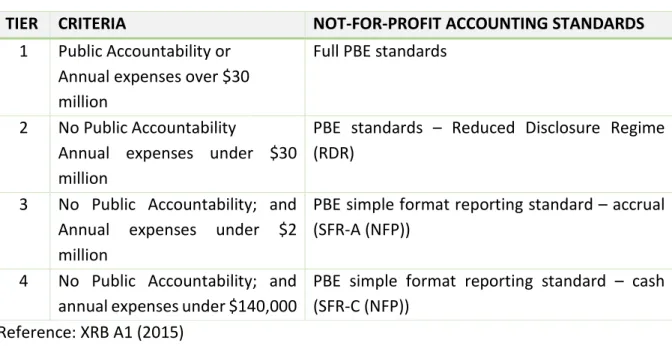
The reporting requirements for PBEs are based on tier structure relating to public accountability1 and the total annual expenses for an entity as shown in Table 1. Large charities report under Tier 1, medium charities report under Tier 2 and smaller charities report under Tier 3 and 4.
[Insert Table 1 here]
The Tier 3 reporting standard, PBE SFR-A (NFP) required charities to prepare a SSP to provide information to help users understand what the entity had done. Charities were required to disclose what the entity was trying to achieve (outcomes) and what the entity did (outputs) (XRB, 2013).
2.2 Research on financial reporting for charities in New Zealand
There are a small number of studies that have researched the introduction of financial reporting standards and how this has affected smaller (Tier 3 and Tier 4) charities in New Zealand. Most of the studies have interviewed charities to examine the impacts. There has only been one comprehensive study on the SSP.
Before the introduction of financial reporting for charities, research focussed on the need for accountability, transparency and public trust in the sector and the lack of regulation.
Accountability, transparency and public trust are common themes within the charity literature. Sinclair et al. (2010) define accountability as a process in which assets are used as they were supposed to be used and any information about the usage of the assets is readily available. Transparency is associated with openness and can be seen as allowing the flow of information about an organisation including its performance (Hyndman & McConville, 2018).
Hyndman & McConville (2018) found that charities rely on public trust to be sustainable and owe a duty of accountability to the public. Managers of large charities were interviewed to identify the mechanisms which charities use to build trust and discharge accountability.
Publicly available information such as annual reports was important in developing trust with stakeholders but as the relationships developed more direct engagement was made to stakeholders using private mechanisms such as direct reporting and participation. Agyemang
1 Entities have public accountability if they publicly trade equity or debt securities, hold funds in a fiduciary capacity for a group of outsiders or are deemed have higher public accountability as specified in the Financial Markets Conduct Act 2013 (XRB A1m, 2015)
7
et al., (2017) believe that compliance with external reporting requirements is also important to build trust and for ongoing stakeholder support.
Trust has been described as the belief in the reliability, truth or ability of someone or something (Yang & Northcott, 2019). Charities cannot exist without public trust and accountability practices are especially important around the disclosure of information that is relevant Yang & Northcott (2019). The research used a case study of two New Zealand charities in which it was found that face-to-face accountability is highly visible to stakeholders and promotes accountability. It also found that regulation has a role in providing accountability which supports public trust.
Pre-regulation, only 5% of charities were considered to provide quality reporting including non-financial reporting. The research highlighted a lack of reporting about grants, gifts-in-kind and expenses incurred in fundraising (Cordery & Patel, 2011). Financial reporting issues for charities were identified by Hooper et al., (2007). Both studies called for the introduction of new financial reporting standards so that all charities could follow the same formats.
Once the new reporting standard PBE SFR-A (NFP) was introduced, research was undertaken to investigate the effects. Baskerville et al., (2017) reported on the compliance of Tier 3 and 4 charities with the new financial reporting standards. Responses from 1,594 charities showed that 92% of them had applied with the new reporting standards. Peterson- Palmer & Mathus (2017) interviewed five small and medium-sized registered charities in the Nelson region (Tier 3 and 4). The implementation of the standard was found to be time- consuming with an increase in accounting and audit costs with the cost proportionately greater for smaller charities. Hooks & Stent (2020) study extended the scope of research by interviewing 11 Tier 3 and Tier 4 charities in a range of sectors in Auckland and Wellington.
They found that small charities experienced difficulties in the reporting and preparation of non-financial information. Most of the interviewees found the task of identifying outcomes and defining outputs very difficult and were sceptical about the need to disclose non-financial information as it did not serve a purpose. There were also technical difficulties using the new XRB reporting template. One interviewee expressed concern that most people that prepare reports in charities were not capable of providing reports to the standard required.
Ahmed’s (2021) research examined the SSP disclosures of 30 Tier 3 and 30 Tier 4 charities. The study identifies a gap between what charities disclose in terms of performance
8
data and what the financial reporting standard requires. Eves (2020) investigated the changes to both the accounting and governance practices of small charities (Tier 3 and 4) as a result of the introduction of the PBE SFR-A (NFP). The research was conducted by using semi- structured interviews of two charities and document analysis including annual reports were also examined. The research found that the charities relied on the auditors to complete the SSP
The research findings indicate that while there is compliance with the standard it was time-consuming and costly to implement. Analysis of the SSP content indicates gaps in reporting in comparison with the standard. There is also scepticism expressed about the value of the statements.
The External Reporting Board (XRB) is currently in consultation with the public regarding changes to the Tier 3 (NFP) Standard. The replacement of the words, “outcomes”
with “significant activities and achievements” and “outputs” with “appropriate and meaningful measures” is being proposed in the Statement of Service Performance (XRB, 2022).
Based on these studies, the research questions are as follows:
RQ1 How well have Tier 3 charities reported disclosure of the Statement of Service Performance (SSP) since the introduction of the Financial Reporting Standard PBE SFR-A (NFP)?
The first research question looks at how well Tier 3 charities reported the disclosures in the SSP. This focuses on the outcomes and outputs submitted by charities well as other information disclosed which may help to explain some of the issues discussed in other research papers specifically Hooks & Stent (2020) and Ahmed (2021
The second question for this research is linked to the research by Peterson-Palmer & Mathus (2017) regarding smaller charities being more likely to be affected by changes in regulation.
The question is as follows:
RQ2 Did the application of the Financial Reporting Standard PBE SFR-A (NFP) show differences in the reporting of the Statement of Service Performance (SSP) between small and medium to large Tier 3 charities and were there improvements?
9
The second question is important as it reflects on whether the smaller charities have struggled since the implementation of the new financial standard.
3.0 Research method and sample selection 3.1 Method
The chosen methodology for this research paper was content analysis. This is a common approach used in charities research of annual reports and reviews (Dhanani &
Connolly, 2012; McConville et al.,2021, Ahmed, 2021).
This was carried out by examining the disclosures reported by Tier 3 registered charities in the SSP and coding them against a content analysis index. The content analysis index followed the requirements and guidelines as set out in Section 4: Statement of Service Performance in Tier 3 reporting Standard PBE SFR-A (NFP).
The content analysis was applied to the 2016 and 2020 Performance Reports of a sample of charities. These two years are selected to identify if there was an improvement in the application of the standard. The 2016 year was chosen as SPP reports were filed for the frist time after the introduction of the new financial reporting standard (PBE SFR-A (NFP)). At the time of the study, the 2020 year was chosen as the most recent SPP reports would be filed.
A comparison is also made between the reporting of small tier and medium to large tier 3 charities as Peterson-Palmer & Mathus (2017) identified that smaller charities were more affected by the implementation of the new financial reporting standard. Small charities were defined as having total annual operating expenses of up to $500,000 and medium to large charities with total annual operating expenses of $501,000 to $2 million.
3.2 Sample selection
For the study, the religious sector was selected. This selection was made on the basis that previous research had focused on Tier 3 and 4 charities from a range of sectors. Faith- based charities can be differentiated from other charities in two main ways. The first is about the primary source of its income. Many church organisations rely on donations from their parishioners. Other sources of income include bequeaths, trading activities and government grants and contracts. Part of the rationale for greater accountability from charitable organisations is to provide information to donors as to the activities of the charity and the impact that they have made towards the charitable purpose. Church organizations however
10
receive relatively little donations from the general public. Those who donate are usually members who are privy to the ongoing activities of the organization and the impact that it is making. There is little need for the less detailed information disclosed in the public domain.
In addition, funding gained from government contracts has built-in accountability mechanisms that also negate the need for a less detailed statement of service performance.
The second important difference between church organizations and other charities is the measurement criteria for what may be deemed as the advancement of religion. The relief of poverty may be measured using well-established indicators including income, employment, and wealth. Attaining and maintaining a status of spiritual enlightenment as the goal of advancing religion is more challenging. A statement of service performance for a church organization is likely to require a different set of disclosure compared to other recognized charitable activities.
The data for this research was collected by performing an advanced search in the Charities Register. Using the “Financial” option, the charities that provided religious services/activities were selected. A further filter was applied to select only Tier 3 charities.
The data was also filtered to exclude any deregistered charities and charities that were registered after 2015. After these exclusions, the population of Tier 3 religious charities was 1,432 charities.
To select the sample size, the Yamane (1967) simplified formula for proportions was used. The formula is as follows:
𝑛𝑛 = 𝑁𝑁
1 + 𝑁𝑁(𝑒𝑒)2 = 1,432
1 + 1,432(0.10)2 = 93.4726 𝐶𝐶ℎ𝑎𝑎𝑎𝑎𝑎𝑎𝑎𝑎𝑎𝑎𝑒𝑒𝑎𝑎
Where: 𝑛𝑛 = sample size N = population size e = level of precision or sampling error
Due to time restrictions of this study, the level of precision or sampling error chosen was 10% Using these numbers, a sample size of 94 charities was determined. A systematic random sampling technique applying a sampling interval (𝑘𝑘) was used to determine the 94 charities. The following formula was used to calculate 𝑘𝑘:
𝑘𝑘 =𝑁𝑁 𝑛𝑛 =
1,432
94 = 15.23
11
Every 15th charity was then selected the until 94 charities had been selected. The 94 charities used in the sample all had to report under Tier 3 and to have submitted an SPP in 2016 and 2020. Based on this criteria, 24 charities that had been originally chosen, were excluded and replaced with another selection.
4.0 Analysis of results
The performance report and annual return summary were analysed for 2016 (188 documents) and 2020 (188 documents) and officer details (94) for the 94 charities. In total 470 documents were examined. Appendix 1 lists the information gathered from the documents. The information gathered about the SSP followed the requirements of PBE SFR- A (NFP) and the content analysis procedure used by Ahmed (2021).
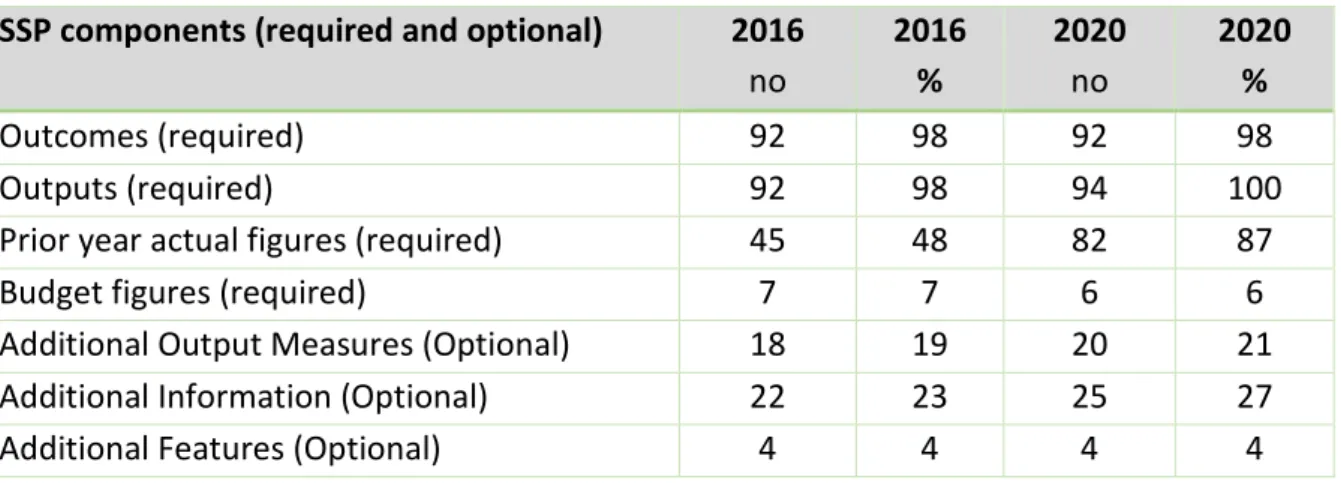
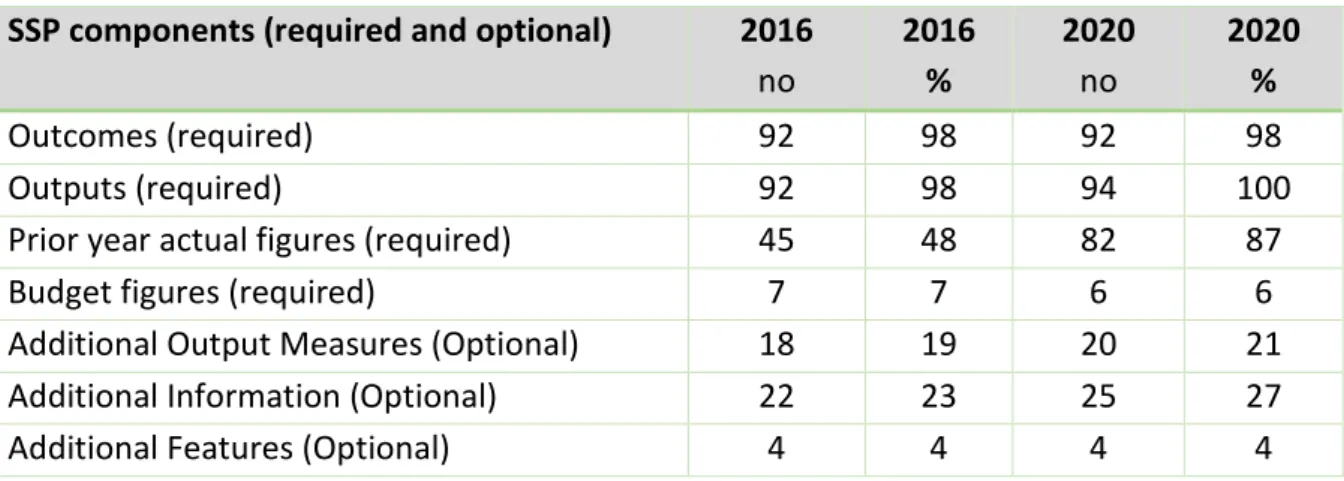
Table 2 records the number of Tier 3 Charities that disclosures required and optional components of the SSP in 2016 and 2020.
[Insert Table 2]
In 2016, a total of 92 Tier 3 charities reported outcomes in the SSP. The number was unchanged in 2020. The number of Tier 3 charities reporting outputs in 2016 was 92 increasing to 94 charities in 2020.
In 2016, 45 out of the 94 (48%) reported the prior year's actual figures. This increased to 82 out of 94 charities (87%) in 2020. Very few charities reported budget figures in both years; seven charities in 2016 dropping to six charities in 2020.
Only a fifth of the charities (20%) provided additional output measures. Additional information was proved at a similar rate but with some improvement in 2020 to 27%.
Additional features such as photos, commentaries and stories were provided by only four charities.
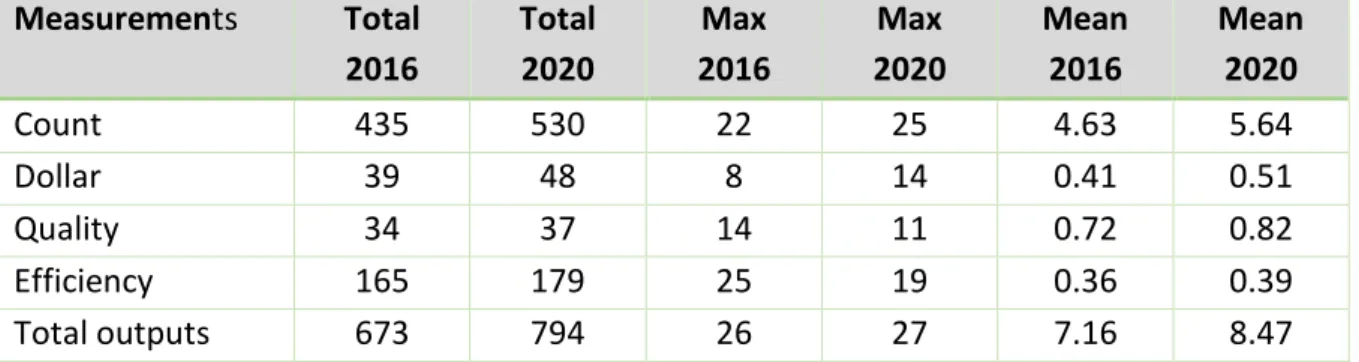
[Insert Table 3 ]
Table 3 reports the output measures in total by nature. The data shows an
improvement in reporting the number of outputs reported by each type of measure. Count measurements are the main measurement of outputs disclosed by Tier 3 charities with a mean of 4.63 measures in 2016 increasing to 5.64 in 2020. In comparison Ahmed (2021) reports lower mean counts of 3.80 in 2016 and 3.83 in 2019. Efficiency outputs were the
12
next most common measure with a mean of 1.76 for 2016 and 1.90 in 2020. The means are higher than that reported by Ahmed (2021) of 0.17 in 2016 and 0.07 in 2019.
Table 4 reports the mean output measures comparing small and medium to large entities. Medium to large charities reports a higher mean number of count and efficiency measures in comparison to smaller charities. In contrast, smaller charities report a higher mean number of dollar and quality measures compared with larger charities.
[Insert Table 4]
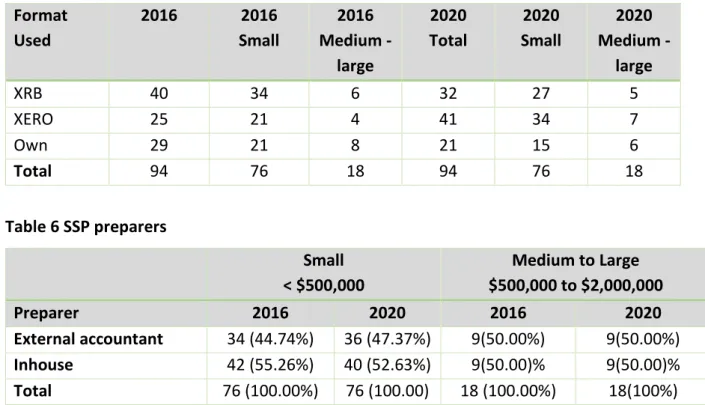
Table 5 shows the format used by Tier 3 Charities in 2016 and 2020. Hooks & Stent (2020) found that most charities had technical difficulties using the XRB template with Xero being more user-friendly. Charities with more experienced staff or volunteers were able to develop their format.
[Insert Table 5]
Table 5 shows that there has been a reduction in the number of charities using the XRB template or customised templates to greater use of Xero. The Xero format was used by 25 Tier 3 charities (26.60%) in 2016, increasing to 41 (43.62%) in 2020.
Table 6 shows that in 2020, 52.63% of the smaller charities prepared SSP in-house compared to 47.37% that used an external accountant. For medium, to large charities, half of the charities prepared the reports in-house and half used external accountants.
5.0 Discussion and conclusion
This study examines the trends in SSP reporting for 94 small to medium Tier 3 charities.
The study focuses on one charitable sector of religious activities. The study finds good rates of compliance with reporting of outcomes and outputs. An improvement in the reporting of prior year actuals was noted. However, very few charities report budgeted figures. Only 20%
of charities provided additional output measures or information in the SSP. This suggests that SSP preparation might be seen more as a compliance exercise rather than providing information to stakeholders for purposes of accountability and transparency.
The study shows an improvement in the total number of outputs and mean number of outputs reported per charity. The most commonly used measure is counts. This improvement may be due to more practice and experience by the charities in preparing SSP reports. Smaller charities report a smaller number of outputs per charity.
13
The level of compliance against the XRB reporting template for the SSP suggests a misalignment between the disclosure requirements and the complex outcomes of faith-based organisations. It is possible that having a single format for all charities is inappropriate and that a more flexible set of guidelines be developed to accommodate the differences that are apparent between religious and non-religious charities.
This research is not without limitations. Firstly, this research only uses secondary data to compile data. This data only includes what is submitted in the form of Performance Reports (Annual Reports) by registered charities on the Charities Services website. The method used in this research along with interviews would have given a more rounded and broader picture. This research is also limited in both scope and generalizability. The scope of this research is limited to only Tier 3 registered charities that provide religious services or activities and may not be generalisable to other charity sectors.
14
References
Agyemang, G., O’Dwyer, B., Unerman, J., & Awumbila, M. (2017). Seeking ‘conversations for accountability’: mediating the impact of non-governmental organization (NGO)
upward accountability processes. Accounting, Auditing & Accountability Journal, 30(5), 982-1007.
Ahmed, H. (2021). Service Performance Reporting in New Zealand Charities [Master's thesis, Auckland University of Technology]. Tuwhera.
https://openrepository.aut.ac.nz/handle/10292/14561
Baskerville, R.F., Cordery, C.J., & Pells, J. (2017). Small Charities in New Zealand: Responses to the New Financial Reporting Changes. SSRN Electronic Journal.
doi.org/10.2139/ssrn.2920808 Charities Act 2005.
http://www.legislation.govt.nz/act/public/2005/0039/latest/DLM344368.html
Charities Services. (2021a). 2020/2021 Annual review. https://www.charities.govt.nz/assets/
Annual-Review-2020-2021.pdf
Charities Services. (2021b). Annual Reporting to Charity Services. A guide for Tier 3 Charities.
https://charities.govt.nz/assets/Uploads/Resources/Tier-3-Guide-161103-printed- V2.0-web.pdf
Charities Services. (2022a). About Charities Services. https://www.charities.govt.nz/about- charities-services/
Charities Services. (2022b). About the Reporting Standards. https://www.charities. govt.nz/
reporting-standards/about/
Charities Services. (2022c). Annual Return – Visuals. https://register.charities.govt.nz/
PowerBI
Charities Services. (2022d) Reporting Standards. https://www.charities.govt.nz/reporting- standards/
Charities Services. (2022e). Tier 3 annual reporting resources and templates.
https://www.charities.govt.nz/reporting-standards/tier-3/tier-3-annual-reporting- guide-template-standard-and-guidance-notes/
Chartered Accountants Australia and New Zealand. (2017). New charity reporting – one year on. https://www.charities.govt.nz/assets/Uploads/262-Charity-Reporting-Standards- One-year-on-FA-1.pdf
15
Chartered Accountants Australia and New Zealand (2022a). Guidance for not-for-profit reporting in New Zealand. https://www.charteredaccountantsanz.com/tools-and- resources/client-service-essentials/reporting/guidance-for-nfp-reporting-nz Chartered Accountants Australia and New Zealand. (2022b). Not-for-profit reporting.
https://www.charteredaccountantsanz.com/member-services/technical/reporting/
not-for-profit-reporting
Connolly, C., & Hyndman, N. (2004). Performance reporting: a comparative study of British and Irish charities. The British Accounting Review 36, 127-154.
Cordery, C.J. (2013). Regulating small and medium Charities: Does it improve transparency and accountability? International Journal of Voluntary and Non-profit Organizations, 24, 831-851. doi:10.1007/s11266-013-9381-6
Cordery, C.J., & Baskerville, R.F. (2007). Charity financial reporting regulation: A comparative study of the UK and New Zealand. Accounting History, 12(1), 7-
27.http://doi:10.1177/1032373207072806
Cordery, C.J., & Patel, K. (2011). Financial reporting stock-take: An assessment of
accountability through charities’ filings on New Zealand’s Charities Register: A Report for the Ministry of Economic Development, Accounting Standards Review Board and Charities Commission. Wellington: Victoria University.
Cordery, C., & Sinclair, R. (2013). Measuring performance in the third sector. Qualitative Research, 10(3/4), 196-212. https://doi.org/10.1108/qram-03-2013-0014
Cordery, C. J., Fowler, C. J., & Morgan, G. G. (2016). The development of incorporated structures for charities: A 100-year comparison of England and New
Zealand. Accounting History, 21(2-3), 281-303.
Cordery, C., Sim, D., & van Zijl, T. (2017). Differentiated regulation: The case of Charities.
Accounting & Finance, 57(1), 131-164.
Eves, P. (2020). Walking the regulatory tightrope: A case study in compliance of New Zealand Small Charities. [unpublished Master's thesis, Auckland University of Technology]. Tuwhera. https://openrepository.aut.ac.nz/handle/10292/13707
External Reporting Board (XRB). (2013). Public benefit entity simple format reporting accrual (Not-for-profit) (PBE SFR-A (NFP)). https://www.xrb.govt.nz/accounting-
standards/not-for-profit/pbe-sfr-a-nfp/
16
External Reporting Board (XRB). (2015). XRB A1 Application of the accounting standards framework. https://www.xrb.govt.nz/standards/accounting-standards/accounting- standards-framework/
External Reporting Board. (2018). Template for PBE SFR-A (NFP).
https://www.xrb.govt.nz/standards/accounting-standards/not-for-profit-standards/
standards-list/pbe-sfr-a-nfp/
External Reporting Board (XRB). (2022). Proposed improvements to the Tier 3 (NFP)
Standard, Consultation document. https://www.xrb.govt.nz/consultations/accounting- standards-open-for-consultation/tier-3-and-4-reporting/
Filimoehala, K. (2021). The audit and review of service performance information in the New Zealand Charity Sector. [Master's thesis, Auckland University of Technology]. Tuwhera.
https://openrepository.aut.ac.nz/handle/10292/14664
Financial Reporting Act 2013. http://www.legislation.govt.nz/act/public/2013/0101/latest/
DLM4632829.html
Harris, E. E., & Neely, D. (2021). Determinants and consequences of nonprofit transparency.
Journal of Accounting, Auditing & Finance, 36(1), 195–220.
doi.org/10.1177/0148558X18814134
Hooks, J., & Stent, W. (2020). Charities’ new non-financial reporting requirements:
preparers’ insights. Pacific Accounting Review, 32(1), 1–19. doi-org/10.1108/PAR-12- 2018-0119
Hooper, K., Sinclair, R., Hui, D., & Mataira, K. (2007). Financial reporting by New Zealand charities: Finding a way forward. Managerial Auditing Journal, 23(1), 68-83.
Hyndman, N., & McConville, D. (2018). Trust and accountability in UK charities: Exploring the virtuous circle. The British Accounting Review, 50(2), 227-237.
Inland Revenue Department (IRD). (2021). Charities.
https://www.ird.govt.nz/roles/charities
McConville, D. Henderson, E., & Cordery, C. (2021). Vacant jurisdictions: The accountancy profession and the UK charity sector.Financial Accountability & Management, 37(3), 344–360. https://doi.org/10.1111/faam.12279
Muir, K., & Ramia, I. (2020, June 19). Investing in our social fabric or paying the price of social dislocation? Centre for Social Impact. https://www.csi.edu.au/news/investing- our-social-fabric-or-paying-price-social-dislocation/
17
Palmer, P.D. (2013). Exploring attitudes to financial reporting in the Australian not-for-profit sector. Accounting & Finance, 53(1) 217-241.
Peterson-Palmer, K., & Malthus, S. (2017). Financial reporting by charities: the impact of recent changes to accounting standards and assurance requirements. New Zealand Journal of Applied Business Research, 15(1), 41-57.
Saj, P. (2012). The influence of mandatory requirements on voluntary performance reporting by large multi-service community service organisations. Third Sector Review, 18(2), 139-169.
Sinclair, R., Hooper, K., Ayoub, S., Finance, P., & ESSCA, G. (2010, July). Perspectives of accountability in charities. AFAANZ Conference, Adelaide, Australia.
Statistics NZ (2020). Non-profit institutions satellite account: 2018.
https://www.stats.govt.nz/reports/non-profit-institutions-satellite-account-2018 Yamane, T. (1967). Statistics: An introductory analysis, (2nd ed.). Harper and Row.
Yang, C., & Northcott, D. (2019). How can the public trust charities? The role of performance accountability reporting. Accounting & Finance, 59(3), 1687–1713.
18
Appendices
Appendix 1: Content Analysis Index Content Analysis Index
Item Definition (as per PBE SFR-A
(NFP) Standard) Example
Number of Outcomes What the entity is seeking to achieve in terms of its impact on society
Number of outcomes coded 1
To transform lives through the gospel message and to help people to meet Jesus Christ
Number of Output Measures The goods or services that the entity delivered during the year
Number of output measures disclosed
Number of Count Outputs Performance Indicator is stated as a number
Number of outputs is entered
Number of Baptisms
Number of Dollar Outputs Performance Indicator is stated in dollars ($) Number of ($) outputs is entered
Expenditure on Ministry efforts
Number of Quality Outputs Performance Indicator is stated in terms of improvement or quality Number of outputs is entered
Maintenance project is completed
Number of Efficient Outputs Performance Indicator is described in terms of efficiency
Number of outputs is entered
Average hours of volunteers
Additional Output Measures Appropriate quality measures of goods or services delivered;
The entity’s plans for the financial year being reported on, and an explanation of actual performance
achieved against the plans set by the entity;
Number of Output Measures is entered
Free coffees given out at community event
19
Additional Information Any additional information that is relevant to users’
understanding of the entity’s outcome goals, or the delivery of goods or services.
Yes – Coded 1 No – Coded 0
The church are planning to renovate the hall
Other Features Features such as Photos, Stories and commentaries
Yes – Coded 1 No – Coded 0
Stories of events and photos of beneficiaries
Main Source of the Entity’s Cash and Resources
The main source of income Coded per item
Donations Fundraising Change in Charity Purpose Yes – Coded 1
No – Coded 0 Change in Entity Structure Yes – Coded 1
No – Coded 0
Total Operating Expenditure Less than $500,000 or
Between $500,000 and $1 million or
Over $1,000,000
Less than $500,000
Number of New Officers The number of New Officers from 2016-2020
Number of Past Officers The number of Past Officers from 2016-2020
20
Table 1: Public Benefit Entity Reporting Standards Tier Structure
TIER CRITERIA NOT-FOR-PROFIT ACCOUNTING STANDARDS
1 Public Accountability or Annual expenses over $30 million
Full PBE standards
2 No Public Accountability
Annual expenses under $30 million
PBE standards – Reduced Disclosure Regime (RDR)
3 No Public Accountability; and Annual expenses under $2 million
PBE simple format reporting standard – accrual (SFR-A (NFP))
4 No Public Accountability; and annual expenses under $140,000
PBE simple format reporting standard – cash (SFR-C (NFP))
Reference: XRB A1 (2015)
21
Table 2: SSP components reported of by Tier 3 Charities (n=94) SSP components (required and optional) 2016
no 2016
% 2020
no 2020
%
Outcomes (required) 92 98 92 98
Outputs (required) 92 98 94 100
Prior year actual figures (required) 45 48 82 87
Budget figures (required) 7 7 6 6
Additional Output Measures (Optional) 18 19 20 21
Additional Information (Optional) 22 23 25 27
Additional Features (Optional) 4 4 4 4
Table 3 SSSP outputs by measurement Measurements Total
2016 Total
2020 Max
2016 Max
2020 Mean
2016 Mean 2020
Count 435 530 22 25 4.63 5.64
Dollar 39 48 8 14 0.41 0.51
Quality 34 37 14 11 0.72 0.82
Efficiency 165 179 25 19 0.36 0.39
Total outputs 673 794 26 27 7.16 8.47
Table 4 Mean SSP outputs by measurement small vs medium to large charities TOTAL ANNUAL EXPENSES
Measurements Small
< $500,000 n=76
Medium to large
$500,000 to $2,000,000 N=18
Mean
2016 Mean
2020 Mean
2016 Mean
2020
Count 4.59 5.54 4.78 6.06
Dollar 0.43 0.57 0.33 0.28
Quality 0.45 0.45 0.00 0.17
Efficient 1.53 1.76 2.72 2.50
Total Outputs 6.96 8.32 8.00 9.00
22
Table 5: Format used for SSP Format
Used 2016 2016
Small 2016 Medium -
large
2020
Total 2020
Small 2020 Medium -
large
XRB 40 34 6 32 27 5
XERO 25 21 4 41 34 7
Own 29 21 8 21 15 6
Total 94 76 18 94 76 18
Table 6 SSP preparers
Small
< $500,000 Medium to Large
$500,000 to $2,000,000
Preparer 2016 2020 2016 2020
External accountant 34 (44.74%) 36 (47.37%) 9(50.00%) 9(50.00%) Inhouse 42 (55.26%) 40 (52.63%) 9(50.00)% 9(50.00)%
Total 76 (100.00%) 76 (100.00) 18 (100.00%) 18(100%)