CITY OF SWAN
Planning Information
ECM Doc Set ID:
Approval Date:
Disclaimer:
The City makes every attempt to keep its published records up to date; however the subject document may have been superseded
by a more recently approved document.
4307086 4/07/2022
Document Set ID: 7274869
DEVELOPER
RWM PROPERTIES PTY LTD ON BEHALF OF NOAHS ROSEHILL ESTATE PTY LTD (‘the proponent’)
PROJECT TEAM
URBIS – Planning and Urban Design COTERRA ENVIRONMENT – Environmental COTERRA ENVIRONMENT - Hydrology PRITCHARD FRANCIS – Civil Engineering URBIS – Landscape Design
HERRING STORER ACOUSTICS – Acoustic Assessment BUSHFIRE SAFETY CONSULTING – Bush Fire
DVC – Traffic & Transport
AMERGIN – Aboriginal Heritage Assessment
KAREN GREGORY COMMUNITY AND CONSULTATION – Community Advisor MCMULLEN NOLAN GROUP – Land Survey
IT IS CERTIFIED THAT AMENDMENT NO. 1 TO ROSEHILL WATERS STRUCTURE PLAN WAS APPROVED BY RESOLUTION OF THE WESTERN AUSTRALIAN PLANNING COMMISSION ON: 04 JULY 2022
Signed for and on behalf of the Western Australian Planning Commission
__________________________________________________________
an officer of the Commission duly authorised by the Commission pursuant to Section 16 of the Planning and Development Act 2005 for that purpose.
Document Set ID: 7274869
TABLE OF AMENDMENTS
AMENDMENT NO.
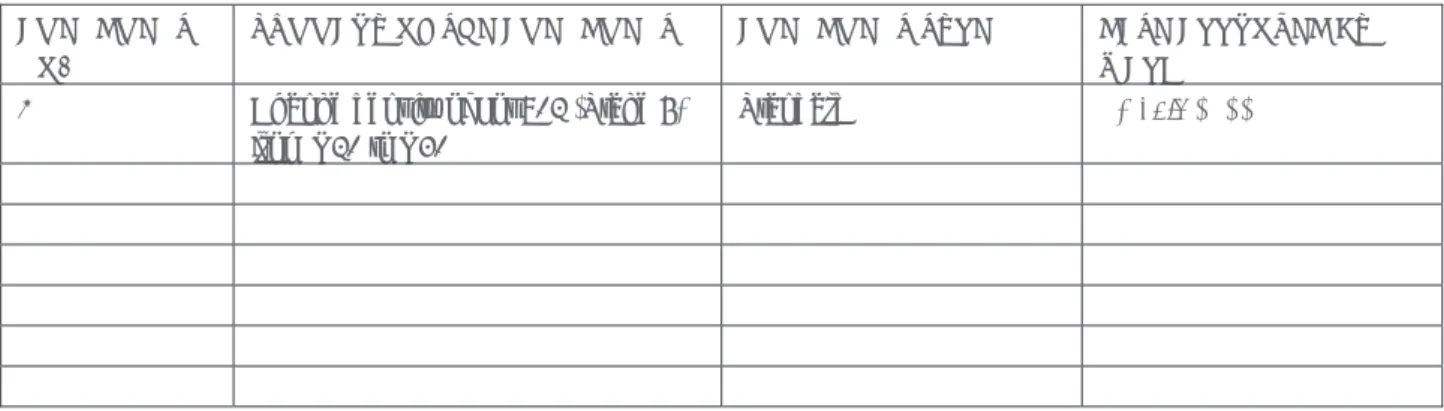
SUMMARY OF THE AMENDMENT AMENDMENT TYPE DATE APPROVED BY
WAPC 1 Change density of Lot 802 (Stage 5)
from R20 to R30
Standard -XO\
URBIS
PA-951 STRUCTURE PLAN ROSEHILL WATERS_V2
EXECUTIVE SUMMARY
The Rosehill Waters Structure Plan (the Structure Plan) applies to the former Rosehill Golf Course and Country Club located in South Guildford, in the City of Swan. The subject site is approximately 49 hectares in area, positioned between the Palmer Barracks to the south-west and the Waterhall Estate to the north-east.
This Structure Plan promotes innovative and sustainable development, that includes provisions for built form and urban design as well as environmental and community benefits. The planning of the site has been heavily influenced by the contemporary urban design principles of integration and permeability, enhancement of natural features, and an amenity for the residents and the surrounding community.
The development of the site provides a key opportunity for urban infill within Perth’s north east corridor, representing a logical and efficient delivery of urban development, consistent with the State Government’s strategic vision and priorities as identified in Directions 2031 and Beyond and the North-East Sub-Regional Planning Framework. In addition, the Rosehill Waters Structure Plan celebrates the locality’s history and natural assets through the retention and enhancement of the Helena River waterways and its foreshore and the existing historical and socially significant buildings and garden.
The Structure Plan proposes a highly progressive response to environmentally sensitive and sustainable design within the built form, density and mixed typologies. Rosehill Waters demonstrates how a challenging site can yield a great development in the hands of a committed developer who will also be responsible for influencing the built form product on the ground. Whilst limited in the range of residential densities provided, the Structure Plan allows for diversity in housing choice, as well as the creation of a robust community, with appropriate lot typologies and built form responses to open space areas, within proximity to the Helena River and to community centres.
The Structure Plan has the potential to deliver an overall housing density of 12 dwelling units per gross urban hectare. The Structure Plan allows for the creation of approximately 583 dwellings over approximately 41.21 hectares of Urban zoned land.
A focus has been given to the incorporation of water sensitive design principles, the retention of existing vegetation along key corridors and within open space areas, retention of natural drainage corridors and the enhancement of pedestrian linkages through to the Helena River. The Structure Plan supports the provision of approximately 5.4503ha of creditable public open space, over the 10% requirement, achieving an
appropriate amount of equitably distributed, useable and connected open space areas.
The proposed street and movement network within the Structure Plan results in a well - connected and permeable street network which connects and directs residents to key points of interest, public open space and the broader local area efficiently and safely. Improvements and expansions are delivered to the existing pedestrian and cycle networks which will connect people to Guildford and Hazelmere and offer alternative modes of transport to the local community. Inherent within the overall sustainable design strategy, the street network performs an integrated role with the drainage strategy, supporting the conveyance within the road reserves along several streets.
As part of the preparation of the Structure Plan, the following technical and supporting documentation has been prepared and is summarised in this report. Full copies of these documents are provided in the technical appendices.
Local Water Management Strategy (Coterra).
Environmental Assessment and Management Strategy (Coterra).
Foreshore Management Strategy (Coterra).
Transport Impact Assessment (DVC).
Infrastructure & Servicing Report (Pritchard Francis).
Fire Management Plan (Bushfire Safety Consultant).
Acoustic Report (Herring Storer Acoustics).
Aboriginal Heritage Assessment (Amergin)
Community Engagement Report (Karen Gregory)
Document Set ID: 7274869
STRUCTURE PLAN SUMMARY TABLE
ITEM DATA SECTION NUMBER
REFERENCED WITHIN THE STRUCUTRE PLAN REPORT
Total area covered by the Structure Plan: 49.2309 hectares Part 2, Section 3.4 Area of specific land uses:
Residential
Private Clubs and Institutions
Public Purposes (Water Corporation)
25.4724 hectares 4.9886 hectares 1.0565 hectares
Part 2, Section 3.4
Estimated lot yield: 583 lots Part 2, Section 6.4.1
Estimated number of dwellings: 583 dwellings Part 2, Section 6.4.1
Estimated residential site density 12 dwellings per hectare Part 2, Section 6.4.1
Estimated population Approx 1,700 Part 1
Estimated area and percentage of public open space given over to:
Neighbourhood parks
5.4503 hectares (inclusive of drainage)
Part 2, Section 6.6
URBIS
PA-951 STRUCTURE PLAN ROSEHILL WATERS_V2
CONTENTS
Endorsement Page ...3
Table of Amendments ...4
Executive Summary ...5
PART ONE: IMPLEMENTATION ...11
IMPLEMENTATION OF STRUCTURE PLAN ...12
1.1. Structure Plan Area ...12
1.2. Structure Plan Objectives ...12
1.3. Structure Plan Content...12
1.4. Operation ...12
1.5. Staging ...14
1.6. Subdivision and Development Requirements ...14
1.6.1. Land Use and Development ...14
1.6.2. Precinct Requirements ...14
1.6.3. Residential Density ...14
1.6.4. Public Open Space ...14
1.6.5. Local Development Plans ...14
1.6.6. Additional Information ...15
PART TWO: EXPLANATORY SECTION ...17
2. Introduction and Purpose ...18
3. Land Description ...19
3.1. Regional Context ...19
3.2. Local Context ...19
3.3. Population & Demographics ...19
3.4. Site Details ...20
4. Planning Framework ...22
4.1. Zonings & Reserves ...22
4.1.1. Metropolitan Region Scheme ...22
4.1.2. City of Swan Local Planning Scheme No. 17 (LPS17) ...22
4.2. Planning Strategies & Policies ...23
4.2.1. State Planning Strategy ...23
4.2.2. North-East Sub-Regional Planning Framework ...24
4.2.3. State Planning Policy No.3: Urban Growth and Settlement ...24
4.2.4. State Planning Policy No.5.1 – Land Use Planning in the Vicinity of the Perth Airport ...24
4.2.5. State Planning Policy No.3.7 – Planning in Bushfire Prone Areas ...24
4.2.6. City of Swan Urban Housing Strategy ...24
4.2.7. Other Policies and Guidelines ...25
4.3. Other Approvals and Decisions ...25
4.3.1. Metropolitan Region Scheme Amendment No.1266/57 ...25
4.3.2. Local Planning Scheme No.17 – Amendment No.194 ...26
5. Site Conditions & Contraints ...27
5.1. Biodiversity and Natural Area Assets ...27
5.1.1. Flora & Vegetation ...27
5.1.2. Fauna...29
5.1.3. Waterways ...30
5.2. Landform & Soils ...30
5.2.1. Topography ...30
5.2.2. Soils & Geology ...31
5.2.3. Acid Sulfate Soils ...32
Document Set ID: 7274869
5.3. Groundwater and Surface Water ...32
5.3.1. Groundwater ...32
5.3.2. Surface Water ...33
5.3.3. Floodways & Floodplains...33
5.3.4. Wetlands ...34
5.4. Bushfire Hazard ...35
5.5. Aboriginal Heritage ...35
5.6. European Heritage ...36
5.7. Other Land Use Conditions and Constraints ...36
5.7.1. Existing Road Network ...36
5.7.2. Contaminated Sites ...36
5.7.3. Aircraft Noise ...36
5.7.4. Infrastructure & Utilities ...36
6. Design Philiosphy, Land Use & Subdivision/Development ...40
6.1. Design Vision ...40
6.2. Sustainable Responsive Design ...41
6.3. Community Consultation ...42
6.4. Land Use ...44
6.4.1. Residential ...44
6.4.2. Private Clubs and Institutions ...44
6.5. Local Reserves ...44
6.5.1. Public Purposes ...44
6.5.2. Public Open Space ...44
6.6. Open Space ...46
6.6.1. Open Space Distribution and Calculation...46
6.6.2. Tree Protection Zone ...46
6.6.3. Public Open Space (POS) Form & Function ...46
6.7. Landscape Design ...50
6.7.1. Irrigation Strategy ...50
6.7.2. Landscape Management ...50
6.8. Civic and Community Facilities ...51
6.9. Future MRS Amendment ...52
6.10. Future Village Centre ...52
6.11. Management of Interfaces ...53
6.12. Movement ...56
6.12.1. Existing Access & Movement ...56
6.12.2. Movement Network Hierarchy ...56
6.12.3. Street Types ...56
6.12.4. Upgrades to Great Eastern Highway/Queens Road Intersection ...61
6.12.5. Pedestrian and Cycle Network ...61
6.12.6. Public Transport ...61
6.13. Water Management ...64
6.13.1. Water Conservation ...64
6.13.2. Stormwater Management ...64
6.13.3. Living Streams ...65
6.13.4. Groundwater Management ...65
6.13.5. Flood Management ...65
6.14. Bushfire Management ...66
6.15. Noise Management ...67
6.16. Servicing & Infrastructure ...70
6.16.1. Power...70
6.16.2. Sewer...70
6.16.3. Water ...70
6.16.4. Gas ...70
6.16.5. Telecommunications ...70
6.16.6. Earthworks ...71
6.17. Built Form Delivery ...71
URBIS
PA-951 STRUCTURE PLAN ROSEHILL WATERS_V2
Technical Appendices ...73
Disclaimer ...86
Appendix A ENVIRONMENTAL ASSESSMENT REPORT Appendix B APPROVED LOCAL WATER MANAGEMENT STRATEGY Appendix C FORESHORE MANAGEMENT STRATEGY Appendix D INFRASTRUCTURE AND SERVICING REPORT Appendix E TRAFFIC IMPACT ASSESSMENT (AND ADDENDUM – DENSITY) Appendix F APPROVED BUSHFIRE MANAGEMENT PLAN Appendix G ACOUSTIC ASSESSMENT (2015) Appendix H ABORIGINAL HERITAGE ASSESSMENT Appendix I COMMUNITY ENGAGEMENT REPORT Appendix J OUTCOMES OF PRELIMINARY CONSULTATION Appendix K MINISTERS CORRESPONDENCE FIGURES Figure 1 Structure Plan ... 13
Figure 2 Aerial Plan ... 18
Figure 3 Regional Context Plan ... 20
Figure 4 Local Context Plan ... 21
Figure 5 Metropolitan Region Scheme Zoning ... 22
Figure 6 Local Planning Scheme No. 17 Zone ... 23
Figure 7 Bush Forever Sites ... 28
Figure 8 Vegetation Units Mapping ... 29
Figure 9 Existing Topography ... 31
Figure 10 Flood Risk ... 34
Figure 11 Bushfire Hazard – Original Assessment ... 35
Figure 12 Aboriginal Heritage Assets... 37
Figure 13 Aircraft Noise (DPLH: 2019)... 38
Figure 14 Opportunities and Constraints... 39
Figure 15 Design Philosophy ... 41
Figure 16 Sustainable Responsive Design ... 43
Figure 17 Public Open Space ... 45
Figure 18 Landscape Masterplan ... 51
Figure 19 Future Village Centre ... 53
Figure 20 Buffer & Separation Treatments ... 55
Figure 21 Movement Network Plan ... 57
Figure 22 Road Cross Sections ... 58
Figure 23 Ped-shed Analysis ... 62
Figure 24 Pedestrian & Cycling Network ... 63
Figure 25 Building Protection Zone ... 67
Figure 26 Acoustic Construction Measures ... 69
TABLES Table 1 Subdivision & Development Requirements ... 15
Table 2 Compliance with MRS No. 1266/57 Conditions ... 26
Table 3 Soil Types ... 32
Table 4 Public Open Space Calculation ... 47
Document Set ID: 7274869
URBIS
PA-951 STRUCTURE PLAN ROSEHILL WATERS_V2 ENVIRONMENTAL ASSESSMENT REPORT
11
PART ONE: IMPLEMENTATION
Document Set ID: 7274869
IMPLEMENTATION OF STRUCTURE PLAN
1.1. STRUCTURE PLAN AREA
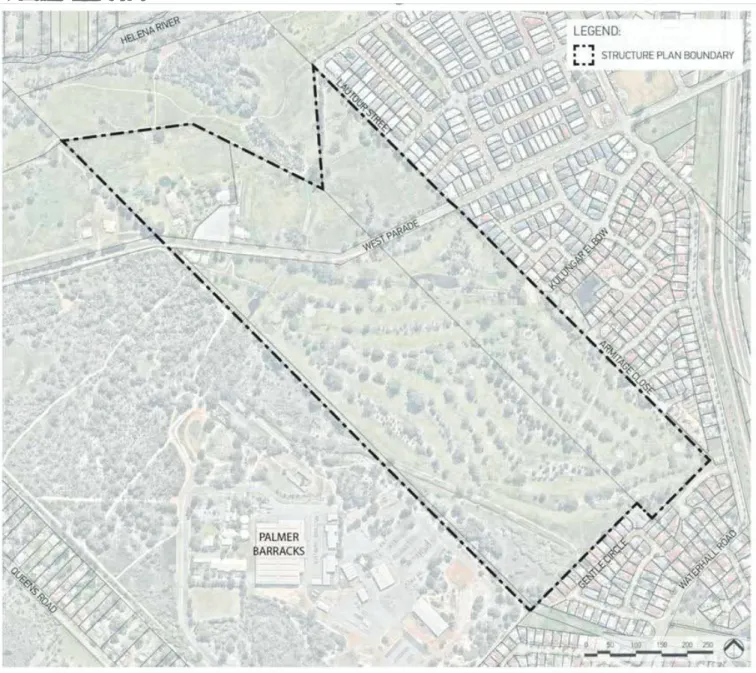
The Rosehill Waters Structure Plan (the Structure Plan), once endorsed, will become the guiding document in the consideration of future subdivision and development for the land contained within the inner edge of the line denoting the Structure Plan boundary on the Structure Plan Map as shown in Figure 1.
1.2. STRUCTURE PLAN OBJECTIVES
The objectives of the Structure Plan are:
1. To provide guidance on the subdivision and development of the Structure Plan in a circumstance where the site has particular locational and developmental requirements.
2. To facilitate the orderly and proper planning of the Structure Plan within the context of the site’s constraints relating to aircraft noise.
3. To adequately address the conditions of the Metropolitan Region Scheme (MRS) Amendment 1266/57 and the City of Swan’s Local Planning Scheme No.17 (LPS17), Special Use Zone No.24.
1.3. STRUCTURE PLAN CONTENT
This Structure Plan comprises:
Part 1: Implementation Section
Part 2: Explanatory Section
Part 3: Technical Appendices
The Structure Plan should be read in conjunction with the City of Swan Local Planning Strategy and the LPS17.
Part 1 of this Structure Plan is the implementation component of the Structure Plan which contains the Structure Plan Map and outlines the purpose and intent of the Structure Plan.
Part 2 of this Structure Plan is the explanatory section which contains the background information and explanation of the Structure Plan including design methodology, relevance and compliance with the planning framework. Part 2 also contains all supporting plans and figures.
Part 3 of this Structure Plan includes all of the relevant technical reporting which has been undertaken in support of the Structure Plan.
1.4. OPERATION
The Rosehill Waters Structure Plan comes into effect on the date in which the Structure Plan is approved by the Western Australian Planning Commission (WAPC). An approved structure plan is a document to which planning decision-makers are to give due regard to when making decisions on the subdivision and
development of land within the Structure Plan.
URBISPA-951 STRUCTURE PLAN ROSEHILL WATERS_V2ENVIRONMENTAL ASSESSMENT REPORT
13
Figure 1 Structure PlanVersion: 1, Version Date: 06/07/2022 Document Set ID: 7274869
1.5. STAGING
Due to the nature and size of the Structure Plan area, it is proposed that the development be undertaken within seven (7) stages. The staging of the Structure Plan is largely influenced by existing site levels and earthworks, rather than the delivery of required infrastructure.
Notwithstanding, upon the creation of the 300th lot, upgrades to Great Eastern Highway and Queens Road intersection are required to be undertaken in accordance with the Structure Plan and the Legal Agreement between the proponent and the City of Swan.
Note: since the adoption of the original Rosehill Waters Structure Plan, and following negotiation between the proponent, City of Swan and MRWA, the proponent has paid to the City of Swan its contribution to the upgrade of the intersection. The City of Swan will determine when these works occur.
1.6. SUBDIVISION AND DEVELOPMENT REQUIREMENTS
1.6.1. Land Use and Development
1. Land use and development within the Structure Plan is to be consistent with the prescribed zonings and reservations as detailed on the Structure Plan Map and as defined under LPS17.
2. Land use permissibility is to be in accordance with the relevant zone and the land use permissibility’s of the Zoning Table and Special Use Zone No.24 of LPS17.
3. No unacceptable land uses, as detailed under State Planning Policy 5.1 (SPP 5.1) are to occur within the 25 ANEF contour area.
1.6.2. Precinct Requirements
1. Land use and development within the Structure Plan is to be in accordance with the City of Swan LPS17 Special Use Zone No.24. All subdivision and development is to be in accordance with the conditions of this zone.
1.6.3. Residential Density
1. The residential density for the Structure Plan is R20, other than where the land is not affected by ANEF contours, in which case density is to be in accordance with the Structure Plan. The density for those areas affected by ANEF contours has been restricted to an R20 maximum through the conditions of the Metropolitan Region Scheme (MRS) Amendment 1266/57 which applies to the Structure Plan.
2. Residential density targets were established in Directions 2031 and Beyond and require new areas to adhere to a target of 15 dwelling units per gross hectare of ‘Urban’ zoned land. Due to the restrictions to density imposed under MRS Amendment 1266/57, the Structure Plan delivers a density of 12 dwellings per hectare across the Structure Plan.
Note: The detail as to how the Structure Plan addresses the conditions of MRS Amendment 1266/57 is outlined below.
1.6.4. Public Open Space
1. The provision of a minimum of 10 per cent public open space (POS) being provided in accordance with the WAPC’s operational policy, Liveable Neighbourhoods (2009).
2. Public open space is to be provided generally in accordance with Figure 1 (Rosehill Waters Structure Plan) and Table 4 and Figure 17 of Part 2. An updated public open space schedule is to be provided at the time of subdivision for determination by the WAPC, on advice from the City of Swan.
1.6.5. Local Development Plans
(a) Residential Local Development Plan.
(i) Prior to determination of an application for approval to commence development or as a condition of subdivision (whichever comes first) a Local Development Plan (LDP) is to be prepared and submitted
URBIS
PA-951 STRUCTURE PLAN ROSEHILL WATERS_V2 ENVIRONMENTAL ASSESSMENT REPORT
15
to the City of Swan for approval for all land which directly abuts existing residential development.
This LDP is to address the interface between existing and proposed dwellings and detail any required setbacks and interface treatments.
(ii) An LDP may also be prepared for any other area within the Structure Plan which requires specific built form controls and/or any specific requirements to address bush fire constraints and to achieve sustainable design initiatives.
(b) Private Clubs and Institutions Local Development Plan.
(i) Prior to the determination of an application for approval to commence development or subdivision (whichever comes first) a Local Development Plan (LDP) is to be prepared and submitted to the City of Swan for approval for all land within the ‘Private Clubs and Institutions’ zone. An LDP is not required prior to any change of use application.
(c) A LDP is required, at a minimum to address the objectives and requirements of the Structure Plan as well as Part 5A of the LPS17 and include details relating to:
x Street network and street block boundaries.
x Notional location and distribution of land uses which demonstrate how the development of the location contributes towards the objectives of the Structure Plan.
x Built form controls including building height, setbacks, indicative servicing/ storage areas and any other building design feature considered relevant.
x Location, areas, and primary function/ roles of any public/private open space.
x Indicative landscape treatments within the public realm.
x Interface treatments with the adjoining Helena River foreshore.
x Any other information considered relevant by the City of Swan to address the requirements of the Structure Plan.
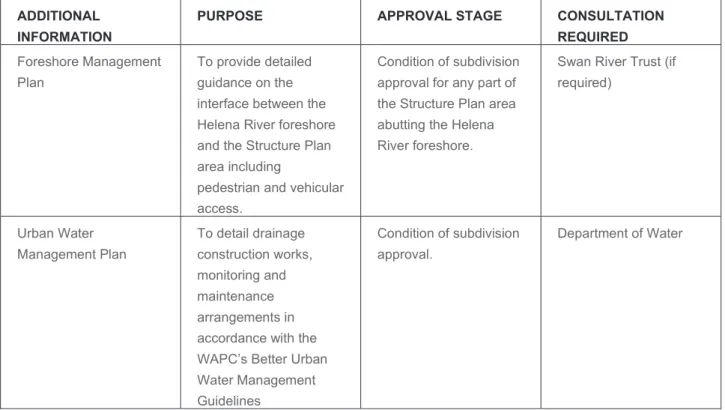
1.6.6. Additional Information
The following technical information is required to be undertaken at future planning stages:
Table 1 Subdivision & Development Requirements
ADDITIONAL INFORMATION
PURPOSE APPROVAL STAGE CONSULTATION REQUIRED
Foreshore Management Plan
To provide detailed guidance on the interface between the Helena River foreshore and the Structure Plan area including
pedestrian and vehicular access.
Condition of subdivision approval for any part of the Structure Plan area abutting the Helena River foreshore.
Swan River Trust (if required)
Urban Water Management Plan
To detail drainage construction works, monitoring and maintenance arrangements in accordance with the WAPC’s Better Urban Water Management Guidelines
Condition of subdivision approval.
Department of Water
Document Set ID: 7274869
Landscape and Public Open Space
Management Plan
To detail the ongoing management and maintenance arrangements of landscaping and public open space areas.
Condition of subdivision approval
City of Swan
Traffic Management Plan
To provide technical specifications relating to the upgrading of Queens Road/Great Eastern Highway and construction
management arrangements and broader traffic requirements.
To be submitted with subdivision application
City of Swan, Main Roads WA (if required)
Flora/Vegetation Management Plan
To provide detail of specific management, mitigation and tree retention methods to be implemented at construction stage.
Condition of subdivision approval
City of Swan, Department of Environment (if required)
Fauna Management Plan
To provide detail of specific management strategies for the protection of fauna habitats.
Condition of subdivision approval
City of Swan
Geotechnical Report Detailing the specific design and construction recommendations and requirements.
Condition of subdivision approval.
City of Swan
URBIS
PA-951 STRUCTURE PLAN ROSEHILL WATERS_V2 ENVIRONMENTAL ASSESSMENT REPORT
17
PART TWO: EXPLANATORY SECTION
Document Set ID: 7274869
2. INTRODUCTION AND PURPOSE
The Rosehill Waters Structure Plan (the Structure Plan) is prepared and lodged on behalf of the landowner, RWM Properties Pty Ltd. The Structure Plan encompasses former Lots 1, 57, 200 and 9000 West Parade, South Guildford (the site)(refer Figure 1).
The purpose of the Structure Plan is to provide a broad framework to guide future subdivision, development and use of the land within the Structure Plan.
The Structure Plan will facilitate the establishment of an infill development of approximately 583 dwellings, contribute to an extensive open space network which integrates with the existing Helena River, connects to the established local and regional road network and expands on existing infrastructure.
This document provides all the necessary information and addresses the reporting requirements of the City of Swan’s Local Planning Scheme No.17 (LPS17) and the requirements of the Planning and Development (Local Planning Scheme) Regulations 2015, including the Western Australian Planning Commission’s Structure Plan Framework (August 2015).
Figure 2 Aerial Plan
URBIS
PA-951 STRUCTURE PLAN ROSEHILL WATERS_V2 ENVIRONMENTAL ASSESSMENT REPORT
19
3. LAND DESCRIPTION
The following section examines the context with respect to location, land use and ownership of the land the subject of the Structure Plan.
3.1. REGIONAL CONTEXT
The site is located within the City of Swan, approximately 13 kilometres north-east of the Perth Central Business District, within the South Guildford locality. The site is approximately 5 kilometres south-west of the Midland Strategic Regional Centre (refer Figure 3).
3.2. LOCAL CONTEXT
Locally, the site is approximately 1.5 kilometres south of the Guildford town centre and 2.5 kilometres north of Perth airport. The Structure Plan area is approximately 1 kilometre east of Great Eastern Highway,1 kilometre south of James Street, 1.5 kilometres west of Bushmead Road and less than 1 kilometre north of Great Eastern Highway Bypass (refer Figure 3).
The site is traversed by West Parade, a key connector between Hazelmere to the east of the site. The site has frontage to the Helena River foreshore to the north. The site is located directly adjacent to the
established residential area of Rosehill and the developing Waterhall Estate to the immediate east and the Palmer Barracks to the west.
The Structure Plan area is serviced by the Guildford and Woodbridge Primary School which are located approximately 1.5 kilometres to the north-west and north-east respectively.
From a retail and employment standpoint, the site is serviced by the Guildford town centre, Bassendean Shopping Centre and Midland Centrepoint, and at a larger scale, Midland Gate. Swan Park Leisure Centre services the broader Guildford locality, and is approximately 6 kilometres to the north-east.
Bus services currently run from Midland train station through Rosehill Waters and Waterhall Estate. The Guildford Train Station is located approximately 2.0 kilometres to the north-east.
3.3. POPULATION & DEMOGRAPHICS
Guildford and South Guildford currently comprise approximately 7,000 residents.
There has been a growth in population by 1,000 residents since 2011. (2017; ABS). The South Guildford area comprises nearly 3,000 residents itself. Rosehill Waters will create dwellings to accommodate up to a further 1,700 residents bringing the total South Guildford community to 4,700 residents.
The demographic profile for the Structure Plan is likely to reflect the profile for the existing South Guildford community, which is currently characterised by:
An average age of 35 years which is consistent with WA averages.
An average household size of 2.6 persons which is consistent with WA averages.
A higher proportion of young pre-school aged children and 35-45 year old adults.
High mobility with an average of two vehicles per household.
Low unemployment rates.
High rates of full time employment.
Income levels 20%-25% above the WA average.
Separate dwellings – the Structure Plan will create more diversity and housing choice for the area.
Houses developed mainly for owner occupiers rather than rental accommodation - suggesting a highly sought after area which is subsequently capable of creating stronger communities due to a less transient population
Document Set ID: 7274869
Figure 3 Regional Context Plan
3.4. SITE DETAILS
The Structure Plan encompasses the lots formerly described as 1, 57, 200 and 9000 West Parade, South Guildford (the site), and since subject to further subdivision. The site occupies a total of 49.2309 hectares of land, including a portion of West Parade which traverses the site. The site is largely vacant land with most of the land previously being occupied by a private golf course.
The site includes Lot 1 which includes a Water Corporation water main running in freehold land along the south-western boundary. Topography across the site is gently undulating. There is little remnant vegetation within the site, with most of the trees having been planted as part of the previous land use activity.
URBIS
PA-951 STRUCTURE PLAN ROSEHILL WATERS_V2 ENVIRONMENTAL ASSESSMENT REPORT
21
Figure 4 Local Context Plan
Document Set ID: 7274869
4. PLANNING FRAMEWORK
The following section provides an overview of the relevant planning framework as it relates to the Structure Plan.
4.1. ZONINGS & RESERVES
4.1.1. Metropolitan Region Scheme
The majority of the site is zoned to ‘Urban’ under the Metropolitan Region Scheme (MRS), as per MRS Amendment 1266/57 which was endorsed and gazetted in June 2015.
Areas zoned ‘Urban’ provide for a range of activities including residential, commercial, recreational and light industrial. The remaining portion of the site remains zoned ‘Rural’ under the MRS.
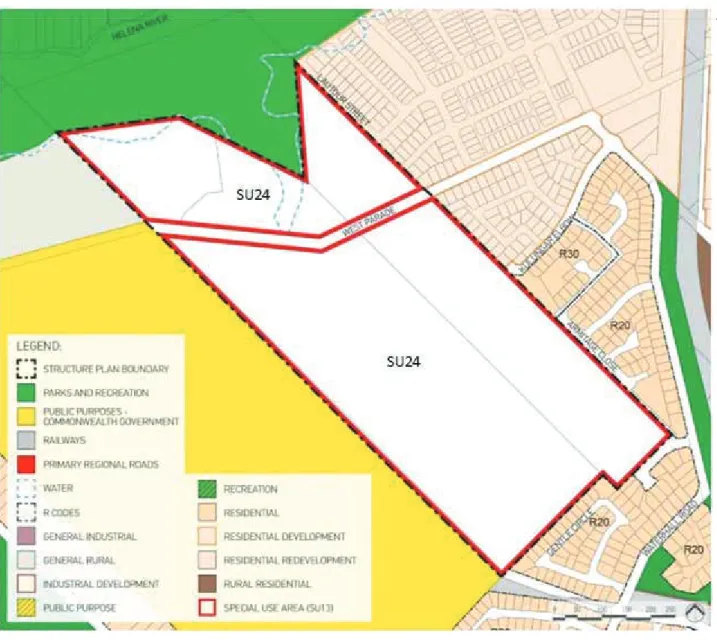
4.1.2. City of Swan Local Planning Scheme No. 17 (LPS17)
The site is currently zoned ‘Special Use’ zone which assists in facilitating the implementation of the Structure Plan and provides the appropriate statutory framework to deal with unique site characteristics relating to aircraft noise, and the control over potential uses within the northern portion of the site affected by aircraft noise above the 25 ANEF contour.
Figure 5 Metropolitan Region Scheme Zoning
Source: Urbis
URBIS
PA-951 STRUCTURE PLAN ROSEHILL WATERS_V2 ENVIRONMENTAL ASSESSMENT REPORT
23
Figure 6 Local Planning Scheme No. 17 Zone
4.2. PLANNING STRATEGIES & POLICIES
The Structure Plan design has been shaped by the many State government considerations operating within the strategic planning environment. In reaching a holistic land use and urban outcome it is crucial that the relevant frameworks that apply to the land are carefully considered. This section summarises the relevance of these strategies/policies within the context of the Structure Plan.
4.2.1. State Planning Strategy
The State Planning Strategy (2007 as amended) was prepared by the WAPC as a whole of Government approach to guide sustainable land use planning throughout the State up until 2029. The Strategy is aimed at developing a land use planning system to help the State achieve a number of goals.
These include wealth, the protection of the environment and building and maintaining lively and safe communities for the enjoyment of future generations of Western Australians. The Structure Plan will ensure the alignment with the key objectives of the State Planning Strategy.
Document Set ID: 7274869
4.2.2. North-East Sub-Regional Planning Framework
The Perth and [email protected] Million document provides strategic guidance to government agencies and local governments on land use, land supply, land development, environmental protection, infrastructure
investment and the delivery of physical and community/social infrastructure for the Perth and Peel regions. It makes the case for change from a business-as-usual perspective to a more considered, connected,
consolidated urban form. It links the four frameworks for each sub-region (North-West, North-East, Central and South Metropolitan Peel) and encourages the consideration of new urban growth opportunities.
The North-East Sub-Regional Planning Framework forms part of the Perth and [email protected] Million strategic suite of planning documents. Future areas for urban and industrial development have been determined in conjunction with the Green Growth Plan, which is the State Government’s Strategic Assessment of the Perth and Peel Regions, in order to avoid and protect areas which have significant environmental value.
The Framework identifies Rosehill Waters for Urban and Rural purposes. The Structure Plan is consistent with the Framework in this regard.
4.2.3. State Planning Policy No.3: Urban Growth and Settlement
State Planning Policy No.3: Urban Growth and Settlement (SPP 3) applies to the whole of the State in promoting a more consolidated settlement pattern which is more aligned to sustainable design and
development. The objectives and principles of Directions 2031 and Liveable Neighbourhoods are preserved in this policy.
SPP3 recognises the historical low density housing trend and urban sprawl which has occurred in
metropolitan Perth, acknowledging that this form of development only intensifies pressure on valuable land and water resources, imposes additional costs of infrastructure and services, and increases the dependency on private vehicles as a mode of transport.
Accordingly, the Structure Plan provides a consolidated development response which builds upon existing communities and established local economies, resulting in a more liveable and sustainable development.
4.2.4. State Planning Policy No.5.1 – Land Use Planning in the Vicinity of the Perth Airport
The purpose of State Planning Policy No.5.1 – Land Use Planning in the Vicinity of the Perth Airport (SPP 5.1) aims to protect the Perth airport from unreasonable encroachment by incompatible (noise-sensitive) land use and development and aims to minimise the impact the Perth airport has on the existing and future residential communities who may be impacted by noise.
SPP 5.1 provides guidance on the type of uses which can be entertained within the different noise exposure zones in accordance with Australian Standard 2021 (AS2021).
The Structure Plan area is affected by the 20-25+ ANEF contours, and since late 2019, approximately one third of the estate is no longer affected by any noise contours. Consistent with the recommendations of SPP 5.1 and the recently adopted Local Planning Scheme Amendment No.194, the use of the land will be
consistent with those densities and uses contemplated as being either acceptable or conditionally acceptable within the relevant ANEF contour area.
4.2.5. State Planning Policy No.3.7 – Planning in Bushfire Prone Areas
Version 1.4 of the Guidelines for Planning in Bushfire Prone Areas assist in the interpretation and implementation of State Planning Policy No.3.7 – Planning in Bushfire Prone Areas (SPP 3.7), where residential development is proposed within fire prone areas. Portion of the estate is subject to risk of bush fire due to the adjoining Bush Forever Site to the immediate west and vegetation located within the Helena River reserve to the north. A Bush Fire Management Plan was approved in 2018 (Appendix F).
4.2.6. City of Swan Urban Housing Strategy
The City of Swan’s Urban Housing Strategy was adopted by Council in June 2012 in response to the State Government’s Directions 2031 and Beyond. The strategy provides the basis for the consideration of higher residential density in suitable locations in a bid to address Perth’s growing population. The Strategy only identified land for increased densities on land which was already zoned ‘Urban’ at that time, and therefore, did not include the site, despite its recognition for future expansion under Directions 2031 and Beyond.
URBIS
PA-951 STRUCTURE PLAN ROSEHILL WATERS_V2 ENVIRONMENTAL ASSESSMENT REPORT
25
4.2.7. Other Policies and Guidelines
The following State policies are also directly relevant and applicable to the Structure Plan:
Structure Plan Preparation Framework
Liveable Neighbourhoods Operational Policy
State Planning Policy No.7.3 – Residential Design Codes
City of Swan Floodplain Management Development Local Planning Policy
The Structure Plan has been prepared to be consistent with the principles and requirements of the Western Australian Planning Commission’s (WAPC) and City of Swan’s operational policies and guidelines outlined above. Compliance with policy requirements is further demonstrated throughout Section 6 of this report.
The existing version of Liveable Neighbourhoods (2009) has been utilised in the development of this Structure Plan.
4.3. OTHER APPROVALS AND DECISIONS
4.3.1. Metropolitan Region Scheme Amendment No.1266/57
The majority of the Rosehill Waters Estate was rezoned from ‘Rural’ to ‘Urban’ as part of the MRS Amendment No.1266/57. This amendment was approved subject to a number of WAPC and Ministerial
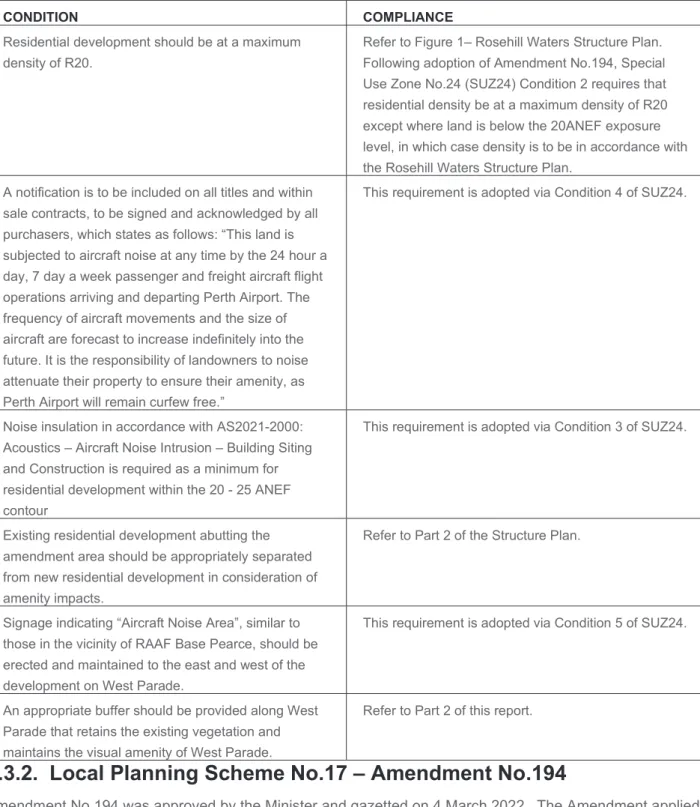
‘conditions’ which were required to be complied with as part of the subsequent planning stages. The manner in which these have or are proposed to be addressed is outlined in Table 2.
The Western Australian Planning Commission (WAPC) and Department of Planning (DoP) have provided in- principle support to the preparation of a separate MRS amendment to rezone the remaining portion of ‘Rural’
zoned land to ‘Urban’, subject to further consideration of land uses and a demonstrated development capability. A MRS amendment will be progressed for this land in due course.
In accordance with the Local Planning Scheme Regulations 2015, the preparation and assessment of a future MRS amendment has no bearing on the ability for the Structure Plan to be progressed and the land developed. A structure plan may be prepared for any land (regardless of the underlying zone) where ‘the Commission considers it necessary that a structure plan for the area is required for the purposes of orderly and proper planning’ (Part 4, Clause 15 of the Deemed Provisions).
In the case of the approved 2015 Structure Plan, the WAPC provided consent to progress with the lodgement of the Structure Plan ahead of the land being rezoned under the MRS and the City of Swan LPS17. The letter from the WAPC Chairman to this effect is appended to this Structure Plan.
In progressing with a cohesive plan for the site, it is considered consistent with the orderly and proper planning for a structure plan to apply to the whole of the site, enabling a holistic approach to the planning for the area and to ensure the appropriate use of the land transpires.
Until such time as the remaining portion of the site affected by the 25+ ANEF contour is rezoned from ‘Rural’
to ‘Urban’ under the MRS, in the short term, the land within this area will be planned for and developed consistent with the objectives of the ‘Rural’ zone and its existing non-conforming use rights, acknowledging its future potential for Urban purposes.
Document Set ID: 7274869
Table 2 Compliance with MRS No. 1266/57 Conditions
4.3.2. Local Planning Scheme No.17 – Amendment No.194
Amendment No.194 was approved by the Minister and gazetted on 4 March 2022. The Amendment applied to Condition 2 of SUZ24 in response to modifications to the ANEF contours for Perth Airport which resulted in approximately one third of the Estate no longer being subject to ANEF contours, and the north-east portion being less affected. The revised condition adopted via Amendment No.194 reads as follows:
‘Residential development shall be at a maximum density of R20, except where the land is below the 20ANEF exposure level, in which case the applicable density shall be in accordance with the Rosehill Waters
Structure Plan.’
CONDITION COMPLIANCE Residential development should be at a maximum
density of R20.
Refer to Figure 1– Rosehill Waters Structure Plan.
Following adoption of Amendment No.194, Special Use Zone No.24 (SUZ24) Condition 2 requires that residential density be at a maximum density of R20 except where land is below the 20ANEF exposure level, in which case density is to be in accordance with the Rosehill Waters Structure Plan.
A notification is to be included on all titles and within sale contracts, to be signed and acknowledged by all purchasers, which states as follows: “This land is subjected to aircraft noise at any time by the 24 hour a day, 7 day a week passenger and freight aircraft flight operations arriving and departing Perth Airport. The frequency of aircraft movements and the size of aircraft are forecast to increase indefinitely into the future. It is the responsibility of landowners to noise attenuate their property to ensure their amenity, as Perth Airport will remain curfew free.”
This requirement is adopted via Condition 4 of SUZ24.
Noise insulation in accordance with AS2021-2000:
Acoustics – Aircraft Noise Intrusion – Building Siting and Construction is required as a minimum for residential development within the 20 - 25 ANEF contour
This requirement is adopted via Condition 3 of SUZ24.
Existing residential development abutting the amendment area should be appropriately separated from new residential development in consideration of amenity impacts.
Refer to Part 2 of the Structure Plan.
Signage indicating “Aircraft Noise Area”, similar to those in the vicinity of RAAF Base Pearce, should be erected and maintained to the east and west of the development on West Parade.
This requirement is adopted via Condition 5 of SUZ24.
An appropriate buffer should be provided along West Parade that retains the existing vegetation and maintains the visual amenity of West Parade.
Refer to Part 2 of this report.
URBIS
PA-951 STRUCTURE PLAN ROSEHILL WATERS_V2 ENVIRONMENTAL ASSESSMENT REPORT
27
5. SITE CONDITIONS & CONSTRAINTS
Based on the background and planning context outlined above, the following section describes the key site opportunities and constraints that have informed and impacted on the Structure Plan urban form and structure.
5.1. BIODIVERSITY AND NATURAL AREA ASSETS
An Environmental Assessment Report (EAR) has been prepared by Coterra Environment and is included in Appendix A. The following sections have been directly informed by this report.
The former golf course use of the site has informed the structure and composition of the sites environmental and landscape features, which consist primarily of large cleared areas of planted lawn and introduced and planted trees. This vegetation provides limited environmental value and visual amenity to the landscape.
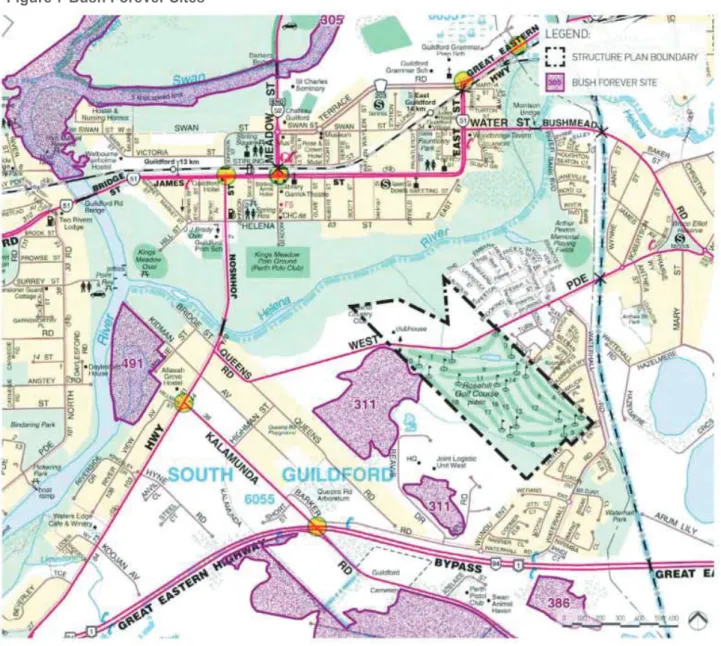
There are no Bush Forever sites located within the Structure Plan, however there is Bush Forever Site No.311 located directly adjacent to the west of the Structure Plan (refer Figure 8). This site is under the management of the Department of Defence and is owned by the Commonwealth Government.
The City of Swan Biodiversity Strategy (2005) indicates that there are no local natural areas occurring within the site. A regional ecological linkage occurs to the west of the Rosehill Waters site, connecting the Swan River (and associated Bush Forever Site No.491), Bush Forever Site No.311 and Bush Forever Site No.386 to the south. This linkage narrowly intersects with the western boundary of the Structure Plan. A second ecological linkage has been identified as marginally intersecting with the most northern portion of the Structure Plan.
These linkages have been identified as being cleared for pasture and heavily degraded, therefore offering very little ecological benefit. As such, any potential impacts on ecological linkages and adjoining Bush forever sites, as a result of the urban development of the site are considered minimal.
5.1.1. Flora & Vegetation
Original vegetation complexes occurring across the site include the Swan Complex (to the northern portion of the site), the Guildford Complex (to the north-western corner) and the Southern River Complex to the remainder of the site. The site has been largely altered from its original natural state due to the development of the Rosehill Golf Course in the 1950’s, resulting in extensive clearing over years and very few examples of the above vegetation complexes remaining on site.
A Level 1 Flora and Vegetation Survey has been undertaken across the site in June 2012 (refer Appendix A). The survey confirms that very little remnant vegetation remains within the site, with the exception of a small area of remnant marri (Corymbia calophylla) woodland in the south-western corner of the site. The site does not contain any Threatened Ecological Communities or Priority Ecological Communities. Furthermore, no Threatened flora species as listed under the Environment Protection Biodiversity Conservation Act 1999 (EPBC Act) or Declared Rare or Priority Flora as listed by the Department of Parks and Wildlife (DPaW) were identified during the survey.
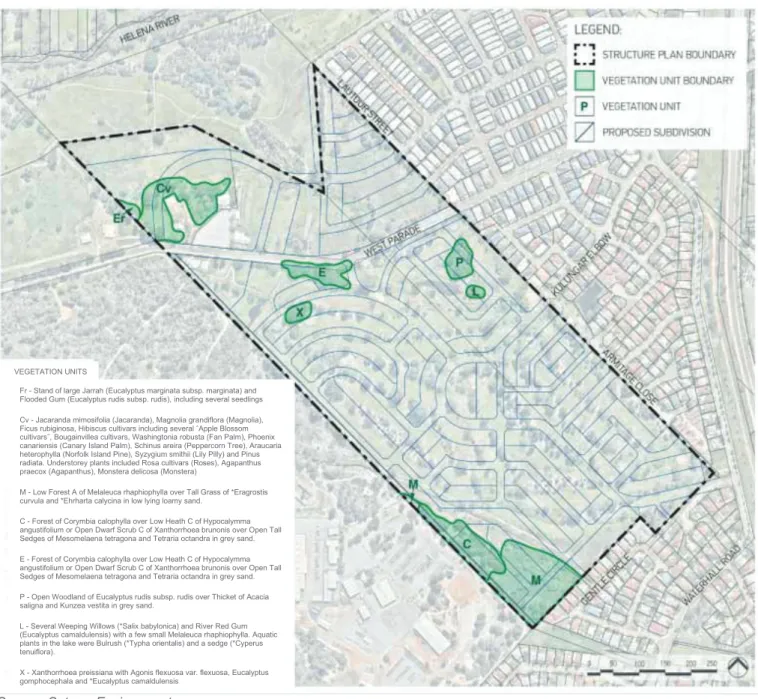
There were two ‘true’ (non-introduced) vegetation types identified within the site.
Low forest A of Melaleuca rhaphiophylla over Tall Grass
Forest of Corymboia calophylla over Low Heath C of Hypocalymma angustifolium or Open Dwarf Scrub C of Xanthorrhoea brunonis over Open Tall Sedges of Mesomelaena tetragona and Tetraria octandra Various other vegetation units were identified across the site as detailed in Appendix A.
Most vegetation was recorded as being in a Completely Degraded condition, with the vegetation in the south-west corner varying between Very Good and Completely Degraded condition and the stand of Eucalyptus rudis subsp. Rudis along West Parade in a Degraded condition. There are a number of weed species which cover the site.
Any mature trees to be retained or transplanted will be identified and marked appropriately as part of the future Environmental Management Plan and Landscape Management Plan and prior to commencement of any pre-construction activities to ensure that they are provided with the appropriate tree protection zones.
No management practises are required for significant flora or TECs/PECs as there were none found on site.
Document Set ID: 7274869
Figure 7 Bush Forever Sites
Source: Coterra Environment
URBIS
PA-951 STRUCTURE PLAN ROSEHILL WATERS_V2 ENVIRONMENTAL ASSESSMENT REPORT
29
Figure 8 Vegetation Units Mapping
5.1.2. Fauna
An environmental assessment was conducted to identify potential fauna species that may inhabit the site. It was concluded that the native and planted mature trees and regrowth areas may be visited opportunistically by the native birds moving through the locality.
However, an assessment has considered it unlikely that the trees would be used exclusively by native fauna species on a permanent basis and there is no evidence of the Black Cockatoos nesting on the site.
There are 16 conservation significant species that could potentially be seen on the site. Of these species only three have been identified as potentially utilising the site for habitat. These are:
Calyptorhynchus latirostris (Carnaby’s Black Cockatoo).
Calyptorhynchus banksia naso (Forest Red-tailed Black Cockatoo).
Calyptorhynchus baudinii (Baudin’s Black Cockatoo).
Fr - Stand of large Jarrah (Eucalyptus marginata subsp. marginata) and Flooded Gum (Eucalyptus rudis subsp. rudis), including several seedlings Cv - Jacaranda mimosifolia (Jacaranda), Magnolia grandiflora (Magnolia), Ficus rubiginosa, Hibiscus cultivars including several ˆApple Blossom cultivars˜, Bougainvillea cultivars, Washingtonia robusta (Fan Palm), Phoenix canariensis (Canary Island Palm), Schinus areira (Peppercorn Tree), Araucaria heterophylla (Norfolk Island Pine), Syzygium smithii (Lily Pilly) and Pinus radiata. Understorey plants included Rosa cultivars (Roses), Agapanthus praecox (Agapanthus), Monstera delicosa (Monstera)
M - Low Forest A of Melaleuca rhaphiophylla over Tall Grass of *Eragrostis curvula and *Ehrharta calycina in low lying loamy sand.
C - Forest of Corymbia calophylla over Low Heath C of Hypocalymma angustifolium or Open Dwarf Scrub C of Xanthorrhoea brunonis over Open Tall Sedges of Mesomelaena tetragona and Tetraria octandra in grey sand.
E - Forest of Corymbia calophylla over Low Heath C of Hypocalymma angustifolium or Open Dwarf Scrub C of Xanthorrhoea brunonis over Open Tall Sedges of Mesomelaena tetragona and Tetraria octandra in grey sand.
P - Open Woodland of Eucalyptus rudis subsp. rudis over Thicket of Acacia saligna and Kunzea vestita in grey sand.
L - Several Weeping Willows (*Salix babylonica) and River Red Gum (Eucalyptus camaldulensis) with a few small Melaleuca rhaphiophylla. Aquatic plants in the lake were Bulrush (*Typha orientalis) and a sedge (*Cyperus tenuiflora).
X - Xanthorrhoea preissiana with Agonis flexuosa var. flexuosa, Eucalyptus gomphocephala and *Eucalyptus camaldulensis
VEGETATION UNITS
Source: Coterra Environment
Document Set ID: 7274869
A number of trees were identified as part of the fauna habitat tree survey as being potentially significant in providing habitat (feeding and/or roosting) for black cockatoos. These trees are identified in Appendix A.
Where possible potential fauna habitat trees will be retained on site within public open space and road verges. A Landscape Management Plan and Fauna Management Plan will be required at subdivision stage which details those trees identified for retention.
The drain and ornamental pond also provide habitat opportunities to aquatic fauna (e.g. waterbirds, long- necked turtles and native fish). The rehabilitation and retention of these natural drainage lines will ensure that the opportunities for fauna habitats are maintained.
5.1.3. Waterways
The two tributaries of the Helena River flowing through the site form the key environmental features of the Structure Plan.
A biophysical assessment has been undertaken as part of the Local Water Management Strategy (refer Appendix B) to determine the biological and physical
qualities of the waterways in accordance with relevant State Government policy.
The waterways traversing the site have been largely modified due to their historic use within the golf course and no rare and/ or endangered water-dependent flora or fauna have been identified. Notwithstanding there are still important local biological and hydrological functions of these waterways that require consideration in the future redevelopment, these include:
Water quality treatment of surface water prior to discharge to the Helena River
Support of aquatic, riparian and fringing vegetation
Provision of localised aquatic habitat
Water source for local terrestrial and avian fauna
Flow regulation and floor risk management.
Significant efforts have been made to retain and enhance the biological and hydrological value of the watercourses and these natural assets have formed the foundation for the Structure Plan design response.
However, some minor modifications to the existing systems will be required to facilitate functional urban form.
5.2. LANDFORM & SOILS
5.2.1. Topography
The site is gently undulating, with topography across the site ranging from approximately 10m AHD in the south-western portion of the site to approximately 5m AHD along the northern boundary (refer Figure 9).
Three high points of 13m AHD occur in the central area of the site, the north-west and the north-east. From the high points there are uninterrupted views south-east to the hills and to the north towards Helena River.
These viewpoints provide opportunities to capitalise on views from these naturally elevated areas from both development and public spaces.
The low points of the topography provide opportunity to accommodate stormwater drainage into natural drainage and green corridors of public open space to maximise infiltration at source in line with the principles of water sensitive urban design, improving the amenity of the urban space and remaining sensitive to the existing environment.
URBIS
PA-951 STRUCTURE PLAN ROSEHILL WATERS_V2 ENVIRONMENTAL ASSESSMENT REPORT
31
Figure 9 Existing Topography
5.2.2. Soils & Geology
The site is characterised by the Guildford Formation – sand of varying depths over clay. The depth of the sand over the clay layer is less along the two tributaries and approaching the Helena River. The sub- systems contained within the site generally consist of minor sandy rises with moderately deep well-drained sand overlying gravelly mottled clay. The other sub-system comprises of seasonally inundated swamps with shallow very poorly drained grey siliceous sand over clay.
Generally, the site is capable of accommodating residential urban development which will include a balance of cut to fill site works. The soils and groundwater characteristics within the site pose some limitations however these limitations can be managed appropriately through engineering design and are therefore not considered to be serious constraints to the future development of the site. Structural fill which is required in certain areas, and where loose sand/uncontrolled fill currently exists will need to be reworked and applied in compact layers in order to sufficiently support buildings and infrastructure. The Geotechnical Report
(included in Appendix D) provides engineering design recommendations which specifically address site preparation, foundation design, soil permeability, stormwater disposal and site drainage.
There are no known and/or registered contaminated sites within or adjacent to the site.
The soil types specified to the site, as detailed in the Geotechnical Report (refer Appendix D) are:
Source: Urbis
Document Set ID: 7274869
Table 3 Soil Types
SOIL TYPE CHARACTERISTICS
Topsoil Grey-brown to black, sandy topsoil with some rootlets, from surface to a depth of 0.1 metres and 0.15 metres.
Sand Generally loose to medium dense, yellow-brown, brown and grey, fine to medium grained sand to depths of between 0.6 metres and 6.0 metres underlying topsoil. The sand is loose to a depth of 2 metres at some test locations.
Clayey Sand/ Sandy Clay Generally medium dense clayey sand and very stiff sandy clay, grey-green and orange-brown, medium to high plasticity, slightly gravelly in places, encountered underlying the sand from depths of between 0.2 metres to 6.0 metres.
Silty Sand Generally loose, dark grey, black and grey brown silty sand with some clay underlying the topsoil to depths of between 0.2 metres and 0.5 metres.
Clayey Gravel/ Gravelly Clayey Sand
Medium dense, grey-green and brown with medium sized gravel ranging in depths of 0.4 metres – 1.6 metres.
5.2.3. Acid Sulfate Soils
The majority of the site is mapped by the Department of Environment Regulation (DER) as having a
Moderate to Low risk of Acid Sulfate Soils occurring within 3 metres of the soil surface. It has been identified that a small area in the southern portion of the site is mapped as having a Low to Nil risk.
It is recommended that further detailed investigations be undertaken at detailed engineering design stage, at which point ground disturbing activities will be known.
5.3. GROUNDWATER AND SURFACE WATER
A Local Water Management Strategy (LWMS) has been prepared to support the Structure Plan, refer to Part 6 and Appendix B for more detailed information with respect to the management and conservation strategies proposed to be implemented as part of the more detailed planning stages.
5.3.1. Groundwater
The Perth Hydrogeological Atlas (DoW) indicates that the site is located above the Superficial, the Leederville and the Yarragadee aquifers. The Structure Plan is not located within a Public Drinking Water Source Area.
The groundwater within the site generally flows in a north westerly direction towards the Helena River.
Groundwater level data has been obtained from four bores across the site. Groundwater levels of
approximately 10 metres AHD are found to the south-west of the site with levels reducing in depth towards the river at 6 metres AHD. Similarly, groundwater becomes more saline towards the river, however salinity levels remain below regional data levels. Maximum levels recorded are consistent with regional data (refer Appendix B for more detail).
Areas where there is potential for groundwater perching were monitored, with maximum groundwater levels ranging between 0.13 metres to 0.51 metres below ground level for the shallower nested bores. Perching has been observed during winter.
The site has a licence to extract 160,500 kL per annum of groundwater from the Perth Superficial Swan aquifer until October 2020. Once consumption levels for earthworks and irrigation of public open space areas are confirmed, the current licence may need to be reviewed.
URBIS
PA-951 STRUCTURE PLAN ROSEHILL WATERS_V2 ENVIRONMENTAL ASSESSMENT REPORT
33
5.3.2. Surface Water
The site immediately abuts the Helena River foreshore, with the most northern boundary of the site being approximately 200 metres south of the river itself. A small tributary/ drain transects the site in a north- westerly direction. This tributary is highly modified, with long straight flow paths and uniform cross-sections.
The tributary splits immediately upstream of West Parade. The EAR identifies that the culvert under West Parade and some small online ponds have hydraulic influence on the open channels.
The Structure Plan proposes to rehabilitate the highly modified drainage line into a ‘living stream’ multiple use corridor, forming part of the overall stormwater management of the Structure Plan. This will include vegetated banks and a more natural morphology that provides habitat opportunities for local fauna, aesthetic values to the local community and the conveyance of flood flows and water quality treatment.
Pre-development surface water flow and quality at the site has been measured since September 2012 (refer Appendix B). The quality of water flowing into and through the site was found to vary depending on its location along the drains. In particular, runoff entering from the adjoining urban area to the east exceeded general standards, largely as result of this estate not containing any Water Sensitive Urban Design (WSUD) features.
In addition, due to the sites historical use as a golf course (and agriculture prior to that) the site was subject to many years of fertiliser, herbicide and pesticide exposure. As a result, the change in land use will lend itself to a significant reduction in the application of chemicals.
Further details are provided in Section 5.13 of this report.
5.3.3. Floodways & Floodplains
The site is subject to flooding from the Helena River and its tributaries which flow through the site. Floodways and floodplains are defined by the Department of Water and their implications on the site are shown in Figure 10. The northern portion of the site along the drainage channel downstream of West Parade is slightly impacted upon by the 100 Year ARI flood fringe.
It is important to consider the impact any flooding will have on the future residential development of the site and the impact any modifications to the existing system will have downstream. The flood flow route must be maintained to prevent risk to upstream or downstream communities.
Future urban development will be required to maintain appropriate minimum floor levels as determined by the Department of Water at the subdivision and development stages.
Further details with respect to flood mitigation and management are included in this report.
Document Set ID: 7274869
Figure 10 Flood Risk
5.3.4. Wetlands
A large portion of the site is shown in the DEC Geomorphic Wetlands of the Swan Coastal Plain dataset as being Multiple Use Wetland (MUW). MUW’s are described as having few environmental attributes and have no statutory and limited policy protection. The wetland on the site fits the definition of a palusplain MUW along the northern edge and a dampland MUW extending into the southern and northern areas.
The use, development a management of the wetland should be considered in the context of ecologically sustainable development and best management practice catchment planning. There are no statutory buffers applicable to the wetland.
There are no mapped Environmental Protection (Swan Coastal Plain Lakes) Policy 1992 (EPP) wetlands located within or immediately adjacent to the site.
Source: Coterra Environment
URBIS
PA-951 STRUCTURE PLAN ROSEHILL WATERS_V2 ENVIRONMENTAL ASSESSMENT REPORT
35
5.4. BUSHFIRE HAZARD
A Bushfire Management Plan for Rosehill Waters Estate was adopted by the Department of Fire and Emergency Services (DFES) in 2018. Portion of the site is affected by bush fire risk, primarily due to the abutting Bush Forever site and vegetation within the Helena River foreshore.
Figure 11 Bushfire Hazard – Original Assessment
5.5. ABORIGINAL HERITAGE
The Heritage Inquiry System contains a number of Registered Aboriginal Sites and Other Heritage Places within and near to the site (refer Figure 12). These include:
Bridge Camps – Aboriginal campsite (Site No. S02345)
Helena River (ceremonial, mythological, repository /cache) (Site No.S02148)
Bennett Brook Camp Area – plant resource, Aboriginal campsite, hunting place, water source (ceremonial, mythological, skeletal material / burial, man-made structure, fish trap, artefacts, scatter, historical) (Site No.S01997)
The watercourse/drain that traverses the site is mapped as part of the Helena River site (DAA Site ID 3758) and is a registered Aboriginal Site under Section 5 of the Aboriginal Heritage Act WA (AHA). Significance was attributed to the watercourse/drain as a result of movement of people, camping, ceremonial uses, hunting, fishing, gathering bush tucker and bush medicine.
Document Set ID: 7274869
An ethnographic and archaeological field survey has been carried out by Amergin Consulting (refer Appendix H) to assist in the preparation of the Structure Plan and to assist in determining the most appropriate design response for future subdivision and development, within the context of the existing cultural values. The key outcomes of the ethnographic study highlighted the significance of the Helena River, including the movement of people, camping, ceremonial uses, hunting, fishing, gathering bush tucker and bush medicine.
Similarly, the significance associated with the modified watercourse /drain which extends into the site and forms part of a registered site was highlighted. During consultation, concern was flagged around the realignment of the watercourse/drain with a preference that the drain returns to its former, natural course.
The realignment of the drain along with its conversion to a “living stream” with associated public open space and indigenous planting was a favoured option.
Department of Aboriginal Affairs (DAA) has confirmed however, that the portion of the modified watercourse that extends into the Structure Plan is outside of the area reported as having heritage values. Therefore, no approvals under the Aboriginal Heritage Act 1972 are required. Notwithstanding, the design response has focussed around maintaining wherever possible a ‘living
stream’ incorporated into a public open space green link centred around the retention of any trees. This will result in an integrated water management system that is sensitive to the existing cultural values and aligned with Water Sensitive Urban Design (WSUD) principles.
5.6. EUROPEAN HERITAGE
No recorded sites of European heritage significance have been found within the site.
5.7. OTHER LAND USE CONDITIONS AND CONSTRAINTS
5.7.1. Existing Road Network
There is one key movement network traversing the site, being West Parade, which runs in an east/west direction.
5.7.2. Contaminated Sites
The DER’s Contaminated Sites Data Base was searched and there are currently no known and/or registered contaminated sites within or adjacent to the site.
5.7.3. Aircraft Noise
The site is located within close proximity to the Perth airport and portion of the site is affected by aircraft noise. Approximately one third of the site is unaffected by aircraft noise contours, with the balance of the site being within the 20-25 and 30+ ANEF contour range as identified in the Perth Airport Master Plan 2020 and within DPLH mapping adopted in late 2019 (refer Figure 13).
Development within the Structure Plan is required to comply with the requirements of SPP 5.1 with respect to the use of land, density and standard of built form to mitigate the impacts of noise on future residents.
5.7.4. Infrastructure & Utilities
The Infrastructure & Servicing Report included in Appendix D provides a full overview of the preliminary engineering investigations that have been undertaken as part of the formulation of the Structure Plan. The report does not identify any constraints with respect to the sites ability to be provided with key infrastructure into the future.
Figure 14 demonstrates the key site considerations and constraints as outlined in this report.
URBIS
PA-951 STRUCTURE PLAN ROSEHILL WATERS_V2 ENVIRONMENTAL ASSESSMENT REPORT
37
Figure 12 Aboriginal Heritage Assets
Source: Urbis
Document Set ID: 7274869
Figure 13 Aircraft Noise (DPLH: 2019)
Opportunities and constraints are consolidated within Figure 14: Opportunities and Constraints:
URBIS
PA-951 STRUCTURE PLAN ROSEHILL WATERS_V2 ENVIRONMENTAL ASSESSMENT REPORT
39
Figure 14 Opportunities and Constraints
Document Set ID: 7274869