We have had to determine the current education in Tasmania and the trends that have developed in n i t and we have had to make. We present to you our views and recommendations of what seem to us to be the most s i g n i f i c a n t aspects of Tasmanian education.
BASIC ASSUMPTIONS AND GENERAL PRIORITIES
CURRICULUM
G u d e l i n e should be produced by committees which should be teachers, teacher-educators and community members who should become, as p o s i b l e , connoisseurs of theory and development of p r a c t i c e o f u c u r . The success of school-based work will depend very much on whether it can be given ongoing and informed support. For the purpose, the c o n t r i b u t i o n made by the Curriculum Branch of the Directorate of Education, as we have already mentioned, by the I n - s e r v i c e Branch and by the Media Center of s v i t a l.
What is needed is a thorough study of the nature of these processes and of the content and methods that seem most appropriate before they are taught. However, we do not recommend that values education be introduced as a subject in Tasmanian schools. We believe that it should be spread across the entire curriculum, and that teachers should take the time and opportunity to teach it in each.
It is an area that should be within the competence of every teacher and we recommend that. Second, it is the body of values that the community cherishes and which can be considered a fundamental part of the community's character.
ORGANISATION OF EDUCATION
In this report, we have supported ideas and practices that change the nature of the teacher's job and change the job. for a widespread discussion that should involve both the community and the education profession. Consequently, what is known as open education was more likely to take place in open schools than in more traditionally built schools, but open education is by no means limited to schools without. In contributions to us and in our meetings with community groups in different parts of Tasmania, several people have expressed doubts about the soundness of education in open schools; we have also received a number of expressions of interest and approval.
When I observe work in some of them and the s u b j e c t is with the groups of teachers, we are favorably impressed with the quality of work we have seen in many classrooms which has made us very aware of the tasks we have set. t h a t open education forces teachers. Effective communication with parents and the general community is important so that they can thoroughly understand the school program and help with the achievement of objectives. In the company, Tasmania had no very large schools and only a small number of very small ones; most Tasmanian secondary schools had from 600 to 1000 enrolments, most.
Our committee has noted and thoroughly approved the extent to which the schools we have seen have succeeded in keeping up with the general trend of modern elementary education. M a t e r i a l s for various areas of the curriculum such as reading, science, social studies, art and art I have not It seems that these features of today's primary education have been well developed in Tasmanian primary schools and will.
We have already opened open education and the favorable impression that much of the work has made on us. Expression through language, music, art, drama and dance is the basis both for improved performance and enjoyment in these areas, and for the development of a student's character and personality. When the school is run on a whole school basis, teachers are able to connect with their colleagues in the grade and teach at whatever level is most needed.
One of the best statements of the purpose of high school education that we have seen came from R ive r s i d e High School. With the growth of diversity now occurring in the state system, there is no longer a need to look to independent schools for greater educational choice. This would be very useful for boards who have to decide to receive from the independent schools themselves a considered statement on the criteria for assessing the claim of new independent schools for a share of public money.
In our schools, we noticed on several occasions that classes and rooms were shared between two independent schools or between the old and independent schools. The sharing of school resources should also be developed more broadly by uniting small independent schools of the same belief.
SCHOOL AND LOCAL COMMUNITY
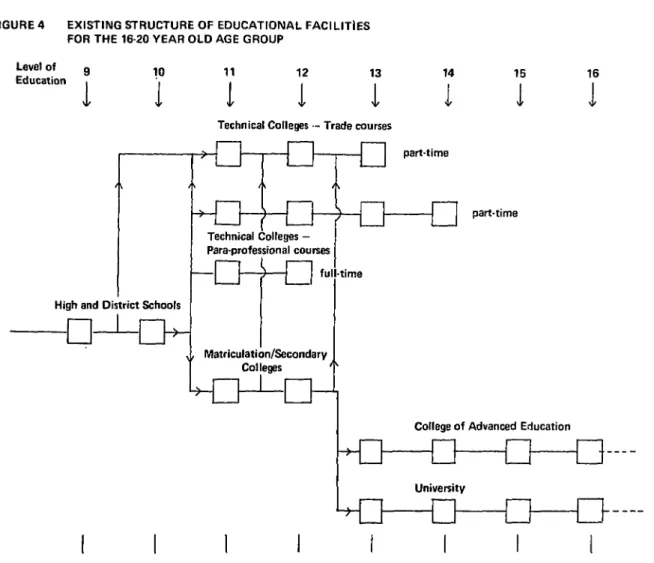
A fundamental and enduring foundation upon which school-community cooperation is built is the need for students to understand and learn how to become active members of the community. The changes recommended here in the education of 16 to 20-year-olds are in line with trends already evident in Tasmania and elsewhere: but they represent a fundamental change.
TEACHERS AND TEACHER EDUCATION
Both divisions of teacher education at the Tasmanian College of Advanced Education of f e r dif e r i n g versions of the three-year Diploma in Teaching course, extendable to a four-year B.Ed, a degree in which academic and educational work is undertaken. We found that both the Ministry of Education and the Teachers' Union support keeping the choice that is now in place.
EDUCATION IN RURAL TASMANIA
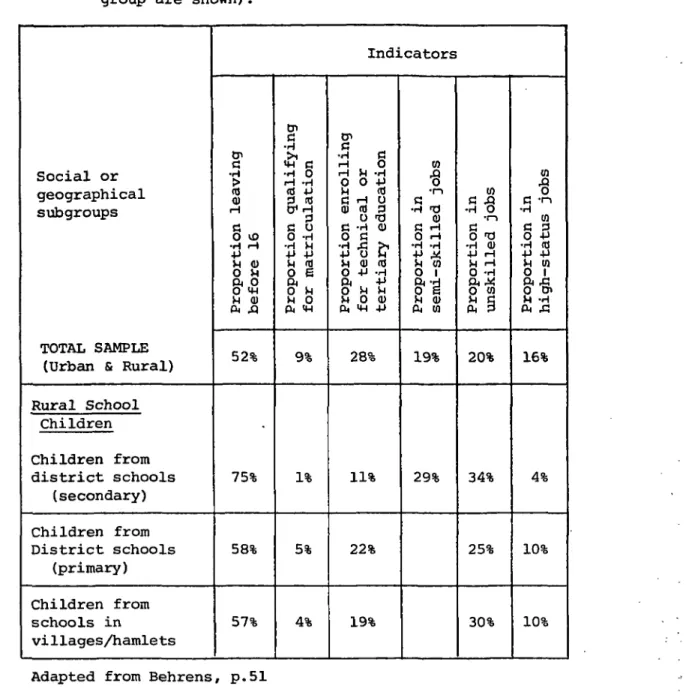
Smithton was well aware of the low proportion of rural students who completed a full high school or went on to further education. Share leaving before age 16 Share qualifying for entrance exam Share enrolling in technical or tertiary education Share of semi-skilled jobs Share of unskilled jobs Share of high status jobs TOTAL SAMPLE. The handicap under which rural schools suffer from rapid teacher turnover needs to be overcome by providing greater incentives for teachers and school principals to stay longer in the country.
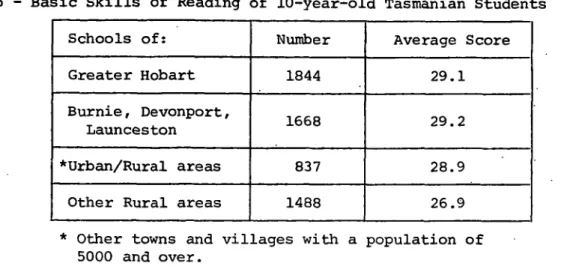
If the s u c c e s s f u l candidates are already teaching in local areas, they should be promoted and should continue to function as before in the present school. Elsewhere we have proposed that the r e years should not use teachers in a national employment; we suggest that a term of employment should be considerably longer. We are also concerned that rural students not only drop out of school, but they also perform worse in basic learning and numeracy.
DEVELOPMENT AND INNOVATION
The committee should not be merely an advisory body, but should have its own budget, and, in terms of the Director-General, should have e x e c u t i v e powers. There seems to be no good reason why the community should look to independent schools to make a choice of approach in education.
Schools Commission and Australia Council, Education and the Arts, National Report, A.G.P.S., Canberra, 1977; National Report, A.G.P.S., Canberra, 1977;.
Tasmanian Advisory Committee on Libraries, Report, State Library of Tasmania, Hobart, 1977;
Tasmanian Association for the Teaching of English, A Case for Small Schools, Hobart June 1976;
APPENDICES
TERMS OF REFERENCE
WRITTEN SUBMISSIONS
- INDIVIDUALS
Parents and Friends Associations unless otherwise stated) Albuera Street Primary School
Modern Language Teachers' A s s o c i a t i e van Tasmania Northern A c t i e Committee on Sexism in Education Northern Tasmanian Preschool & Kleuterschool Parents'.
North-West Guidance Section, Education Department of Tasmania Professional Adult Education Officers' Association
Social Workers, Education Department of Tasmania
Specific Learning Difficulties Association of Tasmania Speech Pathologists of the Education Department of Tasmania
North)
Tasmanian Council for Early Childhood Education
Tasmanian Council of State School Parents & Friends Associations Tasmanian History Teachers' Association
Tasmanian Infant Mistresses & Masters Association Tasmanian Primary Schools Principals Association
Tasmanian Teacher-Librarians Association Tasmanian Teachers Federation
Tasmanian Technical Colleges Staff Society
Aboriginal Information Service (Tasmania) Association to Maintain Living Standards
Australian Association of Speech & Hearing (Tasmanian Branch) Australian Federation of Business & Professional Women's
Australian Federation of University Women (Tasmania) Australian Institute of Physics (Tasmanian Branch)
Comalco Aluminium (Bell Bay) Ltd
Communist Party of Tasmania
Country Women's Association i n Tasmania Heads of Churches Commission
Launceston Chamber of Commerce
Master Plumbers' Association of North West Tasmania Master Plumbers' Association of Tasmania
National Council of Women of Tasmania
Regional Council for Social Development (Southern Tasmania) Rokeby Women's Morning Group
Scripture Union of Tasmania
Tasmanian Arts Council (New Norfolk Branch) Tasmanian Association of Occupational Therapists
Tasmanian Committee on Discrimination i n Employment and Occupation
Tasmanian Tourist Council
Tasmanian Trades and Labor Council
Women's Action Alliance sub-committee on Education
MEETINGS AND DISCUSSIONS
SCHOOL VISITS