1
Three Essays on CEO Compensation
Yulin Li
Master of Business Research, University of Adelaide, Adelaide, Australia Master of Professional Accounting, University of Adelaide, Adelaide, Australia Master of Science, International Finance, Nottingham Trent University, Nottingham, UK
Bachelor of Economics, Guang Dong University of Finance, Guang Zhou, China
A thesis submitted in fulfilment of the requirement for the Doctor of Philosophy Degree in Finance
Faculty of Arts, Business, Law and Economics
Discipline of Finance and Banking, Adelaide Business School The University of Adelaide, Australia
February 2023
2
Declaration
I, Yulin Li, certify that this work contains no material which has been accepted for the award of any other degree or diploma in my name, in any university or other tertiary institution and, to the best of my knowledge and belief, contains no material previously published or written by another person, except where due reference has been made in the text. In addition, I certify that no part of this work will, in the future, be used in a submission in my name, for any other degree or diploma in any university or other tertiary institution without the prior approval of the University of Adelaide and where applicable, any partner institution responsible for the joint-award of this degree.
I give permission for the digital version of my thesis to be made available on the web, via the University’s digital research repository, the Library Search and also through web search engines, unless permission has been granted by the University to restrict access for a period of time.
I acknowledge the support I have received for my research through the provision of an Australian Government Research Training Program Scholarship.
Yulin Li
15th February 2023
3
Acknowledgements
“Veritas lux mea”
--From a Latin voice, for the reason I started my PhD journey
I express my heartfelt gratitude to my thesis supervisors, Associate Professor Jean Canil and Associate Professor Chee Seng Cheong, for their guidance and continuous support throughout this spectacular PhD journey. I really appreciate their insightful comments, lively discussions and great encouragement. As the old Chinese saying goes, “He who teaches me for one day is my father for life.”
I am extremely grateful for the unconditional support and love from my husband, Luke John Betts. Without him, I could not conquer the obstacles of this extremely challenging study. I would also like to dedicate this thesis to him for being the light of my life.
Special thanks to my parents, Xiaomei Xiong and Jian Li, for their love and guidance throughout my study and life. I thank my fellow PhD students, especially Dr Jin Ma, Miss Xiaohui Liu, and Dr G M Wali Ullah, for motivating and inspiring me during the whole PhD journey.
“Agnosco veteris vestigia flammae”
--From a Latin voice, for the moment I finished my PhD journey
4
Three Essays in CEO Compensation Table of Contents
Acknowledgements ... 3
Abstract ... 7
Chapter 1: Introduction ... 9
1.1 Overview of the Thesis ... 9
1.2 Disagreements between shareholder Say-on-Pay voting results and ISS recommendations ... 11
1.3 CEO-employee pay ratio and labour investment efficiency ... 14
1.4 CEO-employee pay ratio and stock price crash risk ... 17
1.5 Contributions ... 21
1.6 Thesis structure ... 23
Chapter 2: Disagreements between shareholder Say-on-Pay voting results and ISS recommendations ... 24
Abstract ... 24
2.1 Introduction ... 25
2.2 Literature review ... 36
2.2.1 Agency conflicts... 36
2.2.2 Institutional shareholder governance ... 37
2.2.3 Proxy advisors ... 40
2.2.4 The components of compensation contracts ... 44
2.2.5 The disagreement between ISS and institutional shareholders ... 48
2.3 Hypothesis development ... 53
2.4 Research methods ... 55
2.4.1 Sample and data ... 55
2.4.2 The measure of disagreement between shareholder voting outcomes and ISS recommendations ... 56
2.4.3 The measure of institutional shareholders’ investment horizon ... 57
2.4.4 The measurement of the different components of compensation packages ... 59
2.4.5 Baseline methods ... 60
2.4.6 Identification tests ... 63
2.5 Results ... 66
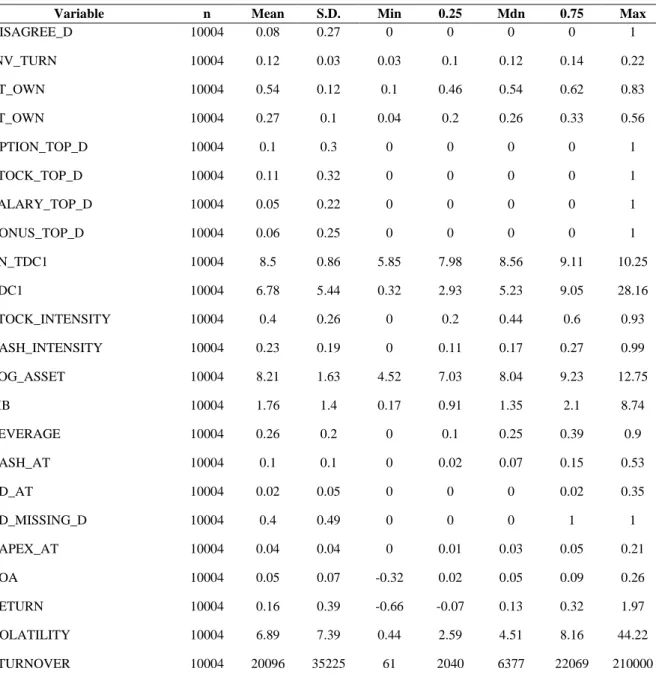
2.5.1 Descriptive statistics ... 66
2.5.2 The effect of institutional shareholder investment horizon on disagreements ... 68
2.5.3 Addressing endogeneity concerns ... 74
2.6 Robustness tests ... 86
2.6.1 Additional proxy for institutional shareholders’ investment horizon ... 86
2.7 Conclusion ... 90
Appendix Table 1: Variable definitions ... 93
Chapter 3: CEO-employee pay ratio and labour investment efficiency ... 94
5
Abstract ... 94
3.1 Introduction ... 95
3.2 Literature review ... 99
3.2.1 CEO-employee pay ratio ... 99
3.2.2 Labour investment inefficiency ... 105
3.2.3 Linking the CEO-employee pay ratio to labour investment efficiency: A theoretical view ... 108
3.3 Hypothesis development ... 111
3.4 Research method ... 114
3.4.1 Sample and data ... 114
3.4.2 The measurement of labour investment efficiency ... 115
3.4.3 Measurement of CEO-employee pay ratio ... 116
3.4.4 The model to test the hypothesis and control variables ... 116
3.4.5 Identification tests ... 117
3.5 Results ... 121
3.5.1 Descriptive statistics and univariate results ... 121
3.5.2 The impact of pay ratio on inefficient labour investment ... 123
3.6 Robustness tests ... 137
3.6.1 Additional controls ... 137
3.7 Conclusion ... 144
Appendix: Description of the regression variables ... 147
Chapter 4: CEO-employee pay ratio and stock price crash risk ... 150
Abstract ... 150
4.1 Introduction ... 151
4.2 Literature review ... 155
4.2.1 CEO-employee pay ratio ... 155
4.2.2 Stock price crash risk ... 161
4.2.3 Theories that link stock price crash risk and the CEO-employee pay ratio ... 168
4.3 Hypothesis development ... 173
4.4 Research methodology ... 175
4.4.1 Sample and data ... 175
4.4.2 Measurement of the stock price crash risk ... 175
4.4.3 Measurement of the CEO-employee pay ratio ... 179
4.4.4 A Model to test the hypothesis ... 179
4.4.5 Control variables ... 180
4.4.6 Identification tests ... 181
4.5 Results ... 185
4.5.1 Descriptive statistics and univariate results ... 185
4.5.2 The impact of the pay ratio on stock price crash risk ... 189
4.5.3 Addressing endogeneity concerns ... 191
4.6 Cross-sectional tests ... 203
4.6.1 The role of CEO incentive compensation packages ... 203
6
4.6.2 The role of corporate governance ... 209
4.7 The channel of bad news hoarding ... 214
4.8 Robustness tests ... 222
4.8.1 Additional controls ... 222
4.8.2 Hand-collected CEO-employee pay ratio ... 227
4.9 Conclusion ... 231
Appendix: Variable Definitions ... 233
Chapter 5: Conclusion ... 235
5.1 A summary of the findings ... 235
5.2 Contributions to the literature ... 237
References ... 239
7
Abstract
This thesis presents three essays on CEO compensation. The first essay studies the disagreement between shareholders' Say-on-Pay voting results and ISS (Institutional Shareholder Service) recommendations on CEO compensation packages. Shareholders are expected to follow ISS "Against" recommendations if CEOs' compensation packages are inappropriate for the firm. However, around 8% of shareholders overlook ISS "Against"
recommendations despite these recommendations being deemed informative (Albuquerque et al., 2020). Based on my findings, the cause of the disagreement is institutional shareholders' investment horizon. When CEO compensation packages include a high proportion of option grants and salary payments, firms with higher short-term institutional shareholder ownership are more likely to disagree with ISS. These findings reveal that the disagreements are caused by short-term institutional shareholders strategically making decisions that align with their interests. I observe no effect of long-term institutional shareholder ownership on the disagreement. These results remain constant after addressing possible endogeneity concerns through firm fixed effects, two-stage regressions with instrumental variables, falsification tests and entropy balancing. These findings provide the first explanation for the cause of the disagreement and additional evidence of short-term institutional shareholder voting behaviour.
The second essay explores how the CEO-employee pay ratio (a proxy of within-firm pay disparity) affects firms' labour investment efficiency. The results in this essay reveal a negative association between the pay ratio and labour investment efficiency, indicating that firms with a larger CEO-employee pay ratio tend to have lower labour investment efficiency. Further tests demonstrate that this association is more profound when firms over-invest in labour. This essay
8
adds to the literature by offering additional evidence to support the Rent Extraction Theory, which posits that CEOs tend to recruit excess employees to "build their empire" to extract rent, leading to over-investment in labour (Stein, 2003, Williamson, 1963). Again, I employ firm fixed effects, falsification tests and entropy balancing to address potential endogeneity concerns. The results remain robust to these tests. This essay identifies the CEO-employee pay ratio as an essential determinant for labour investment efficiency, which may help firms’
stakeholders make informed decisions.
The third essay examines how the CEO-employee pay ratio influences firms’ stock price crash risk. The stock price crash risk is a major concern for shareholder welfare. In this essay, I document a significant and positive association between the CEO-employee pay ratio and the stock price crash risk, revealing that firms with a more significant pay ratio have a higher stock price crash risk. This result remains robust after addressing plausible endogeneity concerns using tests including firm fixed effects, two-stage regressions with instrument variables, change of specifications and entropy balancing. To further boost robustness, I include additional control variables and an alternative measure of the pay ratio in my baseline estimations, and again my results remain constant. In cross-sectional analysis, I find that firms granting more stocks to CEOs have a lower chance of stock crashes when the pay ratio is larger.
Based on these findings, shareholders can make better investment decisions, especially concerning the risk of a stock price crash.
9
Chapter 1: Introduction
1.1 Overview of the Thesis
This thesis includes three essays on CEO compensation. First, I investigate the disagreement between shareholders' voting results and ISS (Institutional Shareholder Service) recommendations on CEO compensation packages (Say-on-Pay), second the effect of the pay gap between CEO compensation and median employee on firms' labour investment efficiency, and thirdly, the same pay gap on stock price crash risk.
The first essay identifies the cause of the disagreements between shareholders' voting results and ISS recommendations in Say-on-Pay. It is expected that shareholders will vote in line with ISS "Against" recommendations when a CEO’s compensation package is inappropriate for the firm. However, around 8% of shareholders do not follow ISS "Against" recommendations even when these recommendations are deemed informative (Albuquerque et al., 2020). My results reveal that the cause of the disagreement hinges on the investment horizon of institutional shareholders. I demonstrate that firms with larger proportions of short-term institutional shareholder ownership are more likely to disagree with ISS when a CEO compensation package includes more option grants and a more significant salary payment. This finding indicates that the disagreement is driven by short-term institutional shareholders strategically choosing option grants and salary payments as preferable forms of executive compensation. However, long-term shareholder ownership generally has no impact on disagreements. These results remain robust after addressing possible endogeneity concerns using a two-stage estimation with instrumental variables, falsification tests and entropy balancing.
10
The second essay examines the effect of the CEO-employee pay ratio (a proxy of within-firm pay disparity) on firms' labour investment efficiency. I find that firms with a larger CEO- employee pay ratio tend to over-invest in labour leading to lower labour investment efficiency.
This finding offers additional evidence supporting the Rent Extraction Theory, which contends that CEOs tend to recruit excess employees to "build their empire", resulting in overinvestment in labour (Stein, 2003, Williamson, 1963). To address possible endogeneity concerns, I test my baseline Model with firm fixed effects, falsification tests and entropy balancing; my results remain robust. These empirical results provide a useful insight into firms' investment decisions for board members governing firms' labour investment efficiency.
The third essay explores the association between the CEO-employee pay ratio and a firm's stock price crash risk. I provide evidence that firms with a larger CEO-employee pay ratio are more likely to experience stock price crashes in the following year. This result supports the Rent Extract Theory that to satisfy incentive compensation requirements (e.g., improving firms’
return on assets to a certain level), CEOs are eager to invest in risky projects to extract rent (Chalmers et al., 2006, Hutton et al., 2009). Some of these high-risk investments inevitably fail, driving CEOs to hoard bad news leading to a stock price crash (Armstrong et al., 2013b, Callen and Fang, 2015a). I use firm fixed effects, two-stage regressions with instrumental variables, change of specifications and entropy balancing to mitigate possible endogeneity concerns. My results remain robust to a series of additional controls and an alternative measurement of the pay ratio. Cross-sectional estimates reveal that, given a large pay ratio, firms that grant more stocks to CEOs are less likely to have stock crashes. However, corporate governance does not affect the relationship between the pay ratio and stock price crash risk. In light of these findings,
11
shareholders can make better investment decisions if they want to avoid investing in firms with a higher risk of stock price crashes.
1.2 Disagreements between shareholder Say-on-Pay voting results and ISS recommendations
Corporate voting is a key way institutional shareholders exert their influence over firms’
management decisions. Since the mandatory Say-on-Pay law was enacted, institutional shareholder voting has become even more vital in corporate governance (Malenko and Shen, 2016). To gather sufficient information to vote at a low cost, institutional shareholders seek advice from proxy advisory firms (e.g., ISS) on major corporate decisions, such as executive compensation. As a result of enormous market demand, the number of ISS’s clients increased by over 100% in 2022 compared with 2018 (Copland et al., 2018). The increasing influence of ISS raised concern among regulators and academia, creating doubt regarding the quality of ISS recommendations (McCahery et al., 2016, Larcker and Tayan, 2011). A recent empirical study by Albuquerque et al. (2020) finds a positive relationship between ISS “Against”
recommendations and worsening firm future performance, indicating that “Against”
recommendations have identified suboptimal executive compensation packages. All parties are expected to vote congruently–favourably if compensation is appropriate and unfavourably if compensation is not. Shareholder voting results generally support this argument, with around 92% of votes in line with the ISS recommendation. However, 8% of votes still do not align with the ISS recommendations, resulting in disagreements. Interestingly, nearly all of these disagreements occur when ISS recommends “Against” and shareholders vote “Yes”. If ISS
“Against” recommendations have informed institutional shareholders about suboptimal compensation packages, what causes institutional shareholders to vote against them?
12
The literature on institutional shareholders’ investment horizon may offer an answer (Gillan and Starks, 2000, Kim et al., 2019a). Since institutional shareholders have different investment horizons (long- or short-term), they follow ISS recommendations only if the associated benefits outweigh the costs (Kahn and Winton, 1998). If each party (i.e., ISS, short-term and long-term institutional shareholder) evaluates executive compensation packages differently, they may have distinct views on what is appropriate or inappropriate, leading to disagreements. ISS claims to “…empower investors and companies to build for…sustainable growth…”1, so it believes sufficient but not excessive compensation can better align shareholders’ and executives’ interests. Therefore, ISS recommends a “For” vote for compensation packages that offer adequate pay to executives to maintain firms’ sustainable growth. Generally, short-term institutional shareholders should follow ISS recommendations to avoid costly monitoring.
However, empirical studies suggest that short-term institutional shareholders may actively vote for compensation packages that better align with their interests (Stathopoulos and Voulgaris, 2016). For example, short-term institutional shareholders prefer compensation packages with a greater cash component (i.e., salary and bonus) because executives are incentivised by cash compensation to boost short-term profit, which may reward them with higher compensation in the next year (Iatridis, 2018). Analogously, since short-term institutional shareholders have expertise and preference in trading firms with high uncertainty (Yan and Zhang, 2009), they may favour compensation packages that increase firms’ volatility, such as option grants (Fich and Shivdasani, 2005). Although short-term institutional shareholders vote in favour of more cash/option components that better link to their interests, ISS may recognise that these cash components or option grants are excessive and recommend “Against”, resulting in a
1 See ISS front page “About ISS”. https://www.issgovernance.com/about/about-iss/
13
disagreement. Research shows that long-term institutional shareholders tend to conduct independent research to gather firm-specific information because they can minimise the research cost by spreading it over the long run, reusing the information in the following years (Iliev and Lowry, 2015, Ertimur et al., 2013, Larcker et al., 2015). Malenko and Shen (2016) provide evidence that if long-term institutional shareholders’ votes rely on their independent research, then ISS recommendations are uncorrelated with long-term institutional shareholders’
decisions.
In this essay, I use the logit regression Model to test the relationship between disagreement and institutional shareholders’ investment horizon, conditional on the different components of compensation packages. The dependent variable is the disagreement, measured as a dummy variable equals to one if Say-on-Pay voting result against the ISS recommendation. The main test variable is the ownership by institutional shareholders with different investment horizons.
Institutional shareholders’ investment horizon is measured by an investor turnover ratio (Nguyen et al., 2020, Pathan et al., 2021). To evaluate the effect of distinct compensation components, I generate several dummy variables equal to one for firms with top 10% CEO option grants, stock grants, salary and bonus payments. I then interact them with the main test variable. I hypothesise that a disagreement between shareholders and ISS is positively associated with the proportion of short-term institutional shareholders when compensation packages contain excessive cash payments or/and option grants. The results from the baseline regressions support my hypothesis that short-term institutional shareholder ownership is significantly positively associated with the disagreement when firms grant excessive options and salary to the CEO. These results indicate that short-term institutional shareholders strategically choose option grants and salary payments as preferable forms of executive compensation, which causes the disagreement with ISS.
14
My results hold when I address possible endogeneity concerns in a two-stage estimation with an instrumental variable. Short-term institutional shareholder ownership continues to significantly drive the disagreement after being instructed by the instrument variable. I then apply falsification tests and entropy balancing to further mitigate missing variable bias and selection bias; my findings remain unchanged. These robustness tests demonstrate that the relationship between the disagreement and institutional shareholder investment horizon is causal.
1.3 CEO-employee pay ratio and labour investment efficiency
Firms’ ability to compete in the modern marketplace depends heavily on their labour cost. This is because of the demand for sufficient, creative employees not only in conventional manufacturing industries but also in the emerging service sectors (Ghaly et al., 2020). Whether firms can efficiently invest in labour demonstrates their operating and financial performance (Jung et al., 2014). As a result of this significance, extant research has been searching for determinants that can boost firms’ labour investment efficiency, including executive compensation. For example, Sualihu et al. (2021a) provide evidence that labour investment efficiency is negatively associated with executive option grants. They argue that options incentivise executives to take extra risks when making investment decisions, resulting in suboptimal labour investment. Despite studies identifying the driving factors of labour investment efficiency, they direct their investigation toward either employees (treatment) or executives (compensation). However, the CEO-employee pay ratio, a potential determinant that can affect employees and executives simultaneously, has been overlooked. The CEO- employee pay ratio measures the difference between a CEO's total compensation and a median
15
employee’s pay. In the U.S., after the enactment of the Dodd-Frank Act (Section 935 b), firms have been mandated to disclose the pay ratio in their financial statements since 2018. Given the ratio connects the salaries of employees to those of the CEO, the size of the pay gap may impact employee behaviour, affecting labour investment efficiency.
Three disparate theories provide distinct explanations and predictions regarding how the pay ratio affects labour investment efficiency. The Talent Assignment Theory posits that a more significant pay gap between a CEO and rank-and-file employees is because of firms’ strategy to secure CEO talent (Cheng et al., 2017a). Modern firms have complex governance frameworks across incremental work levels to maintain a higher state of effective functioning;
such a framework then requires a commensurate level of ability and talent to fill positions within the hierarchy. As a result, employees within the hierarchy should be rewarded on an escalating scale congruent with their talents, position and responsibilities. Since CEOs are at the top of the hierarchy, they should be compensated proportionately more for their talents, resulting in a larger pay gap. If this theory is valid, I expect CEOs with a more significant pay gap to have superior talent and the ability to make better labour investment decisions, leading to higher labour investment efficiency.
The Rent Extraction Theory suggests that CEOs tend to extract rent in larger firms where more rent is available (Bebchuk et al., 2011, Mueller et al., 2017, Rouen, 2020). Since rank-and-file employees are less likely to extract rent, the more rent a CEO captures, the larger the pay ratio.
Stein (2003) argues that the “efficient” way for CEOs to extract rent from a firm is to “build their empire”. A simple method to successfully build an empire is to increase employee numbers to enlarge the firm (Williamson, 1963). Consequently, hiring employees beyond the
16
optimal level reduces labour investment efficiency. Under this argument, I expect that firms with a larger CEO-employee pay ratio have lower labour investment efficiency because of over-investment in labour.
The Equity Theory states that rank-and-file employees perceive unfairness from a larger pay gap (Akerlof and Yellen, 1990). Because of the perceived inequity, these employees undertake costly behaviours, including shirking and quitting harming firms’ operations (Adams, 1965, Cowherd and Levine, 1992, Faleye et al., 2013). As a result, the shortage of labour led by the perceived inequity from a large pay ratio causes under-investment in labour. Along with this argument, I predict that firms with larger CEO-employee pay ratios have lower labour investment efficiency because of under-investment in labour.
I employ the ordinary least squares regression Model to identify the effect of the CEO- employee pay ratio on labour investment efficiency. My dependent variable is the absolute value of a firm’s abnormal net hiring, which is the residual from a regression of a firm’s net hiring over several firm fundamental economic variables (Ben-Nasr and Alshwer, 2016, Jung et al., 2014, Khedmati et al., 2020). In further analysis, I include over-/under-investment in labour as dependent variables, the positive/negative value of a firm’s abnormal net hiring. The primary test variable is the CEO-employee pay ratio calculated from a firm’s financial data (Faleye et al., 2013, Przychodzen and Gómez-Bezares, 2021). The baseline results show that the CEO-employee pay ratio is negatively associated with labour investment efficiency, supporting the Rent Extraction and Equity Theories.
17
Further analysis finds that the CEO-employee pay ratio drives over-investment in labour but has no effect on under-investment in labour. This result supports the Rent Extraction Theory but rules out the Equity Theory. These results remain constant after applying several tests to address potential endogeneity concerns, including firm fixed effects, falsification tests and entropy balancing. I include ten additional controls from recent research in my baseline regressions to alleviate concerns about missing variables and alternative explanations. My results remain robust.
This essay identifies that the CEO-employee pay ratio significantly determines labour investment efficiency. Further tests support the prediction from the Rent Extraction Theory that a larger CEO-employee pay ratio represents the rent captured by the CEO. These findings can help stakeholders make informed investment decisions, especially when a firm suffers from low labour investment efficiency.
1.4 CEO-employee pay ratio and stock price crash risk
A large strand of studies has identified the economic consequences of the CEO-employee pay ratio, a representative of within-firm pay disparity, especially after Section 953 (b) of the Dodd- Frank Act took effect in 2018. These studies offer additional evidence that helps debate whether mandatory disclosure of the pay ratio informs stakeholders. These studies link the pay ratio with firm performance and shareholder reactions. For instance, Mueller et al. (2017) demonstrate that a larger pay ratio links to better firm performance, but Rouen (2020) finds no significant relationship between the pay ratio and firm performance. Pan et al. (2020) investigate U.S. market reactions to the first-time disclosure of the pay ratio and reveal that
18
firms announcing higher pay ratios suffer lower abnormal market returns. In particular, firms’
seven days cumulative abnormal returns are lower by roughly 42 basis points on average if they announce a pay ratio one standard deviation higher than the industry average. That study shows that stock markets react quickly to a large CEO-employee pay ratio. The question remains: “Does the stock market react to the pay ratio in the short-term only, or are there long- term effects on share prices?” This essay aims to address this gap and provide new evidence on the economic consequences of the pay ratio and its effect on shareholder value.
Stock price crash risk significantly affects shareholders’ investment return in the long run. It is even more meaningful for retail shareholders because they could have salient losses for their highly concentrated portfolio when share prices crash (Barber and Odean, 2013). Therefore, identifying the determinants of a stock price crash risk is essential to protect shareholder value in the long run. Theory suggests that bad news hoarding by executives is a reason that firms experience stock price crashes (Jin and Myers, 2006, Callen and Fang, 2015a, Habib et al., 2018). The rationale is that executives are keen on withholding bad news from shareholders for personal interest, such as achieving a promotion (Jin and Myers, 2006) or fulfilling incentive compensation requirements (Kim et al., 2011a). However, once executives realise they cannot withhold the accumulated bad news, they give up withholding and releasing them to the market (Callen and Fang, 2015a). Consequently, a sudden drop of substantial bad news in the stock market leads to a significant drop in stock prices. A series of driving factors of stock price crash risk has been demonstrated (Hutton et al., 2009, Kim et al., 2011b, Andreou et al., 2017), but the CEO-employee pay ratio that could potentially affect stock price risk has been overlooked.
19
Regarding how the pay ratio affects the stock price crash risk, two competing theories (the Talent Assignment Theory and the Rent Extraction Theory) offer distinct predictions. As elaborated in essay two, the Talent Assignment Theory posits that within-firm pay disparity represents executives’ talent and ability to manage a complex firm at the top of the organisational hierarchy. Therefore, I expect that firms with larger pay ratios have lower stock price crash risk since talented CEOs are supposed to accomplish better-operating results; thus, there is less bad news to hide. The Rent Extraction Theory states that a larger CEO-employee pay ratio reflects managerial rent extraction. Since it is unlikely for rank-and-file employees to extract significant rent, managers’ rent-seeking behaviour potentially increases their compensation leading to a larger pay ratio. For example, Chalmers et al. (2006) reveal that managers utilise the channel of incentive compensation to extract rent. To fulfil specific criteria in the compensation packages, managers intend to boost firms’ short-term profits by investing in short-sighted and risky projects (Hutton et al., 2009). When some of these high-risk projects inevitably fail, managers are keen to hide the bad news to minimise their negative effects on stock price (Armstrong et al., 2013b). In light of this theory, I expect firms with a larger pay gap between the CEO and rank-and-file employees to have a higher stock price crash risk.
I employ the ordinary least squares regression model to estimate the effect of the CEO- employee pay ratio on stock price crash risk. My dependent variables are three different proxies of stock price crash risk extracted from recent studies: (1) the negative coefficient of skewness of firm-specific daily returns (NCSKEW); (2) the down-to-up volatility of firm-specific daily returns (DUVOL); and (3) the difference between the number of days with and without negative extreme firm-specific daily returns (CRASH_COUNT). The key test variable is the CEO-employee pay ratio calculated from the firm’s financial data (Faleye et al., 2013, Przychodzen and Gómez-Bezares, 2021). My baseline results show that the CEO-employee
20
pay ratio is positively associated with stock price cash risk, indicating that a large pay gap between the CEO and the median employee increases the risk of future price crashes. This finding supports the Rent Extraction Theory that predicts a positive association between the pay ratio and stock price crash risk. To address possible concerns that these results are driven by missing variable bias or selection bias, I use several tests to ensure their robustness: firm fixed effects; change of specification; two-stage estimation with instrumental variables; and entropy balancing. My baseline findings remain in these tests. To further test the robustness of my results, I include an additional control variable and replace the pay ratio with hand-collected data in baseline regressions. Again, my results hold.
In further analyses, I use cross-sectional tests to investigate the possible economic mechanism that could drive the effect of the pay ratio on stock price crash risk. In particular, I explore how the association between the pay ratio and stock price varies with the design of the CEOs’
incentive compensation contracts and the quality of corporate governance. The results show that given a large pay ratio, more CEO stock grants in the compensation packages can reduce future stock price crash risk, while option grants and cash payments have no such effect.
Corporate governance plays no role in the effect of the pay ratio on the stock price crash risk, which agrees with Faleye et al. (2013) findings.
21
1.5 Contributions
This study contributes to the corporate finance literature in several different fields. First, it introduces the investor investment horizon as an essential determinant of the disagreement between shareholder Say-on-Pay voting results and ISS recommendations. Previous studies mostly focus on investigating the general effect of ISS recommendations on shareholder voting, assuming an alignment between them (Iliev and Lowry, 2015, Ertimur et al., 2013, Larcker et al., 2015). To the best of my knowledge, this is the first study to explore the cause of the disagreement; it shows that short-term institutional shareholders vote against ISS recommendations when option grants and salary payments are excessive.
Second, this study offers new evidence on shareholder governance behaviour. The literature states that if short-term institutional shareholders are not satisfied with executives or firm governance, they prefer to sell their shares in the market rather than actively engage in voting because the former has a lower cost (Duan and Jiao, 2016). Nevertheless, this study shows that short-term institutional shareholders make strategic voting decisions that are more in line with their requirement for short-term profits, such as choosing excessive option grants and salary payments.
Third, this study provides new evidence that contributes to the debate on whether mandatory disclosure of the CEO-employee pay ratio adds value to firms’ stakeholders’ information about executive compensation and firm performance. The results highlight the information provided by the CEO-employee pay ratio by showing that a large pay gap in the firm reduces labour investment efficiency.
22
Fourth, this study incorporates an in-depth analysis of the economic consequences of the CEO- employee pay ratio. A series of research has evaluated the effect of the pay ratio on firm performance, but these studies provide conflicting results that are ambiguous to advance decision-making as they rely on general firm performance proxies like Tobin’s Q or ROA (Cheng et al., 2017a, Elkins, 2016). This study, however, suggests a clear relationship between the pay ratio and labour investment efficiency. Firms’ stakeholders benefit from these findings to make informed decisions if they are concerned about labour investment efficiency.
Fifth, this study provides novel evidence that can help shareholders protect their investments by wisely managing stock price crash risk in the long run. The study’s results reveal that firms with a larger CEO-employee pay ratio have a higher chance of experiencing a stock price crash risk. However, given a large pay ratio, more stock grants for CEOs could significantly reduce the chance of a stock price crash.
Sixth, the study adds to the literature by extending the determinants of stock price crash risk, especially with respect to top executives’ compensation. Few studies offer insights into the effect of executive compensation on stock price crash risk (Jia, 2018b). However, this study indicates that the CEO-employee pay ratio is a significant determinant of managers' bad news hoarding behaviour, leading to a higher chance of a stock crash.
23
1.6 Thesis structure
The remainder of this thesis is organised as follows. Chapter 2 explores the cause of the disagreement between ISS recommendations and shareholder Say-on-Pay voting results.
Chapter 3 examines the effect of the CEO-employee pay ratio on labour investment efficiency.
Chapter 4 investigates the role of the CEO-employee pay ratio in worsening firms’ stock price crash risk. Chapter 5 concludes the thesis by summarising the findings and discussing the contributions to knowledge.
24
Chapter 2: Disagreements between shareholder Say-on-Pay voting results and ISS recommendations
Abstract
This essay investigates the cause of disagreements between shareholder Say-on-Pay voting results and ISS recommendations. My results suggest that investor investment horizon is the key determinant. On considering compensation, the results show that short-term institutional shareholders strategically choose option grants and salary payments as preferable forms of executive compensation even when they are excessive, which causes a disagreement with ISS recommendations. However, long-term institutional shareholders’ ownership generally does not affect the disagreement. I employ a two-stage estimation with instrumental variables, falsification tests and entropy balancing to address endogeneity concerns. My results remain robust to an alternative proxy for investor investment horizon. The findings imply that the disagreements are caused by short-term institutional shareholders strategically making decisions that align with their interests.
25
2.1 Introduction
Corporate voting is an important way for institutional shareholders to voice their opinions and exert influence over firms' management decisions. Institutional shareholder voting plays a key role in corporate governance and even more so since the increase in institutional ownership, the rise of shareholder activism, the shift to majority voting for director elections, and mandatory Say-on-Pay (Malenko and Shen, 2016). The Dodd-Frank Consumer Protection Act governs Say-on-Pay in the United States (here forward, "The Act") since it was enacted in January 2011. The legislation requires all public, listed companies to give their shareholders a Say-on-Pay on executive compensation. Even though the Say-on-Pay vote is officially non- binding, evidence suggests many parties, such as politicians, corporations, and shareholder advocates, take the vote very seriously (Bach and Metzger, 2019, Iliev and Lowry, 2015).
Given that gathering information is costly for institutional shareholders, shareholders seek advice from proxy advisory firms advising investors on how to vote their shares on major corporate decisions, including executive compensation. Institutional Shareholder Services (ISS), the largest proxy advisor in the U.S., is used as a proxy for institutional shareholders' opinions because of its increasing influence. In 2018, ISS hired over 1,000 employees and operated in 13 countries, serving over 1,700 institutional shareholders at 40,000 meetings (Copland et al., 2018). In 2022, ISS's website showed its client number had increased by 100%
to over 3,400 of the world's leading institutional shareholders, with 2,600 employees in 15 countries.
26
The increase in the influence of ISS has raised concerns among regulators and academia.
According to SEC commissioner Michael Piwowar at the 2013 SEC roundtable on proxy advisors, "proxy advisory firms may exercise outsized influence on shareholder voting", and the "Dodd-Frank provisions, such as mandatory Say-on-Pay votes, make proxy advisory firms potentially even more influential". Michael Piwowar worries that shareholders may over-rely on proxy advisor firms to make decisions. Consequently, after several discussions, the SEC published Staff Legal Bulletin No. 20 in June 2014, which guides the use of proxy advisors in terms of responsibilities and conflicts of interest. However, as SEC commissioner Daniel Gallagher documents, though these reforms are much-needed, he is concerned that the guidance does not go far enough. In academia, concerns raised include recommendations are inaccurate (McCahery et al., 2016), a one-size-fits-all approach to governance matters (Larcker and Tayan, 2011), and conflicts of interest stemming from providing recommendations to shareholders and consulting services to managers at the same time (Malenko and Shen, 2016).
Though the quality of ISS recommendations has long been debated, a recent empirical study by Albuquerque et al. (2020) provides evidence of the informativeness of ISS recommendations in executive compensation. They find that ISS “Against” recommendations identify suboptimal executive pay packages, evidenced by a negative relationship between ISS
“Against” recommendations and worsening firms’ future long-run accounting performance.
Albuquerque et al. (2020) also find that the relationship between ISS “Against”
recommendations and firms’ future accounting performance is independent of whether shareholders “agree” or “disagree” with the “Against” recommendations. It is expected that all parties involved in voting on compensation should vote consistently, i.e., favourably if compensation is appropriate, and unfavourably if compensation is not. If ISS “Against”
27
recommendations are indicative of inappropriate compensation practices, then why do shareholders vote “For”?
Empirical studies support the argument that ISS recommendations are a significant determinant of shareholder Say-on-Pay voting results, with around 92% of votes following ISS recommendations (Collins et al., 2019, Alissa, 2015, Kimbro and Xu, 2016). But I also observe that around 8% of votes do not follow ISS recommendations, resulting in disagreements.
Disagreements between shareholders and ISS recommendations remain stable, with a minimum of 6.77% and a maximum of 8.55% of total votes annually during my sample period (2011-2020). The data reveals that most disagreements occur when ISS recommends an
“Against” vote, but shareholders cast “Yes” passing the Say-on-Pay vote. Why do shareholders pass a vote when ISS recommends “Against”?
The literature indicates that institutional shareholders' investment horizon may provide an answer (Kim et al., 2019a, Gillan and Starks, 2000). Institutional shareholders, which hold around 70% of outstanding U.S. shares, have different investment horizons (long- or short- term) and distinct effects on voting results (Kahn and Winton, 1998, Shleifer and Vishny, 1986).
For example, Gillan and Starks (2000) find that proposals sponsored by long-term institutional shareholders in annual general meetings (AGMs) gain substantially more support than those sponsored by individuals. Kim et al. (2019b) find that short-term institutional shareholders worsen agency conflicts between debt holders and shareholders because short-term institutional shareholders will force executives to implement myopic investments. This chapter examines whether institutional shareholders’ investment horizons lead to voting disagreements.
28
I focus on voting in Say-on-Pay to identify the effect of the institutional shareholders’
investment horizons on disagreements. The U.S. Dodd-Frank Consumer Protection Act (2010) mandates all public-listed firms to give shareholders a Say-on-Pay vote on executive compensation. It is expected that all parties involved in voting on compensation should vote consistently, i.e., favourably if compensation is appropriate and unfavourably if it is not.
Research shows that excessively paid executives harm firm performance (Brick et al., 2006, Chung et al., 2015); thus, if acting in shareholders' interests, ISS should recommend an
“Against” vote, as should long-term and short-term institutional shareholders. Following ISS recommendations to vote “No” for over-paid executives is in institutional shareholders’
interests. Empirical studies support this argument, revealing that excessive pay packages tend to be rejected in Say-on-Pay votes (Armstrong et al., 2013a, Balsam et al., 2016, Cai and Walkling, 2011), thus providing an appropriate vehicle for analysing disagreements.
To investigate disagreements in Say-on-Pay, I explore how each party (i.e., ISS, short-term and long-term institutional shareholders) evaluates compensation contracts. If each party considers compensation contracts differently, they may have distinct views on what is appropriate or inappropriate for executive compensation, leading to disagreements. ISS claims to “…empower investors and companies to build for … sustainable growth …"2. For example, the ISS publication "2013 Comprehensive U.S. Compensation Policy" states that ISS is concerned about whether a new CEO’s incentive compensation is excessive, especially when there is an insufficient rationale3. ISS believes adequate but not excessive compensation can reduce firms' risk and better align shareholders’ and managers’ interests. Thus, ISS recommends a “For” vote
2 See ISS front page “About ISS”. https://www.issgovernance.com/about/about-iss/
3 See ISS official website. https://www.issgovernance.com/policy-gateway/2013-comprehensive-us- compensation-policy/
29
for compensation contracts that provide executives sufficient pay to maintain firms’ sustainable development. However, research finds that managerial short-termism incentivised by excessive compensation harms firms’ sustainable development (Bushee, 1998, Graham et al., 2005). For example, Mizik (2010) finds that managers with excessive option grants close to expiry may manipulate the information they send to the market to inflate the stock price. To do so, managers will conduct myopic management, such as discretionary accruals manipulation, to report better results in accounting reports (Mizik, 2010). Consequently, the stock price will fall once shareholders discover these myopic behaviours (Bushee, 1998). As a result, if ISS believes compensation contracts contain excessive incentives that harm firms’ sustainable development, they recommend an “Against” vote.
Theory suggests that different components of compensation contracts can lead executives to make investment decisions that could affect firm value in different ways. For example, research shows that cash components in compensation contracts (e.g., salary or bonus) are less effective in enhancing firms’ long-term returns because they do not provide executives with incentives linked to future firm performance (Chakraborty et al., 1999, Basuroy et al., 2014). Iatridis (2018) finds that cash is negatively associated with firm value in the long run but positively related to firms’ short-term growth rate (i.e., a higher one-year lagged operating income).
Iatridis (2018) further reveals that cash is positively related to discretionary accruals, indicating that firms that pay more cash are more likely to engage in earnings manipulation and, therefore, have a higher short-term growth rate.
On the other hand, equity compensation, which includes option grants and stock grants, incentivises executives to increase firm value by investing more in value-enhancing and risky
30
projects (Chakraborty et al., 1999, Larcker, 1983, Guay, 1999). But the literature also suggests that option and stock grants lead executives to choose investment projects with different risk profiles. Bettis et al. (2018) argue that option grants can incentivise executives to take excessive risks because options provide zero payoffs below the performance threshold but increase payoffs above the threshold without a limit. For example, executives can benefit from potentially higher returns of risky projects but suffer no consequences if they fail. Empirically, Shue and Townsend (2017) find that option grants significantly increase equity volatility, indicating that executives take more risks in their investment decisions. Although riskier investments lead firms to potentially better market performance and higher market-to-book ratios (Fich and Shivdasani, 2005), they can also lead to higher losses. Conversely, stock grants restrict executives from choosing too-risky projects because they expose executives to downside risk (Mehran, 1995, Basuroy et al., 2014). Subsequently, firms with more stock grants have more stable but relatively lower performance (Ryan Jr and Wiggins III, 2001).
The literature reveals that short-term institutional shareholders prefer to monitor firms through their “exit” threat (e.g., selling shares), given their expertise gained from their frequent trading on open markets (McCahery et al., 2016). Thus, monitoring firms through “voice” (e.g., direct intervention in voting) is of no interest to short-term institutional shareholders (Duan and Jiao, 2016). But, short-term institutional shareholders are required to vote in Say-on-Pay.
Institutional shareholders, like mutual funds, have a fiduciary duty to disclose how they vote their shares to protect their customers’ interests. Thus, the most cost-effective course of action is for short-term institutional shareholders to follow ISS recommendations (Iliev and Lowry, 2015, Malenko and Shen, 2016).
31
Empirical studies demonstrate that short-term institutional shareholders may not simply follow ISS recommendations to vote for compensation contracts that affect their interests if the monitoring cost is low. For instance, Stathopoulos and Voulgaris (2016) find that short-term institutional shareholders vote against CEO excess compensation if the compensation contracts are “clearly excessive” (e.g., excess pay in the top 10% of the distribution). Thus, when monitoring costs are low, short-term institutional shareholders may ignore ISS recommendations to vote if it affects their interests. For example, compensation contracts' cash components (e.g., salary and bonus) are positively associated with a firm’s short-term operating income but negatively related to a firm’s long-term value because executives are incentivised to boost short-term profit (Iatridis, 2018). Thus, short-term institutional shareholders benefit from a higher short-term growth rate that links to positive short-term market returns (Lewellen, 1999, Agnes Cheng et al., 1993, Black, 2016).
On the other hand, option grants incentivise executives to choose riskier projects which simultaneously bring uncertainty to firms (Fich and Shivdasani, 2005). Research finds that short-term institutional shareholders prefer to trade and specialise in firms with more uncertainty (e.g., higher stock volatility) because such firms enable them to build up profitable trading strategies (Yan and Zhang, 2009). Thus, short-term institutional shareholders may favour compensation contracts that increase firms’ volatility. As a result, when such incentives (e.g., option grants) become high, it is more likely that short-term institutional shareholders will vote “Yes” to such compensation contracts. Conversely, short-term institutional shareholders may vote “No” to high stock grants in compensation contracts because higher stock grants expose executives to downside risk and restrict them from choosing risky investments that increase firm volatility (Basuroy et al., 2014). ISS may correctly identify these incentives as excessive, harming the firm’s sustainable development and, therefore,
32
recommend an “Against” vote. Thus, I expect to observe disagreements between short-term institutional shareholders and ISS when firms grant excessive options and cash to executives, but not so with excessive stock grants.
For long-term institutional shareholders, theory suggests that they favour choosing “voice”
(e.g., engaging in voting) to monitor firms directly (Duan and Jiao, 2016). To cast a meaningful vote with a manageable cost, long-term institutional shareholders can purchase a report from ISS or conduct their own research (Iliev and Lowry, 2015). It is cost-effective for long-term institutional shareholders to use ISS recommendations avoiding the costs of gathering and processing the necessary information to vote (Malenko and Malenko, 2019).
However, research also shows that long-term institutional shareholders are keen to do their research. Unlike short-term institutional shareholders, long-term institutional shareholders can significantly reduce their research costs by spreading them over the long run (Iliev and Lowry, 2015). Secondly, because of long holding periods, long-term institutional shareholders can gather unique private information from individual firms, which could arguably be more precise than ISS recommendations (Iliev and Lowry, 2015, Malenko and Shen, 2016). As a result, if long-term institutional shareholders obtain more accurate information at a relatively low cost, they are highly likely to conduct their research. Empirical research supports this argument (for example, Ertimur et al. (2013) and Larcker et al. (2015)). Further, Malenko and Shen (2016) find that if long-term institutional shareholders vote based on their independent governance research, then ISS recommendations are uncorrelated with long-term institutional shareholders’
decisions. Thus, I expect that, in general, long-term institutional shareholders’ decisions will be uncorrelated with disagreements.
33
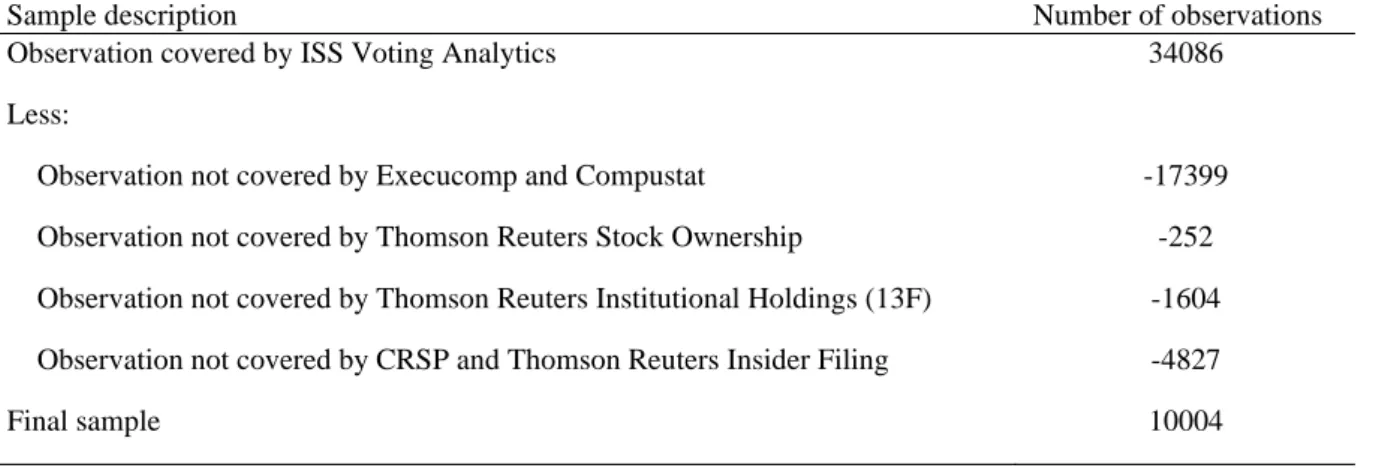
Using a sample of S&P 1500 firms from 2011 to 2020 (10,004 firm-year observations), I find that short-term institutional shareholders are less likely to cause disagreements. This result supports my expectation that, in general, short-term institutional shareholders are keen to follow ISS recommendations to fulfil their fiduciary duties and avoid high monitoring costs.
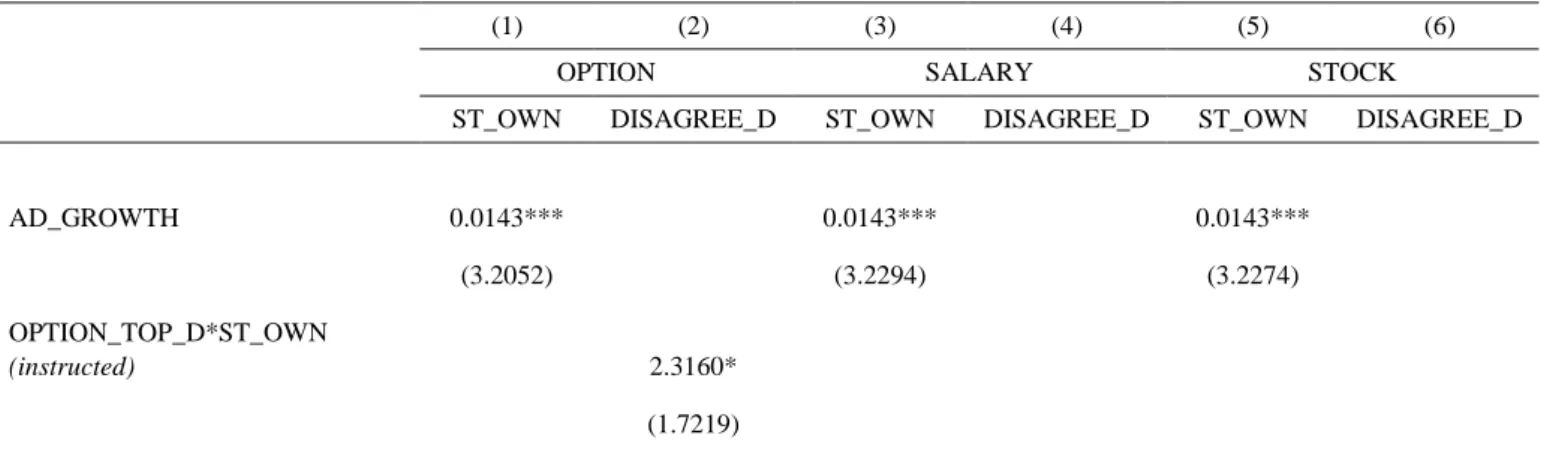
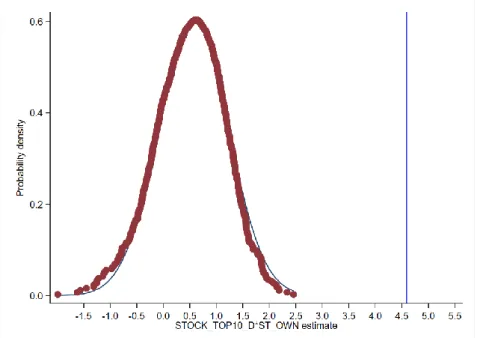
However, I also find that various designs of compensation packages attenuate this association between short-term institutional shareholders’ investment horizon and disagreements. To study the effect of different compensation packages, I generate several dummy variables equal to one for firms with excess CEO option grants, stock grants, salary and bonus payments. I then interact these dummy variables with the long- and short-term ownership and rerun my baseline tests. As expected, the results reveal that short-term institutional shareholders have strategic choices in the form of compensation contracts that cause disagreements with ISS. Short-term institutional shareholders are more likely to disagree with ISS when firms grant executives more options and higher salaries. This result indicates that short-term institutional shareholders favour a package design that boosts firms’ short-term profits, despite if ISS believes it might harm firms’ long-term performance and recommend an “Against” vote. The results are robust after addressing endogeneity concerns using several identification techniques, such as firm fixed effects, two-stage instrumental variables, falsification tests and entropy balancing.
I also find that long-term institutional shareholders have no significant relationship with disagreements, indicating that they are likely to conduct independent research to acquire firm- specific information for voting. If long-term institutional shareholders have more private information than ISS, their research is deemed more precise (Ertimur et al., 2013, Larcker et al., 2015). If long-term institutional shareholders significantly disagree with ISS, concern about
34
the quality of ISS recommendations may arise. However, the results show long-term institutional shareholders’ decisions are independent of ISS recommendations.
The contributions of this chapter are two-fold. First, it introduces investor investment horizon as a determinant of disagreement between ISS recommendations and shareholder Say-on-Pay voting results. Previous research focused on the general effect of ISS recommendations on Say- on-Pay voting, assuming alignment with in-between them (Iliev and Lowry, 2015, Ertimur et al., 2013, Larcker et al., 2015). No study has explored disagreements between shareholders and ISS recommendations. This chapter fills this gap by providing the first evidence that short-term institutional shareholders vote against ISS recommendations when option grants and salary payments are excessive. However, long-term institutional shareholders are not the cause of disagreements. Identification tests confirm that this effect is incremental to other possible driving factors that might be correlated with disagreements found in prior research.
Second, the chapter provides new evidence on shareholder governance behaviour. Previous studies suggest that short-term institutional shareholders are prone to choose “exit” over
“voice”/vote to monitor firms, as “voice” is costly and, therefore, not aligned with their short- term interests (Duan and Jiao, 2016). However, I find that short-term institutional shareholders do strategically choose option grants and salary payments as preferable forms of executive compensation even when they are excessive, which aligns with their desire for short-term profits (Basuroy et al., 2014). Therefore, short-term institutional shareholders are more likely to vote against ISS recommendations when firms pay excessive salaries and option grants.
35
This chapter is structured as follows: Section 2.2 outlines the background of relevant theory and a summary of empirical findings in the literature. Section 2.3 develops the hypothesis of the chapter. Section 2.4 provides the sample selection and methodology, followed by section 2.5, which presents the baseline results. Section 2.6 details the identification tests, Section 2.7 offers a robustness test, and Section 8 concludes the chapter.
36
2.2 Literature review 2.2.1 Agency conflicts
Agency Theory states that agency conflicts arise because of the principal-agent relationship that emerges when executives (the agent) manage the firm and make decisions on behalf of the shareholders (the principals), which can subsequently lead to conflict between the agent and the principals (Eisenhardt, 1989). For example, Holmström (1979) argues that managers have different motives from shareholders because of moral hazards based on their interests rather than shareholders’. For example, asymmetric information allows managers to control the release of information that may affect shareholders' performance judgements (Bebchuk and Fried, 2005).
Two theories have been suggested to mitigate these conflicts. First, Holmström (1979) argues that managers should receive incentives that bind their payment to easily observable operation outcomes, leading to better alignment with shareholders' interests. Second, Gillan and Starks (2000) argue that shareholder governance could significantly control agency conflicts. Unlike incentive theories (Holmström, 1979), shareholder governance does not provide interest alignment. Instead, it uses an "inherent monitoring function" of the stock market (threat to sell the share) or direct intervention by law (voting) to discipline managers (Gillan and Starks, 2000).
Since institutional shareholders hold around 70% of outstanding U.S. corporate stocks (Aggarwal et al., 2019), they can potentially play a pivotal role in corporate governance. After the U.S. Securities and Exchange Commission (SEC) ruled that institutional shareholders must vote in AGMs to protect their customers’ interests, their significant influence on corporate
37
governance became more noticeable (Cremers and Romano, 2011, Ng et al., 2009). Therefore, I focus on investigating how institutional shareholders affect disagreements in this chapter.
2.2.2 Institutional shareholder governance
2.2.2.1 Institutional shareholders govern firms through “voice” or “exit”
Hirschman (1970) argues that there are two mechanisms through which institutional shareholders can voice their opinions if they disagree with managers' actions. They can either sell their shares on the market (“exiting” or “voting with their feet”) or participate in some form of management (“voice” or “direct intervention”) to exert their power. Hirschman (1970) also argues that these two mechanisms are efficient when direct control is unavailable or too costly for institutional shareholders. Theoretical Models argue that firms have better governance when they receive institutional shareholders' “voice” because this “voice” provides corrective suggestions (McCahery et al., 2016). For example, by presenting a theoretical Model, Shleifer and Vishny (1986) document that institutional shareholders' “voice” can discipline inefficient management. Currently, as a representative of “voice”, shareholder voting is increasingly being identified by scholars as one of the most important mechanisms to govern a firm (Bebchuk and Fried, 2005, Mallin and Melis, 2012).
A question raised by concern over “voice” governance is: “What happens if managers do not listen to institutional shareholders' “voices”?” There are two possible channels through which to enforce governance. First, institutional shareholders can threaten to “exit” (McCahery et al., 2016), leading to a reduction in agency costs (Admati and Pfleiderer (2009). Institutional shareholders with significant shareholdings can threaten (actual or imply) to sell their shares on the public market, profoundly affecting the company's share price. If managers'
38
compensation is closely linked to share performance, those managers must listen (Palmiter, 2001).
Secondly, managerial reputation is essential in ensuring that managers listen to shareholders.
Though institutional shareholder governance (e.g., proposals and votes) is only advisory in current corporations, managers tend to implement a proposal if the majority supports it (Bach and Metzger, 2019). Managers are concerned about reputation loss if they were not to follow institutional shareholders' opinions, especially after implementing the Sarbanes Oxley Act and several accounting scandals (Ertimur et al., 2010, Del Guercio et al., 2008).
2.2.2.2 Institutional shareholders’ willingness to choose “voice” or “exit”
As elaborated above, “voice” and “exit” are two mechanisms institutional shareholders can exert their power to govern firms when they disagree with the managers. However, the question of whether institutional shareholders have the same willingness to engage in “voice” or “exit”
to govern firms still exists. In other words, are there any characteristics of institutional shareholders that will inevitably lead to a different preference between “voice” and “exit”?
Empirical studies provide some answers to this question based on the costs and benefits of each choice.
In choosing “voice” or voting in proxies, significant ownership rights of a firm owned by institutional shareholders with long-term investment horizons could play a vital role for two reasons. On the one hand, a large ownership block can create greater liquidity constraints for institutional shareholders, which makes it costly to “exit” by selling shares in the open market
39
(Maug, 1998, Edmans, 2009, Edmans and Manso, 2011). On the other hand, a large ownership block can help incentivise institutional shareholders to engage in corporate governance through
“voice”. If a firm’s performance can be enhanced by more robust corporate governance, institutional shareholders with significant ownership would benefit (Shleifer and Vishny, 1986, Maug, 1998, Kahn and Winton, 1998). Empirically, Duan and Jiao (2016) find a negative association between institutional shareholders’ ownership and their “exiting” behaviour, indicating that a large ownership block deters governance through “exit”.
The literature suggests that, in general, institutional shareholders with short-term horizons prefer to choose “exit” as a mechanism to govern firms. Duan and Jiao (2016) argue that institutional shareholders with short-term investment horizons do not have incentives to actively participate in direct intervention because direct intervention through “voice” is not aligned with their short-term investment horizons. However, Stathopoulos and Voulgaris (2016) find that institutional shareholders with short-term investment horizons actively vote when monitoring costs are low. Thus, if compensation is excessive in that it incentivises short- term profits at the expense of long-term profits, then institutional shareholders with short-term investment horizons vote, and possibly against ISS recommendations.
2.2.2.3 The economic consequences of institutional shareholder governance
Studies on whether institutional shareholder governance can create value provide conflicting results. Appel et al. (2016) and Edmans and Holderness (2017) find that once institutional shareholders can “voice” their opinion in voting, they significantly influence and discipline managers. Harris and Raviv (2010) find that institutional shareholder governance ensures