http://researchcommons.waikato.ac.nz/
Research Commons at the University of Waikato
Copyright Statement:
The digital copy of this thesis is protected by the Copyright Act 1994 (New Zealand).
The thesis may be consulted by you, provided you comply with the provisions of the Act and the following conditions of use:
Any use you make of these documents or images must be for research or private study purposes only, and you may not make them available to any other person.
Authors control the copyright of their thesis. You will recognise the author’s right to be identified as the author of the thesis, and due acknowledgement will be made to the author where appropriate.
You will obtain the author’s permission before publishing any material from the thesis.
Kant’s Universalism in Historical Context:
Repoliticising the Foundations of a Seminal Political Philosophy
A thesis
submitted in fulfilment of the requirements for the degree
of
Doctor of Philosophy in Political Science & Public Policy at
The University of Waikato by
BERKAY KOÇAK
2024
i
A BSTRACT
In the contemporary global political milieu, Immanuel Kant's universalist political philosophy has assumed a prominent role, eliciting substantial discourse and scrutiny due to its enduring significance in shaping the fundamental principles that underpin the present-day international order. Kant's philosophy is celebrated for its commitment to universality and its pioneering articulation of political ideals aimed at establishing the foundational principles requisite for the construction of a peaceful, sustainable, and self-regulating global order, grounded upon universally applicable moral precepts. While an array of scholarly works has meticulously explored Kant's groundbreaking contributions and intellectual influence, a discernible gap exists in comprehending how his philosophical framework intersects with the multifaceted social and material backdrop of his era. This thesis embarks on a critical exploration of Kant's universalism, employing a novel approach grounded in the social history of political theory, firmly rooted in historical materialism. Diverging from abstract interpretations of political theory, this method seeks to historically recontextualise Kant's ideas within their original social, political, and class contexts.
To illuminate Kant's universalism from this perspective, a pivotal question must be addressed:
What kind of political project does Kant’s universalism propose in terms of the political polarisations between absolutism, feudalism, and liberalism in the Prussian context? This research endeavours to reevaluate Kant's universalist political philosophy by examining its connection to the protracted crisis of German feudalism, its influence on social and political thought, and its entanglement with the power struggles between absolutist-paternalists, traditional feudalists, and liberal reformists vying for control over social property relations in the Prussian Ständestaat. Within this context, Kant's philosophy also intersects with the reform project of the rising educated professional classes, known as the Bildungsbürgertum, whose growing influence shaped the trajectory of social property relations and the Enlightenment (Aufklärung) in the Prussian state-building period.
A distinctive contribution of this thesis is that it highlights the unique class character of the Prussian Bildungsbürgertum, distinct from the British and French bourgeoisie traditionally analysed in Marxist perspectives. Notably, the thesis contends that this state-dependent educated professional class had a particular affinity for Kantian universalism, making it, for a time, the prevailing ideology of the Prussian Bildungsbürgertum. By adopting this historical materialist perspective of the social history of political theory, this thesis aims to shed light on the intricate relationships between Kant's universalist political thought and the historically specific conditions of 18th-century Prussia, ultimately elucidating the nuanced limitations imposed by his class context on his philosophical contributions.
ii
A CKNOWLEDGEMENTS
I would like to extend my heartfelt gratitude to the individuals whose unwavering support and guidance have played a pivotal role in the completion of this research project. Their contributions have been instrumental in shaping this thesis and have enriched my academic journey in immeasurable ways.
Foremost, I express my deepest appreciation to my chief supervisor, the late Dr. David Neilson, whose dedication to this project was unwavering until his unexpected and untimely passing during the revision process. Dr. Neilson's profound insights, relentless encouragement, and vast knowledge were a constant source of motivation, and his absence brought forth unforeseen challenges.
I want to acknowledge and express my profound gratitude to my chief supervisor Dr. Justine Kingsbury for her exceptional dedication and unwavering support during the most challenging phases of my academic journey. Dr. Kingsbury's remarkable assistance in securing funding and navigating the intricate administrative procedures was nothing short of extraordinary. Her tireless efforts, even under the most demanding circumstances, demonstrated a level of commitment that transcends the typical advisor-student relationship. Dr. Kingsbury's guidance exemplified the true spirit of mentorship. Her invaluable contributions were pivotal in ensuring the successful completion of this research project, and for that, I am deeply appreciative.
Furthermore, I owe a debt of gratitude to Dr. Norman Franke for his exclusive and unwavering support throughout this project. His mentorship has been instrumental in shaping the direction of my research. I would also like to express my appreciation to Dr. Brian Roper for affording me the opportunity to visit the Politics Programme at the University of Otago, where I had the privilege of benefiting from the enriching academic atmosphere in Dunedin.
I am also grateful to Dr. Anthony Richardson for his invaluable assistance in proofreading and carefully organising my thesis, a contribution that played a pivotal role in elevating the overall quality and readability of this work.
I extend my sincere thanks to my diligent examiners, Professor Lisa Ellis and Professor Reidar Maliks, who generously provided constructive feedback and valuable suggestions, elevating the quality of this thesis. Their detailed reviews and perceptive insights have been invaluable, and I am deeply appreciative of the time and effort they invested in their assessments.
I am also thankful to my former thesis supervisor at the Middle East Technical University, Professor Örsan Akbulut, for his profound feedback on various aspects of organisation and methodology. During the revision process, his insights have been invaluable in shaping the structure of this thesis.
I express my heartfelt gratitude to my family, friends, mentors, and all those who stood by me through the highs and lows of my academic journey. Special thanks go to my partner, Melanie Oncog, for her unwavering support and motivation. I am also grateful for the encouragement and assistance provided by my friends at Otago University, namely Dr. Dmitri Zavialov, Dr.
Carmen Fulco, and Dr. Danella Glass. Additionally, I appreciate the support and motivation from my friends at the University of Waikato, namely Furkan Yazıcı, Dilara Aydın, and Pınar İper. Their consistent emotional and practical support has been instrumental in the successful completion of this research project, and for that, I am sincerely thankful.
iii
T ABLE OF C ONTENTS
ABSTRACT ... I
ACKNOWLEDGEMENTS ... II
TABLE OF CONTENTS ... III
LIST OF TABLES & FIGURES ... VI ABBREVIATIONS OF KANT’S WORKS ... VII
INTRODUCTION ... 1
PREFACE ... 1
RESEARCH TOPIC ... 5
LITERATURE REVIEW ... 6
Literature on Approaching the History of Political Thought: The Methodological Debate ... 7
Literature on Kant’s Context ... 9
METHODOLOGY ... 13
A. Defining the Historically Specific: Locating the Social and Political Conflict ... 13
B. Discovering Social Property Relations & Class Positions ... 14
C. Identifying the Social History of Political Theory... 15
CONTRIBUTION ... 17
KEY FINDINGS ... 18
OVERVIEW ... 19
CHAPTER I - RETHINKING THE FEUDAL CRISIS IN GERMANY: A CATALYST FOR KANT'S POLITICAL THOUGHT ... 21
1.1 INTRODUCTION ... 21
1.2 DEFINING THE CRISIS OF FEUDALISM IN THE GERMAN CONTEXT ... 24
1.2.1. On Feudalism and Absolutism ... 24
1.2.2. Feudalism in the German Context ... 26
1.3 RESPONSES TO THE CRISIS OF FEUDALISM... 31
1.3.1. Reconsidering the Long Feudal Crisis as a Catalyst for German Political Thought ... 31
1.3.2. The Response of the Traditional Feudal Polity to the Crisis of Feudalism ... 37
1.3.2.1 The Making of Mini-Absolutisms with Mixed Constitution ... 38
1.3.3. Response of Absolutism to the Crisis: Hohenzollern Consolidation and Emergence of the Bureaucratic Absolutism ... 43
1.3.3.1 The Hohenzollern Consolidation: ‘Re-form’ and Compromise ... 43
1.3.3.2 Professionalism & Reform in the Emergence of Bureaucratic Absolutism ... 47
1.3.3.3 Cameralism and Paternalism ... 50
1.3.4. Response of Liberal Reformism to the Crisis of Feudalism: the Bildungsbürgertum & the Question of Aufklärung ... 57
1.3.4.1 The Emergence of the Bildungsbürgertum: Socio-Economic Orientation ... 59
1.3.4.2 Aufklärung as a Political Movement & Reformation Project ... 62
1.3.4.3 Rethinking the Limits of the State: The Birth of German Liberalism ... 65
1.4 IMPACT OF THE CRISIS IN PRUSSIA ON THE EMERGENCE OF IMMANUEL KANT AS THE INTELLECTUAL OF THE BILDUNGSBÜRGERTUM ... 68
1.4.1. Main Political & Philosophical Questions ... 69
1.4.1.1 How to establish a universal ground for philosophical inquiry? ... 69
1.4.1.2 How to restore the Aufklärung Project to the centre of political theory?... 71
1.4.1.3 How to reconstitute state-society-individual tripartite relations without remaining within the conventional limits of the political conflicts? ... 72
1.4.2. Considering Kant as the Intellectual of Bildungsbürgertum ... 75
CHAPTER II - KANT’S EPISTEMOLOGICAL BREAK AND THE CHALLENGES OF CRISIS: NAVIGATING A PHILOSOPHICAL CROSSROADS ... 77
iv
2.1 INTRODUCTION ... 77
2.2 KANT’S EPISTEMOLOGICAL BREAK ... 80
2.2.1. Critique of Empiricism ... 85
2.2.1.1 The Discontent with Classical Empiricism ... 86
2.2.1.2 Hume’s Scepticism ... 88
2.2.2. Dialectical Empiricism ... 91
2.2.2.1 Kant’s Notion of the ‘a priori’ ... 92
2.2.2.2 The Synthetic a priori ... 93
2.2.2.3 Conception of Space and Time ... 95
2.2.2.4 Transcendental Logic ... 96
2.2.2.4.1 Metaphysical Deduction ... 97
2.2.2.4.2 Transcendental Deduction ... 98
2.3 POLITICAL AND PHILOSOPHICAL IMPLICATIONS OF KANT'S EPISTEMOLOGICAL BREAK FOR THE BILDUNGSBÜRGERTUM ... 101
2.3.1. Re-Philosophising Universalism ... 103
2.3.2. Promotion of the Individual Agency ... 104
CHAPTER III - KANT'S AUFKLÄRUNG: A SOCIAL EPISTEMOLOGICAL FOUNDATION FOR THE BILDUNGSBÜRGERTUM ... 108
3.1 INTRODUCTION:TOWARDS A SOCIAL EPISTEMOLOGY ... 108
3.2 EMANCIPATION OF HUMAN REASON ... 110
3.2.1. The Categorical Imperative... 112
3.2.2. The Constitution of the Selfhood as Moral Agency ... 114
3.3 KANT'S TELEOLOGICAL APPROACH TO HUMAN PROGRESS:AN ANTHROPOLOGICAL AND HISTORICAL JUSTIFICATION ... 115
3.3.1. Discovering the Universal Human Sociality ... 115
3.3.1.1 The Rousseauan Conception of Human Progress from Nature to Culture ... 116
3.3.1.2 Conceptualising Selfhood: Unsocial Sociability... 118
3.3.1.3 The Ultimate End of Nature as a Teleological System ... 122
3.4 THE AUFKLÄRUNG PROJECT ... 126
3.4.1. Redefining the Enlightenment ... 128
3.4.2. The Public Sphere: Kant’s Road to Enlightenment ... 129
3.4.3. Aufklärung as a Class Project ... 131
3.5 KANT AS AN INTELLECTUAL OF BILDUNGSBÜRGERTUM ... 132
CHAPTER IV - KANT'S UNIVERSALISM IN CONTEXT ... 135
4.1 INTRODUCTION ... 135
4.2 IMPACT OF THE FRENCH REVOLUTION:FRAGMENTATION OF THE BILDUNGSBÜRGERTUM ... 138
4.2.1. Fragmentation of the Bildungsbürgertum ... 140
4.2.2. The Fall of the Aufklärung Project ... 147
4.3 KANT’S UNIVERSALIST POLITICAL THEORY: AN INTERVENTION TO 1790S PUBLIC DEBATES ... 149
4.3.1. Casting Off Absolutist-Paternalism: Kant's 1790s Discourses on Freedom & Republicanism .. 150
4.3.1.1 Universalising Doctrines of Freedom ... 151
4.3.1.2 Blueprints for Democratic Republicanism: Reflections on Popular Sovereignty ... 154
4.3.2. Resisting Tradition: Kant's Universalist Approach against the Revival of Feudalism ... 161
4.3.2.1 Universalising Self-Legislation ... 162
4.3.2.2 Towards a Post-Feudal Society ... 164
4.3.3. Kant's Universal Lens: A Thoughtful Rejection of Liberal Reformism ... 169
4.3.3.1 Co-existence of Political Rights with Universal Law ... 170
4.3.3.2 Universal Groundworks for Political Participation: Citizenship & Property ... 172
4.3.3.3 Right to Resist: A Non-Universalisable Paradox ... 176
4.4 FORGING A UNIVERSALIST POLITICAL PHILOSOPHY ... 180
CONCLUSION: IMPLICATIONS OF KANT’S UNIVERSALISM FOR THE CLASS POLITICS OF THE BILDUNGSBÜRGERTUM & THE BROADER CONTEXT... 183
v
I. KANT'S UNIVERSALISM, THE BILDUNGSBÜRGERTUM & THE FUTURE VISION FOR PRUSSIA ... 183
II. THE IMPLICATIONS OF KANT'S UNIVERSALISM FOR BROADER POLITICAL TRADITIONS ... 185
III. THE LIMITS OF KANT'S UNIVERSALISM:THE PRUSSIAN PREDICAMENT ... 186
IV. UNIVERSALISM REASSESSED:AHISTORICAL MATERIALIST LENS ... 190
V. EPILOGUE:ASCHOLARLY ENDEAVOR REIMAGINED ... 193
BIBLIOGRAPHY ... 196
PRIMARY SOURCES IN GERMAN ... 196
PRIMARY SOURCES IN ENGLISH ... 196
OTHER SOURCES ... 197
APPENDIX I: THE INFLUENCE OF ACHENWALL’S THEORY OF NATURAL LAW ON THE DEVELOPMENT OF KANT’S UNIVERSALISM ... 218
APPENDIX II: OVERVIEW OF THE PRE-CRITICAL YEARS: INVOLVEMENT IN PHILOSOPHY AND THE CLASS POLITICS OF THE BILDUNGSBÜRGERTUM ... 222
KANT’S INVOLVEMENT IN PHILOSOPHY AND THE CLASS POLITICS OF THE BILDUNGSBÜRGERTUM ... 223
THE RISE AND FALL OF A PRE-CRITICAL PROJECT ... 227
APPENDIX III: POLITICS OF THE FRENCH REVOLUTION ... 233
vi
L IST OF TABLES & F IGURES
FIGURE 1:IMPERIAL CONSTITUTION ... 29
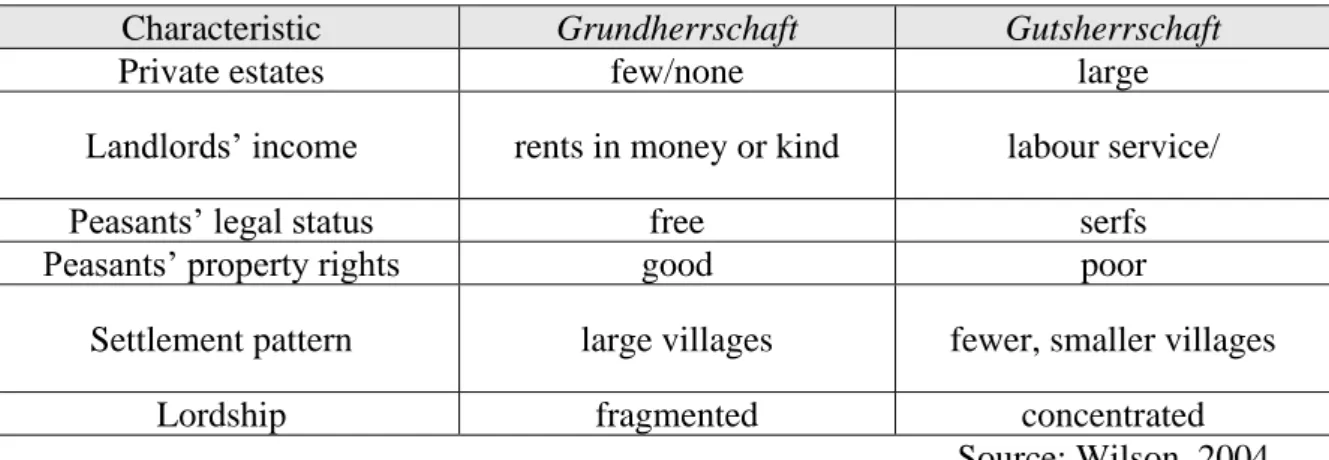
TABLE 1:WESTERN AND EASTERN MODELS OF GERMAN FEUDALISM ... 27
TABLE 2:KANT'S RESPONSE TO THE DEBATE ON THE SOURCES OF KNOWLEDGE ... 94
TABLE 3:COMPARISON OF KANT’S THREE THEORIES OF SPACE WITH THOSE OF NEWTON AND LEIBNIZ ... 231
vii
A BBREVIATIONS OF K ANT ’ S W ORKS
Anthr Anthropology from a Pragmatic Point of View CBHH Conjectural Beginning of Human History C.F. Conflict of the Faculties
Cor Correspondence
CPJ Critique of the Power of Judgment CPR Critique of Pure Reason
CPrR Critique of Practical Reason
D.S. Differentiation of Directions in Space
Disc On a Discovery Whereby any New Critique of Pure Reason Is to Be Made Superfluous by an Older One
Dist Inquiry Concerning the Distinctness of the Principles of Natural Theology and Morality Dreams Dreams of a Spirit-Seer
Was An Answer to the Question: What Is Enlightenment?
G Groundwork of the Metaphysics of Morals ID Inaugural Dissertation
Idea Idea for a Universal History with Cosmopolitan Intent JL Jäsche Logic
L.P. Lectures on Pedagogy
M.F. Metaphysical Foundations of Natural Science M.J. The Metaphysical Elements of Justice
MM Metaphysics of Morals
NE A New Elucidation of the First Principles of Metaphysical Cognition O.P. Opus Postumum
Prac Practical Philosophy PP Perpetual Peace
Prog What Real Progress Has Metaphysics Made in Germany since the Time of Leibniz and Wolff?
Pro Prolegomena to Any Future Metaphysics Rel Religion
RH Rezensionen zu Johann Gottfried Herders Ideen zur Philosophie der Geschichte der Menschheit TP On the Common Saying: That May Be Correct in Theory, but no Use in Practice
1
INTRODUCTION
“Without sensibility (experience), no object would be given to us, and without understanding, none would be thought. Thoughts without content are empty; intuitions without concepts are blind.”
— Immanuel Kant, Critique of Pure Reason, A 51, B 75
P
REFACEIn his book The End of History and the Last Man (1992), Francis Fukuyama proclaimed the global triumph of key elements of Enlightenment universalism. Fukuyama argues that the triumph of Western liberal democracies over late Stalinism has led to the universal acceptance of principles such as human rights, the rule of law, and peaceful conflict resolution, which are no longer seriously opposed politically or ideologically in late modernity. The final victory of liberal universalism seemed symbolised in the fall of the Berlin Wall and was once and for all secured in global history. As Wuriga (2003) already pointed out, Fukuyama’s political analyses and predictions are not only rooted in the discursive history of Anglo-Saxon and French Enlightenment and liberalism but also refer to German-speaking thinkers such as Immanuel Kant. The epistemological as well as the ethical, political, and historical-philosophical theories of Kant and Hegel, among others, had informed Fukuyama’s seminal study, sharing the assumption “that history is moving towards an end point or goal.” Says Wuriga, “It is from [philosophers like Kant] that Fukuyama appropriates the idea of universality to envisage the universality of liberal democracy” (Wuriga, 2003, p.5)
Thirty years later, Fukuyama’s claims and forecasts seem oddly naive and uninformed; at worst, they appear as ideological wishful thinking. For although large parts of Eastern Europe introduced bourgeois democratic political systems, enshrined basic and human rights in their constitutions and guaranteed freedom of expression and freedom of movement, the universal liberalism announced by Fukuyama, especially in Russia, but also in other successor states of the Soviet Union, could not be ideologically and politically established. In Africa and Latin America, too, Western liberalism did not prevail. Similar to the successor states of the former Soviet Union, precarious parliamentary democracies alternated with fascist and autocratic forms of government; sometimes, only mafia-type political structures remained. In the first decades of the 21st century, even the numerically largest democracy in the world, India, appears to be far removed from the universalistic ideas of Fukuyama in terms of domestic governance and external polices. Most especially in China, Fukuyama’s predictions did not materialise. One of the basic assumptions of Fukuyama’s neo-liberal approach to universal history is that, at least in the medium term, the spread of Western capitalism based on American and European models would also lead to the development of parliamentary systems, civil societies, and the rule of law, has not been confirmed, particularly in China. One can therefore conclude that Fukuyama’s assumption that universal human rights, freedom of expression and peaceful international conflict resolution as a result of the spread of neo-liberal capitalism is not correct. There is no evidence that in the neo-liberal era, the basic rights enshrined in the UN Declaration of Human Rights are universally honoured and worked towards. To put it bluntly, these humanistic universals remain abstract regulative ideas for all those many people who are harassed by hunger and exploitation or who, without the slightest say in the matter, are driven into international conflicts by murderous rulers who may very well be champions of neo-liberal capitalism.
2
After 1980, (neo-) liberalism and capitalism did not resolve the difference between the two former superpowers. In the USA, the first modern democracy based on enlightened, universalist ideas, the 1990s saw a dramatic decline in rational political discourses and civil society. During the Trump era (2016-2020), which some political analysts have described as semi-fascist (Reich, 2016), the Western Alliance saw a rapid decline in political culture and the appeal of, and attempts to implement, liberal and universal ideas. Under Trump, US human rights universalism, which is part of the Enlightenment tradition which provides the ideological foundation of the US, and which had been represented by all American presidents since the end of World War II, was replaced by an America First approach. Amongst other policies, this drastically reduced American co-financing of the United Nations.
At the beginning of the war in Ukraine, the world public also witnessed the failure of peaceful conflict resolution between states that boast high educational levels and rational decision- making. While the United Nations was still in session to prevent war through negotiations, Russian troops were already marching on Kyiv. Fukuyama’s high-spirited announcement of the global spread and implementation of enlightened universals and philosophical and political practices in the tradition of the Western Enlightenment has evidently failed.
It was the philosopher Immanuel Kant who, in his essay Vom Ewigen Frieden/On Perpetual Peace (1795), was one of the first modern Europeans to theoretically think about the prevention of war through reason and rule-based international diplomacy. The formulation of the fundamental human rights enshrined in the United Nations Declaration of Human Rights, which, as a regulative idea, serves as a foundation for worldwide debates about their best realisation, also owes important impulses to the work and philosophical reception of the Königsberg philosopher. In his ‘Grundlegung zur Metaphysik der Sitten/Groundwork of a Metaphysics of Morals’ (1785), Kant famously spoke of the fundamental dignity of man: “Act so as to treat humanity, whether in your own person or in that of another, at all times also as an end, and not only as a means.” (Kant, 2002, p.421, G, 4:429) Kant’s definition of fundamental humanity as a right and obligation, which he saw as being based on the universal right to freedom, was also of particular importance to the post-World-War II discourse on ethical and political universals. Kant undertook to underpin ‘natural law’ principles through rational- argumentative philosophies and, in his Categorical Imperative, to secure the basic freedom of human thought and action with a universally rationally recognisable conceptualisation of the Golden Rule, and thus free the human rights discourse from older theological theories.
Historically, Kant’s influence on liberal philosophical and political discourses was immense, especially in the German and English-speaking world. However, his impact reaches far into contemporary discourses of political philosophy and questions around the epistemological and ethical grounding of universals, truth, and relativism. As an example, I would like to mention the seminal contemporary philosophies of John Rawls (1993) and Jürgen Habermas (1991, 1994), well-known to a wider academic public, who have taken up key elements of Kant’s thoughts on universality by relating the basic validity claims of humanistic ethics to all human beings regardless of their ethnicity and gender and arguing for their fundamental regulative independence from geographical, and cultural conditions. This conceptualisation of universality, which is an integral part of the Kantian tradition, is represented in particular in debates with proponents of cultural and linguistic relativism, e.g., Lyotard or Derrida.
It is, therefore, safe to say that Immanuel Kant is one of the central figures in the modern discourses of universalism. It can be argued that his ideas, but also the criticism and further development of his ideas, have had significant philosophical and political implications for contemporary discourses in the humanities. In order to evaluate the discursive and political
3
history of the success of modern universalism (as argued by Fukuyama) or their failure, an understanding of Kant’s work remains of the greatest importance.
Nevertheless, what were the social and intellectual prerequisites for his work? Who was this thinker whose ideas influenced modern notions of freedom, human rights, democracy, republicanism, and universals like few others? In which contexts of the history of ideas and the history of universalist discourses did his thinking develop? Which historical precursors and which of his contemporaries did Kant absorb and take issue with? In what historical environment and under what socio-psychological conditions did his writings emerge?
Attempted answers to these questions fill half a library. There are numerous Kant studies in the area of systematic philosophy, which reconstruct and criticise Kant’s epistemology and ethics and their connections to his conceptualisation of universalism1. There are also a large number of discourse analyses, e.g., on the position of Kant’s universalism within the development of the German-speaking and European Enlightenment (Beiser, 1992; Hunter, 2004, 2006, 2012;
Maliks, 2014, 2022; Shilliam, 2009, Wood, 1972). Several works present and critique international law-making and law from a Kantian perspective (Doyle, 1983, 1993; Molloy, 2017). Some monographs analyse Kant from a psychoanalytic point of view and see his highly cognitive and cerebral theory of reason, his ‘idealism’, in the context of long-term European discourses on body-mind dualism (Böhme, 1995; Cassirer, 2020). In addition, there is a wealth of Kant biographies that depict his life story and the genesis of his work within the context of contemporary Prussian history in the 18th century (Cassirer, 1981; Kuehn, 2001). With regard to Kant’s crucial contributions to modern philosophical and political universalism, many of these works are confronted with a strange paradox: The question arises how a person who spent his entire life on the ‘European periphery’ in Königsberg and only ever made one journey out of his hometown, was able to express superbly crafted ideas on topics such as universalism and global validity claims of rationality. How did the Prussian professor in the provinces become a philosophical world phenomenon? How was it possible for the man who came from the humblest of backgrounds to become a well-respected authority in the areas of state-building and international communication?
The current state of academic literature regarding Immanuel Kant's philosophical, political, and legal reflections on universalism is marked by a lamentable deficit in terms of a thorough examination that situates his ideas within the complex interplay of the persistent crisis of feudalism that pervaded the German context and its subsequent impact on the political and philosophical debates surrounding the establishment of a universal common ground for German philosophy, all while taking into consideration Kant's own social class affiliation as a member of the newly emergent German-speaking Bildungsbürgertum, his humble and almost proletarian origins, and his academic pursuits as a representative of the educated class. The tradition of Marxist Kant research, which sees Kant within the framework of his class relations and in connection with the political and economic disputes between absolutist centralist cameralists, traditional feudalists and proto-liberal citizens in Prussia and in German-speaking Central Europe during the Enlightenment era, has lain dormant for decades and thus missed the opportunity to challenge (neo-) liberal theories such as Fukuyama’s by uncovering problematic aspects of Western liberal universalist discourses at their origin. The last major Marxist
1 Many other scholarly works were used in relevant sections of the thesis in addition to the recent significant works on Kantian political theory (Beck, 1999; Beitz, 1999, 2005; Bohman & Lutz-Bachmann, 1997; Booth, 1986;
Browning, 2011; Doyle, 1983a, 1983b, 1996; Elis, 2005, 2008, 2012, Fine & Cohen, 2002; Flikschuh, 2000;
Franke, 2001; Gallie, 1978; Habermas & MacCarthy, 1984; Hinsley, 1963: Hutchings, 2013; Ion, 2012; Jahn, 2005; Pogge, 1988, 1992, 1998, 2002, 2008, 2008; Rawls, 1971; Shell, 1980; Williams, 2001).
4
monographs on Kant (van der Linden, 1988; Williams, 1977, 1983; Wood, 1972; Vörlander, 1926, 1977) were written quite a long while ago. Since Marxist theory on the history of political thought has made great methodological advances in the past thirty years, especially in the area of the social history of political theory (Comninel, 1987, 2018; Wood, 1995, 2008, 2012; Wood
& Wood, 1997; Wood, 1978), I believe the time has come to explore these new methodological approaches within the contexts of Kant’s philosophical and political writings on universalism.
This scholarly endeavour seeks to engage in a nuanced analysis of Immanuel Kant’s universalist political philosophy, incorporating a historical materialist methodology to shed light on the complex interplay between Kant’s intellectual and political predispositions and the cataclysmic structural crisis of feudalism in the Germanic milieu. By situating Kant within the broader historical, political, and ideological landscape of late 18th-century Prussia, a moment marked by the efflorescence of the Aufklärung and the rise of a bureaucratic class exerting its hegemonic influence, this research aims to illuminate the genesis of some of Kant’s seminal works on universalism, including Perpetual Peace, Idea for a Universal History, and the Metaphysics of Morals. The overarching objective of this study is to catalyse a re-politicisation of Kant’s universalistic ideation, which has been subject to a degree of anachronistic ahistoricism and detached from the political and economic realities of its time. In so doing, this research constitutes a seminal contribution to Marxist scholarship on Kant, advancing the existing contextual analysis of the philosopher’s class context.
Kant's 'idealist' construction of universalism, which, theoretically, aims to rescue (the human subjects’) universal rights from a historical dependence on systems of rule and social orders, elevates them into a truly unquestionable realm, or at least into a highly self-referential system of rational thought. It also transforms concrete historical reality into an unworldly, abstract, and idealistic system which prioritises the coexistence of multiple poles of the Prussian political crisis under one universal moral order. While Kant, under the progressive influence of Enlightenment thinkers, establishes new approaches to the interrelationship between the individual, society, and the state by justifying these conceptions regarding human sociality, public interest, and impersonal universal moral principles, his universalism has political and philosophical limitations. Kant’s philosophical ‘republic’ remains a scholar’s republic, an affair of thinkers and the exchange of ideas. The material and social needs of the majority of the population in his contemporary Prussia (Kant excludes women and poorer social classes from certain political, civil, and legal rights) are largely ignored by Kant and then, later on, by his
‘liberal’ successors. The ‘universalism’ of Kant’s universalist discourse is, in much of its political implications, universalism without the majority. This abstract universalism ignores crucial political and economic power structures in modernity; it ignores the very concrete bodies and emotions of the people it is theoretically intended to serve. Furthermore, it is precisely this problem of idealistic universalism, complicated by modern technological innovations and globalisation, that extends into late modernity and the unsuccessful (neo-) liberal attempts to establish fairer state rule and an international political order. Historical materialist archaeology of the class and power structures in which Kant’s ideas originated may, thus, have further interpretative power for analysing the predicament of modern capitalist societies, especially their (neo-) liberal, Kant-based discourses.
In this PhD project, I am animated by a steadfast commitment to advancing the seminal work of Ellen Meiksins Wood on the method of Social history of political theory. My scholarly curiosity in this approach is fuelled by Wood’s innovative endeavours in providing a historically nuanced and materially informed exegesis of the development of political thought.
Specifically, I am drawn to her unfinished project, which aimed to re-politicise and re-
5
contextualise the political thought of the late 18th century (Wood, 2012). In this vein, I have elected to concentrate on the figure of Immanuel Kant, as I perceive him as a mysterious political thinker whose class positionality and response to the prolonged crisis of feudalism have been long occluded.
Through this project, I aspire to proffer my research as a PhD thesis that constitutes a substantial contribution to both the perpetuation of Wood’s legacy and the disciplinary discourse of Political Marxism. In doing so, I aim to validate and underscore the import of the method of the Social history of political theory as a sophisticated and updated historical materialist perspective. I am hopeful that my contribution will furnish a novel perspective on Kant and advance our understanding of the complexities of the historical trajectory of political thought.
R
ESEARCH TOPICThis dissertation draws from the same point that Immanuel Kant (1781) stressed when sketching the essential dialectical relationship between the powerful potential of ideas and their practical nature. This dialectical relationship puzzled Kant for more than half a century, enabling him to position the potential power of thought as the key to interpreting the real world.
While reading the world, Kant claimed to discover where the power of thought comes from and how it will shape history; in other words, how the subject who can establish and direct thought can interpret the historically given. It was not a discovery he came to alone, of course.
Throughout history, political thinkers have sought to explore the human/subject’s relationship to social reality. In doing so, they have largely sought to expand and interpret the worldview presented to them by their historical context. Often, this exploration ended at the point of defining social reality through the ‘historically given’. Throughout history, political thinkers have emphasised the relationship between human nature and historical development by ensuring that the man/subject intersects the historically given, and in this case, the historically given determines the subject.
It was at this point that Kant’s difference emerged. Kant developed an approach that would try to reverse the common belief that absolute and fixed reality defines man’s relationship with his nature; with this approach, Kant argued in a critical philosophical way that the human/subject is free to the extent that it is rationally activated. In this sense, the absolute and fixed are not external to humanity.
Taking these factors into account, it becomes obvious that Kant’s potential for thought and its dialectical relationship with reality must be reconsidered in light of today’s systemic crisis. In recent decades, the value systems, institutions, and practices used in conceptualising and enacting the international political order have been called into question once again as capitalist systems have become destructive towards the human and natural environment. The estrangement from the political sphere throws us into personalised fights against the people and institutions that hold political power and clouds our critical approach towards the system.
Populist movements gaining strength in this direction are holding the people and establishments (not the system) accountable for the crisis. In the end, solving the problem of the planet turns away from looking for a new structure and system, and the conflict turns into a personal power struggle between individuals.
As his three hundredth birthday approaches, the necessity of reconsidering Immanuel Kant reappears here. Kant is not far from the problems of our modern world since he was among the
6
few founding thinkers, along with Marx, who influenced liberalism and socialism, the two political ideologies which most shaped the modern world we live in. This is primarily due to the epistemological and methodological discoveries I outlined earlier, as well as the political universalism Kant expresses when he identifies human beings with social reality. However, the world has changed and transformed in many ways since Kant began to interpret it three centuries ago. Hence, reconsidering Kant requires more than classical methods.
The purpose of this dissertation is to examine Immanuel Kant’s relationship with his historical context, the long political and social crisis of his context. To do this, it will uncover the historical and social relationships that influenced his propositions about building a political order based on universally applicable principles. Kant’s universalism will be illuminated in this way, and his visions’ limits will be highlighted. By exposing the limits of Kant’s vision, this research hopes to tie these limitations to Kant’s political project to reform the context through the promotion and ideology of his class: Bildungsbürgertum. Thus, a clear assumption of this thesis is that Kant’s political universalism has limits and restrictions tied to the material and social background of the thinker’s class.
Further, this thesis will use the social story of political theory as a method for analysing the political theory of the thinker. By re-evaluating political thinkers on a material basis, the social history of political theory reflects the implications of historical materialism, taking into account class antagonisms and conflicts over property, along with the political problems resulting from this conflict (and those with which political theory directly interacts).
This thesis examines Kant’s relationship with his class in light of structural and systemic factors that set it apart from classical Marxist readings, which only affiliate thinkers with their class positions and present them as political propagandists. In this study, Kant will not only be examined within the historical context of Prussia but also viewed through the lens of a materialist perspective that examines him in the context of a structural crisis.
In parallel to all of these, this dissertation proposes that Kant’s relationship with the Bildungsbürgertum, his own class, can be understood in terms of the long-term impacts of the crisis of feudalism on German political and social thought. It will use the method of the social history of political theory to examine the responses to the main questions of politics and philosophy that evolved in the context of the long crisis of feudalism. So, Kant’s original political philosophy was to overcome the crisis by critically examining the other responses within a universalist attempt to consolidate his own class through theoretical and ideological integrity. In parallel, the primary purpose of this research is to show that Kant’s universalist political philosophy can be reconsidered using the social history of political theory method by reviewing Kant’s relationship with (i) Prussia, where the Enlightenment (Aufklärung) flourished under an absolutist state-building process, and (ii) with the ideology/reform project (Bildungsbürgertum) of the rising educated bureaucratic classes who became more influential in the control of social property relations.
L
ITERATURER
EVIEWBuilding on the main premises of analysis in the historical materialism of Marx and Engels (Marx, 1993, 2009; Marx & Engels, 1974), this thesis will engage with the literature on the social history of political theory of Neal Wood (1978, 1997) and E.M. Wood (1972, 1991, 1998, 2008, 2012) and scholars of Political Marxism (Comninel, 1987, 2018; Mooers, 1991; Teschke, 2003, 2014; Knafo & Teschke, 2020), I here try to extend the method of the social history of
7
political theory by developing the analysis of the social property relations in the Prussian state- building process to critically examine Kant’s political universalism in the context of the crisis of feudalism in Germany along with the class origins of Bildungsbürgertum. Besides being an examination of Kant’s political universalism, this research aims to create an example of a study undertaken with the social history of political theory method.
There are two key literatures which are pivotal to the positioning of my research.
Literature on Approaching the History of Political Thought: The Methodological Debate
One of the most vital and controversial issues in the history of political thought is its relationship with its historical context. As the relationship between political thought and history is problematised, methodological approaches to the history of political thought become more contested and polarised. When the history of political thought is considered alongside history and social relations, the production of political theory and political thinkers is either contextualised or philosophised. Therefore, in this process, the theoretical output is either
“violently abstracted” (Sayer, 1987) and formulated as imaginary laws, or reduced to, and broadly explained only with, the very specific cultural, linguistic, and textual characteristics which cause the authentic elements of the social and material context to be negated in the analysis. In both ways, political theory is squeezed into certain narratives that obscure historically specific relationships in the related society that constitute class positions, ideological alignments, and pursuits of material interests in specific complex periods. Do ideas have a social and material ground? This question becomes vital when considering the content of the history of political thought regarding the relationship between historical context and the production of political theory by political thinkers.
As the primary provider of the ‘new mainstream’ content in writing on the history of political thought, the Cambridge School, led by Quentin Skinner and John Pocock, approached this field intending to reveal the historical context surrounding political thinkers, with documentation of the intellectual and textual content of their theoretical production2. In this documentation, the Cambridge School’s concern is to philosophise and link the textual content with the relevant thinkers’ political theories3 (Dunn, 1996; Hampster-Monk, 1992; Pocock, 2009; Skinner, 1969, 1974, 1978a, 1978b, 1988).
2 Skinner's departure point was the early medieval renaissance which examined early humanist texts from Ancient Greece to Italian city-states. He drew attention to the intellectual circulation of ideas created by religious and moral philosophers who frequently emerged from different churches (Skinner, 1978a). The rereading of republican ideas, the early rational ways of political theorising and essential debates on human nature appeared to undermine the medieval scholastic argument around the nature of political ideas. Skinner’s subsequent work on the Foundations examined this early detailed effort within the Reformation period, paying attention to the political figures in early modern Germany (Skinner, 1978b). Skinner’s texts offer a recognised, detailed, and consistent analysis of the content that has influenced modern political theories, providing strong historical evidence. His linking of the historical reconstructions of the intentions of political thinkers continues to provide a valuable perspective to trace intellectual traditions across the centres of Western political thought (Skinner, 1969, 1974, 1978a, 1978b, 1988).
However, Skinner’s approach does not investigate the social and political context in which the theories have been developed, influencing political thinkers' social life. Following Skinner’s analysis, the relationship between the context and the theories is still ambiguous. Skinner’s and the Cambridge School’s ideas around the history of political thought remained popular, and no alternative attempts that challenged their approach emerged until the end of the 1970s.
3 A deeper investigation on the objectives of the Cambridge School can be pursued through “Alexander, J. (2016).
While investigating the roots of the various traditions inside the making of the Cambridge School, Alexander focusses on the point that the main objective of Cambridge School is to establish a relation between history and
8
Against the take of the Cambridge School, Neal Wood reconsidered the notion of context in the history of political thought. From the critique of Skinner’s Foundations and Macpherson’s Possessive Individualism, the social history of political theory emerged as an alternative approach that tried methodologically problematising the context of the history of political thought (Wood, 1978). Neal Wood describes the central premises of this new approach, much earlier than the method completely defined by George Comninel (2018):
[the method that] … particularly emphasises the way in which the social, political, and economic context of an author – and not merely the contemporary context of ideas - not only powerfully shaped the author’s thought but generally constituted the terrain of its engagement.4 (p. xvii)
What constitutes the ‘political’ for political theory or a political thinker? Although there are various explanations for the definition of political for each political thinker, the only historical way to analyse the main assumptions of the content of the political theory is to illuminate what it corresponds to in the social and political context. The focus on changing social property relations plays a vital role in shaping this method since it is considered the source of the development of unique forms of the social and political structure in each context. Neal Wood and Ellen Meiksins Wood’s perspective on the history of political thought is based on production and context combined with stories of historical development5 (Wood, 1972, 1991, 1998, 2008, 2012; Wood & Wood, 1997; Wood, 1978).
The social history of political theory can be applied to demystify the impact of transition in a political context on the political theory. The contributions of Comninel, Mooers and Teschke investigated the contexts of England, France and international political thought in these
politics (Alexander, 2016: 1). In this series of efforts on this objective, the tradition becomes an intersection point for intellectual history and political theory.
4 Neal Wood was trying to develop an alternative method, distinct from the ‘over philosophised and abstract’
understandings of political texts of the Cambridge School within its intellectual context. Wood’s approach was also distinct from the canonical Orthodox Marxist effort to reduce political texts and thinkers to contributors to the emerging class of bourgeois, as Macpherson advocates for Hobbes and Locke (Macpherson, 1964). Wood concentrated on the context as the terrain full of social and political relations that political thinkers engage with and problematise. What constitutes the terrain or context of engagement was, for Wood, the social and material relations of the mode of production. However, he could go further only in his later works. He developed the social history of political theory in more detail with the contribution of Ellen Meiksins Wood.
5 As Ellen Wood defined her method in 2008, the primary purpose of developing this method indicates an open route without any reduction of content to the context:
The ‘social history of political theory’ [...] starts from the premise that the great political thinkers of the past were passionately engaged in the issues of their time and place. This was so even when they addressed these issues from an elevated philosophical vantage-point, in conversation with other philosophers in other times and places, and even, or especially, when they sought to translate their reflections into universal and timeless principles. Often, their engagements took the form of partisan adherence to a specific and identifiable political cause or even fairly transparent expressions of particular interests, the interests of a particular party or class. But their ideological commitments could also be expressed in a larger vision of the good society and human ideals.(Patriquin, 2012, p.141)
Wood’s definition here continues to clarify specific differences of the social history of political theory from the Orthodox Marxist canon:
At the same time, the great political thinkers are not party-hacks or propagandists. Political theory is, certainly, an exercise in persuasion, but its tools are reasoned discourse and argumentation in a genuine search for some kind of truth. Yet if the ‘greats’ are different from lesser political thinkers and actors, they are no less human and no less steeped in history.
(Patriquin, 2012, p.141)
9
transition processes and enriched the social and material explanation of political theories (Comninel, 1987; Mooers, 1991; Teschke, 2003, 2014).
The first wave of contributions was focused on demystifying the controversial characteristics of specific historical contexts. In contrast, the second wave analysed the relationship between class struggles and the reproduction of the ‘politically constituted property’ (Brenner, 1987) as the key to understanding historical developments (Knafo & Teschke, 2020). This new concentration included a more vigorous polemical engagement with the Marxist literature, which followed World System Theory(ies) (Anievas & Nisancioglu, 2013, 2019; Knafo &
Teschke, 2020). The contributors of the second wave articulated the approach as a tradition:
Political Marxism.
Some contributors define Political Marxism as a tradition that gained its uniqueness from its denial of structural accounts in Marxism (Knafo & Teschke, 2020, p.6). From this view, the strength of Political Marxism is its ability to historicise the material grounds that originate the political constitution of property in a specific historical context. Unlike Political Marxism, the structuralist traditions obscured the social and material conditions6; instead, they focused on the patterns of development of the structures. Another definition7 of Political Marxism considers its capacity to emphasise the specific conditions that mainly emerged with the capitalist mode of production to contextualise and politicise the related historical setting (Comninel, 2018, p.xvii).
This research is aimed at providing a critical expansion of the social history of political theory, as well as presenting an alternative historical materialist interpretation of Kant’s political universalism. In this way, this research could also be considered as a case study in the social history of political theory.
Literature on Kant’s Context
Immanuel Kant has been the subject of a vast body of research in a wide range of disciplines8. Although a great deal of literature discusses Kant’s influence on Marxism and historical
6 Structural explanations tend to obscure the importance of social and material contexts and typologically justify social change by the transformation of institutions and certain structures.
7 Political Marxism as a tradition seeks to emphasise that in pre-capitalist forms of class society the supposed separation of political and economic spheres of social existence does not exist even in superficial appearance as it does under capitalism (Comninel, 2018, p. xvii).
8 This research can only take some representatives of the most recent and significant literature on Kantian political theory. Elisabeth Ellis', Kant's politics: Provisional Theory for an Uncertain World (Yale University Press, 2005);
Kant's Political Theory: Interpretations and Applications (Penn State Press, 2012); Provisional Politics: Kantian Arguments in Policy Context (New Haven: Yale University Press, 2008) are three very helpful works in understanding the nature of Kant's political thought and the second also includes various other contributions from highly regarded Kantian scholars. Besides these, on the topic of the universalism of Kantian political theory, a recent account by Huseyinzadegan illuminates Kant’s careful effort to present a teleology that promotes a non- ideal world (Huseyinzadegan, 2019). Pauline Kleinfeld concentrates on the relationship between Kant and cosmopolitanism from universalism, autonomy, the idea of a world citizen, and patriotism (Kleingeld, 2012, 2014, 2018, 2020). Sean Molloy’s recent account explores the impact of Kant on theories of international relations and shows the literature developed from Kant’s international political theory (Molloy, 2017). Many other scholarly works were used in relevant sections of the thesis in addition to the recent significant works on Kantian political theory on universalism (Beck, 1999; Beitz, 1999, 2005; Bohman & Lutz-Bachmann, 1997; Booth, 1986;
Browning, 2011; Doyle, 1983a, 1993, 1996; Fine & Cohen, 2002; Flikschuh, 2000; Franke, 2001; Gallie, 1978;
Habermas & MacCarthy, 1984; Hinsley, 1963: Hutchings, 2013; Ion, 2012; Jahn, 2005; Pogge, 1988, 1992, 1998, 2002, 2008, 2008; Rawls, 1993; Ripstein, 2009; Shell, 1978, 1980; Williams, 2001).
10
materialism (van Linden, 1988; Williams, 1983), there is no historical materialist study that analyses Kant’s thought within its own historical context, in conjunction with the major political considerations revealed by its historical context. Similarly, Wood’s early work Mind and Politics (1972) is the only Kant study with a historical materialist perspective that points to Kant’s methodological and epistemological ruptures.
Analysing a historical subject through a historical materialist perspective involves analysing the mode of the production model of the period within which the subject is situated (Carchedi, 2011; Jessop, 1990; Marx & Engels, 1974; Sayer, 1987). As a result of this analysis, the social property relations underlying class conflicts are illuminated. The social history method, on the other hand, adopts these general principles of historical materialism and examines political thinkers using structural analysis (Wood, 1978). Additionally, social history of political theory (SHPT) uses the class relations of the thinker to analyse and contextualise them through the mode of the production model and the social property relations (Wood, 2008, 2012). Using the method of the social history of political theory, a study of Kant must examine the social property relationships revealed by the structural crisis of the ongoing mode of production (the long crisis of German feudalism) in the historical period in which Kant lived (Prussian state-building era), the class dimensions of these relations (Bildungsbürgertum), and the reflections of these class dynamics in Kant’s philosophy (political universalism) to define Kant’s context.
Building on the Mind and Politics of E. M. Wood (1972), I try to extend Wood’s early historical materialist interpretation of Kant and contextualise the thinker’s political universalism among the impacts of the long crisis of feudalism in German legal and political thought. Hence, Kant’s political philosophy is examined first through an analysis of the long crisis of German feudalism and the responses developed by different class actors seeking more influence in the social property relations of this historical context.
Using the method of the social history of political theory, this study will explore how the structural crisis of feudalism in the German historical context was characterised and how it transformed social and political thought. The crisis and transformations of feudalism in Germany and its impacts were discussed in detail by historians, political scientists and philosophers who studied the time period, and the majority of them are covered in this dissertation’s historical analysis (Anderson, 1982; Blickle, 1992, 2004, 2012; Blickle, 1979;
Braudel, 1986, 1994; Brenner, 1990; Carsten, 1947; Chrisholm, 1911; Dahrendorf, 1965;
Frank, 2011; Ganshof, 1952; Ghosh, 2016, 2017; Hagen, 1985, 2002, 2005, 2011; Hamerow, 1958; Harnisch, 2016; Hilton,1976; Koch, 1978; Mooers, 1991; Rosenberg, 1966; Sreenivasan, 1991, 2001, 2004, 2013; Strayer, 1965; Wilson, 2004; Wunder, 1985, 1996). The class conflicts shaped by these social property relations were discussed following the analysis of the transformations brought about by the crisis. To complement the analysis of how political thinking reacted to the crisis, an analysis of class perceptions of social realities was undertaken.
In line with this analysis, it is viable to determine that there are three basic responses to the crisis in German political philosophy (absolutist-paternalist, traditional feudalist, and liberal reformist). The political philosophies of the representatives and theorists of these responses have been examined in relation to the legacy of Kant’s period, which is the main subject of study (Achenwall, 2020; Althusius, 1997; Justi, 1760; Leibniz, 1969; Pufendorf, 1990, 1991;
Seidler, 2021; Wolff, 1720). Considering both the effects of the long feudal crisis on German political philosophy and the politicisation that was brought about by the crisis, Kant initially
11
wanted to establish a universalist basis on which he could build his political philosophy in order to establish an integrated methodological and epistemological break (Kant, 1998). The second thing he worked on was a project that would bring the estate together with Bildungsbürgertum, which is his own class, in an effort to consolidate it with the Enlightenment (Aufklärung) movement. Kant, who was able to achieve this in the 1780s with his increasing sphere of influence, became the original intellectual of his class by providing its ideological and political integrity. At this stage of the research, accounts that examine German political thought in detail Beck (1969), Beiser (1987, 1992), Hunter (2000, 2004, 2006, 2009, 2012), Sheehan (1973, 1978, 1989, 2011), Shilliam (2009), and Thornhill (2007) are used and critically reviewed. As part of my study, I analyse Kant’s historical context, the structural crisis that feudalism underwent, the resulting new property relations and social classes that were brought about by this crisis, and the political theories proposed by these social classes to solve the crisis in which they found themselves. This analysis has led me to categorise the primary problems Kant faced during his lifetime.
After defining Kant as the intellectual of Bildungsbürgertum, it is fundamental to critically review his class origins and identify how he accomplished an epistemological and methodological break. Composed of two main examinations of both the class origins and the methodological and epistemological break undertaken by Kant, in the second part of the research, I aim to uncover the main social and material conditions, philosophical and political influences and motivations of Kant that guided him towards being the intellectual of Bildungsbürgertum. Benefiting from the biographical accounts of Kant (Beck, 1969; Beiser, 1992; Cassirer, 1981; Guyer, 1987; Kuehn, 2001; Shilliam, 2009), I analyse the social and material conditions of Kant’s early life and tried to understand his class engagements with the Bildungsbürgertum in his early career (precritical years) as a public servant in academia in Königsberg (Schönfeld, 2000). The influence of the philosophical works of Achenwall, Hume and Rosseau on Kant (Achenwall, 2020; Hume, 2000; Rosseau, 1979, 1997) is also important here.
In the methodological and epistemological examination, I aim to extend Wood’s historical materialist analysis of Kant in Mind and Politics, emphasising the original contribution of the thinker to the making of social epistemology (Wood, 1972). Social epistemology here refers to a new discussion of Kant’s revolutionary intervention to activate human reason to interpret social reality (Kant, 1998). Although Kant promoted a philosophical a