Chukwujekwu A. Obianefo12 Luka Mailafia3
Ismaila Yusuf4 Chibuike B. Nwatu5
ABSTRACT
The outbreak of Covid-19 saw the loss of jobs which necessitates the need to embrace entrepreneurship, especially among women who are more economically marginalized in the labour market in Sub-Sahara Africa. The disease outbreak warrants the need to consume healthy food which many women especially those heading their households could not afford due to inactive economic engagement. This present study found the need to beam a searchlight on mediating role of entrepreneurship development on the economic growth of women in Nigeria.
Data for the study came from a cross-section of Five hundred (500) women entrepreneurs, randomly selected to represent 71% of the total sample size. Structural equation modelling (SEM) technique was used to operationalize the study objectives and suppositions. Constructively, it was found that psychological indicators (PSYI) and knowledge of business practice indicator (KBPI) catalyzed entrepreneurship development in the area by 17.8% and 38.1% respectively. This strong affinity or association between the PSYI and KBPI indirectly resulted in over 100%
growth in the economic status of women in the area. Hypothetically, PYSI and KBPI were mediated to economic growth through entrepreneurship development by 5% and 1% levels of probability which caused the rejection of the null hypotheses two and three. The study explicitly suggests that separating household and business income, and maintaining a separate business account, among others are the knowledge of business practice indicators; openness to change, and desire for self-independent among others are the psychological indicators, while the increase in the size of the inventory among others is the business performance indicator that stimulates entrepreneurship development; These led to higher formalization, and increases in capital investment as entrepreneurship development indices that stimulates economic growth. Thus, women entrepreneurs should be properly trained on the guiding principles of entrepreneurship development and practices. The study, therefore, recommends that government and non- governmental agencies should concentrate effort on training women to come near competence in their economic activities.
Keywords: Mediating role, entrepreneurship development, indicators, economic growth, women
1 Department of Agricultural Economics and Extension, Nnamdi Azikiwe University, Awka,
2Rural Finance Mainstreaming Area, IFAD/FGN assisted Anambra State Value Chain Development Programme, Awka
3Department of Accounting Ahmadu Bello University Zaria
4 Department of Accounting Federal University of Dutsin-ma
5 Department of Marketing, Enugu State University of Science and Technology, Enugu
*Corresponding author: Chukwujekwu Aloysius Obianefo, Department of Agricultural Economics and Extension, Nnamdi Azikiwe University, Awka, Nigeria. Email: [email protected]
I. INTRODUCTION
The term economic growth means a macroeconomic conception reflecting the process of improving the size of a nation’s economy (Alina-Petronela, 2012). The nation’s economic- growth conception was viewed by Addison (2015) as an important tool for reducing poverty and perfecting the quality of life, growth on its own can generate a sustained level of opportunity and occasion of posterity. The economic growth creates employment occasion for perfecting impulses for women to invest in their children’s education (Adu, 2015;
Ravallion, 2007), especially for the marginalized female children in Sub-Sahara Africa, which in turn promotes the development of female entrepreneurs. Scholars noted that such growth capable of spurring the nation’s economy should be measured from the point of physical capital (asset accession) and human/mortal capital (skills and education attainment) development (Ndulu, 2007). The economic-growth phase should be centered on developing strategies for poverty reduction and acclimatizing to sustainable development for women entrepreneurs. To drive this focus on growth; the capacity of women should be erected to strengthen their business operation, which is a sort of skill by every entrepreneur. Standing on this economic-growth medium, the entrepreneurial capacity of women should be empowered in form of women's agency through training.
The term women's agency gives women power and control over their own lives. This commission energizes women to share in social movements and the process of liberation (Sharifah, 2015). This women's agency or commission improves the spiritual, political, social, educational, gender or economic strength of individualities and communities of women (Rajeshwari, 2015; Selvi & Bakialekshmi, 2017). Anju (2015) contend that this commission affords the women the capability to make strategic life choices that they had been denied in the past, seeing that this will help them to make and act on profitable opinions (Golla et al., 201). Inversely, social background, culture and educational position play an important part in getting the women empowered (Selvi & Bakialekshmi, 2017), this is because Rajeshwari (2015) suggested that women's empowerment will contribute to the development of the country’s social & economic, and political space (Rajeshwari, 2015). Empowering women will mean getting women involved in profitable activities and these must be with a sensitive intention seen that women hourly are victims of gender demarcation, lack of equal openings in education, rape, abuse and torture, kidnap, and fiscal constraints among others. These justify the need for women to be organized and develop themselves into entrepreneurs.
These women entrepreneurs connote women or groups of women who initiate, organize and run a business enterprise (Dani, 2007). While entrepreneurship as a process makes women economically strong and freedom to take opinions, women entrepreneurs initiate, organize and operate the business enterprise. The study by Rusu et al. (2012); Uzonwanne-Obianefo et al. (2021) allude that an important factor used to define an entrepreneur is risk-taking, innovation and identification and use of opportunities with varying degrees of emphasis.
Since this assertion is group-specific, such definition is termed the sociology of entrepreneurship by Bula (2012).
Entrepreneurship participation by women helps to grow a country’s gross domestic product (GDP) as an important element of the demand side of job creation strategies in developing countries (Fox and Kaul, 2017) which Smriti (2020) viewed as a key to profitable development or growth. In Nigeria; entrepreneurship programs were conceived by
consecutive governments as a programme to enhance the knowledge, behaviour, and skill of individual and groups to assume the part of entrepreneurs who manages the production process for product developments or rebranding of already existing products (Swetha et al., 2014).
Henrekson and Sanandaji (2014); Henrekson and Sanandaji (2020) further editorialized that entrepreneurship has more than one definition, noting that what was defined as entrepreneurship in some countries may not be viewed as entrepreneurship in another, they inversely submitted that entrepreneur is occasionally used to relate to anyone operating a private business despite its size and conditioning. Far back in 1934, Schumpeter formerly proposed that a true sense of entrepreneurship should be rested on enterprises that are innovative and growth-driven and should be able to beget a shift in the equilibrium of the national economy (Schumpeter, 1934). Latterly in 1942; Schumpeter added that the function of an entrepreneur is to revise the pattern of a product by exploiting an invention or further generally an entire technological possibility for producing a new commodity or product of old bones in a new way by opening up a new source of force for the product (Schumpeter, 1942). The above assertion easily showed that utmost small businesses are not in a true sense, entrepreneurial as they do not bring an invention to the request. This aspersion created doubt in what was classified as types of entrepreneurship in Nigeria by Sule et al. (2018) which are a small business, large company, scalable startup, social, innovative, hustler, imitator, researcher, and buyer entrepreneurship.
Going by Schumpeter’s concept, many women in the true sense are self-employed and are frequently incorrect as entrepreneurs. Therefore, since women in developing countries are more involved in husbandry, eatery, child daycare, and beauty salon among others, attention should be paid to self-employed women since it can engage them economically (Henrekson and Sanandaji, 2014). This aspect of encouraging women entrepreneurs in a space of increased job loss due to the Covid-19 outbreak is veritably important to reduce women's dependence on family cousins or members, as well as help to achieve the gender equality objective of the sustainable development goal through participation in economic activities to prepare women for national political space.
For quality participation of women's entrepreneurial engagement in frugality, entrepreneurs should be made to suffer training and followed-up with an entitlement, externship and mentorship support for effectiveness (Zenobia, 2018); this will help to invalidate some scholars’ assertion that women are economically vulnerable in Sub-Sahara Africa (Obianefo et al., 2019). However, the governments should concentrate on encouraging entrepreneurship development due to its part in job creation, invention, significance to large businesses and dynamic frugality (Ayoade and Agwu, 2016). Considering the significance of the study, Zenobia (2018) refocused some pointers that gestured profitable entrepreneurship events or growth in the women's economic activities, these Zenobia’s pointers or indicators are different from the income and profit index proposed by Cho and Honorat (2014). Zenobia’s idea of entrepreneurship is different from regular entrepreneurial studies that see it as a means of job creation and the process of creative destruction (Ikeije and Onuba, 2015), but the entrepreneurs themselves should understand the underlying principles that makes an entrepreneur to succeed. However, the pointers or indicators are knowledge of business practice (record-keeping, separation of family and business income, separation of the business account, bettered marketing strategies, stock-keeping practices), business performance
(income and gains, deals or sales, number of paycheck workers, size of the force, business launch-up, increased hours of work or increased employment, reduced inactivity, loans, savings, business survival, business growth), and psychological pointers (women’s agency or decision- timber capacity, confidence, tone-confidence and cooperation), with an intermediate index that signal entrepreneurship development (more start-ups, increases in investment, bettered business knowledge/ chops, bettered agency over business opinions, advanced formalization, bettered business practices and performance, increased request access, and further employment) and out-come pointers that symbolize economic-growth (Zenobia, 2018). This means that the novelty of the study tends to add value to the understanding of women's involvement in small business, scalable startup, hustler, and buyer entrepreneurship types. As hard as it may sound, the areas of entrepreneurship are facing a series of challenges in the study area which Okeke and Eme (2014) noted that the sector has not contributed much to the country’s economy due to limitations posed by finance and infrastructural deficit. Corroboratively, Bodunrin (2014) suggested that poor transportation systems, inaccessible open markets, inadequate capital, unstable political structure, poor response of financial institutions and shortage of infrastructure limit the performance of entrepreneurs. That of Uzonnwanne-Obianefo et al. (2021) included that technological setback and high tax rate reduces entrepreneurial profit.
For clarity of purpose, if these challenges are properly addressed, the pointers identified would stimulate the economic and profitable growth of women which will encourage them to actively provide for their homes especially now that the Covid-19 pandemic necessitates the need to consume healthy foods to survive the virus amidst observing different protocols.
Therefore, the study espoused a structural equation modelling (SEM) approach with kin attention to mediating role for a better understanding of how these pointers or indicators interact with each other. This approach is different from the common descriptive and inferential analysis done in similar works in the study area. Therefore, mediation is the preface of an intermediate variable acting as a middleman which helps to explain how or why an exogenous variable(s) influences an outcome or endogenous variable(s) (Obianefo et al., 2020). It will be of great interest to identify the mechanisms through which an intermediate variable (mediator) achieves its effect on the outcome variable(s) (MacKinnon and Fairchild, 2009; Douglas et al., 2013). The espoused or proposed SEM model to understand this interaction and commerce of women's entrepreneurial insight or knowledge is new in the study area. It is on this background that the study objectively wants to establish the mediating role of entrepreneurship development indicators on business performance, and psychological and knowledge of business practice indices. The study will hypothetically investigate whether this mediating role existed among the construct’s variables.
II. MATERIAL AND METHODS 2.1 Study area and Sample Size
The study was carried out in Nigeria, Nigeria is an African country on the Gulf of Guinea with 36 States and 774 Local Government Areas (LGAs) and a Federal Capital Territory in Abuja. Nigeria is subdivided into six Geopolitical zones (Southeast, South-South, Southwest, Northeast, Northwest and North-central) to aid planning. Nigeria is famed in literature for commerce, adventure and dexterity. The United Nation’s data estimated the number of women in Nigeria as 49.4 per cent (102,590,998) of the total population. Nigeria is located at
a latitude of 9.0820°N and longitude of 8.6753° E with a total land area of 923,768km2, and an average rainfall of 126 mm.
The study population comprised all the women entrepreneurs involved in micro and small- scale enterprises in Nigeria. A multi-stage sampling procedure was adopted to achieve the appropriate sample size and the data was collected with a structured questionnaire. In the first stage; five geopolitical zones were intentionally selected due to high-security issues affecting some parts of the country. Afterwards; in stage two, 2 States were randomly selected from each zone (Southeast; Anambra and Ebonyi, South-south: Akwa Ibom and Rivers, Northwest:
Kaduna and Kano, North-central: Niger and Plateau, Southwest: Lagos and Ogun). In stage three, due to the infinite nature of the study population, the researcher(s) initially carried out a pilot survey to ascertain the standard deviation to be used for calculating the sample size.
30 pre-tested (3 per State) questionnaires were sent out for the pilot survey using the recruited research assistants, the survey recorded a 90% success or return rate. We later used the Binomial-based method of standard deviation ( ) adapted from Obianefo et al. (2021) to determine the standard deviation value, by definition, the standard deviation is stated as:
= npq
Where n is the number of pilot questionnaires distributed (30), p is the success rate, and q is a failure. Thus, = 30*0.9*0.1 = 2.7. It is important to notify the readers that the States used for the pilot survey are outside the selected States for the eventual study. Furthermore, a mean sample size technique was used to arrive at the right sample size for the study, the method is mathematically defined as:
=
Where: ni is the sample size, Z2 is Z-score (1.64), is the standard deviation (2.7), and e2 is a marginal error at a 10% significance level (0.10). applying the right method, we calculated the sample size as:
=1.64 2.7 0.1
ni = 726.19 which is approximately 700 to the nearest unit. In the fourth and last stage, 70 sample strata were allocated to each State where the enumerators randomly collected the data from the State capitals due to the higher concentration of female entrepreneurs in the cities.
The recruited assistants were trained on how to use the SurveyCTO data collection tool (Android data collection tool) via an online venue. The use of SurveyCTO complied with COVID-19 guidelines of reducing physical contact, it also helped to improve the quality of data which prevents falsification of information by the exploration enumerators since the database is linked directly to the analyst or critic SPSS package. After two weeks of fieldwork, only five hundred (500) women were randomly sampled which represents 71% of the total sample size.
2.2 Measurement of variables
Deciding how variables will be measured is the first step in organizing the observation of a study. In this study of the mediating role of entrepreneurship development on the economic
growth of women in Nigeria, we were able to differentiate between the dependent and the independent variables for the study. Both the dependent and the independent variables of the study are carefully selected from the study of Zenobia (2018) who editorialized that understanding the principles and ethics of entrepreneurship is the first step to becoming a successful entrepreneur.
Independent variable: an independent variable is a variable whose variation or outcome does not depend or influenced by another variable. The variables under this category for the study include:
Knowledge of business practice indicator (KBPI): Jae-Hyeon and Suk-Gwon (2004) noted that knowledge is a difficult concept to measure, but that the variables that make up this entity can be classified using a qualitative technique. The KBPI refereed to strategic and important asset representing all the skills, insight and experiences which is necessary for an entrepreneur to collectively create a viable business opportunity. The level of entrepreneurs’ knowledge of business practice will affects all the activities upon which the success and failure of economic growth is rested on. The variables captured by Zenobia (2018) to represent the indicators of KBPI are use of ICT tools, record keeping, stock-keeping, maintenance of a separate business account, separating household and business income, improved marketing strategies, training for improvement, and insurance cover.
The business performance indicator (BPI) is an important economic concept that is necessary for the economic growth. Mills, Gerber, and Terblanche-Smit (2016) conclude that BPIs are regarded as those events that fulfils vital roles that translates organizational strategy into results. The variables under these indicators are improved access to credit, profitable venture, availability of market for the products, increase in the size of the inventory, reduced inactivity, the tendency for business survival, and increased business savings.
The term psychological indicator (PSYI) refers to an observable event that subjectively determined behavioral change especially with regards to developing the right attitude to becoming a better entrepreneur. Judging from the Zenobia’s (2018) indicators, the variables under the psychological indicator are decision-making capacity, self-confidence, team-work, desire for self-independent, and openness to change. Women that exhibits positive attitude to these variables are seen to make a good entrepreneur for economic gain or growth.
Dependent variable: a dependent variable is a variable whose variation depends on that of another, it is gotten as a result of the manipulation of another variable. The variables that made up this category are: entrepreneurship development and economic growth indicators.
Entrepreneurship development indicator (EDI): this indicator is concerned with those variables that addresses entrepreneurial issues with special attention to market condition, regulatory framework, entrepreneurial cultural and capability, among other variables that promotes entrepreneurship startup. OCED (retrieved July 22, 2022) submitted that critical factors affecting entrepreneurship development are covered by these inexhaustible indicators For this study, the variables that comprises the EDIs are: ownership of a business, increases in capital investment, improved business knowledge/skills, improved agency over business decisions, higher formalization, improved business practices and performance, increased market access, increase in employment, ownership of a product brand, and ability to access loan for expansion.
Economic growth indicators (EGI): the outcome of this study remains to grow the economic status of women engaged in entrepreneurial activities. The term evidently referred to the process by which a nation's or individual wealth increases over time. The action of entrepreneurship activities will cause an increase in the number of economic goods and growth of wealth-base of women involved in entrepreneurship exercise. The variables classified as economic growth indicator in the study as occasioned by Zenobia (2018) include increase in revenue or income, contributes to the family food budget, increase in affordable health care fee, reduction in financial dependence, increased financial security through savings, contribute to personal and children school fare, reduced income differential among men, increased ability to purchase, and some personal asset need.
These qualitative indicators were operationalized with the help of psychometric tools (5 points Likert scale) where the respondents were requested to tick the extent of their agreement with each variable such that 5 = strongly agree, 4 = agree, 3 = undecided, 2 = disagree, and 1 = strongly disagree. The dataset was treated to meetup with some stated assumptions before the application of the SEM techniques.
2.3 Analytical framework
Structural equation modelling (SEM) is a multivariate analysis used to analyze the structural relationships between measurement and a latent observation otherwise called construct (Schreiber, 2008; Raykov, 2005; and Byrne, 2004). SEM analysis integrates the concepts of factor analysis and multiple regression techniques. This model can estimate multiple and interrelated dependent variables in a single analysis. Testing the internal consistency of data before subjecting them to SEM analysis is very important (Newsom et al., 2016). Thus, the first step is to conduct a default principal factor analysis (PFA) to ascertain the convergent validity and non-negative definite of the dataset (Table 1) before estimating the causal connection of the variables. The mathematical definition of SEM as adapted in Douglas et al.
(2014) is specified in equations 1 and 2 as:
= + + (1)
= + + + (2)
The error terms ( & ) are uncorrelated. These two structural equations are linked together to impact outcome contemporaneously unlike two independent standard regression equations, while ( ) is the direct effect of the path from independent variables to the outcome variable through the mediator. Also, is the direct effect, and xz + Yxy are the sum of the total effect (Obianefo et al., 2020; Douglas et al., 2016; & Clogg et al., 1992).
This study adopted the Imai et al. (2010) mathematical definition of SEM in a reduced regression method with a mediator as:
= + + (3)
Where: Yi is the outcome variable, Y*i is the mediator variable, Y*xyXi is the direct effect of independent variables (business performance; psychological; knowledge of business practice indices) on the endogenous variable (mediator), and *yi is the stochastic error term. A distinguishing feature of SEM from multiple regression analysis is that a dependent mediator
variable (MV) becomes an independent variable (IV) to the outcome variables. Thus;
endogenous variable is a better word in SEM than using a dependent variable (DV).
Likewise, the mediation or agreement effect of SEM was defined by Hair et al. (2014) in equation 4 as:
= ( ) ( ) ( ) ( ) (4)
Where: a is the effect of independent variables (business performance; psychological; knowledge of business practice indices) on the mediator (entrepreneurship development), b is the effect of a mediator (entrepreneurship development) on the outcome variable (economic growth), SEa is the standard error on the effect of independent variables to a mediator and SEb is the standard error on the effect of a mediator to the outcome variable. Before one can proceed with SEM analysis, it is necessary to ensure the existence of convergent validity. Fornell and David (1981); Bentler & Bonett (1980) proposed a composite reliability (CR) value of 0.7 to 1.0, and average variance extracted (AVE) value of 0.5 to 1.0 which is defined in equations 5, 6, 7 and 8 as: = ( ) (5)
( ) = 1 (6)
= (7)
= 1 (8)
Where: CR is the composite reliability of the dataset from the principal factor analysis (PFA) or regression weight ( i) on each variable construct, Var( i) is the error variance, and FL is the factor loading. To strengthen the mediating or agreement role of the mediator, the square correlation from the explanatory factor analysis (EFA) of all the constructs must be lower than the AVE (Fornell and David, 1981). In SEM analysis, there is room for modification or revision of the path until a good fit model is achieved. Due to its complexity, experts devised indices of “goodness of fit, virtuousness” or “approximate fit” using maximum likelihood estimation (MLE) to ensure that researchers come up with a model that meets the stated suppositions. This virtuousness of fit indicators should express the degree of approximation plus estimation discrepancy, and give a fresh base for the acceptance or rejection of a model. Nearly all the goodness-of-fit indicators (GFI) are grounded on Chi2 ( 2) and degree of freedom (DF) (Bentler, 1990; and Bentler & Bonett, 1980) as defined in equation 9 as: = 1 (9)
is the minimal value of the discrepancy function, is attained by assessing F with g from maximum likelihood estimation defined by Bollen (1989) in equation 10 as: , ,… ( ) = 0 (10) The alternate model fitness called Turker-Lewis measure or index (TLI) (Bentler and Bonett, 1980) is defined as:
= (11)
where and d is the discrepancy and the degrees of freedom for the model being estimated independently, , db is the discrepancy and the degrees of freedom for the baseline or birth model. The typical range for TLI lies between zero and one, but it is not limited to that range, the value near one indicates a veritably good fit. Another model indicator that we adhered to was relative or comparative fit indexes (CFI) (Bentler, 1990) defined as:
= 1 (( , ), )= 1 (12)
where is the discrepancy, NCP is the non-centrality estimate for the model being estimated, , and db are the discrepancy, non-centrality and degree of freedom for the baseline or birth model independently. This CFI model is identical (Engellant et al., 2016) to the relative non-centrality index (RNI) defined as:
= 1 (13)
The only identifying feature of CFI and RNI is that CFI is benchmarked to fall in the range of zero to one (Bentler, 1990). However, a CFI value near 1 indicates a veritably good fit model. Lastly, another indicator we considered was the root mean square error of approximation (RMSEA) which has an indirect relationship with the residuals since it is grounded on Chi-square ( 2), degree of freedom (DF) and sample size (Brunner and Süß, 2005). It is therefore expressed as:
= ( ) (14)
Several suggestions have been made regarding the critical point values to determine the acceptance or rejection of a model. Some of the goodness of fit model indexes frequently reported in SEM studies include root mean square error of approximation (RMSEA < 0.06), comparative fit index (CFI > 0.95), and Tucker-Lewis index (TLI > 0.95) among others (Hair et al, 2006). They are of the note that the Chi2 should be veritably low, which will be of help to determine the point of rejection or acceptance of the SEM analysis.
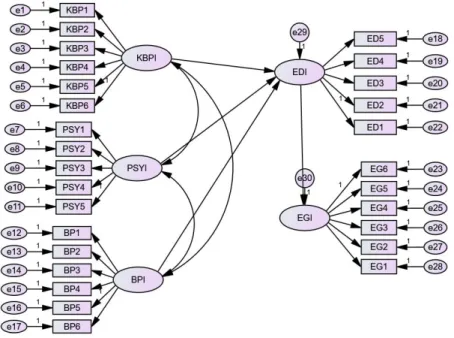
It is clearly shown in figure 1 that the constructed knowledge of business practice (KBP) psychological indicator (PSYI), and business performance indicator (BPI) are the independent variables with their respective measurement variables. The endogenous construct – entrepreneurship development indicator (EDI) intervening between the independent variable and outcome construct known as economic growth indicator (EGI) is the focus of this very study. The variables that make up each construct are seen in Appendix 1; table A to E.
Figure 1: proposed structural equation modelling of women entrepreneurship development
2.4 Tested assumptions: Convergent and Discriminant validity 2.4.1 Convergent validity
One peculiarity of structural equation modelling (SEM) is that they are subordinated to a series of hypotheticals. Before the examination of the study suppositions or hypotheses progressed, we checked the position of the establishment of some supposition which includes unit dimensionality, convergent validity, and discriminant validity. The unit dimensionality approach was used to ensure that the observation with the highest estimate was set to constant to enable the SEM to converge easily and produce the best result with a better fit index.
Convergent validity: it is a theoretical base that describes the observable indicators which relate to the degree of measures on how the construct is related (Agarwal et al., 2011). On the other hand, convergent validity should not be lower than 0.5 (Carlson and Herdman, 2012).
The study of Fornell and David (1981) examined convergent validity using the composite reliability (CR) or measure of trustability test and average variance extracted (AVE). The CR is a measure of internal consistency in scale particulars which Fornell and David (1981);
Brunner and Süß (2005) contend that the standard for the establishment of the supposition is 0.7. Though, this value is still debatable as others like Diamantopoulos and Siguaw (2000) suggested a standard of 0.6 value.
Likewise, AVE is the average quantum of variance in measured variables that a construct observation can explain (Brunner and Süß, 2005; Tellis et al., 2009). The standard for the establishment of AVE is 0.5 (Fornell and David, 1981; Brunner and Süß, 2005). Table 1 reflects the establishment of convergent validity of the five indicators conceptualized by the study. The result (Table 1) shows that knowledge of the business practice (KBP), business
performance (BP) indicator(s), psychological indicator (PSYI), and entrepreneurship development indicator (EDI) were completely established. Likewise, the study shows that the economic-growth indicator (EGI) was partly established based on acceptable CR and AVE standards. With these values, we are expecting the SEM analysis to return a result with a good model fit index to support the study findings. This women’s insight into business performance will help to gauge the success of the business performance and management strategies. Their knowledge of business practice will help them to maintain and position themselves toward keeping the right documentation for institutional transactions. Information on psychological indices will help to instigate the women to take up an insurance cover while taking the risk involved in the entrepreneurship world. Furthermore, the entrepreneurship development indices will help the women to select the category of practice they want to involve themselves in. Equally, by economic growth indices; the women are expected to have started reporting improvement in livelihood as a result of their participation in the entrepreneurship world.
Table 1: convergent validity of study indicators
Indicators CR AVE Determinants Decision
KBPI 0.849 0.556 0.832 Established
PSYI 0.878 0.500 0.726 Established
BPI 0.928 0.606 0.611 Established
EGI 0.763 0.361 0.913 Partly established
EDI 0.869 0.495 0.741 Established
Source: Field Survey, 2020 2.4.2 Discriminant validity
A default explanatory factor analysis (EFA) was estimated to calculate the discriminant validity of the SEM data. Discriminant validity is the extent to which measures of different constructs diverge or minimally relate to one another (Engellant et al., 2016). For the supposition to be completely established, the AVE estimated should be higher than the squared correlation estimates (Hair et al., 2006). Inversely, for a respectable discriminant validity test of any two constructs, the AVE for construct one says knowledge of business practice and the AVE for construct two says business performance needs to be larger than the shared variance (square of the correlation) between the two constructs (Bentler and Bonett, 1980). This means that the constructs should have a weak association to enable the variables to converge. The measurement variables associated with each construct are presented in appendix 1 Table A to E.
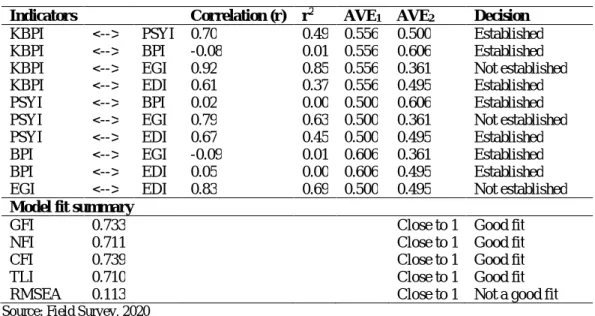
Table 2 represents the result of the discriminant validity test which shows that Knowledge of business practice indicator (KBPI) and psychological indicator (PSYI), Knowledge of business practice indicator (KBPI) and business performance (BPI), Knowledge of business practice and entrepreneurship development indicator (EDI), psychological indicator and business performance indicator, psychological indicator and entrepreneurship development indicator, business performance indicator and economic growth indicator (EGI), and business performance indicator and entrepreneurship development indicator are fully established.
However, psychological indicator (PSYI) and economic growth indicator, Knowledge of business practice indicator and economic growth indicator, and economic growth indicator and entrepreneurship development indicator are not established. This signals a high
correlation between the indicated constructs. Therefore, there is a need to watch out for the variables. This association was established using Amos version 24 software.
Table 2: Discriminant validity of study indicators
Indicators Correlation (r) r2 AVE1 AVE2 Decision KBPI <--> PSYI 0.70 0.49 0.556 0.500 Established KBPI <--> BPI -0.08 0.01 0.556 0.606 Established KBPI <--> EGI 0.92 0.85 0.556 0.361 Not established KBPI <--> EDI 0.61 0.37 0.556 0.495 Established PSYI <--> BPI 0.02 0.00 0.500 0.606 Established PSYI <--> EGI 0.79 0.63 0.500 0.361 Not established PSYI <--> EDI 0.67 0.45 0.500 0.495 Established BPI <--> EGI -0.09 0.01 0.606 0.361 Established BPI <--> EDI 0.05 0.00 0.606 0.495 Established EGI <--> EDI 0.83 0.69 0.500 0.495 Not established Model fit summary
GFI 0.733 Close to 1 Good fit
NFI 0.711 Close to 1 Good fit
CFI 0.739 Close to 1 Good fit
TLI 0.710 Close to 1 Good fit
RMSEA 0.113 Close to 1 Not a good fit
Source: Field Survey, 2020
Down the Table 2 is the model fit summary of the EFA, the five parameters used to judge the fitness of the model include the goodness of fit indices (GFI), comparative fit index (CFI), Tucker-Lewis index (TLI), normed fit index (NFI), and root mean square error of approximation (RMSEA) out of which Kenny (2012) editorialized that a GFI, CFI, NFI, and TLI closer to one shows a good model, while the RMSEA should be near to zero. Four (GFI, CFI, NFI, and TLI) out of five parameters agree with the work of Kenny (2012). The model is fit to accept the result of the discriminant validity. The study can then be proceeded to investigate the structural interactions between the indicators for the study outcome.
III. RESULT AND DISCUSSIONS
3.1 Regression relationship between the construct and observed variables
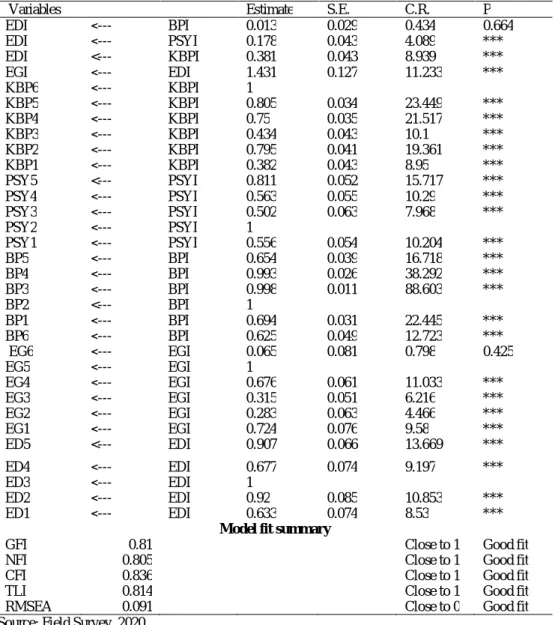
Table 3 shows the result of the default SEM analysis done to determine the regression coefficient or measure of the construct indicators and their measurement variables as well as the relationship between all the construct indicators. Down the table is a model fit summary showing a GFI (0.810), NFI (0.805), CFI (0.836) and TLI (0.814) which is near to 1 and an RMSEA (0.09) near to zero which is in agreement with Kenny (2012). This suggests that the model was veritably a good fit model since they are within the appropriate standard suggested by Bentler (1990).
This regression weight represents the causal effect and relationship between the latent or constructs on the observed variables. As earlier defined, KBPI, PSYI and BPI are the exogenous or independent construct, EDI is the mediator, and EGI is the outcome construct.
The majority of the estimates in Table 3 were significant at a 1% level of probability.
Improved marketing strategies (KBP6), self-confidence (PSYI2), profit venture (BP2), improved business knowledge/skills (ED3), and increased financial security through savings (EG5) were the measurement variables assumed to have a constant relationship with the latent loading as suggested by the model revision or modification history. The unchanging understanding of the aforementioned variables will continue to help women to perform better in their economic activities. We found that only the psychological indicator ( = 0.178), and knowledge of business practice indicator ( = 0.381) are the constructs that have a positive and direct relationship with the mediator variable (entrepreneurship development indicator) at a 1% level of probability. These causal effect sizes or relationship of 0.178 (PSYI) and 0.381 (KBP) implies that a 1% increase in these constructs will increase the women's entrepreneurship development ability by 17.8% and 38.1% respectively. Therefore, the more the women are abreast with psychological (risk-taking, desire to be independent, etc.) and knowledge of business practice (record keeping, ICT compliance, maintaining a business account, etc.) indices, the better their chances of business survival. This will as well help to develop them into full-blown micro and small-scale entrepreneurs to guarantee their economic performance and independence from family support. This finding that psychological and knowledge of business practice indices helps to metamorphose women into better micro and small-scale entrepreneurs agrees with Zenobia’s (2018) study on entrepreneurship upon which this present study is anchored. Also, the entrepreneurship development indicator ( = 1.431) has a significant and positive relationship with the economic growth indicator at a 1% level of probability. Thus, the casual effects size of 1.431 (EDI) on economic growth (EGI) implies that a unit increase in the number of women that are entrepreneurially inclined with the understanding of entrepreneurship concept such as higher formalization of business, improved agency of business performance, ability to access loan for business expansion, etc. will increase economic growth of the women by over a 100%
in the study area. This suggests that entrepreneurship remains the best approach to economic empowerment in Nigeria.
The study equally reveals that the knowledge of business practice indicator (KBPI) had a positive and significant relationship at a 1% level of probability with all the measurement variables in the group and their causal effect sizes are 0.805 (separating family and business income), 0.750 (maintaining a separate business account), 0.434 (stockkeeping), 0.795 (record keeping), and 0.382 (use of ICT tools) respectively. The association between the measurement variables and the KBPI construct is large, suggesting that women with better insight into business performance tend to be more sustainable in their entrepreneurship quest.
This is because the knowledge applied will bring a lasting impact on their micro and small- scale business practices.
Psychological indicator (PSYI) had a positive and significant relationship at a 1% level of probability with all the measurement variables under the group, the causal effect sizes are 0.811 (openness to change), 0.563 (desire for self-independent), 0.502 (teamwork), and 0.556 (decision-making capacity). Women that are psychologically balanced and understand the value of teamwork will progress better in the world of entrepreneurship because they will leverage on opportunities around their environments, again, how they perceived changes like the outbreak of Covid-19 among other issues to a great extent affects their entrepreneurial involvement.
Table 3: Regression relationship between the construct and observed variables
Variables Estimate S.E. C.R. P
EDI <--- BPI 0.013 0.029 0.434 0.664
EDI <--- PSYI 0.178 0.043 4.089 ***
EDI <--- KBPI 0.381 0.043 8.939 ***
EGI <--- EDI 1.431 0.127 11.233 ***
KBP6 <--- KBPI 1
KBP5 <--- KBPI 0.805 0.034 23.449 ***
KBP4 <--- KBPI 0.75 0.035 21.517 ***
KBP3 <--- KBPI 0.434 0.043 10.1 ***
KBP2 <--- KBPI 0.795 0.041 19.361 ***
KBP1 <--- KBPI 0.382 0.043 8.95 ***
PSY5 <--- PSYI 0.811 0.052 15.717 ***
PSY4 <--- PSYI 0.563 0.055 10.29 ***
PSY3 <--- PSYI 0.502 0.063 7.968 ***
PSY2 <--- PSYI 1
PSY1 <--- PSYI 0.556 0.054 10.204 ***
BP5 <--- BPI 0.654 0.039 16.718 ***
BP4 <--- BPI 0.993 0.026 38.292 ***
BP3 <--- BPI 0.998 0.011 88.603 ***
BP2 <--- BPI 1
BP1 <--- BPI 0.694 0.031 22.445 ***
BP6 <--- BPI 0.625 0.049 12.723 ***
EG6 <--- EGI 0.065 0.081 0.798 0.425
EG5 <--- EGI 1
EG4 <--- EGI 0.676 0.061 11.033 ***
EG3 <--- EGI 0.315 0.051 6.216 ***
EG2 <--- EGI 0.283 0.063 4.466 ***
EG1 <--- EGI 0.724 0.076 9.58 ***
ED5 <--- EDI 0.907 0.066 13.669 ***
ED4 <--- EDI 0.677 0.074 9.197 ***
ED3 <--- EDI 1
ED2 <--- EDI 0.92 0.085 10.853 ***
ED1 <--- EDI 0.633 0.074 8.53 ***
Model fit summary
GFI 0.81 Close to 1 Good fit
NFI 0.805 Close to 1 Good fit
CFI 0.836 Close to 1 Good fit
TLI 0.814 Close to 1 Good fit
RMSEA 0.091 Close to 0 Good fit
Source: Field Survey, 2020
Business performance indicator (BPI) had a positive and significant relationship at a 1% level of probability with all the measurements variables in the group, their causal effect sizes are 0.654 (reduced inactivity), 0.993 (increase in the size of the inventory), 0.998 (availability of market for the products), 0.694 (improved access to credit), and 0.625 (increased business savings). The observations of these measured variables underlying the business performance indicators hopes to improve entrepreneurs during appraisals and the business growth period.
Entrepreneurship development indicator (EDI) had a positive and significant relationship at a 1% level of probability with all the measurement variables, they had a causal effect value of 0.907 (higher formalization), 0.677 (improved agency over business decisions), 0.920 (increases in capital investment), and 0.633 (ownership of a business). Agency involvement in creating women entrepreneurs will be beneficial to ensure that their business is properly registered with legal institutions to ensure the future sustainability of the enterprise. They have to understand that fund is needed for business expansion and such fund comes through a loan, this justifies the need to formalize their business to encourage the financial institution to grant such loan request.
Economic growth indicator (EGI) had a positive and significant relationship at a 1% level of probability with only four measurement variables out of the six observations, those significant had a causal effect size of 0.065 (contributing to personal and children school fare), 0.676 (reduction in financial dependence), 0.315 (increase in affordable health care fee), 0.283 (contributes to the family food budget), and 0.724 (increase in revenue or income). These practices would make the women independent of relatives for financial support since they are economically viable. Again, their standard of living and participation in economic activities will be tremendously improved. The study by Liu and Liu (2021) submitted that empowering women will bring about vitality to promote profitable growth.
3.2 Mediation analysis
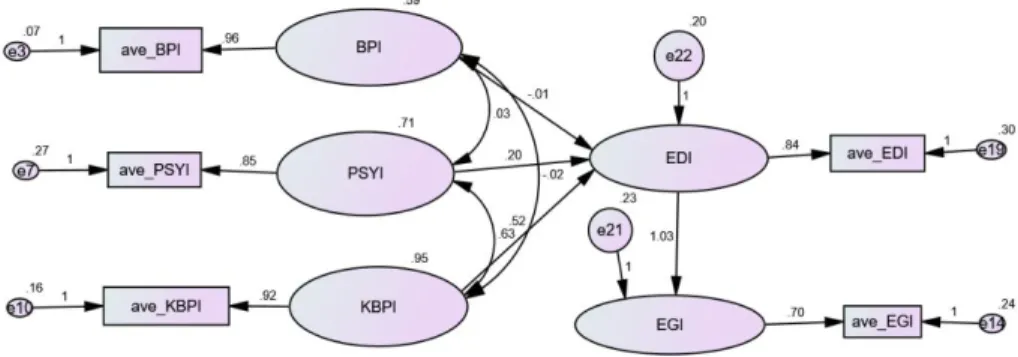
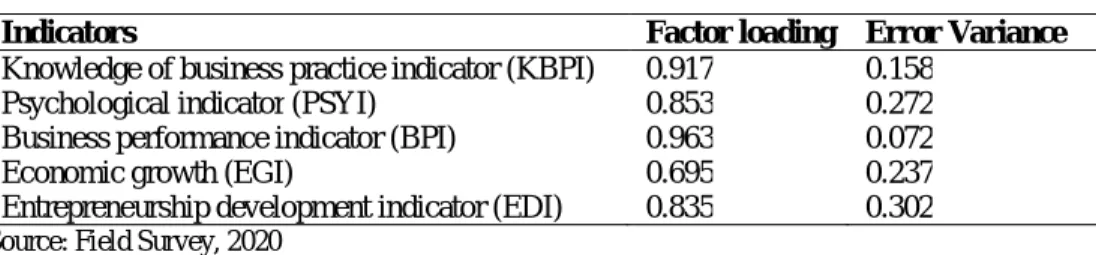
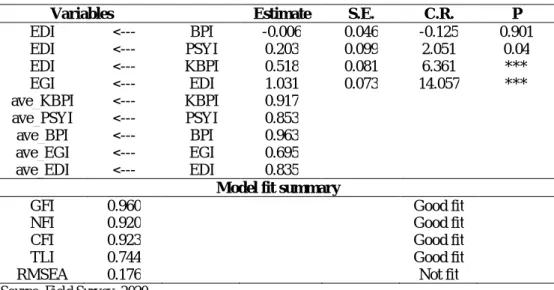
Table 5 shows the result of the mediation analysis executed to test for the stated supposition or hypotheses, while figure 2 is graphical evidence of how the model was arranged in Amos version 24 software. For simplicity, we calculated the average of all the measurement variables that made up each indicator(s) to enable the researcher(s) to prepare for the mediation estimation (see Table 5). The factor loading (square root of CR) and error variance (1 – CR) were likewise calculated and hand loaded into the path diagram. The result of the above exercise is presented in Table 4.
Figure 2: Mediated arrangement of the indicators
Below Table 5 is the model fit summary which had GFI, NFI, CFI, TLI, and RMSEA values of 0.960. 0.920, 0.923, 0.744, and 0.176 respectively. Four (GFI, NFI, CFI, and TLI) out of the five fit indices were in agreement with Engellant et al. (2016) and Kenny (2012) recommended standard except for RMSEA whose value is near 1 against the standard value of 0.06.
Table 4: Factor loading and error variance hand loaded into Amos software
Indicators Factor loading Error Variance
Knowledge of business practice indicator (KBPI) 0.917 0.158
Psychological indicator (PSYI) 0.853 0.272
Business performance indicator (BPI) 0.963 0.072
Economic growth (EGI) 0.695 0.237
Entrepreneurship development indicator (EDI) 0.835 0.302 Source: Field Survey, 2020
From Table 5, the coefficient of psychological indicator (PSYI) was positive and significant at a 5% level of probability. The implication is that a 5% increase in PSYI will cause a 20.3%
increase entrepreneurship development ability of women in Nigeria. Also, the measure or coefficient of knowledge of business practice indicator (KBPI) was positive and significant at a 1% level of probability. The implication is that a 1% increase in the KBPI will cause a 51.8% increase in the development of entrepreneurship capability among women in Nigeria.
This is in agreement with the study of Cho and Honorat (2014) and Zenobia (2018) who identified knowledge of business practice as an agent of entrepreneurship development. This finding revealed a direct and significant relationship between PSYI and KBPI with EDI.
The coefficient of entrepreneurship development indicator (EDI) was positive and significant at a 1% level of probability, this implies that a 1% increase in the women's entrepreneurial ability will increase the economic growth of women by 134.1%. This finding was expected as the result is in agreement with the result of Cho and Honorat (2014) who contend that entrepreneurship development acted as an intermediate variable for an outcome effect of economic growth. Empowering more women through entrepreneurship skills will help not just to better their livelihood but grow the GDP of the nation.
Table 5: A mediation analysis
Variables Estimate S.E. C.R. P
EDI <--- BPI -0.006 0.046 -0.125 0.901
EDI <--- PSYI 0.203 0.099 2.051 0.04
EDI <--- KBPI 0.518 0.081 6.361 ***
EGI <--- EDI 1.031 0.073 14.057 ***
ave_KBPI <--- KBPI 0.917 ave_PSYI <--- PSYI 0.853
ave_BPI <--- BPI 0.963
ave_EGI <--- EGI 0.695
ave_EDI <--- EDI 0.835
Model fit summary
GFI 0.960 Good fit
NFI 0.920 Good fit
CFI 0.923 Good fit
TLI 0.744 Good fit
RMSEA 0.176 Not fit
Source: Field Survey, 2020
3.3 Mediation establishment
Table 6 reflects the result of the mediation agreement or establishment used to test the null hypotheses which assume that entrepreneurship development does not mediate business performance indicators to economic growth (Ho1), entrepreneurship development does not mediate psychological indicators to economic growth (Ho2), and entrepreneurship development does not mediate knowledge of business practice indicators to economic growth (Ho3). The economic growth of this present study is assumed to be a sustained improvement in the livelihood of women involved in entrepreneurship activities. From the result, we fail to reject supposition one, while we make bold to reject suppositions two and three. Therefore, the study has established that entrepreneurship development completely mediated psychological indicators and knowledge of business practice indicators to the economic growth of women entrepreneurs in the study. This finding is a confirmation that developing entrepreneurs in an economy is tied to the nation’s economic growth as promoted by Zenobia (2018).
Table 6: Mediation establishment
A B C D E F G
Indicators a*b ( ) ( ) Sqrt. (C + D) B/E Decision rule
BPI -0.006 0.002 0.0001 0.047 -0.13 Fail to reject
PSYI 0.209 0.010 0.0002 0.103 2.03** Rejected
KBPI 0.534 0.007 0.0014 0.092 5.83*** Rejected
Source: Field Survey, 2020.
Note: Z-tab = 1.96 @ 0.05.
IV. CONCLUSION
The method of structural equation modelling (SEM) was used to objectively examine the mediating role of entrepreneurship development in the economic growth of women in Nigeria.
The study uncovered the actuality of three suppositions to find out if the independent constructs (KBPI, PSYI, and BPI) were mediated to the outcome (economic growth) through entrepreneurship development. The data collected from a cross-section of 500 women micro and small-scale entrepreneurs were subjected to various degrees of reliability or trustability check to ensure they are eligible for the SEM interactions.
The study found that separating family and business income, maintaining a separate business account, stockkeeping, record-keeping, and use of ICT tools are the knowledge of business practice indicators that stimulate entrepreneurship development. Also, openness to change, desire for self-independent, teamwork, and decision-making or timbered capacity are the psychological indicators that stimulate entrepreneurship development among women.
Likewise, reduced inactivity, increase in the size of the inventory, availability of market for the products, improved or bettered access to credit, and increased business savings are the business performance indicators that stimulate entrepreneurship development among women.
All these indices worked collectively to promote and ensure sustainable improvement in the livelihood status of women. Therefore, the study recommends that government and non- governmental agencies should concentrate effort to train women to come near competence in their economic activities that will graduate them from hustlers to scalable startups, from micro-businesses to small-scale entrepreneurs which are the onions of this work. One reason
to subject the women to a series of entrepreneurship training remains the fact that business performance indices which include improving women's access to credit, increasing the size of their inventory, and increasing business savings among others are still insignificant in the study.
If a concerted effort is put in place to address women's inactivity; it will help to increase the in-flow of women into the entrepreneurship world because empowering women will bring about vitality to promote profitable growth, by catalyzing advanced formalization of businesses which is seriously lacking among practitioners of small business; scalable startup, hustler, and buyer entrepreneurs. Also, it will help bettered agency over business opinion or decisions, increases in capital investment, and ownership of a business as entrepreneurship development indices. Above all, entrepreneurship development intention will help the women to grow economically in the areas of contributing to personal and children's school fees, reduction in financial dependence, increase in affordable health care fees, contributions to the family food budget, and increase in revenue or income ability.
From Table 6, the study empirically contributes that entrepreneurship development completely mediated psychological and knowledge of business practice indicators to economic growth at 5% and 1% levels of significance respectively. This study summarized those women with better knowledge of business practice do better as an entrepreneur because they are prepared to take risks and force economic change in their welfare and livelihood status.
ACKNOWLEDGEMENT: We acknowledge that this is an original paper and has not been previously accepted for publication by any journal house. The first attempt to send the paper to the Journal of Entrepreneurship and Innovation was rejected at the review stage for reason that the subject area is not within their scope of coverage. However, the paper has a preprint DOI as: https://doi.org/10.21203/rs-129774/v1
REFERENCES
Addison, T. (2015). Thirty years in Africa's development: From structural adjustment to structural transformation? No wp-2015-119, WIDER Working Paper Series, World Institute for Development Economics Research (UNU-WIDER).
Adu, R., Ioannis, L. and Mark, B. (2019). Real exchange rate and asymmetric shocks in the West African Monetary Zone (WAMZ), Journal of International Financial Markets, Institutions and Money, 59(C): 232-249.
Agarwal, S., Amromin, G., Ben-David, I., Chomsisengphet, S. and Evanoff, D. (2011). Financial Counseling, Financial Literacy, and Household Decisionmaking. In: Mitchell OS, Lusardi A, editors. Financial Literacy: Implications for Retirement Security and the Financial Marketplace. Oxford: Oxford University Press, pp. 181–205.
Alina-Petronela, H. (2012). Concepts of Economic Growth and Development. Challenges of Crisis and Knowledge. Economy Transdisciplinarity Cognition, 15(1): 66-71.
Anju, S.C. (2015). Economic Empowerment of Rural Women Entrepreneurs in Rajasthan through Self- help Group: A Case of SAKHI. Advances in Economics and Business Management, 2(3): 287- 292.
Ayoade, O.E. and Agwu, M.E. (2016). Employment Generation through Entrepreneurial Development:
The Nigerian Experience. British Journal of Economics, Management & Trade, 11(3): 1-14.
Bentler, P.M. and Bonett, D.G. (1980). Significance test and goodness of fit in the analysis of covariance structure. Psychological Bulletin, 88: 588-606.
Bentler, P.M. (1990). Comparative fit indexes in structural models. Psychological Bulletin, 107: 238- 246.
Bodunrin, A.K. (2014). The Problems and Prospects of Entrepreneurship Activities and Business Management Practices in Nigeria. European Journal of Business and Management, 6(13): 58- 61.
Bollen, K.A. (1989). A new incremental fit index for general structural equation models. Sociological Methods and Research, 17: 303-316.
Brunner, M. and Süß, H. (2005). Analyzing the Reliability of Multidimensional Measures: An Example from Intelligence Research. Retrieved November 30, 2020 from:
http://citeseerx.ist.psu.edu/viewdoc/download?
Bula, H.O. (2012). Entrepreneurship Development, Culture and Practice: A Theoretical Analysis of Literature. International Journal of Emerging Technology and Advanced Engineering, 2(8):
456-466.
Byrne, B.M. (2004). Testing for multigroup invariance using AMOS Graphics: A road less traveled.
Structural Equation Modeling, 11(2): 272-300.
Carlson, K.D, and Herdman, A.O. (2012). Understanding the Impact of Convergent Validity on Research Results. Organizational Research Methods, 15(1):17-32.
doi:10.1177/1094428110392383
Cho, Y. and Honorati, M. (2014). Entrepreneurship programs in developing countries: A meta regression analysis. Labour Economics, 28: 110–130.
Clogg, C.C., Petkova, E. and Shihadeh, E.S. (1992). Statistical methods for analyzing collapsibility in regression models. Journal of Educational Statistics, 17(1): 51 74.
Dani, R. (2007). One Economics, Many Recipes: Globalization, Institutions and Economic Growth.
Princeton University Press. Available at:
https://edisciplinas.usp.br/pluginfile.php/4093442/mod_resource/content/0/Rodrik%2C%20 Dani%20One%20Economics%20%E2%80%A2%20Many%20Recipes.pdf
Diamantopoulos, A. and Siguaw, J.A. (2000). Introducing LISREL. Sage Publications, London.
Douglas, G., Tian, C., Paw, W. and Hui, Z. (2013). Introduction to mediation analysis with structural equation modeling. Shanghai Arch. Psychiatry, 25(6): 390-394.
Engellant, K.A., Holland, D.D. and Piper, R.T. (2016). Assessing Convergent and Discriminant Validity of the Motivation Construct for the Technology Integration Education (TIE) Model. Journal of Higher Education Theory and Practice, 16(1): 37-50.
Fornell, C. and David, F.L. (1981). Evaluating structural equation models with unobserved variables and measurement error. Journal of Marketing Research, 18(1): 39-50.
Fox, L., and Kaul, U. (2017). The Evidence is in: How Should Youth Employment Programs in Low Income Countries be Designed. USAID. Retrieved from https://static.globalinnovationexchange.org/s3fs-public/asset/document/YE_Final-
USAID.pdf
Golla, A., Malhortra, A., Nanda, P. and Mehra, R. (2011). Understanding and Measuring Women’s Economic Empowerment: Definiion, Framework and Indicators. International Center for
Research on Women (ICRW)
http://www.icrw.org/pdf_download/1659/download/34839c01dffefeaedd9799c26ebb2ad9
Hair, J.F., Marko, S., Lucas, H. and Volker, K. (2014). Partial Least Squares Structural Equation Modeling (PLS-SEM): An Emerging Tool for Business Research. European Business Review, 26(2): 106-121.
Hair, Jr., J.F., Black, W.C., Babin, B.J., Anderson, R.E. and Tatham, R.L. (2006). Multivariate data analysis (6th Ed.), Pearson-Prentice Hall, Upper Saddle River, NJ.
Ikeije, U.C. and Onuba, C.O. (2015). Contributions and challenges of entrepreneurship in Nigeria: a sociological analysis. European Journal of Business and Innovation Research, 3(3): 1-9.
Imai, K., Keele, L. and Tingley, D. (2010). A general approach to casual mediation analysis.
Psychological Methods, 15(4): 309 334.
Jae-Hyeon, A. and Suk-Gwon, C. (2004). Assessing the contribution of knowledge to business performance: the KP3 methodology. J.-H. Ahn, S.-G. Chang / Decision Support Systems, 36:
403–416, doi:10.1016/S0167-9236(03)00029-0
Kenny, D.A. (2012). Measuring model fit. http://davidakenny.net/cm/fit.htm
Liu, Y. and Liu, Z. (2021). Ecology mechanism of female talents social mobility, Ecofeminism and Climate Change, 2(2): 103-108. https://doi.org/10.1108/EFCC-12-2020-0036
MacKinnon, D. and Fairchild, A. (2009). Current directions in mediation analysis. Current Directions in Psychological Science, 18(16): 20.
Mills, H., Gerber, C. and Terblanche-Smit, M. (2016). Business performance measurement: Does size matter? Risk governance & control: financial markets & institutions / Volume 6, Issue 3, Summer 2016, Continued 2Special issue "Risk Management and Corporate Governance in
African Countries". Available online at:
https://www.researchgate.net/publication/311333236_Business_performance_measurement_
Does_size_matter#fullTextFileContent
Henrekson, M. and Sanandaji, T. (2020). Measuring Entrepreneurship: Do Established Metrics Capture Schumpeterian Entrepreneurship? Entrepreneurship Theory and Practice, 44(4): 733–760.
https://doi.org/10.1177/1042258719844500
Henrekson, M. and Sanandaji, T. (2014). Small business activity does not measure entrepreneurship.
Proceedings of the National Academy of Sciences, 111(5): 1760–1765, doi:10.1073/pnas.1307204111
Ndulu, B.J. (2007). Challenges of African growth: Opportunities, constraints, and strategic directions.
World Bank Publications. Available at:
https://web.worldbank.org/archive/website01010/WEB/IMAGES/AFR_GROW.PDF Newsom, E.R., Fassbender, A.J., Maloney, A.E. and Bushinsky, S.M. (2016). Increasing the usability
of climate science in political decision-making. Elementa: Science of the Anthropocene, 4:
000127, doi: 10.12952/journal.elementa.000127
Obianefo, C.A., Meludu, T.N. and Onah, O.G. (2019). Agribusiness Development on Pro-vitamin A Cassava Recipes among Female Youth in IFADValue Chain Development Programme in Southeast Nigeria. International Journal of Science and Research, 8(9): 1148- 1153.
Obianefo, C.A., Osuafor, O.O., Ezeano, C.I. and Anumudu, O.O. (2020). Mediation effect of adopting good agronomic practices on rice productivity in Anambra State, Nigeria. International journal of agriculture and Rural Development, 23(1): 4913-4926
Obianefo, C.A., Osuafor, O.O. and Ng’ombe, J.N. (2021). On the Challenges Faced by Female Members of Agricultural Cooperatives in Southeast Nigeria. Journal of Agricultural Extension and Rural Development, 13(1): 94-106, doi: 10.5897/JAERD2021.1227.
OECD (retrieved 2022). Indicators of entrepreneurial determinants. Available online at:
https://www.oecd.org/sdd/business-stats/indicatorsofentrepreneurialdeterminants.htm.
Okeke, M.I. and Eme, O.I. (2014). Challenges facing entrepreneurs in Nigeria. Singaporean Journal of Business Economics and Management Studies, 3(5): 18-34.
Rajeshwari, M. (2015). A Study on Issues and Challenges of Women Empowerment. Journal of Business and Management, 4(1): 13-19.
Ravallion, M. (2007). Inequality is Bad for the Poor, Chapter 2 in Inequality and Poverty Re-examined, ed S. Jenkins and J. Micklewright, 37-60. New York: Oxford University Press. Available at:
https://blogs.commons.georgetown.edu/economicsofpoverty/files/2015/12/Inequality-is- Bad-for-the-Poor-Jenkinsand-Micklewright-Chapter-2.pdf
Raykov, T. (2005). Bias-corrected estimation of noncentrality parameters of covariance structure models. Structural Equation Modeling, 12(1): 120-129.
Rusu, S., Isac, F., Cureteanu, R. and Scorba, L. (2012). Entrepreneurship and entrepreneurs: A review of literature concepts, African Journal of Business Management, 6(10): 3570-3575.
Schreiber, J. B. (2008). Core reporting practices in structural equation modeling. Research in Social &
Administrative Pharmacy, 4(2): 83-97.
Schumpeter, J.A. (1934). The theory of economic development. Neo Brunswick, NJ and Londi, UK:
Transaction Publisher (Original work Published 19)
Schumpeter, J.A. (1942). Capitalism, socialism and democracy. New York: Harper & Row, p. 132 Selvi, N. and Bakialekshmi, S. (2017). Challenges of women empowerment in a private organization in
Malaysia. International Journal for Studies on Children, Women, Elderly and Disabled, 1(1):
90-96
Sharifah, S. (2015). Affirmative Policy Implementation and Women Empowerment in Malaysia Public Sector. Proceedings of the Australasian Conference on Business and Social Sciences (in partnership with The Journal of Developing Areas).
Smriti, C. (2020). Entrepreneurship: Characteristics, Importance, Types and Functions of
Entrepreneurship. Available online at:
https://www.yourarticlelibrary.com/entrepreneur/entrepreneurship- characteristicsimportance-types-and-functions-of-entrepreneurship/5228
Sule, O.E., Amuni, S.I. and Batholomew, P. (2018). Entrepreneurship as a Business Organization:
Nigeria Perspective. International Journal of Economic Theory and Application, 5(1): 13-21.
Swetha, M., Reddy, M.J.M., and Sudharani, V. (2014). Extent of Empowerment of Women Entrepreneurs on Entrepreneurial and Technological Empowerment. Journal of Extension
Education, 26(4): 5333-5337. Available at:
https://backup.extensioneducation.org/index.php/jee/article/view/66
Tellis, G.J., Yin, E., and Bell, S. (2009). Global consumer innovativeness: Cross-country differences and demographic commonalities. Journal of International Marketing, 17 (2): 1-22.
Uzonwanne-Obianefo, R.N., Igweh