However, the treatment assigned to a unit may be a function of the covariates of other units in the sample, creating dependencies between the unit-specific observed data structures. In such a study, the chances of enrollment may differ depending on the characteristics of the subgroup to which the enrollees are assigned (for example, the extent to which the subgroup includes charismatic or vocal individuals who have failed similar weight loss programs in the past.) . Finally, a special case of the general experiment described in this paper is one where the treatment allocation for each unit in an i.i.d.
Depending on the basic characteristics of the sample, each individual's treatment assignment is independent; For example, the sample can be divided into groups according to a known algorithm applied to the baseline characteristics of the sample, and the intervention is randomly assigned within each group. Under both formulations of the data-generating experiment, the observed data is Oi = (Wi, Ai, Yi), i = 1, . On), under distributionPn, is given by.
1, allows treatment to be assigned to each unit in the sample according to a separate unit-specific mechanism that may depend on the baseline covariates of the entire sample. The following theorem presents the canonical gradient of the pathwise derivative of the parameter Ψ: Mn → IR. Derivation of the canonical gradient of the pathwise derivative of the target parameter Ψ allows us to construct a directed minimal loss estimator (TMLE).
This equation will be a crucial ingredient for establishing dual robustness and asymptotic normality of the TMLEΨ(Q∗s).
Statistical inference
Ifgni =gi, andg¯n = ¯g0, andCj(Wn) are singletons, then it can be shown that the asymptotic variance is consistently estimated as. Note that this latter variance estimator is the estimator one would have used if one treated the sample as independent observations and ignored the adaptivity of the design. In the special case of adaptive pair-matching designs (and hence g¯n = ¯g0 and ICW = D∗W), we prove below that under a mild condition the same estimator (4.2) of the asymptotic variance remains conservative ifQ¯∗nis inconsistent for trueQ¯0.
Finally, if the design g0n is actually unknown and thus must also be estimated, and if we assume that this design is estimated stably, then we conjecture that the asymptotic bound variance described above will be conservative, due to the result general that estimating a factor orthogonal to the likelihood (ie, the tangent space of the treatment mechanism is orthogonal to the tangent space of the corresponding Q factors) generally improves the asymptotic variance (Theorem 2.3 of van der Laan and Robins (2003)). We have the following theorem which establishes the asymptotic normality of the TMLE presented in Section 4 and thus in particular the basis for the variance estimator presented in Section 4.2. Asymptotic linearity of the function ofg¯n: Assume that for a function ICW,i,¯gofW with zero mean and finite variance (uniformly ini).
Under certain treatment allocation mechanismsgn0,i, the contributions captured by XW,n in this statement might require a more general representation XW,n= 1/√. Depending on the applications of interest, we can pursue such a more general representation of this theorem with little additional work. In the special case that Cj(Wn) are singletons, it follows that σ20 can be consistently approximated with 1/nP.
The entropy condition is equivalent to assuming that F is a Donsker class and is thus a natural condition that places (minimal) constraints on the size of the class F. For example, one can define F as the class of multivariate real valued functions, that has a uniform section variation norm bounded by a universalM <∞(van der Laan (1996); Gill et al. To demonstrate the condition (5.1), we consider the special case that Cj(Wn) is singletonsj = 1,.
This leaves open a number of key questions regarding the design and analysis of experiments in which matched pairs are constructed based on the application of some algorithm to the underlying characteristics of the entire sample (adaptive pair matching). And finally, under what conditions will adaptive pair-matching provide a more efficient estimator than that provided by a non-matching design.
Estimation of the average treatment effect
Statistical inference
In particular, previous literature on pair-matched tests considered the pair as the unit of independence (Freedman et al. Estimation of σ2Y can be based on Theorem 2, which shows that σY2 is consistently approximated by 1/nP. In the implementation of ' n substitution estimator ofσ2Y, we naturally replacedQ¯∗ byQ¯∗n (the updated fit ofQ¯0 on which the TMLE substitution estimator ofψ0 is based).
When implementing a consistent estimator of the asymptotic variance of σ2, it may be necessary to estimate Q¯0 with a super learner to be as unbiased as possible (van der Laan et al. In particular, even if a simple parametric regression-based estimator was used as the estimator, the initial estimator of Q¯0 at performing TMLE for ψ0 when estimating σ2 warrants a more flexible approach to estimating Q¯0 in order to reduce bias in the final variance estimator.Interestingly, although we have constructed an estimator of ψ0 that is guaranteed to be consistent and asymptotically normally distributed under misspecified Q¯ ∗n as long as gn0,i is known or well estimated, no such robust estimator of the asymptotic variance of σ2 appears to be available in general.
Fortunately, below we will construct conservative variance estimators that do not rely on a consistent estimator of Q¯0.
Robust conservative estimation of the variance
This theorem, together with Theorem 2, implies that randomized trials with adaptive pair matching can be analyzed without regard to the matching process, both to generate an efficient and unbiased point estimator of the treatment effect and for inferences on this estimator . Assuming that the last covariance term is positive, as would be expected if units were effectively matched to predictors of the outcome, a variance estimator that treats the data as if it were i.i.d. In general, one can aim to construct a target Cl known to be Cl≤C, and estimate the variance using σI,n2 −Cl,n, where Cl,nis is a consistent estimator of Cl.
In this case, we want to find such aCl that can be consistently estimated without relying on the consistent estimator Q¯0. This will be done in the next two subsections, possibly resulting in a much less conservative variance estimator.
Comparison of the “naive” variance estimator with the true variance
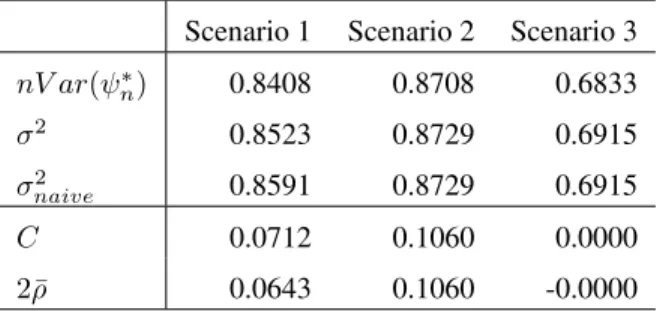
This expressionσ2 was represented as the asymptotic variance σ2I of this TMLE under i.i.d sampling of PQ0,g0, i.e. Let us compare this true asymptotic varianceσ2/n of the unadjusted estimator with the variance estimate used in current practice, which we will refer to as the "naive" variance estimator. The true asymptotic variance and the naive asymptotic variance are respectively given byσ2/nand(0.5 σ2naive)/(n/2) = σ2naive/n given.
To show that a naive variance estimator represents a conservative variance estimator, we would have to show that. So, if the latter covariance term Cov( ˜Q0(W1),Q˜0(W2)) is non-negative, then the naive variance estimator is conservative. Thus, we can conclude that, in general, the naive estimator of the variance is a conservative estimator.
We also note that if there really is no treatment effect, conditional on the covariates, then this covariance term is equal to zero, so the naive variance estimator is unbiased.
A general conservative estimator of the asymptotic variance of TMLE
This estimator can be seen as the generalization of the "naive" variance estimator for the unadjusted estimator of ψ0, analyzed in the previous subsection.
A simulation confirming the variance formula for the unadjusted estima- tor
Scenario 3 corresponds to setting β2, β3 and β4 to zero to examine the asymptotic variance if the underlying variables (used for matching) do not affect the result.
Efficiency gains due to adaptive pair matching
The same asymptotics can be applied, and the formulas for the asymptotic variance are the same as those presented earlier, with the only modification that gi(a|Wi) is now replaced by ngagi(a,1|Wi). We calculated the efficient influence curve of the target parameter for the statistical model implied by this design without making additional assumptions about the joint distribution of the full PX,0 data. Further, when the groups are of size 2 or larger, the asymptotic variance of the TMLE under dependent sampling rests on a stable estimator of Q¯0 even when known.
We further considered adaptively tailored trials as an important special case of the general dependent treatment allocation design. We formally compared the asymptotic variance of TMLE under this design with that of TMLE under i.i.d. We also showed that under the pairwise matching model and the positive correlation condition, a variance estimate that treats further observations as i.i.d.
We have shown that the estimator of the variance for the unadjusted estimator as currently used by practitioners in the analysis of paired associated trials is also valid, and our above less conservative variance estimator is just a generalization of this estimator. However, understanding the complications arising from the adaptive pair matching requires advanced empirical process theory, and makes even the analysis of the unadjusted estimator a serious challenge. Targeted maximum likelihood estimation of the parameter of a marginal structural model. Int J Biostat 6(2), Article 19.
A case study of an adaptive clinical trial in the treatment of outpatients with major depressive disorder. Journal of the American Statistical Association. The random play-the-winner rule in medical trials. Journal of the American Statistical Association. By factoring the probability, this is also the canonical gradient for any modelMnwhich instead assumes thatg0n∈ Gn for a modelGn.
In order to establish the asymptotic linearity of ZW,¯gn, we therefore need to study form conditions√. For the paired matching design, the asymptotic varianceσ2 of the TMLE is given by the bound on There is an important connection between the orlics norm and a bound on the tail probability of the random variable.
As we'll see, one of the main things we'll need is a bound on kXn(f)kψ in terms of d(f, f) for the semimetric ionF.