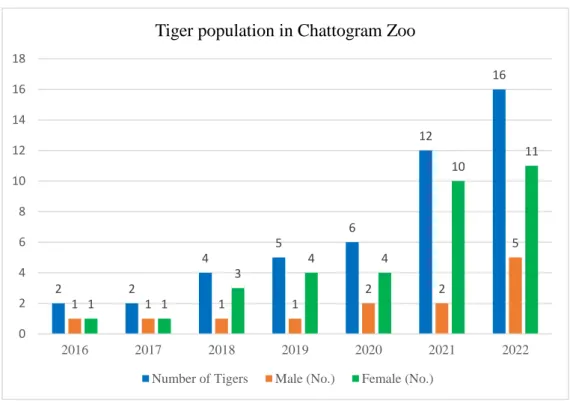
The most famous Royal Bengal Tiger is the tiger of the Sundarbans (Panthera tigris tigris), as they like to live in the mangrove. Besides, due to effective management, the population of the almost extinct Sambar deer is also expanding here. Due to the efficient action of the management committee and the Chattogram District Commissioner, this zoo works for the recreation of the visitors as well as the implementation of the educational programs.
In the future, this zoo adopts various policies to increase the number of endangered species. Tiger conservation is an extremely emerging issue these days and obtaining up-to-date knowledge of the feeding, management, behavior and reproductive parameters of this species can contribute to conservation policy. To investigate the behavioral changes of the tigers in captivity and in the presence of the visitors.
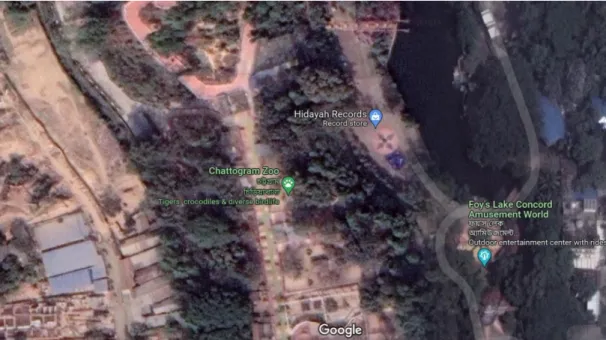
It is situated between the hill ranges and the Bay of Bengal, on the banks of the Karnaphuli River. First, we developed a structured open-ended questionnaire for qualitative and quantitative data about the growth, feeding, reproduction and behavior of captive tigers. In the roaming area, half of the cage was covered with a roof, while the other half was open.
It also served the zoo's "no feeding by visitors" policy and reduced disturbance to the tigers.
Feeding
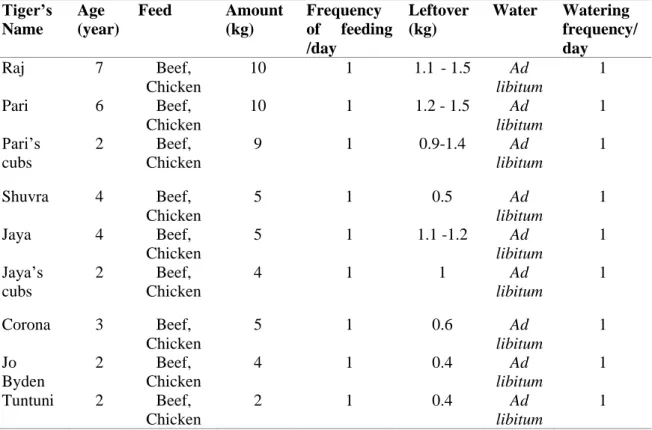
After they finished feeding, they were allowed to walk around the walking area while the keeper cleaned the leftovers and troughs. Feeding normally lasted one to two hours and approximately 0.5 to 1.5 kg of leftovers were available from the daily meals, with most of the leftovers being bones. According to Schaller (2009), Bengal tigers required between 5.4 and 6.8 kg per day during long-term feeding in the wild.
In a study on the population characteristics of tigers and their prey, Tamang (1979) pointed out that free tigers consume 7 kg daily. However, Sankhala (1977) suggests that a tiger in the wild consumes about 10–12 kg of meat per day. It is important for the breakdown of fats in the body, which reduces the incidence of diabetes, arthritis, obesity, and reproduction (Bahar, 2020).
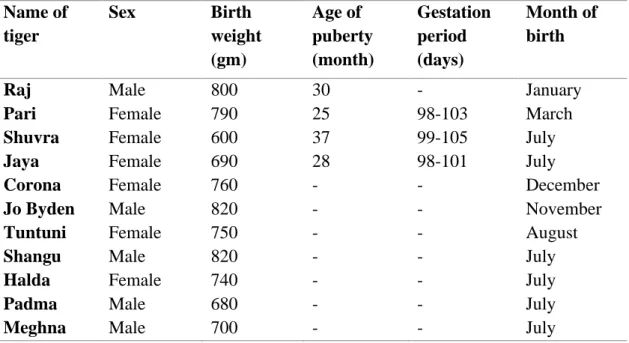
During the study period, we collected the reproductive parameters of the tigers shown in Table 2. Sexual maturity was reached at four to five years in males and three to four years in females in the wild Royal Bengal Tiger. The maximum age of the tiger in captivity has been recorded as twenty to twenty-six years; this may also be close to their natural age.
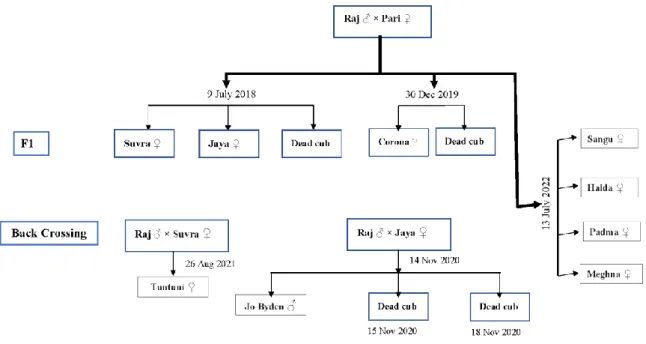
We evaluated the morphology of the cubs, the average size of the litter, the percentage of mortality of the females (Pari, Jaya and Shuvra), which are shown in Table 3. During the observation period, Shuvra's and Jaya's children grew up under the loving care of the curator. To introduce the new cub to the cage, they first kept him in the cage with his urine and feces for a few days so that the other tigers could get to know his scent and that when the new cub was introduced to the cage, the others did not suddenly show aggression.
When the baby was placed in the cage, he was carefully watched every moment. From day one, the time spent in the cage was gradually increased in order to get comfortable in the new environment and with the new companions. Joe Biden, the third cub, then grew up in the quarantine center office and a room at the zoo under the care of the deputy curator and two other staff members.
Vaccination and medication history
Behavior
Lions and tigers usually stalk their prey before attacking from a short distance or lying in wait to ambush the prey as it wanders in the wild (Guggisberg, 1975; Seidensticker & McDougal, 1993). Whenever he walked in front of the cage, everyone started roaring at the sight of him. During our study period, we did not design any enrichment procedures that are typically designed to elicit typical feeding behaviors observed in nature.
On presentation day, Fish reduced stereotypic tiger behavior from 60% to 30% of scans. In another study, a tigress in estrus became restless and moved frequently, marking enclosure structures, i.e. wall, fence (chain mesh). After a successful mating, the tigress lay still for three to five minutes before rolling onto her back.
The tigress in estrus has begun the mating process. 1996) also found that to attract the male, female tigers engaged in a variety of mating activities. 21 | p. when a little swelling was seen on one side of the tigress's abdomen, the pregnancy was confirmed and then special care was given to the tigress. To provide privacy, the entire cage was covered with a black curtain during this time so that the tiger tree does not feel any discomfort.
They saw that the tigress can also eat the droppings of the cubs to protect them from potential predators that detect their scent. They are often seen moving their young from one place to another in their cages. Therefore, the tigress and her cubs were observed for 10 hours immediately after birth.
The mother's refusal to give the cub at first parity may be due to her previous experiences and the fact that she was not used to feeding her young. These types of neglected cubs were separated shortly after birth because the curator recognized their behavioral history. 22 | Page and it may be crucial to initiate the circulation of the cubs immediately after parturition (Guggisberg, 1975). The presence of visitors near the enclosure, occasionally in the building, or in the immediate vicinity of the animals, is a regular occurrence for the animals during the zoo's opening hours (Salas & Manteca, 2017).
Introduction of captive animals in the wild
In this present study, we have provided sufficient information about housing, diet, behavior and reproductive parameters of tigers of Chattogram zoo. The data from other zoos and safari parks can enrich the information on breeding and management of captive tigers in Bangladesh. Research on Human Royal Bengal Tiger Interaction of In Situ and Ex Situ in Bangladesh.
Prey abundance and food habits of tigers (Panthera tigris tigris) in Pench National Park, Madhya Pradesh, India. American Journal of Physical Anthropology: Official Publication of the American Association of Physical Anthropologists. In Tigers of the World: Biology, Biopolitics, Management and Conservation of an Endangered Species (pp. 149–160).
The effect of visitor density on the behavior of two Siberian tigers (Panthera tigris altaica) housed in a zoo enclosure. Prey selection by tigers (Panthera tigris tigris) in the Karnali floodplain of Bardia National Park, Nepal. Welfare, husbandry and veterinary care of wild animals in captivity: changes in attitudes, advances in knowledge and techniques.
Biological studies of the white tiger Panthera Tigris linn with special reference to Nandankanan Biological Park Orissa India. I would also like to thank the managers of Chattogram Zoo for support and for providing the necessary material for the study. After completing her DVM degree, she will engage in the research field.
Her research interests include working with bioinformatics and she also has an interest in wildlife conservation.