They have shown that poultry can be a means of improving the income and food security of the poorest people. It is an integral part of the agricultural sector of the village community (according to the 1996 agricultural census published in July 1999). The majority of rural households in Bangladesh maintain poultry for their family income and consumption.
The relevant agencies, individuals and policy makers will benefit from the research's recommendations. The research will be useful to chicken and egg producers as it will give them insight into the relative profitability of chicken farming. The measurements of variables depended on the reporting of the farmers in most cases who could remember or collect incorrect information along the way.
Most of the owners of chicken farms thought that the investigator was an agent of government authority and therefore they initially did not want to cooperate with the researcher. Alam (2001) conducted a similar nature of study in 5 districts of Bangladesh and evaluated the impact of interventions made by the Smallholder Livestock Development Project (SLDP) on the socio-economic condition of the poor people. As a result, they are robbed, suffer losses as many of the birds have died due to diseases.
Based on the field study, some recommendations are also made for policy makers and implementing agencies to consider in order to improve the applicability of the partial broiler poultry model in Bangladesh.

Analytical Techniques
RESULT & DISCUSSION
- Traditional Managemental practices followed by the owners of chickens
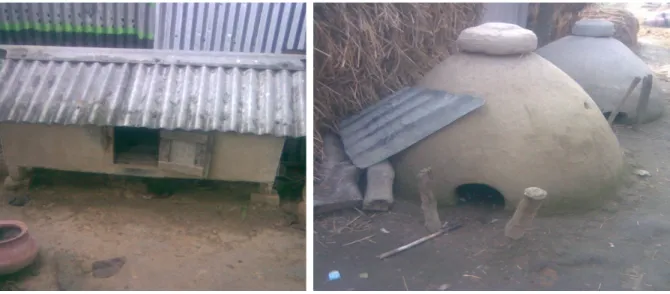
- Housing
- Feeding management
- Differences in feeding of chickens in the three regions
- Breeding
- Incubation of eggs
- Report about early chick mortality
- Reasons for chickens rearing
- Procurement and sale
- Frequency of disease prevalence
- Existing preventive approach
- Vaccination
- Land holding sizes of the farm owners
- Livestock strength of the farm owners
- Constraints faced by backyard chickens rearers
In village chicken production systems, it is difficult to estimate the economic and/or physical value of this input because there are no direct methods to estimate the feed resources consumed, which constitute the majority of the feed input. Chickens are the most efficient type of poultry for processing fallen grain from the field, insects and plant material. Seventy-nine percent of respondents fed their birds crushed grain as available in season, but feeding practices are causal, with no separate feeding for chicks and adults.
It is difficult to assess the diet pattern of chickens due to the adhoc supplementary feeding system. About 75% of farmers allowed their chickens to clean for 2-4 hours per day, while 25% of farmers allowed their chickens to clean for less than 1 hour. Most of the farmers reported that they had their own source of supplementary feed for chickens, while others collected from the open market and feed vendor.
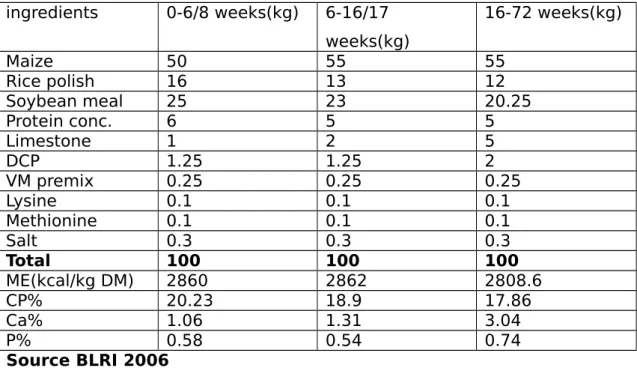
The table above shows that most people give their chickens supplemental feed to get more eggs and meat, so backyard hens also lay quite a lot. The differences in the types of feed and the composition of mixed feed and the amount of feed supplied to the chickens are shown in Table 7 and it shows that 55% of the farmers in Patija used mixed feed and only 2% of the farmers in Patija. fed their chickens extra rice. Differences in types of feed used by farmers (%) and withdrawal period in different locations.
The time of sexual maturity of the local breeds of chickens in the present study agreed with previous works (Hassan, 1997). The number of eggs laid for incubation varies from 10-15 per chicken according to 80% of the respondents and the rest of the respondents said that 13-18 eggs are laid for incubation per chicken. Forty-five percent of respondents said that the largest number of birds die in the 1-7 day age group.
Eighty-five percent of people said that birds are used for consumption during festivals and special occasions; and percentage of rural family rest use chickens for traditional rituals and. Fifty-seven of the 75 respondents said that backyard chickens could be a good source of income. Ninety percent of respondents found that there was no problem in buying or selling chickens in the village itself.
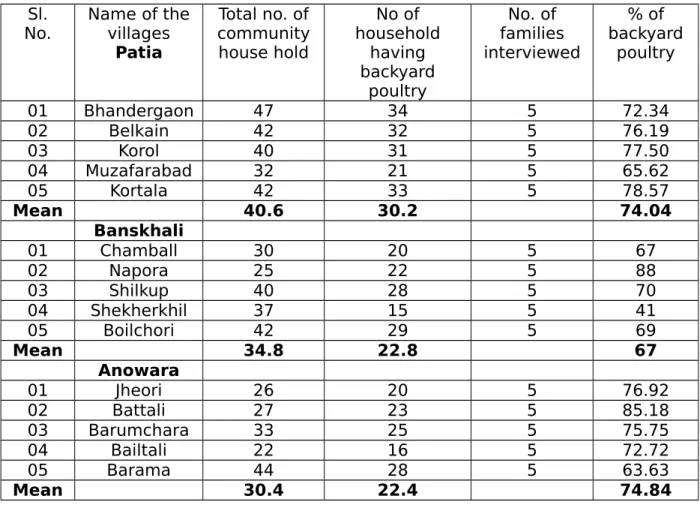
In Patia, 3 out of 25, in Banskhali 2 out of 25 and in Anowara 1 out of 25 respondents said that vaccination and deworming was done as a routine preventive measure and the remaining farmers did not do vaccination &. It also shows that 36% of all farmers in the survey were in the category of landless, small and marginal, medium and large land farmers in Patija.

CONCLUSION AND RECOMMENDATION
Conclusion
Recommendations
Stress and other less infectious diseases worsen the health condition leading to higher mortality, so stress management should be maintained during the first week of growth and glucose or salt water may be used.
Performance of Khaki Campbell, Jinding and Khaki Campbell × Native ducks in integrated fish-cum-duck rearing system. Egg production, feed consumption, viability and egg characteristics of bareneck, hillbill and other native chickens under local conditions. Monitoring the health of semi-breeder chickens reared under domestic chickens in Chatkhil, Noakhali District, Bangladesh, A final report submitted to the Smallholder Livestock Development Project-2 (SLDP The Department of Livestock Services (DLS), Bangladesh.
Comparative egg production and egg quality of indigenous full-feather and bare-neck chickens in hot humid climates. 34; Status of Food Security in Bangladesh in the Context of Sustainable Livelihood Improvement." published in Bangladesh Journal of Extension Education, Vol. No. 16 (Special Issue), pp. , Bangladesh Agricultural University, Mymensingh, Bangladesh, Report No.
A comparative study of performance of Khaki Campbell and India Runner ducks under BAU farm condition. Poultry as a tool in poverty alleviation – Experience of BRAC in implementing the model, - A workshop paper held in Dhaka, Bangladesh, October International Network for Family Poultry Development. Proceedings of the First Annual Livestock Research Workshop, Bangladesh Livestock Research Institute, Savar, Dhaka, Bangladesh pp: 63-67.
QUESTIONNAIRE THAT WAS FOLLOWED DURING STUDY