A Convolutional Neural Network Approach to Recognize The Insect: A Perspective in Bangladesh
BY
Md. Mushfiqul Islam ID: 161-15-6842
and
Md. Imran Hossain ID: 153-15-6554
and Bidhan Paul ID: 161-15-6786
This Report Presented in Partial Fulfillment of the Requirements for The Degree of Bachelor of Science in Computer Science and Engineering
Supervised By Abdus Sattar Assistant Professor Department of CSE
Daffodil International University
DAFFODIL INTERNATIONAL UNIVERSITY
DHAKA, BANGLADESH DECEMBER 2019
ACKNOWLEDGEMENT
First we express our heartiest thanks and gratefulness to almighty God for His divine blessing makes us possible to complete the final thesis successfully.
We really grateful and wish our profound our indebtedness to Abdus Sattar, Assistant Professor, Department of CSE Daffodil International University, Dhaka. Deep Knowledge & keen interest of our supervisor in the field of “Human Computer Interaction in Education” to carry out this thesis.
His endless patience ,scholarly guidance ,continual encouragement , constant and energetic supervision, constructive criticism , valuable advice ,reading many inferior draft and correcting them at all stage have made it possible to complete this thesis.
We would like to express our heartiest gratitude to Prof. Dr. Syed Akhter Hossain, Professor and Head, Department of CSE, for his kind help to finish our thesis and also to other faculty members and the staff of CSE department of Daffodil International University.
We would like to thank our entire course mate in Daffodil International University, who took part in this discuss while completing the course work.
Finally, we must acknowledge with due respect the constant support and passion of our parents.
ABSTRACT
In Bangladesh huge amount of agricultural products are destroying by the pests every year due to lack of poor knowledge about pest detection. As we know that manually identification is difficult for a farmer. So, classic pest detection and identification can ensure excellent productivity. This would be a fulfil research in the technical area of computer vision. The dataset is typically random cropping of square size images together with grayscale color and brightness shifts are used here.
Here Convolutional Neural Network (CNN) will be used to do the image recognition and the algorithm will provide an optimal architecture for image recognition. The big idea behind CNNs is that a local understanding of an image is good enough. The research contains the proportions of validation accuracy of 93.46%. This approach resulted in the agriculture sector that will help a farmer to recognize the insect from harvest. The computer vision and object recognition can be used with image processing to create an interactive and enlarge user experience of the real world.
This research aims to demonstrate the possibility and test the performance of the project which only focuses on insect detection in crop plants that recognize the pest which can help a farmer to get immediate solution of harvest problem.
TABLE OF CONTENTS
CONTENTS
PAGE
Board of examiners i
Declaration ii
Acknowledgements iii
Abstract iv
CHAPTER
CHAPTER 1: INTRODUCTION 1-4
1.1 Introduction
1.2 Motivation 1.3 Problem Definition
1.4 Research Question 1.5 Research Methodology 1.6 Research Objective 1.7 Report Layout
01
02
02
02
03
03
03
CHAPTER 2: BACKGROUND 5-7
2.1 Introduction 052.2 Related work 05
2.3 Bangladesh Perspective 07
CHAPTER 3: RESEARCH METHODOLOGY 8-13
3.1 Introduction 083.2Experiment Data Set 08
3.3 Data Pre-Processing 09
3.4 Architecture of the Model 09
3.5 Learning rate and Optimizer of the model 12
3.6 Data Augmentation 12
3.7 Training the model 13
CHAPTER 4: PERFORMANCE OF THE PROPOSED MODEL 14-16
4.1 Training, Testing and the Validation of the model 14
4.2 Model efficiency 15
CHAPTER 5: RESULT COMPARISON AND DISCUSSION 17-18
CHAPTER 6: CONCLUSION AND FUTURE WORK 19
REFERENCES 20
APPENDIX 21
a. Survey form for Farmers 21
LIST OF FIGURES
FIGURES PAGE NO.
Figure 3.1.1 Steps of Data Collecting and Processing 08
Figure 3.2.1 Collected Dataset 09
Figure 3.4.1 Representation of model summary 11
Figure 3.7.1 Convolutional neural network layer 13
Figure 4.1.1 Validation data 14
Figure 4.2.1 (I) Representing training loss and validation loss 15 Figure 4.2.1 (II) Representing training accuracy and validation accuracy 15
LIST OF TABLES
TABLE NO. PAGE NO.
Table 5.1 Comparison with some previous works 17
CHAPTER 1 INTRODUCTION 1.1 Introduction
Bangladesh has made admirable progress in the rural economy sector and specifically agriculture play an emergent role for scaling down poverty. Here 77% workforce of Bangladesh’s population lives in rural areas and the maximum rural households about 87% of farmers depend on the agricultural sector for their diurnal day income. However, our agriculture facing frightens challenges and badly needed the necessary steps to develop the sector. Every year lots of productive agricultural land is lost through non-agricultural use like housing, roads, and another development program. Riverbank erosion, global warming, and climate change affect people who lose everything annually and making them virtually beggars. The most important note that the outbreak of diseases and pests has recently become very sharp due to the unfavorable effects of climate change, especially the rise in temperature. Agriculture is an ancient and developing day by day but due to adverse effects of climate change, the pest disease becomes very severe now.
However, a closer inspection debunks this exaggerated talk that agriculture is really a revelation sector of several sciences and a neatly engaged emanation system. Biology and zoology are the main ecosystems that involve the complicated knowledge of nature and insects are generally identified by farmers. But sometimes they can’t identify the pest clearly. As we know that Bangladesh is a developing country but the agriculture sector does not grow in parallel with the country and the technologies. A pest that makes diseases are the main reason behind it. Most of the diseases are unknown to the farmer and they also don't know the new technologies in our country. This research's aim is to detect the pest of the plant and that will help to get a better profit from the harvest.
In Bangladesh, an everyday agricultural scientist discovering new pest and they are making the solution to the problem. But the pests are totally unknown to the farmer. When they are facing the problem in their harvest land for the pest they can’t get rid of the problem. By eating leaves Pests is quickly injured to the plants and sneaking holes in stalk, fruit and roots. Viral or fungal infection is also dangerous for harvest. The research mainly focuses on agricultural crops that can identify the pest in a different position or angle of the pest. If the pest is on the leaf, fruits, ground or
anywhere it can detect and can provide the details of the pest species. And then it can give an idea about the pest that, what kind of diseases can create on the plant or fruit and then it will provide a better antidote for the pest.
1.2 Motivation
In recent years, Bangladesh is going through an ICT revolution. The development of Bangladesh in the field of information and communication technology is remarkable. But the application of ICT in the field of agriculture is very limited. Moreover, Bangladesh is an agricultural country and most of our economic support of this country comes from agriculture. However, due to proper steps farmers cannot enjoy the facilities of ICT in this field. Use of digital devices and update technology is still absent in the field of agriculture. We need to engage more ICT application in this field if we want to develop our agricultural site along with the ICT. Traditional methods are very complicated to detect the problems and find out the possible solutions in this sector. Besides most of our farmers are not educated and that is why it is not very easy to know about the new diseases and insects through blogs and books. AI will help them to find out the insects easily. This thesis focuses on the current status of agriculture in Bangladesh and will try to make a revolutionary change in the field of agriculture using AI and image processing. Which will help the farmers to detect insects easily and perfectly.
1.3 Problem Definition
AI is a very important term in the field of ICT in this modern age. Application of AI will help to develop our agricultural sector. To give a proper solution it’s necessary to find out the problems and related requirements in this field. It’s also necessary to know the government policy or regulations and software industry requirements along with the course methodologies to implement AI in agricultural sector. Go through a short survey on farmers and developers to find out the problems related to agriculture and AI that are the barriers to detect insects.
1.4 Research Questions
Here are the main questions those are focuses in this thesis are given below:
What is the current situation of farmers and the application of AI in the field of agriculture in Bangladesh?
What are the limitations to work with AI in the agricultural sector to detect insects?
How to solve the limitations to detect insects?
1.5 Research Methodology
In this section of our research paper, we reveal the Experiment Data Set, Data Pre-processing, Architecture of the Model, Learning Rate and Optimizer of the Model, Data Augmentation process and Training the Model. At the end of this chapter performance of the proposed model will be described.
1.6 Research Objectives
There are some benefits of using AI in insect detection. There are some technical and agricultural objectives of using AI.
Some of the technical objectives are given below:
Develop an efficient model to detect insects.
To inspire the software developers to work with AI using the model.
Integrate the model in mobile apps and websites.
Some of the agricultural objectives are given below:
Help the farmers to detect unknown insects.
Make the farmers self-dependent.
Reduce the costs of farming treatment.
Increase the production of crops.
Will increase the annual income in agricultural sector.
1.7 Research Layout
Chapter 1: will discuss about introduction, motivation, Problem Definition, Research Question, Research Methodology and the expected outcome of our project.
Chapter 2: will discuss about background of this research and the related work and current status based on Bangladesh perspective and government goals and regulations.
Chapter 3: will describe situation of AI in the field of agriculture in Bangladesh.
Chapter 4: will discuss about development perspective for the AI in agriculture.
Chapter 5: it is focus to the result and benefit of using AI in agriculture.
Chapter 6: It describes the conclusion of this research.
Chapter 7: here all the references we used for this research.
CHAPTER 2 BACKGROUND 2.1 Introduction
In Bangladesh there are no similar work or research was done which can detect insects perfectly.
So the background is the current situation of agriculture and the use of AI in agricultural sector of Bangladesh.
2.2 Related Works
Image processing using CNN, for detection the pest is quite powerful for recognize the image.
Researchers are trying to detect the pest using image processing and different algorithm where a few researchers got success in this type of work.
Hafiz Gulham Ahmed Umar et.al [1] proposed a system to classify insect using image processing and Bayesian network. Aedes aegypti, scarab beetle black widow spider and termite having explicit colors and posture is the subject of this research. They collected 10 samples for each species. Based on color and histogram feature extraction has been used. In this research color shape texture and histogram is used to implement the system. K means clustering method which is used to classify the image. MATLAB has been used to RGB color projection value extraction. The Bayesian network has been used for classifying the images.
Ganesh Badhane et.al [2] build a software prototype model for insect recognition that damages the different leaves. Infected leaves pictures are taken by a camera for processing by image growing and segmentation techniques to find the infected portion of leaves. Background subtraction is used to extract the object. Monika Wadhai et al. (2015) [3] proposed a method that they made a sticky trap which is used to detect the pest. The flying pest can damage the crops at this level. They get rid of it by using pan-tilt camera which can zoom and move continuously to capture the image so that flaying away the pest could not create any problem. The proposed method first read the video which is captured by video reader and then convert it into the frame and save it and then consecutively read two frames and resize them.
Apurva Sriwastwa et al. (2018) [4] used a methodology in this paper are preprocessing image and color-based image segmentation. In preprocessing they transform the image in better quality, convert in grayscale and made adjustment of contrast. They convert the color of theimage in L*a*b color space from RGB color space after that they perform k-means clustering on the image.
Jia Shijie et al. [5] made an automatic system that can identify tomato pest and diseases depending on the surface of the leaf. They used VGG16 algorithm and transfer learning to construct the CNN model to detect the pest. They used the original VGG16 model by the help of fine-tuning algorithm to classify the model. Trupti S. Bodhe et al. [6] mentioned a system for Color image segmentation using entropy for image segmentation to calculate each color space component. Different color space is used, like YUV, HSV, RGB, YIQ, HSI color space for appropriate transform operations.
They cluster pixels into salient image regions. Nguyen Tuan Nam et al. (2018) [7] select three implementation method using CNN. In this, all implementation is based on CNN. First, to achieve classification purposes put together an adaptive threshold function for localizing objects with CNN. Second, for localizing and classifying object using a feed-forward convolutional network used SSD (Single Shot Multi-Box Detector) with CNN. Third, a sliding windows approach with CNN.
Suchang Lim et al. (2018) [8] implemented a Convolutional Neural Network (CNN) approach based on Alex Net to identify how the formation of dataset and kernels values effect on the accuracy of the model. Their proposed CNN model has a total of five convolutional layers. After that applied k-fold cross-validation to check that, the competency of the CNN could be changed depending on how the training dataset and test dataset are designed when the dataset is well- formatted. According to the value of k 10 sample, CNN was built. Yufeng Shen et al. (2018) [9]
used R-CNN with the deep network for making faster running speed. They used SVD operation to improve inception model and the operation was 199M smaller than the original model size. They used the high-resolution image in their model then the performance was improved but got lower running speed.
Medhani Menikdiwela et al. [10] proposed a network using VGG16 based on convolutional neural network (CNN). Feature activation mapping technique used for the work that is different from other working methods. By using low-level feature maps and the high-level maps this system produces a feature activation map. Denan et al. [11] (2018) implemented a model with a combination of VGG19 and RPN. By the pre-training VGG19 model the weights of the network were initialized. The two models VGG19 and RPN can be periodically trained to optimize them exceedingly train two separate networks. First, they trained the RPN network for learning an image and the predict region generated using RPN was input to VGG19 network to train itself.
The research can give a spanking framework to support the research. Here all the literature survey paper is talking about pest identification and several researchers made a variant solution to recognize the insect. The main goal of this paper is to find out the pest and provide a piece of better information to the farmer and somehow here all the literature survey paper is related to the goal of this paper.
2.3 Bangladesh Perspective
In Bangladesh's perspective the great threat of increasing crop productivity is a huge population that has become a vulnerable threat for the crop. The majority of the farm that constitutes by small and marginal farmers who are financially poor cannot afford high-level technology which can detect and can give a solution to this problem. In our country, our government always try to help our farmer but they don't have a good knowledge of technology. Some farmers are unskilled about insect detection and cannot use exact medicine for this insect. Some are well known about insects but don't know the proper solution to it. The government doesn't give enough effort into researching our farming problems, especially insect detection problems. So people can not aware of it. The government doesn't make enough seminars to make good public awareness about insect problems. Due to climate change impacts and lack of modern technology incidence of pests and diseases has lately become severe problems. Due to a lack of enough knowledge about technology farmers have no interest in technology. There is another problem is they are not familiar with technology.
CHAPTER 3
RESEARCH METHODOLOGY 3.1 Introduction
Using Convolutional Neural Network with 6 different classes of images this work achieved 93.46% accuracy.
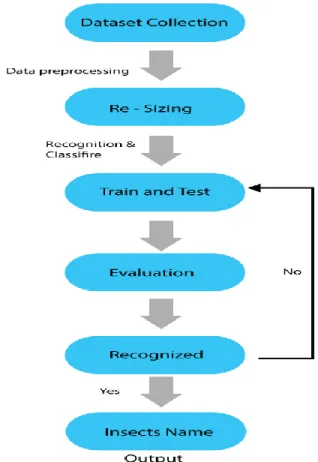
Figure 3.1.1 Steps of Data Collecting and Processing
3.2 Experiment Data Set
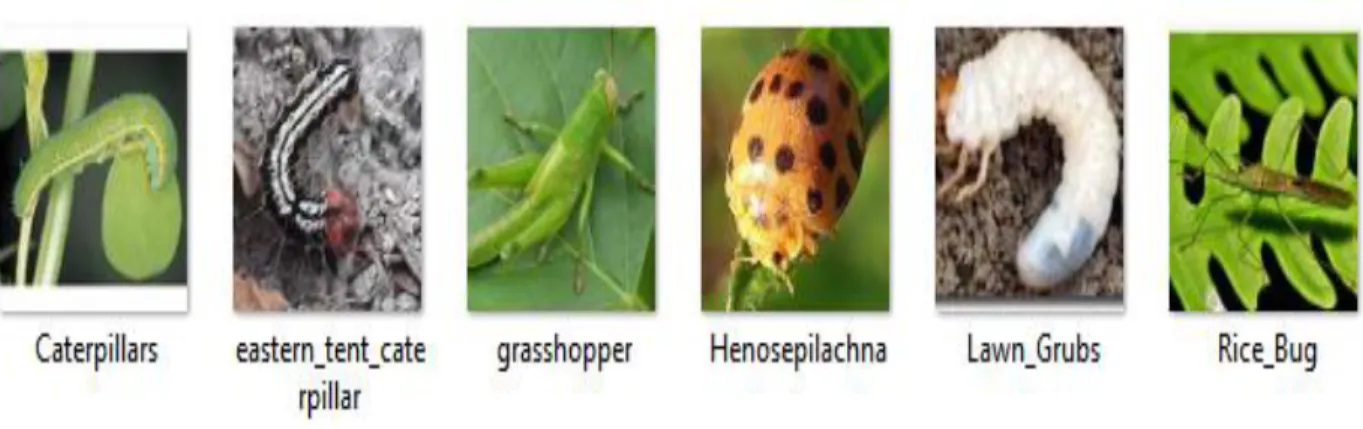
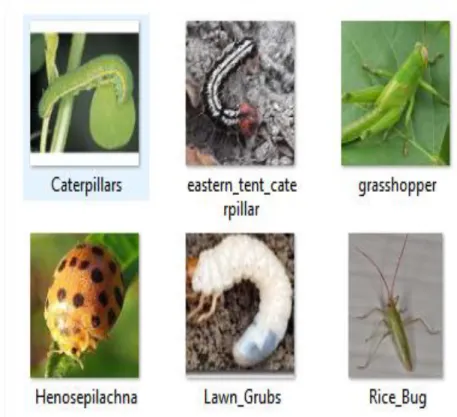
This dataset consists of over fourteen hundred square images and there are six categories. Most of the images of this dataset were captured from fields and trees and others are downloaded from the
web. The grievous things were that collection of all the data manually from field was difficult because of seasonal problem. This dataset is created to perform an image recognition thesis. In this dataset there are around 1600 images, where are around 1200 images for train the model and the rest of this are for the testing purpose. In the research, there is 6 class of train and test data sets.
Around 200 to 250 images have differentiated for training purpose and around 60 to 70 images are picked for testing purposes for each class.
Figure 3.2.1 Collected Dataset
3.3 Data Pre-Processing
All of the data which has been collected from Google and some from manually from the field by smartphone where the images were not in the same size and resolution. When we were trying to train and test the dataset it was very difficult. This version of the dataset containing a fixed resolution of pictures. According to our project requirements, we have converted all images into a square dimension. We made the images to a fixed resolution of 256 × 256 that is the down-sampled of the image. First, we cropped all the images at a variable square dimension for reducing unnecessary objects from the images. Then we scaled it into the required dimension form the cropped images. We use Adobe Photoshop to preprocess all the images. In addition, we trained our model on the RGB color mode.
3.4 Architecture of the Model
The model which is designed to identify the pest from anywhere and there are four convolution layer in the model and the model has two fully connected layers. A fully connected layer is
included with batch normalization, several dense and dropout which can help to utilize the model.
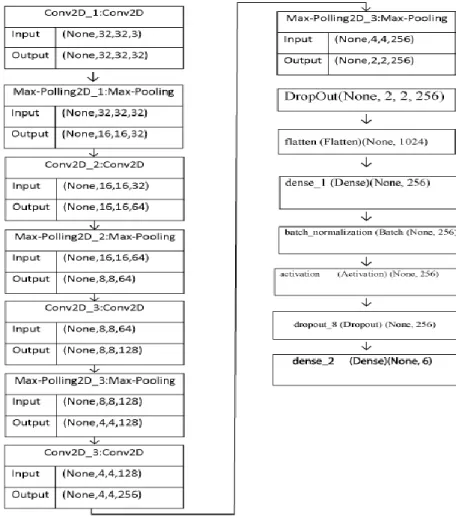
First convolution layer which is considered as input layer and its kernel size is 3 with input shape 32x32 of RGB color mode and the filter size is 32. The layer using ReLU (1) activation with strides (1) and have the same padding property. The ReLU function when get input positive value, it returns that value back and similarly when getting input negative value it returns 0.
f(x)=max (0, x) (1)
The convolution layer 1 output goes to the input of the first max-pooling layer. To make sub- regions binned max-pooling reducing the number of parameters and here the max-pooling layer containing pool size 2 with strides 2. In the second layer, the filter size is 64 with kernel size is 3 and the stride is 1. In this layer has batch normalization to regularize the convolutional network which is vanishing gradient during training and can make better performance and minimize the training time. Here batch normalization is using to makes the learning process quicker and can use the higher learning rate. The result of convolution layer 2 is connected with the next pooling layer.
The layer has also same pool size 2 with strides 2.
Layer 3 holds 128 filter size but the other property of kernel size, strides and batch normalization same as like as layer 2. Layer 3 gives output and the output is associated with the third pooling layer and the pool size, strides is 2. Layer 4 has filter size 256 where it is containing the same feature as like as layer 3. But here in this layer, 25% dropout used to make the model more stable during training and this can be too strong of regularized.
After all this 4 layer there are two dense layers which represent a matrix-vector multiplication. In the first dense layer have 256 concealed units and drop out is 25% with activation value. To tackle the over fitting dropout technique is used here. In the second dense layer, the dense is 6 without drop out to normalize the model and the activation is sigmoid. This how the model is built.
After adding all this layer in the model the result is becoming smooth and noisy free and then adding two fully connected dense layer for making a better performance of the classification task where there are also batch normalization and drop out the property. Then by applying a sigmoid to it, it will convert the data to probabilities for each class. A sigmoid function-
(𝑧)=1/ (1+ⅇ−𝑧) (2)
The binary cross-entropy is helped to define the loss which acts as a loss function for binary classification problems. After that, the optimizer, which will help to perform gradient descent and the metrics set accuracy since this is a classification problem.
The figure 3 which is presenting the architecture of the summary of the model: -
Figure 3.4.1 Representation of model summary
3.5 Learning rate and Optimizer of the model
Based on training data Adam Optimizer 0.001 update network weights and make result faster in the initial learning level. In their technical words of the paper they updated the network weights by passing from one iteration to the next iteration [12]. Weights are updated according to k (3), where k is the iteration index.
wlij(k+l) = wlij(k) - µglij(k) l= 1,2,….L (3)
Learning rate performs best for moth 1x size and 10x model size the same, which means it does not depend on model size. Selecting learning rate is the most momentous hyper parameter for the model. The system (4) of calculation of each update with learning rate decay as bellow:
LR =initial_lrate × (1 / (1 + decay × iteration)) (4)
We have used minimum learning rate reduction 0.000001 and turning down the learning rate quickly reduce the error. We used to call back function to call the learning rate which is supported by Keras. The callback function designed to make a fine-tuning model weight to reduce the learning rate when the model stops improving.
3.6 Data Augmentation
We augmented our train and test data by rotating 30 degrees and the width, height shift range 0.2 where the zoom range is also the same. Transforming training data so that the accuracy and robustness can improve the classifier by the help of data augmentation can generate for each sample xi the network outputs the selected class label yi, as well as a probability pij for each class j [13]. Data augmentation algorithm can be written as:
Using the prediction of the sample the classifier is most sure about:
y = argmaxj max({pij}1≤i≤r) (5)
𝐴𝑣𝑒𝑟𝑎𝑔𝑖𝑛𝑔 𝑎𝑙𝑙 𝑝𝑟𝑒𝑑𝑖𝑐𝑡𝑖𝑜𝑛𝑠: 𝑦 =1
𝑟∑𝑟𝑖=1 pij (6)
For this paper, data augmentation has played an active role in acquiring recent-most wondrous results in many pest detection tasks and it is used in order to enhance generalization feature.
Horizontal flipping, brightness shifts and random RGB color are used with rescaling the image.
Before any other processing, we have to multiply the data then it generates a result is known as rescaling value. The color mode of the model is RGB and the RGB coefficients range is 0 to 255 but at this situation, such values can be so much high for processing the model. So we rescale the image (rescale=1. /255) with a horizontal flip.
3.7 Training the model
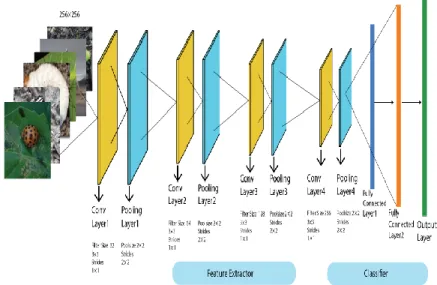
Experiment is carried out with four convolution layer and two fully connected layers. When we train the model with our unique insect data sets that give us a better performance. Batch size 30 was used here with 60 epochs. Our model achieves a marvellous fineness accuracy where the training accuracy is 96.37% and test accuracy is 93.46%. The target size of the image is 32 × 32 both for train and test. The CNN model that is using here can classify the image that is all level with different classes can predict the class of the images accurately.
Figure 3.7.1 Convolutional neural network layer
CHAPTER 4
PERFORMANCE OF THE PROPOSED MODEL
4.1 Training, Testing and the Validation of the model
We separate training data and test data and validation data and the total images are around 1600.
About 77% data (1221 total) used for training and 23% data (377 total) used for testing for the model. There are some data for validation. Tensor Flow and Keras is used as the image processing deep learning framework. We used categorical mode with RGB color mode and the batch size is 30 both training and testing the data sets. The model which is proposed in the research showing a good performance. our validation data containing the pest as like as our train and test data set and also other pests that are unknown for the model look like bellow:
Figure 4.1.1 Validation data
4.2 Model efficiency
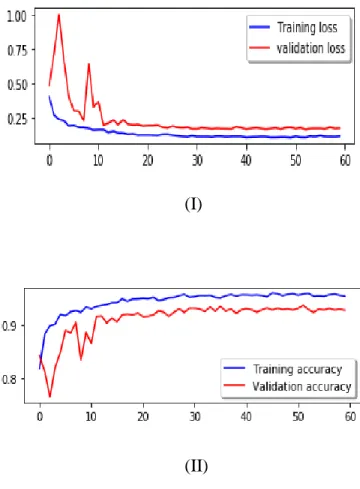
After finishing 60 epochs the model which is used in this work, gained 96.37% accuracy for the training data set that we have made and gained 93.46% accuracy on the testing dataset. Completing the training and testing session the work reaches a successive accuracy rate. Based on the accuracy and the confusion matrix which is gained by this work, it can say that the proposed CNN model is admissible for the insect recognition work. The performance of this work is representing here.
(I)
(II)
Figure 4.2.1 (I) Representing training loss and validation loss (II) Representing training accuracy and validation accuracy.
Accuracy
=
(𝑇𝑃+𝑇𝑁)(𝑇𝑃+𝑇𝑁+𝐹𝑃+𝐹𝑁) (7)
To describe the performance of the classification model the confusion matrix (7) is extensively used. Here the False positive(FP) rate where observation is negative and negative values predicted as positive, True Positive(TP) rate means observation is positive and is predicted to be positive, True negative(TN) rate where Predicted values correctly predicted as an actual negative and false negative(FN) means Positive values predicted as negatively for each type of dataset.
CHAPTER 5
RESULT COMPARISON AND ANALYSIS
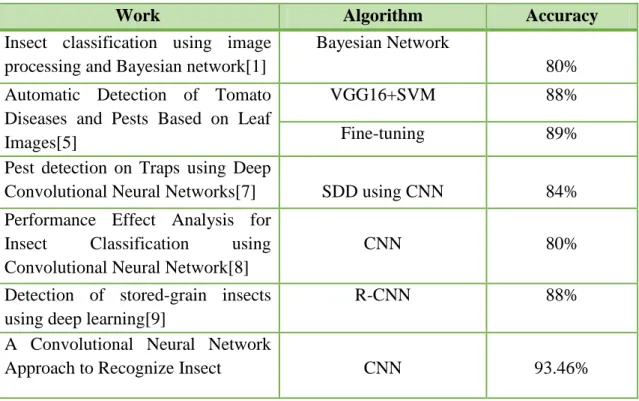
This work gives us the highest accuracy comparing with the other paper. There are some researcher who worked nearly closed to this work. Table 1 exhibiting some Interrelation between our work and some previous work on several insect detections.
Table 5.1 comparison with some previous works:
Work Algorithm Accuracy
Insect classification using image processing and Bayesian network[1]
Bayesian Network
80%
Automatic Detection of Tomato Diseases and Pests Based on Leaf Images[5]
VGG16+SVM 88%
Fine-tuning 89%
Pest detection on Traps using Deep
Convolutional Neural Networks[7] SDD using CNN 84%
Performance Effect Analysis for Insect Classification using Convolutional Neural Network[8]
CNN 80%
Detection of stored-grain insects using deep learning[9]
R-CNN 88%
A Convolutional Neural Network
Approach to Recognize Insect CNN 93.46%
From the above table, we can see many researchers approach different types of algorithms and got various accuracy but from all of the accuracy the highest accuracy is 88%. They used R-CNN with deep network for making faster running speed. They also use high resolution image to get better accuracy but that is not far better than our accuracy. Another researcher got 89% accuracy by fine tuning technology that can classify the image correctly and also used VGG16 original model to get better accuracy but they also have not better accuracy. After reviewing their paper, then implemented a model based on CNN that reached 93.46% accuracy which is higher than all of the work from the above table. The table shows that our accuracy is higher than all of the above works and we just use only CNN and in our data preprocessing, we just resize the image according to our
requirement. This model can correctly identify the insect correctly and it could be a far better solution for our farmers and their farming.
CHAPTER 6
CONCLUSION AND FUTURE WORK
This work mainly focuses on insect detection from any surface by using CNN. We found that CNN is the best way to perform this kind of recognition work. However, this model gain 93.46%
validation accuracy where we can nearly identify the image correctly. Although we have a low amount of data set we have tried our best to get the best accuracy. This type of work can bring a great evaluation in agriculture sector for Bangladesh. Most of the farmer in Bangladesh are illiterate and they can't correctly recognize the insect and they don't know the exact antidote of the insect. That's why the insect gradually destroying the harvest day by day and farmer get to suffer from it. This work can change the situation of the farmer in Bangladesh.
Looking forward our aim is to create an android system that can identify the insect and can give a better antidote for the disease. In future by enhancing our database so that the model can gain far better accuracy and build an android app which is still in the development process. There will be a system where a farmer can get instant service of his problem by detecting the pest easily.
REFERENCE
[1] Hafiz Gulham Ahmed Umar,Qaisar Abbas, Fatima Gulzar “Insect classification using image processing and bayesian network ” ,journal of entomology and zoology studies , 2017.
[2] Ganesh Bhadane, Sapana Sharma and Vijay B. Nerkar, "Early Pest Identification in Agricultural Crops using Image Processing Techniques", International Journal of Electrical, Electronics and Computer Engineering 2(2), 2013, pp. 77-82.
[3] Monika Wadhai, Dr. V.V. Hohokam, Dr.ArtiKhaparde “Agriculture Pest Detection Using Video Processing Technique”, International Conference on Information Processing (ICIP) Vishwakarma Institute of Technology.
Dec 16-19, 2015.
[4] Apurva Sriwastwa,Shikha Prakash,Mrinalini ,Swati Swarit,Khushboo Kumari,Sitanshu Sekhar Sahu, "Detection of Pests Using Color Based Image Segmentation", Proceedings of the 2nd International Conference on Inventive Communication and Computational Technologies (ICICCT 2018)
[5] Jia Shijie, Jia Peiyi, Hu Siping, Liu Haibo, "Automatic Detection of Tomato Diseases and Pests Based on Leaf Images", Chinese Automation Congress (CAC), 2017.
[6] Trupti S. Bodhe,"Selection of Color Space for Image Segmentation in Pest Detection ", International Conference on Advances in Technology and Engineering (ICATE), 2013.
[7] Nguyen Tuan Nam, Phan Duy Hung “Pest detection on Traps using Deep Convolutional Neural Networks”
ICCCV '18, Singapore, Singapore. © 2018 Association for Computing Machinery, June 15–18, 2018.
[8] Suchang Lim, Seunghyun Kim, Doyeon Kim “Performance Effect Analysis for Insect Classification using Convolutional Neural Network” 2017 7th IEEE International Conference on Control System, Computing and Engineering (ICCSCE 2017), 24–26 November 2017.
[9] Yufeng Shen , Huiling Zhou, JiangtaoLi , FujiJian, Digvir S.Jayas,“Detection of stored-grain insects using deep learning”,Computers and Electronics in Agriculture, Volume 145, February 2018.
[10] Medhani Menikdiwela, Chuong Nguyen, Hongdong Li, and Marnie Shaw, "CNN-based small object detection and visualization with feature activation mapping", International Conference on Image and Vision Computing New Zealand (IVCNZ),2017.
[11] Denan Xia, Peng Chen, Bing Wang, Jun Zhang and Chengjun Xie, "Insect Detection and Classification Based on an Improved Convolutional Neural Network", Sensors, November 2018
[12] D.R. Hush and J.M. Salas, "improving the learning rate of back-propagation with the gradient reuse algorithm", IEEE 1988 international conference on neural networks, (1988).
[13] Gil Keren1, Jun Deng1, Jouni Pohjalainen1, Bjorn Schuller "Convolutional Neural Networks with Data Augmentation for Classifying Speakers’ Native Language”, Published in INTERSPEECH 2016.
APPENDIX
Appendix A: Survey form for Farmer
Respondent Information:
Respondent Name : Address :
Crop name :
Date :
Time :
Insects Name
Visibility Solution
Clear Blurry Very Blurry
Known Unknown
Caterpillars
Eastern Tent Cate Rpillar Grasshopper
Henosepilachna Lawn Grubs Rice Bug