1
EFFECT OF SALINITY ON SEED GERMINATION AND SEEDLING ESTABLISHMENT OF Moringa oleifera
KAMAL UDDIN
DEPARTMENT OF AGROFORESTRY AND ENVIRONMENTAL SCIENCE SHER-E-BANGLA AGRICULTURAL UNIVERSITY
DHAKA-1207
JUNE, 2021
EFFECT OF SALINITY ON SEED GERMINATION AND SEEDLING ESTABLISHMENT OF Moringa oleifera
BY
KAMAL UDDIN REG. NO.14-06297
A Thesis
Submitted to the Faculty of Agriculture, Sher-e-Bangla Agricultural University, Dhaka,
in partial fulfillment of the requirements for the degree of
MASTER OF SCIENCE IN
AGROFORESTRY AND ENVIRONMENTAL SCIENCE SEMESTER: JANUARY-JUNE, 2021
Approved by:
Md. Shariful Islam Associate Professor
Supervisor
Dr. Md. Kausar Hossain Professor
Co-Supervisor
Dr. Jubayer-Al-Mahmud Chairman
Examination Committee
3
DEPARTMENT OF AGROFORESTRY AND ENVIRONMENTAL SCIENCE
Sher-e-Bangla Agricultural University (SAU) Sher-e-Bangla Nagar, Dhaka-1207
CERTIFICATE
This is to certify that thesis entitled, “EFFECT OF SALINITY ON SEED GERMINATION AND SEEDLING ESTABLISHMENT OF Moringa oleifera”
submitted to the Faculty of Agriculture, Sher-e-Bangla Agricultural University, Dhaka, in partial fulfilment of the requirements for the degree of MASTER OF SCIENCE (MS) in AGROFORESTRY AND ENVIRRONMENTAL SCIENCE, embodies the result of a piece of bona-fide research work carried out by KAMAL UDDIN, Registration no. 14-06297 under my supervision and guidance. No part of the thesis has been submitted for any other degree or diploma.
I further certify that such help or source of information, as has been availed of during the course of this investigation has duly been acknowledged.
Dated: June, 2021
Place: Dhaka, Bangladesh
Md. Shariful Islam Associate Professor
Supervisor
DEDICATED TO MY
BELOVED PARENTS
i
ACKNOWLEDGEMENTS
All praises, gratitude and thanks are due to the Almighty Allah, the Great, Gracious and Merciful, Whose blessings enabled the author to complete this research work successfully.
The author likes to express his deepest sense of gratitude, sincere appreciation and immense indebtedness to his respected supervisor, Assoc. Prof. Md. Shariful Islam, Department of Agroforestry and Environmental Science, Sher-e-Bangla Agricultural University (SAU), Dhaka, Bangladesh, for his scholastic guidance, support, encouragement and invaluable suggestions and constructive criticism throughout the study period and gratuitous labor in conducting and successfully completing the research work and in the preparation of the manuscript writing.
The author also expresses his gratefulness to respected Co-Supervisor, Prof. Dr. Md.
Kausar Hossain, Department of Agroforestry and Environmental Science, Sher-e-Bangla Agricultural University (SAU), Dhaka, Bangladesh, for his scholastic guidance, helpful comments and constant inspiration, inestimatable help, valuable suggestions throughout the research work and preparation of this thesis.
The author expresses heartfelt thanks to all the teachers of the Department of Agroforestry and Environmental Science, SAU, for their valuable suggestions, instructions, cordial help and encouragement during the period of the study.
The author is also grateful to all his seniors and friends especially for his help, encouragement and moral support towards the completion of the degree.
Last but not least, the author expresses his heartfelt gratitude and indebtedness to his beloved parents, brother, sisters and well-wishers for their inspiration, encouragement and blessings that enabled her to complete this research work.
The Author
EFFECT OF SALINITY ON SEED GERMINATION AND SEEDLING ESTABLISHMENT OF Moringa oleifera
ABSTRACT
A pot experiment was conducted at the agroforestry farm of Sher-e-Bangla Agricultural University, Dhaka during July 2020 to November 2020 to examine the establishment of Moringa seedling under the effect of saline soil. The experiment was set up by taking a single factor: Salinity. The factor had six (6) different levels viz., T0 = 2 ds m-1, T1 = 4 ds m-1, T2 = 6 ds m-1, T3 = 8 ds m-1, T4 = 10 ds m-1, and T5 = 12 ds m-1. The experiment was laid out on simple Randomized Complete Block Design (RCBD) with four replications. Experimental result revealed that in terms of germination percentage (87.5% and 100% at 10 DAS and 15 DAS, respectively), plant height, number of leaves plant-1, branch length, shoot length, and root length, as well as total fresh weight (16.2 g), shoot fresh weight, and root fresh weight, total dry weight (4.97 g), and shoot dry weight and root dry weight, the T0 treatment showed the best performance. While increasing salinity drastically impact on moringa seedling and in this experiment the T5
treatment had shown the worst results in terms of germination percentage (25% and 31.25% at 10 DAS and 15 DAS, respectively), plant height, number of leaves per plant-
1, branch length, shoot length, and root length. Total fresh weight (3.07 g), shoot fresh weight, and root fresh weight (0.50 g), as well as total dry weight (0.50 g), shoot dry weight, and root dry weight, were also low T5 (12 ds m-1) treatment. As the saline content increased, the effect of salt on had a negative impact on seed germination and seedling of moringa seedling.
iii
LIST OF CONTENTS
CHAPTER TITLE PAGE
NO.
ACKNOWLEDGEMENTS i
ABSTRACT ii
LIST OF CONTENTS iii
LIST OF TABLES v
LIST OF FIGURES vi
LIST OF APPENDICES vii
LIST OF PLATES viii
LIST OF ABBREVIATIONS ix
1 INTRODUCTION 1
2 REVIEW OF LITERATURE 4
3 MATERIALS AND METHODS 19
3.1 Experimental site 19
3.2 Condition of the experimental site 19
3.3 Planting materials 19
3.4 Preparation of soil and filling of pots 19
3.5 Experimental treatments and design 20
3.6 Treatments of the experiment 20
3.7 Imposition of salinity treatments 20
3.8 Preparation of stock solution 20
3.9 Sowing of seeds 21
3.10 Seedling raising 21
3.11 Intercultural operations 21
3.11.1 Irrigation 21
3.12 Parameter studied 21
3.13 Procedure of recording data 22
3.14 Data collection stages 22
LIST OF CONTENTS (Cont’d)
CHAPTER TITLE PAGE
NO.
3.15 Data analysis 23
4 RESULTS AND DISCUSSION 24
4.1 Seed germination percentage pot-1 24
4.2 Plant height 25
4.3 Number of leaves plant-1 26
4.4 Branch length 27
4.5 Shoot length 28
4.6 Root length 29
4.7 Fresh weight 30
4.7.1 Effect of levels of salinity on total fresh weight 30 4.7.2 Effect of levels of salinity on shoot fresh weight 30 4.7.3 Effect of levels of salinity on root fresh weight 30
4.8 Dry weight 31
4.8.1 Effect of levels of salinity on total dry weight 31 4.8.2 Effect of levels of salinity on shoot dry weight 32 4.8.3 Effect of levels of salinity on root dry weight 32
5 SUMMARY AND CONCLUSIONS 34
REFERENCES 36
APPENDICES 44
PLATES 49
v
LIST OF TABLES
TABLE NO. TITLE PAGE
NO.
01 Effect levels of salinity on total fresh weight, shoot fresh weight and root fresh weight.
31
02 Effect levels of salinity on total dry weight, shoot dry weight and root dry weight.
33
LIST OF FIGURES FIGURE
NO. TITLE PAGE
NO.
01 Effect of levels of salinity on seed germination percentage pot-1
25
02 Effect of levels of salinity on plant height 26 03 Effect of levels of salinity on number of leaves plant-1 27 04 Effect of levels of salinity on branch length 28 05 Effect of levels of salinity on shoot length. 29
vii
LIST OF APPENDICES
FIGURE NO. TITLE PAGE
NO.
I Map showing the experimental site under the study 44 II Monthly records of air temperature, relative humidity and
rainfall during the period from October 2020 to November 2020.
45
III Characteristics of experimental soil analyzed at soil resources development institute (SRDI), Farmgate, Dhaka.
45
IV Layout of the experiment (RCBD). 46
V Analysis of variance for seed germination percentage. 47
VI Analysis of variance for plant height. 47
VII Analysis of variance for number of leaf plant-1. 47
VIII Analysis of variance for branch length. 47
IX Analysis of variance for shoot length. 47
X Analysis of variance for root length. 48
XI Analysis of variance for whole seedling fresh weight, shoot fresh weight and root fresh weight.
48
XII Analysis of variance for whole seedling fresh weight, shoot fresh weight and root fresh weight.
48
LIST OF PLATE
PLATE NO. TITLE PAGE
NO.
01 Chronological demonstration of moringa seedling establishment
49
ix
LIST OF ABBREVIATIONS
Full meanings Abbreviations
Percent : %
Degree Celsius : 0C
Agro-Ecological Zone : AEZ
Boron : B
Bangladesh Agricultural Research Institute
: BARI
Bangladesh Bureau of Statistics : BBS
Percentage of Coefficient of Variance
: CV%
Days after Transplanting : DAT
And others : et al.
Food and Agricultural Organization
: FAO
gram (s) : g
Gibberellic acid : GA3
Per hectare : ha-1
Kilogram : kg
Least Significant Difference : LSD
Maximum : Max
Minimum : Min
Muirate of Potash : MOP
Nitrogen : N
Nitrogen, Phosphorus and Potassium
: NPK
Not significant : NS
Randomized Complete Block Design
: RCBD
Sher-e-Bangla Agricultural University
: SAU
Soil Resources and Development Institute
: SRDI
Triple Super Phosphate : TSP
Weight : wt
CHAPTER 1 INTRODUCTION
The genus Moringa -following the family of Moringaceae, a fast-growing tree. The genus Moringa has 13 species (Fuglie, 1999). It is originated in the Indian subcontinent and then distributed into many different tropical and subtropical countries of the world (Alaklabi, 2015). Among the species, Moringa peregrine and M. Oleifera Lam are the most widely cultivated, which are indigenous to south Asia and were introduced and became naturalized in other parts of the world because of multifarious use and medicinal properties (El-Alfy et al., 2011).
Moringa has earned its name as „the miracle tree‟ due to its amazing healing abilities for various ailments and even some chronic diseases. Several investigations were carried out to isolate bioactive compounds from various parts of the plant due to its various applications (Guevara et al., 1999). The Moringa's incredible medicinal usage which is claimed by many cultures and communities based on real-life experiences are now slowly being confirmed by science (Matic et al., 2018).
Through research, the Moringa was found to contain many essential nutrients, for instance, vitamins, minerals, amino acids, beta- carotene, antioxidants, anti- inflammatory nutrients and omega 3 and 6 fatty acids (Fahey, 2005; Hsu et al., 2006;
Kasolo et al., 2010).
Moringa oleifera L. is one of the most useful tropical trees; its leaves are highly valuable source of nutrition for people of all ages. Nutritional analysis indicates that moringa leaves contain affluence of essential disease preventing nutrients. They even contain all of the essential amino acids which are not found in other plant source (Matic et al., 2018). The young leaves are edible and are commonly cooked and eaten like spinach or used for making soups and salads. It is an exceptionally good source of antioxidant compounds such as flavonoids, ascorbic acid, carotenoids, phenolics and some mineral nutrients (in Particular, iron) and the sulphur containing amino acids methionine as well as cystine. The composition of amino acids in the leaf protein is well balanced; they contain high amounts of many of these nutrients and total phenols also a very low source of fat (Abdull Razis et al., 2014; Mishra et al., 2012; Osman and Abohassan, 2012).
Stress in plants refers to external conditions that adversely affect growth, development or productivity of plants. Stresses trigger a wide range of plant responses like altered gene expression, cellular metabolism, changes in rates, crop yields, etc. (Verma et al., 2013). Plants are subjected to a wide range of environmental stresses which reduces and limits the establishment and productivity of agricultural crops. Two types of environmental stresses are encountered to plants which can be categorized as abiotic stress and biotic stress. The abiotic stress causes the loss of major crop plants worldwide. Among a number of abiotic stresses, salinity is the one (Gull et al., 2019).
It is estimated that about approximately 7% of world land is affected by salinity and approximately 20% of 230 million ha irrigated land is salt- affected. This number could be increased in the future due to increased land salinization as a consequence of contaminated artificial irrigation, climate change, and unsuitable land management (Parihar et al., 2014).
Salinity reduces the germination rate and delay in initiation of germination in arid and semi-arid regions, which in turn affect seedling establishment. Salt stress affects the seed germination and seedling establishment through osmotic stress, ion toxicity, and oxidative stress. Salinity may adversely influence seed germination by decreasing the synthesis of seed germination stimulants such as GAs, enhancing ABA amounts, and altering membrane permeability and water behavior in the seed.
Rapid seed germination and subsequent seedling establishment are important factors affecting tree performance under salinity conditions (Ucarli, 2020).
Salinity in soil has a significant effect on germination, establishment and productivity of moringa plant. Up to a certain level, salinity does not affect the growth and establishment of seedlings. Above that threshold level, salinity affects root fresh and dry weight, shoot fresh and dry weight, root and shoot length, seedling emergence percentage, root and shoot proline and carbohydrate content. The proline and carbohydrate of shoot and root significantly increases with increase salinity levels. The proline content of root becomes higher than the shoot at different salinity levels. Unlike to proline, the content of soluble carbohydrates in the shoot remains higher than the root at different salinity treatments (Salehi et al., 2012).
Salinity stress have a negative impact on most histological characteristics of M.
oleifera L. stem diameter as well as length of branch. The salinity stress treatment decreased most of the stem anatomical features. Obvious reduction also occurs in many anatomical features. (Abou-Shlell et al., 2020).
In all of the three experiments mentioned above revealed that with the control treatment (no saline water application in soil), all of the seedling features were the best in performance. Therefore, it may be noted that salinity affects the seedling establishment.
There is a number of researches that show that the saline soil hampers the growth and development of seedling (Salehi et al., 2012; Abou-Shlell et al., 2020). But it depends on the concentration of salinity in the soil, soil physical and chemical characteristics, weather and climatic condition of the study area, etc. Very few researches have been conducted to find out the effect of saline soil in moringa seedling establishmentin Bangladesh. Therefore, the objective of the experiment is to investigate the –
i. Effect of salinity on moringa seed germination and ii. Influence of salinity on moringa seedling establishment.
CHAPTER 2
REVIEW OF LITERATURE
Recent studies have been showing that nutritionally and medicinally important crop plant moringa is facing increasingly salinity problems, especially in the seedling establishment stage. This section of the study will focus on reviewing of some previous works that provide insight about the fact.
2.1 Moringa and its benefits
Moringa oleifera, Lam., a native plant to tropical and sub-tropical regions of South Asia (Devkota and Bhusal, 2020), commonly named as horseradish or drumstick tree, is cultivated for multiple purposes because all its parts including seeds, stems, shoots, leaves, flowers, fruits and roots are useful (El- Dabh et al., 2011).
Moringa had been used for centuries due to its medicinal properties and health benefits. It also has antifungal, antiviral, antidepressant, and anti- inflammatory properties (Wilson, 2020). One serving of moringa can provide one-quarter of daily intake of vitamin C, about half of daily potassium and magnesium, almost three- quarters of daily iron, and all the calcium and vitamin A needed in a day. A serving of Moringa also provides essential amino acids and fatty acids, and other antioxidants and nutrients (Kossow, 2014).
Moringa was being cultivated not only for its medicinal value, but also for meeting the goal of sustainable food and livelihood system in some parts of the world. For example, studies have stated that moringa has the potential to battle malnutrition where it natively grows and create sustainable livelihoods for those who farm it. Moringa is not just the new health fad of developed countries; it is much more than that. In Nepal, national food policy makers have identified moringa as „future-smart food‟ (Devkota and Bhusal, 2020; Kossow, 2014).
2.2 Moringa in agroforestry
A Paris based moringa oleifera agroforestry system project has stated that agroforestry is the spatial or temporal combination of trees and crops or animals, with biological and economic interactions which leads to higher productivity, reduced risk, more stable incomes for local people, and positive environmental impacts. The project has added that moringa‟s agroforestry projects create economic benefits for
investors and local communities while contributing to building resilient landscapes.
Specifically, the combination of moringa trees with agricultural crops or animal husbandry contributes to control climate change effects positively. In addition, moringa agro-forestry system helps in soil improvement, erosion-control and water availability. Higher crop productivity and profitability may also be ensured from moringa agroforestry system (Moringa, 2021).
Another study was conducted in Nepal to find out the prospects of Moringa in agroforestry system. The study has claimed that the excellent benefits of moringa offer global cultivation in recent years; however, it is still categorized under-utilized species in Nepal. Recently, efforts are being carried out by researchers, policymakers and nutritionists on its prospects for including in sustainable food system in Nepal.
Moringa oleifera is a highly nutritious food crop along with promising characters like rapid growing and drought resistance. The study reviewed the prospect of Moringa oleifera as an agroforestry tree in Nepal. Available literature suggested that it is considered as an “ideal tree” for agroforestry. A review of the literature indicates that Moringa oleifera under the multistoried cropping pattern under the shade of this tree is highly effective for crops. The tree is less sensitive for price change; hence, it can override mono-cropping. Also, the agroforestry with Moringa oliferia plays a vital role in soil and water conservation. Further, we recommended a research study on the most suitable crops under agroforestry with this tree, the economic analysis of the moringa-based agroforestry system and the effect of shade due to moringa tree on soil quality(Devkota and Bhusal, 2020).
A review study was conducted by Kumar et al. (2017) to investigate the adaptability of moringa in agroforestry system. The study has described that Moringa oliefera Lam is a wonder tree grow in all type of soil and climate especially in semiarid tropics. The tree has fast-growing and drought resistant in nature. The versatile nature and diversify uses of tree open new dimension for fit in agroforestry system of cropping. Beside the domestic uses, ecosystem services, it‟s highly marked for industrial uses. The industrial utility, positive interaction with crop, diversified products and low management practices, enhance the value of tree at large scale. In spite of immense benefit provided by tree, it is restricted or grows only by traditional farmers in country.
The contracted recognition of tree is result of inadequate knowledge about the use of tree, market of its product and deficit scientific approach.
2.3 Soil salinity
The distinguishing characteristic of saline soils from the agricultural stand point is that they contain sufficient neutral soluble salts to adversely affect the growth of most crop plants. For purposes of definition, saline soils are those which have an electrical conductivity of the saturation soil extract of more than 4 dS m-1 at 25°C (Richards, 1954). This value is generally used the world over although the terminology committee of the Soil Science Society of America has lowered the boundary between saline and non-saline soils to 2 dS m-1 in the saturation extract. Soluble salts most commonly present are the chlorides and sulphates of sodium, calcium and magnesium. Nitrates may be present in appreciable quantities only rarely. Sodium and chloride are by far the most dominant ions, particularly in highly saline soils, although calcium and magnesium are usually present in sufficient quantities to meet the nutritional needs of crops. Many saline soils contain appreciable quantities of gypsum (CaSO4, 2H2O) in the profile. Soluble carbonates are always absent. The pH value of the saturated soil paste is always less than 8.2 and more often near neutrality (Abrol et al., 1980).
2.4 Saline prone areas in Bangladesh
The coastal zone of Bangladesh covers about 20% of total land of the country and over 30% of the cultivable lands. According to the National Adaptation Program of Action (NAPA), water related hazards due to climate change are likely to become a critical issue for Bangladesh. The western region of the country is very high saline zone and eastern region is low saline zone in terms of soil salinity. About 0.223 million ha (26.7%) new land is affected by various degrees of salinity during the last four decades. The maximum saline affected area is found at Galachipara Upazila in Patuakhali District while the minimum saline affected area is found at Maladi Upazila in Barisal district. The saline affected areas are increased in Khulna, Bagerhat, Satkhira, Patuakhali districts. It is also identified that the lower middle and the corner of the southern part of Bangladesh fall at the zone of high and very high risk (Miah et al., 2020).
The coastal region covers almost 29,000 km2 or about 20% of the country. Again, the coastal areas of Bangladesh cover more than 30% of the cultivable lands of the country. About 53% of the coastal areas are affected by salinity. Agricultural land use in these areas is very poor, which is much lower than country's average cropping
intensity. Salinity causes unfavorable environment and hydrological situation that restrict the normal crop production throughout the year. The severity of salinity problem in Bangladesh increases with the desiccation of the soil. Soil reaction values (pH) in coastal regions range from 6.0-8.4. The organic matter content of the soils is also pretty low (1.0-1.5%). Nutrient deficiencies of N and P are quite dominant in saline soils. Micro- nutrients, such as Cu and Zn are widespread. During the wet monsoon the severity of salt injury is reduced due to dilution of the salt in the root- zone of the standing crop (Haque, 2006).
2.5 Mechanism of salinity in retarding seed germination and seedling establishment
Salinity is the major environmental stress source that restricts on agricultural productivity and sustainability in arid and semiarid regions by a reduction in the germination rate and a delay in the initiation of germination and subsequent seedling establishment. Salt negatively effects the crop production worldwide. Because most of the cultivated plants are salt-sensitive glycophytes (Shrivastava and Kumar, 2015). Salt stress affects the seed germination and seedling establishment through osmotic stress, ion toxicity, and oxidative stress. Salinity may adversely influence seed germination by decreasing the amounts of seed germination stimulants such as GAs, enhancing ABA amounts, and altering membrane permeability and water behavior in the seed. Rapid seed germination and subsequent seedling establishment are important factors affecting crop production under salinity conditions (Farooq et al., 2022). Seed priming is one of the useful physiological approaches for adaptation of glycophyte species to saline conditions during germination and subsequent seedling establishment. In seed priming, seeds are exposed to an eliciting solution for a certain period that allows partial hydration without radicle protrusion (Bouzidi et al., 2021). Seed priming is a simple, low cost, and powerful biotechnological tool used to overcome the salinity problem in agricultural lands (Uçarlı, 2020). Excess soil salinity causes poor and spotty stands of crops, uneven and stunted growth and poor yields, the extent depending on the degree of salinity. The primary effect of excess salinity is that it renders less water available to plants although some is still present in the root zone. This is because the osmotic pressure of the soil solution increases as the salt concentration increases. Apart from the osmotic effect of salts in the soil solution, excessive concentration and absorption
of individual ions may prove toxic to the plants and/or may retard the absorption of other essential plant nutrients (FAO, 2019).
2.6 Moringa salinity relation
The decrease in biomass production of many plants under salt stress conditions is mainly attributed to generation of reactive oxygen species (ROS) in chloroplasts (Allen, 1995). ROS diminishes the plant growth in the absence of any protective system like antioxidant system. Moringa leaves are rich in minerals having high antioxidant activity rate, which can make them tolerant under salt stress conditions (Nouman et al., 2012).
Response of moringa to salinity is mixed. It can be both positive and negative. A positive correlation may be found between salinity levels and root biomass, sodium, phosphorous, chlorophyll b and antioxidants‟ activity but a negative correlation may be seen between salinity levels and shoot biomass, calcium, magnesium, potassium, crude protein and chlorophyll a content. Moringa can tolerate saline to some extent until it has better antioxidant system, activating defensive enzymes and better ionic homeostasis (Nouman et al., 2012).
2.7 Effect of salinity on moringa seed germination and seedling establishment A study was conducted to evaluate salt tolerance of Moringa oleifera during its early growth stage. In the experiment, equal amounts of sodium chloride and calcium chloride (w:w, 1:1) were mixed with sandy loam soil at six rates: 0.0, 0.2, 0.4, 0.6, 0.8 and 1.0 %. Forty-day-old seedlings were planted and kept to grow for 18 months until recording the data. Young Moringa trees were affected by soil salinity at relatively high levels. Low salt concentrations slightly reduced growth, whereas increasing salinity decreased plant height, stem diameter, branch number, leaf number, and root length. High salinity had a detrimental effect on shoot and root dry weights, and pigment contents. Nitrogen, phosphorous, and potassium contents in all plant parts were greatly reduced under high salinity levels. Sodiumcontent increased with increasing salinity and showed a higher accumulation in roots (El-Dabh et al., 2011).
As Moringa peregrina is a valuable medicinal plant in traditional medicine, it is necessary to determine responses of this plant to salinity. Salehi et al. (2012) was conducted an experiment to determine some biochemical and growth responses of Moringa peregrina to salinity at the seedling stage. The treatments included a
combination of 3 different sources of salt (NaCl, NaCl+ CaCl2 and natural saline water) and eight levels of salinity (control, 2, 4, 6, 8, 10, 12 and 14 dS m-1). The results showed that the salinity levels had significant effect (p < 0.01) on the studied traits.
Although the sources of salinity hadn‟t a significant effect on shoot and root length, other traits were significantly (p < 0.01) affected by it. This study indicated that Moringa peregrine hadn‟t reduction in growth parameters and seedling emergence up to 6 dS m-1, then these traits significantly decreased with increasing salinity. Proline and carbohydrate content as compatible organic solutes increased with increasing salinity and these results indicated an important role of proline and carbohydrates in Moringa peregrina tolerance to salinity. The survival and no reduction in seedling emergence and growth parameters up to 6 dS m-1 indicated that moringa was a salt tolerant species at the early growth stage.
Bafeel et al. (2018) carried out an experiment to investigate the impact of irrigation with seawater during germination and seedling growth and to identify salinity tolerance in Moringa species that can be utilized for further physiological, chemical and genetic studies. The genus Moringa following the family of Moringaceae, a fast-growing plant that has 13 species. In present study two Moringa species (Peregrina and Oleifera) were irrigated with six different levels of diluted red seawater (0, 10%, 25%, 35%, 45% and 60%) that equal (3500,8750,12250, 15575 and 21000 ppm, respectively) for evaluating the effect of diluted red seawater irrigation on germination percentage. The result of germination percentage in Moringa Peregrina showed that 64%, 56%, 48%, 40%, 32% and 0%, respectively, where the result of germination percentage in Moringa Oleifera showed that 60%, 48%, 40%, 32%, 20 % and 0%, respectively.
Therefore, germination rate decreases gradually with increased Red Seawater concentration. Also, germination in M. peregrina is faster than in M. oleifera by two days.
Two pot trials were conducted by Hegazi (2015) during the period of February 15 - October 15 of 2012 and 2013 seasons at two different locations, to evaluate the effect of soil type, sowing date and diluted seawater irrigation on: germination percentage in the first trial and on both plant vegetation and leaves chemical constituents of moringa (Moringa oleifera, Lam.) in the second one. The results showed that, generally, Kafr El-Sheikh area (Agricultural area where clayey soil and Nile River water is available)
available) in most studied characters. Lowest seawater ratios in Moringa oleifera irrigation water gave the best results for germination %, growth characters and some chemical and mineral contents as total green color, leaf protein, total carbohydrates, nitrogen, potassium, calcium and magnessium whereas, the highest ratios gave the best results for phosphorus and sodium contents.
For evaluation of moringa growth and its minerals content response to irrigation with diluted seawater and spraying by potassium silicate solitary (Si) or in combination with salicylic acid (Si+SA), a pot experiment was conducted in the greenhouse of the National Research Center, Cairo, Egypt. Negative relationship was shown between salt stress degree and plant growth characters i.e., plant height, leaves area and dry weight of root, stem and leaves, which decreased as the salt concentration increased in the diluted seawater. Nevertheless, shoot/root ratio and leaf water content were increased with salinity increased. All growth characters increased with Si+SA addition. While adding sole silicate gave more plant height than the combined application without significant difference between them. The highest positive effect was shown when plants irrigated by tap water and spraying with Si+SA together. Significant depressions were obtained in nitrogen concentration or content as a result of growing moringa plants under salinity condition. Similar response in Pcontent but the differences were not significant. Calcium and K concentrations did not significantly respond with salinity but Mg concentration decreased significantly only with the first level of salinity. Calcium showed its higher increment in content by spraying single Si under fresh water treatment. In most cases, application of potassium silicate in combination with salicylic acid gave the higher increases in mineral content estimated in this work.
This means that, a synergistic effect was found between these two materials (Hussein and Abou-Baker, 2014).
A pot experiment was conducted in the greenhouse of the National Research Centre to evaluate the effect of salt stress and foliar amendments on mineral status of moringa plants. The treatments of salinity were irrigated by diluted seawater with 2000 and 4000 ppm salts and tap water (285 ppm) as a control. The treatments of silicate treatments were 300 ppm SiO2 as potassium silicate and 300 ppm salicylic acid + 300 ppm SiO2 more than distilled water as a control. Significant responses were detected in Zn, Mn and Cu ppm as a result of salt stress but Fe ppm without significant responds to this treatment. The depression effect in nutrients of plants received Si+SA exceeded
those induced by Si alone. Generally, all of the calculated ratios (Mn with N, P, K and Na) lowered by the high salinity level and the reverse were true by the lesser level of salinity. The ratios of macronutrients and micronutrients as affected bysalinity, foliar application as well as the interactive effect between them were included (Haggag and Abou-Baker, 2014).
Abou-Shell et al. (2020) was carried out two pot experiments out at the Experimental Farm of the Agricultural Botany Department, Faculty of Agriculture, Al-Azhar University (Assiut branch), Assiut, Egypt, during two successive seasons of 2018 and 2019. The main aim of the study was to find out the effect of both of foliar application with some growth promoters (using nanotechnology) i.e., zinc, iron, copper oxide nanoparticles at 50, 100 and 150 mgl-1 of each and silica nanoparticles at 20, 40 and 60 mgl-1 as well as salinity stress level of irrigation water at 9000 mgl-1 individually and their interactions on growth, biochemical and anatomical characteristics of Moringa oliefera L. plant. The results showed that individually salinity stress level of irrigation water at 9000 mgl-1 decreased all studied vegetative growth parameters of moringa plant i.e., plant height (cm), stem diameter (cm), leaves number plant-1, leaf area plant-1 as well as root, stem and leaves dry weights plant-1 compared with the control.
Elhag and Abdalla, (2012) reported that germination was only significantly decreased by the highest NaCl concentration (160 mM l-1), whereas mean germination time and germination uniformity were significantly retarded by the lowest concentration (40 mM/l). NaCl concentrations higher than 0.2 % (4 dS m-1 Ec) had significant effects on emergence and its attributes as well as seedlings growth. The reductions of all growth parameters ranged between 30% and 90% at the lowest (0.2% NaCl) and the highest (0.8% NaCl) concentrations, respectively. It could be concluded that moringa may be considered as NaCl sensitive at germination and emergence but to be tolerant atother stages. For utilization of salt affected soils with moringa seedlings which could be raised in the nursery on soils of low or no NaCl.
Abiotic stresses such as drought and salinity severely affect the mineral nutrients and protein level of plants, thereby affect the seedling establishment. A study was conducted on two Moringa species M. oleifera and M. peregrina inside glass house, using three factorial arrangement in Randomized complete Block Design (RCBD) to investigate how different levels of drought (2, 7 and 14 days) and salinity (0, 10, 25,
(Fe) and total proteins in the leaves of Moringa species. A dynamic decline in both nutrients and proteins contents were reported in both species with increasing interval of drought and concentrations of salinity. Most remarkable decline for both nutrient (N, P, K and Fe) and total proteins in both species were reported at drought interval of fourteen days and salinity concentration of sixty percent. The study concluded that abiotic stresses such as drought and salinity significantly hampered the uptake of important nutrients in addition to metabolic activities involved in the synthesis of proteins (Alrashedi et al., 2018)
Salinity is the major environmental stress that affects the growth and productivity of plants. A study was conducted to determine the effect of salinity on growth and ions uptake by moringa (Moringa oleifera L.) plant. Theexperiment was carried out in two phases. Initially, a germination test was conducted in the laboratory under the different salinity levels (control, 5, 10,15, and 20 dS m-1) and found that moringa seeds were germinated only at 5 and 10 dS m-1 salinity levels, and no germination occurred at higher salinity levels (15 and 20 dS m-1). The experiment was laid out in a completely randomized design (CRD) with five replications. In the second phase, three- week-old nursery grown plants of moringa were shifted in pots under the five salinity levels (control, 5, 10, 15, and 20 dS m-1). The experiment was laid out in CRD and replicated four times. In pot experiment, the root, shoot length, and dry weights were significantly affected by increasing the salinity levels. The uptake of K+ and Ca2+ was highly affected at different salinity levels as compared to control and Na+ ions accumulation was higher in roots rather than shoot. The results reveal that moringa plant can germinate, survive, and can be cultivated in areas with moderate saline condition (Fatima et al., 2018).
Sardooi et al. (2019) was conducted an experiment to investigate germination and seedlinggrowth response of Moringa peregrina toward different levels of salinity and drought stress at an optimum temperature. In the experiment, seed germination was assessed in four levels of salinity and drought with the osmotic potential of 0, -4, -8 and -12 bar. The results indicated that seed germination speed and percentage were decreased due to drought and salinity stress. Generally, seed germination of Moringa peregrina was more sensitive to drought stress than to salinity stress.
The Moringa oleifera belongs to the Moringaceae family and presents different uses meanly for family farming. Aiming to establish plantations in areas of family
agriculture of the Sergipe State (Brasil), A study conducted was to evaluate the effect of pre-soaking on M. oleifera seeds as a way to overcome salinity stress at first stages of development aiming the planting in marginal areas subjected to salinity. For the test we used twobatches of seeds, with 0 and 3 months of storage. Both seed batches were treated for two times of pre-soaking in water (0 and 24 hours). After the treatment the seeds were placed on germination paper soaked 2.5 times with saline solutions (0, 25, 50, 100, 200 and 250 mol m-3) and kept into germination chamber at 25°C and continuous light. The variables analyzed were percentage, speed of germination index, length and dry matter of seedlings. The treatment with submersion in water for 24 hours was effective to promote higher average values for vigor on Moringa seeds (Santosa et al., 2011).
Achillea fragrantissima and Moringa peregrina are dominant plants in themountainous desert of Saudi Arabia. The two species suffer from intensive anthropogenic pressures as they have important medicinal uses. A study was conducted to evaluate the effect of temperature and salinity on germination of A. fragrantissima and M. peregrina in order to provide information about germination requirements which could be useful for conservation. To this end, seeds of both species were germinated at different constant (5, 15, 25 and 35°C) and alternating temperatures (5/15, 10/20, 15/25, and 25/35°C).
Moreover, seeds were germinated under different NaCl concentrations (0, 1000, 2000, 3000, 4000 and 5000 ppm). At both constant and alternating temperatures, seed germination of both species was significantly different among different incubation temperatures. At constant temperature, germinationpercentage of A. fragrantissima and M. peregrina was maximum (67.7 and 83.0%, respectively) at 25°C, while at alternating temperatures, the optimal germination (81.0%) of A. fragrantissima occurred at 15/25°C, and for M. peregrine, it (95.3%) was at 25/35°C. Germination at alternating temperatures is higher than at constant temperatures. Germination of M.
peregrina occurred at higher temperatures when compared to that of A. fragrantissima.
Salinity showed significant inhibitory effect on seed germination of the two species.
Germination of A. fragrantissima seeds was more sensitive to salinity than M.
peregrina. Maximum seed germination of both species occurred in distilled water, and then germination percentage decreased with increasing NaCl concentration. The lowest germination percentage occurred at 5000 ppm (15.3 and 60.7% for A. fragrantissma and M. peregrina, respectively) (Abdurahman, 2011).
Moringa oleifera Lam. is a tree species that has several purposes of use, standing out in the recovery of degraded areas and the use of seeds as bio- adsorbents in water clarification. However, only a little is known about the behavior of seed germination under saline conditions, common in soils and water in the Brazilian Northeast. Thus, the objective was to evaluate the increment of water during the soaking and seed germination of M. oleífera that were submitted to different electrical conductivity of the irrigation water. The work was developed following a completely randomized design, with stress simulation employing saline solutions at the concentrations of 0.0;
3.0; 6.0 and 9.0 dS m-1. To determine the soaking curve, the water increment of the soaked seeds in the different saline solutions was monitored at regular intervals with four replications per treatment. To characterize the physiological quality of the seeds, the percentage, first count, speed index, average time and average germination speed were evaluated. The M. oleífera is tolerant to the effect of salinity during the germination phase, however seed vigor is reduced as a function of increased salinity.
Soaking the seeds makes begin the phase II of the germination process around 10 hours and extends for up to 50 hours, when phase III begins, they absorb approximately 0.2 g of water and require 86 hours for germination. Salinity reduces the absorption and increase of water in the seeds (Nobrega et al., 2021).
Salinity is a devastating environmental stress factor that severely affects plant growth and development. Soil salinity often hinders plant productivity in both natural and agricultural settings. Vesicular Arbuscular mycorrhizal fungal (VAM) symbionts can mediate plant stress responses by enhancing salinity tolerance. Experiments were conducted in a greenhouse at the nursery of the Experimental Station of Forestry and Wood Technology Dept., Faculty of Agriculture, University of Alexandria, Abies region, Alexandria, from June, 2017 to May, 2018 and repeated at the same time in the second season. The obtained results showed that the inoculation with VAM and addition of RP led to enhance the growth significantly, in terms of survival, shoot height, shoot root ratio, root dry weight, shoot dry weight and total dry weight and minerals of the leaves of M. oleifera (N, P and K%) compared with the uninoculated ones. Chlorophyll a of M. oleifera was affected by salinity. NaCl treatments caused a decrease in chlorophyll a and chlorophyll b content in both seasons. The largest increases in plants nutrient uptake (N, P and K) and decreasing in Na were observed with the VAM+RP treatment. The inoculated seedlings with VAM induced the highest value in Proline content in the first and second seasons compared with the uninoculated
ones. The study concluded that (M. oleifera Lam.) could tolerate salt concentration up to 171.1 mM in the presence of mycorrhiza. It is recommended; however, to inoculate the seedlings with VAM and (1g/kg soil) rock-phosphate application to enhance its growth and mitigate salinity stress (Frahat and Shehata, 2021).
The jug is presented as a plant of great importance for the northeastern population, however, are few studies on this plant. The study was to evaluate the effect of different levels of salinity of irrigation water on seedling emergence of this species. The design was completely randomized in a factorial scheme 2×6, the first factor consists of two conditions of seeds (with and without tegument), and the second of six levels of salinity of irrigation water (0.0; 1.0; 2.0; 3.0; 4.0 and 5.0 dS m-1) with four replications.
The variables were the percentage and emergence velocity index, height, numberof leaves, leaf area and total dry matter weight of seedlings. The jug comes as mediating a plant tolerant to salinity and may well emerge in salinity up to 3.0 dS m-1. The removal of the tegument has not increased the percentage and emergence speed index. The features most affected by salinity were the leaf area and dry matter accumulation, regardless of the presence or absence of the tegument, the effect being more pronounced in seeds without tegument. Withdrawal of the integument of the seed reduced the tolerance of seedling the salinity of irrigation water (Oliveira et al., 2009).
Application of Chlorella vulgaris, Nannochloropsis salina and Enterobacter cloacae has been reported to improve the growth of multiple plant species. Moringa oleifera is a medicinal plant found in Saudi Arabia. Its leaves, flowersand fruit have been used as food. Moringa oleifera is rich in rutin and gallic acid and many other bioactive compounds, which collectively contribute to its demonstrated range of pharmacological activities. In Saudi Arabia, the semi- arid and arid weather presents a significant challenge to agriculture. High salinity in cultivated land is a particular threat. Chlorella vulgaris, Nanno chloropsis salina, and Enterobacter cloacae were applied at multiple salinities to Moringa oleifera to investigate their effects on the growth, yield, and photosynthetic pigment content. We also examined possible changes in the phytochemical composition. The application of Chlorella vulgaris, Nanno chloropsis salina and Enterobacter cloacae enhanced plant growth and yield, while inhibition was observed at high (6000 ppm) salinity. The presence of Chlorella vulgaris and Nanno chloropsis salina altered plant growth and yield and rutin and gallic acid
recommended for use as a bio- fertilizer alternative to mainstream synthetic fertilizers (Al Dayel and El Sherif, 2021).
A study was carried out in sandy soil at DRC Station, Sheikh Zoweid region, north Sinai Egypt. The studied soil irrigated with two saline water (1.35 and 4.83 dS m-1).
Two field experiments were done on moringa trees in soil during two successive seasons. Drip irrigation system, 3 years old of moringa tress (672 trees/fed). Mineral fertilizers were applied at two rates 0.3 and 0.6 kg/tree of NH4NO3, 0.13 and 0.26 kg tree-1 of calcium super phosphate and 0.15 and 0.3kg tree-1 of K2SO4, 1.5 kg compost tree-1 with liter-1 biofertilizers tree-1 (Azotobacter and Bactria solved phosphor). The aim of this study was approaching to maximum yield (quantity and quality) of leaves and seeds of moringa by using the integration between mineral, organic and bio fertilization under the conditions of saline irrigation water in sandy soil. The most effective treatment at second season was (N2P2K2 + OM +Bio) which scored 3.51 and 1.61 ton leaves fed-1 while seeds was 0.42 and 0.21 ton seeds fed-1 for level 1.35ds m-1 and level 4.8 ds m-1 of water irrigation respectively. The economic treatment at the same conditions of most effective treatment was (N2P2K2 + OM) which scored 3.46 and 1.52 ton leave fed-1 while seeds was 0.40 and 0.20 ton seeds fed-1 respectively, the all treatments were taken the same trend for nutrients content, biochemical contents in leaves and seeds of moringa trees at two saline water levels. Saline irrigation water at level 4.83 ds m-1 lower for all yield parameters than the level 1.35 ds m-1 for by average 43% and 50% at first and second seasons respectively, The control treatment was lower for yield components of moringa trees in second season than first season.
(Attia et al., 2014).
Variation in the yield and composition of Moringa oleifera (M. oleifera) seed oil from two differently adopted (non-saline and saline) provinces of Pakistan was examined.
Hexane extracted M. oleifera seeds from saline and non-saline areas contained 33.50%
and 32.79% oil yield, respectively. The analysis of variance (ANOVA) revealed no significant differences in the physical (refractive index (40 oC), color and specific gravity (24°C) or chemical (iodine value, free fatty acid value, peroxide value, unsaponifiable matter, saponification value, conjugated diene and triene values and p- anisidine value) characteristics of the oils obtained from both areas. The concentration of C18:1 and C16:0 was significantly (P < 0.001) higher whereas, that of C14:0 was lower in M. oleifera seed oils from the saline area. A tocopherol analysis demonstrated
the concentration of α- and δ-tocopherol of Moringa seed oils to be significantly (P <
0.001) higher from the saline area. Whereas, the contents of γ-tocopherol were found to be significantly (P < 0.001) higher in the Moringa seed oils native to the non-saline area. Results from the study revealed that salinity did not affect the oil content of M.
oleifera seeds. Nevertheless, it might affect the tocopherol and fatty acid profiles of M.
oleifera seed oil (Anwar et al., 2006).
2.8 Mitigation of Salinity
Under natural field conditions, plants are often exposed to a variety of abiotic stresses that negatively affect the performance of crop plants. Among these stresses, drought and salinity stresses cause severe reductions in crop growth and productivity worldwide. Presently, different approaches are being used to ameliorate the detrimental effects of drought and salinity. Seed priming has emerged as an effective and practical approach to induce the plant tolerance against different stress factors including drought and salinity. In seed priming, seeds are allowed to imbibe in low water potential that permit partial imbibition without radicle protrusion. Priming of seed enables the faster and better germination in plants under stressful conditions. Different cellular and metabolic events are involved in induction of drought and salinity tolerance after seed priming. Primed seeds can activate the signal pathways during the early growth stage and triggered the faster stress response. Faster emergence and uniform stand establishment in primed seeds ultimately increases the crop productivity under drought and salinity conditions. In this chapter, we discuss a wide range of seed priming techniques including hydropriming, osmopriming, chemical priming, biopriming, hormonal priming, and nutrient priming, used to enhance the drought and salinity stress tolerance in plants (Hussain et al., 2022).
A study was carried out to evaluate the effect of pre-soaking on M. oleifera seeds as a way to overcome salinity stress at first stages of development aiming the planting in marginal areas subjected to salinity. For the test, two batches of seeds were used, with 0 and 3 months of storage. Both seed batches were treated for two times of pre-soaking in water (0 and 24 hours). After the treatment the seeds were placed on germination paper soaked 2.5 times with saline solutions (0, 25, 50, 100, 200 and 250 mol m-3) and kept into germination chamber at 25°C and continuous light. The variables analyzed were percentage, speed of germination index, length and dry matter of seedlings. The
treatment with submersion in water for 24 hours was effective to promote higher average values for vigor on Moringa seeds (Santosa et al., 2011).
Provin and Pitt (2002) have suggested some other ways of correcting soil salinity in moringa cultivation. They have stated that the negative impact of salinity in moringa can be overcome by using seeds of saline tolerant moringa cultivars, improving drainage, leaching, reducing evaporation, applying chemical treatments, and a combination of these methods.
CHAPTER 3
MATERIALS AND METHOD
The experiment was conducted during the period from July 2020 to November, 2020.
The materials and methods those were used and followed for conducting the experiment have been presented under the following headings.
3.1 Experimental site
This study was conducted in the Agroforestry Farm of Sher-e-Bangla Agricultural University, Dhaka−1207, Bangladesh. The location of the experimental site is 23°74′ N latitude and 90°35′ E longitude at an altitude of 8.6 meter above the sea level. The experimental site has been represented in Appendix I.
3.2 Condition of the experimental site
The experimental area was under the sub-tropical climate characterized by high temperature, high humidity, and heavy rainfall with occasional gusty winds during April - September (kharif season) and less rainfall associated with moderately low temperature during October-March (rabi season). The weather data of the experimental site during the study period have been presented in Appendix II.
3.3 Planting materials
Moringa oleifera seeds were used as the planting materials in the current study. The seeds were collected from Savar seed market. Seed were healthy vigorous, well matured and free from other crop seeds and inert materials.
3.4 Preparation of soil and filling of pots
Silt loam soil for pot preparation was collected from Savar, Dhaka, Bangladesh. A total of 24 earthen pots were prepared each with 10 kg of air- dried soil. The size of the pot was 30 cm top diameter with a height of 25 cm. Thus, the surface area of an individual pot was 750 sq cm. Collected soil was dried under the sun. Plant parts, inert materials, visible insects and pests were dispelled from soil by sieving. The dry soil was thoroughly mixed with well rotten cow dung and fertilizers before filling the pots. Both organic and
inorganic fertilizers were collected from SAU farm. The pots were placed under shed.1.7 kg well rotten cow dung, 15gm TSP, 7gm MoP and 10 kg soil were mixed for each pot and pots were filled 15 days before transplanting. The fertilizer mixture was produced and the pots were filled by following the pot preparation method proposed by Ahammed (2018). All 24 pots were filled on October 2020.
3.5 Experimental treatments and design
Six levels of saline water irrigation (2, 4, 6, 8, 10 and 12 dS m-1) were imposed in three different stages: Pre-emergence, 10 DAS, and 20 DAS. The experiment was performed following Randomized Complete Block Design (RCBD) with four replications (Appendix IV). Thus 24 experimental pots were placed in ambient air under a shed at Agroforestry Farm of Sher-e- Bangla Agricultural University, Dhaka, Bangladesh.
3.6 Treatments of the experiment
Treatments of the study include six different levels of salinity.
T0 = 2 ds m-1 T1 = 4 ds m-1, T2 = 6 ds m-1, T3 = 8 ds m-1, T4 = 10 ds m-1 and T5 = 12 ds m-1.
3.7 Imposition of salinity treatments
Salinity was imposed as per treatments at three stages: Pre-emergence, 10 DAS, and 20 DAS. Salinity was measured by using an electrical conductivity meter (HANNA HI 993310 Direct Salinity Meter) which was expressed in dS m-1.
3.8 Preparation of stock solution
Saline water was adjusted by using a mixture of 1.28 g NaCl for 2 dS m-1, 2 . 56 g NaCl for 4 dS m-1, 3.84 g NaCl for 6 dS m-1 and 5.12 g for 8 dS m-1, 6.4 g NaCl for 10 ds m-1,
and 7.68 g NaCl for 12 ds m-1 so that their composition was almost alike with the average composition of the saline groundwater.
3.9 Sowing of seeds
The seeds of Moringa oleifera were sown on the 13th October 2020 by hand in individual pots to raise the seedlings. Proper care was taken following recommended measures for the development of healthy seedlings (Ahammed, 2018).
3.10 Seedling raising
A common procedure was followed in raising of seedlings in the pot. After sowing, seeds were covered with light soil to a depth of about 0.6 cm. Heptachlor 40 WP was applied @ 4 kg ha-1 in each pot as precautionarymeasure against ants and worm. After 9 days of seeds sowing, germination was visible.
3.11 Intercultural operations
Proper intercultural operations were done for better growth and development of moringa seedling in pots. Weeding was done to keep the pots free from weeds, better soil aeration.
Weeding was done after 10 days after seed germination.
3.11.1 Irrigation
Irrigation was done with saline water as per treatments thrice at pre- emergence, 10 DAS and 20 DAS. Thereafter, no irrigation was given.
3.12 Parameter studied
Data on the following parameters were recorded:
i. Germination Percentage (%) ii. Plant Height (cm)
iii. Number of leaf plant-1 iv. Branch Length (cm)
v. Shoot Length (cm) vi. Root Length (cm)
vii. Total Fresh Weight (g) viii. Shoot Fresh Weight (g)
ix. Root Fresh Weight (g) x. Total Dry Weight (g) xi. Shoot Dry Weight (g) xii. Root Dry Weight (g) 3.13 Procedure of recording data 3.13.1 Germination percentage (%)
Germination percentage was recorded by following the formula below:
Germination percentage (%) = Number of germinated seed
× 100 Number of seeds sown
3.13.2 Plant height (cm)
Plant height was measured in cm by setting a measuring tape from ground level to the tip of the upper most leaf.
3.13.3 Number of leaves plant-1
Number of leaves plant-1 were counted manually and recorded.
3.13.4 Branch length (cm)
Branch length was measured in cm by setting the measuring tape to the junction of trunk and branch and continued to the top most portion of the branch.
3.13.5 Shoot length (cm)
Shoot length was measured in cm by setting the measuring tape to the base of the seedling and continued to the base of the top most leaf up to which the stem persists.
3.13.6 Root length (cm)
Root length was measured in cm by setting the measuring tape to the end of the seedling‟s trunk/stem and continued to the tip of the root.
3.13.7 Fresh weight (g)
Total fresh weight, shoot fresh weight, and root fresh weight were measured in gram (g) individually using a digital electric balance after sampling and before keeping the sample seedlings to be dried in an oven.
3.13.8 Dry weight (g)
Total dry weight, shoot dry weight, and root dry weight were measured in gram (g) individually using a digital electric balance after drying the sample seedlings in an oven at 600 for 10 hours.
3.14 Data collection stages
Data were collected in four different stages: 15 DAS, 22 DAS, 29 DAS, and 36 DAS.
3.15 Data analysis
The recorded data were statistically analyzed to find out the statistical significance of the experimental results. The means for all the treatments were calculated and then analyzed with the statistical software package Statistix-10. The significance of the difference among the means was evaluated by the least significant difference test (LSD) at 5% level of significance.
CHAPTER 4
RESULTS AND DISCUSSION
The results obtained from the study have been presented, discussed and compared in this chapter through different tables and figures. The possible interpretation has also been given under the following headings:
4.1 Seed germination percentage pot-1
The effect of salinity on the seed germination percentage pot-1 was non-significant. But there were significant differences among and between the individual treatments. Results are represented in the figure 1. At 15 DAS, germination percentage was ranged from 31.25% to 100%, where seeds belong to T0 treatment appeared as the highest germination capacity which was significant over T1, whilst T5 was the lowest in germination capacity closely followed by the plants belong to T4 treatment. Third and fourth highest germination percentages were obtained from T2 and T3, respectively. At the early germination stage (10 DAS), T0 showed the maximum germination percentage and consistently performed better than any other treatment used in the experiment. Whereas, T5 was recorded to provide the minimum germination percentage. Salt stress affects the seed germination and seedling establishment through osmotic stress, ion toxicity, and oxidative stress. High salinity leads a decrease in osmotic potential of ambient soil water, resulting with a decrease in water uptake by dry seeds (imbibition). Besides, the absorption of excess Na+ and Cl− ions from soils creates ionic stress and cause toxicity which contributing to disruption in biochemical processes which ultimately cause seed germination failure (Ucarli, 2020).
T0 = 2 ds m-1, T1 = 4 ds m-1, T2 = 6 ds m-1, T3 = 8 ds m-1, T4 = 10 ds m-1, and T5 = 12ds m-1 (LSD 0.05 = 0.65 and 0.61 at 10 DAS and 15 DAS, respectively).
Fig.1. Effect of levels of salinity on seed germination percentage pot-1. 4.2 Plant height
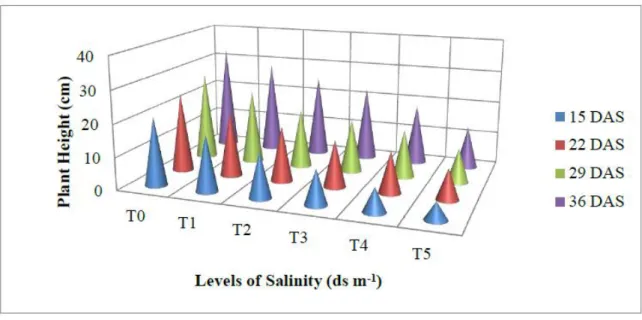
Plant height is significantly affected by salinity levels. Effect of salinity levels on plant height is represented in the figure 2. At the final sampling stage (36 DAS), plant height ranged from 12.95 to 32.75 cm, where plants belong to T0 treatment appeared as the tallest in stature which was significant over T1, whilst T5 was shortest in height closely followed by the plants belong to T4 treatment. Third and fourth highest plants were obtained from T2 and T3, respectively. At early growth stage (15 DAS) and mid growth stages (22 DAS and 29 DAS) T0 was the fastest growing and consistently performed better than any other treatment used in the experiment. Whereas, T5 was recorded to provide the slowest growing plants at all sampling stages. Almost all aspects of plant development including: germination, vegetative growth and reproductive development are affected by salinity. It works by imposing ion toxicity, osmotic stress, nutrient (N, Ca, K, P, Fe, Zn) deficiency and oxidative stress on plants, and thus limits water uptake from soil (Bano and Fatima, 2009). So, the study indicates that the pant height as a vegetative part of moringa is also affected by increasing doses of salinity.