Digital Marketplace Bangladesh
BY
Md. MASUD PARVAZE ID: 151-15-5203 PIAS AHMMED ID: 151-15-5198
AND
MD. ABED CEUM ID: 151-15-5309
This Report Presented in Partial Fulfillment of the Requirements for the Degree of Bachelor of Science in Computer Science and Engineering
Supervised By
Shah Md. Tanvir Siddiquee Senior Lecturer
Department of CSE
Daffodil International University Co-Supervised By
Ahmed Al Marouf Lecturer
Department of CSE
Daffodil International University
DAFFODIL INTERNATIONAL UNIVERSITY DHAKA, BANGLADESH
DECEMBER 2018
APPROVAL
This Project titled “Digital Marketplace Bangladesh”, submitted by Md. Masud Parvaze, ID:
151-15-5203 and Pias Ahmmed, ID: 151-15-5198 and Md. Abed Ceum, ID: 151-15-5309 to the Department of Computer Science and Engineering, Daffodil International University, has been accepted as satisfactory for the partial fulfillment of the requirements for the degree of B.Sc. in Computer Science and Engineering (BSc) and approved as to its style and contents. The presentation has been held on December 2018.
BOARD OF EXAMINERS
Dr. Syed Akhter Hossain Chairman
Professor and Head Department of CSE
Faculty of Science & Information Technology Daffodil International University
Narayan Ranjan Chakraborty Internal Examiner
Assistant Professor
Department of Computer Science and Engineering Faculty of Science & Information Technology Daffodil International University
Md. Tarek Habib Internal Examiner
Assistant Professor
Department of Computer Science and Engineering Faculty of Science & Information Technology Daffodil International University
_______________________ External Examiner
Dr. Mohammad Shorif Uddin Professor
Department of Computer Science and Engineering Jahangirnagar University
DECLARATION
We hereby declare that, this project has been done by us under the supervision of Shah Md.
Tanvir Siddiquee, Senior Lecturer, Department of CSE, Daffodil International University.
We also declare that neither this project nor any part of this project has been submitted elsewhere for award of any degree or diploma.
Supervised by:
Shah Md. Tanvir Siddiquee Senior Lecturer
Department of Computer Science and Engineering
Daffodil International University
Co-Supervised by:
Ahmed Al Marouf
Lecturer
Department of Computer Science and Engineering
Daffodil International University
Submitted by:
Md. Masud Parvaze ID: 151-15-5203
Department of Computer Science and Engineering
Daffodil International University
Pias Ahmmed ID: 151-15-5198
Department of Computer Science and Engineering
Daffodil International University
______________
Md. Abed Ceum ID: 151-15-5309
Department of Computer Science and Engineering
Daffodil International University
ACKNOWLEDGEMENT
First we express our heartiest thanks and gratefulness to almighty God for His divine blessing makes us possible to complete the final year project/internship successfully.
We really grateful and wish our profound our indebtedness to Shah Md. Tanvir Siddiquee, Senior Lecturer, Department of CSE Daffodil International University, Dhaka. Deep Knowledge & keen interest of our supervisor in the field of “Web application” to carry out this project. Her endless patience, scholarly, guidance, continual encouragement , constant and energetic supervision, constructive criticism , valuable advice ,reading many inferior draft and correcting them at all stage have made it possible to complete this project.
We would like to express our heartiest gratitude to DR. Syed Akhter Hossain, Professor and Head, Department of CSE, for his kind help to finish our project and also to other faculty member and the staff of CSE department of Daffodil International University.
We would like to thank our entire course mate in Daffodil International University, who took part in this discuss while completing the course work.
Finally, we must acknowledge with due respect the constant support and patients of our parents.
ABSTRACT
The main purpose of this project “Digital Marketplace Bangladesh” to build a reliable platform where merchants would enjoy freedom and flexible business experience. This project for those people who trust online business and want to sell, buy or promote own products. Who find a marketplace where he/she able to create a virtual shop, embellished by his/her product. This project belong to them. Our system allow merchants to customize their stores and product pages, and to conduct follow-up to customers. In our platform no one will discourage them to build their own brand. Our vision that a merchant can control his/her own brand and merchandising.
But we have some terms and conditions that they have to follow.
TABLE OF CONTENTS
CONTENTS PAGE
Board of examiners i
Approval ii
Declaration iii
Acknowledgement iv
Abstract v
CHAPTER 1: INTRODUCTION (1-3)
1.1 Introduction 1
1.2 Motivation 2
1.3 Objective 2
1.4 Expected Outcome 2
1.5 Report Layout 3
CHAPTER 2: BACKGROUND (4-11)
2.1 Introduction 4
2.2 Related Work 5
2.3 Comparative Studies 9
2.4 Description of Current System 9
2.5 Problem of Current System 10
2.6 Aim of the Project 10
2.7 Client Server Architecture 10
2.8 Secured System 11
2.9 Challenges 11
CHAPTER 3: REQUIREMENT SPECIFICATION (12-15)
3.1 Business Processing Model 12
3.2 Requirement Collection and Description 12
3.3 Use Case Modeling and Description 13
3.4 Logical Data model 14
3.5 Design Requirement 15
CHAPTER 4: DESIGN SPECIFICATION (16-22)
4.1 Front-end Design 16
4.2 Back-end Design 21
4.3 Interaction Design and UX 21
4.4 Implementation Requirements 22
CHAPTER 5: IMPLEMENTATION AND TESTI (23-28)
5.1 Implementation of Database 23
5.2 Implementation of Front-end Design 25
5.3 Implementation of Interactions 26
5.4 Testing Implementation 26
5.5 Test Result and Report 28
CHAPTER 6: CONCLUSION AND FUTURE SCOPE (29-29)
6.1 Discussion and Conclusion 29
6.2 Scope for Further Developments 29
REFERENCES
30PLAGIARISM CHECK REPORT
LIST OF FIGURES
FIGURES PAGE
Figure 2.1: Screenshot of Homepage of Rekuten.com 5
Figure 2.2: Screenshot of Homepage of Ebay.com 6
Figure 2.3: Screenshot of Homepage of Amazon.com 7
Figure 2.4: Screenshot of Homepage of Storrea.com 8
Figure 3.1: Business Process Model 12
Figure 3.2: Use Case Diagram for User 13
Figure 3.3: Screenshot of Database Table 14
Figure 3.4: Screenshot of Database Relation 14
Figure 4.1: Homepage with Slideshow 16
Figure 4.2: Screenshot of Shop Category 16
Figure 4.3: Screenshot of Featured Shop 17
Figure 4.4: Screenshot of Trend Product 17
Figure 4.5: Screenshot of Create an Account 18
Figure 4.6: Screenshot of Registered Customer 18
Figure 4.7: Create Your Own Shop 19
Figure 4.8: Screenshot of Shop Details 19
Figure 4.9: Screenshot of All Products 20
Figure 4.10: Seller Dashboard 20
Figure 4.11: Screenshot of Admin Panel 21
Figure 4.12: Screenshot of Interaction Design and Ux 21
Figure 5.1: Implementation of Database 23
Figure 5.2: Implementation of Buyer’s Database Table 24
Figure 5.3: Screenshot of Front-End Design 25
Figure 5.4: Test Sign Up Form 26
Figure 5.5: Test Case Registered Customer 27
LIST OF TABLES
TABLE PAGE Table 1: Registration and Login Test Case 28 Table 2: Input User Information Test case 28
CHAPTER 1 INTRODUCTION
1.1 Introduction
This era is highly experiencing the evolution of technology and as the consequences in the business sector, e-commerce is a phenomenon. E-commerce is now seen as a reality for many businesses and a part of a normal business plan. Ecommerce business still stand because of Immediate benefit, in terms of cost saving, efficiencies and enhanced profitability.
This Project title “Digital Marketplace Bangladesh” is totally an online based business web application. The domain of the website is “NULL”. It is a marketplace where buyer and seller would enjoy freedom and flexibility to buy, sell and promote their own products. We built a platform where merchants get opportunities to create and customize his/her own shop that embellish by own brand. So they don’t need their own website. So they don’t have to face any trouble like site maintenance or renew domain, hosting. That means they will get all kind of facilities without facing any trouble. They just have to do, visit our site open an account and sell what he/she wants to sell. But we have some conditions that they have to follow. As well as a buyer got an opportunity to choose the right product and before buy the product he/she can compare product, check average rating.
The topic that will be discussed through this report are as follow:
Current situation of this type of project.
Data validation testing.
Database system of this project.
Future scope of this project.
1.2 Motivation
A couple of month earlier when we have started to develop this site, we had a business plan in our mind. We researched on market business and realize ecommerce is growing too fast. So if we completely build this project, it may help few merchants who don’t have any independent and flexible platform where he/she can sell product. A platform where no one encourage to promote their product. This wasn’t all about motivation. We was passionate for complete this project.
And we believe this may change a little bit ecommerce business strategy in our county.
1.3 Objectives
Most convenient way to shop.
Offers the ability to shop 24 hours a day.
Biggest discount offers.
Expands the marketplace.
1.4 Expected Outcome
To take advantage of brand name.
To enter the global market place.
To react to pressure from competitors.
To introduce new products and service.
To meet customer’s demand.
To increase sales.
To reduce transection cost.
To reduce customer support cost.
Bright future.
1.5 Report Layout
The report layout is organized as follows:
In chapter two, brief discussion on related works that are already implemented. And we made comparison with other. We have figured out the problem of current system and tried to solve.
What kind of Challenges we have faced for completing this project also discussed on this chapter.
On chapter three, we focused on requirement specification. It also includes business process model, use case model, logical data and some other stuffs that cover the whole chapter.
On chapter four, we have tried to show the front-end design, back-end design and interaction design and UX. As well as we listed the component that we used to build the system. The component part is denoted by implementation requirement.
How we implemented the whole project, how end user visualize the system, how it’s actually work and how it interact with the database will be discussed on chapter five. Also included testing result and report part.
On chapter six, here we have discussed present condition of our project and the future scope of this project. Also a conclusion about what we did in there.
CHAPTER 2 BACKGROUND
2.1 Introduction
Initial study is very important. It is required for investigating a system background information.
It helps to find out system’s fault, what to update and what to add as new feature.
The main goal of our project is to build a platform where provides a flexible, reliable business opportunities for buyer and seller. We developed this project for some specific people who want to sell products online but he/she doesn’t have that capabilities to maintain a website or he/she doesn’t want it. So we developed a website where a seller can create a virtual shop like the real one, then the seller can customize it and promote any type of legal product.
On the other hand, a buyer get a lots of opportunities before he/she buy some products.
Convenient way to compare price and product, provide a level of trust between buyer and seller, reliable source, secured money transaction and greater transparency.
If a merchant sell niche products, he/she could likely be a successful businessman in any marketplace. But now technologies are updated as well as business technic too. For this reason all over the world people are more interested doing business online. As a result now virtual marketplace exists and profitable.
2.2 Related Work
In our research perspective, we explored a few websites which service concept are almost similar like our proposed system. We analyzed those website and try to dig a hole for find out their system fault [3].
URL:https://www.rakuten.com
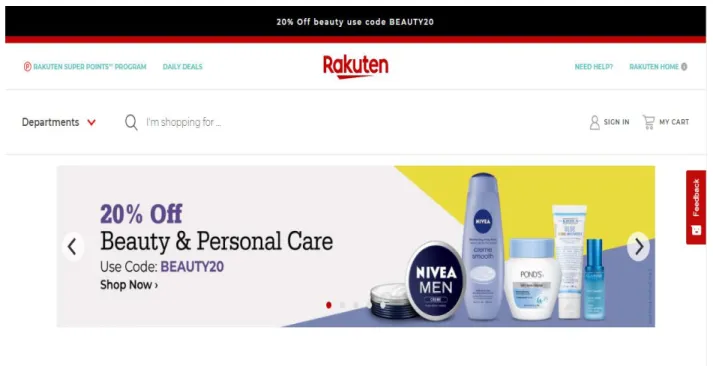
Figure 2.1: Screenshot of Home page of rakuten.com
Rakuten is a Japanese largest ecommerce company. On our research we found out Rakuten applies a different business strategy for growing their business. When other big companies focus on product quality and customers. Rakuten takes this opportunities, they mostly focus on seller section. They provide a profitable marketplace for seller.
EBay is an American multinational ecommerce company. EBay is a place for online auction.
Although it’s an ecommerce site, but this organization follow a different business strategy [1].
URL: https://www.ebay.com
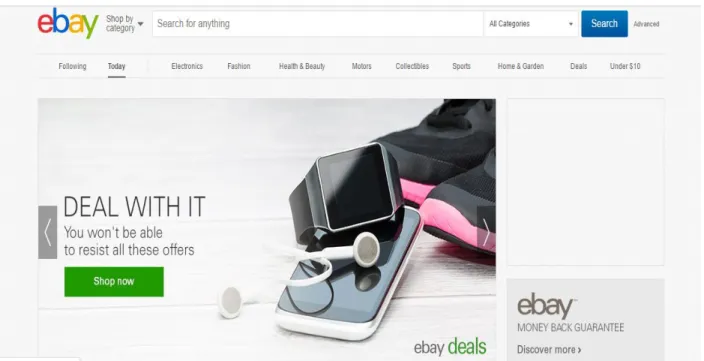
Figure 2.2: Screenshot of Home page of ebay.com
There are two ways a user can sell his/her product, that eBay offer. It can be a fixed prize sell otherwise auction is another option. EBay allow a merchant for sell almost anything, but after complete transaction they took a percentage of money.
Amazon is an American electronic commerce and cloud computing company. It’s one of the largest ecommerce company in the world. A seller can sell any product directly amazon customer. If seller think he/she can’t take shipment responsibility then he/she have to sell it via vendor center [2].
URL: https://www.amazon.com
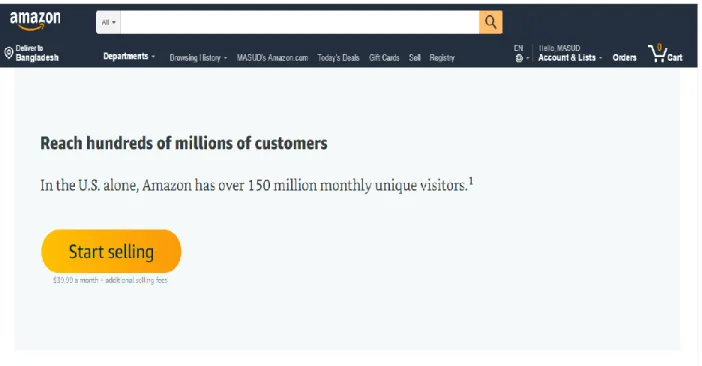
Figure 2.3: Screenshot of Home page of amazon.com
Anyone can open seller center account. In vendor section it is quite different. Only invited people are allowed here. Seller center and vendor center both payments are different. Seller center directly sell to the customer. Vendor sell to amazon. Seller center got limited advertising opportunities but vendor center got multiple advertising opportunities.
Storrea is a Bangladeshi ecommerce site. Storrea is a market platform where merchants can sell their product by using own identity. They give an opportunity like three type of package that a merchants have to buy before started selling product [9].
URL: https://www. storrea.com
Figure 2.4: Screenshot of Homepage of Storrea.com
They also provide some service like email marketing, Facebook marketing and SEO. It has different type of package. Each and every package has some product selling limits. You don’t need any technical skill/knowledge to run a store through Storrea.
2.3 Comparative Studies
After comparing the above website to ours, we can say both of the sites concept and goal are almost same. But their service process are different.
If we talk about Rakuten, they significantly focus on local merchants. Their service provide a merchants to create his/her own virtual shop. Same as our plan. Rakuten have also its own product for sell. It means this organization have lots of responsibilities like product shipment, product quality, delivery deadline etc. In our marketplace we don’t have any product. That’s means we are not selling anything [3].
Comparing with eBay, their business model is little bit different. Basically eBay is an auction site for buying and selling goods. Buyers browse the site to search for suitable product sold by a 3rd party eBay seller, and bit on item through auction. Bidding lasts for 3, 5, 7 or 10 days, and the buyer willing to pay the highest price for win [1].
Now comparing with amazon, amazon is providing customer with fixed price on all products.
But amazon is a direct provider. But it has a seller hub too. Independent seller may promote their product on this platform. But problem is the list of restricted product and categories is huge [2].
After research those site, we can say may be our business plan or goal are same but we believe our platform visual angel and targeted customer are completely different.
2.4 Description of Current System
An independent seller have two option, either he/she has to embellish product in real shop, otherwise he/she can use own website for promoting product. Those are the easiest option in a seller hand. Day by day technology updated as well as business strategy too.
2.5 Problem of Current System
Here we have pointed some important reason why people are not interested doing business online and why they afraid.
Data security.
Product return and refund.
Competing against retailers and manufactures.
Online identity verification.
Maintaining customer’s loyalty.
Competitor analysis.
Slow speed.
Suspicious review.
Payment problem.
2.6 Aim of Our Project
Like we said before we want to build a single stable platform or a marketplace where buyer and seller doing their business independently. If we tell more specifically this platform built for those merchants who are not able to maintain a website or he/she don’t want it. As well as for those buyer who seeking for a reliable and dependable marketplace.
2.7 Client-Server Architecture
This system is mainly built for the client. The whole system is totally congruous for end user.
The people who need marketplace through internet this system will help them.
2.8 Secured System
In our system we have four types of user. “Admin”, “Registered seller”, “Registered buyer”,
“Unregistered Visitor”. Admin, registered seller and registered buyer have their own unique username. And registered seller have also a unique shop name. Without authentication no one can access to his/her personal information or activity. Unregistered visitor can only view limited information that provided by admin panel. Unregistered visitor visualize any shop or product but he/she can’t buy or order anything before registration. For complete registration process he/she must need a valid email and valid phone number. Without verification one can create account in our platform.
2.9 Challenges
At this present situation, implementing this type of project is a biggest challenge for our team.
Still people don’t trust online business. Find out competitors fault also a challenging part. We have tried our best to give users a better UI wisdom so that they feel comfortable when they use our system.
CHAPTER 3
REQUIREMENT SPECIFICATION
3.1 Business Process Model
Business process model (BPM) is generally a diagram representing a sequence of actives. BPM shows events, actions, connection point and links, in the sequence from end to end. Business process model is a sort of tool, which help a reader easily understand the whole business process [5].
Figure 3.1: Business Process Model for this project
3.2 Requirement Collection and Analysis
Requirement collection and analysis is very crucial part for any project. Without analysis, collecting data or a good planning, a project will never complete properly. If the required data and statistical analysis data is not suitable for any project, it will create a mess. Sometimes the project may not be fail, but it will be at a chance to fall out. Analysis and requirement collection was our big challenge, when we start thinking about this project. After start analysis we figure out some significant features that boost our project.
3.3 Use case Modeling and Description
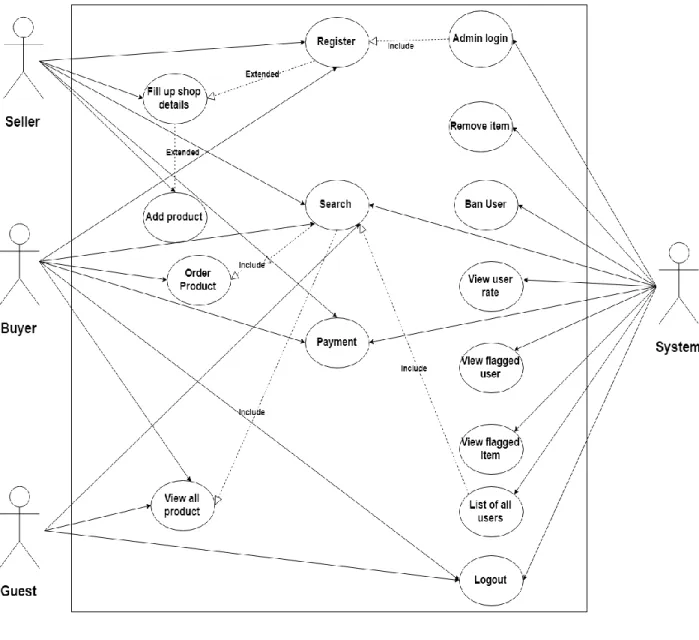
There are four types of user in our system. Those are System, registered user, seller, and guest.
Use case diagram for whole system given below [4].
Figure 3.2: Use Case for User
3.4 Logical Data Model
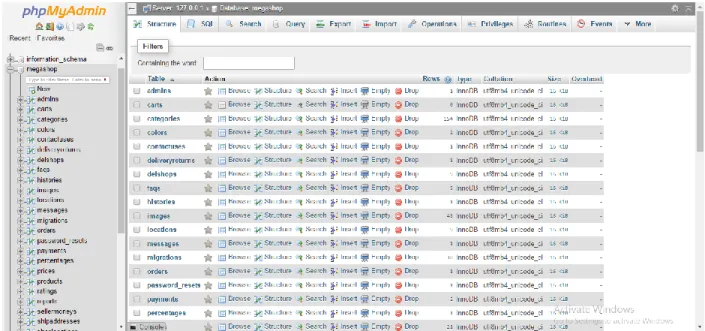
Figure 3.3: Screenshot of Database Table
Database Relation
Figure 3.4: Screenshot of Database Relation
3.5 Design Requirement
We have tried to build a user friendly web application. Our system interface is very simple that everyone can use it without facing any trouble. For better understanding we have drawn business process model and use case diagram from different website [4]. We have used “MySQL” for designing our database. For front end design we have used HTML and CSS [7]. We have used OOP concept for creating back end design. For better user interface we use jQuery, C3.js and D3.js [10] [14] [15]. We ensure that it’s totally a dynamic web application.
CHAPTER 4
DESIGN SPECIFICATION
4.1 Front-end Design
In this section we include some home page front-end design.
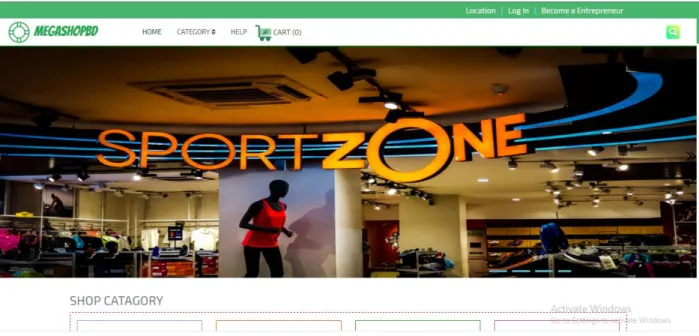
Figure 4.1: Homepage with slideshow
Figure 4.2: Screenshot of Shop Category
Figure 4.3: Screenshot of Featured Shop
Figure 4.4: Screenshot of Trend Product
Figure 4.5: Screenshot of Create an account
Figure 4.6: Screenshot of Registered Customer
Figure 4.7: Screenshot of create your own shop
Figure 4.8: Screenshot of Shop details
Figure 4.9: Screenshot of All product
Figure 4.10: Screenshot of Seller Dashboard
4.2 Back-end Design
Figure 4.11: Screenshot of Admin Panel
4.3 Interaction Design and UX
Figure 4.12: Screenshot of interaction design and UX
4.4 Implementation Requirements
User experience design is the process of designing products that are easy to use, useful and delightful to interact with it. This is the process of creating product that provide relevant experience to the users. For develop this application, we follow those instruments
Development IDE: Sublime Text
Development Language : PHP (Laravel), JavaScript (jQuery, VUE.js, Ajax) Development Design : HTML5, CSS, Bootstrap
Server : Xampp
Web browser : Google chrome, UC browser, Mozilla Firefox Database : MySQL
Domain : NULL Hosting : NULL
CHAPTER 5
IMPLEMENTATION AND TESTING
5.1 Implementation of Database
Here we have implemented registered user profile.
Figure 5.1: Screenshot of Implementation of Database
From the Buyers table, we can view buyer’s details.
Figure 5.2: Screenshot of Implementation of Buyer’s Database table
5.2 Implementation of Front-end Design
After researching and gathering all the information about our project, we have started to implement of front end design. We also made a demonstration design before we start. We have followed some procedure that helped a lot. We have tried to build front-end design more user friendly. Let’s have an overview of using them.
Figure 5.3: Screenshot of Front-end Design
In homepage there is a slide show, which will automatically change periodically. And on top side navigation bar provide service to user. It’s contain some features like login, registration, search etc. after scroll down a user figure out lots of option like shop category, different type of products, top selling product and some other stuff.
5.3 Implementation of Interaction
Interaction can found almost everywhere. It is a key to make a system dynamic and attractive to user. And it is very necessary to make a system interactive. Like we said before we tried to build a user friendly and an interactive platform.
5.4 Testing Implementation
The purpose of this test to evaluate our system’s compliance with the specified requirement. We tried to make this system secured. Every single data that a user input on our system must pass the test. Let’s see few example.
Figure 5.4: Test Sign up form
Figure 5.5: Test case Registered Customer
5.5 Test results and Reports
Table 1: Registration and Login Test Case Sl
No
Test case Input Expected
outcome
Actual output Result
1 Email check Input without @ Invalid email Invalid email. Must have @
Passed
2 Valid phone number
Input numeric value
correct Correct Passed
3 Invalid phone number
Input character Incorrect Numeric value required
Passed
4 Special
character
Input special character
Special character not allowed
Not allowed Passed
Table 2: Input User Information Test Case Sl
No
Test case Input Expected
outcome
Actual output Result
1 Display the webpage
Tested on us browser, chrome
Display successful
Display successful Passed
2 User name Wrong Login failed Login failed Passed
3 Blank or Incorrect pass
Wrong password Login failed Login failed Passed
4 Username Input character Special character not allowed
Letter and whitespace allowed
Passed
CHAPTER 6
CONCLUSION AND FUTURE SCOPE
6.1 Discussion and Conclusion
Day by day ecommerce has undeniably become an important part of our society. So we have decided to build this system for business purpose. In our system customers get an authentic marketplace. We assure our user privacy and protect their confidential information.
Although there are many negative aspects of ecommerce. But at the end of the day we have to consider that there is no other option in our hand. So we try to give an opportunity for those people who look up this type of service. We hope our platform will be a best way for them.
6.2 Scope for Further Development
We believe we can make this system more advance in future. This could be a revolutionary web application that may help bonding between seller and buyer. We try to overcome all limitation though we didn’t mention anything about it. Advance features and User interface will be updated in future. Our system is already user friendly but we will try to make this system more user friendly in future.
REFERENCE
[1] About eBay<<https://www.x-cart.com/sell-online/how-to-sell-on-ebay.html>> last access 24/10/2018 at 3:20 AM
[2] About Amazon<https://content26.com/blog/amazon-vendor-central-v-seller-central/>>last access 2/11/2018 at 12:08 AM
[3] About Rakuten <<https://en.wikipedia.org/wiki/Rakuten>> last access 2/11/2018 at 12:08 AM
[4] Use Case Diagram<<https://about.draw.io/uml-use-case-diagrams-with-draw-io/>>last access 29/10/2018 at 8:00 PM
[5]BPM Diagram<<https://online.visual-paradigm.com/>> last access 31/10/2018 at 2:31 AM [6] Bootstrap<<https://getbootstrap.com/>> last access 30/10/2018 at 3:12 PM
[7] HTML, CSS, PHP<<https://www.w3schools.com/>> last access 7/25/2018 at 9:40 AM [8] Front Awesome<<https://fontawesome.com/>> last access 8/25/2018 at 11:07 PM [9] About Storrea <<https://www.storrea.com/>>last access 4/11/2018 at 8:46 PM [10] jQuery <<https://jquery.com/ >> last access 31/11/2018 at 3:11 PM
[11] Animate.CSS <<https://daneden.github.io/animate.css/ >> last access 28/11/2018 at 3:20 PM [12] GitHub << https://github.com/ctmaloney/fwslider >> last access 5/8/2018 1:25 AM
[13] GitHub <<https://github.com/patrickkunka/easydropdown >> last access 5/8/2018 1:25 AM [14] C3.js <<https://c3js.org/ >> last access 15/9/2018 at 2:45 AM
[15] Data-Driven Documents <<https://d3js.org/ >> last access 26/9/2018 at 6.09 PM
[16] CountUp.js <<https://inorganik.github.io/countUp.js/ >> last access 28/10/218 at 8:30 PM [17] CLNDER.js <<https://kylestetz.github.io/CLNDR/ >> last access 12/11/2018 at 10:15 AM