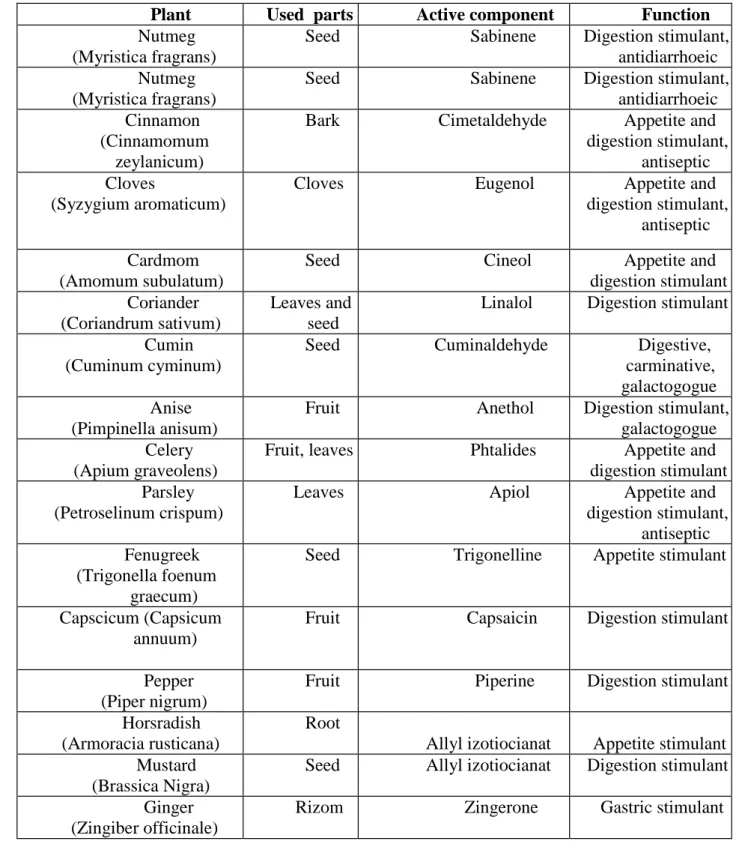
Phytobiotics include therapeutic herbs and spices, plant extracts and essential oils with different biological effects (Giannenas et al., 2018, Puvaca et al., 2015). Due to biological variables (plant species, growing area and harvesting conditions), manufacturing (extraction/distillation and stabilization) and storage conditions, the content of phytobiotic substances varies greatly (light, temperature, oxygen tension and time); (Huyghebaert et al., 2011). Oregano and thyme both contain significant levels of the monoterpenes thymol and carvacrol (Rahim et al., 2011).
Herbal feed additives as antioxidants
Herbal feed additives as immune-stimulant
Herbal feed additives as coccidiostat
Body growth responses of broiler on herbal diet
According to the findings of (Koochaksaraie et al., 2011), the inclusion of cinnamon in feed at doses ranging from 500 to 2000 mg/kg had no impact on the development of broilers. Toghyani et al., 2011) found that the inclusion of cinnamon in the diet at a rate of 2 grams per kilogram led to a significant increase in body weight. According to the findings of (Ebrahimi and colleagues, 2013), the group that supplemented their meals with cinnamon had significantly greater body weight than the control group. 14 | P a g e compared to the control diet which did not include any antibacterial or anticoccidial additives.
Feed consumption and feed conversion ratio of broiler chicken fed on herbal supplemented diet
According to (Emadi and Kermanshashi., 2006), the addition of 0.25-0.75 percent turmeric powder had no effect on the amount of feed consumed by Ross broilers. On the other hand, (Daramola, 2020) discovered that feed consumption in broilers (Arbor-acre) decreased when 0.5% turmeric powder was used. According to research conducted by (Nascimento et al., 2019), adding 3% turmeric powder to the meal had a negative effect on the amount of feed consumed by the chicken, even though the animal had been infected with Salmonella typhimurium.
Carcass traits and gastro-intestinal organ development of broilers in response to herbal diets
A disease such as coccidiosis can have a negative impact on the amount of feed consumed by broilers (Christaki et al., 2004). Cinnamon did not seem to have any effect, according to (Stefan et al., 2009)'s results, on the amount of MDA found in liver and kidney tissues. Supplementation of broilers with turmeric powder increases crude protein and reduces triglycerides and saturated fatty acids (Daneshyar et al., 2011).
Meat quality and herbal diet
Curcuminoids, natural antioxidants in turmeric, are deposited in the skin and tissue when added to the diet, generating less yellowing of the meat (Johanna et al., 2018). Bozkurt et al., 2009) compared an unsupplemented control diet with one containing 1.0 g/kg oregano oil and found no difference in carcass parameters (carcass weight, carcass yield and liver. The combination of essential oil of peppermint and eucalyptus showed said to have an immunostimulatory effect on the humoral and cell-mediated immune response against Newcastle disease in chickens, resulting in a lower death rate (Awaad et al., 2009a).
Economical analyses of broiler fed on herbal diet
Their utility in modulating the immune response of immunocompromised birds following infection with infectious bursal disease virus (IBDV) and/or vaccination against IBDV was also evident compared to untreated control groups. This was demonstrated by their ability to suppress the immune response in immunocompromised birds following IBDV infection (Awaad et al., 2009b). The curcumin in turmeric played a role in the immune system's production of an immune-enhancing factor, which in turn led to lower mortality in chickens (Al-Kassie et al., 2011).
Water consumption of broiler and herbal diet
20 | Temperature, heat stress, etc., may account for the variation in water consumption by the broiler fed herbal extract or photogenic essential oil (Lee et al., 2003; Sang-Oh et al., 2013). This is also supported by (Sang-Oh et al., 2013) who reported that broilers had increased water holding capacity when fed diets supplemented with herbal products (cinnamon). Furthermore, water consumption is dramatically reduced when broilers are fed herbal products (cinnamaldehyde) reported by another researcher (Lee et al., 2003).
Importance of the current study
It can be hypothesized that the sensory flavors, higher water retention capacity and lower thirst of broilers may lead to lower water consumption by birds. In this regard, poultry feed added with vegetable phytogenic essential oil (Digemax EER) can promote nutrient utilization by reducing the amount of harmful microorganisms detected in the intestines of birds. Using plant phytogenic essential oil as a supplement in broiler chickens can be cost-effective as it has the potential to both reduce feed costs and increase profitability.
Chapter-III
Materials and Methods
- Statement of the experiment
- Preparation of the experimental shed
- Collection of the experimental feed and test ingredient
- Management
- Brooding
- Floor space
- Lighting
- Immunization and medication
- Data and sample collection
- Sample processing and analyses
- Feed sample
- Record keeping
- Mortality
- Body weight
- Feed intake
- Water intake
- Body weight gain (BWG)
- Feed conversion ratio (FCR)
- Statistical analyses
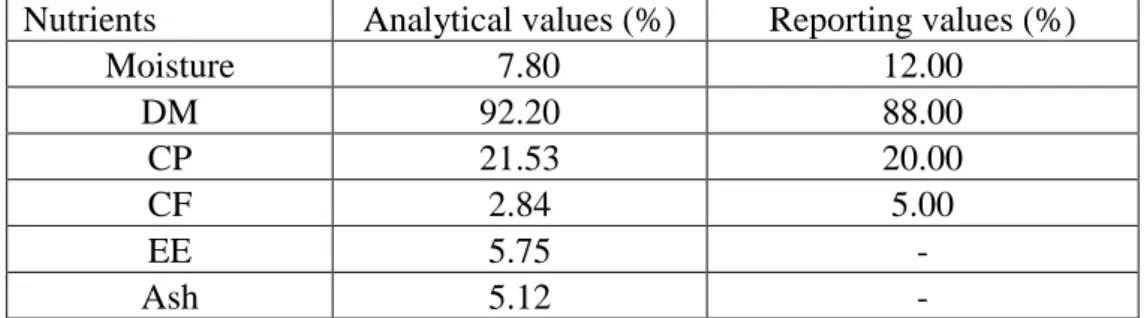
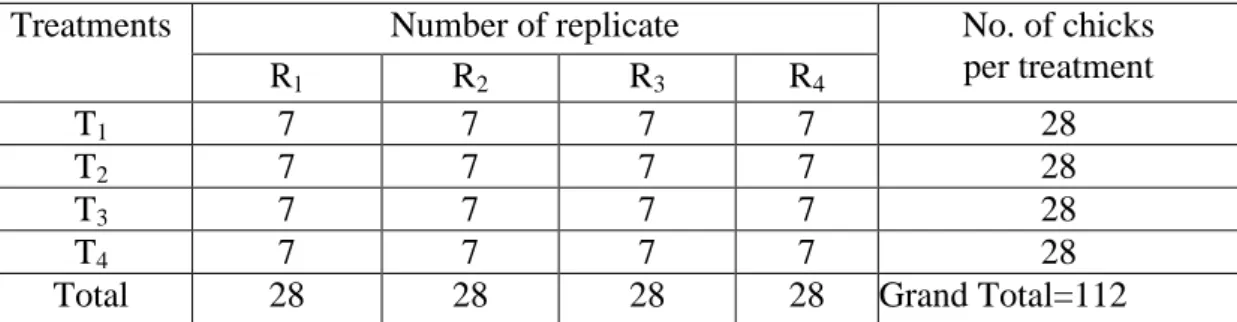
The chemical composition of the ready-made diets is shown in Table 3 and Table 4, respectively. Note: Phytogenic essential oils contain cinnamic aldehyde, inhibits the GTPase enzyme and prevents the accumulation of FtsZ protein in Z-ring of bacteria (harmful bacteria), which is necessary for cell division. Pre-starter feed was provided to birds up to 10d, starter feed was given up to 20 days and grower feed was given to the bird from 21 until the rest of the trial period.
Vitamin-C was given after each vaccination to help the body recover from the stress of the shot and the cold shock. To determine the growth of the birds' gastrointestinal systems, the amount of abdominal fat and the weight of the specific gastrointestinal organs (liver, heart and gizzard) were also recorded. On the last day of the experimental period, two broilers were randomly selected, weighed and humanely killed from each replicate pen to evaluate the meat characteristics of body yield (dressing percentage, breast weight, thigh, lower thigh, back, wing, head, shank, neck), abdominal fat content and weight of the visceral organs (liver, heart, proventiculus with gizzard).
After the killing procedure, the bird carcasses were processed by stripping of their feathers, skin, heads, shanks, viscera, oil glands, hearts, kidneys, livers, lungs, and small and large intestines. The average live weight of broilers was also noted by weighing at the beginning of the experiment and at the end of each weekend. The number of dead birds during the experimental period divided by the total number of housed birds at the beginning of the experiment served as the basis for the calculation of bird mortality.
The cost of the feed was calculated based on the retail price of the feed offered by the company to the dealers.
Chapter-IV Results
Responses of broiler chickens given herbal extract (phytogenic essential oil)
- Live weight of broilers fed herbal extract or phytogenic essential oil
- Live weight gain (LWG) of broiler chicken on day 32 fed herbal extract
- Feed intake (FI) of broiler chicken fed herbal products
- Feed conversion ratio (FCR) of broilers fed herbal extract
- Meat yield traits of broilers fed herbal extract
- Gastro-intestinal development of broilers fed herbal extract
- Meat quality of broilers fed herbal extract or essential oil
- Water consumption of broiler fed with the herbal extract
- Cost benefit analyses of broiler fed herbal extract
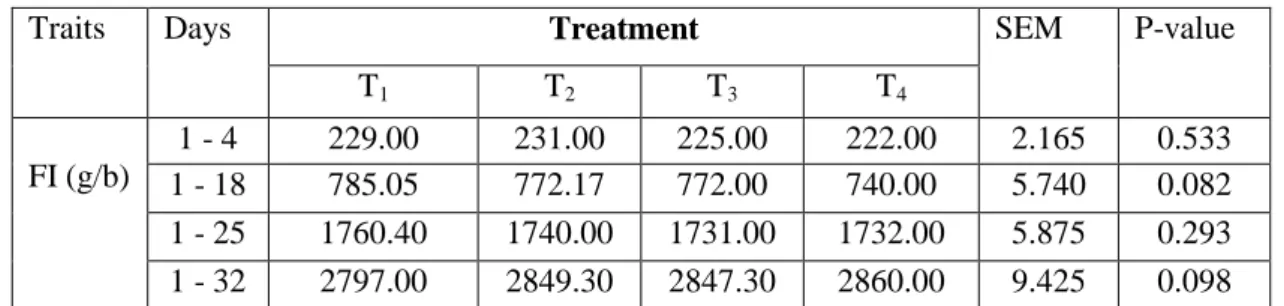
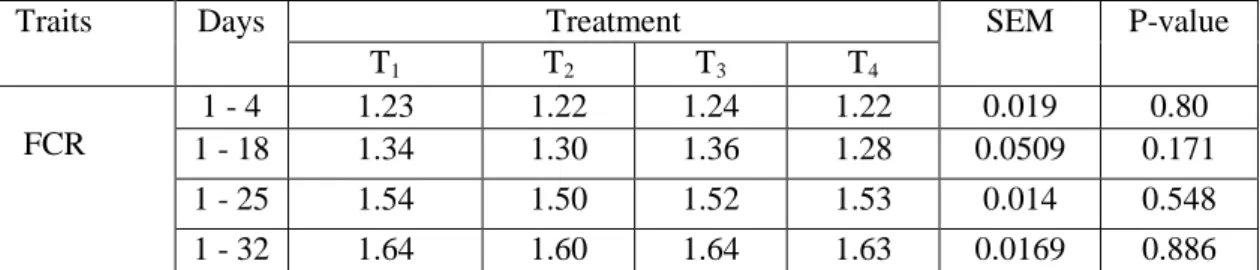
The findings showed that there was no significant (P>0.05) variation in FI of broilers between treatment groups from day 1 to day 32. The FI of broilers fed with supplemented diets is significant (P<0.098) between 1 and 32 days of age. Although the FCR of broilers was insignificant (P>0.05) during treatment, a numerically improved FCR (1.60) was observed in T2 group birds on day 32.
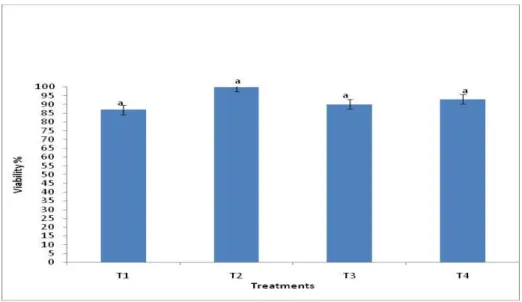
The response of broilers in terms of viability fed with herbal supplements at 32 days was not found significant (P>0.05) among the treatments, as shown below in Figure 2. The relative weight of the intestines of broilers fed with the supplemental diet is displayed. in Table 10. The data show that the weights of proventriculus, gizzard, liver and heart of birds were identical between treatments (P>0.05).
To evaluate the meat quality of broilers, data on the abdominal fat accumulation of broilers at 32 days was recorded. The result showed that there was no detectable variation (P>0.05) in the abdominal fat content of broilers between treatments. 37 | P a g e Fig.3: Fat content (g/w; mean ±SE) of broilers fed herbal diet; Bar with similar superscripts.
Fig.4: Water intake (ml/b; mean ±SE ;) of broilers fed herbal products from day 25 to 32 days; Bars with different headings have a significant difference (P<0.05) between treatments].
Chapter-V Discussion
Gross responses of broiler chickens
- Growth performance of broiler chicken fed the supplementing water treated with herbal phytogenic essential oil (Digemax EE R )
- Feed intake (FI) of broiler fed herbal extract or phytogenic essential oil
- Feed conversion ratio (FCR) of broiler fed herbal extract or essential oil
- Survivability of broilers fed herbal extract or essential oil
- Impact of herbal extract or essential oil on the carcass yield traits and gastro-intestinal development of broiler
- Effect of herbal extract or essential oil on the meat quality of broiler chicken
- Effect of herbal extract or essential oil on the water intake (WI) of broiler
- Effect of herbal extract or essential oil on the farm profitability of broiler
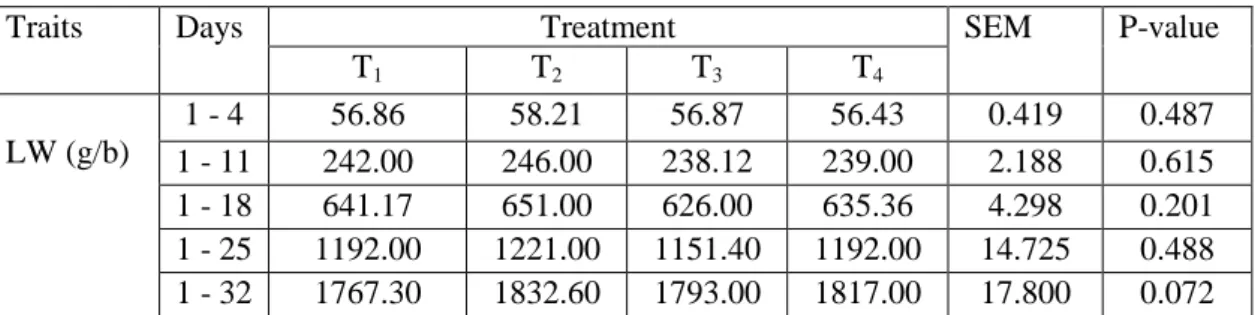
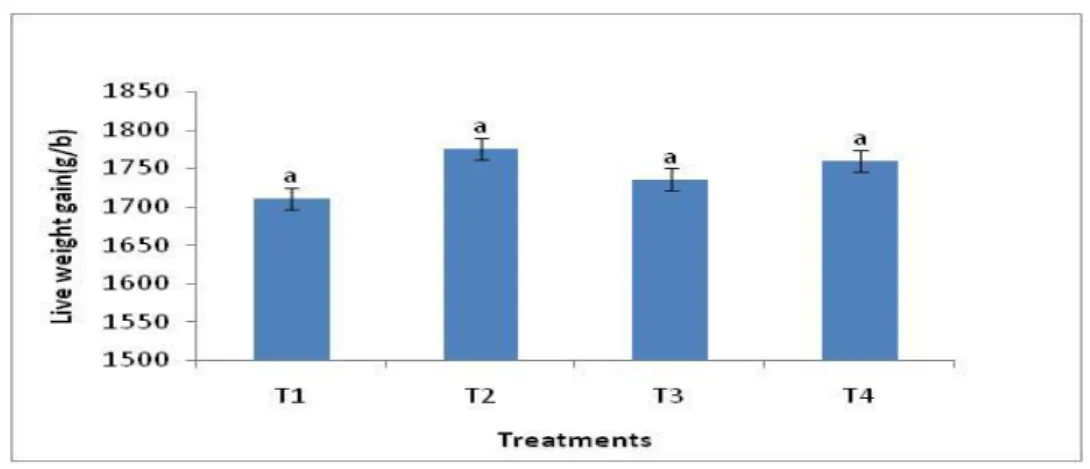
The results are also consistent with the results of the previous researchers (Toghyani et al., 2011, Raghdad and Al-Jaleel, 2012, Shirzadegan, 2014, Devi et al., 2018), who found increased weight gain of broilers when birds fed with diet supplemented with turmeric, cinnamon powder and cinnamon essential oil respectively. The marginally increased body weight of broilers in this treatment group (T2) may be a result of broilers' efficient feed consumption and feed efficiency. Lee et al., 2003) observed that addition of cinnamaldehyde to feed did not significantly affect FI and FCR in female chickens. The result is in agreement with the report of (Lal et al., 1999) and (Al-Sultan et al., 2003) who found no difference in the size of the liver and heart when broilers are fed herbal extracts (turmeric powder).
The likely reason for the increase in abdominal fat on the diets may be due to faster growth leading to earlier transition from muscle to fat deposition (Hossain et al., 2013). As one phase nears completion, the rate of the next phase increases, so birds that grow rapidly tend to enter the fat deposition phase earlier than those that grow slowly (Hossain et al., 2013). Numerically lower fat content (11g/b) was observed in the T2 treatment group in this study and this may support the results of (Nouzarian et al. 2011) who found that broilers fed a diet containing 0.5% turmeric powder had less fat %.
Another researcher suggests that essential oils can increase meat yield/production by reducing abdominal fat deposition in chicken carcasses (Cross et al., 2011). Curcuminoid level increases the ability of meat to resist oxidation (Zhang et al., 2018; Partovi et al., 2020). Many factors such as smell, aroma, taste, level of water holding capacity, level of thirst, health status of the bird, temperature, heat stress etc., can be responsible for the variation in water consumption by the fed hen. with herbal or photogenic extract. essential oil (Lee et al., 2003; Sang-Oh et al., 2013).
Our result is in agreement with the findings of previous researcher (Singh et al., 2009; Alam et al., 2021) who found similar result in profitability of rearing broilers with herbal diet.
Chapter-VI
Conclusion & Recommendations
Chapter-VII References
Effects of cinnamon powder in the diet on the taste and quality of chicken meat in broilers. Effect of turmeric rhizome powder on broiler chicken performance and carcass characteristics. International Journal Poultry Science. Effects of dietary organic acids and essential oils on growth performance and carcass characteristics of broilers.
The effect of feeding red chili and garlic as feed additives on increasing the performance of broilers. 2003). 2013).Effects of synbiotic dietary supplement and cinnamon (Cinnamomum verum) on growth performance and meat quality in Japanese quail.
2011).Effect of turmeric powder on performance, carcass traits, humoral immune responses and serum metabolites in broilers. Effect of dietary cinnamon powder on taste and quality of chicken meat in broilers. Effects of turmeric powder as a dietary supplement on performance indicators and immune responses in broilers.
Effect of using cinnamon powder as a natural feed additive on performance and carcass quality of broilers. International Journal of Innovative Agriculture and Biology Research, 2(3): 1-8. Effects of cinnamon (Cinnamomum zeylanicum) bark powder on growth performance, carcass fat and serum cholesterol levels of broiler chicken. International Journal of Science and Environmental Technology Effect of acidified turmeric and/or black pepper on growth performance and meat quality of broilers.
Chapter-VIII Appendix
Brief Bio-data of the Author