Biplots of principal component analysis (PCA) of variation in aquatic plankton abundance and ecological factors, and growth performance of green mussels at different culture depths. Biplots of principal component analysis (PCA) of variation in aquatic plankton abundance and ecological factors, and growth performance of green mussels at different locations. Linear regression analysis between different length-weight parameters of green mussels over three cultivation depths.
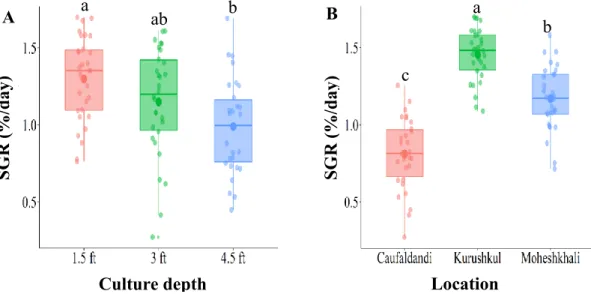
Linear regression analysis between different length-weight parameters of green mussels between three cultivation locations. This study investigated the effects of different water depths (1.5 feet, 3 feet and 4.5 feet) on the growth performance of green mussels grown at different locations (Khurushkul, Moheshkhali and Caufaldandi) along the Moheshkhali Canal, Bangladesh. The growth rate of green mussels in different water depths was ranked in the following range: 1.5 feet > 3 feet > 4.5 feet.
Later, the general growth of green clams at different locations was classified into the following series: Khurushkul > Moheshkhali > Caufaldandi. The PCA analysis also showed that high concentrations of nutrients (NH3-N and NO3-N) have a positive effect on the abundance of the main planktonic groups, which was also shown by a higher value of chlorophyll-a, which has a beneficial effect on the growth of green mussels.
Research Objectives
To know the effects of different water depths on growth performance and nutritional aspects of green mussels cultured under raft culture system in different countries. To investigate the multifaceted relationship between various environmental factors and food availability and growth performances of green mussels.
- Feeding Habit
- Growth
- Habitat
- Environmental Factors
- Plankton Composition
- Biochemical Composition of Green Mussels
- Culture Methods
- Suitable Water Depth
- Study Area
- Experimental Design
- Spat Collection and Inoculation
- Sample Collection
- Water Quality Parameters
- Chlorophyll-a measurement
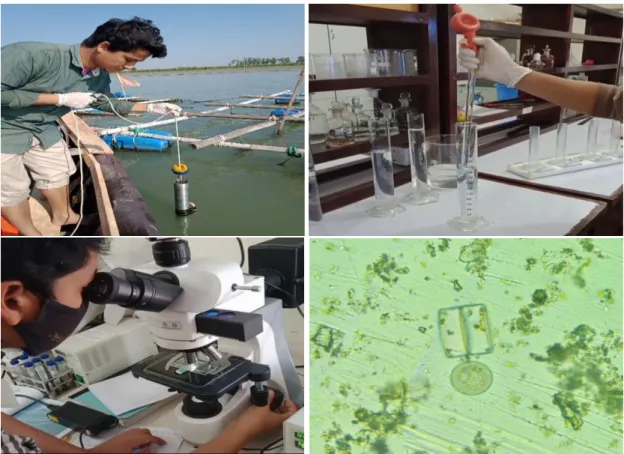
- Qualitative and Quantitative Estimation of Water Plankton
- Harvesting of Green Mussels & Biometric Measurements
- Growth Estimation
- Calculation of Allometry
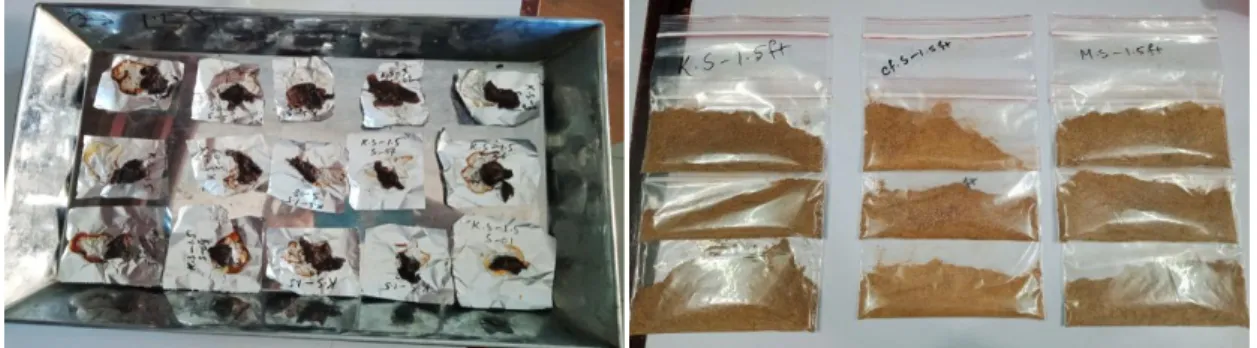
- Sample Preparation
- Proximate Composition Analysis
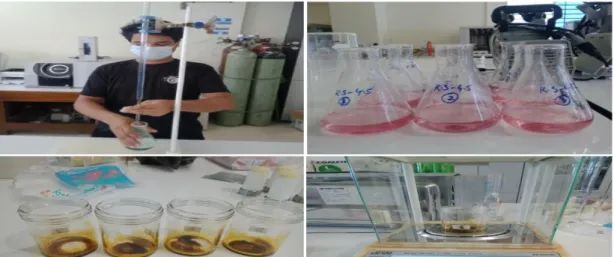
- Protein Analysis
- Lipid Analysis
- Ash Analysis
- Fatty Acids Analysis
- Statistical analysis
In potential cultivation of green mussels, distribution of chlorophyll-a ranges from 0.7 mg/m3 to 17 mg/m3 (Rajagopal et al., 1998). According to Bardach et al. 1972), the most successful type of saltwater aquaculture is mussel farming, and its spread is practically inevitable. Noor et al., 2021) in the southeast coast of Bangladesh, but no study has compared the growth performance of green mussel (P. viridis) in different water depths in raft culture system.
Only the southeastern coast of Bangladesh, especially in the Moheshkhali Channel, which is directly connected to the Bay of Bengal, is home to the naturally occurring Perna viridis (Shahabuddin et al., 2010). These areas are favorable for green mussel farming due to their inductive water quality parameters and salinity consistency from previous research (Asaduzzaman et al., 2020). Quantitative measurement of plankton was performed using a Sedgewick-Rafter (S-R) cell with 1000 1-mm3 cells (Asaduzzaman et al., 2008).
Analysis of proximate composition (protein, lipid and ash) was carried out in the Nutrition and Processing Laboratory, Faculty of Fisheries, CVASU. The fatty acid composition was carried out in the Nutrition and Processing Laboratory, Faculty of Fisheries, CVASU. For all data sets, the assumptions of normal distributions were validated using the Shapiro-Wilk test and Levene's test from the 'onewaytests' package (Dag et al., 2018).
Using the 'FactoMineR' program, principal component analysis (PCA) was performed for all datasets (Sebastien et al., 2008).
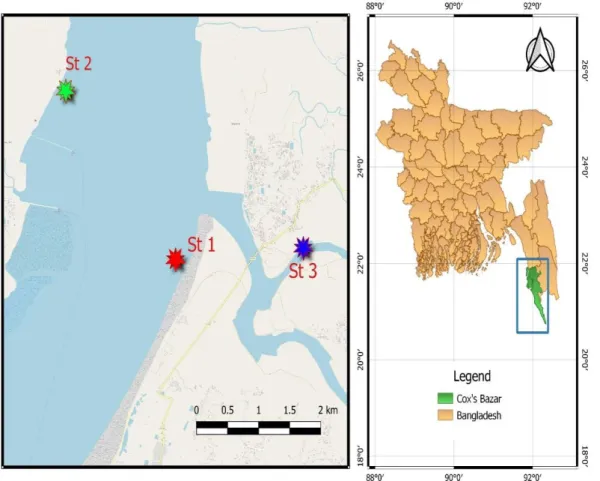
- Ecological Factor and Growth Performance of Perna viridis
- Plankton Abundance and Growth Performance of Perna viridis
- Allometry Relationship
- Biochemical Composition of Perna viridis
- Proximate Composition
- Fatty Acids Profile
Comparison of the survival rate (%) of green mussels cultured at three depths (E) and three locations (F). Variation of the growth of Perna viridis between different culture depths and locations using two-way ANOVA. A comprehensive correlation analysis was used to investigate the impact of various environmental factors on the growth of green mussels (Fig. 14).
The correlation test showed that temperature was not correlated with body weight of green mussels (r=0.12; p>0.05). The variations in different groups of water plankton on green mussel growth, measured over the experimental periods from different depths and different locations, are shown in Table 4. The linear relationship between the total body weight of green mussels and the abundance of water plankton is shown. in fig.
Most plankton groups were significantly (p<0.001) correlated with body weight of green mussels. But the body weight of green mussels was not significantly affected by the plankton group Coscinidiscophyceae (Fig. 16). Further analysis using PCA showed that high concentrations of nutrients (NH3-N and NO3-N) favorably affected the abundance of the main plankton groups, which was also demonstrated by a greater value of chlorophyll- a that affected the growth of green mussels.
However, different ecological processes differentiated the growth parameters of green mussels, and higher values of turbidity, NO2-N and PO4-P differentiated the growth of green mussels at different depths (Fig. 17). While higher values of turbidity, NO2-N and PO4-P distinguished the growth of green mussels at different culture sites, opposite ecological processes distinguished the growth characteristics of the green mussel (Fig. 18). Biplots of the principal component analysis (PCA) of the variation of ecological factors, aquatic plankton abundance and growth performance of green mussels at three different culture depths.
Biplots of the principal component analysis (PCA) the variation of ecological factors, aquatic plankton abundance and growth performance of green mussels at three separate culture locations. Twenty-one (21) length-weight dimensions (shell length, width and height versus total weight) showed significant (p<0.001) linear relationships in this study, with the higher values of coefficient of determination, R2 for green mussels (Figs. 19, 20 and 21). Here, A-C represents overall length-weight relationship of green mussels harvested from each depth and each location.
Length-weight ratios of green mussels harvested separately at three depths using linear regression analysis. Length-weight ratios of green mussels harvested at three locations separately using linear regression analysis.

- Ecological Factors and Growth Performance of Perna viridis
- Plankton Abundance and Growth Performance of Perna viridis
- Interrelationship among Body Weight, Plankton Abundance, and
- Allometry Growth Patterns
- Biochemical Composition of Perna viridis
- Proximate Composition
- Fatty Acids Profile
According to Incze et al. 1980), growth of the blue mussel Mytilus edulis is reported to be inhibited at temperatures above 20 °C. In the present study, water collected from Caufaldandi culture area showed high turbidity (17.64 NTU). Similar to other suspension-feeding bivalves, the diet of Perna viridis mainly consists of a variety of plankton of different shapes and sizes (Lopes-Lima et al., 2014; Tan and Ransangan, 2017).
Seasonality, environmental factors, food availability, feeding activity and other physiological aspects significantly influence the growth of marine bivalves (Bauer, 1983; Ravera et al., 2007). Allometry relationships are often used to measure the growth and output of an organism (Meher et al., 2006). This slope, which is influenced by various biotic and abiotic factors, is widely used to assess the dimensional growth of the same species living in different habitats (Winberg, 1971; Thejasvi et al., 2013).
Shellfish are reported to be a cheap source of fat and protein with excellent biological value (Espana et al., 2007). According to Ferrández-Reiriz et al. (1989) food availability appears to be a major factor in differences in protein content of known food sources for filter feeders such as Perna viridis. The mean lipid content in this study was lower than that of Kamal et al. (2007) who found dry weight in the Moheshkhali Channel in the Bay of Bengal.
The findings of the study were also lower than in previous research (Fatima et al., 1986; Shafee, 1978). It is widely recognized that differences in water salinity and temperature are the main environmental factors affecting the growth and development of gonads in marine mussels (Pazos et al., 1996), which is the main cause of differences in lipid content. The abundance of food allows the accumulation of proteins and lipids in the tissues of various species such as bivalves and snails.
42 water environment can lead to an increase in the amount of biocompounds in the tissues of the different species of Mollusk (Koueta and Boucaud-Camou, 2003). No significant difference was found in the ash content of green mussels between the three depths. In the present study, MUFA content in Perna viridis varied, of which was lower than in the previous study.
Length-weight relationship of the Asian green mussel, Perna viridis (Linnaeus 1758) (Bivalvia: Mytilidae) population in Bolinao Bay, Pangasinan, northern Philippines. Studies on the identity and abundance of the molluscan fauna of the Bay of Bengal. Age structure, age-specific mortality rates and population trends for the freshwater pearl mussel (Margaritifera margaritifera) in Northern Bavaria.
Multivariate analyzes of the role of environmental factors in seasonal and site-related growth variation in the Pacific oyster Crassostrea gigas. A genetic and morphological comparison of shallow- and deep-water populations of the introduced dreissenid bivalve Dreissena bugensis. Species fact sheet Perna viridis (Linnaeus, 1758); Food and Agriculture Organization of the United Nations: Rome, Italy.
Variation in biochemical composition of green mussel Perna viridis Linnaeus from the North Arabian Sea. Shell morphometry of the deep-sea protobranch bivalve Ledella pustulosa in the Rockall Trough, northeastern Atlantic Ocean. Within- and between-lake variation in the shell morphology of the freshwater clam Elliptio complanata (Bivalvia: Unionidae) from south-central Ontario lakes.
Growth of the green mussel, Perna viridis (Linn. 1758), from the Moheshkhali Channel in the Bay of Bengal, Bangladesh. Effect of eco-physiological factors on biometric traits of the green mussel Perna viridis cultured on the south-eastern coast of the Bay of Bengal, Bangladesh. Seasonal changes in lipid content and fatty acid composition of Crassostrea gigas grown in E1 Grove, Galicia, NW Spain.
Reproduction, growth rate and culture potential of green mussel, Perna viridis (L.) in Edaiyur backwaters, east coast of India. A review of food availability, seawater characteristics and mussel growth performance at coastal culture sites in temperate and warm temperate regions of the world. Changes in the biochemical composition of the green mussel, Perna viridis Linnaeus from Ennore Estuary, Madras.
Abundance, distribution and cultural potentials of three commercially important mollusc species along the Bay of Bengal coast. Seasonal differences in reproductive activity, physiological state and biochemical constituents of the brown mussel Perna perna from the coastal waters of Yemen (Gulf of Aden).