End user driven collaboration service composition framework for pluggable IoT
sensor and actuator services
Avee Chakraborty (151-35-924) Diganta Protic Biswas
(151-35-960)
A thesis submitted in partial fulfillment of the requirement for the degree of Bachelor of Science in Software Engineering
Department of Software Engineering
Daffodil International University
Spring-2019
APPROVAL
This Thesis titled on “End user driven collaboration service composition frame- work for pluggable IoT sensor and actuator services.”, submitted byAvee Chakraborty (151-35-924)&Diganta Protic Biswas (151-35-960)to the Department of Software En- gineering, Daffodil International University has been accepted as satisfactory for the partial fulfillment of the requirements for the degree of Bachelor of Science in Software Engineering and approval as to its style and contents.
BOARD OF EXAMINERS
———————————————————
Prof. Dr. Touhid Bhuiyan Chairman
Professor and Head
Department of Software Engineering
Faculty of Science and Information Technology Daffodil International University
———————————————————
Dr. Md. Asraf Ali Internal Examiner 1
Associate Professor
Department of Software Engineering
Faculty of Science and Information Technology Daffodil International University
———————————————————
Mohammad Khaled Sohel Internal Examiner 2
Assistant Professor
Department of Software Engineering
Faculty of Science and Information Technology Daffodil International University
———————————————————
Prof Dr. Mohammad Abul Kashem External Examiner Professor
Department of Computer Science and Engineering Faculty of Electrical and Electronic Engineering
Dhaka University of Engineering & Technology, Gazipur
DECLARATION
It hereby declere that this thesis has been done by us under the supervission ofK.M.Imtiaz- Ud-Din, Assistant Professor,Department of Software Engineering, Daffodil International University. It also declere that nithor this thesis nor any part of this has been submitted elesewhere for award of any degree.
Diganta Protic Biswas Avee Chakraborty
ID: 151-35-960 151-35-924
Batch:16th Batch:16th
Department of Software Engineering Department of Software Engineering Faculty of Science & Information Technology Faculty of Science & Information Tech-
nology
Daffodil International University Daffodil International University
ACKNOWLEDGEMENT
This document presents our Bachelor of Science Thesis “End user driven collaboration service composition framework for pluggable IoT sensor and actuator services”.
Appreciatively, we received advice from various people to whom we want to explicit our acknowledgment towards in this section.
Our sincerest thanks to our supervisor and mentorK.M. Imtiaz-Ud-din, Assistant Pro- fessor,Department of Software Engineering,Daffodil International Universityfor providing us to a chance to do this. Without his encouragement, guidance and motivation we would not be able to realize the structure and got an output.
We also thankful to our mentors Kaushik Sarker and Md. Anwar Hossen for all the support to execute this milestone.
Grateful to the Ambient Intelligence Lab group members especially Abu Sayeed Bin Mozahid, Md. Ariful Islam, Md. Ashiqur Rahman who always work and help with us in this research project.
We also thankful toProfessor Dr. Touhid Bhuiyan Head of Department of Software Engineering, Daffodil International University, and all the teacher in our department.
We also thank to researchers for their works which help us to learn design and implement our research project.
Last but not least, we want to thank almighty Allah for giving us patience. We are also thankful to teachers, family-members, friends, seniors, juniors for providing their effective support and prayers.
Contents
APPROVAL i
DECLARATION iii
ACKNOWLEDGEMENT iii
ABSTRACT vi
1 INTRODUCTION 1
1.1 MOTIVATION . . . 1
1.2 GOAL . . . 2
1.3 THESIS BACKGROUND . . . 2
1.4 RESEARCH METHOD . . . 3
2 SCENARIO BASED PROBLEM DESCRIPTION 5 2.1 SCENARIO . . . 5
2.2 ANALYSIS OF SCENARIO . . . 6
3 STATE OF ART 7
3.1 HOW TO SIMPLIFY AND GIVE FULL CONTROL? . . . 7
3.2 HOW TO MAKE ARCHITECTURE LOOSELY COUPLED? . . . 8
3.3 HOW TO MAKE THINGS PLUGGABLE ? . . . 8
3.4 RELATED TECHNOLOGY AND FRAMEWORK . . . 9
4 PROPOSED SOLUTION 10 4.1 END USER . . . 10
4.2 SERVICES . . . 10
4.3 COMPOSITE COMPOSITION . . . 10
4.4 PLUGGABILITY . . . 11
4.5 DISTRIBUTED ARCHITECTURE . . . 11
5 ARCHITECTURE 12 5.1 SERVICE REGISTRY . . . 13
5.2 WATCHER . . . 13
5.2.1 Block generator . . . 13
5.2.2 Service creator . . . 13
5.3 3rd PARTY WEB SERVICES . . . 13
5.4 GENERATED BLOCKS AND SERVICES . . . 14
5.5 COMPOSITE COMPOSITION . . . 14
5.6 ORCHESTRATION SERVICE . . . 14
6 IMPLEMENTATION 15
6.1 USER INTERFACE . . . 15
6.2 USER REQUIREMENT . . . 17
6.3 CODE GENERATION . . . 18
6.4 CODE EXECUTION . . . 19
6.5 DISTRIBUTION OF COMPONENTS . . . 19
6.6 PLUGGABILITY . . . 19
7 PROOF OF CONCEPT 20 7.1 DESCRIPTION TEST CASE . . . 20
8 CONCLUSION 25 8.1 CONTRIBUTION . . . 25
8.2 APPLICATION . . . 25
8.3 LIMITATION OF OUR WORK . . . 26
8.4 FUTURE WORK . . . 26
List of Figures
1.1 Research method . . . 4
5.1 Proposed System Architecture . . . 12
6.1 User interface . . . 16
6.2 Trigger type block . . . 16
6.3 Condition type block . . . 17
6.4 Service type block . . . 17
6.5 Service type block . . . 18
6.6 Service type block . . . 18
7.1 Automatically created blocks for controlling sensors/actuators . . . 21
7.2 A actuator block with a information block attached . . . 22
7.3 A composite Composition with sensor , actuator , web service . . . 23
7.4 After Running The Composite Combination the door opens . . . 23
7.5 The composite combination with multiple actuator at a time . . . 24
7.6 Two actuator function in real time . . . 24
ABSTRACT
In recent years,technologies in the era of Internet of things have experienced a great ad- vancement and end user services are more capable than before. people demands to take full control over those services and personalize them. while there have been many works in end user driven service composition,to the best of our knowledge, none gives the end user the ability to build distributed dynamic composition services by building a collaboration of any 3rd party services and Iot based services. Existing work involves in iot based system support or only web based system support. Our work is step towards building a distributed end-user driven environment in order to solve the existing problem. More specifically our team’s contribution lies in designing a software architecture, implementing that architecture that supports end user to control their own iot based services and 3rd party web services through any possible service composition dynamically and distributively.
Chapter 1
INTRODUCTION
1.1 MOTIVATION
Over the last decade there has been rapid progress in internet of things and end user driven services that assist us in our everyday life has increased significantly.But a less progress a has been made of combining those two technologies.The advent of new technologies such as various sensors,actuators, dynamic web frameworks,3rd party web services,simple ui-ux have fueled this growth in services. Furthermore this development has also enhanced the possi- bility for the realization of a end user driven services combing those technologies.Typically end users do not have a programming background but they wants to take full control over these services and personalize them to fulfill their needs. End user wants to make their own services by customizing a existing service or by composing two or more services together to fulfill their needs. end-user can not customize a service as their requirement changes over time, they software professionals to do that change for them.however those iot based services and end user driven service working independently ,could not collaborate with each other according to the end user’s needs.For that reason,our motive is to design and develop an ar- chitecture,where their will be iot based services,3rd party web services and end user friendly interface can make collaborative services by compositing them together distributively, which will fulfill end user’s requirement.
1.2 GOAL
The goal of this thesis is to devise, document, and present a novel approach with which an end user will design and develop composite services based on the user’s need. These preferences can be updated dynamically at runtime and communicate with the project components distributively. The service composition can be adapted according to end user’s need. In order to fulfill this objective, we work towards developing an intelligent software system that supports enough flexibility for end users in defining the service composition, while ensuring both the end user control,3rdparty web services and iot services. A task description to realize these goals includes the following set of milestones:
• Review related work in end user service composition and the adaptation
• Review the end user-friendly ui-ux
• Review the support for developing service against user’s need
• Develop a mechanism for end user service composition to include:
– concepts related distributive service works
– concepts related distributive architecture for distributively communicate different parts of the core component
• Implement the concepts developed above
• Test the validity of the concept and the implementation using a simple scenario and by conducting a user survey
• Document the work by writing the thesis report
Two groups have worked in this concept. Group A handle Sensor or Service and Web Service components and Group B handle Middleware and User Interface. We are working with Group A thats why rest to thesis we will be talking about sensor or service and web service.
1.3 THESIS BACKGROUND
we are working on a lab called Ambient Intelligence Lab and the motivation for this thesis stems from our previous team’s work. their objective was to build a end user friendly system where services are modular and easily pluggable without having the need of a software professional to customize and control the system. Their system was designed by many
microservices and a easily understandable user interface which provides the ability to end user to build and change their services without having the knowledge of coding. End users were able to create their own service by themselves by compositing IoT based services and web services. But there was a lot of limitations to build such thing. This project’s limitations are our goal.
1.4 RESEARCH METHOD
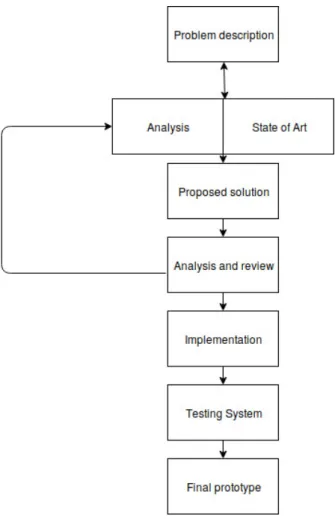
In our thesis life cycle, we followed a systematic research method in order to achieve our goal in a precise way. the method consists of different sequential approaches, helped us to easily maintain the whole research life cycle. we have started to find the problem.when ever we found our problem, then we started analysing and reviewing another’s paper. after getting our analysis report and the other’s paper review report we started to designing our proposed solution.Then our proposed solution was analysed and reviewed again. We made an exit point to go again analysis and state of art state to review again if our proposed solution is not perfect. If our proposed solution is perfect then we went through the implementing our solution state,testing the solution. At the last,we found our final prototype.
Figure 1.1: Research method
Chapter 2
SCENARIO BASED PROBLEM DESCRIPTION
2.1 SCENARIO
• Scene 1: End Users , Mr X lives in Country A and Mr Y lives in country B . They both have smart water tank refiller . At present they can only control their own devices . If they want to have more than one devices on different locations to pump water they can’t do it . As all data resides in one place.
• Scene 2: In addition Mr X buys a hidro sensor , and he wants his water pump to detect the water level and work according the readings. But he can not add the sensor with the system of his . Because it needs help of professional , and the integration of a new component is quiet complex .
• Scene 3: Suppose Mr Y sets up a hydro with the help of professional. But yet he does not have full control upon his new component.As a non technical person he wants full control of his device and use the full extend of every technology .
2.2 ANALYSIS OF SCENARIO
According to the scenario the the points where technological improvement needed are :
• In scene 1 : Users can’t control devices if it is distributed in different locations. They can only control those devices which are situated in the same directory.
• In Scene 2 : Users can not add new components themselves. To add a new component they need help of professionals . Even after adding those components those are not immediate functional . This means in this scenario there is a lack of pluggability.
• In Scene 3 : After the addition of new users the system is not ready to be fully controlled by a user . As different devices has different functionalities a common control architecture is missing here .
Chapter 3
STATE OF ART
We can explore more effectively in this path of making an user control friendly and dynamic and adaptive IoT architecture by simply reviewing the literature based on following questions :
• How to simplify and give full control ?
• How to make architecture loosely coupled ?
• How to make things Pluggable ?
3.1 HOW TO SIMPLIFY AND GIVE FULL CON- TROL?
A paper (Shaha,A& Sharnaker, S.P, 2018) used the theory of building bridge between user control and runtime adaptation . This paper they discussed a way by which an user can develop and design a composite service at runtime . This allows a user more control over the system. They used a technique that introduces us with a concept “composite composition”.
This paper helps us to think about the scope of contribution in user control simplification sector . But this paper did not work with adaptive iot devices . To more relative work we can look up to the paper (Towards middleware supporting end-user driven collaborative IoT and web services).
The paper (Shaha,A& Sharnaker, S.P, 2018) also working on the same objective as they are using blockly type blocks to give full control of a system to end user but their proposed architecture is not fully distributed and it does not offer a feature to make a actual composite composition . The proposed architecture also lacs of pluggability . It means if any new component is newly attached with the system that proposed system can’t handle the new components.
3.2 HOW TO MAKE ARCHITECTURE LOOSELY COUPLED?
The paper (kovatsch,M., & Lanter,M., & Duquennoy,A.,2012) proposed an architecture that provides web like scripting for low-end devices through cloud based application servers and a consistent restful programming model. Their novel runtime container actinium(AC) exposes scripts, their configuration and their lifecycle management through a fully restful program- ming interface using the constrained application protocol(CoAP). They endow the Javascript with an API for direct interaction with mote class iot devices the CoapRequest object and means to export script data as web resource. Although, They are not fully distributed and loosely coupled.
3.3 HOW TO MAKE THINGS PLUGGABLE ?
The paper (Hachem,S.,& Teixeira.,2011) addressed that, internet of things are amplified by the anticipated large scale development of devices and services, information flow and involved users in the IoT. The author of that paper focused on addressing those related to scalability, pluggability and heterogeneity of IoT components and the highly dynamic and unknown nature of the network topology. On that paper they showed a service -oriented middleware solution that addresses those challenges using semantic technologies to provide interoperabil- ity and flexibility. They said about some aspects of the ontology.The first aspect is the thing aspect ontology described in a device ontology,second aspect consists of real world concepts and functionalities of things, modeled in a domain ontology as mathematical formulas and third is a real world approximation unavailable service and estimated information.
For better results, they need to further investigate the sensor, actuator modeling ap- proach on different levels of detail, as they plan on performing deeper comparison with existing solutions.
3.4 RELATED TECHNOLOGY AND FRAMEWORK
For developing this architecture, we mainly focused on highly maintainable, pluggable, loosely coupled and end user friendly technologies.
• Blockly : Blockly is a client-side JavaScript library for creating visual block program- ming languages and editors.
• Django : Django is a Python-based free and open-source web framework, which fol- lows the model-view-template architectural pattern. It helps us to make pluggable architecture.
• Ajax : Ajax is a set of web development techniques using many web technologies on the client side to create asynchronous web applications. With Ajax, web applications can send and retrieve data from a server asynchronously without interfering with the display and behavior of the existing page.
Chapter 4
PROPOSED SOLUTION
4.1 END USER
End User is the actor of this system who does not have any programming knowledge but wants result according to his/her need .
4.2 SERVICES
Service (Imtiaz-Ud-Din, K. M., 2011) is a process that uses a set of instructions which are predefined to accomplish a specific goal . Services in this case is the perspective of user . Using services user can obtain a certain goal.
4.3 COMPOSITE COMPOSITION
Composite Composition (Imtiaz-Ud-Din, K. M., 2011) is a composition of various services and conditions . The service compositions must follow some criteria . Composite composition allows the full control of a device.
4.4 PLUGGABILITY
Pluggability is a process that automatically discovers new components and makes them functionable .
4.5 DISTRIBUTED ARCHITECTURE
In distributed architecture components are presented in different platforms or locations and communicate through network to achieve a specific goal .
Chapter 5
ARCHITECTURE
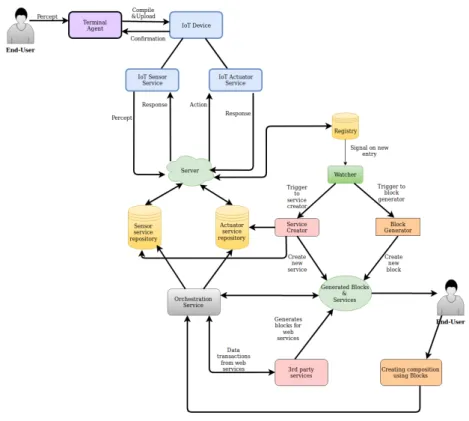
Figure 5.1: Proposed System Architecture
Our architecture consists of ten components which are distributively connected with others because all the components are loosely coupled. The above figure presents a higher
view of our proposed architecture and presents a view of communication between those component.
5.1 SERVICE REGISTRY
A service registry shown in appendix 5 is a storing mechanism. Whenever a new sensor or actuator will be added, service registry takes some sorts of information from those sensors and actuator,like sensor’s/ actuators unique id, name, present state etc.
5.2 WATCHER
Watcher will distributively continuously watch the change of service registry. If a new change happens like, if a new sensor/actuator is added in service registry, then at that time watcher will send two signals for the last updated service on service registry.
5.2.1 Block generator
From watcher one signal will come into block generator phase shown in appendix 2. according to the type of service, new blocks will be generated.
5.2.2 Service creator
Another signal from the watcher will trigger the service creator section shown in appendix 3 and according to the service, service creator will create service for the latest update on the service registry.
5.3 3
rdPARTY WEB SERVICES
End user can use 3rd party web services as per their choice.
5.4 GENERATED BLOCKS AND SERVICES
With the collaboration of block generator and service creator, in that phase services and blocks will be created.This phase is a collaboration of sensor iot services, actuator iot services and 3rd party web services.
5.5 COMPOSITE COMPOSITION
A composite (Imtiaz-Ud-Din, K. M., 2011) composition is created by combining 1 or more tasks , From Ubicom For All Service Composition Concepts and Notation we can say a composite combination can be made of triggers, services, conditions or/and queries .
5.6 ORCHESTRATION SERVICE
According to the re composite composition, data processing unit shown in appendix 4 will write the results from composite composition on its own section. Then this section will change the current values of sensor and actuator current state value according to the end user’s need.
Chapter 6
IMPLEMENTATION
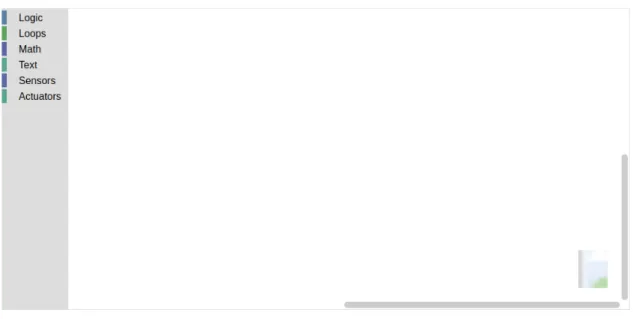
Our prototype runs with the help of django framework and the database part is independent as it is loosely coupled . The User interface is easy to use and users can combine blocks and make a dynamic commands .
6.1 USER INTERFACE
We used Blockly (Blockly, Google,2018) library , because from the perspective of a non technical end user this is easier than ever . They will just combine blocks and they can create logic that is fully functionable . What blockly does is , it generates python output of the combination depending on its predefined set of rules .
To grant full access we used ontologies from the paper(Imtiaz-Ud-Din, K. M., 2011) .Here we used various types of custom and default blocks .
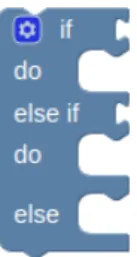
• Trigger Block : Trigger is a is a set of if-else . The trigger sends a signal true or false based on some condition (Imtiaz-Ud-Din, K. M., 2011) . Upon trigger’s signal the full code is executed.
• Condition Block :
Condition (Imtiaz-Ud-Din, K. M., 2011) type blocks (Blockly,Google.,2018) compare things exactly as if-else . These Trigger and conditions are similar but their purpose is different. Condition Blocks can have nested if-else.
Figure 6.1: User interface
Figure 6.2: Trigger type block
• Service Block : Service(Imtiaz-Ud-Din, K. M., 2011) type blocks are the actions which are to be perform upon completion of the conditions . These are custom made blocks . It has a end which can take another block as input which we use as a perimeter of a predefined generic function . There is a socket type part at other end of these blocks which we use to attach with other blocks like print , show , etc . This part returns value from the function we mentioned earlier.
• Query Block : This is a custom made block . It can act two different ways . One is It can directly accept a value and another is it can receive return value returned from another function . Suppose you have a phone book block which is query(Imtiaz-Ud- Din, K. M., 2011) type . You can directly dial number and call that entry . And other way you can use this same block is that you can enter recipient name and it will find the number and return the number then you call him/her .
Figure 6.3: Condition type block
Figure 6.4: Service type block
• Web API Blocks : This type block is created using data we get from web api. Suppose we want to know the weather and use the data of that weather to accomplish a task . This type of block help us in this regard . User can use one or more of these Blocks at a time .
6.2 USER REQUIREMENT
User can use the blocks to express requirements . Google’s Blockly made this an easy task . User can drag and drop blocks , combine them . The final combination express a full logic . To build this logic user does not have to know programming at all.
Figure 6.5: Service type block
Figure 6.6: Service type block
6.3 CODE GENERATION
A fully machine understandable code is generated from the block combinations which we get from user . The blocks use javascript to convert it into a meaningful code structure , then we can get a python output of that code using google’s blockly . The code given by blockly is fully executable in python .
6.4 CODE EXECUTION
Code execution is done using python’s default exec() method . After user creates the com- bination , the generated code is sent to the server-side using javascript . The Code then executed by python .
6.5 DISTRIBUTION OF COMPONENTS
We used Restful API to send and receive . with the help of api we can transform it into a distributed system where we do not need to keep all the components in one place. Now the Team working with the Sensor and Actuator can easily send and receive data from anywhere anytime . We designed the database for actuators and sensors and built an api that can filter the data and give the specific data to the devices .
6.6 PLUGGABILITY
This is a major part of our work . We made the architecture pluggable . So prototype is ready to have new components and it make it full functional . Here whenever we refresh the page it looks for any new components added or not. If any new device is added to the system our system will automatically create controlling blocks , and server side functions to make it fully operational . We made a generic way of writing functions that will improve the control functionalities .
Chapter 7
PROOF OF CONCEPT
7.1 DESCRIPTION TEST CASE
Mr D wants to implement a smart system to his house by himself . He went to the market and bought some sensors and actuators and other parts to automate the lights , fans , and the door . He wants to control his smart home automation based on some web service, and sensor values. He is not a programmer or tech person . So if he uses this architecture described above, the sensors and actuators will follow the plug and play concept and all the control options will generate automatically .
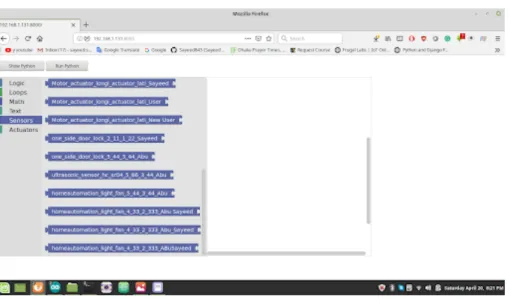
In the figure we can see some blocks generated by blockly , these blocks are created after a new sensor or actuator connects with the system . The name and functionality is provided into the registry . The automatic Block Generator creates these blocks using those information.
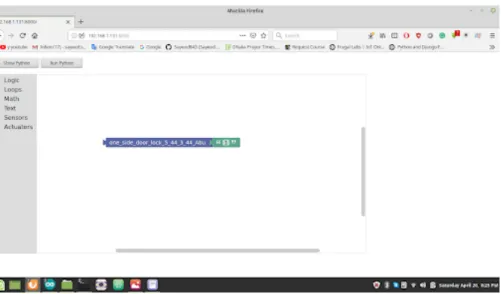
A actuator block can attach with another block . The second block acts as parameter . Here 1 means On and if the info block was 0 then it means this block is giving the actuator information to turn of.
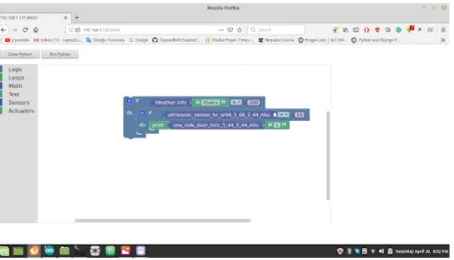
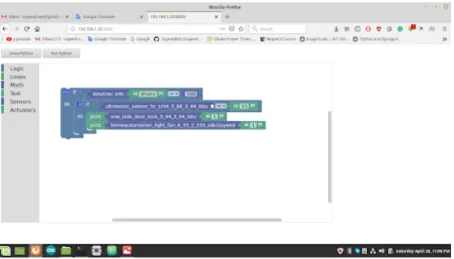
In the figure above we can see a composite composition where user is using the data from web service , and sensor as condition checkup . We can see the condition type blocks (If statement) . Here we can see that there is a web service named weather info which returns the temperature of the place provided with the info block . this is a query type block . Then it checks it with a number . Here it checks if it is greater than 200 kelvin . After that
Figure 7.1: Automatically created blocks for controlling sensors/actuators
the block ’Ultrasonic sensor hc sr04 5 66 3 44 abu’ provides the info of sensor value and it compares with a number . if that is true then the certain block can be turn on or off.
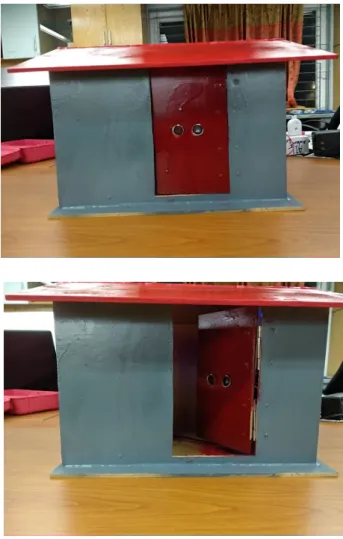
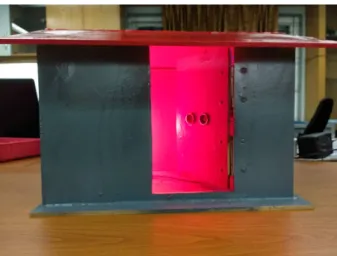
The figure above shows the door’s position before executing the combination and after executing it .
Figure 7.2: A actuator block with a information block attached
In the figure above we can see that There are two actuators . Before there was only one . This shows the dynamic and adaptability of the combinations .
The figure above shows that when the tow actuator is turned on the doors open and at the same time the lights are also on .
Figure 7.3: A composite Composition with sensor , actuator , web service
Figure 7.4: After Running The Composite Combination the door opens
Figure 7.5: The composite combination with multiple actuator at a time
Figure 7.6: Two actuator function in real time
Chapter 8
CONCLUSION
8.1 CONTRIBUTION
Our system gets user inputs using Google’s Blockly , those blocks generate a executable code which can be run by python , when it is run it can get data from different distributed database. Though blockly provided us some basic blocks like if , else etc but most of the blocks are custom made. We also made a generic way of writing services so that it can support plug and play functionality . Used the concept of API to make the system distributed and independent . Making a adaptive architecture and pluggability with flexible controlling options are the main contribution of our work .
8.2 APPLICATION
This research will help to provide non technical users with full control of a system . It will open new ways to provide End users the ability to control their services without depending on technical expertise . Using our concept remote use of services will be easier than ever . And the best thing is now End users can extend and grow the main system without the help of any professional . Non technical people like a farmer can easily set up a irrigation system . and they do not have to worry about all the technical things . This architecture will handle the server side works .
From kids to old people , everyone can setup and use various IoT devices . Till now non-technical end users were controlled by the service provider . But our research shows new way of providing the full functionality to end user .
8.3 LIMITATION OF OUR WORK
Though our system works with composite composition of services it still has a fare amount of limitations . We do not have stand alone watcher for new plugged devices , the web services are parsed from json , as the json response can be different from different websites it’s not fully adaptable in this regard .
8.4 FUTURE WORK
Work on making the web services fully pluggable , Use Ai to help the system controlling more efficient . Develop the idea of a stand alone watcher to watch over the changes in system .
Reference
• Shaha,A& Sharnaker, S.P, 2018: Towards a middleware supporting end-user driven collaborative IoT and web service composition.
• Imtiaz-Ud-Din, K. M., 2011: Collaboration-based intelligent service composition at runtime by end users
• kovatsch,M., & Lanter,M., & Duquennoy,A.,2012 : Actinium: A RESTful Runtime Container for Scriptable Internet of Things Applications
• Hachem,S.,& Teixeira.,2011: Ontologies for the Internet of Things
Appendix
Index.html
1
2
3 {% l o a d s t a t i c %}
4 <!DOCTYPE html>
5 <html>
6 <head>
7 <meta c h a r s e t=” u t f−8”>
8 <t i t l e></ t i t l e>
9 <s c r i p t s r c=”{% s t a t i c ’ b l o c k l y / b l o c k l y c o m p r e s s e d . j s ’ %}”></ s c r i p t>
10 <s c r i p t s r c=”{% s t a t i c ’ b l o c k l y / b l o c k s c o m p r e s s e d . j s ’ %}”></ s c r i p t>
11 <s c r i p t s r c=”{% s t a t i c ’ b l o c k l y / p y t h o n c o m p r e s s e d . j s ’ %}”></ s c r i p t>
12 <s c r i p t s r c=”{% s t a t i c ’ b l o c k l y /msg/ j s / en . j s ’ %} ”></ s c r i p t>
13 <s c r i p t s r c=”{% s t a t i c ’ j s / g e n e r a t o r s / c o d e g e n e r a t o r−w e a t h e r . j s ’ %}”></ s c r i p t
>
14 <s c r i p t s r c=”{% s t a t i c ’ j s / g e n e r a t o r s / c o d e g e n e r a t o r−motor−on . j s ’ %}”></
s c r i p t>
15 <s c r i p t s r c=”{% s t a t i c ’ j s / g e n e r a t o r s / c o d e g e n e r a t o r−motor−o f f . j s ’ %}”></
s c r i p t>
16 <s c r i p t s r c=”{% s t a t i c ’ j s / g e n e r a t o r s / c o d e g e n e r a t o r−u p p e r s e n s o r . j s ’ %}”></
s c r i p t>
17 <s c r i p t s r c=”{% s t a t i c ’ j s / g e n e r a t o r s / c o d e g e n e r a t o r−l o w e r s e n s o r . j s ’ %}”></
s c r i p t>
18 <s c r i p t s r c=”{% s t a t i c ’ j s / g e n e r a t o r s / c o d e g e n e r a t o r−p r i n t c o n t e n t . j s ’ %}”></
s c r i p t>
19 <s c r i p t s r c=”{% s t a t i c ’ j s / g e n e r a t o r s / c o d e g e n e r a t o r−v a l u e t o p r i n t . j s ’ %}”
></ s c r i p t>
20 <s c r i p t s r c=”{% s t a t i c ’ j s / g e n e r a t o r s / c o d e g e n e r a t o r−d o i t . j s ’ %}”></ s c r i p t>
21 <s c r i p t s r c=”{% s t a t i c ’ j s / j q u e r y . min . j s ’ %}”></ s c r i p t>
22 {% i n c l u d e ” b l o c k s j s d e c l a r a t i o n . j s ” %}
23 <s c r i p t s r c=”{% s t a t i c ’ j s / j q u e r y . min . j s ’ %}”></ s c r i p t>
24 <s t y l e>
25 body {
26 background−c o l o r : # f f f ;
27 f o n t−f a m i l y : s a n s−s e r i f ;
28 }
29 h1 {
30 f o n t−w e i g h t : normal ;
31 f o n t−s i z e : 140%;
32 }
33 </ s t y l e>
34 </head>
35<body>
36 <!−− added t h r e e b u t t o n s i n t h e v e r y f i r s t−−>
37 <p>
38 <b u t t o n o n c l i c k=” showCode ( ) ”>Show Python</button>
39
40 <b u t t o n o n c l i c k=” runCode ( ) ” i d=” r u n c o d e ”>Run Python</button>
41 <b u t t o n o n c l i c k=” s a v e ( ) ” i d=” s a v e ”>Save Combination</button>
42 <b u t t o n o n c l i c k=” r e s t o r e ( ) ” i d=” r e s t o r e ”>R e s t o r e</button>
43 <!−−n o t u s e d r i g h t now
44 <b u t t o n o n c l i c k=”showXml ( ) ”>G e n e r a t e XML t r e e</button>
45 −−>
46 {% c s r f t o k e n %}
47 </p>
48
49 <!−− work s p a c e −−>
50 <d i v i d=” b l o c k l y D i v ” s t y l e=” h e i g h t : 480 px ; width : 1000 px ; ”></div>
51 <!−− end work s p a c e −−>
52
53
54 <!−− b l o c k l y b l o c k s ( d e f a u l t from d o c u m e n t a t i o n ) −−>
55 <xml i d=” t o o l b o x ” s t y l e=” d i s p l a y : none ”>
56 <c a t e g o r y name=” L o g i c ” c o l o u r=”%{BKY LOGIC HUE}”>
57 <b l o c k t y p e=” c o n t r o l s i f ”></b l o c k>
58 <b l o c k t y p e=” l o g i c c o m p a r e ”></b l o c k>
59 <b l o c k t y p e=” l o g i c o p e r a t i o n ”></b l o c k>
60 <b l o c k t y p e=” l o g i c n e g a t e ”></b l o c k>
61 <b l o c k t y p e=” l o g i c b o o l e a n ”></b l o c k>
62 <b l o c k t y p e=” d o i t ”></b l o c k>
63 </ c a t e g o r y>
64 <c a t e g o r y name=” Loops ” c o l o u r=”%{BKY LOOPS HUE}”>
65 <b l o c k t y p e=” c o n t r o l s r e p e a t e x t ”>
66 <v a l u e name=”TIMES”>
67 <b l o c k t y p e=” math number ”>
68 <f i e l d name=”NUM”>10</ f i e l d>
69 </b l o c k>
70 </v a l u e>
71 </b l o c k>
72 <b l o c k t y p e=” c o n t r o l s w h i l e U n t i l ”></b l o c k>
73 </ c a t e g o r y>
74 <c a t e g o r y name=”Math” c o l o u r=”%{BKY MATH HUE}”>
75 <b l o c k t y p e=” math number ”>
76 <f i e l d name=”NUM”>123</ f i e l d>
77 </b l o c k>
78 <b l o c k t y p e=” m a t h a r i t h m e t i c ”></b l o c k>
79 <b l o c k t y p e=” m a t h s i n g l e ”></b l o c k>
80 </ c a t e g o r y>
81 <c a t e g o r y name=” Text ” c o l o u r=”%{BKY TEXTS HUE}”>
82 <b l o c k t y p e=” t e x t ”></b l o c k>
83 <b l o c k t y p e=” t e x t l e n g t h ”></b l o c k>
84 <b l o c k t y p e=” t e x t p r i n t ”></b l o c k>
85 </ c a t e g o r y>
86 <!−− end b l o c k l y b l o c k s −−>
87
88
89 <!−− custom b l o c k l y b o c k s ( made by us ) −−>
90 <c a t e g o r y name=” S e n s o r s ” c o l o u r=”%{BKY MATH HUE}”>
91
92 <!−− T h i s i s h e r e t o d e c l a r e a l l b l o c k s −−>
93 {% i n c l u d e ” b l o c k s d e c l a r a t i o n . html ” %}
94
95 </ c a t e g o r y>
96
97 <c a t e g o r y name=” A c t u a t o r s ” c o l o u r=”%{BKY TEXTS HUE}”>
98
99
100
101 </ c a t e g o r y>
102 <!−− end custom b l o c k l y b o c k s −−>
103 </xml>
104 105
106
107 <s c r i p t>
108 // i n i t i a l i z e w o r k s p a c e
109 // g e t t h e l o g i c s t a t e m e n t s from b l o c k l y / media
110 v a r demoWorkspace = B l o c k l y . i n j e c t ( ’ b l o c k l y D i v ’ ,
111 {media : ’ b l o c k l y / media / ’ , t o o l b o x : document . getElementById ( ’ t o o l b o x ’ )})
;
112 // G e n e r a t e J a v a S c r i p t c o d e and d i s p l a y i t .
113 f u n c t i o n showCode ( ) {
114 B l o c k l y . Python . INFINITE LOOP TRAP = n u l l ;
115 // c o n v e r t b l o c k l y l o g i c s i n t o python c o d e
116 v a r c o d e = B l o c k l y . Python . workspaceToCode ( demoWorkspace ) ;
117 a l e r t ( c o d e ) ;
118 }
119
120
121 f u n c t i o n s a v e ( ){
122 c o n s o l e . l o g ( ” abcd ” ) ;
123 i f ( t y p e o f ( S t o r a g e ) !==” u n d e f i n e d ” )
124 {
125 v a r xml = B l o c k l y . Python . workspaceToDom ( B l o c k l y . demoWorkspace ) ;
126 l o c a l S t o r a g e . s e t I t e m ( document . getElementById ( ” b l o c k l y D i v ” ) . v a l u e , B l o c k l y . Python . domToText ( xml ) ) ;
127 B l o c k l y . demoWorkspace . c l e a r ( ) ;
128 }
129 e l s e{
130 a l a r t ( ” e r r o r i n s a v e ” ) ;
131 }
132 }
133
134
135 f u n c t i o n r e s t o r e ( ){
136 B l o c k l y . demoWorkspace . c l e a r ( )
137 v a r nameOfTheProject = document . getElementById ( ” b l o c k l y D i v ” ) . v a l u e ;
138 i f ( t y p e o f ( S t o r a g e ) !==” u n d e f i n e d ” ){
139 i f ( l o c a l S t o r a g e . d a t a != n u l l ){
140 v a r xml = B l o c k l y . Python . textToCode ( l o c a l S t o r a g e . g e t I t e m ( nameOfTheProject ) ) ;
141 B l o c k l y . Python . domToWorkspace ( B l o c k l y . demoWorkspace , xml ) ;
142 }
143 e l s e{
144 a l a r t ( ” n o t h i n g t o r e s t o r e ” ) ;
145 }
146 }
147 }
148
149 150
151
152
153
154 // run c o d e and g i v e a p o s t h t t p r e q u e s t t o t h e s e r v e r
155 // t h e n s e r v e r w i l l g e t t h e v a l u e and make d e c i s s i o n s
156 f u n c t i o n runCode ( ){
157 B l o c k l y . Python . INFINITE LOOP TRAP = n u l l ;
158 // c o n v e r t b l o c k l y l o g i c s i n t o python c o d e
159 v a r c o d e = B l o c k l y . Python . workspaceToCode ( demoWorkspace ) ;
160 // v a r c o d e = S t r i n g ( c o d e ) ;
161 // v a r f i e l d s = c o d e . s p l i t ( ’ : ’ ) ;
162 // v a r l o g i c s e c t i o n = f i e l d s [ 0 ] ;
163 // v a r f u n c t i o n c a l l = f i e l d s [ 1 ] ;
164 $ . a j a x ({
165 t y p e: ’POST ’ ,
166 u r l : ” / g e t M o t o r S t a t u s / ” ,
167 h e a d e r s :{
168 ”X−CSRFToken” : $ ( ” i n p u t [ name=c s r f m i d d l e w a r e t o k e n ] ” ) . v a l ( )
169 },
170 d a t a : {’ c o d e ’ : c o d e},
171 s u c c e s s : f u n c t i o n ( r e s p o n s e ) {
172 c o n s o l e . l o g ( r e s p o n s e . c o d e ) ;
173 }
174 }) ;
175 }
176 // w e a t e r b l o c k s t a r t
177 // B l o c k l y . B l o c k s [ ’ w e a t h e r ’ ] = {
178 // i n i t : f u n c t i o n ( ) {
179 // t h i s . appendValueInput ( ” t o i n p u t ” )
180 // . s e t C h e c k ( n u l l )
181 // . a p p e n d F i e l d ( ” Weather i n f o ” ) ;
182 // t h i s . s e t O u t p u t ( t r u e , n u l l ) ;
183 // t h i s . s e t C o l o u r ( 2 3 0 ) ;
184 // t h i s . s e t T o o l t i p ( ” ” ) ;
185 // t h i s . s e t H e l p U r l ( ” ” ) ;
186 // }
187 // };
188 // w e a t h e r b l o c k end
189
190 // motor b l o c k s t a r t
191
192
193 B l o c k l y . B l o c k s [ ’ d o i t ’ ] = {
194 i n i t : f u n c t i o n ( ) {
195 t h i s . appendValueInput ( ”NAME” )
196 . s e t C h e c k ( n u l l )
197 . a p p e n d F i e l d ( ”Do” ) ;
198 t h i s . s e t P r e v i o u s S t a t e m e n t ( t r u e , n u l l ) ;
199 t h i s . s e t N e x t S t a t e m e n t ( t r u e , n u l l ) ;
200 t h i s . s e t C o l o u r ( 2 3 0 ) ;
201 t h i s . s e t T o o l t i p ( ” ” ) ;
202 t h i s . s e t H e l p U r l ( ” ” ) ;
203 }
204 };
205
206 B l o c k l y . B l o c k s [ ’ motor−on ’ ] = {
207 i n i t : f u n c t i o n ( ) {
208 t h i s . appendDummyInput ( )
209 . a p p e n d F i e l d ( new B l o c k l y . F i e l d L a b e l ( ’ motor on ’ ) ) ; / / l a b e l
210 // t h i s . s e t O u t p u t ( t r u e , ’ S t r i n g ’ ) ;
211 t h i s . s e t P r e v i o u s S t a t e m e n t ( t r u e , ’ A c t i o n ’ ) ;
212 t h i s . s e t C o l o u r ( 6 0 ) ;
213 }
214 }
215 B l o c k l y . B l o c k s [ ’ motor−o f f ’ ] = {
216 i n i t : f u n c t i o n ( ) {
217 t h i s . appendDummyInput ( )
218 . a p p e n d F i e l d ( new B l o c k l y . F i e l d L a b e l ( ’ motor o f f ’ ) ) ;
219 // t h i s . s e t O u t p u t ( t r u e , ’ S t r i n g ’ ) ;
220 t h i s . s e t P r e v i o u s S t a t e m e n t ( t r u e , ’ A c t i o n ’ ) ;
221 t h i s . s e t C o l o u r ( 2 0 ) ;
222 }
223 }
224 // motor b l o c k end
225 // l o w e r s e n s o r b l o c k s t a r t
226 B l o c k l y . B l o c k s [ ’ l−s e n s o r ’ ] = {
227 i n i t : f u n c t i o n ( ) {
228 t h i s . appendDummyInput ( )
229 . a p p e n d F i e l d ( new B l o c k l y . F i e l d L a b e l ( ’ l o w e r s e n s o r ’ ) ) ;
230 t h i s . s e t O u t p u t ( t r u e , ’ Number ’ ) ;
231 // t h i s . s e t P r e v i o u s S t a t e m e n t ( t r u e , ’ A c t i o n ’ ) ;
232 t h i s . s e t C o l o u r ( 2 0 ) ;
233 }
234 }
235 // l o w e r s e n s o r b l o c k end
236
237 238
239 // s t a r t p r i n t c o n t e n t
240
241 B l o c k l y . B l o c k s [ ’ p r i n t c o n t e n t ’ ] = {
242 i n i t : f u n c t i o n ( ) {
243 t h i s . appendValueInput ( ” t o p r i n t ” )
244 . s e t C h e c k ( n u l l )
245 . a p p e n d F i e l d ( new B l o c k l y . F i e l d T e x t I n p u t ( ” P r i n t v a l u e ” ) , ”NAME” ) ;
246 t h i s . s e t C o l o u r ( 2 3 0 ) ;
247 t h i s . s e t T o o l t i p ( ” ” ) ;
248 t h i s . s e t H e l p U r l ( ” ” ) ;
249 }
250 };
251 252
253
254
255 B l o c k l y . B l o c k s [ ’ v a l u e t o p r i n t ’ ] = {
256 i n i t : f u n c t i o n ( ) {
257 t h i s . appendValueInput ( ” t o i n p u t ” )
258 . s e t C h e c k ( n u l l )
259 . a p p e n d F i e l d ( ” p a s s ” ) ;
260 t h i s . s e t O u t p u t ( t r u e , n u l l ) ;
261 t h i s . s e t C o l o u r ( 2 3 0 ) ;
262 t h i s . s e t T o o l t i p ( ” ” ) ;
263 t h i s . s e t H e l p U r l ( ” ” ) ;
264 }
265 };
266
267
268
269
270 // T h i s i s h e r e t o i n c l u d e a l l b l o c k s Ui
271 {% i n c l u d e ” b l o c k s . j s ” %}
272
273
274 </ s c r i p t>
275
276 </body>
277 </html>
Block Generator.py
1
2
3 #T h i s f i l e i n c l u d e A l l B l o c k G e n e r a t o r F u n c t i o n s
4 from . models i m p o r t ∗
5 i m p o r t s t r i n g
6 i m p o r t random
7 from d j a n g o . h t t p i m p o r t HttpResponse
8 from d j a n g o . s h o r t c u t s i m p o r t r e n d e r , r e d i r e c t
9
10#Random Name G e n e r a t o r
11# T h i s F u n c t i o n W i l l be R e p l a c e d With Watcherb
12 d e f FunctionNameGenerator ( s i z e =6 , c h a r s=s t r i n g . a s c i i u p p e r c a s e + s t r i n g . d i g i t s ) :
13 r e t u r n ’ ’ . j o i n ( random . c h o i c e ( c h a r s ) f o r i n r a n g e( s i z e ) )
14
15#Main E x e c u t i o n F u n c t i o n
16 d e f B l o c k G e n e r a t o r ( nameid , s e r v i c e t y p e ) :
17 BlockName = nameid
18 BlockType = s e r v i c e t y p e
19 B l o c k U i G e n e r a t o r ( BlockName , BlockType )
20 B l o c k D e c l a r a t i o n ( BlockName )
21 B l o c k J s G e n e r a t o r ( BlockName , BlockType )
22 B l o c k J s D e c l a r a t i o n ( BlockName )
23 p r i n t( ’ g o t i t ’ )
24
25# T h i s F u n c t i o n G e n e a r t e UI o f The B l o c k
26 d e f B l o c k U i G e n e r a t o r ( BlockName , BlockType ) :
27 f= open( ” t e m p l e t e s / b l o c k s . j s ” , ” a+” )
28 B l o c k U i C o n t a i n e r = GetBlockUI ( BlockName , BlockType )
29 f . w r i t e ( B l o c k U i C o n t a i n e r )
30 f . c l o s e ( )
31
32# T h i s f u n c t i o n D e c l a r e b l o c k t o make i t v i s i b l e t o End User
33 d e f B l o c k D e c l a r a t i o n ( BlockName ) :
34 f= open( ” t e m p l e t e s / b l o c k s d e c l a r a t i o n . html ” , ” a+” )
35 f . w r i t e ( ’\n ’+”<b l o c k t y p e=”+ ’ ” ’+BlockName+ ’ ” ’+”></b l o c k>” )
36 f . c l o s e ( )
37
38#G e n e r a t e JS f i l e f o r show c o d e
39 d e f B l o c k J s G e n e r a t o r ( BlockName , BlockType ) :
40 f= open( ” s t a t i c / j s / g e n e r a t o r s / c o d e g e n e r a t o r−”+BlockName+” . j s ” , ”w+” )
41 B l o c k J s C o n t a i n e r = G e t B l o c k J s ( BlockName , BlockType )
42 f . w r i t e ( B l o c k J s C o n t a i n e r )
43 f . c l o s e ( )
44
45#r e t u r n Type o f B l o c k Ui you want
46 d e f GetBlockUI ( BlockName , BlockType ) :
47 # i f BlockType == ’ s e n s o r ’ :
48 # B l o c k U i = ’\n\n ’+”//”+BlockName+” s e n s o r b l o c k s t a r t ”+ ’\n ’+” B l o c k l y . B l o c k s [”+” ’”+ BlockName +” ’”+”] = {”+ ’\n ’+ ’\t ’+” i n i t : f u n c t i o n ( ) {”+ ’\n ’+ ’\t
\t ’+” t h i s . appendDummyInput ( ) ”+ ’\n ’+ ’\t\t ’ + ” . a p p e n d F i e l d ( new B l o c k l y . F i e l d L a b e l (”+” ’”+ BlockName +” ’”+”) ) ; ” + ’\n ’+ ’\t\t ’+” t h i s . s e t O u t p u t ( t r u e , ’ Number ’ ) ; ” + ’\n ’+ ’\t\t ’+” t h i s . s e t C o l o u r ( 2 0 ) ; ” + ’\n ’+ ’\t ’+”}”+ ’\n ’+”}”+ ’\n
’+”//”+BlockName+” s e n s o r b l o c k end ”
49 # r e t u r n B l o c k U i
50 i f BlockType== ’ s e n s o r ’ o r ’ a c t u a t o r ’ :
51 B l o c k U i = ”””
52 B l o c k l y . B l o c k s [ ’ ”””+BlockName+””” ’ ] = {
53 i n i t : f u n c t i o n ( ) {
54 t h i s . appendValueInput ( ” t o i n p u t ” )
55 . s e t C h e c k ( n u l l )
56 . a p p e n d F i e l d ( ’ ”””+BlockName+””” ’ ) ;
57 t h i s . s e t O u t p u t ( t r u e , n u l l ) ;
58 t h i s . s e t C o l o u r ( 2 3 0 ) ;
59 t h i s . s e t T o o l t i p ( ” ” ) ;
60 t h i s . s e t H e l p U r l ( ” ” ) ;
61 }
62 };
63 ”””
64
65 r e t u r n B l o c k U i
66
67#Greturn t y p e o f b l o c k j s you want
68 d e f G e t B l o c k J s ( BlockName , BlockType ) :
69 # i f BlockType == ’ s e n s o r ’ :
70 # B l o c k J s = ” B l o c k l y . Python [”+” ’”+ BlockName +” ’”+”] = f u n c t i o n ( B l o c k ) {”+ ’\n ’+ ’\t ’+” v a r c o d e = ”+ ’” ’+ BlockName + ’ ( ) ” ’+”;”+ ’\n ’+ ’\t ’+” r e t u r n [ code , B l o c k l y . Python .ORDER ATOMIC] ; ” + ’\n ’+”}”
71 # r e t u r n B l o c k J s
72 i f BlockType== ’ s e n s o r ’ o r ’ a c t u a t o r ’ :
73 B l o c k J s = ”””
74 B l o c k l y . Python [ ’ ”””+BlockName+””” ’ ] = f u n c t i o n ( b l o c k ) {
75 v a r v a l u e t o i n p u t = B l o c k l y . Python . valueToCode ( b l o c k , ’ t o i n p u t
’ , B l o c k l y . Python .ORDER ATOMIC) ;
76 // TODO: Assemble J a v a S c r i p t i n t o c o d e v a r i a b l e .
77 v a r c o d e = ’ ”””+BlockName+””” ( ’+ v a l u e t o i n p u t + ’) ’ ;
78 // TODO: Change ORDER NONE t o t h e c o r r e c t s t r e n g t h .
79 r e t u r n [ code , B l o c k l y . Python .ORDER NONE ] ;
80 };
81 ”””
82 r e t u r n B l o c k J s
83
84
85 d e f B l o c k J s D e c l a r a t i o n ( BlockName ) :
86 f= open( ” t e m p l e t e s / b l o c k s j s d e c l a r a t i o n . j s ” , ” a+” )
87 f . w r i t e ( ’\n\n<s c r i p t s r c =” s t a t i c / j s / g e n e r a t o r s / c o d e g e n e r a t o r−’+BlockName+ ’ . j s ”></ s c r i p t>’ )
88 f . c l o s e ( )
Automatic writer.py
1
2 d e f a c t u a t o r f u n c t i o n w r i t t e r ( f u n c t i o n n a m e , t a g ) :
3 p r i n t( ” w r i t t i n g a c t u a t o r f u n c t i o n w r i t t e r ” )
4 f i l e = open( ” t e s t f i l e . py ” , ” a+” )
5
6 c o d e = ”””
7 d e f ””” + f u n c t i o n n a m e+””” ( m o t o r s t a t u s ) :
8 u r l = ’ h t t p : / / 1 2 7 . 0 . 0 . 1 : 8 0 0 0 / a p i / a c t u a t o r s / ’
9
10 d a t a = {
11
12 ” t o p i c ” : ’ ”””+t a g+””” ’ ,
13 ” v a l u e ” : m o t o r s t a t u s ,
14 ” t i m e ” : ”2019−01−24T13 : 3 5 : 2 4 . 2 4 6 2 2 6 Z ” ,
15 ”name ” : ”1”
16 }
17
18 #C a l l REST API
19 r e s p o n s e = r e q u e s t s . p o s t ( u r l , d a t a=d a t a )
20
21 #P r i n t Response
22 p r i n t ( r e s p o n s e . t e x t )
23
24 ””
25 f i l e . w r i t e ( c o d e )
26
27 f i l e . c l o s e ( )
28
29
30 d e f s e n s o r f u n c t i o n w r i t t e r ( f u n c t i o n n a m e , t a g ) :
31 f i l e = open ( ” t e s t f i l e . py ” , ” a+”)
32
33 c o d e = ”””
34 d e f ”””+f u n c t i o n n a m e+”””( ) :
35 e m p t y l i s t = [ ]
36 s e n s o r t a g = ”””+t a g+”””
37 d a t a = r e q u e s t s . g e t ( ” h t t p : / / 1 2 7 . 0 . 0 . 1 : 8 0 0 0 / a p i / l o w e r s e n s o r s / ” ) . j s o n ( )
38 f o r i i n d a t a :
39 i f i [ ’ t o p i c ’ ]== s e n s o r t a g :
40 e m p t y l i s t . append ( i )
41
42 d a t a = e m p t y l i s t [−1 ]
43 p r i n t( d a t a )
44
45 d a t a = i n t( d a t a [ ’ v a l u e ’ ] )
46 r e t u r n( d a t a )
47 ”””
48
49 f i l e . w r i t e ( c o d e )
50
51 f i l e . c l o s e ( )
Data processing.py
1
2 i m p o r t r e q u e s t s
3 i m p o r t j s o n
4
5 d e f w e a t h e r i n f o ( c i t y ) :
6 a p i k e y = ” b d 2 7 4 1 9 d 6 6 c 8 6 7 8 6 1 3 e 9 7 8 c a 5 6 1 a d 3 f 7 ”
7 u r l = ” h t t p : / / a p i . openweathermap . o r g / d a t a / 2 . 5 / f o r e c a s t ? q=”+c i t y+”&APPID={}
” .f o r m a t( a p i k e y )
8 d a t a = r e q u e s t s . g e t ( u r l ) . j s o n ( )
9
10 #d a t a = d a t a [ ’ w e a t h e r ’ ]
11 #p r i n t ( d a t a [ ’ name ’ ] )
12 #p r i n t ( j s o n . dumps ( data , i n d e n t = 4 , s o r t k e y s=True ) )
13
14 d a t a =( d a t a [ ’ l i s t ’ ] [ 0 ] [ ’ main ’ ] [ ’ temp ’ ] )
15 p r i n t( d a t a )
16 r e t u r n d a t a
17
18