ENERGY EFFICENCY IMPROVEMENT FOR COMMERCIAL BUILDING IN BANGLADESH
THROUGH ENERGY AUDIT
A Thesis submitted in partial fulfilment of the requirements of the Award of Degree of Bachelor of Science in Electrical and Electronic Engineering
By
Md. Showkot Hossain (ID #: 152-33-2682) Md. Akib Hasan (ID #: 152-33-2718)
Supervised by
Mr. Md. Mahmudur Rahman Assistant Professor
Department of EEE
DEPARTMENT OF ELECTRICAL AND ELECTRONIC ENGINEERING FACULTY OF ENGINEERING
DAFFODIL INTERNATIONAL UNIVERSITY
September 2019
Certification
This is to certify that this thesis entitled “ENERGY EFFICENCY IMPROVEMENT FOR COMMERCIAL BUILDING IN BANGLADESH THROUGH ENERGY AUDIT” is done by the following students under my direct supervision and this work has been carried out by them in the laboratories of the department of Electrical and Electronic Engineering under the Faculty of Engineering of Daffodil International University in partial fulfillment of the requirements for the degree of Bachelor of Science in Electrical and Electronic Engineering. The presentation of the work was held on
Signature of the candidates
_______________________
Md. Showkot Hossain ID #: 152-33-2682
_______________________
Md. Akib Hasan ID #: 152-33-2718
Countersigned
_______________________
Mr. Md. Mahmudur Rahman Assistant Professor
Department of Electrical and Electronic Engineering Faculty of Science and Engineering
Daffodil International University.
The thesis entitled “ENERGY EFFICIENCY IMPROVEMENT FOR COMMERCIAL BUILDING IN BANGLADESH THROUGH ENERGY AUDIT,” submitted by Md. Showkot Hossain, ID No: 152-33-2682 and Md. Akib Hasan, ID No: 152-33-2718, Session: Fall 2019 has been accepted as satisfactory in partial fulfilment of the requirements for the degree of Bachelor of Science in Electrical and Electronic Engineering September 2019.
BOARD OF EXAMINERS
_____________________________
NAME: Chairman Professor
Department of EEE, DIU
_____________________________
NAME: Internal Member Professor
Department of EEE, DIU
_____________________________
NAME: Internal Member Professor
Department of EEE, DIU
ACKNOWLEDGEMENT
First of all, we give thanks to Allah. Then we would like to take this opportunity to express our appreciation and gratitude to our thesis supervisor Mr. Md. Mahmudur Rahman, Assistant Professor of Department of EEE for being dedicated in supporting, motivating and guiding us through this thesis. This thesis can’t be done without his useful advice and helps. Also thank you very much for giving us opportunity to choose this thesis.
We also want to convoy our thankfulness to NAME, Professor and Chairperson of the Department of EEE for his help, support and constant encouragement.
Apart from that, we would like to thank our entire friends for sharing knowledge;
information and helping us in making this thesis success. Also, thanks for lending us some tools and equipment.
To our beloved family, we want to give them our deepest love and gratitude for being very supportive and also for their inspiration and encourage during our studies in this University.
Dedicated to,
Our parent, respected teachers, those people who enriches this field by their
research and the person we love.
ABSTRACT
Commercial Buildings are the large consumers of energy, which they use in many different ways. In this thesis we have successfully proved that there is a huge potential of energy savings in the commercial utilities by implementing some energy conservation measures on the largest energy consumption equipment’s such as Light and AC.
Bangladesh is developing country, is advancing at a quick pace because of the expansion in industries and technologies. However, the country has been confronting a major energy crisis for a long while to meet the growing needs. Day by day, the gap between energy demand and supply is increase. One effecting way to minimize the gap between supply and demand energy audit is need to conduct in commercial sectors in regular basis. Energy audit helps to find the loss, wastage and give space for improvements in utilization. Main objective of our thesis is to improve energy utilization in commercial building for our country by finding energy loss, provide method and techniques through energy audit. The data entries are facilitated by user forms. They are calculated by MS excel sheet and the transferred to the data table.
That’s help to generates different pie charts to point the highest energy consumed sector and their cost.
This thesis also focuses on the energy saving opportunities and the potential to reduce energy consumption cost. This is done by replacing conventional lighting and other important equipment with more energy efficient appliances to increase the efficiency.
The result of our study successfully demonstrated that, a substantial amount of energy and money can be conserved, if energy audit is practice and executed.
Table of Contents
ACKNOWLEDGEMENT ...IV ABSTRACT ...VI LIST OF FIGURES ... X LIST OF TABLES ... XI LIST OF ABBREVIATION ... XII
CHAPTER 1... 1
INTRODUCTION ... 1
1.1 Energy Audit ... 2
1.2 Problem Statement ... 3
1.3 Thesis Objectives ... 4
1.4 Scopes ... 4
1.5 Research Methodology ... 4
1.6 Thesis Organization ... 5
CHAPTER 2... 6
SIGNIFICANCE OF ENERGY AUDIT ... 6
2.1 Introduction ... 6
2.2 Basics of Energy Audit ... 6
2.3 Literature Review ... 8
2.4 Energy Audit Instruments ... 12
2.4.1 Clamp on Ammeter ... 12
2.4.2 Electrical Power Analyzer ... 12
2.4.3 Infrared Camera ... 12
2.4.4 IR Thermometer... 13
2.4.5 Light Meter ... 13
2.4.6 Power Factor Meter... 13
2.4.7 Ultrasonic Flow Meter ... 13
2.4.8 Airflow Measurement Devices ... 13
2.4.9 Safety Equipment ... 14
2.5 Lighting Audit ... 14
2.6 Electrical Audit ... 14
2.7 Envelope Audit ... 16
2.8 Summary ... 17
CHAPTER 3... 18
AUDITING DAFFODIL UNIVERSITY LIBRARY BUILDING ... 18
3.1 Introduction ... 18
3.2 Daffodil University Library Building Audit ... 18
3.3 Electrical Energy Utilization Systems ... 22
3.4 Energy Use Index ... 24
3.5 Calculation of Daffodil University Library Building ... 25
3.6 Analysis in Terms of Actual Bill... 31
3.7 Comments ... 31
3.8 Summary ... 32
CHAPER 4 ... 33
ECONOMIC FEASIBILITY STUDY ... 33
4.1 Introduction ... 33
4.2 Lighting Consideration ... 33
4.2.1 Incandescent Lights ... 34
4.2.2 Fluorescent Lamps ... 34
4.2.3 Compact Fluorescent Lamps ... 35
4.2.4 High Density Discharge Lamps ... 35
4.2.5 LED ... 35
4.3 Retrofits ... 37
4.4 Electrical Equipment Consideration ... 39
4.4.1 Replacement of Air Conditioner ... 39
4.4.1.1 Cooling Capacity ... 39
4.4.1.2 Power Consumption ... 40
4.4.1.3 EER & SEER ... 40
4.4.1.4 Air Flow ... 41
4.4.1.5 Noise and Dehumidification ... 41
4.4.2 Inverter Technology in Air Conditioner ... 41
4.4.3 Fan Size and Blade Angle ... 42
4.4.3.1 Fan Installation ... 42
4.4.3.2 Noise Levels ... 42
4.4.3.3 CFM ... 43
4.4.3.4 Motors ... 43
4.5 Building Envelope Consideration ... 44
4.6 Saving on Lighting ... 47
4.7 Saving from Electrical Equipment ... 49
4.8 Savings on Building Envelope Audit ... 54
4.9 Payback Period ... 56
4.10 Summary ... 57
CHAPTER 5... 58
ENERGY EFFICIENCY IMPROVEMENT ... 58
5.1 Introduction ... 58
5.2 Installation of Solar System ... 58
5.3 Operation Time ... 58
5.4 Performance of Equipment ... 58
5.5 Improving the Power Factor ... 59
5.6 Energy Efficient Technologies in Commercial Utilities ... 59
5.7 Best Practice ... 59
5.8 Field Saving Opportunities ... 59
5.8.1 Lighting ... 60
5.8.2 Air Conditioning System ... 60
5.8.3 Fan... 60
5.8.4 Pump ... 60
5.9 Summary ... 60
CHAPTER 6... 61
CONCLUSION ... 61
6.1 Limitations of the Work... 61
6.2 Future Scopes of the Work ... 61
APPENDIX A ... 63
APPENDIX B ... 75
REFERENCES ... 78
LIST OF FIGURES
Figure 3. 1: Lighting audit manual form... 20
Figure 3. 2: Envelope audit manual form ... 21
Figure 3. 3: Floor plan of DIU library building 2nd and 3rd ... 22
Figure 3. 4: Electricity consumption by different connecter load ... 24
Figure 3. 5: Energy use index per month ... 25
Figure 3. 6: Total lighting load of DIU library building... 26
Figure 3. 7: Monthly lighting cost of DIU library building ... 27
Figure 3. 8: Monthly equipment energy consumption ... 29
Figure 3. 9: Monthly equipment cost... 29
Figure 3. 10: Percentage of total cost ... 31
Figure 4. 2: Incandescent lamp ... 36
Figure 4. 1: Fluorescent lamp... 36
Figure 4. 4: LED lamp ... 36
Figure 4. 3: Compact fluorescent lamp... 36
Figure 4. 5: Percentage of cost before saving ... 55
Figure 4. 6: Percentage of cost after saving ... 55
LIST OF TABLES
Table 2. 1: Audit Phase ... 8
Table 3. 1: Electricity Bill ... 18
Table 3. 2: Connected load ... 23
Table 3. 3: Data of connected lighting load ... 25
Table 3. 4: Data of connected electric equipments ... 28
Table 3. 5: Data of building envelope audit ... 30
Table 4. 1: Comparison of features for different type of lights ... 36
Table 4. 2: Data of light in commercial building ... 37
Table 4. 3: Average luminous level measured by light meter ... 37
Table 4. 4: Replacement of typical lamps by LED lamps ... 38
Table 4. 5: Recommended illumination level by BNBC ... 38
Table 4. 6: Length of drop rod for different heights... 42
Table 4. 7: Specification of ENERGY STAR rated ceiling fan ... 43
Table 4. 8: Savings from lighting audit ... 49
Table 4. 9: Savings of power consumption for DIU Library Building... 53
Table 4. 10: Summarizes the savings of money in BDT/month for the electrical appliances for DIU Library Building... 53
Table 4. 11: Star rated appliances for DIU Library Building ... 56
List of Abbreviation
kWh Kilowatt hour
Bbl Barrel of oil
bcm Billion cubic meters
toe Tons of oil equivalent
MW Megawatt
HFO Heavy Fuel Oil
HSD High Speed Diesel
EPBD Energy Performance of Buildings Directives HVAC Heat, Ventilation, and Air Conditioning
SAP Standard Assessment Procedure
HER Heat Energy Rating
ERBM Energy Rating Mark
EPA Energy Performance Study
RMS Root-mean-square
kVA Kilo-volt-ampere
kW Kilowatt
PF Power Factor
kVAR Kilo Volt Ampere Reactive
FL Fluorescent Lamp
CFL Compact Fluorescent Lamp
BDT Bangladesh Taka
BLDC Brushless Direct Current (motor) BNBC Bangladesh National Building Code
CRT Cathode Ray Tube
LED Light Emitting Diode
AC Air Conditioner
LCD Liquid Crystal Display
CHAPTER 1
INTRODUCTION
Electric energy is a crucial part of our human life, and it is one of our most widely used forms of energy. Electricity is a second source of energy, from the conversion of energy like coal, natural gas, oil and nuclear power. In our modern life it plays a vital role for economic development of our country. In all economic sectors, like household and commercial, electricity demand is comprehensive, and day by day demand of electric energy is increases extensively. Yearly electric energy consumption in Bangladesh in 2013 was 53.65 billion kWh, per capita this is an average of 326 kWh, oil consumption is 25,526 Bbl and natural gas consumption is 29.53 bcm [1]. Global electrical energy consumption has already reach to 4185.1 ton of oil and 3030.4 tons of natural gas by 2013 which was 1.4% more than the year 2012, and primary energy consumption growth averaged 2.2% in 2017, up from 1.2% more than the year 2016 and the fastest since 2013. This compares with the 10-year average of 1.7% per year. Global oil consumption growth average 1.8% or 1.7 million barrels per day, above its 10-year averaged of 1.2% for the third consecutive year. Natural gas consumption increases 96 bcm or 3% the fastest since 2010. And coal consumption increased by 25 million toe or 1% the fastest growth since 2013 [2]. This statistic shows that the energy consumption is mostly dependent on fossil fuel like coal, oil, natural gas, which are non-renewable. Now days many alternatives are developed as renewable energy sources such as solar, wind, tidal and geothermal. But there is no sustainable solution to reduce dependency on fossil fuel.
In our country we reached maximum daily consumption is 11,387 MW [3]. According to Bangladesh Energy and Mineral Resources Division in the year 2021, the total electricity demand in Bangladesh will be approximately 24,000 MW [4]. Now in Bangladesh installed power generation capacity is about 16,982 MW out of which 524 MW coal-based power plant; 10,001 MW gas-based power plant; 3,597 MW HFO based power plant; 1,690 MW HSD based power plant; 230 MW hydro power plant;
and 660 MW are imported as of March 2019 [5], The total installed capacity combining
solar is 20,000 MW [10]. By this statistics Bangladesh still far away from generation of electricity to satisfy the daily demand.
Bangladesh electricity generation is mostly depending on gas power plant its capacity is 10,001 MW [5]. Bangladesh is the eighth largest natural gas producer in Asia Pacific region, approximately 26.6 billion cubic meter in 2017 [6], and Bangladesh reserved capacity of natural gas is 2,33,000 million cubic meters [7]. For power generation and fertilizer production consumes 80% of natural gas at present. Total gas consumption stands as follow: power (45%), fertilizer (35%), industrial, commercial and domestic (20%). Annually the demand of natural gas is increasing at a rate of 13.4%, According to energy experts the reserve of natural gas may last for nearly next two decades and after that Bangladesh need to look for substitutes in terms of non-renewable energy sources [8].
Energy user is increased day by day, currently 90% of the population has access to electricity [9], and the government is also kept to provide the entire country with electricity coverage by 2021. Bangladesh will need an estimated 34,000 MW of power by 2030 to sustain its economic growth of over 7% [10].
In this situation, the cheapest and fastest solution to overcome all the energy demand is energy conservation and improvement of energy efficiency. Energy conservation stand for reduction in energy uses by less energy service and energy efficiency improvement stand for uses of less energy for a constant output. These two-concept merged together by energy audit [11]. In energy audit all types of energy conservation in a building is survey and analysis for reduce the amount of energy consumption in the system with more efficient way without effect the output of the system.
1.1 Energy Audit
Energy audit refers to identifying, investigate and analyse energy efficiency potential, an energy is an important method for identifying such potential for energy efficiency measures and help to reduce their cost [12]. Simply the purpose of energy audit is to analyse or investigate whether it is possible to reduce one system energy consumption or improving the system efficiency without affecting the system final output. According to the energy conservation Act, 2001 of India, the term energy audit is defined as “the verification, monitoring and analysis of use of energy including submission of technical
report containing recommendation for improving energy efficiency with cost benefit analysis and an action plan to reduce energy consumption”. If the object under audit is a commercial building in use, the main purpose of audit is to reduce the energy consumption and improve the comfort of residence and also improve the health and security at the same time. Main objective of energy audit is to optimize the overall energy consumption, to achieve high performance with low cost, and save energy.
Preliminary or level one energy audit based on the historical data on use of energy and visual inspection of the facility and operating equipment and also finding the broad energy input output of a system, identifies the low-cost energy saving opportunities [12]. Level two or medium level audit include an in-details analysis of energy cost, energy uses and characteristics of the system along with on-site energy demand measurement to identify energy measures which are more capital intensive and need to be aligned with the financial budget of the site [12]. I would be interesting to seek the probable reason behind the energy balance. Most sophisticated or level three energy audit is referred to as an investment grade audit, in which it is necessary to give the result when some measures are applied to achieve these results. Also includes an additional continuous monitoring of system data and process characteristics [12].
Using energy audit, it can be possible to optimize the use of energy and the greatest opportunities to cost effective for energy saved.
1.2 Problem Statement
The accessibility of energy has turned into a significant part of our society. In this and related problems, we will talk about the issues of energy utilization, energy reserves, and energy related outflows. Moreover, we will analyse conventional and substitute energy frameworks.
Commercial sector is one of the greatest purchaser portions of power/energy in Bangladesh. Right now, there is a noteworthy contrast in energy demand among urban and rural households. Anyway, such contrast will be decreased one day, when households in the entire nation will enjoy a decent way of life. But they don't follow efficiency measures.
Our pioneers can possibly configuration substitute apparatuses for conventional ones which will be efficient with respect to energy utilization. It will encourage consumers to make perpetual and reasonable behavioural changes to reduce energy use. Besides, the innovation can also encourage the consumers to improve their capacity to monitor, track and deal with one's energy consumption. This will help increase mindfulness on energy issues and keeping everybody informed about the effect of their energy consumption. Energy Audit is the way to find the way of improvement in energy consumption for existing equipment’s in commercial sector.
1.3 Thesis Objectives
The objectives of this thesis paper are to study the energy consumption in commercial building, get reliable knowledge of energy consumption and how to improve the efficiency by reduces energy use to have constant output. Also eliminate energy loss, and detect the access savings opportunities and improving energy efficiency. Also, analyse the possibility of cost reduction. However due to innumerable limitations and shortcomings of instruments, in this paper we will focus the major energy consume equipments and the way of improvement of efficiency, which will be discussed in the following chapter.
1.4 Scopes
Developing country like Bangladesh, where energy production and transmission cost is higher than developed country, energy saving in commercial or household buildings is important for saving money for country and individual consumers. In this paper we find a better energy saving way for consumers. It will help to reduces energy consumption cost and extra pressure on national energy production. Also help to improve operational efficiency of the building. By minimizing energy consumption through this research will help to reduces greenhouse gas which impact on global warming. This will play vital role in our overall economy.
1.5 Research Methodology
The methodology is as follow
• The preliminary phase involved information gathering from library online portal, through interviews and discussion with various operating personnel.
• Current operating data for key parameters influencing energy efficiency were obtained from control panels and through random, on-site measurements.
• Precisely identify the energy conservation options which would affect cost and energy saving.
• Collecting water and electricity bill from office stuff.
1.6 Thesis Organization
This thesis is organized as follows:
Chapter 1 have discussed the scenarios of overall energy crisis and also defined energy audit and subsequent energy studies.
Chapter 2 of this thesis paper will mainly discuss the significance of energy audit and the basic steps to perform an energy audit for a building.
Chapter 3 is based on the presentation of data for DIU library building, after energy audit is performed.
Chapter 4 is discussing all the possible retrofits and savings that can be achieved after a complete energy audit.
Chapter 5 discusses all the possible way to improve energy efficiency.
Chapter 6 is the conclusion part where further research topics and development are stated.
CHAPTER 2
SIGNIFICANCE OF ENERGY AUDIT
2.1 Introduction
For saving energy bills and to conserve national energy resources of a country energy audit is considered to be one of the fundamental and necessary process. Country like Bangladesh are mainly depending upon natural resources for power generation, which has a population over 180 million, Energy audit can be an effective way to find the way to use the energy efficiently. This chapter focus on basic energy audit level, concept about lighting, Electrical equipment and envelope audit.
2.2 Basics of Energy Audit
Energy audit is one of the important ways to find the possible way to, reduces energy use, and reduce the operational cost of electrical appliances, to cut down the electrical bill and save our money and electricity. Quality of energy audit is totally depended on the experiences of the auditor and how much money owner will spent. Simple energy audit provides building owner a list of no cost or low-cost recommendation which can be implemented by operations and maintenance staff. Advance energy audit is a part of the large energy management program. Energy auditing service are provided by energy services companies, energy consultant and engineering farms. Energy auditing process is mainly divided into three levels. They are as follows,
Level 1: Walk-through or Preliminary Audit
The preliminary audit is the simplest type of audit. It consists simple interviews with site operating personnel, review utility bills and other operating data briefly. Walk- through audit is physical site inspection and become familiar with the building operation. Also finding the areas of energy waste and energy efficiency improvement.
By these auditors find the areas where the energy is used properly and the areas where the saving opportunities can be applied. It’s not provided details analysis.
Level 2: Standard or General Energy Audit
Standard or general energy audit provide expansion of preliminary audit. Collecting more detailed information about operation, it includes depth analysis of energy cost, usage and analysis equipment, system and characteristics of the building. To evaluate the facilities energy demand rate structures and energy usages profile, auditor need to collect utility for a 12 to 36-month period. In depth interview conducted with operation personnel to understand of major energy consumption system, and knowing the variation in short-term and long-term energy consumption and demand like daily and annual. This type of audit covered detailed financial analysis for cost estimate, site specific operating cost saving, and investment criteria. Also provide sufficient detail to justify project implementation. This type of audit is helpful for energy and cost saving of the building by using energy engineering calculations based on the data collected from the site.
Level 3: Detailed or Investment-grade Energy Audit
Detailed energy audit is the most comprehensive and complete energy audit, it estimates the energy input for different process and collecting of fast data on specific energy consumption. It provides detail energy use characteristics of both the existing facility and energy conservation measures identified. Level 3 energy audit provides detailed calculations of cost and saving with the high level of confidence required for major investment decisions. An actual utility data is provided to making a realistic baseline against which to compare. Extensive attention is given to understanding operating characteristics of all energy consuming systems. Finally, auditors need to prepare details energy audit report, including all the data, energy savings, also including a list of recommendations to save energy.
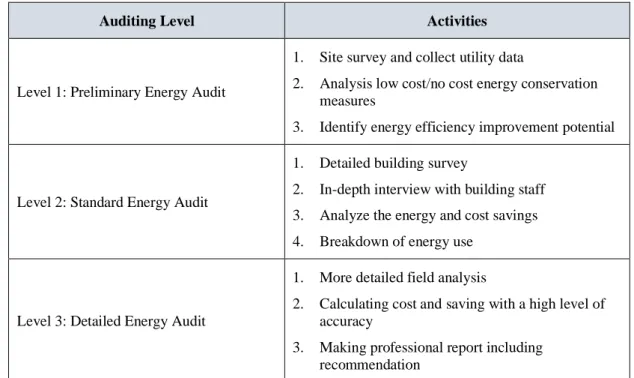
From above these levels, the auditing can be summarized in table 2.1
Table 2. 1: Audit Phase
Auditing Level Activities
Level 1: Preliminary Energy Audit
1. Site survey and collect utility data
2. Analysis low cost/no cost energy conservation measures
3. Identify energy efficiency improvement potential
Level 2: Standard Energy Audit
1. Detailed building survey
2. In-depth interview with building staff 3. Analyze the energy and cost savings 4. Breakdown of energy use
Level 3: Detailed Energy Audit
1. More detailed field analysis
2. Calculating cost and saving with a high level of accuracy
3. Making professional report including recommendation
2.3 Literature Review
World energy crisis is one of the major problems. In developing countries like Bangladesh, where electrical energy resources are scare and production of electricity is very costly, energy conservation studies are of great importance. In order to reduce energy consumptions for sustainable and energy efficient manufacturing, continuous energy audit and process tracking of electrical equipment are essential. The main objectives of energy audit are, to minimize energy cost without affecting production and quality, minimize environmental effect, optimize utilization and procurement of energy for all organization.
Energy audits initially became popular in response to the energy crisis of 1973 and later years. Interest in energy audits has recently increased as a result of growing understanding of human impact upon global warming and climate change. Energy audits are also popular due to financial incentives for homeowners [13].
The Primary objective of energy audit is to recommending appropriate policies for bringing down consumption per unit of product output or to lower operating costs.
Energy provides a “bench-mark” for managing energy in the organization and also
provide the basis for planning a more effective use of energy throughout the organization [14].
European Union Directive Building Conduct
On 16th December, 2002 European Union Directive on Energy Performance of Buildings Directives was proposed. After, this became major areas for future studies on energy performance on buildings. The main purpose of EPBD was to improve the energy performances on the building considering indoor and outdoor conditions. It also mentioned some requirement such as an outline of integrated energy performance of a building, minimum use of appliances, minimum requirements of energy performance in major buildings that are subjected to renovation, regular inspection of boilers and heaters also provide energy efficiency certificates for the buildings. One noticeable upturn of EPBD is the inevitable national energy performance calculation procedure on buildings, for both new and existing buildings. Performance analysis is followed by improvement techniques, certification and assessment on HAVC installations [15].
After the release of EU directive on performance of buildings, in terms of energy, many countries follow the rules such as UK, Denmark, Ireland, Netherland, France, Belgium and Germany [16].
Since 1995, for energy conservation, Standard Assessment Procedure and building regulations-Part L (a section which states energy conservation of houses) are compulsory for new buildings in United Kingdom. SAP is mainly concerned on annual cost of heating, lighting, building envelope insulation, efficiency of heating and domestic hot water system, the fuel prices affect the SAP ratting, which ranges from 1- 100. SAP does not include location, consumption on domestic appliances and does not suggest for making buildings more energy efficient. Statics shows that, applying SAP on 17,000 houses per year, almost three million buildings can be audited [17].
In Europe, energy audit and the ratting assessment were first initiated by Denmark and they have provided a benchmark for other states to continue. They introduced a mandatory energy analysis in 1985 and “Act on Promotion of energy and Water Conservation in Buildings” is published in 1996, which officially approved on 1997.
This act promoted different types of audit, EM/EK and certifications on mainly
industrial buildings. Around 45,000 to 50,000 audits are performed per year, and energy consumption is estimated to drop near 20% for 70% single family residence.[17]
In 1997 and later on in 1992, HER and ERBM were introduced in Ireland and was mandatory for all newly constructed buildings. ERBM is broadly used by fuel suppliers and house builders to provide low energy consumption in the buildings. It accounts for annual CO2 emission and consumption of energy while considering the outputs of HVAC appliances that are the buildings. It also provides suggestion and improvement on building envelope, heating process and also estimates savings [18].
The current regulations for the buildings of Netherlands are EPA. Standard Energy Performance is introduced for new buildings. This encourages on energy conservations and savings. It focuses on energy consumption for heating, lighting system, water pumps and fans [17].
For new non-industrial buildings, Decree 2000-1153 is set-up by the Ministry of Housing and Transport of France so that all the new buildings comply with regulations.
While the buildings follow the rules and regulations, two methods are introduced for calculation purpose. First one is a precise, intricate process, developed for expertise and the second one is for amateur, non-experts or for common people [19].
Since 1987, NBN B62-002 and NBN B62-004 regulations have commenced in Belgium and are obligatory for all buildings in residential areas. It is also compulsory for non- industrial in some region such as Brussels and Walloon. They are mainly concerned with the heat transfer coefficient for a building, and the legislation limited to 0.55 W/m2 degree Celsius. However, the legislation varies for the newly build non-industrial buildings [20].
From 1982, Germany has started to work on energy efficiency and a legislation named
“Energy Saving Decree” was approve in the year 2001. The two important consequences from this legislation was yearly energy consumption limited to 7 liters of oil equivalent fuel for every m2 and mandatory replacement of old boilers. The latter one started from 1978 [17].
Energy Conduct Studies
Since the concept developed around 1970, many surveys and assessment has been conducted to find different parametric solutions.
According to Mungwititikul and Mohanty (1996), an energy audit on the consumption of office, performance pattern revealed that 25% of electricity can be saved by controlling sleep modes idle times of the office appliances [21]. Aktacir (2008), investigated on air conditioners and various operation pattern for different designs.
Thus, a sample building was chosen somewhere near Adana (a geographically hot region) for developing cooling loads relationships with capacity of air conditioners.
Using simplified version of ASHRAE heat balance method the results were concluded that outdoor conditions are very important for the size selection of air conditioners [22].
Also, as per Di Stefano (2000), a study was conducted on lighting system at Melbourne University, Australia. The study replaced conventional lights by 1.2 meter of fluorescent with different ballast. The study showed that up to 64% energy can be saved CO2emission could be reduced to 10%. However high cost instalments of light and ballast were the mail problem to deal with and much further investigations are required [23]. Wang, Huang and Cao, audited commercial buildings in Shanghai presented the findings of energy consumption, focusing mainly on electrical equipment such as air conditioner, elevators and also on lighting system. According to this study, climate and occupancy rate were the predominant factors for total energy consumption. They also deduced that air conditioner consumes around 45% and lighting system consumes 10%
of the net energy usage [24].
In USA, Mauriello, Norooz and Froehlich studies that 41% of their primary energy is consumed by the building sectors. The paper presented the idea of using thermography infrared (IR cameras) to uncover the thermal defects and inspect building efficiency.
Two cases were studied: one with five automated with 10 professional auditors and other one included a case study of a simple residential audit. The paper suggested incorporating automated thermography tool designers’ robots and computer science for energy analysis [25]
Aue and Pierce from china uncovered the savings by energy auditing in a paper mill.
Several comprehensive steps were followed in their study and an estimation of 4,000
pounds savings per hour steam, improvements in sheet quality and machine efficiency was observed. If energy auditing is done in such type of mills then, $100,000 to over
$1 million per year can be saved. Machine efficiency is also expected to rise by 20%
[26]. Another study in china showed one of the technical instruments of energy saving in energy audit. A steel plant of china was chosen as a sample site and analysis was done for energy consumption and substantial amount of energy was seed by their activities for example in management sector and using intelligent methods [27].
2.4 Energy Audit Instruments
To Analyse energy consumption and estimate the cost-effectiveness of energy conservation measures, an auditor can use myriad calculation methods and simulation tools. The Auditors must make some measurement during the audit visit, the amount of equipment needed depends on the type of energy consuming equipment used at the facility. Portable instruments are generally used by energy auditors to measure various operating parameters like electrical power, pressure, flow, temperature, flow gas consumption etc.
Some commonly used instruments are mentioned below:
2.4.1 Clamp on Ammeter
These are very useful instruments for measuring current in a wire without having to make any live electrical connections. The clamp is opened up and put around one insulated conductor, and the meter reads the current in that conductor. New clamp on ammeters can be purchased inexpensively that read true RMS value.
2.4.2 Electrical Power Analyzer
These are instruments for measuring major electrical parameters such as kVA, kW, PF, Hertz, kVAR, Amps and Volts. In addition to this, some of these instruments also measure harmonics. It can be able to record the real online data.
2.4.3 Infrared Camera
Infrared cameras are still rather expensive piece of equipment. However, these are very versatile piece of equipment and can be used to find overheated electrical wires, connections, neutrals, circuit breaker, transformers, motors and others pieces of
electrical equipment. They can also be used to find wet insulation, missing insulation, roof leaks and cold spots.
2.4.4 IR Thermometer
This instrument is used to measure the temperature, it consists a lens to focus on the detector which converts the energy to an electrical signal that can show in units of temperature.
2.4.5 Light Meter
One simple and useful instrument is the light meter which is used to measure illumination levels in facilities. A light meter that reads in foot-candles allows direct analysis of lighting systems and comparison with recommended light levels specified by the Illuminating Engineering Society.
2.4.6 Power Factor Meter
A portable hand held power factor meter is very handy for determining the power consumption and power factor of individual motors and other inductive devices. This meter typically has a clam on feature which allows an easy connection to the current carrying conductor.
2.4.7 Ultrasonic Flow Meter
This is non-contact flow measurement instrument. The ultrasonic signal travelling with the flow travels faster than a signal travelling against the flow. Ultrasonic flow meter measures the transmit time of both signals.
2.4.8 Airflow Measurement Devices
Measuring air flow from heating, ventilating ducts or from other sources of air flow is one of the energy auditors’ tasks. Airflow measurement devices can be used to identify problems with air flows, such as whether the combustion air flow into a gas heater is correct.
2.4.9 Safety Equipment
A good pair of safety glasses is an absolute necessity for almost any audit visit. Hearing protectors may also be required on audit visits to noise plants and high-power industrial equipment. Electrical insulated gloves should be use when electrical measurements will be taken. Due to numerous limitations and lack of availability of instruments. We used some of instrument for measuring temperature, power consumption area and lighting level in this audit.
2.5 Lighting Audit
According to information of power division, electricity consumption per capita 464 kWh in Bangladesh which is one of the lowest in the world. Now in Bangladesh 93%
of the total population has the access to electricity [28]. Lighting load takes a large portion of generated power. It consumes about 25% to 35% of the total generated power in the world [29]. The occupied energy for lighting is 15% and 30% for residential buildings and commercial buildings respectively [29]. Nowadays, people prefer Fluorescent Lamps and Compact Fluorescent Lamps to Incandescent Lamps due to higher efficiency and higher lifetime for getting same luminous level [29]. FLs and CFLs are discharged lamps and they require ballast. Ballast generates high initial voltage across lamp tube for required lamp ignition and to limit the lamp current [30].
Magnetic ballast using iron-core transformer and it causes extra heat losses across the ballast [30]. Electronic ballast is much more efficient than Magnetic ballast through lifetime of Electronic ballast is lower than the Magnetic ballast [31]. By energy auditing auditors can find the ways for efficient use of electricity. Auditors can easily come up with some fruitful recommendations based on the findings during energy audit.
Lighting energy usage can be reduced by 75% to 90% compared to the conventional practice [32]. This will help us to save our cost and electrical energy. It will also enlarge the community of people getting access in electricity.
2.6 Electrical Audit
It is necessary to audit the electrical equipment which means that equipment that we use in our daily life and which are directly related to the electrical energy consumption.
Lights, different types of fan, computer, air conditioner, refrigerator, elevators etc. are the common electrical appliances used in any type of building such as residential,
commercials and in industries. In our work we have separated the lighting section from the electrical equipment. Electrical audit means auditing any equipment powered by the electricity or electrical appliances. Some factor which influence these audits are number of equipment, wattage ratings and operation time.
It is defined that the electrical equipment will consume more electricity than other two factors which are lighting and envelope. Electrical equipment is the reason of most of our electricity bills, there is more opportunities for us to save electricity from this sector of the energy audit. So, it is determined that the electrical equipment audit is the most significant part of the energy audit.
Nowadays, our life is completely depended upon the latest technologies. All the latest technologies, gadgets and equipment consume electricity, in short, we are depending on the electricity for our daily life. In offices and industries there are more electricity consuming equipment are increase day by day. This increasing equipment results in increase in the amount of energy consumption. This is one of the main reasons to initiate energy saving and thus electrical equipment auditing is very important.
Sometimes the appliances we use in our buildings consume extra electricity which leads to the wastage of electrical energy. While electrical appliances get older it takes much energy than it used to at the start. As a result, the consumer does not get the desired output. Instead, they get the amplified electricity bills. By electrical equipment audit, we can find out the areas where we need to focus and improve the quality of the equipment so that the owners get benefit from the electrical appliances and save the energy bill at the same time.
Humans tend to commit mistake and also to be forgetful. Sometimes the electrical equipment is switched on for long time and people forget to switch off even after they are done with the use. The electricity bills depend on how long use the appliances. We need to be self-conscious, so that we can use the appliances when it is necessary. Even some specified appliances need to be well maintained to reduce the operational hour.
Which helps to reduce electricity bill.
One of the burning and most widely discussed topic is global warming and CO2
emission. Unfortunately, the appliances we use emit CO2 and other harmful gases. In addition to that, if the appliances are not maintained properly then there is a chance
pollute the climate. Thus, to reduce the impact of this harmful gas and to make our world or workplace safer and better, electrical equipment audit is very essential.
2.7 Envelope Audit
The building envelope consists of those elements of a buildings that enclose conditioned spaces through which thermal energy may be transferred. Energy is saved when the heat exchange between the building and the outside environment is reduced, solar and internal heat gains are controlled [33]. The building envelope audit generally requires gathering the following data:
• Building characteristics and construction
• Window and door Characteristics
• Insulation status
For some buildings, the envelope like walls, roofs, floors, windows and doors can have an important impact on the energy used to condition the facility. The energy auditor should determine the actual characteristics of the building envelope. During the survey, a descriptive sheet for the building envelope should be established to induce information such as construction materials for instance, the level of insulation in walls, floors, roofs and areas, and the number of building envelope assemblies for instance, the type and the number of panes for the windows [34].
The energy audit of the envelope is especially important for residential buildings.
Indeed, the energy use from direct condition of heat or from air infiltration or exfiltration through building surfaces accounts for a major portion (50% to 80%) of the energy consumption. For commercial buildings, improvements to the building envelope are often not cost-effective due to the fact that modification to the building envelope like replacing windows, adding thermal insulation in walls are typically considerably expensive. However, it is recommended to audit the envelope components systematically not only to determine the potential for energy savings but also to ensure the integrity of its overall condition. The moisture condensation is often more damaging and costly than the increase in heat transfer because it can affect the structural integrity of the building envelope.
Building envelope is not directly related to the electricity bill or energy consumption but it plays a vital role for lights and the cooling equipment to work hard. These factors are added in the electricity bills and we have to pay some unnecessary money. About 40% of worldwide energy consumption is related to the buildings [35]. As a matter of great regret, most of the energy losses related to the envelope are invisible to us. By energy audit, we can find out the cracks and gaps that cause us to pay more.
Building orientation and geographical location Is the most important factor in case of envelope audit. The heating and cooling capability of the building is the prime factor for our comfort. We invest a lot of money into our heating and cooling appliances, but still maximum efficiency cannot be obtained. One of the biggest reasons behind this is the roof, walls surrounded the room, windows and doors are not well insulated or the envelope of the building is not appropriate to get the desired output and ultimately there is a loss of energy. The solution of this problem can be founded by envelope audit.
Thus, it is clear to us the building envelope audit has much significance to save the energy consumption as well as the energy bill.
2.8 Summary
This chapter mainly focused on basic three level of energy audit, difference between them. Then discuss about the instruments which are important for energy audit. Basic concept about lighting audit how it can be done, electrical equipment audit which process need to follow for electrical equipment audit and finally concept about envelop audit. This chapter mainly focused on the major part of energy audit and the details about it.
CHAPTER 3
AUDITING DAFFODIL UNIVERSITY LIBRARY
BUILDING
3.1 Introduction
After developing the idea about energy efficiency improvement in commercial building our next step is to examine and check the building energy consumption and its output, also any scope available for improvement. As part of our thesis we surveyed several commercial buildings. In this chapter we will show the process of auditing, data collection and energy consumption for Daffodil university library building.
3.2 Daffodil University Library Building Audit
As we have discussed the audit processes, we have audited in similar fashion. To star the audit, we need some specification about the building. It operates 12 hours and average students’ study daily 600 to 800. The sunlight is used more in the daytime most of the floor. On the other hand, electric lights are used in more in night time. During summer time cooling loads like AC fan are running most of the time cooling purposes, and winter time this type of load used lightly.
Table 3. 1: Electricity Bill
Month Monthly usage (kWh) Demand Charge Cost/Unit Total Bill
Jan 21,745.25 15000 10.81 250,066.15
Feb 22,230.21 15000 10.81 255,308.57
Mar 22,685.45 15000 10.81 260,229.71
Apr 22,595.85 15000 10.81 259,261.13
May 23,478.15 15000 10.81 268,798.80
At first, we collected the electricity bill of Daffodil university library building.
Electricity bill from January to December 2018 shown in table 3.1, which is collected from official personnel.
From the electricity bill, we have a precise idea about the building energy consumption.
This table shows total energy bill with demand charge and per-unit charge from January 2018 to December 2018. This value helps to determine the monthly electric energy use, and gives an idea about overall electricity use per month and helps to setting achievable benchmarks for the electricity use in library building for low electricity bill.
In December 2018 electricity consumption is very low that’s why amount of bill 241,672.07TK, compared to bill 266,702.85TK from June 2018. Audit team fined the reason behind the difference between the bill of December and June 2018. In Bangladesh December to February is a winter season in this period less amount of electricity is used, because of less use of AC. As corresponding electricity bill is less than another month. On the other hand, during summer season temperature is high, and AC load use continuously that’s why electricity bill in June is much high.
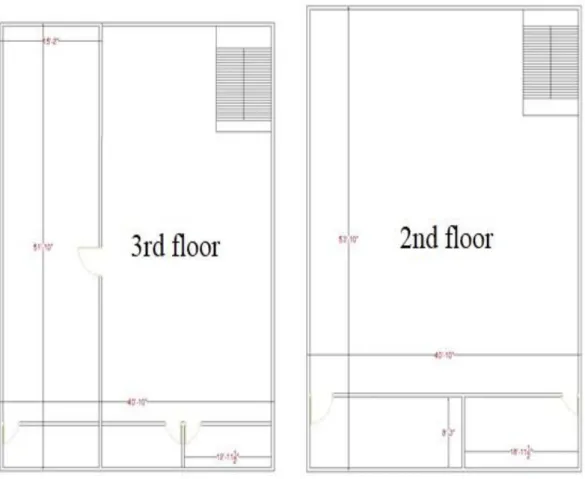
After that, we need the floor plan of this building to get idea about the building orientation and the envelope system. Figure 3.1 show us the 2nd and 3rd floor plan of the library building.
Month Monthly usage (kWh) Demand Charge Cost/Unit Total Bill
Jun 23,284.26 15000 10.81 266,702.85
Jul 22,749.95 15000 10.81 260,926.96
Aug 22,875.35 15000 10.81 262,282.53
Sep 21,942.31 15000 10.81 252,196.37
Oct 22,125.85 15000 10.81 254,180.43
Nov 21,564.95 15000 10.81 248,117.11
Dec 20,968.74 15000 10.81 241,672.07
Daffodil university library building located at Sukrabad and the building is west facing.
From the floor plan we get the actual length and size of the rooms, windows and doors which are necessary for calculation of our envelope losses.
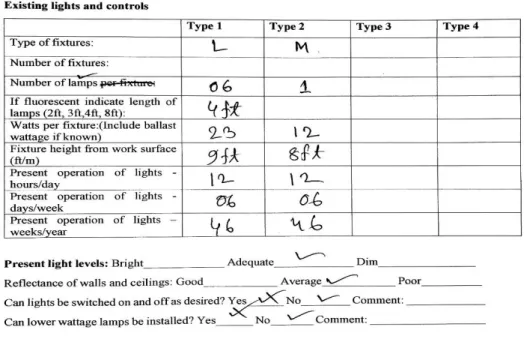
Next comes data collection, where we used lighting and envelope audit manual forms, figure 3.1 and 3.2 shows the lighting audit form and envelope audit form respectively.
These forms are hand written and to fill the form we take help of the floor in charge, security guards and other official personnel related to the building.
Figure 3. 1: Lighting audit manual form
Figure 3. 2: Envelope audit manual form
Library building is six storeys building. Ground floor contains a start-up shop, first floor for student’s bag keeping room, second floor is for library office, third floor for student study room, fourth floor for book collection and fifth floor for group study room.
Ground. 1st, 2nd and 5th floor are same design and 3rd & 4th floor are same.
Figure 3. 3: Floor plan of DIU library building 2nd and 3rd
3.3 Electrical Energy Utilization Systems
Daffodil library building receives electricity supply from DPDC distribution line. This building has its own generator which only operate during load shedding. Total connected electric load 82,322 watt, where AC contains 63,000-watt, Fan load 4,300- watt, Lighting load 4,196-watt, Water pump load 3,730 watt. Server load 1500 watt, and 96-watt load for CCTV.
Table 3. 2: Connected load
Sl.
No. Name of Appliance Number of
Appliances Watts
Total Watts (Number of Appliance*Watts)
1 Light
Compact Fluorescent
Lamp (CFL) 13 23 299
Compact Fluorescent
Lamp (CFL) 10 15 150
Fluorescent Lamp
(T12) 53 36 1908
LED Tube 63 23 1449
LED Tube (Mini) 18 15 270
LED Bulb 10 12 120
2 AC
AC (3 ton) 4 4500 18000
AC (2 ton) 12 3000 36000
AC(1.5ton) 4 2250 9000
3 Computer 22 250 5500
4 Fan
56” 30 75 2250
36” 3 55 165
Wall Fan 19 65 1235
Exhaust Fan 13 13 650
5 CCTV 16 6 96
6 Server Box 3 500 1500
7 Water Pump 1 3730 3730
Total connected electric load 82,322
Figure 3. 4: Electricity consumption by different connecter load
Here AC load contains 76% of total load, Computer contains 7%, Fan and light both 5%, Server 2%, Pump 5%, and CCTV Contains less than 1%.
3.4 Energy Use Index
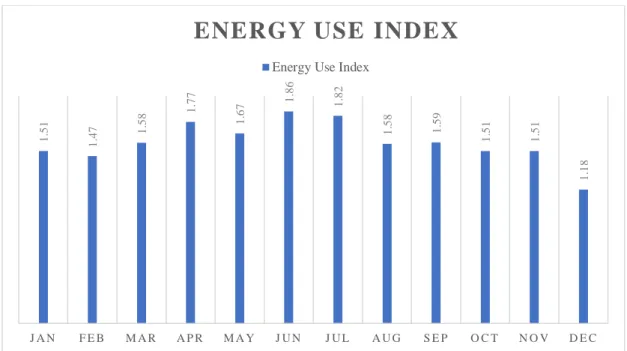
Audit team used the values related to monthly energy consumption this value helps to determining the monthly/annually energy usage. It gives an idea of overall energy usages, energy intensity and helps to setting achievable benchmarks for existing equipment’s. EUI is very important for proper use of energy.
EUI have been calculated based on monthly consumption of electricity of different months. EUI shown in figure 3.5.
This is calculated by this formula, EUI = 𝑇𝑜𝑡𝑎𝑙 𝐸𝑛𝑒𝑟𝑔𝑦 𝐶𝑜𝑛𝑠𝑢𝑚𝑝𝑡𝑖𝑜𝑛 (𝑘𝑊ℎ)
𝑇𝑜𝑡𝑎𝑙 𝐴𝑟𝑒𝑎 (𝑠𝑞.𝑓𝑡)
From EUI chart we found EUI 1.86 in June and 1.18 in December.
76%
5%
5%
2%
5%
0%
7%
AC Fan Light Server Pump CCTV Computer
Figure 3. 5: Energy use index per month
3.5 Calculation of Daffodil University Library Building
The data we have collected from the building, we put them into data sheet to get calculations for the building.
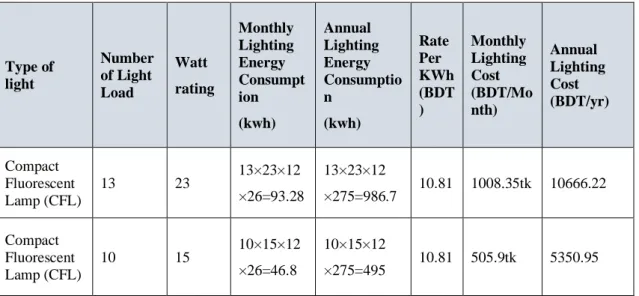
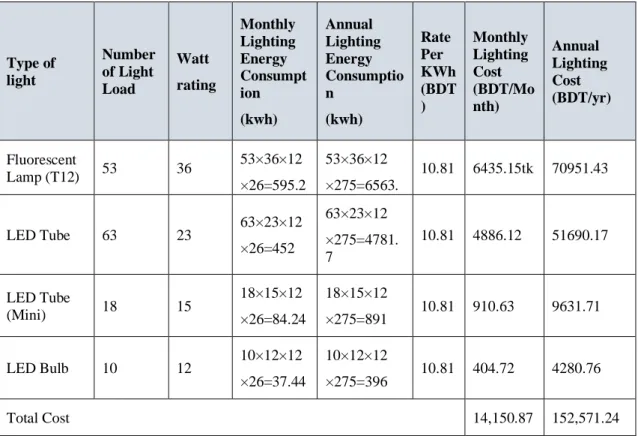
Starting the process with lights, Table 3.3 shows the concise lighting information of the library building.
Table 3. 3: Data of connected lighting load
Type of light
Number of Light Load
Watt rating
Monthly Lighting Energy Consumpt ion (kwh)
Annual Lighting Energy Consumptio n
(kwh)
Rate Per KWh (BDT )
Monthly Lighting Cost (BDT/Mo nth)
Annual Lighting Cost (BDT/yr)
Compact Fluorescent Lamp (CFL)
13 23 13×23×12
×26=93.28
13×23×12
×275=986.7 10.81 1008.35tk 10666.22 Compact
Fluorescent Lamp (CFL)
10 15 10×15×12
×26=46.8
10×15×12
×275=495 10.81 505.9tk 5350.95
1.51 1.47 1.58 1.77 1.67 1.86 1.82 1.58 1.59 1.51 1.51 1.18
J A N F E B M A R A P R M A Y J U N J U L A U G S E P O C T N O V D E C
ENERGY USE INDEX
Energy Use Index
Type of light
Number of Light Load
Watt rating
Monthly Lighting Energy Consumpt ion (kwh)
Annual Lighting Energy Consumptio n
(kwh)
Rate Per KWh (BDT )
Monthly Lighting Cost (BDT/Mo nth)
Annual Lighting Cost (BDT/yr)
Fluorescent
Lamp (T12) 53 36 53×36×12
×26=595.2 96
53×36×12
×275=6563.
5
10.81 6435.15tk 70951.43
LED Tube 63 23 63×23×12
×26=452
63×23×12
×275=4781.
7
10.81 4886.12 51690.17
LED Tube
(Mini) 18 15 18×15×12
×26=84.24
18×15×12
×275=891 10.81 910.63 9631.71
LED Bulb 10 12 10×12×12
×26=37.44
10×12×12
×275=396 10.81 404.72 4280.76
Total Cost 14,150.87 152,571.24
From the table we get monthly lighting cost of 1008.35 BDT for CFL 23W, 505.9 BDT for CFL 15W, 6435.15 BDT for FL T-12 and 4888.12 BDT for LED Tube 23W, 910.63 BDT for LED tube mini 15W, 404.72 BDT for LED bulb 12W. The monthly energy consumption of CFLs 23W, CFLs 15W, FL T-12 and LED Tube/Tube mini/Bulb are 93.28 kWh, 46.8 kWh, 595.29 kWh, 452 kWh, 84.24 kWh and 37.44kWh respectively.
Moreover, the total monthly lighting cost is 14,150.87 BDT, and annual lighting cost is 152,571.24 BDT. From lighting summery, we get two pie charts, shown in figure 3.6 and 3.7
Figure 3. 6: Total lighting load of DIU library building
CFL(23W), 0.299kw,7%
CFL(15W), 0.15kw,4%
FL-T12(36W), 1.908kw,45%
LED Tube (23W), 1.449kw,35%
LED Tube Mini (15W), 0.27kw,6%
LED Bulb (12W), 0.12kw,3%
TOTAL LIGHTING LOAD (KW)
In this figure we can see the total lighting load of DIU Library building, where FL T- 12 consume 1.908 kW which is 45% of the total lighting energy consumption, CFL (15W) consume 0.15 kW which is 4% of the lighting energy consumption, CFL (23W) consume 0.299 kW which is 7% of lighting energy consumption, LED bulb (12W) consume 0.12 kW which is 3% of the lighting energy consumption, LED Tube (15W) consume 0.27 kW which is 6% of the lighting energy consumption, LED Tube (23W) consume 1.449 kW which is 35% of the lighting energy consumption. During our study we observed that, LED tube and LED bulb are better in quality than FL T-12 and CFLs.
But still FL T-12 and CFLs are used in the most of the cases.
Figure 3. 7: Monthly lighting cost of DIU library building
From this figure, we can see FL t-12, CFLs and LED are responsible for 45%, 11%, and 44% lighting cost respectively. Although FL T-12 consumes more electricity than CFLs.
Next we move to electrical equipment calculations; Table 3.4 shows the concise information about electrical equipment.
CFL(23W), 1008.3TK,7%
CFL(15W), 505.9TK,4%
FL-T12(36W), 6435.15TK,45%
LED Tube (23W), 4486.12TK,35%
LED Tube Mini (15W), 910.63TK,6%
LED Bulb (12W), 404.72TK,3%
MONTHLY LIGHTING
COST(BDT/MONTH)
Table 3. 4: Data of connected electric equipments
Equipment Type No. of
Equipment
Total Equipment Load (kW)
Monthly Equipment Energy Consumption (kWh)
Monthly Equipment cost
(BDT/Month)
Air Conditioner
AC (3 ton) 4×4500 18 5,616 60,708.96
AC (2 ton) 12×3000 36 11,232 121,417.92
AC(1.5ton) 4×2250 9 2,808 30,354.48
Computer 22×250 5.5 1716 18,549.96
Fan
56” 30×75 2.25 702 7,588.62
36” 3×55 0.165 51.48 556.5
Wall Fan 19×65 1.235 390 4,215.9
Exhaust
Fan 13×50 0.65 202.8 2,192.26
CCTV 16×6 0.096 69.12 747.18
Server Box 3×500 1.5 1080 11,674.8
Water Pump 1×3730 3.73 193.96 2096.7
Total Cost 260,103.28
From the above data table, we can see air conditioner consume 19,656 kWh which costs 212,481.36 BDT per month. Computer consume 1,716 kWh which costs 18,549.96 BDT per month. Different types of Fan consume 1,346.28 kWh, which costs 14,553.28 BDT per month. Server Board consumes 1080 kWh and costs 11,674.8 BDT per month.
Figure 3.8 shows the pie charts of the electric equipment consumption summery And figure 3.9 shows the pie charts of the electrical equipment cost summery.
Figure 3. 8: Monthly equipment energy consumption
From the above pie charts, we can see air conditioner consumes most of the electricity and which is 82% of total electricity consumptions. Then computer which consumes 7% of electricity, Fan consumes 6%, Server board and water pump consumes 4% and 1% respectively.
Figure 3. 9: Monthly equipment cost
AC 82%
Computer 7%
Fan 6%
CCTV 0%
Server Box
4% Water Pump 1%
MONTHLY EQUIPMENT ENERGY CONSUMPTION(KWH)
AC, 212,481.36 TK 82%
Computer, 18,549.96 TK,7%
Fan, 14,553.28 TK,6%
CCTV, 747.18 TK,0%
Server Box,
11,674.8 TK,4% Water Pump, 2096.7 TK,1%
MONTHLY EQUIPMENT COST (BDT)
From the above pie charts, we can see air conditioner consumes most of the electricity and causes large electrical equipment cost which is 212,481.36 BDT of total electrical equipment cost. Then computer electricity cost is 18,549.96 BDT, Fan cost 14,553.28 BDT, server Board and Water pump cost 11,674.8 BDT and 2096.7 BDT respectively.
After that we comes, envelope audit calculation. Table 3.5 shows leakage loss due to envelope audit.
Table 3. 5: Data of building envelope audit
From the table, we get the calculation of DIU library building leakage loss. The Leakage loss we get is 14,468.23 BDT per month. This is the extra money we have to pay without any service.
Floor no.
Total Area of Windo w (sq-ft)
Ambient Temperat ure (in F)
Room Temperat ure (in F)
R value of Glass
A.C operation Hours
Rate Per kWh
Leakage transfer loss <