Institute of Environmental Science (IES) PhD Thesis
2006
Environmental Consequences of Development Interventions in Rural Areas: A Study on Selected Villages
Ahsan, Kamrul
University of Rajshahi
http://rulrepository.ru.ac.bd/handle/123456789/912
Copyright to the University of Rajshahi. All rights reserved. Downloaded from RUCL Institutional Repository.
ENVIRONMENTAL CONSEQUENCES OF DEVELOPMENT INTERVENTIONS IN RURAL AREAS: A STUDY ON
SELECTED VILLAGES
Researcher
Kamrul Ahsan
Ph.D. Research Fellow Institute of Environmental Science
Rajshahi University Rajshahi, Bangladesh
Supervisor
M. Sarwar Jahan, Ph.D.
Professor & Director
Institute of Environmental Science (JES) Rajshahi University
Rajshahi, Bangladesh
Institute of Environmental Science Rajshahi University
Rajshahi, Bangladesh
January, 2006
I do hereby declare that the dissertation entitled "Environmental Consequences of Development Intervention in Rural Areas: A Study on Selected Villages" is prepared by myself. This dissertation is an outcome of one-year course work experience field survey and laboratory experimentation under the auspicious supervision of Professor Dr. M. Sarwar Jahan, Director, Institute of Environmental Science, Rajshahi University. The study was designed to explore degradation of rural environment for implementing various development activities and to provide an additional contribution to this very crucial issue of rural area for the development. I humbly submit this thesis to the Institute of Environmental Science, University of Rajshahi, Rajshahi. The contents of this thesis or part of it were not submitted to any other institutes for achieving any academic degree.
January, 2006
Ke--,,__H--~
(Kamrul Ahsan) '3 1 / 01
f
u,c Research FellowInstitute of Environmental Science University of Rajshahi
Rajshahi, Bangladesh
CERTIFICATE
This is my proud privilege to certify that the dissertation entitled
"Environmental Consequences of Development Interventions in Rural Areas: A Study on Selected Villages" was prepared by Mr. Kamrul Ahsan, Joint Director, Bangladesh Academy for Rural Development (BARD), Kotbari, Comilla under my direct supervision. Mr. Ahsan has successfully completed his one year course works of 36 units of credits (UoC) during the session 2002 - 2003 and carried out his field works and laboratory experimentations meticulously. This dissertation is a comprehensive presentation of the investigation he made about the rural environment of Bangladesh. He has tried to explore the experiences and indigenous knowledge of peoples of various statuses along with the scientific investigations of the consequences of developmental interventions on rural environment.
To the best of my knowledge, this dissertation or part thereof has not been submitted for the award of any academic degree, diploma or associate ship of any other similar title to any other University.
Mr. Kamrul Ahsan has fulfilled all the requirements according to the rules of Rajshahi University for Ph. D degree and has made distinct contribution to the field of Environmental Science.
I am. forwarding this dissertation to be examined for the degree of Doctor of Philosophy to the Institute of Environmental Science (IES), University of Rajshahi.
January, 2006
II
31,01.:2.oCJb
d. Sarwar Jahan) Director
Institute of Environmental Science University of Rajshahi
Rajshahi, Bangladesh
&
Supervisor
It is my great pleasure to convey indebtedness, gratitude and respect to my reverend Supervisor Professor Dr. M. Sarwar Jahan, Director, Institute of Environmental Science, University of Rajshahi, Rajshahi for his continuous encouragement, cordial guidance and thoughtful suggestion during the whole period of my course and thesis works. His intellectual suggestions and care during the course and research works were invaluable. In spite of his heavy involvement with academic and administrative works of the institute he was always cordial and amiable to provide me guidance and directions for the research work. I express my sincere gratitude from the core of my heart for his great contribution for the research work.
Md. Sikandar Ali Monda!, the then Director General of Bangladesh Academy for Rural Development (BARD) provided all types of inspirations like getting admission into higher degree, getting scholarship and deputation to carryout Ph. D work. Teachers of the course work of this higher degree from Institute of Environmental Science and other Departments of Rajshahi University provided their optimum output to make us suitable for carrying out such a research work in the filed of environment. I express my gratitude to all of them.
Executive Chairman of Bangladesh Agricultural Research Council (BARC) Dr.
M. Nurul Alam helped me in getting tests of insecticides residual effects on soil samples from Bangladesh Atomic Energy Commission, Savar, Dhaka. Social Science Research Council (SSRC), Ministry of Planning, GoB provided research grants to carryout the research. work, which was very much helpful to me. I take the opportunity of expressing my sincere thanks to the authorities of both BARC and SSRC in this regard.
Laboratories of Department of Public Health Engineering (DPHE), Camilla, Soil Resources Development Institute (SRDI), Camilla and Bangladesh Atomic Energy Commission (BAEC), Savar, Dhaka carried out various tests of water and soil samples for the study. I express my sincere thanks to the authorities of these departments.
lll
Villagers; Elected Representatives of Union Parishads, Local Leaders and Field Level Workers and Upazila Officials of the study, who were the respondents and acted as key persons of the study provided all information regarding rural environment. The research work could not be furnished up to this level without their contributions. I express my sincere thanks to all of them. Fellow researchers of IES for the year of 2002 - 2003 helped me in various ways particularly in reviewing of literatures, carrying out statistical tests etc. I acknowledge their contributions with respect.
Md. Abdul Hakim, Research Supervisor and Md. Shafiqul Islam Investigator of
Research "Division of BARD who helped me in various ways for selecting study villages; pre testing of different types of questionnaires; carrying out PRA exercises;
collecting and tabulating of data; collecting various samples of water and soils; and carrying out focus group discussion. I acknowledge their contributions with respect.
Staffs of BARD library, IES library, Central Library of Rajshahi University and Library of Department of Environment, Dhaka helped me in reviewing literatures for the study. I endorse their contributions with respect.
Md. Aminul Isla~, Computer Operator and Syed Shahadat Hossain PA to the Director of Local Government and Rural Administration Division of BARD took the painstaking load of typing such a big report. I acknowledge with respect for his contribution.
My wife, Mrs. Nilufar Akhtari, Principal Officer, Janata Bank, Camilla who inspired me all along with mental and financial supports to carryout such a big work.
She created scope for me to keep myself away from family works and concentrate on academic and research works. Her contribution was great. I express my sincere thanks to her. My two daughters Fariba Ahsan and Tasannuma Ahsan who were deprived of me in their very valuable time of education during my course work period.
I owe to my family members for their contribution.
Good wishes and blessing from my father and mother in laws, my sisters &
brothers and relatives helped me to furnish my works smoothly. I owe to them.
I acknowledge the contributions of those who contributed in my res~arch works but I could not mention their names in this acknowledgement.
January, 2006 Kamrul Ahsan
IV
V
ABSTRACT
The study was conducted to explore the indigenous knowledge and concept of people of various statuses from two floods free and two flood-affected villages on rural environmental consequences of development interventions under Camilla Sadar and Sonargaon Upazilas of Bangladesh. As well as the impact of development interventions in soil and water qualities were assessed.
Participatory Rural Appraisal (PRA) and survey methods were used to assess the current environmental conditions in the study areas. Agriculture soil tests covered soil texture, pH, organic matter content, percent of total nitrogen, P and K. Nine soil samples from different land types of the study villages were tested for finding out residual effects of insecticides in soils under the groups of organophosphorus, organocarbamate and organochlorine after the boro season of 2003. Soil samples were collected from different types of agricultural land under the. study. Water quality both for surface and ground water were considered for the study. Total Dissolved Salt, SS, NH/, PH, P and K tests were carried out for surface water. Arsenic, TH and TDS tests were carried out for ground water assessment in the study villages.
Organic matter contents in agriculture soils were found very low compared to
· the actual need of 5.0 percent. Major crop nutrients i.e., N, P and K were found very low and low except phosphorus in two villages under Camilla Sadar Upazila. No residual effects of insecticides under the group of organophosphorus, and organocarbamate were found in different soils under tests. DDT and ODE under the organochlorine group were found in two soil samples of Shahpur village under the study. It is learned that DDT was used in a few of the crop fields of the village two decades ago. So, DDT remains more than 21 years in crop fields. A part of the existed DDT in the field had broken into DDE. On average three crops were cultivated in villages of Comila Sadar Upazila and two crops were cultivated in villages under Sonargaon Upazila under the study. Amount of fertilizers and.
insecticides used were more in villages of Comilla Sadar Upazila than other two villages under the study. The balance existence of major crop nutrients and
vi
High amount of arsenic i.e., much more than the standard of 0.05 mg per liter was found in Ground Water (GW) of Khangshardi village of Sonargaon Upazila. Total Hardness (TH) values of canal water of two villages under Soanargaon Upazila were found higher than the standard for 120 mg per liter for fish. Physical appearances of surface water both for pond and canal water in terms of cleanliness and smell were found better in villages under Sonargaon Upazila. Tests results of suspended solids values in surface water were witl1in the limit of standard fixed for potable water quality. pH values of the same were around the lower limit of standard for potable water quality in all study villages. Major crop nutrients N, P and K were found in all samples of surface water under the study. All water samples had more P than the standard (0) fixed for potable water/ fish resources.
Micro credit leads IGAs in case of crop cultivation were found injurious for environment for the same reasons of using insecticides and fertilizers in crops.
Majority of IGAs were small trade related which had no environmental effect on the study villages.
Diversity of trees was mainly affected in two villages under Comilla Sadar Upazila with the domination in planting timber rich plants. Besides, majority of big trees were lost from all study villages for various reasons. A number of traditional fish species, birds and wild animals extinct form all study villages during the last four decades.
Besides, population of . these species including frogs of various types reduced remarkably in the study villages. In case of cultured fish, production of the same increased in folds mainly in two villages under Camilla Sadar Upazila. Number of ponds was also increased remarkably in the study villages. Number and area of catchments were reduced in two villages of Comilla Sadar Upazila in the last four decades.
Respondents provided information of environmental issues of the village like soil and water pollution; and reduction of biodiversity; effects of these changes to the rural environment; and steps needed for the development. It is evident that major environmental problems for reduction of soil fertility, soil and water pollution; and destruction of biodiversity in rural areas take place due to application of insecticides in crops. Besides, killing and hunting of amphibian, reptile, bird and mammal and over fishing deteriorated further the rural environment.
vu
Most of the upazila level officials did not know about the vital legislation of environment ECR-1997. A number of committees work at the upazila level for better output of various development works. No committee works exclusively for taking care of environmental issues of development activities in the upazila. But Upazila Development and Coordination Committee (UPIC); and Upazila Project Implementation Committee (UPIC) take cares mainly water stagnancy related problems during construction works. Respondents opined that using of mass media like radio, television, miking etc. in large scale for awareness building of common people about the importance of conserving and developing environment would provide a better output for environmental development. Besides, conduction of training and orientation courses for the upazila officials about the measures to be adopted time to time should need to be introduced as regular phenomena. Establishment of safe habitats of fish, amphibian, reptile, bird and wild mammal with people's participation at the local level would improve rural environment. Besides, creating scope for giving posting a official from DoF at the upazila level would help to apply more coordinated efforts to address environmental issues properly in different development activities.
Notable findings of the study included existence of DDT in agricultural soils over two decades of time; existence of crop nutrients particularly P more than prescribed standard in pond and canal water create unfavorable conditions of aquatic lives. Excavation of a irrigation canal in a study village affected the biodiversity of the village seriously as run off rain water from hilly areas of India could not cross that canal and reached up to the catchment's area of the village. The rich biodiversity of the village destroyed and the whole area turned into HYV paddy fields where huge amount of fertilizers and insecticides are used every year to produce HYV paddy and other crops. Replacing of aus paddy cultivation with HYV crops destroyed the vast habitats of migratory birds and moving ground of various traditional fishes at the shallow water of aus fields in the early monsoon season of two flood affected villages under the study. Decreasing trend of owl, eagle and vulture increased harmful mammals like rat ari'd squirrel in study villages. Awareness of villagers and development workers about effects of development interventions on biodiversity of the study villages and ~heir consequent opinion to develop the situation were notable. · Besides, information on change of status of tree, fish, amphibian, reptile, bird and mammal both wild and domestic over last four decades gives a clear picture of their conditions in two different periods of the study villages.
Vlll
Certificate ... ii
Acknowledgment ............. 111
Abstract ... .-........... vi
Contents ... ix
Chapter 1 General Introduction ... 1
Emergence of Development Initiatives in Bangladesh ... 2
1.1 1._1.1 1.1.2 1.1.3 1.1.4 1.1.5 Physical Infrastructure Development ... 3
Land and Soil ... 5
Ground and Surface Water ... 8
Income Generating Activities ... 11
Bio Diversity ... 11
1.2 Objectives ... : ... ; ... 16
Chapter 2 Materials and Methods ... 18
2.1 Study Area ... 18
2.2 Comilla Sadar Upazila ... 20
2.3 Sonargaon Upazila ... 23
2.4 Survey and Sampling Methods ... 26
2.5 Data and Sample Collecting, Processing and Alalysing Methods for Laboratory Tests ... 33
2.6 Data Analysis Formulae ... 37
Chapter 3 Results and Observations ... 38
3.1 Features of Study Villages under Common Criteria ... 38
3.2 Developmental Interventions in the Study Villages ... 41
3.3 Consequences of Developmental Interventions in the Study Villages ... 43
3.3.1 Participatory Rural Appraisal Exercises of the Study Villages ... 43
IX
3.3.2 Road and Embankment Construction in Study Villages ... 44
3.3.3 Agricultural Crop Production and Soil Management.. ... 46
3.4 Biodiversity Status .... : ... : ... 55
3.4.1 Conditions of Major Type of Trees ... 55
3.4.2 Fish Diversity ... 60
3.4.3 Amphibian Diversity ... 66
3.4.4· Reptilian Diversity ... 68
3.4.5 Avifaunal Diversity ... 69
3.4.6 Conditions of Wild and Domestic Mammals ... 71
3.5 Development Works Adopted and Consequences to the Environment at the Upazila Level. ... 75
3.6 Laboratory Tests ... · ... 80
3.6.1 Results of Laboratory Tests of Soil ... 80
3.6.2 Laboratory Tests of Water Samples ... 82
Chapter 4 Discussions ...................... 86
4.1 Implication of Physical Development Interventions ... 86
4.2 Environmental Consequences of Adopting Modern Crop Cultivation Practices on Soils ... 87
4.3 Ground and Surface Water Qualities ... : ... 94
4.4 Effects of Development Interventions on Biodiversity ... 99
4.5 Common Villagers' Awareness and Development Workers Views about Environment and Rural Development. ... 106
4.6 Coordination Committees and their Activities on Environmental Issues at the Upazila Level ... 107
Chapter 5 Conclusion and Recommendations ............ 108
5.1 Conclusion ... 108
5.2 Recommendations ... 110
References ... .-... -.. .. .. . .. . . .. . . .. .. .. . . .. . 113
Annexures ... 120
X
Chapter 1
General Introduction
"Verily all things have vie created in proportion and measure" (AI-Quran: Sura Qamar- Verse: 49). This suggests that man needrnot change this natural proportion and measure of all things in the environment. But man has established civilization by changing the natural set up. He is just supposed to utilize the creation of nature as it is and, in some cases, to make them suitable for developmental purposes. In course of such changes, man is upsetting the appropriate proportion and measures of the environmental components, whereas man indeed has an obligation to future generations to keep life on the planet as original as possible and as diverse as possible, so that the future generation can meet their needs (Challinor, 1988).
Development interventions should be the broad programmes of sectoral change in proportion and measure at structural level and constituents of the environmental states by the activities of government and community (Goodhand, 2001 ). This is not the case for Bangladesh. In rural Bangladesh, development interventions mainly include efforts of government through various Nation Building Departments (NBDs) at the upazila level and village based community participation.
These development interventions mainly comprise agricultural and infrastructural development programmes aimed at maximum utilization of available natural resources for uplifting the pecuniary state and livelihood of people. The development interventions in rural areas of Bangladesh started in 60's with the· introduction of High Yielding Variety (HYV) paddy cultivation, lavee & embankment construction for flood protection and rural road construction. Moreover, the general goal of development activities of Bangladesh is to improve the socio-ecnomic condition of rural and mostly agriculture based urban people. Development of agriculture; construction of road &
embankment; development of education, health, fishery, livestock, sanitation etc. are the major development interventions in rural areas. But it is assumed that major environmental degradation in rural areas is mainly taking place due to excessive use of agrochemicals in crops and unplanned construction of road and embankments in rural areas; soil and water are being polluted; and fish, amphibian, reptile, bird and mammal becoming affected as the consequences of these development interventions. Whereas, Basher (2004) explicitly states that the standard of living for
Chapter 1 : General Introduction
rural people depends on agriculture commodities, fishing and navigation which is benifitted invaluably by water flowing over the country through more than 200 rivers demands the proper management of agriculture soil and water pullution.
1.1
Emergence of Development Initiatives in BangladeshUnder the Local Self Government Act of 1885 and the Village Self Government Act of 1919 of the then British India local government was established to enhance development through creating a number of NBDs and provide with logistic supports for expansion of education, improvement of health, modernization of agriculture and the promotion of co-operative movement for rural development.
Various development projects began to start in 1920's and 1930's, at the initiatives of some interested individuals among the members of the Indian Civil Service and Christian Missionaries. During the 1930's there was determined effort by the governments to improve the village conditions (Khan and Solaiman, 1978).
The most significant achievement in Rural Development (RD) during the Pakistan period was the 'Comilla Model of Rural Development' initiated by Dr. Akhter Hameed Khan, the founder Director of Bangladesh Academy for Rural Development (BARD). Experiments were carried out in Comilla Kotowali Thana considered as social laboratory area of BARD.The Comilla experiment produced models of several viable programmes and institutions in rural development. Four of the models were adopted for nationwide replication. These four national programmes are: Rural Works Programme (RWP), Thana Irrigation Programme (TIP), Thana Training and Development Centre (TTDC) and Two-tier Rural Co-operative System in every thana. The unique combination of this package programmes provided administrative, institutional and physical infras~ructure which ultimately helped for ensuring support service delivery, forming cooperatives, developing better physical infrastructures like road, growth centre, marketing, flood control embankments etc. for uplifting the socio-economic conditions of the rural people.
Awareness about the environmental health of the world began from late 1970's, which originated at the Stockholm conference on the environment in 1972 and later dramatized at the Earth Summit, 1992 at Rio de Genero, Brazil. Since then the phenomenon of a constantly degrading world environment has been receiving international attention.
2
In Bangladesh a number of important factors have been identified which affect environment: These are (i) vast poverty and inadequate literacy of the majority population; (ii) high population growth resulting in high demographic density; (iii) increase of salinity in the south western coastal belt; (iv) falling of underground water level due to uplifting of excessive water for irrigation; (v) increasing trend of flood due to heavy siltation of river bed; (vi) global warming; (vii) use of chemicals for crop production causing harm to aquatic lives, soil microbes and fish resources ; (viii) growing slums in urban areas, specially in the capital city Dhaka ; (ix) discharge of industrial waste and urban sewerage systems in the rivers ; and (x) industrial smoke and increasing vehicular emissions in the big cities (PC, 1990).
To address the above phenomena, the environmental management activities in Bangladesh were organized by the Department of Public Health and Engineering (DPHE) through the water pollution control ordinance of 1973. A National Environmental Policy was finalized in 1992 as a guide to a long-term sustainable environment friendly development. The environment policy 1992 spelled out the following objectives:
(i) Preservation and improvement of ecological balance;
(ii) Identifying and controlling all environment polluting and degrading activities;
(iii) Minimizing the impact of natural disaster on environment;
(iv) Ensuring environment friendly development in all sectors;
(v) Ensuring long term sustainable/environmentally sound utilization of natural resources; and \
(vi) Active promotion and participation in all international initiatives for the improvement of global /regional environment.
The government attached a high priority to environmental promotion, protection and preservation. A separate Ministry of Environment and Forests (MoEF) and a Department of Environment (DoE) were established (PC, 1990).
1.1.1 Physical Infrastructure Development
Physical construction works in habitats bring immediate benefits a!ld cause losses of long sustained ecosystem in most cases, such as when a reservoir is created by flooding rich soils or an area with a large amount of organic matter, the
3
Chapter 1 : General Introduction
first stage in development is a highly productive "bloom" stage of fish production but when the stored nutrients are dispersed and the accumulated food used up, the reservoir stabilizes at a lower rate of productivity resulting in greater benthic oxygen, and lower fish yield (Odum, 1971 ). There are many examples of agriculture projects, which were initially profitable but had to be abandoned after a few years because of various severe environmental problems. In a study of an irrigation district in Uttar Pradesh in India, 87 percent of farmers reported problems of alkalinity, salinity or water logging. These caused 29 percent of cropland to be out of production after a few years (APO, 2000).
In case of Bangladesh, the rural roadways of the country have been constructed under Upazila or District programmes through Upazila or Union Parishads. A significant amount of the roadways constructed under the rural road
I
network program fall within the flood plain. Theje roads are to facilitate easy road communication during the monsoon season from village to village, village to market and village to some industrial units. Therefore, the road heights had to be kept above flood level, for which a significant portion of agricultural land was acquired for the roadway and the borrow pits along the sides of the roads (GoB and UNEP, 2001 ).
The impacts of Flood Control, Drainage and Irrigation (FCD/1) projects are the breaking up of the link between the beels and the rivers through the canals. This breaking up of the link prohibits brood stock of fish from moving out to the rivers and moving further upstream in search of congenial breeding grounds. Migration between rivers and floodplains is necessary for maintaining population stability of diverse fish species. Implementation of these water management projects also reduces the size of the flood lands as well as the length and intensi~y of flooding. Thus fish output is lost because fishing grounds are converted to paddy fields, or the growth in biomass and in the number of fish is hampered due to deteriorati0n in the quality of fish habitat (Ali, 2001 ). Besides, FCD embankment restricts the flood plain and also modifies the timing and amplitude of flooding. These two i.e., FCD and FCD/1 embankments together reduce fish productivity and spe~ies diversity. Reduction or completed elimination of the flood plain aquatic habitat will result in a corresponding reduction in fish biomass produced. No-availability or reduced availability of floodplain aquatic habitat during the monsoon months would wipe out fishing activity of the subsistence fishermen (farmers) and fish supply to the rural areas (Ali, 1990).
4
l.1.2Jand and Soil
Soil is degraded by the excessive use of agricultural chemicals and also lost through erosion. The loss and degradation of soil is a global problem and is often regarded as one of the most serious causes of non-sustainability of agriculture (Brown and Young, 1991 ). Soil Fertility and its sustainability for crop production mostly depend on the status of Organic Matter (OM) of the soil. In Bangladesh, due to intensive and continuous cultivation of crop, soil OM is gradually depleting. The sources of OM, cow dung, compost, crop residue, farmyard manure, green manure etc. are not sufficiently available to satisfy the requirement. Addition of OM through growing green manure crop alone is not possible as because the farmers do not have sufficient land for growing the same by sacrificing their food crops (Bhuiya and Hossain, 1993). Again ,OM is the main fuel source of rural Bangladesh. Traditional biomass fuel is being continuously over-exploited as more than 90 percent of total population of the country depends on biomass fuel for their daily need. The continuous diminishing of biomass fuel adversely affects the fertility of land as agricultural wastes are withdrawn for fuel and other uses (PC, 1985). It was found . that OM contents of the topsoils are generally very low in Bangladesh (below 1 percent in the ridges and 1-2 percent in most other soils). In part of the North- Western Region Y'ith draughty sandy ridge soil poor in OM, symtoms of ongoing desertification can be observed (Jansoneus et al., 1994).
A study of Bangladesh Rural Advancement Committee (BRAG) shows that 44.5 percent (4.0 Mha) of net cultivable area has less than one percent of OM matter which is ve_ry low with respect to need. Net cultivable land of 17 .1 percent (1.56 Mha), 21.3 percent (1.94 Mha) and 17.1 percent (1.56 Mha) have OM contents of 1.0-1.7 percent, 1.7-3.5 percent and > 3.5 percent respectively which are considered as low, medium and high amount of OM contents (GoB and UNEP, 2001). Use of Fertilizer-Irrigation-Seed (FIS) technology has resulted in the break through in cereal production in our country. But continuous crop cultivation especially cereal production puts stress on agricultural soil as agricultural soil does not ,give ·enough scope to retain their OM content. As a result of higher Cropping Intensity (Cl), improper cropping sequences and faulty management practices, depletion of soil fertility takes place (Khan et al., 1996). Farmers having little knowledge about soil components i.e., about actual requirement, often use huge quantity of fertilizer to get higher yield, as a result soil fertility decreases (Anonymous, 2001 ).
5
Chapter 1 : General Introduction
It is proved that increasing substitution of organic fertilizer with chemical fertilizers is bound to destroy the inherent quality of health of the soil in the long run.
But at the same time, in order to maintain a high yield rate, the farmers are being forced to apply more and more fertilizers in the successive rounds of cultivation until the cost becomes unbearable (SHED, 1998).
In Bangladesh excessive cultivation and the absence of proper crop rotation practice are the primary reasons behind agricultural land degradation. Physical, chemical and structural changes in soil result in decreased fertility (Anonymous, 2001 ). The modern rice crops are heavily fertilized to get high returns but crops do not need all fertilizers. As a result, large quantities of nitrogen and mineral fertilizers are drained out of the land to surface water. These also leach into ground water or get absorved into soil in chemically unusable forms, particularly in soil having inadequate humus. The changed soil condition reduces fertilizer absorption by plant tissue (Khan et al., 1996).
World fertilizer use in 1999 totalled 134 million tons, down from 137 million tons in 1998. Indeed, in each of the last three years, 1997 to 1999, fertilizer use has been essentially flat, fluctuating narrowly between 134 million and 137 million tons (Soh and Isherwood, 1999). But in the case of Bangladesh, fertilizer consumption has been growing at over 9 percent per year since independence in 1971 from 282,000 MT in 1969/70 to 1,704,000 MT in 1988/89; average fertilizer use was 131 kg per hectare for food grain crops (PC, 1990).
Bangladesh is a pest prone area and most of the food crops suffer from pre and post harvest losses due to pest attack which emphasize the need for pest management (Alam and Hossain, 1998). Pesticide use in HYVs has become a regular feature of farming although most of the farmers do not understand adequately the necessity and mode of pesticides application. In most of the cases, farmers do not have accurate knowledge of using the pesticides. Even, the spraying decisions often taken by the general farmers are sometimes non-optimal (Sarker et al., 2002). Consequently pollution caused by pesticides has been among the greatest causes of concern in the field of a·gricultural pollution. Pesticide residues occur in soil, air and water as well as in living organisms. Besides, killing the living organism present on the surface of the soil, they reach even the deeper layers.
6
through filling and irrigation on the land, killing still more living forms. With the continuous use, the soil microorganisms lose their capacity of nitrogen fixation (Katyal and Stake, 1998).
World exports of pesticides stood at $ US 11.4 billion in 1980, nearly nine times the level in 1961 (FAO, 1999). This is a 5.4 percent increase over 1997, when trade was adversely affected by the economic slump in Asia. Pesticide use per hectare has been raised dramatically worldwide since 1961 from 0.49 kilogram per hectare to 1.79 kilograms in 1995 (Porter, 2000). Poor weather conditions and pest out- breaks, changes in crop acreages, government regulations, and economic factors such as commodity prices- all have an impact on pesticide usage (Arnold and Grube, 1997).
\\ Insecticides accounts for about 90 percent of total consumed pesticides and are mostly used for cultivating vegetables and Rabi crops in Bangladesh. Research findings show that pesticides applied at the rate of about one kilogram per hectare contaminates the topsoil to a depth of about 30 cm. The pesticides not only destroy harmful insects, but also destroy useful topsoil microbes, which eventually reduce the biological nutrient replenishment of the soil (GoB and UNEP, 2001). The danger of higher concentrations of pesticides in soil arises from fertile soils that contain much living organisms. One pound of rich farm soil contains up to one trillion bacteria, 200 million fungi, 25 million algae, and 25 million protozoa as well as worms, insects and mites. They fix nitrogen for continued fertility of the soil, make minerals available to plants, retain moisture, aerate soil and bring about the essential process of decay.
Studies have shown that some chlorinated pesticides seriously inhibit nitrification by soil bacteria (Bhuiya and Hossain, 1993).
The WHO estimated that nearly 4.0 million people suffer from acute pesticide poisoning and at least 20,000 die in each year. At least two thirds of these illnesses and deaths result from occasional exposures in developing countries where people use pesticide without proper warnings or protective clothing. In Bangladesh, on an average 12>000 MT of pesticide is used per year. Farmers usually have lack of understanding about pest and their control, type of chemical use and the rate of application and timing of control. They also do not know about proper pesticide management including safe pesticide handling and storage (Sarker et al., 2002).
7
Chapter 1 : General Introduction
Dichloro Diphenyl Trichloroethane (DDT) is the best-known organochlorine pesticide. It was synthesized in 1874 and discovery of its insecticidal activity by Paul Miller in 1939 subsequently led to his receiving the Nobel Prize (Carson, 1962). Early work with heavy applications of DDT resulted in mortality of non-target organisms (Cottam and Higgins, 1946, Barnett, 1950, Mohr, 1951 ). More than 90 species of birds, particularly American robins (Turdus migratorious), were found dead in neighbourhoods where DDT was applied to trees (Bernard, 1963, Hickey and Hunt, 1960 and Wurster et al., 1965). Subsequently, a large-scale mortality of insects and other invertebrates was discovered as well as earthworms accumulated high concentrations of DDT and metabolites that subsequently proved lethal to robins and other birds that ingested cotaminated prey (Barker, 19:58). Mortality from organochlorines can occur within hours after exposure in the environment (Blus et al., 1989), but usually death occurs after a builtup in residues after weeks or months.
Determination of lethal brain residues of DDT in laboratory rats (Dale et al., 1963) and birds (Bernard, 1963) and subsequently with the parent compound and the major metabolites Dichiaro Ddiphenyl Ethane (DDE) and Dichiaro Diphenyl Dichloroethane (ODD) in experimental· birds (Stickel et al., 1966 and 1969, Stickel & Stickel, 1969, Stickel et al., 1970 and Stickel, 1984) provided the mechanism whereby die-off in the field was linked with the DDT group.
1.1.3 Ground and Surface Water
As farmers have increasingly turned to underground sources of water to irrigate their crops, the over pumping of Ground Water (GW) is causing water tables to decline beneath vast areas of agricultural land. Based on the best data available, farmers are collectively over pumping regional GW sources by at least 160 billion_
cubic meters a year - the amount of water used to produce nearly one tenth of the world's current grain supply (Postal, 1999). Even as our dependence on GW has grown over the past 50 years, the quality of this virtual resource has been deteriorating in several parts of the world. Aquifers store most of the world's unfrozen fresh water - some 97 percent- and provide driking water to almost a third of the planet's people and over a billion residents of Asia alone depend on GW for drinking (UNEP, 1996). The capacity of GW to sustain people and ecosystem is under enormous threat (USGS, 1999). At Rio Summit 1992, pollution of fresh water resources had taken unfortunately a back seat as developed nations mostly focused
8
on stringent regimes to dispose of toxic chemical and nuclear waste. Developing countries like Ghana has serious problems with water borne diseases; wastes of 188 industries and sewage of Cairo city drain into the Nile of Egypt; streams and rivers around Lahore, Peshwar, Karachi and Faislabad are reportedly highly contaminated and barely 30 percent of Pakistan's 122 million people have safe drinking water; and China suffers from the same syndrome (Katiyar, 1997). In India, some 1,75,000 villages are still without potable water. The urban poor too suffer from a particular lack of access to drinking water with only a third or so having safe access. In consequence, the poor must take resort to pollute surface sources (Rao, 2000).
Water quality is a key environmental concern because of its importance in provision of water for drinking and domestic purpose, irrigation and aquatic life including fish and fisheries. Water quality in Bangladesh is severely affected by industrial pollution in hot-spots e.g. Buriganga, Sitalakhya, Karnophuli and Surma near the major city centre, especially in the capital city and divisional cities by fecal contamination, saline intrusion, as well as by agro-chemicals and large amount of suspended sediments carried out by upstream flow to the Bay of Bengal by mighty rivers Jamuna, Padma and Meghna (Hossain et al., 2002). The overall inland surface water quality in the monsoon season is within tolerable limits, with a few exceptions, including the rivers Buriganga, Balu, Shitalakhaya, Karnaphuli and Rupsha. However, concerns over surface water quality are gradually emerging due to the dispersed location of poultry industries and the adverse effect on surrounding land and aquatic ecosystems, as well as subsequent impacts on the livelihood system of the local community._ Among the polluted areas, the worst problems are in the River Buriganga situated to the South of Dhaka, where the most significant source of pollution appears to be from tanneries in the Hazaribagh area (GoB and UNEP, 2001 ). Non-point sources of pollution include (but are not limited to) agricultural run-off, urban run-off,·
fertilizers, pesticides, acid rain, animal waste, raw sewage, septic tank leakage, household waste etc. Since the source of pollution is not known or identified, it becomes problematic to control their discharge into rivers and streams in a watershed.
Proper sampling techniques and long term monitoring of water quality at carefully selected locations can help to delineate "the sources" of such diffuse pollution.
In many instances, pollutants have direct and measurable effects, so that potential impacts can be fairly confidently predicted. The decomposition of OM (e.g.,
9
Chapter 1 : General Introduction
sewage), for example, results in lowered levels of dissolved oxygen, which are closely correlated with the healths of fish stocks as fish dies at low oxygen level. The excess nitrogen and phosphorus from fertilizers and other sources in water body deteriorate water quality and affect aquatic life. The residual fertilizers infiltrate into soil with irrigation or rainwater and percolate a long way to join ground water.
Leaching of water from fertilized land is one of the major sources of nitrate pollution (Khan et al., 1996). Urea, Triple Super Phosphate (TSP), Muriate of Potash (MP) and Gypsum are the major chemical fertilizers used in Bangladesh.
The total amount of fertilizers used annually is about 2 million tons. With the increase of irrigated areas and cultivation of HYV rice, there was an increase of about 20 percent fertilizer use in 1990. But the present growth in use has decreased and fluctuates from plus minus 5 to 1 O percent (GoB and UNEP, 2001). At present about 33% of the country's cultivated land is under irrigation. Fresh water supply for irrigation is becoming increasingly scarce. Continuous irrigation faces/poses the problems of (i) declining water availability, (ii) low capacity utilization of irrigation system, (iii) degrading natural resources by water logging, salinization and sedimentation due to excessive water use and (iv) pollution of ground and surface water resources (Huq and Hossain, 2000). It is known that irrigation creates new microclimates, which favour certain pests and diseases. Their buildup is often encouraged by the introduction of well-fertilized monocultures of crop varieties, often · having limited genetic resistance to pest attack. The response to the pest outbr~ak is often massive use of pesticides. This causes pollution of watercourses, death of wildlife and frequent illness and death among human. Heavy use of pesticides, however, may also destroy natural controlling agents and results in pest populations becoming resistant. The end effect may be a dramatic crop loss (Conway, 1990).
A new dimension of GW pollution with arsenic was identified first in 1993 at Barogharia Union of Chapai Nawabganj district. Realizing the gravity of the problem, water sample testing activities were started in 1995 by various organizations and agencies. It is reported that 61 out of 64 districts and municipalities of Bangladesh are facing the menace of Arsenic poisoning (Alam et al., 2002). Arsenic toxicity in the water of the affected districts is 25 to 35 limes higher than the safety level set by the WHO (0.01 mg per liter). Permissible level of arsenic in water is 0.05 ppm for Bangladesh, according to experts. Bangladesh Atomic Energy Commission (BAEC)
found the level of arsenic at between 1.5 and 2ppm in tube well in the districts bordering upon West Bengal of India (Chowdhury, 1999). High levels of arsenic in ground water can cause serious human health problems if imbibed for a long time (from 5 to 15 years); including skin ailments, damage to internal organs, skin and lung cancers, and eventual death. The recent major studies carried out on arsenic reveal that among 30,000 TWs studied, 2000 exceeded the national standard of 0.05 mg per liter for drinking purposes. More than 20 million people drink water exceeding the national standard for arsenic levels (GoB and UNEP, 2001 ).
1.1.4 Income Generating Activities
Income Generating Activities (IGAs) at the individual level may have negligible impact on environment, but a large number of people's involvement may have significant impact when considered in a cumulative sense. Consequently, minor_
negative impact of IGAs on environment must be recognized and mitigation measure should be taken to stop long-term ecological damage. It is observed from a study that 94 percent of micro credit led IGAs beneficiaries believed that their economic condition improved, while ninety percent of them perceived that their social status improved (Kamal et al., 1992). It is evident from another study that agro based IGAs like nursery, bee keeping and road side plantation have positive impacts on social, health . related, ecological and economic aspects. Shrimp culture and catfish cultivation have negative impacts on social and ecological aspects. But these two IGAs have positive impacts on health and economic aspects (Kamal, 1995).
1.1.5 Bio Diversity
It is estimated that between 5 and 30 million species exist on the earth (Shafi, 1993). The tropical forests are regarded as the richest in biodiversity. More than half of the species on the earth live in moist tropical forests, which are only 7 percent of the total land surface (Agrawal, 1998). As the human population and its domination over this · planet increases, the threat to the naturally evolved life forms also increases. As the human population continues to raise more and more land under direct human control for agriculture, the amount of natural vegetation diminishes and with it the space available for the species which live in such habitats. The vast expanses of tropical forest have become increasingly threatened in the last few decades (Chapman and Reiss, 1995).
11
Rajshabi University
Libru,
Docurnema tiun • Section Document No])--.~.?.°:~~Date.!~~- i: .. Q .r. ... ...,. _..
Chapter 1 : General Introduction
The process of identification of the threatened species at the global level started in 1960s. As information was compiled and awareness on the threatened animals was growing, it was realized that there must be a well-defined and agreed catagorization for the assessment of species. The need to revise the catagories had been strongly recognized since 1984 when the Species Survival Commission (SSC) held a symposium titled 'The Road to Extinction' (IUCN, 2000). Unplanned constructions of these physical structures in rural areas, on the other hand, have resulted in various environmental problems like drainage congestion, topsoil removal from agricultural lands, destruction of wild and aquatic habitats etc. in many cases.
Environmental degradation such as deforestation, soil erosion and pollution are most visible around the poor settlements both in rural and urban areas (WCED, 1987). In the agricultural production system, several activities like over cultivation, overgrazing, irrigation and salinization, large areas with only one variety (resulting into loss of biodiversity) and so forth, cause various problems that lead to the degradation and destruction of the biological potential of the land. Biodiversity at all levels are negatively impacted. Some consequences of these trends are seen in examples such as the southern corn leaf blight of the 1960s on the Russian wheat epidemic of the 1970s, which has been clearly identified to have been caused by a reduction of the genetic diversity (Fowler and Mooney, 1991 ).
\\ Bangladesh, a country with rich bio-diversity, flora and fauna is now under threat due to development activities that have been undertaken since the country's independence in 1971. Exploration for oil and gas is apprehended to adversely affect the unique ecosystem of the Sundarbans (Haque, 2000). Biodiversity is helpful for pest control (by growing diversionary host plant and through predator prey interaction), for renewal of soil fertility (by growing nitrogen fixing leguminous weeds and crops intermixed with cereals), and for weed control (by growing species that.
inhibits weed growth through toxic secretions) (Bhatia and Sinha, 2000). 1,
Bangladesh supports approximately 5000 floral species, of which about 300 species are being actively cultivated. A tentative list of about 26 angiosperm species endangered in Bangladesh was prepared as the first step in intensive field studies. Field studies also focus on threatened plants, which have been expanded to more than 100 in number (Haque, 2000). Bangladesh was prepared as the first step in
12
intensive field studies to locate the species in the wild. The list of threatened plants has been expanded to more than 100 in number (Haque, 2000). The total forest area in Bangladesh including unclassed state forestland is about 2.25 million ha. A large part of the area, however, has no tree cover. Over the last three decades, forest cover declined by 2.1 percent annually. Village groves or village forests play a very important role in the economy of the country. Since independence, efforts have been directed to develop the forest resource base of the country through expansion and qualitative improvements of the existing forestland. However, for the meager forest resources of the country, usually the removal rates far exceed the sustainable yield limit (PC, 1990). High rate of deforestation affect the biodiversity of the country.
Felling of trees for timber, fuel and encroachment on areas covered by forest has reduced the total reserve forest area in Bangladesh to 50 percent in the last twenty years. · Besides, salinity has affected coastal mangroves forests. In hills of Chittagong, felling of trees took place due to rubber plantation, a monoculture with low economic return (Haque, 2000).
The global decline in fish catch resulted in part from the strongest EL Nino weather event on record, which warmed the eastern Pacific in 1997-98 and reduced fish stocks (NMF, 1998). In three of the world's five top producers-Peru, Chile and the United. States-all fish in waters were affected by EL Nino, and all types saw fishe's decline in the catch. China, on the other hand, the World's leading producer, saw fish catch increase in 1998 by a growth of 9.5 percent (FAO, 2000). In spite of tremendous population growth, fish production has failed to keep pace with its ever- increasing demand due to increased population. As a consequence, per capita availability of fish has declined over the years causing serious nutritional and other problems (PC, 1990).
There are various impediments to fisheries development, some of which are particular to sources of fisheries. In case of capture fishery, inadequate knowledge, over fishing and indiscriminate killing of juveniles and destruction of spawning grounds, observation on migration routes due to unplanned construction of dams and embankments under the FCD/1 projects, degradation of water quality, fish diseases, defective fish conservation laws and inadequacy of proper processing, marketing and other facilities are some of the factors affecting the desired development (PC, 1997)
13
Chapter 1 : General Introduction
Despite the depletion of rivers, canals and flood plains for hundreds of years, Bangladesh still holds the world's most diverse and abundant inland fisheries. But the catch of many population of local species have drastically reduced and many are no more seen. On the migration journey to the flood plains and return journey to the safe sanctuaries the fish face many obstructions and hazards, which seriously disturb its reproduction in the open water and ponds. Mistakenly, the subsistence fisherman is often blamed for over fishing and thus reducing the fish population.
Effluent discharges, excessive use of agrochemicals, faulty fishing practices, and construction of FCD/1 structures are all contributing to depletion of fisheries in the water bodies of Bangladesh. Unsustainable shrimp cultivation has added a new dimension to environmental degradation in the coastal areas (Haque, 1999).
Besides, in dry season surface water withdrawal for irrigation use enhances shrinkage of dry-season water surface area and volume of standing water, thereby reducing living space for the residual parent stocks of fish. This reduction of habitat will produce further reduction of the parent stocks through over fishing/or enhanced natural mortality (Ali, 1990).
Amphibians-frogs, toads, salamanders, and the lesser-known "legless sala·manders" called caecilians- are the world's oldest terrestrial vertebrate class, but because most of them are inconspicuous, relatively little are known about them (Wake, 1991 ). Today, a wealth of new evidence has convinced nearly all specialists that a catastrophic decline is indeed occurring (Wake, 1998). Virtually every major type of environmental stress has been identified as a cause for the decline of one amphibian species or another. Perhaps the most obvious reason has been the loss or degradation of habitat (Halliday and Hever, 1997).
Frogs are in high demand for the international market, although they are environmentally important because they eat a lot of insects (about 42 species) that are agricultural pests. Therefore, indiscriminate collection of frogs from agriculture fields has resulted in enormous use of insecticides to control the subsequent collosal attack of ·insect pests. The excessive harvesting of frogs from the wild has also affected the food chain of their predators, such as monitor lizards, snakes and many species of birds (GoB and UNEP, 2001) whereas frogs reduce the reproduction of insects by eating up 80 to 90 percent eggs and larva (Kabir, 1998).
14
The population of birds in Bangladesh is still very rich (IUCN, 2000) and there is a wide variety in the country. However, bird population around the globe is declining at an alarming rate and it does not exclude Bangladesh. The primary threats to them are habitat destruction, illegal trade, and over-hunting.
Total number of inland and resident vertebrates (fresh and brackish water fishes, amphibians, reptiles, birds and mammals) of Bangladesh have been identified as 895, of which 13 are extinct, 64 are critically endangered, 86 are endangered and 51 are vulnerable. Rest of the species constitutes not threatened (371) and no information (323) (IUCN, 2000). There are 266 fresh and brakish water fish species in Bangladesh, out of which 12 are in critically endangered, 28 are in endangered and 14 are in vulnerable conditions. Out of 22 species of amphibians, 3 are in endangered and 5 are in vulnerable conditions. Similarly, out of 109 reptiles, 1 species has already been extinct, 12 are in critically endangered, 24 are in endangered and 58 are in vulnerable conditions. Among 388 species of birds, 2 have been extinct, 19 are ir:i critically endangered, 18 are in endangered and 4 are in vulnerable conditions (Ullah et al., 2001 ). In a study, it was found that tigers, deers, wild pigs, monkeys and foxes already disappeared or seriously were reduced due to deforesation. The wild birds that already disappeared from the study area were jungle fowl, red-breasted parakets (Tula), spotted owls (Pecha), vultures etc. (Ali et al., 2000).
The above discussions show that construction of road, embankment etc. in the vast flood plain of the country brings huge amount of agriculture land out of agriculture production: Besides, natural fish production faces tremendous barriers·
due to these construction works all over the country. Agricultural soil degradation takes place due to adoption of modern agricultural practices. High Cl and increasing _ use of chemicals to crops decrease soil fertility. Studies and reports about the effects of insecticides on beneficial birds, insects and microorganism provide us with considerable information on large-scale environmental pollution in our country. But these studies do not provide any picture about the soil contamination of pesticides used in crops. Findings of residual effects of pesticides on agriculture soil will fill up knowledge gap of soil pollution., Besides, ·opinion survey on respondents of different
15
Chapter 1 : General Introduction
status and occupation about the degradation of soil fertility and other environmental issues in the villages over the last four decades will provide the effects on environment in rural areas, due to adopting various development interventions.
Ground and surface water are under threat in Bangladesh. Drainage of huge agrochemicals and industrial pollutants to surface water (SW) polluted vast surface water sources of Bangladesh. Recently aesenic contamination in ground water (GW) has become a critical problem in Bangladesh.
Different GOs and NGOs are working with micro credit in rural areas. Though micro credit programmes are mostly related with IGAs of rural poor, which mainly covers agriculture and small business, nevertheless no investigation has been conducted in order to assess the impact on environment especially at villge level.
References on biodiversity particularly relating to tree, fish, amphibians, birds, reptiles and mammals imply that very limited study have been carried out in these fields. Probably no study has been carried out on the above subjects in village situations of Bangladesh.
Based on the above revelations, it appears that there is a relationship between development activities and the environment. However, perhaps, it is fair to say that the probable issues relating to environmental pollution and degradation in rural areas have been addressed inconsistently so far available in literature, and they are not sufficient in content either. A comprehensive account of 'causes and effects' analysis is almost absent in most cases. So, this research proposes to investigate the 'domino effect' of the relationship of 'development and environment' thoroughly.
This will help to assess the current situations and hence to point out the issues that need to be addressed before it gets too late.
1.2
ObjectivesIn the light of above background, the study aims at the following objectives:
The general objective of the study was to assess the overall environmental consequences of different development interventions in rural areas, and
16
i.
The specific objectives of the study were to:
make investigations to identify environmental development interventions such as construction, agriculture practice and IGAs;
ii. assess the extent of ground and surface water qualities;
consequences of adopting modern
iii. find out the change of biodiversity particularly change of tree, fish, amphibian, reptiles, bird and mammals over the last four decades for adopting different development programs;
iv. find out the different nature of the environmental consequences in flood prone and non-flooding areas;
v. find out villagers' awareness about environmental issues and find out development workers' i.e. government & non-government officials, Elected Representatives (ERs) of Union Parishads (UPs), Local Leaders (LLs) and Field Level Workers (FLWs) views and programmes in relation to environment and rural development; and
vi. recommend the possible future coservation activities.
17
2.1
Study AreaChapter 2 : Materials and Methods
Chapter 2
Materials and Methods
Bangladesh is a small country having a land area of only 55,598 square miles. It is one of the largest delta lands in the world with a flat alluvial plain criss- crossed by a number of mighty rivers and their innumerable tributaries. These rivers are the primary importance of the economic and social life of the people. Lying between 20°30' and 26°45' North Latitudes and 88°00' and 92°56' East longitudes, the country has subtropical climate with three prominent seasons: monsoon, winter and summer (ASS, 2003). Mean annual temperature is around 80°F and annual rainfall from 50 inches in the west to 100 inches in the southeast and 200 inches in the hilly regions of the north. Rains are sometimes accompanied by tropical cyclones and storms (Quddus, 1995).
Population density is the highest in the world and it was 1000 persons per square kilometer (CIRDAP, 2002). Flood is a common phenomenon of the country and on an average 10 to 50 percent of the total land area is affected with flood every year.
The natural resources of Bangladesh are threatened with both our exploration and mismanagement due to high population density and lack of comprehensive planning &
inefficient implementing procedures of development interventions in most cases.
18
2,.
• I
,, .. ,.,. .. ,, ,,..1,,
23·
22"
60-1:
-.
\
'SOUTH ASIA
M"I M/\l·o,vr:s
INOI~
' I
I
' ·~1. \
'~I Slt~lAMKA
no· .. ·
I
!
?O"
~ ltr,/,1111,11,,,,,,/
.1J,\'1o11/.,,, J,l,m,I, 1(1
II ;·•,
'
Study Areas
1.rn;o IUN(,l,\l'l:l>IA
(ii~ Scc111111, IIANta.,\l'Flll,\
/\s1:11il: S,11,.'il.'ty ,,f 11:1111:la1h;~l1
92'
I
Mnp No.-1: Mnp of Bnngln~lesh Inclicnting Study Arens
19
2., • ,
20-
Chapter 2 : Materials and Methods
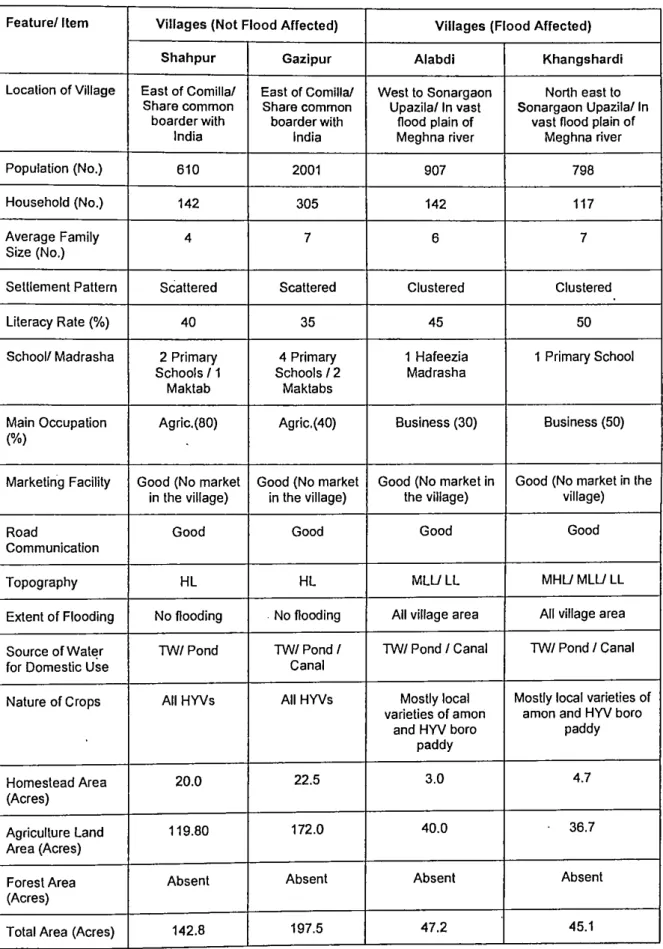
Four villages were selected from two upazilas keeping in mind the objectives of the study. Out of these four villages, two villages were selected on the basis that flood did not occur at least during the last 25 years. These non-flooding villages were selected from Camilla Sadar Upazila and these were Shahpur and Gazipur villages under Jagannathpur Union of the Upazila. The other two villages were selected on the basis that at least 50 percent of the land remains under water in the rainy season. These flooding villages were Alabdi under Moghrapara Union and Khangshardi under Boidder Bazar Union of Sonargaon Upazila within the jurisdiction of Narayanganj District.
2.2
Comilla Sadar UpazilaCamilla Sadar Upazila is bounded with an area of 280 sq. km. on the north Burichang Upazila and Tripura State of India, Laksham and Chauddagram Upazilas on the south, Tripura S~ate of India on the east and Barura Upazila on the west. Main rivers are Gumti and Little Feni. Rajendrapur forestry, Shalban Bihar and Lalmai hills . are most notable features of the upazila. Total population of the upazila is 516319.
Main occupations cover 30.67% agriculture, 18.73% service, 18.03% commerce, 8.96% transport, 8.08%Iabourer, 2.69% construction, 1.94%. wage labourer and 9.97% others. Total cultivable land is 21473.49 hectares; fallow land 72.85 hectares;
single crop 2.34%, double crop 66.23% and tripple crop land 31.43%. Main crops cover paddy, wheat, potato, onion, garlic, sesame and vegetables (ASB, 2003).
Camilla Sadar Upazila has been used by the Academy as its experimental laboratory area since 1960. Pilot project method of practical development model building activities in a number of rural aspects has caused substantial changes in the socio-economic conditions of this upazila. From change, growth and development point of view the average conditions in most areas of rural Bangladesh are not at present as good as they appear in Camilla. But when the Academy started its experiments in 1960, the condition of rural area of this upazila was much worse than the average condition obtaining in other parts of Bangladesh. Population densities in
I
20
Comilla district and Comilla upazila were well above the density for the country. The farms were smaller and the proportions of rural dwellers without land were greater (Khan and Solaiman, 1978).
Various development interventions of BARD and NBDs in different fields of RD improved agricultural production practices, fishery and livestock development, institution building, family planning, health and nutrition development, gender development etc. The common villagers of Camilla Sadar Upazila become more aware and technologically sound in adopting those improved methods compared to the common villagers of other areas.
21
91•us·
COMILLA SADAR UPAZILA
0 2km
91 °12' 91°16' E
L.-, l
·v. -1 _.... ;,,.
. • • <,: 1tl>-'·~~z
:Am.r~taJi
•<·, , . 1
BURICI-II\NG
_k j
r '
'-·
1t'
· <;c1nt()J1ment • :·:•;, ·· · ~;•~ •:it'•··•:·,,.~-- · · · · t
' -\ E ti_f .... : ' ~ ~ ~ g _ ! J -,~---1 -. ·'. '