GROWING CHERRY TOMATO VARIETIES UNDER VARIABLE FREQUENCY OF DRIP IRRIGATION
MD. IMAM HOSSAIN
DEPARTMENT OF HORTICULTURE
SHER-E-BANGLA AGRICULTURAL UNIVERSITY DHAKA-1207
DECEMBER, 2020
GROWING CHERRY TOMATO VARIETIES UNDER VARIABLE FREQUENCY OF DRIP IRRIGATION
BY
MD. IMAM HOSSAIN REG. NO. 14-06290
A Thesis
Submitted to Faculty of Agriculture, Sher-e-Bangla Agricultural University, Dhaka,
In partial fulfillment of the requirements for the degree of
MASTER OF SCIENCE (MS) IN
HORTICULTURE
SEMESTER: JULY-DECEMBER, 2020 Approved by:
Prof. Dr. Khaleda Khatun Department of Horticulture
SAU, Dhaka Co-Supervisor Prof. Dr. A. F. M. Jamal Uddin
Department of Horticulture SAU, Dhaka
Supervisor
Prof. Dr. Md. Jahedur Rahman Chairman
Examination Committee
Most surely in the creation of the heavens and the earth and the alternation of the night and the day, there are signs for men who understand.
(Surah Al Zumar 3:190)
DEDICATED TO
MY BELOVED PARENTS
Department of Horticulture
Sher-e-Bangla Agricultural University
Sher-e -Bangla Nagar, Dhaka-1207
CERTIFICATE
This is to certify that thesis entitled, “GROWING CHERRY TOMATO VARIETIES UNDER VARIABLE FREQUENCY OF DRIP IRRIGATION” submitted to the Faculty of Agriculture, Sher-e- Bangla Agricultural University, Dhaka, in partial fulfillment of the requirements for the degree of MASTER OF SCIENCE in HORTICULTURE, embodies the result of a piece of bona fide research work carried out by MD. IMAM HOSSAIN, Registration No. 14-06290 under my supervision and guidance. No part of the thesis has been submitted for any other degree or diploma.
I further certify that such help or source of information, as has been availed of during the course of this investigation has duly been acknowledged.
Dated: December, 2020 Dhaka, Bangladesh
Prof. Dr. A.F.M. Jamal Uddin Department of Horticulture
Sher-e-Bangla Agricultural University Sher-e-Bangla Nagar, Dhaka- 1207 Supervisor
I
ACKNOWLEDGEMENT
The author is prostrated before almighty Allah, the most Merciful and most Beneficent, for giving the strength and courage to successfully complete the research work.
This thesis owes its existence to the help, support and inspiration of several people. Firstly, the author expresses sincere appreciation and gratitude to his supervisor Prof. Dr. A. F. M. Jamal Uddin for his guidance and constant encouragement during the research. His support and inspiring suggestions have been precious for the development of this thesis contents.
The author indebted to his co-supervisor Prof. Dr. Khaleda Khatun. He is grateful to Prof. Dr. Md. Nazrul Islam and all of other teachers, Department of Horticulture, Sher-e-Bangla Agricultural University who have been constant sources of encouragement and enthusiasm, not only during this thesis work but also during the two years of this Masters program.
Deepest gratitude goes to his family for their unflagging love and unconditional support throughout his life and his studies. They made me live the most unique, magic and carefree childhood that have made him who he is now.
Finally, he thanks all of his fellows 2a biotech lab members for being there in all the hard work and sharing his joys and sorrows. To them the author says, “You make the bad times good and the good times unforgettable.”
- The author
II
GROWING CHERRY TOMATO VARIETIES UNDER VARIABLE FREQUENCY OF DRIP IRRIGATION
BY
MD. IMAM HOSSAIN
ABSTRACT
A pot experiment was conducted on the rooftop at the Academic Building, Sher- e-Bangla Agricultural University, Dhaka-1207 during November 2019 to March 2020 to evaluate the influences of irrigation frequency on the growth and yield of cherry tomato varieties under drip irrigation system. Four cherry tomato varieties and three levels of drip irrigation frequencies were used in this experiment. The cherry tomato varieties were: SAU Cherry Tomato-1 (V1), Crimson Red (V2), Australian Cherry (V3), Sutton Cherry (V4); and drip irrigation frequencies were: Once a day (I1), Twice a day (I2) and Thrice a day (I3). All the drip irrigation treatments have received the same amount of water with different frequency of application. The experiment was outlined in the Completely Randomized Design with five replications. Significant variation was found with the treatments. Among the varieties, the maximum plant height (153.30 cm), flower number (995.20/plant), fruit number (645.50/plant) and fruit yield (3.37 Kg/plant) were found from V1 while the minimum fruit yield (1.67 Kg/plant) was found from V3. Irrigation once a day (I1) gave the best results for growth and yield related parameters than other applications. The highest fruit yield (4.44 Kg/plant) was found from combination V1I1 and lowest yield (1.06 Kg/plant) was found from the combination V3I3. In view of the overall performances, SAU Cherry Tomato-1(V1) with irrigation once a day (I1) provided the best results for the growth and yield attributes.
III
TABLE OF CONTENTS
CHAPTER TITLE PAGE NO.
ACKNOWLEDGEMENTS I
ABSTRACT II
TABLE OF CONTENTS III-V
LIST OF TABLES VI
LIST OF FIGURES VII
LIST OF PLATES VIII
LIST OF APPENDICES IX
ABBREBRIATION AND ACRONYMS X-XI
I INTRODUCTION 1-3
II REVIEW OF LITERATURE 4-24
III MATERIALS AND METHODS 25-39
3.1 Study area 25
3.2 Climatic conditions 25
3.3 Characteristics of soil 25
3.4 Experimental materials 26
3.4.1 Planting materials 26
3.5 Water management 26
3.5.1 Installation of drip irrigation system 26
3.5.2 Crop water requirement 27-29
3.6 Treatments of the experiment 30
3.7 Design and layout of the experiment 30-31
3.7.1 Spacing and pot size 32
3.8 Production methodology 32
3.8.1 Seedbed preparation and raising of seedlings 32
3.8.2 Preparation of pots 32
3.8.3 Application of manure and fertilizers 32
3.8.4 Transplanting of seedlings 33
3.9 Intercultural operations 33
3.9.1 Gap filling 33
3.9.2 Weeding 33
3.9.3 Staking 33
IV
CHAPTER TITLE PAGE NO.
3.9.4 Irrigation 33
3.9.5 Pesticide application 33
3.9.6 Harvesting 34
3.10 Data collection 34
3.10.1 Plant height (cm) 35
3.10.2 Number of branches per plant 35
3.10.3 Number of cluster per plant 35
3.10.4 Days to 50% flowering 35
3.10.5 Days to first fruit harvesting 35
3.10.6 Number of flowers per cluster 35
3.10.7 Number of flowers per plant 36
3.10.8 Number of fruits per cluster 36
3.10.9 Number of fruits per plant 36
3.10.10 Fruit length and diameter (mm) 36
3.10.11 Single fruit weight (g) 36
3.10.12 Yield per plant (Kg) 36
3.10.13 Brix % 37
3.11 Statistical analyses 37
IV RESULTS AND DISCUSSION 40-63
4.1 Plant height (cm) 40-43
4.2 Number of branches per plant 43-45
4.3 Days to 50% flowering 46
4.4 Days to first fruit harvest 46
4.5 Brix % 47
4.6 Number of clusters per plant 55
4.7 Number of flowers per cluster 51
4.8 Number of flowers per plant 52
4.9 Number of fruits per cluster 53
4.10 Number of fruits per plant 54
4.11 Fruit length (mm) 57
4.12 Fruit diameter (mm) 57
4.13 4.14
Single fruit weight (g) Yield per plant (Kg)
58 59
V
CHAPTER TITLE PAGE NO.
V SUMMARY AND CONCLUSIONS 64-68
5.1 Summary 64-67
5.2 Conclusions 67
5.3 Recommendations 68
5.4 Suggestions 68
REFERENCES 69-81
APPENDICES 82-87
VI
LIST OF TABLES
Table No. Title Page No.
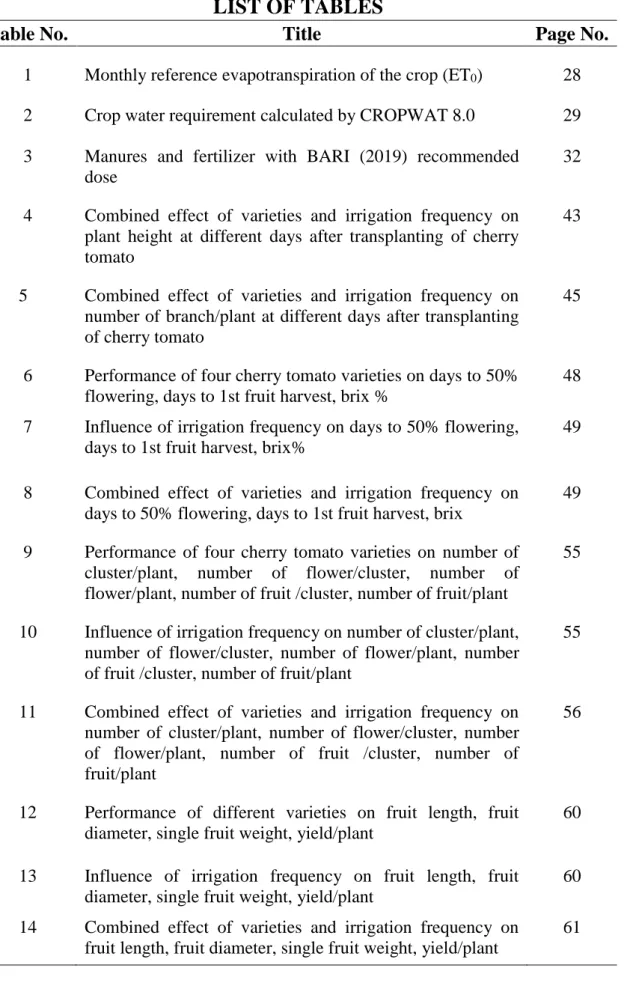
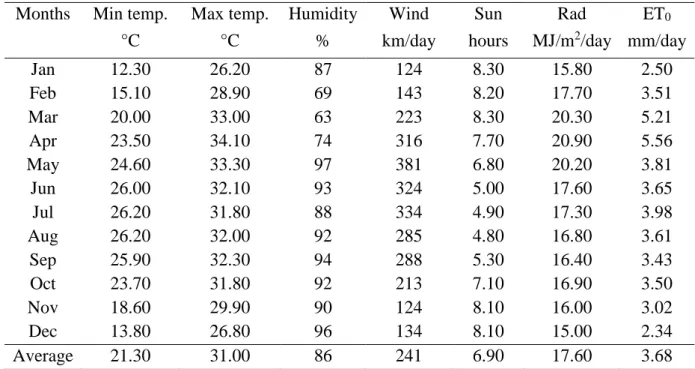
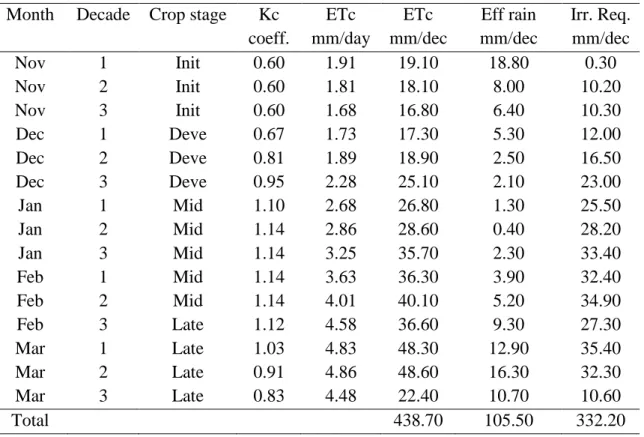
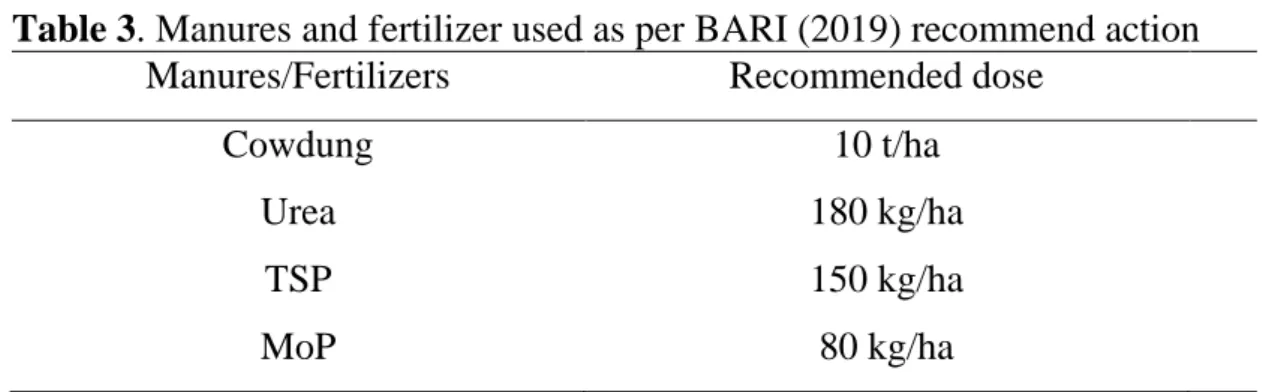
1 Monthly reference evapotranspiration of the crop (ET0) 28 2 Crop water requirement calculated by CROPWAT 8.0 29 3 Manures and fertilizer with BARI (2019) recommended
dose
32 4 Combined effect of varieties and irrigation frequency on
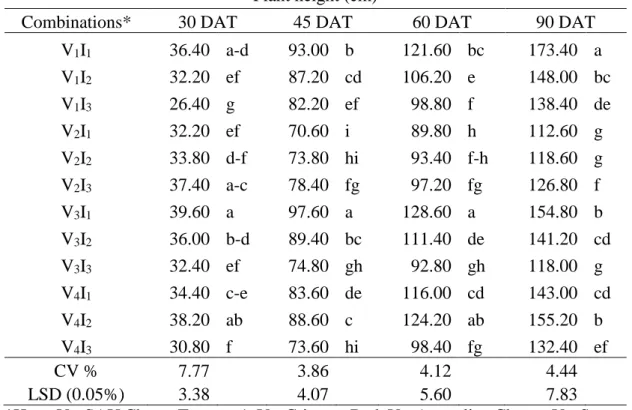
plant height at different days after transplanting of cherry tomato
43
5 Combined effect of varieties and irrigation frequency on number of branch/plant at different days after transplanting of cherry tomato
45
6 Performance of four cherry tomato varieties on days to 50%
flowering, days to 1st fruit harvest, brix %
48 7 Influence of irrigation frequency on days to 50% flowering,
days to 1st fruit harvest, brix%
49
8 Combined effect of varieties and irrigation frequency on days to 50% flowering, days to 1st fruit harvest, brix
49 9 Performance of four cherry tomato varieties on number of
cluster/plant, number of flower/cluster, number of flower/plant, number of fruit /cluster, number of fruit/plant
55
10 Influence of irrigation frequency on number of cluster/plant, number of flower/cluster, number of flower/plant, number of fruit /cluster, number of fruit/plant
55
11 Combined effect of varieties and irrigation frequency on number of cluster/plant, number of flower/cluster, number of flower/plant, number of fruit /cluster, number of fruit/plant
56
12 Performance of different varieties on fruit length, fruit diameter, single fruit weight, yield/plant
60
13 Influence of irrigation frequency on fruit length, fruit diameter, single fruit weight, yield/plant
60 14 Combined effect of varieties and irrigation frequency on
fruit length, fruit diameter, single fruit weight, yield/plant
61
VII
LIST OF FIGURES
Figure No Title Page No
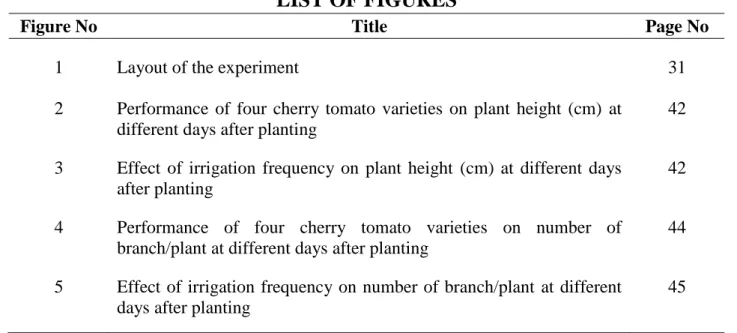
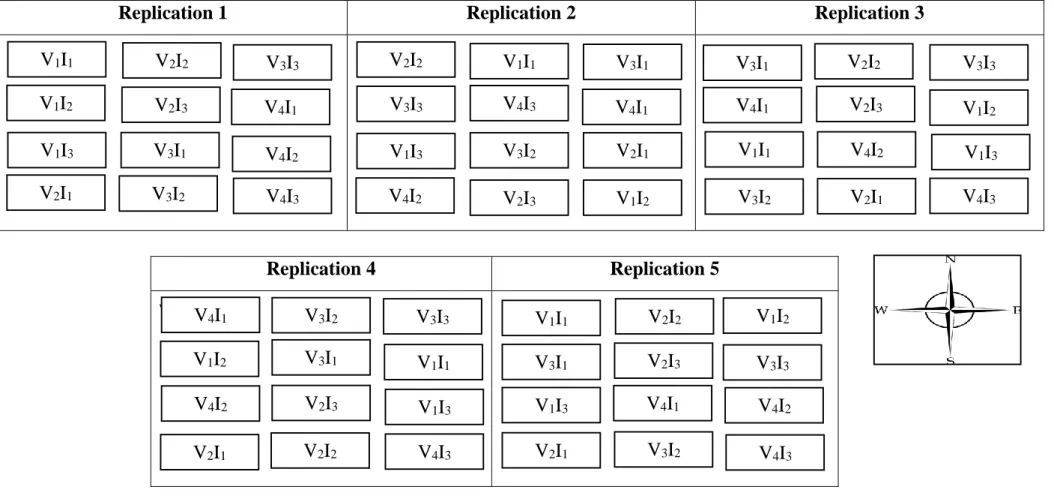
1 Layout of the experiment 31
2 Performance of four cherry tomato varieties on plant height (cm) at different days after planting
42 3 Effect of irrigation frequency on plant height (cm) at different days
after planting
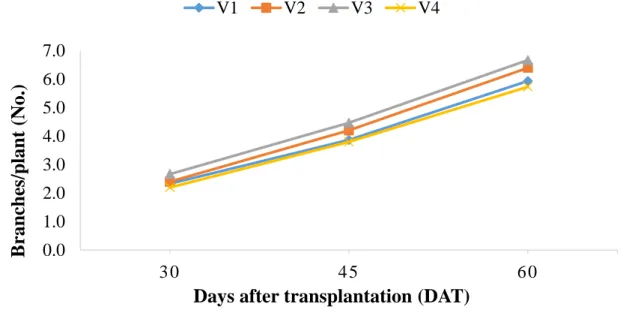
42 4 Performance of four cherry tomato varieties on number of
branch/plant at different days after planting
44 5 Effect of irrigation frequency on number of branch/plant at different
days after planting
45
VIII
LIST OF PLATES Plate
No. Title Page
No.
1 Pictorial presentation of different methodological works, equipment and data collection
38-39
2 Pictorial presentation of cluster of cherry tomato varieties 62 3 Pictorial presentation of varietal performance due to
irrigation frequency
63
IX
LIST OF APPENDICES
Appendix
No. Title Page
No.
1 Monthly reference evapotranspiration of the crop 82 2 Monthly reference rainfall data used for CROPWAT 8.0 82 3 Tomato crop Parameters used for CROPWAT 8.0 model 83
4 Reference soil data used for CROPWAT 8.0 83
5 Crop water requirement calculated by CROPWAT 8.0 84 6 Analysis of variance on plant height at different days after
transplanting of Cherry Tomato
85
7 Analysis of variance on number of branch/plant at different days after transplanting of Cherry Tomato
85
8 Analysis of variance on days to 50% flowering, days to 1st fruit harvest, brix %
86
9 Analysis of variance on number of cluster/plant, number of flower/cluster, number of flower/plant, number of fruit /cluster, number of fruit/plant
86
10 Analysis of variance on fruit length, fruit diameter, single fruit weight, yield/plant
87
X
ABBREVIATIONS AND ACCORONYMS
Agric. = Agricultural
Agron. = Agronomy
AEZ = Agro-ecological Zone ANOVA = Analysis of Variance
BADC = Bangladesh Agricultural Development Corporation BARI = Bangladesh Agricultural Research Institute
Biol. = Biology Chem. = Chemistry Coeff. = Coefficient
cm = Centimeter
CV = Coefficient of variance DAT = Days after transplanting
Dec. = Decimal
Deve. = Development
Eff. = Effective
ET0 = Evapotranspiration et al. = And others
Ex. = Experiment
FAO = Food and Agriculture Organization
FC = Field Capacity
g = Gram
Hort. = Horticulture i.e. = That is
Init. = Initial
Int. = International
Irr. = Irrigation
J. = Journal
Kc = Crop Coefficient
Kg = Kilogram
L = Liter
LSD = Least Significance Difference
XI
Manag. = Management
MJ = Megajoules
mm = Millimeter
Rad = Radiation
CRD = Completely Randomized Design Res. = Research
SAU = Sher-e-Bangla Agricultural University
Sci. = Science
spp. = Species Tech. = Technology
TSS = Total Soluble Solids
UNDP = United Nations Development Programme Viz. = Namely
1
CHAPTER I INTRODUCTION
Cherry tomato (Solanum lycopersicum L. var. cerasiforme) is a cultivated variety of tomato belonging to the family Solanaceae. It is thought to have originated in Peru and Northern Chile. It is the probable ancestor of all the cultivated tomatoes.
The variety is generally considered to be similar but not identical to the wild relatives of the domestic tomato (Prema et al., 2011). Cherry tomatoes are widely cultivated in Central America and distributed in California, Korea, Germany, Mexico and Florida. It is grown for its edible fruits; these are perfect for making processed products like sauce, soup, ketchup, puree, curries, paste, powder, rasam and sandwitch (Anonymous, 2009). It is a popular type of table tomato with small fruits (1.5-3.5 cm in diameter) on long panicles and its demand for has been increased in the market, chiefly due to the recognition of their high quality and good taste (Kobryn and Hallmann, 2005).
Cherry tomato is a tomato variety with small fruit, different shapes and colours and mainly used for fresh consumption. It has a sweeter taste, intense colour and flavour, generally round and weighing 10 to 30g (Prema et al., 2011). Its fruits are consumed more as a salad rather than as a vegetable. Cherry tomato often called ‘Salad tomato too’.
It is also beneficial to human health because of its high contents of antioxidants and phytochemical compounds, including lycopene, β-carotene, flavonoids, vitamin C and many essential nutrients (Rosales et al., 2011). They are a great source of vitamin C (13 mg/100 g), dietary fibre (2.0 g), vitamin A (25%) and vitamin K and also a good source of vitamin E (Alpha Tocopherol), thiamine, niacin, vitamin B6 , foliate, phosphorus, copper, potassium and manganese (Anonymous, 2009).
This tomato is a new crop in Bangladesh and becoming popular day by day but yield is low due to lack of proper irrigation and nutrient management system.
2
Irrigation is a vital agricultural practice affecting both the yield and fruit quality.
Indeed, the irrigation schedule has a great impact on the growth, yield and fruit quality of tomato depending on the amount of water applied (Kere et al., 2003).
Tomato is most sensitive to water shortage during the flowering and fruit formation stages (Jie et al., 2019).
It is a high water demand vegetable crop and is generally cultivated under surface irrigation but excessive use of irrigation water leads to over exploitation of groundwater resources and deterioration of the environment (Kang et al., 2004;
Ma et al., 2005). Although sufficient water is a prerequisite for good plant growth and fruit development, over-watering reduces quality and increases the production costs (Amundson, 2012). In the furrow and the border irrigation system, loss of applied irrigation water from reservoir to the field under unlined irrigation system is as much as 71% (Navalawala, 1991). Such huge amount of water loss also causes abundant nutrient loss through seepage or percolation.
In Bangladesh, water is a scarce resource for irrigation use in many parts of the country. About 88% of the fresh water resources in Bangladesh are currently being used for agriculture (FAO, 2012). About 73.44% of the total cultivated area is irrigated from the groundwater and the remaining 26.56% area is irrigated with the surface water (BADC, 2019). So, there is a tremendous pressure on agriculture sector to reduce its share of water and at the same time to improve total production by enhancing productivity with increased water use efficiency.
Thus, there is an urgent need to increase the productivity of crops with concomitant conservation of water resources.
Drip irrigation can be an effective way to achieve water conservation due to its potential for uniform distribution, localized application of water without irrigating the non-cropped area and reducing soil evaporation, easiness for automated control of water application of small to very small and frequent irrigation depths (Hanson et al., 2006 and Karlberg et al., 2007).
Drip irrigation is a type of micro-irrigation system that has potential to save water and nutrients by allowing water to drip slowly to the root zone of plants either
3
from above the soil surface or buried below the surface. Drip irrigation has proved its superiority over other methods of irrigation and fertilizer application, especially in the cultivation of fruits and vegetables due to precise and direct application of water and nutrients in the active plant root zone. The superiority of drip irrigation over the sprinkling and surface irrigation has been reported by various authors, e.g., drip irrigation system saves irrigation water, increases water use efficiency, decrease leaching and volatilization ensures high quality products, increases crop yield and ensuring higher fertilizer use efficiency (Qureshi et al., 2001; Miller et al., 1981; Papadopoulos, 1995; Sivanappan, 1994 and Namara et al., 2005). Drip irrigation reduces water contact with crop leaves, stems and fruit, thus provides conditions less favourable for disease development. Therefore, optimal irrigation management and scheduling are essential to increase water-use efficiency (WUE) in agricultural production. In addition, frequency of water application is one of the most important factors in drip irrigation management because of its effect on soil water regime, root distribution around the drip holes, the amount of water uptake by roots and water percolating beyond the root zone (Assouline, 2002 and Wang et al. 2006).
For maximizing cherry tomato production, priority must be given on the efficient use of water, thus to both improve yield and control the water use efficiency through minimizing the non-beneficial water uses.
Considering the above facts and present situation this investigation has been undertaken with the two following objectives:
To study the growth and yield performance of four cherry tomato varieties
To study the influence of irrigation frequency on growth and yield of cherry tomato varieties
4
CHAPTER II
REVIEW OF LITERATURE
A comprehensive and critical review of past researches is very essential for any scientific investigation. It provides not only knowledge of work already done in the field but insight in the methods and procedures too. It furthers provides a basis for operational definitions of major concepts. Relevant reviews also support the results and discussion of the study.
Since drip irrigation technology is a new approach in Bangladesh, much work in this field has not been reported so far from extension point of view. However, some of significant research works the done in home and abroad related to this experiment have been presented (alphabetically) in this chapter.
Ahmed et al. (2010) conducted an experiment to study the effect of drip irrigation on growth, yield and quality of banana. They studied water quantity and efficiency with fertigation in comparison to farmer practice. The results indicated that the amount of applied irrigation water with drip irrigation system was lower than that needed under surface irrigation. The banana under drip irrigation system performed better in plant growth and flowered earlier in comparison with surface irrigation.
Alaoui et al. (2014) had an experiment using drip irrigation and plastic mulch to evaluate the effects of irrigation scheduling on water requirements and vegetative parameters of tomato under typical Massa greenhouses growing conditions. Capacitive sensors were used to automatically schedule irrigations.
The result of that study show that irrigation dose and frequency did not affect stem diameter in grafted tomato plant, no significant effect on leaves number had been observed. But irrigation scheduling had a large effect on root’s development. The root containers results indicated that a water stress equivalent to 50% ETc and 20% frequency can lead to deep root system; that makes possible to sustain a suitable vegetative canopy if doses and frequencies are well managed
5
in a daily scale, it was possible save 50% of irrigation water.
Antony and Singandhupe (2004) studied the effect of different irrigation methods and schedules on morphology, yield and water use efficiency of capsicum (Capsicum annum L.) var. California Wonder. It was found that the plants grown under drip irrigation had more number of branches and plant heights compared to that of surface irrigated plants. Root mass was more in surface irrigated crop whereas total root length was more in drip irrigated crop.
Badr and Yazied (2007) conducted a two-year field experiment with subsurface drip-irrigated tomato to determine the effects of two N application rates and four- fertigation frequencies (intervals of 1, 3, 7, and 14 days) on tomato yield, N uptake and soil N status. Total tomato yield and yield components were responsive to N rate and to decreased fertigation frequency. The highest total fruit yields averaged (67.75, 65.13 and 63.29 t/ha) with the frequencies of 1, 3 and 7 days respectively. Yields with the longest duration were significantly lower than these values (54.32 t/ha). Wide differences N concentrations in leaves were observed in the early vegetative stage which were mainly dependent on the rate of N supply. Similarly, N rate and fertigation frequency resulted in significantly differences in N uptake, N recovery and N use efficiency (NUE).
Total N uptake was appreciable higher with increasing N rate and with more frequent than with less frequent fertigation. The averaged N recovery across fertigation frequencies was 60 and 54 % and NUE was 221 and 194 kg yield/kg N with 200 and 300 kg N/ha applied respectively. Analysis of soil samples following tomato harvest indicated considerable influence of fertigation frequency on NO -N distribution in soil profile. The NO3- N in lower soil profiles (50-70 cm soil depth) with the high N rate treatments was marginally affected in daily, 3 days and weekly fertigation (15, 17 and 21 mg/kg soil), respectively.
However, NO3- N in the corresponding soil depth was appreciable higher (80 mg/kg soil) in biweekly fertigation frequency, a fact which has important agronomic implications regarding the frequency of nitrate applications under
6
drip irrigation.
Bangal et al. (1987) indicated that tomato was very much responsive to drip irrigation. Whereas the yield increased from negligible to 50 per cent in some locations, there was universally a high water economy at most of the locations with a saving of 30 to 50 per cent.
Barua and Phookan (2009) evaluated the effect of drip irrigation and plastic mulch on yield of broccoli (Brassica oleracea L. var. italica) and the results showed 64 to 124 % yield increase due to drip irrigation. Among the different drip irrigation levels, 100 % of irrigation requirement met through drip showed highest yield. Highest net return was observed for the treatment where 100 % of net volume of water was met with drip irrigation and plants were mulched with black plastic mulch.
Beyaert et al. (2007) studied the response of processing cucumber (Cucumis sativus L.) to irrigation and fertilization strategies on a loamy sand and found that dry matter accumulation, fruit yield, economic return and water use efficiency were compared for (a) non-irrigated with conventional broadcast fertilizer applications, (b) overhead sprinkler irrigated with conventional broadcast fertilizer applications, (c) surface drip irrigated with fertigation and (d) subsurface drip irrigated with fertigation. All irrigation methods enhanced yields, with drip irrigation coupled with fertigation showed significant advantages in terms of yield and economic returns compared with overhead irrigation and conventional fertilization practices.
Bhakare and Fatkal (2008) investigated the influence of micro irrigation and fertilizer levels through fertigation on growth, yield and quality of onion seed and they reported a saving of irrigation water (39.9 %) through drip system compared to surface irrigation. The water use and fertilizer use efficiency were maximum under fertigation treatments.
7
Bhogi et al. (2011) conducted an experiment on brinjal under drip and furrow irrigation with different recommended doses of fertilizers. The highest benefit cost ratio was recorded in 100 % ET with 100 per cent recommended fertilizer doses (4.99) as compare to furrow irrigation with 100 % fertilizer doses (3.72).
Cukaliev et al. (2008) determined the best irrigation and fertigation practice for tomato crop (Lycopersicon esculentum Mill.) to achieve highest yield with maximum fertilizer use efficiency. Five experimental treatments included the following: The first three treatments (T1, T2 and T3) included a combination of drip irrigation and fertigation, treatment (T4) included drip irrigation, but with conventional application of fertilizer, and the fifth treatment, (T5), included furrow irrigation practice with conventional application of fertilizer. To determine fertilizer use efficiency, part of nitrogen was applied as labelled urea with 15N stable isotope. The results of this study indicated that to obtain acceptable/maximum tomato yield with high nitrogen fertilizer use efficiency (NFUE) the practice of drip irrigation in combination of fertigation with irrigation frequency of either two (T1) or four (T2) days is recommended.
Dingre et al. (2012) studied the feasibility of fertigation scheduling through drip on growth and yield of onion seed (Allium cepa L). The results revealed that 100
% water soluble fertilizers in 12 equal splits up to 2 months was significantly superior in respect of growth and quality parameters of the seed. The fertigation applied in 12 splits up to 2 months produced significantly higher seed yield (602 kg ha-1). The lowest value of growth and seed yield were recorded when irrigation applied by surface method with conventional fertilizer (347 kg ha-1).
The findings showed that drip fertigation resulted into 12 to 74 % increase in the productivity of onion seed as compared to conventional method. It was concluded that drip fertigation of 100 % water soluble fertilizers in 12 weekly splits up to 2 months duration was found effective for growth, yield and quality for onion seed production.
8
Guohua et al. (2010) studied the effects of different irrigation methods: border irrigation, sprinkler irrigation and surface drip irrigation on root development
and profile water uptake in winter wheat. Results showed that the main root distribution zone moved upward under sprinkler and surface drip irrigation when
compared to the traditional border irrigation. Due to the appropriate soil water and higher root density in the surface soil layer under sprinkler and surface drip irrigation, the main water uptake zone was concentrated in the upper layer.
Gupta et al. (2015) evaluated the yield, quality and water/fertilizer use efficiency in tomato hybrid SH-TH-1 under drip irrigation and fertigation technology at the experimental farm of Division of Olericulture, SKUAST-K, Shalimar, Srinagar.
The experiment was with four replications of 16 treatment combinations. Surface irrigation and manual fertilizer application were treated as control. Irrigation was given based on the estimated crop water requirement following alternate day irrigation schedule for drip irrigation while the surface irrigation was given according to the locally adopted frequency. Drip irrigation at 80% ET and fertigation with 60% recommended NPK significantly enhanced fruit yield of (989.3 q/ha), higher water use efficiency (49.9 q/ha-cm) and fertilizers use efficiency (10.9, 18.3 and 27.4 q/kg NPK, respectively). Average fruit weight, fruit length and fruit diameter also exhibited higher values (53.0 g, 4.48 cm and 4.75 cm, respectively with the same treatment combination. However quality characteristics like TSS, vitamin C, lycopene content and total sugar content were found much improved with the treatment combination of 80% ET through drip and 80% recommended NPK through fertigation.
Hakkim (2014) compared the effect of site specific drip fertigation in completely randomized design (CRD) with six treatments. Hybrid chilli (hot line) was used as the test crop. Fertigation was done once in five days starting from 15 up to 150 DAP. The different yield parameters like fruit length, fruit girth, fruit weight and number of fruits per plant also varied in the same trend as that of total green fruit yield. In case of low fertility area, highest BCR was obtained for the
9
treatment site specific drip fertigation and daily drip irrigation (2.42) followed by the treatment site specific drip fertigation and alternate day drip irrigation (2.25). The lowest BCR was obtained under the treatment with manual application of fertilizer and alternate day drip irrigation (1.91). In case of high fertility area, corresponding values of BCR were 2.47, 2.43 and 2. 17 respectively.
Harmanto et al. (2005) four different levels of drip fertigated irrigation equivalent to 100, 75, 50 and 25% of crop evapotranspiration (ETc), based on Penman–Monteith (PM) method, were tested for their effect on crop growth, crop yield, and water productivity. Results were compared with the open cultivation system as a control. Two modes of irrigation application namely continuous and intermittent were used. The distribution uniformity, emitter flow rate and pressure head were used to evaluate the performance of drip irrigation system with emitters of 2, 4, 6, and 8 l/h discharge. The results revealed that the optimum water requirement for the Troy 489 variety of tomato is around 75% of the ETc. Based on this, the actual irrigation water for tomato crop in tropical greenhouse could be recommended between 4.1 and 5.6 mm day−1 or equivalent to 0.3–0.4 l plant−1 day−1. Statistically, the effect of depth of water application on the crop growth, yield and irrigation water productivity was significant, while the irrigation mode did not show any effect on the crop performance. Drip irrigation at 75% of ETc provided the maximum crop yields and irrigation water productivity. Based on the observed climatic data inside the greenhouse, the calculated ETc matched the 75–80% of the ETc computed with the climatic parameters observed in the open environment. Moreover, the distribution uniformity was 93.4 to 90.6%.
Hebbar et al. (2004) judged the effects of fertigation with sources and levels of fertilizer and methods of fertilizer application on the growth, yield and fertilizer- use efficiency of hybrid tomato in red sandy loam soil. The investigation revealed that the total dry matter (TDM) production and leaf area index (LAI)
10
were significantly higher in drip irrigation (165.8 g and 3.12 g) over furrow irrigation (140.2g and 2.25g). Water-soluble fertilizer (WSF) fertigation recorded significantly higher total dry matter and LAI (181.9 g and 3.69 g) over drip irrigation. The fruit yield of tomato was 19.9 % higher in drip irrigation (71.9 Mg ha-1) over the furrow one (59.5 Mg ha-1).
Kannan (2008) determined the effects of different irrigation methods and drip irrigation regimes, and fertigation schedules on the growth and yield of medicinal coleus (Coleus forskohlii). The irrigation methods and drip irrigation regimes include: I1, drip irrigation at 100 % pan evaporation (PE); I2, 80 % PE;
I3, 60 % PE; and a control (surface irrigation and soil application of fertilizer.
The effects of the treatments on tuber yield per plant, tuber length, tuber girth, dry tuber yield, water use efficiency, nitrogen use efficiency and water productivity were studied. Irrigation water got saved due to drip-fertigation compared to surface irrigation and soil application of fertilizer ranged from 14.7 to 48.1 %. An increase in tuber yield (24 %) was evident with drip irrigation compared to conventional method of surface irrigation.
During the rabi season of 2008-09 Kohire and Das (2015) studied the effects of drip irrigation and fertilizer management on capsicum at Research area farms of Assam Agriculture University Jorhat (Assam) India. Result reviled that the effect of drip irrigation and fertilizer management treatments (T3) were significant in respect of percent nitrogen content both in plant (2.18%) and fruits (1.19%).
Similarly the highest uptake of P2O5 by plants (7.37 kg/ha) and by fruits (3.64 kg/ha) K2O by plant (47.05 kg/ha) and by fruits (26.07 kg/ha) recorded in treatment T3 at 100% EPR alone with the application of 75% RD of N and K through drip. The total Uptake of N (69.16 kg/ha) P2O5 (11.0 kg/ha) and K20 (73.12 kg/ha) were also significant over the treatment T9 (N-48.27 kg/ha) P2O5
(7.41 kg/ha) and K2O (48.85 kg/ha) respectively. The nutrient status determined in terms of available N, P2O5, and K2O in kg/ha was significantly influenced by different drip irrigation and fertilizer management. Significantly highest fruit
11
yield (87.20 q/ha) was recorded in drip irrigation at 100 EPR along application of 75 % RD of N through drip irrigation over treatments.
Kumari et al. (2006) conducted a field experiment to studied the effect of drip irrigation at three levels of water application, i.e. 1.0, 0.8 and 0.6 of maximum evapo-transpiration and surface irrigation in combination with two mulches (black polyethylene and paddy husk) on the growth and yield of bell pepper cv.
California Wonder. Results indicated that plants irrigated through drip on an average were taller at harvest by approximately 5.5 cm compared to those that received surface irrigation. Among all the treatments, the highest yield was obtained with drip 0.8 and black polyethylene mulch combination but the lowest was recorded in surface irrigation without mulch.
Kuscu et al. (2009) conducted field experiments for 2 years (2004 and 2005) on sandy loam soil in south Marmara region of Turkey to study the effect of five levels of pan evaporation replenishment (20, 40, 60, 80 and 100%) on marketable yield, irrigation water productivity (IWP), and economic return of tomato (Lycopersicon esculentum), pepper (Capsicum annuum), green bean (Phaseolus vulgaris), and eggplant (Solanum melongena) under a drip irrigation method.
The highest mean marketable yield (2 years) of tomato (87.5 t ha–1), pepper (59.2 t ha–1), green bean (7.6 t ha–1), and eggplant (46.5 t ha–1) were recorded at 100, 100, 80, 100 and 80% of the pan evaporation replenishment, respectively. The IWP of tomato (23.6 kg m –3), pepper (16.5 kg m –3), green bean (2.6 kg m –3), and eggplant (13.6 kg m –3) was the maximum at 80%, 80%, 40%, and 80% of pan evaporation replenishment, respectively. The results revealed that a further increase in irrigation amount resulting from 100% of pan evaporation replenishment did not increase the marketable yield of crops but reduced the IWP significantly. The net return increased with the increase in pan evaporation replenishment. The results revealed that the pepper is the most profitable crop, followed by tomato, eggplant, and green bean.
12
Liu et al. (2013) investigated the suitable drip irrigation scheduling for tomato grown in solar greenhouse based on 20-cm pan evaporation (Epan) in North China Plain. Irrigation treatments included three irrigation frequencies (I1 10, I2 20 and I3 30 mm, and irrigation interval of 2-6 d for I1, 4-9 d for I2 and 8-12 d for I3) based on accumulated pan evaporation (Epan), and four plant-pan coefficients (Kcp1 0.5, Kcp2 0.7, Kcp3 0.9 and Kcp4 1.1). Results indicated that total irrigation amount, seasonal crop evapotranspiration (ET) and tomato yield (Y) were 185.1- 365.8 mm, 249.1-388.0 mm and 99.6-151.8 t ha-1, respectively. Irrigation frequency and amount increased the yield, and second-degree polynomial relationship was found between Y and ET (R2=0.8671). Both irrigation frequency did not increase mean fruit weight, diameter and length significantly but increased fruit number, total soluble solids content (TSS), fruit firmness and water use efficiency (WUE) and irrigation WUE (IWUE) significantly. Irrigation amount increased external quality of tomato but reduced TSS content, fruit firmness, WUE and IWUE significantly. Kcp3 and Kcp4 treatments had the highest fruit yield, but Kcp2 and Kcp3 treatments had the highest WUE. I1Kcp3
treatment (irrigation interval of 2-6 d, and Kcp=0.9) had higher IWUE, WUE, external quality, yield, and TSS yield too.
Mishra and Paul (2009) studied the impact of drip irrigation with plastic mulch on yield and returns of brinjal crop and obtained the highest yield of 34.8 t ha-1 as compared to other treatment. An increase in yield (65 %) and net income (83
%) was recorded in drip irrigation with mulch as compared to conventional surface irrigation. The benefit cost ratio was highest (2.18) for drip alone. The highest yield and net profit per mm of water were observed in case of 0.6 net irrigation volume drip along with mulch.
Nalge et al. (2007) conducted an experiment to study yield and moisture use of cotton under drip irrigation in vertisols at eight replications under rainfed (T1), 50 per cent (T2) and 100 per cent (T3) irrigation through drip. Seed cotton yield was lowest under rainfed (0.862 t ha-1) and at par under 50 per cent (1.552t ha-1)
13
and 100 per cent (1.580t ha-1) irrigation, respectively. Total water use efficiencies were 1.606, 2.092 and 1.915 kg ha-1 mm-1 under T1, T2, and T3
treatments, respectively.
Nilesh and Gulati (2004) conducted a field experiment to evaluate the effect of drip system and conventional furrow system of irrigation on the growth, yield and water use efficiency of American cotton (Gossypium hirsutum) cv. LH-846.
The study revealed that the average plant height was maximum in drip system (158.9 cm) with a high level of irrigation (IW/CPE=1.0) as compared to furrow system (146.9 cm). The average number of bolls per plant were also found maximum in drip system (27.0 bolls per plant) as compared to the furrow system (20.3 bolls per plant). Result on seed-cotton yield was same as that for bolls production. The water use efficiency of 0.54 q (ha-cm)-1 was found in drip system as compared to 0.37 q (ha-cm)-1 in furrow system. Nitrogen use efficiency was found maximum in the drip system as compared to the furrow irrigation system.
Pawar et al. (2013) conducted a study on the effects of drip fertigation on growth, yield and economics of sugarcane (Saccharum officinarum L.).The experiment comprised of 100, 80 and 60 % of recommended fertilizer dose in water soluble form. The 100 % drip fertigation showed 41.8 % increase in yield. Yield increased 25.3 % by applying only 'N' through drip as against conventional method (133.4 t ha-1). Fertigation also resulted into 40 % fertilizer saving. The drip irrigation used less quantity of water (103.7 mm) and saved 57 % water over surface irrigation method.
Pires et al. (2011) had an experiment to evaluate the effects of coconut (Cocos nucifera L.) fibre substrate volumes and drip irrigation frequencies on the vegetative growth and fruit yield of tomato plants under greenhouse conditions.
The experimental design consisted of randomized blocks arranged in a 3 × 2 factorial with four replicates. Treatments consisted of three substrate volumes
14
(5.0; 7.5 and 10.0 L per plant) and two irrigation frequencies (once and five times a day). Leaf area index tended to increase in plants grown with the largest substrate volume (10 L). Although substrate volumes affected shoot dry matter, no effects on tomato yield and its components were observed. However, plants grown with 5 L of substrate and irrigated once a day produced a greater number of non-marketable fruit due to the higher incidence of calcium deficiency symptoms (blossom end rot). When plants were grown in 5 L or 7.5 L of substrate volume, high irrigation frequency favored the vegetative growth, stomatal conductance, CO2 assimilation and transpiration and fruit yield. Fruit yield and healthy fruits were favored by high irrigation frequency and did not depend on the substrate volume.
Ponnuswamy and Santhi (1998) studied the effect of drip irrigation on soil moisture distribution pattern in cassava and revealed that the moisture content from the surface and subsurface decreased from 33.8 to 23.8 per cent and 32.2 to 22.7 per cent for drip irrigation with 100 and 50 per cent of surface applied water, respectively. More water penetrated into the deeper layers in drip system of irrigation and the crop utilized the water very effectively.
Popale et al. (2012) analysed the response of cauliflower to irrigation schedules under drip irrigation. Drip Irrigation schedules comprised of I1 (0.4 CPE), I2 (0.6 CPE), I3 (0.8 CPE) and fertigation levels included F1 (50 % RDF), F2 (75 % RDF) and F3 (100 % RDF). The control I4 was furrow irrigation scheduled at 1.2 IW/CPW with 60 mm depth of irrigation. The results revealed that percentage of average water saving under drip irrigation system over surface irrigation was 43.45 % and it was 75.54, 63.87 and 50.95 % under I1, I2 and I3 irrigation schedules, respectively. The mean water use efficiencies under surface irrigation and drip irrigation schedules were 22.03 and 73.48 kg ha-1mm-1, respectively.
15
Priyanka et al., (2015) evaluated the effect of deficit irrigation on growth and production of drip irrigated tomato under shade net house was studied through field experiment. Four levels of drip irrigation equivalent to 100, 80, 60 and 40%
of crop evapotranspiration with five replications were considered for their effect on crop growth and crop yield inside the shade net house. Tomato (Solanum lycopersicon, Badshah Variety) plants were grown under the shade net house with 50% shade. Plant height, number of leaves and individual fruit weight were found to be highest with 80 % irrigation, giving highest yield of 108.30 t.ha-1. Actual irrigation water application between 1.62 and 4.58 mm.day-1 was thus recommended for tomato crop in a shade net house.
At Sher-e-Bangla Agricultural University, Dhaka, Rakibuzzaman et al. (2018) conducted an experiment during November 2017 to March 2018 to study the performance of drip and traditional irrigation system on growth and yield of BARI-14 tomato. Significant variations were found within the treatments. Plant height, number of leaves plant-1, cluster plant-1, number of flower plant-1, number of fruit plant-1, fruit length, fruit weight, yield plant-1 were higher in drip than conventional irrigation system. In drip irrigation system, 80% water was saved in compare to conventional technique and increased 38% of water use efficiency.
30% increased yield of BARI-14 tomato was found with drip irrigation over the conventional system.
Rathore and Singh (2009) studied the optimization of nitrogen application and irrigation schedules in tuberose (Polianthes tuberosa). The study showed that irrigation applied at 0.8 IW/CPE ratio increased the number of florets per spike and bulb yield by 23 and 22 % over the control (flood irrigation) and by 30 and 44%, respectively, compared to the treatment receiving the minimum water at 0.4 IW/CPE. Water productivity based on consumptive use (WPCU), irrigation water (WPIR) and total water (WPTW) applied through irrigation and rainfall significantly improved the vegetative growth, spike and bulb yield with increasing ratio of water application from 0.4 to 0.8 IW/CPE ratio but failed to
16
increase beyond 0.8 IW/CPE ratio which indicated that water application beyond 0.8 IW/CPE ratio is not being utilized by crop. Irrigation through drip system at 0.8 IW/CPE saved water by 39 % and increased dry matter in florets by 45 % compared to the traditional flood method.
Razzak et al. (2013) determined the most efficient pruning system and optimum irrigation rate under drip irrigation system on cherry tomato to achieve the maximum production and high fruit quality in protected agriculture. Two pruning systems, one and two branches and four irrigation rates, 100% (Tl, full water), 80% (T2), 60% (T3) and 40% (T4) of crop evapotranspiration (ETc) were compared. The highest productivity in plants pruned to two branches was related to the increase in fruit cluster than that detected in plants pruned to one branch.
But, the plants pruned to one branch exhibited improved fruit quality. The highest irrigation rates, Tl and T2, produced the highest fruit yield, although the increased water stress treatment (T4) enhanced the fruit quality traits. Water-use efficiency increased with two branches pruning system and under water stress conditions. Irrigation treatment T2 was considered more appropriate for optimizing water-use efficiency without any significant reduction in the total fruit yield. This study demonstrated that the best results of interaction effects for increasing fruit production and conserving water were obtained by pruning cherry tomato plants to two branches under the T2 irrigation rate. Fruit weight and size were increased by pruning the plants to one branch under the T2
irrigation rate. On the other hand, pruning the plants to one branch under the lowest irrigation rate (T4) resulted in high fruit quality levels.
Razzak et al. (2016) conducted a greenhouse study to evaluate the response of cherry tomato cultivar Dulcito RZ to different irrigation levels and fruit pruning treatments. Treatments were three irrigation levels (50, 75, and 100%) based on the crop Evapotranspiration (ETc), and three fruit pruning treatments (6, 8, and 10 fruits truss-1). Results showed that the highest irrigation level (100% ETc) increased fruit weight and size, and total and marketable yield. However, water
17
stress treatment (50% ETc) increased fruit quality traits (total soluble solids, titratable acidity, vitamin C, and total sugars). Plants pruned to 6 fruits truss-1 yielded a heavier and larger fruit size, while unpruned plants had smaller fruit size with a significant increase in total and marketable yield due to increased number of fruits plant-1. The increased incidence of fruit cracking with lower fruit load (6 fruits truss-1) or with higher irrigation level (100% ETc) were related with the larger fruit size. The 50% ETc and full fruits truss-1 (zero fruit pruning) treatments caused the highest values of irrigation water use efficiency (25.6-25.8 and 29.9-30.4 kg m-3, respectively). To maximize marketable yield of cherry tomato and conserving irrigation water, it is recommended to apply 10 fruits truss-1 pruning treatment along with the medium irrigation water level (75%
ETc).
Rekha and Mahavishnan (2008) reported increased growth and yield with drip irrigation in several crops ranging between 7-11.2 % depending on the crops / varieties and method of irrigation. Also, the water and fertilizer saving through drip fertigation have been reported to be 40-70 and 30-50%, respectively.
Saleh et al. (2007) conducted two experiments to study the effect of irrigation frequency and timing on root developments, tomato yield (var. First Power) and soil water content. The first experiment was conducted in root containers (31 x 15 x 60 cm) with three irrigation frequencies, 1, 3 and 5 days were investigated.
The second experiment was conducted in a greenhouse with two irrigation frequencies, 1 and 3 days and three irrigation timings, early morning (8:00h), afternoon (14:00h) and night (20:00h). The results indicated that increasing water supply increased the root development and root biomass. The 1-day irrigation frequency produced the highest root biomass while the least root biomass was obtained from the 5-days irrigation frequency, indicating that water stress promoted the development of root system in the deeper layer where available soil moisture content was higher than the top layers. The 5-days irrigation frequency saved 18 and 12 % of water at early growth stage compared
18
to 1 and 3 days frequencies. The results of greenhouse experiment showed that the best irrigation frequency was 3- days. The average yield in 3-days frequency was 70 ton/ha while 63 ton/ha in 1-day frequency. The effect of irrigation timing varied with irrigation frequency. For 3 days frequency, irrigation at early morning was better than afternoon and night irrigations. The average yield for irrigation at early morning was increased by 15% and 14% than irrigation at afternoon and night, respectively. For 1 day frequency irrigation at night increased the yield by 11% and 3% than irrigation at early morning and afternoon correspondingly. The lowest soil water content and soil temperature were displayed by the treatment, which produced the highest yield. With the same amount of water, the early morning irrigation after every 3 days increased tomato yield by 11- 20 % compared to night and early morning irrigation of 1-day frequency. A similar increase in water use efficiency in the early morning irrigation every 3 days was also recorded. Therefore, a selection of the proper irrigation frequency and timing led to a higher yield and high water use efficiency.
Sanchita et al. (2010) conducted an experiment to evaluate the effect of different levels of nitrogen fertigation on growth, yield and economics of the broccoli crop. The results revealed that there were significant improvement in growth, yield and fertilizer use efficiency of broccoli under drip irrigation and fertigation.
Fertigation saved fertilizers to the tune of 40 % as compared to conventional fertilization to maintain the same yield levels. Study on fertigation efficiency and economics of cultivation revealed that fertigation with 100 % recommended doses of N was the most efficient treatment with fertigation efficiency of 55.44%
and 57.31%, respectively and cost benefit ratio of 1:4.41.
Sankar et al. (2008) studied the effect of micro irrigation on productivity of onion and found that both drip and micro irrigation systems improved growth, yield and yield attributing parameters of onion. Also, there was a saving of irrigation water of 37.8 % in drip and 32.5 % in sprinkler system compared to surface
19
irrigation scheduled at 50 mm cumulative pan evaporation with 7 cm depth.
Sathya et al. (2008) indicated higher availability of N, P and K nutrients in root zone area of drip fertigated plot. They also showed that fertigation frequency reduced the concentration of immobile elements such as P, K and trace elements in irrigation water and significantly increased saving of fertilizer nutrients up to 40 % without affecting the yield of crops compared to the conventional method of nutrient application.
Sezen et al. (2010) conducted a study to determine the optimal irrigation strategy for drip irrigated fresh market tomato grown in different soilless culture in a glasshouse in the Mediterranean Region of Turkey. Volcanic ash, peat and their mixture were used as growth media. Four different irrigation levels (WL1=75%;
WL2=100%; WL3=125% and WL4=150% of Class A Pan evaporation) and two watering frequencies (once and twice daily applications) were evaluated. Highest yield and fruit number were obtained from the ash+peat mixture (1:1) with twice a day watering at WL4 irrigation level. Soluble solids of tomato fruit decreased with increasing available water. The highest irrigation water use efficiency (IWUE) value of 121.4 kg m-3 was obtained from once a day irrigation WL1
irrigation level with peat+ash (1:1). IWUE decreased in all treatments as the amount of irrigation water increased.
Sharma et al. (2010) reported superiority of gravity fed drip irrigation system over conventional flood irrigation system in vegetable crops. They reported irrigation efficiency as high as 90-95 % with drip irrigation system.
Shedeed et al. (2009) evaluated the effect of method and rate of fertilizer application under drip irrigation system on growth, yield and nutrient uptake by tomato grown on sandy soil. Drip irrigation recorded significantly higher total dry matter production (3.60 t ha-1 ) and leaf area index (3.15) over furrow
20
irrigation (2.86 t ha-1 and 2.27), respectively. The fruit yield of tomato was 28 % higher in drip irrigation (43.87 t ha-1) over furrow irrigation (34.38 t ha-1).
Fertigation with 100 % NPK water-soluble fertilizers increased tomato fruit yield significantly (58.76 t ha-1) over furrow irrigated control.
Shirgure et al. (2004) had a field experiment on irrigation scheduling based on pan evaporation through drip irrigation system. Four levels of open pan evaporation-based irrigations were scheduled (0.6, 0.7, 0.8 and 0.9 of open pan evaporation) and the incremental growth, leaf nutrient status, yields and fruit quality was recorded. The incremental growth of plant height (0.63 m), stock girth (5.63 cm) and canopy volume (7.07 m3) were higher with the irrigation scheduled at 0.8 of open pan evaporation. The average fruit yield (14.08 kg/tree), fruit weight (37.9 g), total soluble solids (7.24% Brix), juice percentage (45.58%) and acidity (6.16%) of the lime were higher with drip irrigation scheduled at 0.8 of open pan evaporation.
Singandhupe et al. (2003) conducted experiment to evaluate the response to urea fertilizer with drip irrigation and compared with conventional furrow irrigation for 2 years (1995 and 1996) at the Research Farm of Water Management Project, Mahatma Phule Agricultural University, Rahuri, Maharashtra, India.
Application of nitrogen through the drip irrigation in 10 equal splits at 8-day interval saved 20-40% nitrogen as compared to the furrow irrigation when nitrogen was applied in two equal splits. Similarly, 3.7-12.5% higher fruit yield with 31-37% saving of water were obtained in the drip system. Water use efficiency in drip irrigation, on an average over nitrogen level was 68 and 77%
higher over surface irrigation in 1995 and 1996, respectively. At 120 kg N ha-1, the maximum tomato fruit yield of 27.4 and 35.2 t ha-1 in 2 years was recorded.
Total nitrogen uptake in drip irrigation was 8-11% higher than that of furrow irrigation. At the highest level of applied nitrogen (120 kg N ha-1), total average N uptake of 2 years was 64.5 (1995) and 104.7 kg ha-1 (1996). The apparent N recovery was 82.5% at 48 kg N ha-1 in comparison with 47.9% at 120 kg N ha-1
21
during 1996.
Singh et al. (2009) investigated water application of different treatment of ET on tomato. Among different irrigation levels, drip irrigation at 80 per cent ET resulted in higher net returns and benefit cost ratio (1.76). The maximum net returns and benefit cost ratio (2.03) were found with drip irrigation at 80 per cent ET coupled with polyethylene mulch compared to other treatments. Drip irrigation besides giving a saving of 38 percent water resulted into 55 per cent higher fruit yield compared to surface irrigation.
A comparative study of drip and furrow irrigation methods was conducted at the farmer's field in Umar Kot. The total area under experiment about 4000m2 was divided into two equal portions. One portion about 40m X 50m was occupied by drip and the other portion about 40m X 50m by furrow irrigation method. Soil at the experimental site was clay loam in texture for 0-60cm depth; average dry bulk density and field capacity was 1.16g/cm 3 and 28.5% respectively. The results reveal that the drip irrigation method saved 56.4% water and gave 22%
more yield as compared to that of furrow irrigation method. Higher water use efficiency about 4.87 was obtained in drip irrigation method; whereas lower water used efficiency about 1.66 was obtained in furrow irrigation method. The present study suggests farming community to adopt drip irrigation method instead of old traditional flooding methods (Tagar et al., 2012).
Tanaskovik et al. (2011) studied the best irrigation and fertigation practice for tomato crop (Lycopersicon esculentum Mill.) in order to achieve highest yield with maximum water use efficiency (WUE). Five experimental treatments tested in that study included the following: the first three treatments (T1, T2, and T3) included a combination of drip irrigation and fertigation, treatment four (T4) included drip irrigation, but with conventional application of fertilizer, and the fifth treatment, (T5), included furrow irrigation practice with conventional application of fertilizer. The results of that study show that the drip fertigation
22
treatments (T1, T2, and T3) gave significantly higher tomato yields in comparison with treatments T4 and T5, almost 24 % and 39%. Treatments under drip fertigation showed almost 28 % more water use efficiency in comparison with the treatment with conventional application of fertilizer and drip irrigation.
Ugalde et al. (2011) conducted the study to determine the effects of fertigation on bean crops in the central and southern areas of the state of Veracruz, Mexico.
Three treatments were evaluated: (1) Gravity irrigation and solid manual fertilization (regional treatment) (RR-40), (2) Drip irrigation and solid manual fertilization (RG-40); in both treatments the fertilizer was applied at 15 days after the emergence of the crop, and (3) Drip irrigation and soluble fertilization, (RG- 60). With the RG-60 treatment the water consumption got reduced to 85 per cent and the highest average yield (2256 kg ha-1 ) was obtained, which surpassed in 145 per cent to that obtained with RG-40, and in 186 per cent to RR-40 (regional treatment).
Veeranna et al. (2001) investigated the effects of broadcast applications and fertigation of normal and water soluble fertilizers at 3 rates through drip and furrow irrigation. Fertilizer use efficiency of 5.28 was obtained in drip fertigation with 80 % water soluble fertilizer (WSF) was effective in producing about 31 and 24.7 % higher chilli fruit yield over soil application of normal fertilizers at 100 % recommended level in furrow and drip irrigation methods respectively with 20 % of saving in fertilizers.
Woltering et al. (2011) reported that total labour requirement for the drip irrigated African Market Garden was on average 1.1 man hours per day against 4.7 man hours per day for the Farmers Practice on a 500 m2 garden.
Xiukang and Yingying. (2016) conducted two-season (2012 and 2013) study to evaluate the effects of irrigation and fertilizer rate on tomato (Lycopersicum esculentum Mill.) growth, yield, and WUE. The fertilizer treatment significantly
23
influenced plant height and stem diameter at 23 and 20 days after transplanting in 2012 and 2013, respectively. As individual factors, irrigation and fertilizer significantly affected the leaf expansion rate, but irrigation × fertilizer had no statistically significant effect on the leaf growth rate at 23 days after transplanting in 2012. Dry biomass accumulation was significantly influenced by fertilizer in both years, but there was no significant difference in irrigation treatment in 2012. Our study showed that an increased irrigation level increased the fruit yield of tomatoes and decreased the WUE. The fruit yield and WUE increased with the increased fertilizer rate. WUE was more sensitive to irrigation than to fertilization. An irrigation amount of 151 to 208 mm and a fertilizer amount of 454 to 461 kg ha−1 (nitrogen fertilizer, 213.5–217 kg ha−1; phosphate fertilizer, 106.7–108 kg ha−1 ; and potassium fertilizer, 133.4–135.6 kg ha−1) were recommended for the drip fertigation of tomatoes in greenhouse.
Yadav et al. (2012) studied the effects of drip irrigation and fertigation in sugarcane and the data revealed that drip irrigation at 60, 80 and 100 % PE increased cane yield by 14.4, 26.4 and 44.6 %, respectively over the cane yield obtained with border strip irrigation. In addition to yield increase, the respective water saving was 32.9, 17.1 and 1.4 %. Drip irrigation also improved the quality of cane and the commercial cane sugar increased by 46.4, 35.8 and 15.1 % as a result of drip irrigation at 60, 80 and 100 % PE, respectively over that obtained with conventional flood irrigation treatment.
A well-designed drip irrigation system with appropriate intervals and water amount loses almost no water to runoff, deep percolation and evaporation. In this study, potted tomato plants were watered by different regimes of drip irrigation and the effects on vegetative growth, fruit yield and irrigation water use efficiency were examined in order to find an appreciate drip irrigation regime for greenhouse tomato in Jiangsu Province, China. The experiment was designed as a factorial split plot with 3 levels (2, 3 and 4 day) of irrigation frequencies or intervals as the main plot and 3 levels (1.8, 1.5 and 1.2 dm) of water amounts.
24
As confirmed by the growth curve analysis using a modified mathematic equation, the differences in plant vegetative growth among different drip irrigation regimes were minimum. The differences in fruit yield among irrigation water frequencies were significant (P≤0.05) and there was also a significant interaction (P≤0.05) between irrigation frequency and water amount. The highest fruit yield was recorded in the plot with irrigation interval of 3 days and irrigation water amount of 1.5 dm and the lowest fruit yield was recorded in the treatment of 4 day1.2 dm. This suggested that the fruit yield would be further lower if the irrigation interval was set longer and the irrigation water amount was set lower at the same time. In general, irrigation water use efficiency tended to increase with a decline of irrigation amount at the same irrigation interval, with the highest value recorded in the treatment of 3-day irrigation interval with 1.2 dm water amount. It was suggested that the 3-day irrigation interval and 1.5 dm water amount at each time were appropriate under the drip irrigation for greenhouse tomato (Zhai et al., 2010).