TOREQUL Islam is a member member of Bangladesh Institute of Cost and Management Accountants (FCMA) and CIMA Adv Dip MA (UK). Mamunur Rashid is a Fellow of the Institute of Cost and Management Accountants of Bangladesh.
EXECUTIVE SUMMARY
Introduction
This blockade additionally causes economic shocks in the form of closures, layoffs and exits of companies (Guerrieri et al., 2020). The deadly Covid-19 pandemic” in the agricultural sector in Bangladesh and what are the possible remedies to heal the economic damage caused by this pandemic.
Sector overview
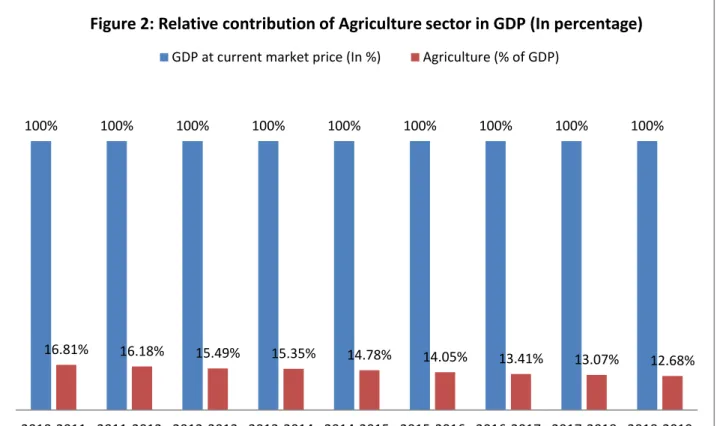
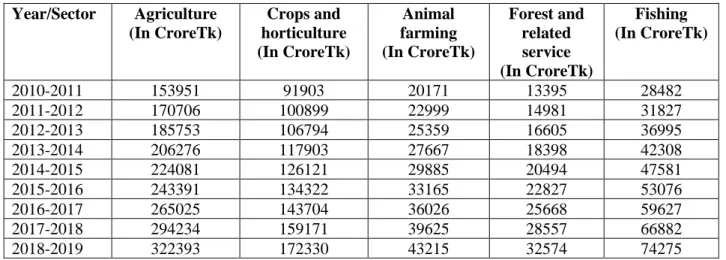
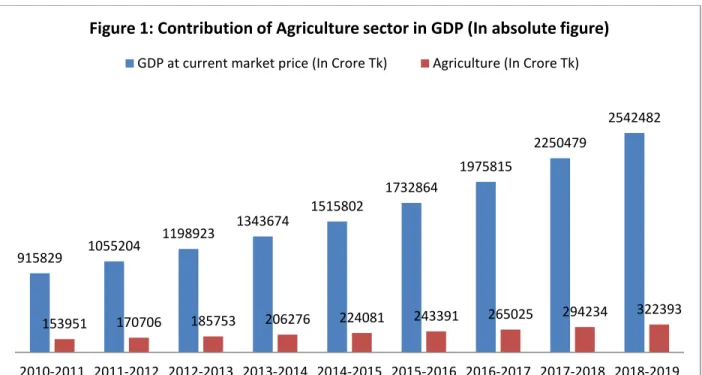
This resulted in the outflow of significant foreign exchange to finance food grain imports. However, the Bangladesh Economic Review presented data on the respective contribution of four subsectors of agriculture, including (1) crops and horticulture, (2) livestock, (3) forestry and allied services, and (4) fisheries. As can be seen from Table 2, agriculture and horticulture contributed the most, followed by fishing and animal husbandry.
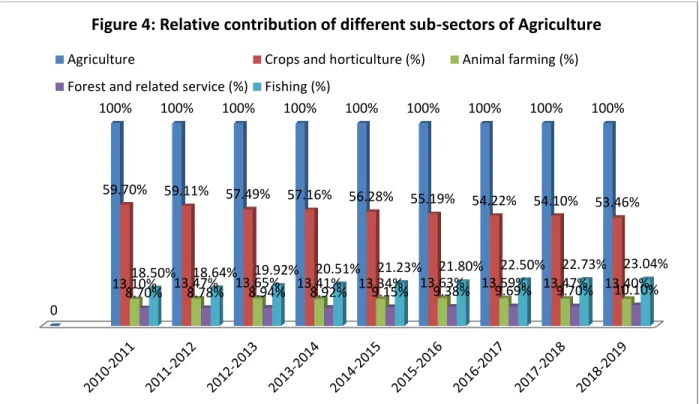
The relative contribution of crops and horticulture in agriculture was around 59.70% in 2010-2011 and the gradual decrease is bringing the number down. Crops and Horticulture (in Crore Tk) Livestock (in Crore Tk) Forestry and Allied Services (in Crore Tk) Fisheries (in Crore Tk). However, two other sub-sectors – fisheries and forestry – appear to have experienced a gradual increase in terms of relative contribution to the agricultural sector.
This pattern of relative contribution of different sub-sectors of agriculture and their trend over the past 9 years is well depicted in Figure 4 below. As can be seen in this figure, there is a gradual decline over time, despite the highest contribution made by crops and horticulture.
Research methodology
Effect of Deadly Covid-19 Pandemic on the Agriculture sector
The use of nuclear technology and bio-technology is also evident in the invention of technology of tolerant and short duration plant varieties (Bangladesh Economic Review, 2018). The report also assesses a slowdown in ongoing horticulture and boro crop harvests and delays in the maize harvest in the short term caused by social distancing measures (The Business Standard, 2020). Farmers, especially those residing in the small-scale category, are highly vulnerable as they are facing obstacles in gaining access to markets to sell their produce and purchase seeds and other essential inputs (The Financial Express, 2020b) .
Since these perishable and fresh foods include various types of vegetables, fish and fruits, which are essential for nutrition and health, any kind of interruption in their supply will further weaken the preventive capacity of people living in the affected areas. Furthermore, agricultural traders of big cities cannot move to local markets to collect agricultural products such as vegetables, eggs, milk and fruits due to the lack of public transport and the fear of being affected by the pandemic (Green Watch, 2020 ). Research findings revealed that the estimated gross loss per day from the agriculture, industry and services sector is Tk 33 billion, of which the agriculture sector is suffering a loss of Tk 2 billion per day (The Financial Express, 2020b).
The report also suggested that although agricultural production was not hampered in the short term, producer prices will fall as the foreign economy is closed. The decline in agricultural marketing and the value chain (supply side) along with the decline in consumer earning power (demand side) appears to be severely damaging the country's agricultural economy.
Findings on the perception of contributors about the effect of Covid-19 Pandemic
- Perceptions of Agro-based Businesses
- Perceptions of Farmers
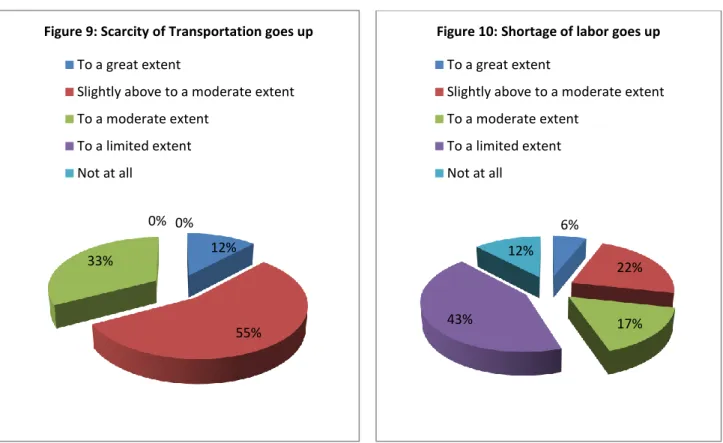
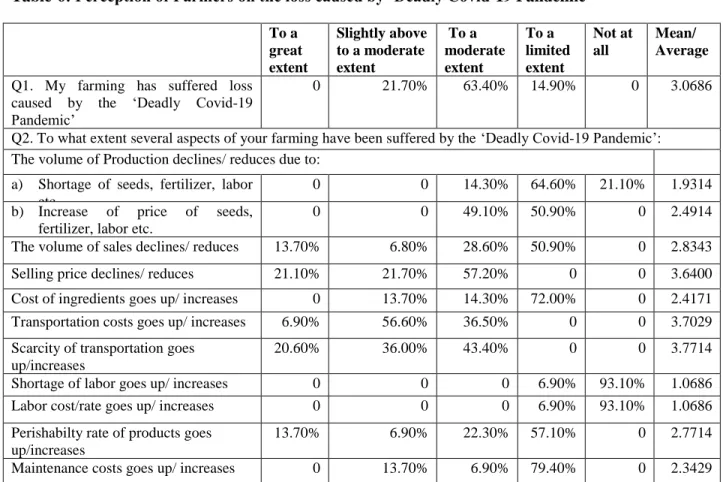
The labor shortage appears to be greater than the rise in labor costs. In the short term, production volumes were not greatly affected by shortages of seeds, fertilizers or rising prices. However, the pandemic has greatly affected the sales volume and selling prices of the crops, as can be seen in the table above.
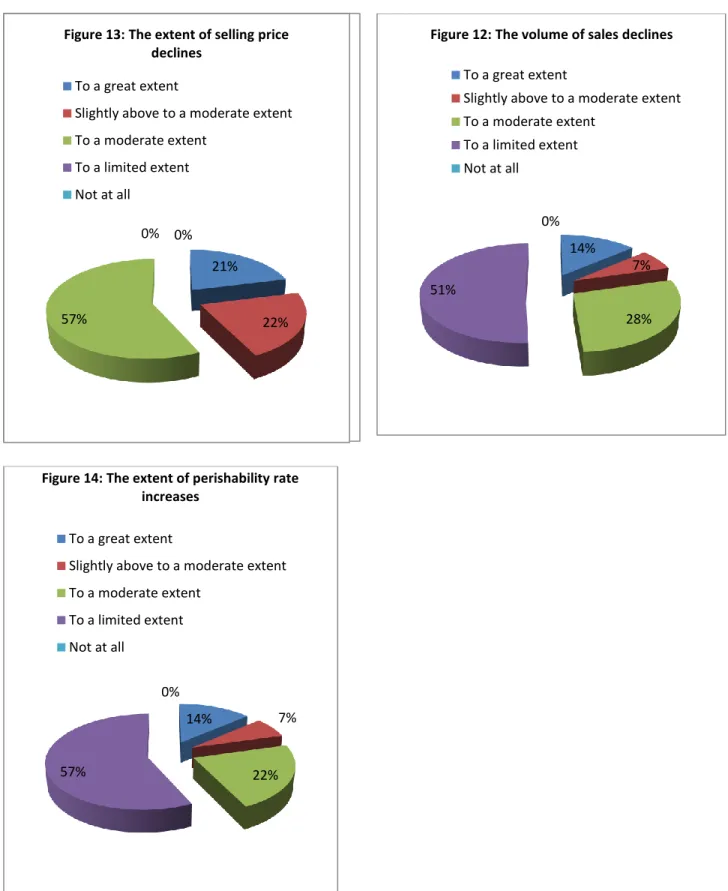
The majority of respondents (57.20%) stated that the decline in sales price was "moderate". 13.70% of respondents recognized the decline in sales volume 'to a large extent', and 28.60% 'to a moderate extent; the majority (50.90%) of respondents perceived it "to a limited extent". Among other things, farmers faced a significant increase in transport costs, lack of transport and the rate of perishability.
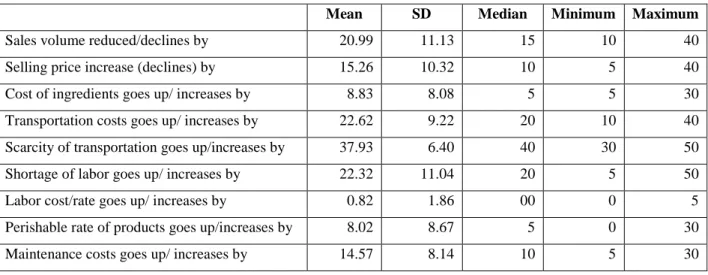
This picture is clearly demonstrated in Figure 11 to Figure 14 which shows the extent of the loss suffered, volume of sales decrease, the extent of selling prices decreased and the perishability rate increased. Table-7: Descriptive statistics of the magnitude of loss suffered (in relation to the amount of income or costs before the appearance of 'Deadly Covid-19 Pandemic').

Recommendations
- Contributors’ recommendations
- Farmers’ recommendations
- Agro-based businesses’ recommendations
- ICMAB’s recommendations
Farmers are also having trouble transporting their produce from their fields to markets due to restrictions on movement as part of the nationwide lockdown. One of the farmers opined that “we are facing chronic problems in operating trucks or vans to move our goods to the markets. In addition, we have to pay high transportation costs due to non-availability of transportation.
One of the farmers suggested that “the prices of various inputs like seeds, fertilizers and pesticides have gone up to an extent which is compounding our misery to continue cultivation at normal level. The low price of agricultural products, increased transport and input costs and high perishability rate have reduced the purchasing power of the majority of the farmers. Since the majority of the farmers are not aware of financial institutional facilities, the government must find ways to reach them with the necessary financial assistance.
One of the agro-based business owners suggested that "farmers are our ultimate buyers. One of the agricultural input dealers opined that "the middleman specifically dishonest hoarders play the key role in raising the price of the produce in the market.
Conclusion
In order to continue the uninterrupted production of agricultural products in the coming seasons, uninterrupted supply of agricultural inputs (such as seeds, fertilizers, pesticides and other ingredients) must be ensured at reasonable prices. Her government has also allocated BDT 100 Crore to the Ministry of Agriculture to mechanize the harvesting of crops and another BDT 150 Crore for the distribution of seeds among the affected farmers to enable them to continue agricultural production (Green watch, 2020). Sub-sector-wise and product-specific research can also provide useful insight to the policy-makers in allocating the funds and to properly address the emerging injuries in this sector.
First, due to the scarcity of time and funds, the study only focused on a limited number of farmers and firms doing business in this sector. Second, the results of different regions may differ significantly due to the existence of different sets of socioeconomic characteristics. Despite these limitations, we believe that the present research will enrich the understanding of policy makers in formulating an appropriate macroeconomic policy to combat the adverse effects on the agricultural sector caused by the deadly Covid-19 pandemic.
CGIAR to help Bangladesh mitigate Covid-19 impact on food system 2020). How Bangladesh's leaders should respond to the economic threats from COVID-19, available at: https://www.weforum.org/agenda/2020/04/covid-19-coronavirus-bangladesh/.
Introduction
Bangladesh economy—pre-COVID-19 scenario
With the above economic indicators in mind, let us now look at the way in which COVID-19 could start to disrupt the gains that the country has accumulated over the years. Facing a fate similar to other countries, Bangladesh is also facing the challenges posed by COVID-19 --- to the health of its population as well as its economy. The country with its limited resources of health facilities is more than overloaded and it is worrying to think about the future.
The purpose of this paper is to dwell on the economic impact of COVID-19 in Bangladesh and how the government plans to deal with it. Now let's look at some of the relevant published statistics on what has happened to the economy over the past few months. Although the situation is still unfolding and the full impact of the pandemic will be known in the coming months, certain fallout is already visible.
Drastic drop in exports of ready-made garments (RMG)9.: According to "Bangladesh Garments Manufacturing and Exporters Association" (BGMEA), foreign orders worth USD 3 billion have already been cancelled. Decline in Tax Revenue Collection: Actual revenue collection during the current financial year (2019-20) will be BDT 395.43 billion10 as compared to the expected/projected amount.
The Agriculture sector
The Industrial sector
The sector has already suffered an order loss of US$3 billion (as mentioned above) and could be looking at a figure of US$6 billion5 in the coming months. Although the supply problem has now been largely resolved; canceling orders from European and American buyers has worsened the situation. The RMG sector currently employs more than 4 million workers, who are already facing uncertainty about the payment of their wages; the prospect of job losses due to the loss of orders from foreign buyers is now staring them in the face.
The way forward
- Some of the major stimuli for the manufacturing and agricultural sectors
- Financial Sector incentives
The government will provide BDT 300 billion as working capital loan to industries affected by the pandemic, both in the manufacturing and service sectors. However, any improvements in the classification resulting from repayments made by a borrower will be properly reflected. The Government has also announced certain measures to improve the banks' liquidity as well as improve the money supply in the economy.
The government needs to work together with the big companies in the sector so that this can be nurtured as an important source of employment and earnings for the country. The COVID-19 pandemic, also known as the Coronavirus pandemic, is an ongoing global pandemic of Coronavirus disease 2019 (COVID-19), caused by Severe Acute Respiratory Syndrome Coronavirus 2 (SARS-CoV-2). The outbreak was first identified in December 2019 in Wuhan, China. Child and maternal mortality has gradually decreased due to proper initiatives by the government.
According to UNCTAD, the downturn would accelerate in the second quarter, causing global trade to decline by 27 percent. According to the Institute for Public Policy Research, migrant workers are particularly likely to work in accommodation and food services, one of the hardest-hit sectors by the COVID crisis. It is estimated that the lockdown has affected the livelihoods of 85% of the country's workforce.
50% of households in the country lost at least a third of their income within the first ten days of the lockdown.