Immunotherapy in the Treatment of Renal Cancer
By
Name: Sumaya Shimu ID: 17146038
A thesis submitted to the Department of Pharmacy in partial fulfillment of the requirements for the degree of Bachelor of Pharmacy (Hons)
Department of Pharmacy Brac University
January 2022
©2022. Brac University All rights reserved.
i
Declaration
It is hereby declared that
1. The thesis submitted is my own original work while completing degree at Brac University.
2. The thesis does not contain material previously published or written by a third party, except where this is appropriately cited through full and accurate referencing.
3. The thesis does not contain material which has been accepted, or submitted, for any other degree or diploma at a university or other institution.
4. I have acknowledged all main sources of help.
Student’s Full Name & Signature:
Sumaya Shimu ID: 17146038
ii
Approval
The thesis titled “Immunotherapy in the Treatment of Renal Cancer” submitted by Sumaya Shimu (ID: 17146038) of Spring 2017 has been accepted as satisfactory in partial fulfillment of the requirement for the degree of Bachelor of Pharmacy.
Examining Committee:
Supervisor: _______________________________
Dr. Md. Abul Kalam Azad
Assistant Professor, Department of Pharmacy Brac University
Academic Coordinator: _______________________________
Namara Mariam Chowdhury Lecturer, Department of Pharmacy
Brac University
Departmental Head: _______________________________
Prof. Dr. Eva Rahman Kabir Department of Pharmacy
Brac University
06.02.2022
iii
Ethics Statement
This study does not involve any human and animal trial.
iv
Abstract:
Renal cancer is fourteenth most common cancer worldwide which is currently increasing in alarming rate. Many people are dying of renal cancer every day. In this situation, finding out an efficient treatment option has become a challenge to the scientists. Immunotherapy has brought a significant impact in terms of treating the renal sarcoma patients by leveraging the immune system and causing tumor regression. Due to having poor prognosis and respond in radiotherapy and chemotherapy, this method of immunotherapy has expanded the opportunity of treatment. Renal cell carcinoma (RCC) is considered to be the most immunogenic tumors in human body. Because of being diffused by the cells of immune system, these cells perform very actively in the field of immunotherapy. Immunotherapy has brought a great success and widened up several opportunities for the patients. There has been developed several ways of immunotherapy treatment along with analyzing the challenges and future aspects for this treatment.
Keywords: immunotherapy; Renal Cell Carcinoma; immune system; success; challenges;
possibilities.
v
Dedication
Dedicated to my parents, grandparents and my project supervisor, Dr. Md. Abul Kalam Azad.
vi
Acknowledgements
First of all, I would like to thank Almighty for his unlimited blessings in attempt to empower me with the strength and willingness to accomplish this project work.
I would like to express my sincere gratitude to my project and academic supervisor, Dr. Md. Abul Kalam Azad (Assistant Professor, Department of Pharmacy, Brac University) for his valuable supervision and enthusiasm throughout this project. He was genuinely a source of advice and support throughout my study and project writing. I am incredibly obliged for his precious feedback and suggestions throughout my research that helped me a lot to complete this project work smoothly.
I would also like to express my humble gratitude to Dr. Eva Rahman Kabir (Professor and Chairperson, Department of Pharmacy, Brac University) for her dedication, contribution and guidance towards the student as well as the department.
Finally, I would like to express my gratitude to my parents who keep inspiring me to go beyond my limits. I would not have come this far without their constant prayers and unconditional love. I would also like to thank all the people who, whenever needed, have helped me with their utmost abilities.
vii
Table of content
Declaration... i
Ethics Statement... iii
Dedication ... v
Acknowledgements ... vi
List of Figures: ... xi
List of Acronyms ... xiii
Chapter 1 ... 14
Introduction ... 14
1.1 Immunotherapy... 14
1.2 History of immunotherapy ... 15
1.3 Cancer and Immunotherapy: ... 16
1.4 Renal cancer and Immunotherapy ... 17
1.5 Positive impact of immunotherapy... 18
1.6 Acceptance of Immunotherapy in renal cancer ... 19
1.7 Objectives of the study... 20
viii
Chapter 2 ... 21
Some conventional treatments for Renal Cancer ... 21
2.1 Surgery ... 21
2.2 Targeted therapy ... 21
2.3 Radiation therapy ... 22
2.4 Chemotherapy ... 22
Chapter 3 ... 23
Pathophysiology and Immunotherapy treatment ... 23
3.1 Pathogenesis of Renal cancer ... 23
3.3 Different possible ways of immunotherapy ... 23
3.3.1 Cytokine based immunotherapy ... 23
3.3.2 Non myeloablative allogenic transplantation immunotherapy... 24
3.3.3 Tumor antigen-specific immune response ... 25
3.3.4 Discovery of immune checkpoint inhibitor... 25
3.3.5 Using Stool bacteria: ... 27
Chapter 4 ... 28
Drug candidates for immunotherapy in RCC ... 28
4.1 PD-1 inhibitors ... 28
ix
4.1.1 Pembrolizumab ... 28
4.1.2 Nivolumab ... 28
4.2 PD-L1 inhibitors... 28
4.2.1 Avelumab ... 28
4.3 CLTA-4 inhibitor ... 29
4.3.1 Ipilimumab ... 29
4.4 Cytokines ... 29
4.4.1 Interlukin-2 (IL-2) ... 29
4.4.2 Interferon-α ... 30
Chapter 5 ... 31
Patients reaction and some challenges ... 31
5.1 Patients reaction ... 31
5.2 Some challenges of Immunotherapy treatment ... 31
5.2.1 Possible side effects for all checkpoints ... 32
5.2.1.1 Side effects for PD-1 inhibitors ... 32
5.2.1.2 Side effects for PD-L1 inhibitors ... 32
5.2.1.3 Side effect for CLTA-4 inhibitor ... 32
5.2.1.4 Some serious side effects for all checkpoints ... 33
5.2.2 Possible side effects for Cytokines ... 33
x
5.2.2.1 Possible side effect for Interlukin-2 (IL-2)... 33
5.2.2.2 Possible side effect for Interferon-α ... 33
Chapter 6 ... 35
Clinical trial of the drug and the success ... 35
6.1 Clinical trial ... 35
6.2 Success rate of immunotherapy ... 36
Chapter 7 ... 38
Conclusion and future aspects ... 38
7.1 Conclusion ... 38
7.2 Future aspects... 38
References:... 40
xi
List of Figures
Figure 1: The cancer-immunity cycle is a self-propagating cycle process (adapted from Chen et al., 2013). ... 15 Figure 2: Important events of the history of cancer immunotherapy (adapted from
Lesterhuis et al., 2011). ... 16 Figure 3: Depicture of cells in the innate and adaptive immune system (altered from Zhang
& Chen, 2018). ... 17 Figure 4: Blockade of immune checkpoints to enhance T cell responses (adapted from Akinleye et al., 2019). ... 26
xii
List of Tables
Table 1: Current ongoing clinical trials involving checkpoint inhibitors in mRCC (adapted from Liu et al., 2017)... 36
xiii
List of Acronyms
RCC Renal Cell Carcinoma
mRCC Metastatic Renal Cell Carcinoma ICI. Immune Checkpoint Inhibitor
CTLA Cytotoxic T-Lymphocyte Associated Protein PD-1 Programmed Cell Death Protein-1
IL-2 Interleukin-2
MHC Major Histocompatibility Complex CR. Complete Response
ORR Objective Response Rate
VEGF Vascular Endothelial Growth Factor VHL Von Hippel Lindau
VMAT Volumetric Modulated Arc Therapy SBRT Stereotactive Body Radiation Therapy IFN Interferon
NK Natural Killer
TIL Tumor Infiltrating Lymphocytes
14
Chapter 1 Introduction
1.1 Immunotherapy
Drugs that target the production or enhancement of anticancer immune responses are known as immunotherapies. The objective of cancer research has always been to activate the immune system in order to destroy cancer cells and create therapeutically meaningful responses. Immune checkpoint inhibitors (ICI) are a type of cancer treatment that was characterized. These antibodies work by enhancing the immune system's ability to destroy cancer cells by targeting specific chemicals on immune cells. Anti-CTLA-4 and anti-PD-1 antibodies are two promising types of antibodies that can be used as monotherapy or in conjunction with other cancer immunotherapies.
Immune checkpoint inhibitors are one of the most promising treatment options for activating antitumor immunity. Multiple inhibitory mechanisms built in the immune system are known as immunological checkpoints. They're important for maintaining self-tolerance and reducing peripheral tissue damage by regulating the length and intensity of physiological immune responses in peripheral tissues. As a primary mechanism of immune resistance, tumors control various immunological checkpoint pathways. Because immunological checkpoints are triggered by ligand- receptor interactions, blocking them with antibodies is a sensible treatment option. (See Figure: 1) Despite their therapeutic effectiveness, targeted treatments are frequently short-lived due to fast resistance development. Immunotherapies have a distinct edge. Multiple inhibitory mechanisms built in the immune system are known as immunological checkpoints. They're important for maintaining self-tolerance and reducing peripheral tissue damage by regulating the length and intensity of physiological immune responses in peripheral tissues. As a primary mechanism of immune resistance, tumors control various immunological checkpoint pathways. Because immunological checkpoints are triggered by ligand-receptor interactions, blocking them with antibodies is a sensible treatment option. Despite their therapeutic effectiveness, targeted treatments are frequently short-lived due to fast resistance development (Lee et al., 2016).
15 Figure 1: The cancer-immunity cycle is a self-propagating cycle process (adapted from Chen et al., 2013).
1.2 History of immunotherapy
The idea of cancer immunotherapy took place in the late 1800s, when William B. Coley reported tumor reduction and even disappearance after injecting bacterial products into and around tumors.
Many observations since then have incited research into strategies that aim to induce specific anti- tumor responses, such as the rare but well-documented occurrence of spontaneous remissions, the higher incidence of cancer in immunosuppressed patients, and the identification of tumor-specific antigens and lymphocytes (See Figure: 2). Allogeneic bone marrow transplantation and monoclonal antibodies that target tumor cells are two widely utilized and effective immunotherapies recently accessible (Hoption et al., 2003).
16
Important basic immunological discoveries and key clinical trials are shown. BCG, bacille Calmette–Guérin; IFNα, interferon-α;
IL-2, interleukin-2; MHC, major histocompatibilty complex; TNF, tumour necrosis factor; VIN, vulvar intraepithelial neoplasia.
Figure 2: Important events of the history of cancer immunotherapy (adapted from Lesterhuis et al., 2011).
1.3 Cancer and Immunotherapy:
Over the last few years, cancer immunotherapy has emerged as an appealing method among many treatment alternatives, demonstrating its efficacy against malignancies. It works by inducing an anti-tumor reaction in the body's immune system, allowing cancer to be vanquished. The area of cancer immunotherapy has lately exploded in popularity. Numerous preclinical and clinical research has looked at the link between the immune system and cancer (Zugazagoitia et al., 2016).
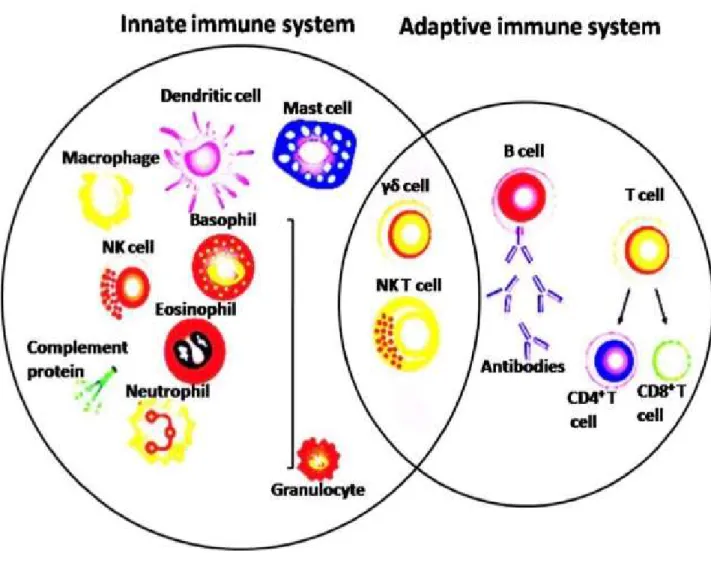
The immune system's primary function is to defend humans against invading infections and diseases. Immune responses are divided into two categories: humoral immunity and cellular immunity, both of which are mediated by B and T cells and their products (Bielinska et al., 2014).
Humoral immunity uses antibodies produced by B cells to neutralize and eradicate external microbes and toxins, whereas cellular immunity responds more quickly to eliminate intracellular microbes by identifying antigens, activating antigen presenting cells (APCs), and activating and proliferating T cells (Tsiantoulas et al., 2014). The anticancer immune response involves both the innate and adaptive immune systems (Dranoff, 2004).
Innate immune cells have the ability to produce signals that are required to activate T and B cell responses (Corrales et al., 2015). B cells, CD8+ cytotoxic T cells, and CD4+ helper T cells are the most important components of the adaptive immune system (Binder, 2014). By detecting foreign
17 antigens and delivering them to naive T cells, APCs serve as a link between the innate and adaptive immune systems. (See Figure: 3)
Furthermore, when toll-like receptors on dendritic cells (DCs) are activated, components on the DC surface that are important for antigen presentation may be enhanced, and cytokines that aid the adaptive immune response may be encouraged. It is now commonly acknowledged that the interaction of the innate and adaptive immune systems can lead to full cancer remission (Zhang &
Chen, 2018).
Figure 3: Depicture of cells in the innate and adaptive immune system (altered from Zhang &
Chen, 2018).
1.4 Renal cancer and Immunotherapy
Renal cell carcinoma is the third urological cancer representing 3% of all cancers in women and 5% in men with an incidence of around 400,000 cases worldwide (Deleuze et al., 2020a). The prognosis is poor since 30% of patients are metastatic at diagnosis and almost 30% of the remaining patients will develop metastases detected during the follow-up (Deleuze et al., 2020a).
Moreover, renal cell carcinoma (RCC) of the clear cell type accounts for approximately 3% of the
18 adult malignancies and 90–95% of the neoplasms arising from the kidney (Gouttefangeas et al., 2007). Renal cancers do have high mortality rate and react poorly to conventional radiation or chemotherapy. Immunotherapy provides an intriguing option to such well-established treatments, and cytokine-based therapies which have now been utilized for several decades with positive clinical outcomes in a limited fraction of patients. Immunotherapeutic studies attacking antigens which are related to renal cell tumor have also been described over recent times, using a variety of active and passive techniques including either antibodies or focused at activating tumor-directed T cells. Furthermore, tumor immunogenicity is linked to a higher number of mutations in the tumor as well as the existence of an immune cell infiltration. RCC has a substantial and complicated immune cell infiltration, despite the fact that it has a low mutational load (Considine & Hurwitz, 2019). To target tumor cells, the immune system must recognize the tumor as foreign substance.
When tumor cells die, they are enveloped by antigen-presenting cells (mainly dendritic cells), which use their MHC (Major Histocompatibility Complex) complexes to present tumor neoantigens. Neoantigens require a second signal to activate T lymphocytes to target malignancies (“Cancer Immunotherapy,” 2008).
1.5 Positive impact of immunotherapy
Cancer immunotherapy drugs, which encourage the immune system to identify and target tumors, have opened up new avenues for cancer treatment (Weiner, 2015). The discovery of a variety of innovative and successful immunotherapies over the last several decades has expanded oncologists' arsenal of cancer-fighting weapons. Many cytokine-based therapies and mAbs have already established the benchmark for treating a variety of cancers. The connection between cancer and the immune system has rapidly advanced in recent decades. Many cancer immunotherapies have shown to be effective, resulting in their fast adoption in clinical practice.
Many cancer immunotherapies are promising because they target abnormal cells while avoiding the harm caused by chemotherapy and radiotherapy, which adds to patient morbidity and death.
Only a few cases of predicted clinical success were previously linked with cancer immunotherapies, such as the use of high-dose interleukin (IL)-2 to produce a complete response (CR) in advanced melanoma and renal cell carcinoma (RCC). However, since then, additional progress has been achieved, and cancer immunotherapy is now generally acknowledged as
19 successful. Even in individuals with solid tumors or severe malignancies, positive responses to cancer immunotherapy are more common—sometimes even full or long-lasting responses or cures. Cancer immunotherapy is now most effective in the treatment of patients with melanoma, RCC, or hematological malignancies. However, recent evidence indicates that immunotherapy may have a broader efficacy in treating a variety of different cancers (Lee Ventola, 2017).
1.6 Acceptance of Immunotherapy in renal cancer
There was a time when there was little data to support any paradigm for renal cancer treatment.
However, the growing area of medical oncology selected a cytotoxic approach to cancer therapy over an immune-centered strategy at the turn of the century. Nearly 120 years of data have proved that (i) even the finest cytotoxic regimens only cure late-stage malignancy in a few percentages of cases, and (ii) techniques that supplement and augment existing antitumor immune responses give the highest chances for potentiating long-term cancer remission. Despite today's universal acceptance of these concepts, the immune system's ability to diagnose and defeat cancer was a widely discussed topic for most of the twentieth century (Decker et al., 2017). Treatment options have evolved since the beginning of renal cancer immunotherapy in the nineteenth century to include monoclonal antibodies, immune checkpoint inhibitors, genetically engineered cancer fighting immune cells, cancer vaccines, and combination therapies that incorporates multiple chemotherapies with one of the above approaches to treat cancer (Lombard et al., 2007). With the introduction of new therapeutic options, there is an increasing demand for improved animal and translational models. These include extremely complex mouse cancer models, spontaneous cancer models like the canine model, and translational models like the PDX models that contain transplanted human renal cancers (Cho et al., 2016). Their combined usage will advance the understanding of cancer biology and antitumor immunology, allow for a faster assessment of innovative methods' effectiveness and safety, and eventually result in a faster bench to bedside transfer (Decker et al., 2017).
20
1.7 Objectives of the study
To study the status and ways of treating renal cancer with the help of immunotherapy.
To analyze the development along with the challenges and future aspects of immunotherapy in Renal Cell Carcinoma (RCC)
21
Chapter 2
Some conventional treatments for Renal Cancer 2.1 Surgery
For individuals with non-metastatic, localized RCC, surgery is the most effective therapeutic option, and patients with low-stage, low-grade tumors have a good long-term prognosis (Kaplan et al., 2002). Advances in partial nephrectomy make this surgical method appealing for individuals with low-risk RCC, and less-invasive approaches employing laparoscopy are now established as viable therapeutic alternatives due to technological advancements. An experimental technique that might be adopted for the elderly or patients with considerable complication is active surveillance of minor renal masses with delayed treatment for individuals whose illness worsens. Tumor tissues removal can be difficult for patients with larger tumors, regional lymph node involvement, or IVC tumor thrombus, and in many cases, surgical treatment alone is not enough to prevent disease renewal or development (Keane et al., 2007).
2.2 Targeted therapy
Renal cell cancer (RCC) is becoming more common across the world, and there have been few treatment options available lately. The molecular and clinical parameters that predict the prognosis of this disease have greatly improved during the previous decade (Dorff et al., 2009) .
Targeted therapy connects Anti-angiogenesis treatment that provides antibodies (e.g., bevacizumab) and tyrosine kinase inhibitors (TKI) such as axitinib, sunitinib, and sorafenib to block the vascular endothelial growth factor (VEGF). The mTOR inhibitors everolimus and temsirolimus are also targeted therapeutics (Terrén et al., 2020). Non- specific immunotherapy was a conventional therapeutic choice for patients with metastatic renal cell carcinoma for a long period, but it was surpassed by specifically targeted molecular treatments, such as VEGF and mTOR inhibitors (Escudier et al., 2012). While research in non-specific immunotherapies faded, the Von-Hippel–Lindau (VHL) gene and associated molecular targets and processes laid the groundwork for the age of "targeted" therapy (Kruck et al., 2012). Several tyrosine kinase (TK) inhibitors targeting the VEGF receptor and mammalian target of rapamycin (mTOR) inhibitors have been gradually brought into clinical practice for the treatment of mRCC patients since 2005 (Escudier et al., 2012). Because of the low long-term efficacy of
22 TK or mTOR inhibitors, new treatment strategies are needed to increase patients' cancer-specific survival (CSS) (Bedke et al., 2014).
2.3 Radiation therapy
RCC is a radiosensitive condition with a wide range of radio-sensitivity, but it is not a radioresistant disorder. There is a number of studies suggesting that higher dose per fraction treatments, such as volumetric modulated arc therapy (VMAT) or SBRT (Stereotactic body radiation therapy), delivered utilizing innovative high-precision RT technology, can overcome RCC's apparent radio resistance (Tselis & Chatzikonstantinou, 2019). Since RCC is radio resistant and many doctors think that substantial biologic dosages are required for significant alleviation, so it may not always be practical or acceptable (Pinho et al., 2002) .
2.4 Chemotherapy
Since earlier period, carcinoma is acknowledged like a dangerous human disease. From scientific viewpoint, cancer therapeutic research just recently begun. Chemotherapy, that includes injecting a drug into the bloodstream that attacks cancer cells, is amongst the most frequent and essential kinds of treatments. Regrettably, this substance also damages healthy cells, resulting in typical adverse reactions including baldness. Chemotherapy requires a lot of study in order to build the drug in such a way that has the best effect on cancer while having the fewest harmful consequence (Pinho et al., 2002). Recent findings reveal a previously anticipated but favorable impact of combining immunotherapy with both new and more traditional cancer treatment methods such as chemotherapy, revealing a whole new and exciting line of clinical study (Rosenberg S, 2004).
23
Chapter 3
Pathophysiology and Immunotherapy treatment 3.1 Pathogenesis of Renal cancer
RCC can be genetic or random, just as breast, prostate, and colon cancers. Over the last two decades, extensive clinical and laboratory research on RCC has resulted in a greater understanding of the tumor biology and genetic background. The examination of the hereditary types of the disease has yielded significant advances in our understanding of the genetic underpinnings and underlying biology of RCC (Blanco et al., 2011). RCC has a wide range of histologic subtypes and molecular profiles, but no medicines targeting molecular abnormalities in subgroups apart from clear cell carcinoma have yet been recognized. There is stimulation of two molecular pathways, which are the Von Hippel-Lindau (VHL) and the mammalian target of rapamycin (mTOR) pathways that causes clear cell RCC to have significant amount of angiogenesis (Hudes et al., 2011). Inactivating mutations in the VHL gene are seen in the majority of individuals with clear cell RCC. Hypoxia inducible factor which is alpha (HIF) is targeted for ubiquitin-mediated proteasomal degradation by the VHL protein complex (Powell et al., 2012). However, HIFα dimerizes with its companion HIFβ that activates a vast number of genes, including VEGF production (Haase, 2009). As a result of inactivation of mutations in VHL, improving HIF activity and angiogenesis occurs. mTOR promotes angiogenesis via boosting HIF levels, which is distinct of the VHL pathway and may be mediated by other mechanisms. PTEN (phosphatase and TENsin homolog) which is a negative regulator of mTOR, has been discovered to have impairment in mutations in 5% of RCC patients. Following the discovery of these angiogenesis mediators, VEGF and mTOR inhibitors were indicated for the management of metastatic renal cell carcinoma (Kondo et al., 2001).
3.3 Different possible ways of immunotherapy 3.3.1 Cytokine based immunotherapy
After surgery, cytokine-based treatments are considered the first-line therapy for mRCC (Gouttefangeas et al., 2007). The immunomodulatory agents, interferon alpha (IFNα), interferon gamma (IFNγ), and interleukin-2 (IL-2) were used to examine the involvement of the immune
24 system in RCC. Activated T cells release interferons, which aid cell-mediated cytotoxicity and anti-proliferative actions on tumor cells. In a phase III trial, participants were randomly assigned to receive subcutaneous weekly IFNγ (60 g/m2) or placebo (Considine & Hurwitz, 2019). IL-2 and IFN-α, both recombinant proteins, are commonly utilized cytokines. Because of toxicities have been documented initially following intravenous infusion of IL-2, subcutaneous administration is currently the preferred approach. IFN-α is given as a subcutaneous injection. With IL-2 alone, a success rate of around 15% (partial or total responses) has been achieved, which is better than IFN- α. Tumor stability can be seen in 15–30% of patients when both treatments are used together (Quesada et al., 1985). Many clinical studies examining dosage, manner, as well as timing of application has been performed, and they have been thoroughly evaluated. Furthermore, the stated efficiency scores for these therapies are often short-term, tumor remission is exceptional, and the percentage of patients will eventually advance (Wagstaff et al., 1987). In a phase III trial, participants were randomly assigned to receive subcutaneous weekly IFNγ (60 g/m2) or placebo. The effects of cytokines in a living organism are most likely due to the non-specific activation of T lymphocytes (CD4+ and CD8+) and potentially natural killer (NK) cells, but new evidence suggesting IL-2 affects the homeostasis and function of CD4+ CD25+ regulatory T cells is perplexing (Scheffold et al., 2005). IFN-α has anti-angiogenic characteristics and operates on a variety of immune effectors. The mechanisms behind cytokine therapy's beneficial benefits have yet to be thoroughly studied (Marschall et al., 2003). However, Cytokines are now being investigated in conjunction with several other chemotherapeutical drugs to increase therapeutic efficacy (Donskov et al., 2002).
3.3.2 Non myeloablative allogenic transplantation immunotherapy
Non-myeloablative conditioning treatments were used before implantation using stem cells generated from HLA-identical sibling donors to reduce transplant-related problems (NST). Several hematologic cancers have been successfully treated with allogenic stem cell transplants. The treatment's therapeutic impact is linked to graft-versus-host illness, while the anti-tumor, or graft- versus-tumor, action is assumed to be transmitted by donating T lymphocyte effectors recognizing secondary histo-compatibity antigens (Ichard et al., 2000). There has been conducted multiple phase I and II clinical testing assessing the efficacy of allogenic transplantation on nephrectomies
25 patients due to the immune-stimulatory features of RCC (Gouttefangeas et al., 2007). The approach of using increased immunosuppression instead of myeloablative cytotoxic conditioning has allowed allogeneic stem cells from associated and distant donors to engraft with decreased early transplant-associated mortality (TRM) and morbidity (Feinstein et al., 2001).
3.3.3 Tumor antigen-specific immune response
Antigens related with tumors that are identified by immune system cellular or humoral effectors might be used to develop antigen-specific cancer immunotherapy (Jäger et al., 2001). T cells, natural killer (NK) cells, and NK T cells play a major role in tumor elimination, according to in mammalian research (Belardelli et al., 2002). This reaction, on the other hand, is essentially immunological reactivity against malignancies in patients. Kidney cancers are well recognized for being often invaded by immune system cells. CD3+ T cells, mostly of the CD8+ instead of CD4+
fraction, and NK cells, which can account for up to 15% of the lymphocyte population, account for the bulk of these (Angevin et al., 1997). These tumor infiltrating lymphocytes (TIL) have stimulation indicators including CD69 and HLA-class II, as well as the ability to carry operational NK inhibitory receptors. Certain TCR-Vbeta areas have shown oligoclonal expansions, implying in-situ screening of an anti-tumor T-cell range. On a functional level, newly extracted CD8+ TIL had a lower cytotoxic capacity, but following in vitro growth, the T cells exhibit a variety of regulatory activities, including cytokine release and endogenous tumor cell eradication (Jantzer P, 1998). The increasing percentage of tumor antigens discovered, as well as experience with peptide vaccination in carcinoma, has laid the foundation for the formation of more successful immuno- therapeutic techniques in renal cancer patients (Jäger et al., 2001).
3.3.4 Discovery of immune checkpoint inhibitor
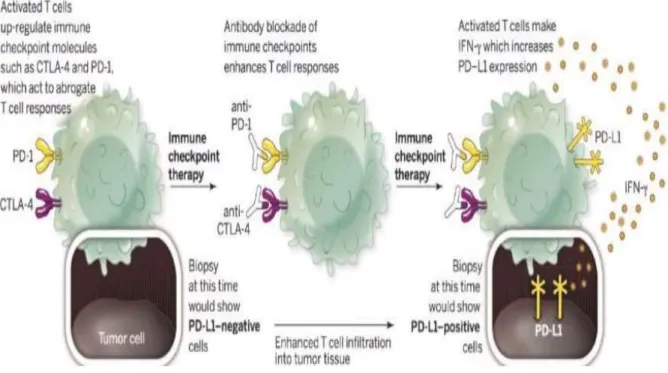
The particular activation of regulatory aspects of the adaptive immune response is a novel field of research in cancer immunotherapy (Linsley & Bradshaw, 1996). T cells identify antigens linked with the leading histocompatibility complex as the initial indications, but other indications via co- receptors are necessary for optimum T-cell identification and development of a powerful and long- term T-cell immune response, according to research published in the previous decade (Saby George, 2011). Antibodies which inhibit programmed cell death 1 receptor (PD-1) and
26 programmed cell death receptor ligand 1 (PD-L1) for a subgroup of people with cancer have attracted researchers' attention since the identification of immune checkpoint proteins. T cell- mediated immune responses are adversely regulated by PD-1 signaling, which allows malignancies to avoid an antigen-specific T cell immune response (Akinleye & Rasool, 2019). (See Figure: 4)
Figure 4: Blockade of immune checkpoints to enhance T cell responses (adapted from Akinleye et al., 2019).
It plays a role in promoting cancer development and progression by enhancing tumor cell survival.
With this background, PD-1 signaling represents a valuable therapeutic target for novel and effective cancer immunotherapy. Clinical data shows that blockade of this PD-1 signaling significantly enhance antitumor immunity, produce durable clinical responses, and prolong survival (Carter et al., 2002). The discovery that RCC is linked to a spontaneous mutation rate, and hence perhaps high antigen production, has led to the testing of these medications at various phases of the illness (Santoni et al., 2018). Agonist co-receptors like CD28, 4-1BB, and OX40, as well as inhibitory coreceptors like CTLA-4 and programmed death-1, are involved in these extra signals for successful T-cell priming (PD-1). Antibodies to various immuno-regulatory components (both receptors and ligands) have already been produced, and several are now being tested in clinical trials with encouraging results, particularly in immunogenic malignant tumors like Renal cell carcinoma (George, 2011).
27
3.3.5 Using Stool bacteria:
Preclinical models and preliminary clinical evidence point to a link between the gut microbiome and immunotherapy response in solid tumors, which include metastatic renal cell carcinoma (mRCC). It has been characterized that the stool microbiome of mRCC patients taking a checkpoint inhibitor (CPI) and evaluated treatment-related modifications in microbiome composition over time (Salgia et al., 2020).
28
Chapter 4
Drug candidates for immunotherapy in RCC 4.1 PD-1 inhibitors
4.1.1 Pembrolizumab
Pembrolizumab (Keytruda®, Merck, Whitehouse Station, NJ) is an extremely potent humanistic IgG4 antibody which targets the PD-1 receptor and has been licensed by the US Food and Drug Administration (USFDA) for the treatment of patients with metastatic carcinoma. It's being looked into for usage in mRCC right now. In patients with advanced cancer with RCC, preliminary safety findings from a recent phase I/II research including pembrolizumab plus ipilimumab or pegylated interferon alfa-2b (PEG-IFN) were currently revealed. Pembrolizumab is also being tested in conjunction with a variety of medicines that have distinct mechanisms of action (Liu et al., 2017).
It is mostly a protein found on T cells which prevents them from destroying neighboring tissues in the area. These medicines increase the response of immune system against kidney cancer cells by inhibiting PD-1. Some cancers may shrink or develop more slowly as a result of this treatment (cancer.org, 2021).
4.1.2 Nivolumab
Nivolumab (Opdivo®, Bristol-Myers Squibb, Princeton, NJ) is a monoclonal antibody that inhibits the immunological checkpoint PD-1. Nivolumab is being investigated as a pre- and post-operative therapy in malignant RCC, as well as in combination with other medications. It has been widely tested in different malignancies and has acquired FDA clearance for the management of mRCC. It has quite the same activity as Pembrolizumab (Younes et al., 2016).
4.2 PD-L1 inhibitors 4.2.1 Avelumab
Avelumab (MSB0010718C) is a humanized anti-PD-L1 IgG1 monoclonal antibody which inhibits PD-1/PD-L1 interactions yet keeping the PD-1/PD-L2 system unaffected. Keeping a natural fragment crystallizable region, it may also produce antibody-dependent cell-mediated cytotoxicity (ADCC). Avelumab was utilized in patients with resistant tumor cells in a phase Ib trial and
29 demonstrated equivalent toxicity patterns to other PD-1 or PD-L1 inhibitors. Avelumab in conjunction with Axitinib is now being evaluated in ongoing two studies (Liu et al., 2017).
Avelumab (Bavencio) is a drug that targets PD-L1, a protein that is similar to PD-1 and is located on tumor cells and immune cells. The PD-L1 protein can be blocked to improve the immune reaction to cancer cells. Certain cancers may reduce or develop more slowly as a result of this treatment. For those with progressive renal cancer, Avelumab can be combined with the targeted medication axitinib as a first-line therapy. This is administered as an Intravenous injection per two weeks (Cancer.org, 2021).
4.3 CLTA-4 inhibitor 4.3.1 Ipilimumab
Ipilimumab (Yervoy®, Bristol-Myers Squibb, Princeton, NJ) is recognized as anti-CTLA-4 IgG1 monoclonal antibody which has been authorized by the US Food and Drug Administration for the treatment of melanoma. It has been studied in hematologic malignancies as a single drug and in combination with nivolumab, with the combination proving to be more successful but with much higher toxicity. In mRCC, the combination of nivolumab and ipilimumab is recently being studied (Larkin et al., 2015).
4.4 Cytokines
4.4.1 Interlukin-2 (IL-2)
Interleukin 2 (IL-2) is the only systemic medication for people with metastatic renal cell carcinoma that is currently accessible (RCC). Because it is difficult to deliver and causes toxicity not seen in clinical oncologists' practice, high-dose IL-2 has been underutilized in the treatment of patients with metastatic RCC. For individuals with extensive RCC, IL-2 should be the primary line of therapy. Sorafenib and sunitinib are useful adjuncts in the treatment of these individuals, but they should be used only as a last resort (Rosenberg S, 2007).
30
4.4.2 Interferon-α
Both of the chemotherapy and radiation therapy are ineffective against renal cell cancer. Clinical trials have looked at the effectiveness of immunotherapy using IFN- alone or in combination with other medicines. Depending on the clinical trial, the medicines were given alone or in different combinations with varying timings. In a limited fraction of patients having RCC, IFN-
as well as IL-2 treatment has resulted in long-term prognosis (Kirkwood, 2002).
31
Chapter 5
Patients reaction and some challenges 5.1 Patients reaction
According to the report of 214 studies, it has been validated that in patients with first-line metastatic renal cancer with moderate and low prognosis the nivolumab and ipilimumab combination over Sunitinib is quite advantageous. The objective response rate (ORR) was counted 42% vs. 27%, and the complete response rate (CRR) was observed 11% vs. 1%. In terms of PFS, no changes were seen. After 30 months of follow-up, a latest statement revealed a significant rise in OS in favor of the Nivolumab (anti-PD-1) + Ipilimumab (anti-CTLA4) combinations. Currently the revisions have also emphasized the advantages of using ICI and TKI together. At a 12-month follow-up, the anti-PD-1 which is pembrolizumab with Axitinib demonstrated an advantage in terms of OS (Deleuze et al., 2020a). For a subgroup of 10–20 percent of patients with metastatic RCC, adjuvant cytokine treatments with IL-2 or IFN- have showed relative effectiveness (Gouttefangeas et al., 2007).
5.2 Some challenges of Immunotherapy treatment
The effectiveness of immunotherapy has prompted new scientific judgment, such as when immunotherapy should be used in early stages of disease, how to optimize dose, timeframe, and length of treatment, which biomarkers to be used for patient selection, and how to propose new surrogate endpoints which represent the effect of immunotherapy on prognosis initially in treatment (Emens et al., 2017). There can be some questions arisen whether the drugs of the treatment are first-line therapy or up-front. In that case, the clinical trials can make the answers.
Moreover, determining an appropriate dose also determines the overall survival (OS) of the renal cancer patients, so it can be counted as the matter to look into (Deleuze et al., 2020). Besides, absence of adequate TAA or combinations can be another challenge as the proper clinical benefits cannot be determined sufficiently (Gouttefangeas et al., 2007).
32
5.2.1 Possible side effects for all checkpoints 5.2.1.1 Side effects for PD-1 inhibitors
Side effects of PD-1 inhibitors can be-
Fatigue
Cough
Nausea
Itching
Skin rash
Loss of appetite
Constipation
Joint pain (Cancer.org, 2021).
5.2.1.2 Side effects for PD-L1 inhibitors
The most common side effects include-
In terms of the combination Avelumab with Axitinib:
Fatigue
Diarrhea
High blood pressure
Skin rash
Blistering
Cough
Shortness of breath
Abdominal pain
Diarrhea (Cancer.org, 2021).
5.2.1.3 Side effect for CLTA-4 inhibitor
The most common side effects from ipilimumab include-
Fatigue
33
Diarrhea
Skin rash
Itching (Cancer.org, 2021).
5.2.1.4 Some serious side effects for all checkpoints
Serious adverse effects are less common, but they can happen. These medications function by releasing the brakes on the immunological system of the body. The immune system can sometimes target other organs or areas of the body, causing major issues in the lungs, intestines, liver, hormone-producing glands (such as the thyroid), kidneys, and other organs. These adverse effects might be life-threatening in certain persons. It's vital to notify the health care provider immediately away, if any new adverse effects during or after treatment are observed. If any major adverse effects are experienced, the medications need to be stopped taking and strong doses of corticosteroids should be taken to suppress the immune system (Cancer.org, 2021)
5.2.2 Possible side effects for Cytokines
5.2.2.1 Possible side effect for Interlukin-2 (IL-2)
Most common side effects shown by high-dose IL-2 are severe. It occurs very rarely. However, it can be fatal in the cases (Cancer.org, 2021)
5.2.2.2 Possible side effect for Interferon-α
Most common side effects for Interferon- include-
Severe fatigue
Fluid in the lungs
Breathing problem
Kidney dysfunction
Heart issues
Intestinal issues
Diarrhea
High temperature
34
Fast heartbeat
Psychological issues (Cancer.org, 2021)
Figure 5: Adverse events associated with Ipilimumab, Pembrolizumab, Nivolumab or Ipilimumab plus Nivolumab (adapted from Emens et al., 2017).
35
Chapter 6
Clinical trial of the drug and the success 6.1 Clinical trial
From several different trials the treatments for different stages patients has been introduced. Such as, Surgery is the only therapeutic option for RCC patients with a renal mass and an inferior vena cava (IVC) thrombus (Keane et al., 2007). On the other hand, a patient with metastatic RCC immunotherapy should be provided. Adverse effects of ipilimumab related to immunity were tended to be associated with response to response. However, they were not required for any response. Ipilimumab was evaluated in pretreated individuals with metastatic melanoma in a major and random placebo-controlled study, and it was the first therapy in 30 years to demonstrate a prognostic value in RCC. After two and three years, patients in the ipilimumab treated group had a general survival rate of about 20%, comparing about 10% in the reference vaccination group (Hodi et al., 2010). In immunotherapy combining Axitinib is a very common molecule to combine with the drugs dedicated to immunotherapy in Renal Cell Carcinoma. Alternative compounds, such as Axitinib (AG013736), are being researched. Axitinib is a newly designed small inhibitor of the tyrosine kinase component of the VEGF and platelet-derived growth factor receptors.
Axitinib showed efficacy in cytokine-refractory, metastatic RCC in a phase 2 study, with a number of respondents of 46%. The treatment was quite well accepted, with a low level of toxicity.
Hypertension (12%), severe hypertension (6%), dysentery (6%), exhaustion (6%), rash (4%), and joint pain (4%), were all class iii/iv adverse events; 6% of patients terminated therapy as a consequence of the adverse consequence. A phase 2 trial is continuing to investigate the safety and effectiveness with Axitinib in individuals with malignant or resistant RCC who repeatedly disappointed with Sorafenib based treatment (Keane et al., 2007). (See Table: 1)
36 Table 1: Current ongoing clinical trials involving checkpoint inhibitors in Metastatic Renal Cell Carcinoma (mRCC) (adapted from Liu et al., 2017).
6.2 Success rate of immunotherapy
Following recent advancements which resulted in the authorization of medications and therapies for cancer, the clinical development of immunotherapy has acquired a new major direction.
Several additional medications under clinical trials are showing significant potentials. It can be single agents. To some extent, it can be combination with any other treatments (Lesterhuis et al., 2011). As the introduction of therapeutic chemotherapy for treatment of advanced germ cell tumors and choriocarcinomas over 30 years ago, there has been minimal advancement in the field of curable therapies for patients with metastatic solid tumors. Recently, the advancement of
37 immunotherapy, that can treat individuals with cancer, is such notable alternative. T cell transplant studies have increased treatment efficacy for cancer recently, and genetic modification of Immune cells to produce anticancer receptors is expanding this technique to the cure of different epithelial tumors as well. (Raising the Bar: The Curative Potential of Human Cancer Immunotherapy.
Interleukin-2 immunotherapy has the ability to treat 5 to 10% of individuals with renal cell carcinoma. Current adoptive cell transfer (ACT) immunotherapies have increased the treatment efficacy to 20 to 40% (Rosenberg, 2012).
38
Chapter 7
Conclusion and future aspects 7.1 Conclusion
Despite different initiatives, such as the use of antibodies or tumor-derived chemicals to activate T cells, immunotherapy development is indeed slow. Tumor-Associated Antigens (TAA) TA found yet in RCC are frequently not tumor cell specific or only produced in a limited percentage of tumors. As a result, additional CD8+-specific TAA-derived epitopes, as well as CD4+-specific TAA-derived epitopes, is needed not only for immunotherapy but also surveillance (Phan et al., 2003). The discovery of target antigens for T cells, as well as for Ab-based studies, should be studied more into this respect. Nevertheless, depending on the previous cancer record, this is doubtful that tumor antigen-specific immunotherapy will then be capable improve therapeutic significance for treated patients. Alternatively, combination treatments, such as Ab treatments with radiotherapy, are now being developed, as they have been for other different cancers. Different adjuvants for the activation of immune system are available as well (Gouttefangeas et al., 2007).
7.2 Future aspects
Considering the success of ICI (Immune Checkpoint Inhibitor) and anti-VEGF (vascular endothelial growth factor) combination therapy, several concerns must be addressed. First and foremost, the large number of TRAE (treatment-related adverse events) is a cause for worry. for balancing the benefits and risks, predictive biomarkers must be identified as soon as possible.
Second, in the first-line scenario, it's unclear whether we should treat mRCC patients with ICI and anti-VEGF (vascular endothelial growth factor) therapies together or in sequence. Third, some individuals develop intrinsic or developed resistance to ICI following therapy. More research is needed to improve the effectiveness of existing immunotherapy drugs. Adjuvant cytokines, on the other hand, were investigated to see whether they may help control the problem, but no further benefit was seen. Nonetheless, considering the effectiveness of modern immunotherapy drugs, clinical trials for assessing the relevance of ICIs in terms of adjuvant context are now underway (Messing et al., 2003). In the future one of these three groups will cover the most effective combined therapies. One can be PD1/PDL1 inhibition in combination with other checkpoint inhibitors, T cell agonists, or microenvironment changing drugs. The second one can be
39 PD1/PDL1 inhibition in combination with (tailored) vaccination strategies, and the third one can be PD1/PDL1 inhibition in combination with adoptive T cell treatment (Hammers et al., 2016).
40
References:
Akinleye, A., & Rasool, Z. (2019, September 5). Immune checkpoint inhibitors of PD-L1 as cancer therapeutics. Journal of Hematology and Oncology, Vol. 12. BioMed Central Ltd.
https://doi.org/10.1186/s13045-019-0779-5
Angevin, E., Kremer, F., Gaudin, C., Hercend, T., & Triebel, F. (1997). Analysis of T-Cell Immune Response in Renal Cell Carcinoma: Pplarization to Type 1-Like Differentiation Pattern, Clonal T-Cell Expansion and Tumor-Specific Cytotoxicity. In J. Cancer (Vol. 72).
Wiley-Liss, Inc.
Bedke, J., Gouttefangeas, C., Singh-Jasuja, H., Stevanović, S., Behnes, C. L., & Stenzl, A.
(2014, February). Targeted therapy in renal cell carcinoma: Moving from molecular agents to specific immunotherapy. World Journal of Urology, Vol. 32, pp. 31–38.
https://doi.org/10.1007/s00345-013-1033-3
Belardelli, F., Ferrantini, M., Proietti, E., & Kirkwood, J. M. (2002). Interferon-alpha in tumor immunity and immunotherapy. In Cytokine & Growth Factor Reviews (Vol. 13).
Bielinska, A. U., Makidon, P. E., Janczak, K. W., Blanco, L. P., Swanson, B., Smith, D. M., … Baker, J. R. (2014). Distinct Pathways of Humoral and Cellular Immunity Induced with the Mucosal Administration of a Nanoemulsion Adjuvant. The Journal of Immunology, 192(6), 2722–2733. https://doi.org/10.4049/jimmunol.1301424
Binder, R. J. (2014). Functions of Heat Shock Proteins in Pathways of the Innate and Adaptive Immune System. The Journal of Immunology, 193(12), 5765–5771.
https://doi.org/10.4049/jimmunol.1401417
Blanco, A. I., Teh, B. S., & Amato, R. J. (2011, December). Role of radiation therapy in the management of renal cell cancer. Cancers, Vol. 3, pp. 4010–4023.
https://doi.org/10.3390/cancers3044010
Cancer Immunotherapy. (2008). New England Journal of MedicineSteven A. Rosenberg, M.D., Ph.D. Mark E. Dudley, Ph.D. Nicholas P. Restifo, M.D, 359(10), 1072–1073.
https://doi.org/10.1056/NEJMc081511
Cancer.org. (2021). Kidney Cancer Treatment. Retrieved from https://www.cancer.org/cancer/kidney-cancer/treating.html
Carter, L. L., Fouser, L. A., Jussif, J., Fitz, L., Deng, B., Wood, C. R., … Carreno, B. M. (2002).
PD-1:PD-L inhibitory pathway affects both CD4 + and CD8 + T cells and is overcome by IL-2.
Chen, D. S., & Mellman, I. (2013, July 25). Oncology meets immunology: The cancer-immunity cycle. Immunity, Vol. 39, pp. 1–10. https://doi.org/10.1016/j.immuni.2013.07.012
Cho, S. Y., Kang, W., Han, J. Y., Min, S., Kang, J., Lee, A., … Park, H. (2016, January 1). An integrative approach to precision cancer medicine using patient-derived xenografts.
41 Molecules and Cells, Vol. 39, pp. 77–86. Korean Society for Molecular and Cellular
Biology. https://doi.org/10.14348/molcells.2016.2350
Considine, B., & Hurwitz, M. E. (2019, April 1). Current Status and Future Directions of Immunotherapy in Renal Cell Carcinoma. Current Oncology Reports, Vol. 21. Current Medicine Group LLC 1. https://doi.org/10.1007/s11912-019-0779-1
Corrales, L., & Gajewski, T. F. (2015). Molecular pathways: Targeting the Stimulator of Interferon Genes (STING) in the immunotherapy of cancer. Clinical Cancer Research, 21(21), 4774–4779. https://doi.org/10.1158/1078-0432.CCR-15-1362
Decker, W. K., da Silva, R. F., Sanabria, M. H., Angelo, L. S., Guimarães, F., Burt, B. M., … Paust, S. (2017, August 2). Cancer immunotherapy: Historical perspective of a clinical revolution and emerging preclinical animal models. Frontiers in Immunology, Vol. 8.
Frontiers Media S.A. https://doi.org/10.3389/fimmu.2017.00829
Deleuze, A., Saout, J., Dugay, F., Peyronnet, B., Mathieu, R., Verhoest, G., … Kammerer- Jacquet, S. F. (2020a, April 1). Immunotherapy in renal cell carcinoma: The future is now.
International Journal of Molecular Sciences, Vol. 21. MDPI AG.
https://doi.org/10.3390/ijms21072532
Deleuze, A., Saout, J., Dugay, F., Peyronnet, B., Mathieu, R., Verhoest, G., … Kammerer- Jacquet, S. F. (2020b, April 1). Immunotherapy in renal cell carcinoma: The future is now.
International Journal of Molecular Sciences, Vol. 21. MDPI AG.
https://doi.org/10.3390/ijms21072532
Donskov, F., Bennedsgaard, K. M., von der Maase, H., Marcussen, N., Fisker, R., Jensen, J. J.,
… Hokland, M. (2002). Intratumoural and peripheral blood lymphocyte subsets in patients with metastatic renal cell carcinoma undergoing interleukin-2 based immunotherapy:
Association to objective response and survival. British Journal of Cancer, 87(2), 194–201.
https://doi.org/10.1038/sj.bjc.6600437
Dorff, T. B., Goldkorn, A., & Quinn, D. I. (2009). Review: Targeted therapy in renal cancer.
Therapeutic Advances in Medical Oncology, Vol. 1, pp. 183–205.
https://doi.org/10.1177/1758834009349119
Dranoff, G. (2004). Cytokines in cancer pathogenesis and cancer therapy. Nature Reviews Cancer, Vol. 4, pp. 11–22. https://doi.org/10.1038/nrc1252
Emens, L. A., Ascierto, P. A., Darcy, P. K., Demaria, S., Eggermont, A. M. M., Redmond, W.
L., … Marincola, F. M. (2017, August 1). Cancer immunotherapy: Opportunities and challenges in the rapidly evolving clinical landscape. European Journal of Cancer, Vol. 81, pp. 116–129. Elsevier Ltd. https://doi.org/10.1016/j.ejca.2017.01.035
Escudier, B., Eisen, T., Porta, C., Patard, J. J., Khoo, V., Algaba, F., … Kataja, V. (2012). Renal cell carcinoma: ESMO clinical practice guidelines for diagnosis, treatment and follow-up.
Annals of Oncology, 23(SUPPL. 7). https://doi.org/10.1093/annonc/mds227
42 Feinstein, L., Sandmaier, B., Maloney, D., Mcsweeney, P. A., Maris, M., Flowers, C., … Storb,
R. (2001). Nonmyeloablative Hematopoietic Cell Transplantation Replacing High-Dose Cytotoxic Therapy by the Graft-versus-Tumor Effect.
Gouttefangeas, C., Stenzl, A., Stevanović, S., & Rammensee, H. G. (2007a). Immunotherapy of renal cell carcinoma. Cancer Immunology, Immunotherapy, 56(1), 117–128.
https://doi.org/10.1007/s00262-006-0172-4
Gouttefangeas, C., Stenzl, A., Stevanović, S., & Rammensee, H. G. (2007b). Immunotherapy of renal cell carcinoma. Cancer Immunology, Immunotherapy, 56(1), 117–128.
https://doi.org/10.1007/s00262-006-0172-4
Haase, V. H. (2009). The VHL Tumor Suppressor: Master Regulator of HIF.
Hammers, H., Frenkel, E. P., & Scholar, M. D. (2016). Immunotherapy in Kidney Cancer: The Past, Present and Future.
Hodi, F. S., O’Day, S. J., McDermott, D. F., Weber, R. W., Sosman, J. A., Haanen, J. B., … Urba, W. J. (2010). Improved Survival with Ipilimumab in Patients with Metastatic Melanoma. New England Journal of Medicine, 363(8), 711–723.
https://doi.org/10.1056/nejmoa1003466
Hoption Cann, S. A., van Netten, J. P., & van Netten, C. (2003). Dr William Coley and tumour regression: A place in history or in the future. Postgraduate Medical Journal, 79(938), 672–
680.
Hudes, G. R., Carducci, M. A., Choueiri, T. K., Esper, P., Jonasch, E., Kumar, R., … Srinivas, S.
(2011). NCCN Task Force Report: Optimizing Treatment of Advanced Renal Cell Carcinoma With Molecular Targeted Therapy.
Ichard, R., Hilds, C., Llen, A., Hernoff, C., Athalie, N., Ontentin, C., … Arrett, B. (2000). The New England Journal of Medicine Regression of Metastatic Renal-Cell carcinoma after Nonmyeloablative Allogenic Peripheral-Blood Stem-Cell Transplantation Abstract Background Since allogeneic stem-cell transplanta (Vol. 14).
Jäger, D., Jäger, E., & Knuth, A. (2001). Immune responses to tumour antigens: implications for antigen specific immunotherapy of cancer. In J Clin Pathol (Vol. 54). Retrieved from www.jclinpath.com
Jantzer P, S. D. (1998). Human Renal Cell Carcinoma Antigen-specific CTLs: Antigen-driven Selection and Long-Term Persistence in Vivo. Retrieved from
https://cancerres.aacrjournals.org/content/canres/58/14/3078.full.pdf
Kaplan, S., Ekici, S., & Demircin, M. (2002). Surgical management of renal cell carcinoma with inferior vena cava tumor thrombus. https://doi.org/10.1016/s0002-9610(02)00782-1
Keane, T., Gillatt, D., Evans, C. P., & Tubaro, A. (2007, March). Current and Future Trends in the Treatment of Renal Cancer. European Urology, Supplements, Vol. 6, pp. 374–384.
https://doi.org/10.1016/j.eursup.2006.12.006
43 Kirkwood, J. (2002). Cancer immunotherapy: The interferon-α experience. Seminars in
Oncology, 29(3 SUPPL. 7), 18–26. https://doi.org/10.1053/sonc.2002.33078
Kondo, K.-I., Yao, M., Kobayashi, K., Ota, S., Yoshida, M., Kaneko, S., … Hosaka, M. (2001).
PTEN/MMAC1/TEP1 Mutations in Human Primary Renal-Cell Carcinomas and Renal Carcinomas Cell Lines. Retrieved from https://pubmed.ncbi.nlm.nih.gov/11146448/
Kruck, S., Bedke, J., Kuczyk, M. A., & Merseburger, A. S. (2012, June). Second-line systemic therapy for the treatment of metastatic renal cell cancer. Expert Review of Anticancer Therapy, Vol. 12, pp. 777–785. https://doi.org/10.1586/era.12.43
Larkin, J., Chiarion-Sileni, V., Gonzalez, R., Grob, J. J., Cowey, C. L., Lao, C. D., … Wolchok, J. D. (2015). Combined Nivolumab and Ipilimumab or Monotherapy in Untreated
Melanoma. New England Journal of Medicine, 373(1), 23–34.
https://doi.org/10.1056/nejmoa1504030
Lee, L., Gupta, M., & Sahasranaman, S. (2016, February 1). Immune Checkpoint inhibitors: An introduction to the next-generation cancer immunotherapy. Journal of Clinical
Pharmacology, Vol. 56, pp. 157–169. Blackwell Publishing Inc.
https://doi.org/10.1002/jcph.591
Lee Ventola, C. (2017). Cancer Immunotherapy, Part 2: Efficacy, Safety, and Other Clinical Considerations (Vol. 42).
Lesterhuis, W. J., Haanen, J. B. A. G., & Punt, C. J. A. (2011a). Cancer immunotherapy-
revisited. Nature Reviews Drug Discovery, 10(8), 591–600. https://doi.org/10.1038/nrd3500 Lesterhuis, W. J., Haanen, J. B. A. G., & Punt, C. J. A. (2011b, August). Cancer immunotherapy-
revisited. Nature Reviews Drug Discovery, Vol. 10, pp. 591–600.
https://doi.org/10.1038/nrd3500
Linsley, P. S., & Bradshaw, J. (1996). Intracellular Trafficking of CTLA-4 and Focal Localization Towards Sites of TCR Engagement. In Immunity (Vol. 4).
Liu, K. G., Gupta, S., & Goel, S. (2017). Immunotherapy: incorporation in the evolving paradigm of renal cancer management and future prospects. In Oncotarget (Vol. 8).
Retrieved from www.impactjournals.com/oncotarget/
Lombard, M., Pastoret, P. P., & Moulin, A. M. (2007). A brief history of vaccines and vaccination. OIE Revue Scientifique et Technique, 26(1), 29–48.
https://doi.org/10.20506/rst.26.1.1724
Messing, E. M., Manola, J., Wilding, G., Propert, K., Fleischmann, J., Crawford, E. D., … Trump, D. (2003). Phase III study of interferon alfa-NL as adjuvant treatment for resectable renal cell carcinoma: An Eastern Cooperative Oncology Group/Intergroup Trial. Journal of Clinical Oncology, 21(7), 1214–1222. https://doi.org/10.1200/JCO.2003.02.005
Phan, G. Q., Yang, J. C., Sherry, R. M., Hwu, P., Topalian, S. L., Schwartzentruber, D. J., … Rosenberg, S. A. (2003). Cancer regression and autoimmunity induced by cytotoxic T
44 lymphocyte-associated antigen 4 blockade in patients with metastatic melanoma. Retrieved from www.pnas.orgcgidoi10.1073pnas.1533209100
Pinho, S. T. R., Freedman+, H. I., & Nani, F. (2002). A Chemotherapy Model for the Treatment of Cancer with Metastasis. In COMPUTER MODELLING PERGAMON Mathematical and Computer Modelling (Vol. 36). Retrieved from www.elsevier.com/locate/mcm
Powell, J. D., Pollizzi, K. N., Heikamp, E. B., & Horton, M. R. (2012, April). Regulation of immune responses by mTOR. Annual Review of Immunology, Vol. 30, pp. 39–68.
https://doi.org/10.1146/annurev-immunol-020711-075024
Quesada, J. R., Rios, A., Swanson, D., Trown, P., & Gutterman, J. U. (1985). Antitumor Activity of Recombinant-Derived Interferon Alpha in Metastatic Renal Cell Carcinoma. Retrieved from https://ascopubs.org/doi/pdf/10.1200/JCO.1985.3.11.1522
Rosenberg, S. A. (2012). Raising the Bar: The Curative Potential of Human Cancer Immunotherapy. Retrieved from 2012 Mar 28;4(127): 127ps8.doi:
10.1126/scitranslmed.3003634.
Saby George, Md. R. P. Md. M. A. C. Md. and J. J. K. Md. B. N. Y. and B. M. (2011). Role of Immunotherapy in RCC. https://doi.org/https://doi.org/10.6004/jnccn.2011.0085
Salgia, N. J., Bergerot, P. G., Maia, M. C., Dizman, N., Hsu, J. A., Gillece, J. D., … Pal, S. K.
(2020). Stool Microbiome Profiling of Patients with Metastatic Renal Cell Carcinoma Receiving Anti–PD-1 Immune Checkpoint Inhibitors. European Urology, 78(4), 498–502.
https://doi.org/10.1016/j.eururo.2020.07.011
Santoni, M., Massari, F., di Nunno, V., Conti, A., Cimadamore, A., Scarpelli, M., … Lopez- Beltran, A. (2018). Immunotherapy in renal cell carcinoma: latest evidence and clinical implications. Drugs in Context, Vol. 7. Bioexcel Publishing LTD.
https://doi.org/10.7573/dic.212528
Scheffold, A., Hühn, J., & Höfer, T. (2005, May). Regulation of CD4+CD25+ regulatory T cell activity: It takes (IL-)two to tango. European Journal of Immunology, Vol. 35, pp. 1336–
1341. https://doi.org/10.1002/eji.200425887
Steven A Rosenberg. (2007). Interleukin 2 for patients with renal cancer. 4. Retrieved from https://www.ncbi.nlm.nih.gov/pmc/articles/PMC2147080/
Steven A Rosenberg, J. C. Y. & N. P. R. (2004). Cancer immunotherapy: moving beyond current vaccines. Cancer Immunotherapy: Moving beyond Current Vaccines, 4(127).
https://doi.org/10.1126/scitranslmed.3003634
Terrén, I., Orrantia, A., Mikelez-Alonso, I., Vitallé, J., Zenarruzabeitia, O., & Borrego, F. (2020, February 1). NK cell-based immunotherapy in renal cell carcinoma. Cancers, Vol. 12.
MDPI AG. https://doi.org/10.3390/cancers12020316
45 Tselis, N., & Chatzikonstantinou, G. (2019, May 1). Treating the Chameleon: Radiotherapy in
the management of Renal Cell Cancer. Clinical and Translational Radiation Oncology, Vol.
16, pp. 7–14. Elsevier Ireland Ltd. https://doi.org/10.1016/j.ctro.2019.01.007
Tsiantoulas, D., Diehl, C. J., Witztum, J. L., & Binder, C. J. (2014, May 23). B cells and humoral immunity in atherosclerosis. Circulation Research, Vol. 114, pp. 1743–1756. Lippincott Williams and Wilkins. https://doi.org/10.1161/CIRCRESAHA.113.301145
von Marschall, Z., Scholz, A., Cramer, T., Schäfer, G., Schirner, M., Öberg, K., … Rosewicz, S.
(2003). Effects of Interferon Alpha on Vascular Endothelial Growth Factor Gene Transcription and Tumor Angiogenesis. Retrieved from
https://academic.oup.com/jnci/article/95/6/437/2520654
Wagstaff, J., Smith, D., Nelmes, P., Loynds, P., & Crowther, D. (1987). aflcer mmunology mmunotherapy A phase I study of recombinant interferon gamma administered by s.c.
injection three times per week in patients with solid tumours. In Cancer Immunol Immunother (Vol. 25).
Weiner, L. M. (2015). Cancer Immunology for the Clinician. In Clinical Advances in Hematology & Oncology (Vol. 13).
Younes, A., Santoro, A., Shipp, M., Zinzani, P. L., Timmerman, J. M., Ansell, S., … Engert, A.
(2016). Nivolumab for classical Hodgkin’s lymphoma after failure of both autologous stem- cell transplantation and brentuximab vedotin: a multicentre, multicohort, single-arm phase 2 trial. The Lancet Oncology, 17(9), 1283–1294. https://doi.org/10.1016/S1470-
2045(16)30167-X
Zhang, H., & Chen, J. (2018). Current status and future directions of cancer immunotherapy.
Journal of Cancer, Vol. 9, pp. 1773–1781. Ivyspring International Publisher.
https://doi.org/10.7150/jca.24577
Zugazagoitia, J., Guedes, C., Ponce, S., Ferrer, I., Molina-Pinelo, S., & Paz-Ares, L. (2016, July 1). Current Challenges in Cancer Treatment. Clinical Therapeutics, Vol. 38, pp. 1551–1566.
Excerpta Medica Inc. https://doi.org/10.1016/j.clinthera.2016.03.026