Thesis On
The Impact of Work from Home on Work Life-Balance from Bangladeshi Working Women’s Perspective .
By:
Tajrina Khan 16204084
A thesis submitted to the BRAC Business School in partial fulfillment of the requirements for the degree of
Bachelor of Business Administration
BRAC Business School BRAC University
January 2021
© 2023. BRAC University
All rights reserved.
2 STATEMENT BY THE AUTHOR
This thesis has been acquiesced in hopes of the fulfillment of requirements for the Bachelor in Business Studies degree at BRAC University and is deposited in the Ayesha Abed Library to be made available to borrowers, as are copies of regular theses and studies.
Brief quotations from this manuscript are allowable without special permission, provided that accurate acknowledgment of the source is made. Requests for permission for any prolonged quotation from or imitation of this manuscript in a whole or in part may be granted by BRAC Business School (BBS) when the proposed use of the material is in the interests of scholarship. In all other instances, however, permission must be obtained from the author.
Tajrina Khan (The author’s name/ signature) _27.01.2022 (date)
APPROVAL BY RESEARCH COMMITTEE
As members of the Research Committee, we recommend that this thesis be accepted as
fulfilling the research requirement for the degree of Bachelor in Business Studies at BRAC Business School.
Supervisor :
________________________________ (type name/ signature) _____________ (date)
3
Acknowledgment:
I have acquired numerous debts of gratitude and gratefulness over the 3 months while preparing this thesis. I would like to extend my heartiest gratitude to all those who have given time and effort to share their thoughts, opinions, and suggestions in preparing the research and have contributed directly or indirectly to the completion of my thesis. The accomplishment of this research work is the consequence of the involvement and support of those people.
First of all, I would like to thank Almighty Allah for giving me the opportunity to obtain six months long internship at Kuehne + Nagel Limited, Bangladesh. With the help of Almighty Allah finally, I have successfully finished my thesis work on Impact of Work from Home on Work Life-Balance from Bangladeshi Working Women’s Perspective.
Secondly, I would like to pay my profound respect and immense gratitude to my academic supervisor Ms.
Nusrat Hafiz Ma’am, Lecturer of BRAC Business School (BBS) for her generous and gracious guidance.
I am grateful to her for helping me to understand even the miniature issues as well as for her endless support, patience, and understanding during the whole preparation and completion of the thesis work. I would also like to give thanks to Ms Tania Akter Ma’am for co-supervising the completion of this research paper.
Thirdly, I would like to pay my hearty gratitude to all my supervisors and colleagues at Kuehne+Nagel Bangladesh for making my journey as an intern there such a memorable and profound one. I cannot think of a better organization or management to kick-start my career with. Working in a leading multinational company that embraces a top-notch work environment and a wonderful bunch of people has truly been one of the substantial blessings of my life. Also, the struggles of my female colleagues inspired me to work on this research in the first place.
At last but not the least, I would like to thank my parents without whom I am nothing. Their infinite faith in me is the sole purpose of my existence and everything I do. By the grace of their blessings, I have been able to exist, study and work. I dedicate my work to my parents, Md. Humayun Khan and Meherun Nisa, whom I nearly lost in the aggressive outbreak of Covid-19. Their presence, words of encouragement, and support have enabled me to accomplish anything and everything I have achieved in my life so far.
4
Table of Contents
Serial No Content Page Number
1 Abstract 5
2 Introduction 6-8
3 Literature Review 8-11
4 Methodology of Study 11
5 Results and Analysis 12-26
6 Discussion 27
7 Conclusion 29
8 Recommendations 29
9
References
30-335
Abstract:
When the pandemic hit in March 2020, it changed our way of life and the process of office work in each and every trade. Organizations had to enforce a new way of attending work, which would require everyone to stay at home for safety but at the same time be present and available to work; also as known as remote working or work from home. Although the concept of remote working or teleworking is not relatively new, the emergent Covid-19 situation made this process of working compulsory for most employees in most organizations, which was never the case before the pandemic. This new way of work has undoubtedly made noticeable changes in our way of life. The resolution of this study was to
determine if the work from home setup of work is beneficial for working women in a developing country like Bangladesh, to find out the connection between work from home and work-life balance. Therefore, the intentions of this study were to observe the effects of working from home, work-life balance, and work stress on job satisfaction, and specifically from the point of view of working women in the context of Bangladesh.
Working women already face multiple challenges in their day-to-day life, be it in their work-life or personal life. The pandemic has been hostile to working women, especially working mothers because it has put more pressure in their livelihood. The pandemic has made socio-economic and psychological adversities rather high on women far more than men for obvious reasons, and the working women of developing countries such as Bangladesh have it harder than others because of the certain lifestyle we practice here.
Therefore, implementing some simple but effective policies can help in establishing good WLB in working women’s life. as women are getting the chance of staying close to their family members at their respective homes, the work from home policy is well accepted among them. However, the work stress needs to be paid attention to, seeing as women also have another shift of work at home which includes doing all the major household tasks. Doing further research and finding out the problems and solutions regarding this issues will help in increasing work life balance in working women’s life and will ultimately result in better employee productivity altogether.
6 INTRODUCTION:
With the economy's rapid growth, women have greater opportunities to gain better levels of knowledge, education, and employment. Women are making inroads into practically every business and sector. This circumstance has been a significant difficulty for working women in terms of fulfilling their increased roles and duties towards their homes, children, parents, husbands, family, societal environment, and workplace.
She is occasionally required to care for an extended family member, and as a result, she is under a great deal of stress in order to ensure consistency between her profession and her family life. To achieve a balance between work and family lives, working women are obliged to cope with a variety of activities and extended obligations at the same time. They must also deal with tremendous pressure and impact on their health as a result of the increased workload. (Work-Life-Balance of Working Women on Higher Education Sector, 2021) From here onwards, work-life balance and work from home will be mentioned as WLB and WFH respectively.
The emergence of the pandemic has made us face and adapt to not one but many brand-new challenges.
The concept of “working from home” is one of the most important and notable ones. As cases of Covid-19 went higher, countries were required to go into lockdown. Though at first offices and institutions remained closed for some time due to the sudden outbreak of coronavirus, it was clear as day that this situation cannot be going on like that for long. The worldwide practice of WFH vastly emerged from here on. People had no choice but to resort to remote work and soon enough, the pros and cons of WFH came to light. Long working hours took a toll on employees both mentally and physically, as the concept of WFH dictates that the employee is always online and always available to work and since 2020 it has been turned into a “new normal” notion. These cons of WFH imply to employees regardless of gender. However, following the introduction of COVID-19, women's lives are becoming more difficult, significantly in relation of achieving a suitable work -life balance (Zhang et al. 2020).
Moreover, after the initial surge of fruitfulness, WFH is hampering productivity and creating emotional and bodily damage, as everyone has to be managing everything else at once while being available to work online. There is little to no dedicated time for family, social life, or even for one’s own self. This is a burning issue for especially working women as they have a “second shift”
of work at home already. As they have the responsibility of taking care of the children and elderly, cooking, and maintaining the household in addition to work. Many people were obliged to remain at home and restructure their life as a result of COVID-19, as their homes were transformed into a business,
7 schools, playgrounds, family refuge, and entertainment centres. Women will centre to take on more responsibilities as a result of this (Anderson & Kelliher, 2020).
In a recent study, Cigna donated to the 360° Health Survey, it was discovered that Covid-19 had a greater impact on women's mental health and stress levels than it does on men, with 85 per cent of women experiencing stress during this period, contrasted to 79 per cent of men. (2020, Cotterill) While stress has shown that both short and long-term detrimental effects on people's health and well-being, the most severe effects for women include fatigue, lack of sleep and attention, depression, and becoming openly susceptible.
In general, women have suffered more than men in terms of overall well-being indicators, ranging from cultural and psychosocial well-being to financial and change management process well-being. (Cotterill, 2020) The significance of this study is that it will be of immense benefit to the management of organizations in identifying challenges working women face in the WFH setting and planning and implementing solutions to overcome those challenges in favor of both the female employees and the organization.
The purpose of this study is to figure out whether WFH is truly beneficial for the working women’s WLB or not and the finding of this study focuses on contributing to establishing good WLB in working women’s lives.
OPERATIONAL DEFINITION:
WLB: Work-Life balance indicates the balance of a person’s ability to dedicate effort and demand to their career and personal life simultaneously.
WFH: Work from home refers to a situation in which an employee works from home rather than at a workplace.
New Normal: Social customs/behavior/ rules that were not considered regular before but due to some situation now it has become typical and acceptable. In the case of the Covid-19 pandemic phenomena, some examples of the new normal are: wearing a mask when you go out, working from home, etc.
Work-related stress: The hostile type of feeling people may face due to a disproportionately excessive amount of pressure or demand from their workplace, which in turn creates various mental and physical issues in an employee with time classifies as work-related stress.
Employee performance: How well/poorly an employee performs his/her job-related duties in the organization.
8
SAMPLE SELECTION:
Employed women who work for international firms and local private organizations were included in the selection criteria. But as they're less experienced with the WFH setting, women working in the public sector institutions were excluded from further analysis.
Literature Review:
Covid-19 and the worldwide emergence of WFH:
The impact of the coronavirus (COVID-19) outbreak that impacted people all over the world in early 2020 generated an economically and socially crisis, which will likely transform the way the world works, as well as how industries operate. Coronavirus (COVID-19), which struck in early 2020, modified people's lives and employment, as well as businesses and institutions all over the world. Numerous companies have started to execute a modern demonstration of working to viably adjust to these changes, such as working from home or a work-from-home approach. (Irawanto et al., 2021)
This global pandemic has brought a slew of new terminology and alterations into our daily lives. While only a handful are fully acknowledged, we feel obligated to do so for others. One of these shifts is the concept of WFH. Working from home (WFH) looked like a pipe dream to many people, and they dismissed it as impractical. Working from home necessitates a calm and dedicated environment in which to fulfill professional obligations, which may be a real struggle for those who live in cramped quarters. Despite the fact that WFH is the most appealing option for reducing the risk of Covid-19 contaminations (Joarder et al., 2021).
9 Fig-1: A Conceptual model of hypotheses
Working from home can be hypothesized as below:
1. WFH has a negative effect on WLB.
2. WFH has a negative effect on work-related stress.
3. WLB does have a positive impact on employee productivity.
4. Professional performance is negatively impacted by work-related pressure.
Work from home:
Working from home was already proposed in the 1970s as flexitime or telecommuting, a new way of doing work from multiple locations (office, home, or elsewhere) with the use of technology (van Meel, 2011). It fully abolished employment trips (Nilles, 1997).
Working from home is a two-edged weapon that has a mixed influence on employees' create income, well- being, and happiness (Kim, Henly, Lambert, & Golden, 2020). Working from home might increase employee job satisfaction (Contreras, Baykal, & Abid, 2020).
Work-life balance:
The concept of work-life balance, as per Tomazevic, Kozjek, and Stare (2014), is to properly blend a professional career with personal commitments and facilitate understanding in between two components.
WLB
Work-related stress
Employee Performance WFH
Independent variable
Mediator Dependent
variable
10 Workloads, work schedules, organizational climate, compensation and rewards system, work overload and leave rules are all part of the WLB (Uddin, 2021).
Disruption in WLB in women worldwide regarding WFH:
COVID-19 might well have drastically transformed the way people work by changing views towards work from home (WFH). Half of individuals who were employed prior to the epidemic are now working remotely, according to a recent MIT study. It's tempting to believe that having more flexible employment options will help women achieve greater equality (Ibarra et al., 2020). That, however, is not always the case. According to economic, social, familial, and sexual standards, working women confront a variety of problems when it comes to balancing work and family life. Ever since the advent of COVID-19, these difficulties are becoming increasingly complex (Uddin, 2021). Furthermore, according to an International Labor Organization (ILO) report, women spend four hours and 25 minutes per day on average on domestic and care work, compared to one hour and 23 minutes for men (Pozzan and Cattaneo 2020).
Working women have numerous obstacles in balancing work and family responsibilities as a result of the unequal allocation of work among men and women. Their career is also hampered by their unbalanced work and family lives, which originate from unequal domestic family role distribution. Women are also responsible for a variety of other responsibilities, which increases the likelihood of role conflict. Due to the obvious longer-lasting and broadly accepted traditional notions of males as "bread-winners" and women as
"home-makers," there is a perception in Bangladesh that work-family obligations are primarily dictated by customary gender norms. As a result of the socio-cultural system, women are less capable of negotiating than men (Uddin, 2021).
Professional women have lost the support of their domestic servants since the lockdo wn began, and remaining at home with the family and spouses has added to their burden. Working women are expected to handle work and family obligations at the same time during the shutdown. Since women are more likely to work and also handle household and care tasks throughout this unusual
"stay at home" period, companies are expecting effectiveness from their employees. (2020, Dhaka Tribune)
In general, women are suffering more than males in every way, scoring lower than that of men in every aspect of well-being, from cultural and psychosocial wellbeing to economic and professional health. ("Op-Ed: Covid-19 has a negative impact on women's mental health," 2021 )
11
The scenery of WLB in working women in Bangladesh regarding WFH
:Working-class women in traditional societies such as Bangladesh have faced the same challenges as women in the workplace in other contexts, making coordinating their work and home obligations more challenging because they have to respond to their expanded family roles. Working mothers, according to a new study in the United Kingdom, are 40 per cent more stressed than the ordinary individual (Chandola et al, 2019) Other studies have found similar results during the outbreaks of other pandemics including such SARS, swine flu, and avian flu (Lewis 2020). Despite the fact that the National congress of Bangladesh's Government guarantees equality with men and women, the reality is far from ideal. Females experience severe discrimination at home and at work, including abuse, rape, and reliance on men, and women are much more fragile and physically weak than men (Uddin et al. 2020a, 2020b).
Women in Bangladesh have played a significant role in our economy and have made significant contributions. Despite this, working women face a variety of challenges in both their personal and professional lives. Women struggle to strike a balance between job and life, which has a negative impact on their social lives. While attempting to strike a work-life balance, women face pressure from both their employers and their families. Women find it particularly difficult to strike a work-life balance because they must fulfill multiple roles in society. (Tasnim and colleagues, 2017)
The COVID-19 epidemic has exposed how troublesome and demanding the work-life interaction is for Bangladeshi women, as Chloe Cooney (2020) points out. There's always been a sense of urgency to complete care activities as well as other familial and domestic duties that need time outside of paid employment hours. Women's general health is likely to worsen as a result of such demands to fulfill both job and family obligations, which are already stressful, illogical, and demanding.
12
Methodology of the Study
The study's goal is to look at the impact of working remotely on work-life balance from the viewpoint of a Bangladeshi professional woman. The research took a qualitative approach, relying on survey methods and field base analysis. The purpose of information acquisition exercises was to learn more about how working from home is affecting working women's work-life balance in Bangladesh's various organizations. The research was carried out at Dhaka's reputable organizations. A total of 80 women from various organizations were given survey questionnaires. The participants and organizations were not chosen on purpose, but their authenticity was guaranteed. A total of 52 surveys were completed and returned. The 52 usable surveys were then evaluated, producing a response rate of 65 percent. There were 21 (40.4%) participants from the private and MNC sector, 17 (32.7%) from the academic sector, 11 (21.2%) from the NGO/INGO sector, 1 (1.9%) from the financial industry, 1 (1.9%) from the freelancing sector, and 1 (1.9%) from the entrepreneurial sector. A large percentage of the attendees worked for private and multinational businesses in Bangladesh. During the epidemic, these groups functioned as full-fledged home offices. As a result, it's safe to infer that the majority of the chosen participants and organizations have prior experience working from home.
The questionnaire was created after evaluating relevant literature in the field of research. There are four dimensions to the questionnaire. Work-from-home productivity (5 things), work-life compatibility (7 items), job pressure (9 items), and career progression are among the several dimensions (5 items).
Furthermore, the influence of working remotely on work-life balance was assessed from the perspective of a Bangladeshi professional female employee using a 5-point Likert Scale, with 1 representing strongly disagree and 5 representing strongly approve. By asking respondents if they struggle to separate work and non-work engagements while working from home, the influence of work from home productivity and work- life balance was investigated. When it came to work-related stress, respondents were asked whether they felt exhausted, discouraged, stressed, overwhelmed, or disengaged. Finally, respondents were asked to rate their degree of overall happiness with their current employment and pay scale.
13
Results and Analysis:
52 working women from different organizations participated in the survey that was conducted. A 5-point Likert scale was used to gather their opinion about different statements indicating different aspects and dimensions such as WFH, WLB, work stress, and job satisfaction. In hopes of an easy and better approach and understanding of the results, the percentage of all the positive (Agree and Strongly Agree) and negative (Disagree and Strongly Disagree) opinions for each statement were calculated together, keeping the neutral opinion in the middle. A detailed pie chart for each statement is included for a more clarified and thorough look at the results and to ensure authenticity. According to the opinion of respondents, the following impacts of WFH on WLB are identified:
Table 01: Work from Home Productivity
S. N. Particulars (n=52) Agreement Neutral Disagreement
1 Working from home allows
me to be highly efficient.
40.4% 34.6% 25%
2 I believe the standard of work I produce while working remotely is higher.
42.3% 30.8% 27%
3 Working remotely has a
number of advantages for me at work.
53.8% 21.2% 25%
4 Working remotely
encourages me to do a better job.
44.2% 21.2% 34.6%
5 Working from home allows
me to focus on completing tasks even though there is a distraction from friends and family.
44.2% 15.4% 25%
14 It is seen from Table 01 that the percentage of respondents regarding different indicators of Work from Home Productivity mostly turned out to be positive. This means that the work from home policy itself is widely acceptable by the working women of Bangladesh. 42.3% of the respondents agree and another 11.5% strongly agree that working from home is personally beneficial for them. The main reason behind this is that home office saves the long hours of journey, time and stress they have to spend each day to go to the office and return home. Work from home enables them to spend that saved time on taking rest or working on personal things such as household chores or hobbies. Therefore, it motivates them to work better. However, 25% of the respondents disagree and another 15.4% strongly disagree on the fact that they can concentrate on the office work when there are distractions from family members during WFH. Although home office has its benefits when it comes to saving time and money on transportation, the biggest demerits of WFH are that firstly, there is no fixed working hour when it comes to home office. One is expected to be available to work/ attend meetings at all hours. And secondly home does not provide a good work environment; many kinds of distractions are caused in the home from either the family members or the different household chores that need to be done at specific times.
Here are the pie charts (1.1 to 1.5) that give us a better understanding of the respondents’ opinions about the statement regarding this dimension:
Chart: 1.1
15 Chart 1.2
Chart: 1.3
Chart: 1.4
Chart 1.5
16 Table 02: Work-Life Balance
S. N. Particulars (n=52) Agree Neutral Disagree
1 Work has taken a toll on my private affairs.
34.6% 13.5% 51.9%
2 My job makes my personal life difficult. 30.8% 13.5% 55.8%
3 Because of my employment, I overlook my personal desires.
46.1% 15.4% 38.5%
4 While working remotely, I held aside spending my private time in order to work.
53.8% 17.3% 28.9%
5 Due to my job, I placed my personal desires aside.
59.6% 11.5% 28.8%
6 I find it difficult to distinguish between job and non-work activities.
46.2% 15.4% 38.5%
7 I find it difficult to distinguish between job and non-work activities.
34.6% 19.2% 46.1%
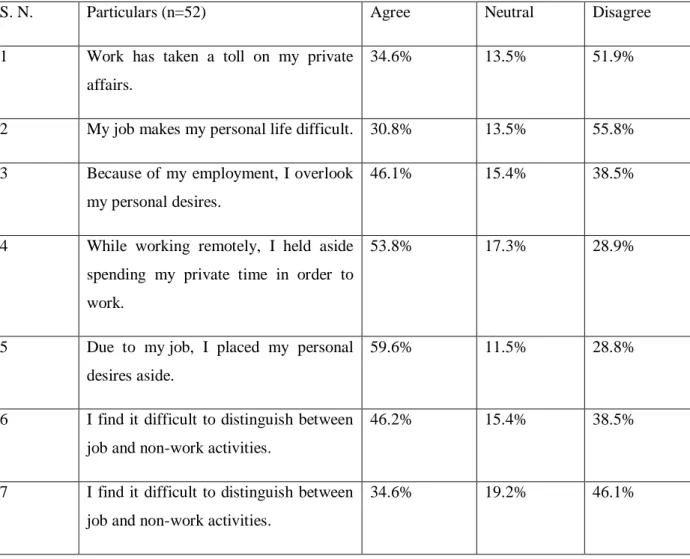
Table 02 shows that the majority of respondents place a high value on their employment, albeit at the price of their personal needs in general. Working from home causes 53.8 percent of respondents to put off enjoying their personal time in order to work. Because it is nearly hard to maintain a healthy work-life balance while working from home, 46.2 percent of them struggle to separate work from non-work activities.
Because of work, 51.9 percent of respondents agree and 7.7 percent strongly agree that they put their personal needs second. This wreaks havoc on the work-life balance. Working too much and putting things off because you don't have time to enjoy non-work hobbies can lead to physical disease and burnout. It can
17 also make it difficult to maintain positive relationships with family members, as well as induce mental disease due to a lack of rest.
Here are the pie charts (2.1-2.7) that give us a better understanding of the respondents’ opinions about the statement regarding this dimension:
Chart: 2.1
Chart: 2.2
18 Chart:2.3
Chart: 2.4
Chart: 2.5
19 Chart: 2.6
Chart: 2.7 Table 03: Work-related Stress
S. N. Particulars (n=52) Agree Neutral Disagree
1 I'm feeling down about my job. 28.8% 15.4% 55.8%
2 While working remotely, I have the impression that many matters are just beyond my authority and abilities.
48% 13.5% 38.5%
20 3 Completing work while working
remotely makes me feel overburdened.
55.8% 21.2% 23.1%
4 I'm considering quitting my job because I'm working remotely.
25% 19.2% 55.8%
5 I can't seem to get away from my profession when I'm working remotely.
42.3% 15.4% 42.3%
6 My work-from-home career has become a source of frustration for me.
26.9% 21.2% 52%
7 Because a mother's primary worry is her children, moms' stress levels spiked during the epidemic as they worried about their child's welfare and well-being.
63.5% 23.1% 13.4%
8 Due to the extra pressure of the current situation, parents who bear children throughout this epidemic are more likely to suffer from post- natal depression.
67.3% 19.2% 13.4%
9 Most females, particularly women, have suffered quite substantial economic and psychologically expenses as a result of the outbreak thus far.
71.1% 17.3% 11.5%
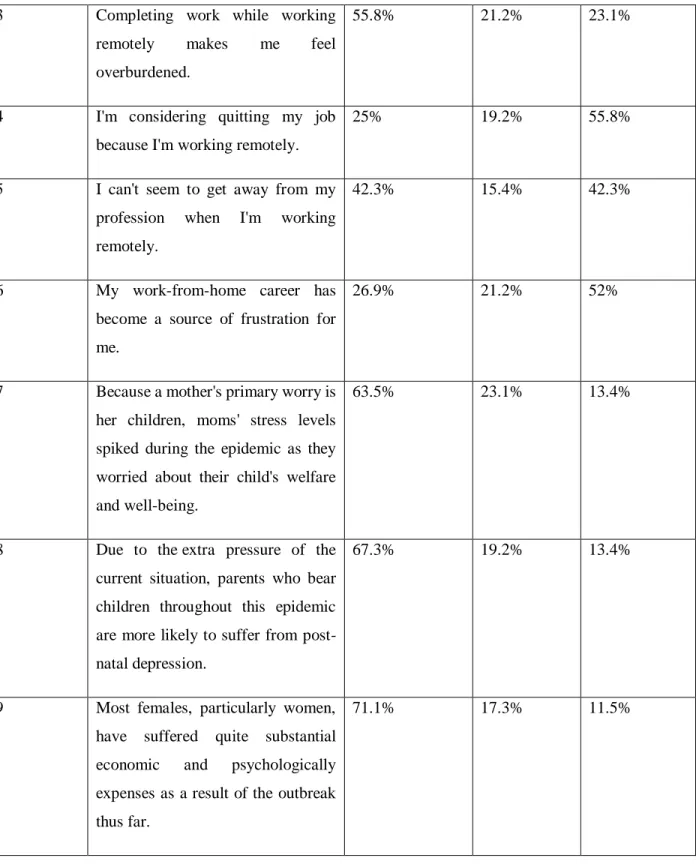
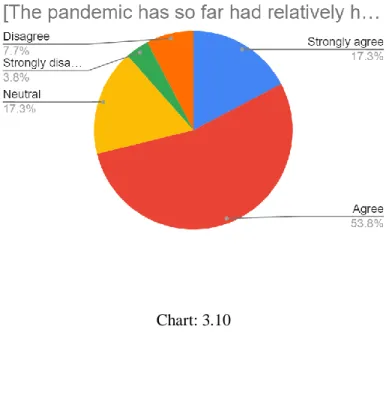
Table 03 shows that working women, particularly moms, experience more work-related stress when they work from home. Most women, especially mothers, have suffered quite substantial socioeconomic and psychological consequences as a result of the epidemic, according to 53.8 percent of respondents who agree
21 and 17.3 percent who strongly agree. Because a mother's primary worry is her children, moms' stress levels spiked during the epidemic as they worried about their children's health and well-being. As a result, working women, particularly working moms, struggle to strike a work-life remaining balance to employment stress compounded by the burden of ensuring their children's well-being. 46.2 percent agree and 9.6 percent strongly agree that completing work while working from home makes them feel overwhelmed, whether they are professional mothers or not.
Here are the pie charts (3.1-3.10) that give us a better understanding of the respondents’ opinions about the statement regarding this dimension:
Chart: 3.1
Chart: 3.2
22 Chart: 3.3
Chart:3.4
23 Chart: 3.5
Chart:3.6
24 Chart: 3.7
Chart: 3.8
Chart:3.9
25 Chart: 3.10
Table 04: Job Satisfaction
S. N. Particulars (n=52) Agree Neutral Disagree
1 I am satisfied with my current job situation.
63.5% 23.1% 13.4%
2 I am satisfied with my current co- workers.
67.3% 23.1% 9.6%
3 I am satisfied and feel happy with my current boss.
65.4% 21.2% 13.5%
4 I am satisfied with my current salary. 30.8% 40.4% 28.8%
5 Overall, I am satisfied with my current job.
57.7% 30.8% 11.5%
26 In Table 04, it can be seen that though the majority of the respondents are satisfied with their current job situation, they are not that satisfied with their salary. 48.1% agree and another 9.6% strongly agree that they are overall satisfied with their job.
Here are the pie charts (4.1-4.5) that give us a better understanding of the respondents’ opinions about the statement regarding this dimension:
Chart: 4.1
Chart: 4.2
27 Chart: 4.3
Chart: 4.4
28 Chart: 4.5
Discussion:
After analyzing the collected data, some very exclusive points have come to light. For instance:
As the pandemic started to spread more and more, most organizations started implementing home office.
The WFH policy itself was quite widely accepted by women of different organizations. It is true that WFH does allow a certain type of flexibility which attending physical office just simply does not. However, there are also some unique setbacks that WFH poses on WLB. While working from home saves money and time spent on the road, it creates space major disturbance and interruption in work.
As there is no specific work hour in the home office setup, and the whole work is done online, employees are expected to be available to work at any given time. Although it is true that working from home is beneficial in many ways, the extra work hours and workload creates mental and physical stress on the employees. Especially people who have been infected by Covid-19 suffer the most because their health has partaken a major toll, both physically as well as mentally. But due to commitment to the organization and the “new-normal” rules, employees have to be available to work 24/7 as they do not have to be present in the workplace physically. Therefore, the pre-existing lean boundary between work life and personal life is shattered.
Work-life balance is very important for good employee performance. An employee who is stressed out, who has no time to rest or complete their personal tasks or to enjoy leisure time properly, will eventually start to burn out and not be able to produce quality work. Moreover, being entangled with work all the time may take away from their precious family or alone time, which is not beneficial in the long run. Also, these stress factors may implicate various mental and physical illnesses which will ultimately result in bad employee performance all over. To conclude, it can be said that the above data analysis and discussion overall support the mentioned hypotheses.
29
Conclusion:
To conclude, it’s important to clarify that a good work-life balance plays a positive role in employee performance, and in a developing country like Bangladesh, the circumstances and setting that working women face are adverse, regardless of work from home or not. Studies prove that the pandemic has made socio-economic and psychological adversities rather high on women far more than men. To answer the question of whether WFH is beneficial for working women or not, it can be said that, as women are getting the chance of staying close to their family members at their respective homes, the work from home policy is well accepted among them. However, the work stress needs to be paid attention to, seeing as women also have another shift of work at home which includes doing all the major household tasks. Implementing some simple but effective policies like daycare facilities at work, division of work at home, and pay raise so that they can afford to manage helping hands can benefit in establishing good WLB in working women’s life which in turn will result in good employee performance. And with that being said, it is determined that the research objective, which was to figure out whether WFH is truly beneficial for the working women’s WLB or not, is fulfilled by this paper.
Recommendation:
While conducting this survey, the main limitation that was confronted was the fact that people are quite reluctant to take some time to fill up the questionnaire. Over 90 working women were approached to fill up the survey but among those only 52 of them responded. The rest of the women were either too busy or uninterested to help out in filling up the questionnaire. Had it been possible to collect more responses, it would have painted a better and clearer picture of the impacts of WFH on WLB on working women in Bangladesh. Also, there was a significant research gap noticed while gathering information, mainly in developing countries like Bangladesh. Therefore, there is an opportunity for future researchers to do extensive studies on this topic.
30
REFERENCES:
1) Work-Life-Balance of Working Women on Higher Education Sector. (2021). Retrieved from http://shisrrj.com/paper/SHISRRJ2143.pdf
2) Elnanto, J. G., & Suharti, L. (2021). The Impact of Work From Home to Work-Life-Balance and Its Implication to Employee Happiness: The Moderating Role of Organizational Support. International Journal of Social Science and Business, 5(3).
https://doi.org/10.23887/ijssb.v5i3.35325
3) The age of working from home. (2020, March 19). Retrieved November 17, 2021, from Dhaka Tribune website: https://www.dhakatribune.com/opinion/op-ed/2020/03/19/the-age-of-working- from-home
4) OP-ED: Working from home, working for home. (2020, June 18). Retrieved from Dhaka Tribune website: https://www.dhakatribune.com/opinion/op-ed/2020/06/18/op-ed-working-from-home- working-for-home
5) OP-ED: Women’s mental health bears the brunt of Covid-19. (2021, September 29). Retrieved November 17, 2021, from Dhaka Tribune website: https://www.dhakatribune.com/opinion/op- ed/2021/09/29/op-ed-women-s-mental-health-bears-the-brunt-of-covid-19
6) JOURNAL OF MANAGEMENT STUDIES AND ACADEMIC RESEARCH A Big Salute to CORONA WARRIORS. (2021). Retrieved from https://sdmcbm.ac.in/wp- content/uploads/2021/02/Journal-Book-Final-For-Website.pdf#page=11
7) Uddin, M. (2021). Addressing work‐life balance challenges of working women during COVID‐19 in Bangladesh. International Social Science Journal. https://doi.org/10.1111/issj.12267
8) Ibarra, H., Gillard, J., & Chamorro-Premuzic, T. (2020, July 16). Why WFH Isn’t Necessarily Good for Women. Retrieved from Harvard Business Review website: https://hbr.org/2020/07/why-wfh- isnt-necessarily-good-for-women
9) Irawanto, D. W., Novianti, K. R., & Roz, K. (2021). Work from Home: Measuring Satisfaction between Work–Life Balance and Work Stress during the COVID-19 Pandemic in Indonesia. Economies, 9(3), 96. https://doi.org/10.3390/economies9030096
31 10) Joarder, A., Phil, & Mustafi, S. (2021). Work From Home: A Curse or Boon? Analyzing People’s
Sentiments. International Journal of Innovative Science and Research Technology, 6(8).
Retrieved from https://ijisrt.com/assets/upload/files/IJISRT21AUG263.pdf
11) Irawanto, D. W., Novianti, K. R., & Roz, K. (2021). Work from Home: Measuring Satisfaction between Work-Life Balance and Work Stress during the COVID-19 Pandemic in
Indonesia. Economies, 9(3), 96. https://doi.org/10.3390/economies9030096
12) Contreras, F., Baykal, E., & Abid, G. (2020). E-Leadership and Teleworking in Times of COVID-19 and Beyond: What We Know and Where Do We Go. Frontiers in Psychology, 11.
https://doi.org/10.3389/fpsyg.2020.590271
13) Kim, J. (1), Henly, J. r. (2 ), Lambert, S. j. ( 2 ), & Golden, L. m. ( 3 ). (2020). Workplace
Flexibility and Worker Well-Being by Gender. Journal of Marriage and Family, 82(3), 892–910.
https://doi.org/10.1111/jomf.12633
14) Van Meel, J. (2011). The origins of new ways of working. Facilities, 29(9/10), 357–367.
https://doi.org/10.1108/02632771111146297
15) Nilles, J. M. (1997). Telework: Enabling Distributed Organizations. Information Systems Management, 14(4), 7–14. https://doi.org/10.1080/10580539708907069
16) Ibarra, H., Gillard, J., & Chamorro-Premuzic, T. (2020, July 16). Why WFH Isn’t Necessarily Good for Women. Retrieved from Harvard Business Review website:
https://hbr.org/2020/07/why-wfh-isnt-necessarily-good-for-women
17) Uddin, M. (2021). Addressing work‐life balance challenges of working women during COVID‐
19 in Bangladesh. International Social Science Journal. https://doi.org/10.1111/issj.12267 18) Pozzan, E. and Cattane, U., 2020. Women health workers: working relentlessly in hospitals and at
home. International Labour Organisation.
32 19) Chandola, T., Booker, C. L., Kumari, M., & Benzeval, M. (2019). Are Flexible Work
Arrangements Associated with Lower Levels of Chronic Stress-Related Biomarkers? A Study of 6025 Employees in the UK Household Longitudinal Study. Sociology, 53(4), 779–799.
https://doi.org/10.1177/0038038519826014
20) Lewis, H. (2020, March 19). The Coronavirus Is a Disaster for Feminism. Retrieved December 3, 2021, from The Atlantic website:
https://www.theatlantic.com/international/archive/2020/03/feminismwomens-rights-coronavirus- covid19/608302
21) Uddin, M., Ali, K. B., Khan, M. A., & Ahmad, A. (2021). Supervisory and co-worker support on the work-life balance of working women in the banking sector: a developing country
perspective. Journal of Family Studies, 1–21. https://doi.org/10.1080/13229400.2021.1922299 22) Uddin, M., Ali, K. and Khan, M.A., 2020A. Perceived Social Support and Work-Life Balance in
developing country: The Moderating Impact of Work-Life Policy. Iranian Journal of Management Studies, 13 (4), 733–761.
23) Uddin, M., Ali, K. and Khan, M.A., 2020B. Impact of Perceived Family Support, Workplace Support, and Work-Life Balance Policies on Work-Life Balance among Female Bankers in Bangladesh. International Journal of Economics, Management and Accounting, 28 (1), 97–122 24) Dhaka Tribune. (2020). OP-ED: Working from home, working for home. [online] Available at:
https://www.dhakatribune.com/opinion/op-ed/2020/06/18/op-ed-working-from-home-working- for-home.
25) OP-ED: Women’s mental health bears the brunt of Covid-19. (2021, September 29). Retrieved from Dhaka Tribune website: https://www.dhakatribune.com/opinion/op-ed/2021/09/29/op-ed- women-s-mental-health-bears-the-brunt-of-covid-19
33 26) Tomazevic, N., Kozjek, T. and Stare, J. (2014) The Consequences of a Work-Family (Im)
Balance: From the Point of View of Employers and Employees. International Business Research, 7, 83-100.
https://doi.org/10.5539/ibr.v7n8p83.
27) Tasnim, M., Hossain, M. Z., & Enam, F. (2017). Work-Life Balance: Reality Check for the Working Women of Bangladesh. Journal of Human Resource and Sustainability Studies, 05(01), 75–86. https://doi.org/10.4236/jhrss.2017.51008
28) Uddin, M. M., & Chowdhury, M. M. (2015). Evaluation of Workforce Diversity Management Practices: A Case of Bangladesh. IOSR Journal of Business and Management (IOSR-JBM) e- ISSN: 2278–487X, p-ISSN: 2319–7668, 17(8.Ver. I), 63–71. Retrieved from
https://www.researchgate.net/profile/Md-Uddin-
72/publication/344245536_Evaluation_of_Workforce_Diversity_Management_Practices_A_Case _of_Bangladesh/links/5f60bb7a92851c078967df77/Evaluation-of-Workforce-Diversity-
Management-Practices-A-Case-of-Bangladesh.pdf