i | P a g e “ © D a f f o d i l I n t e r n a t i o n a l U n i v e r s i t y ”
An Internship Report On
Studies on Production and Quality Control of Food & Beverage At
Akij Food and Beverage Ltd.
Submitted To:
Prof. Dr. Md. Bellal Hossain Head
Department of Nutrition and Food Engineering Faculty of Allied Health Science
Daffodil International University
Submitted By:
Md. Islam Uddin ID: 161-34-505
Department of Nutrition and Food Engineering Faculty of Allied Health Science
Daffodil International University
Date of Submission: 22 December, 2018
Page | ii “© Daffodil International University”
Date: 22 December, 2018
Prof. Dr. Md. Bellal Hossain Head
Department of Nutrition and Food Engineering Faculty of Allied Health sciences
Daffodil International University
Subject: Submission of internship report.
Dear Sir,
It is a great pleasure and honor for me to have the opportunity to submit Internship report as a Part of the Nutrition and Food Engineering (NFE) program curriculum.
I have prepared this report based on the acquired taste knowledge during my internship period In Akij Food and Beverage ltd. It is great achievement to work under your active supervision. This Report is based on, “
Studies on the production and quality control of Food and Beverage
” at Akij Food And Beverage Ltd., Barobaria, Dhamrai, Dhaka. I have got the opportunity to work in Akij Food and Beverage Ltd. In “Quality Control and Production Department” for sixty days, under the supervision Md. Helal Uddin, General Manager (QMS).Firstly of all I have gained knowledge about the organizational culture of a prominent product producing organization of the country. Secondly, the project gave me the opportunity to develop a network with the corporate environment.
I therefore, would like to place this report to your judgment and suggestion. Your kind advice will encourage me to perform better planning in future.
Sincerely Yours,
Md. Islam Uddin ID: 161-34-505
Department of Nutrition and Food Engineering Faculty of Allied Health Science
Daffodil International University
LETTER OF TRANSMITTAL
Page | iii “© Daffodil International University”
Date: 22 December, 2018 Prof. Dr. Md. Bellal Hossain Head
Department of Nutrition and Food Engineering Faculty of Allied Health Science
Daffodil International University
Subject: Declaration regarding the validity of the internship report.
Dear Sir,
This internship report entitled Knowledge and extent the practice of “Studies on Production and Quality Control of Food and Beverages” at Akij Food and Beverages Ltd. was submitted to the Department of Nutrition and Food Engineering, Faculty of Allied Health Science, Daffodil International University, Dhaka, Bangladesh. This study was fully concerned with the department and faculty members.
Sincerely yours,
Md. Islam Uddin ID: 161-34-505
Department of Nutrition and Food Engineering Faculty of Allied Health Science
Daffodil International University
LETTER OF AUTHORIZATION
Page | iv “© Daffodil International University”
CERTIFICATION OF APPROVAL
I am pleased to certify that the internship report on Production and Quality Control of Food and Beverage, conducted by Md. Islam Uddin, bearing respectively ID No: 161-34-505 of the department of Nutrition and Food Engineering has been approved for presentation and Defense/viva-voice.
I am pleased to hereby certify that the data and finding presented in the report are the authentic work of Md. Islam Uddin. I strongly recommended the report presented by Md.
Islam Uddin for further academic recommendations and defense/viva-voice. Md. Islam Uddin bears a strong moral character and a very pleasant personality. It has indeed a great pleasure working with him. I wish him all success in life.
Prof. Dr. Md. Bellal Hossain Head
Department of Nutrition and Food Engineering Faculty of Allied Health Science
Daffodil International University
Page | v “© Daffodil International University”
ACKNOWLEDGEMENT
In the preparation of this report, I would like to acknowledge the encouragement and assistance give to me by a number of people. At first, I would like to express my gratitude to almighty Allah for enabling me the strength and opportunity to complete the report in the schedule times successfully. I am taking this privilege to deliver my gratefulness to each and every people who are involved with me in every phase of my lives.
I am grateful to my parents without whom I cannot be here. Without the support of my parents, I could not be able to achieve my objectives and goals.
My Deep gratitude and sincere thanks to the honorable Head, Nutrition and Food Engineering department Professor Dr.Md. Bellal Hossain for this kind cooperation and to accept this Degree. I am encouragement taking this privilege to deliver my gratefulness to each and every people who are involved with me in every phase of my lives.
I am deeply indebted to my Supervisor Professor Dr.Md. Bellal Hossain honorable Head, Nutrition and Food Engineering department, Department of Nutrition & Food Engineering, Daffodil International University for his whole-hearted supervision during my organizational attachment period. I am very grateful to Sheikh Shamim Uddin, Director of Akij Food and Beverage ltd. For giving us permission to carry out this internship in his organization. I am also grateful to Md. Helal Uddin, (GM, QMS) as my organizational supervisor to conduct. It would have been very difficult to prepare this report up to this mark without their guidance.
I would like to express my warmest thanks to Nutrition and Food Engineering Faculty members for their countless inspiration and encouragement during the student life.
Finally I wish to express immense gratitude & humbly convey my heart- felt respect to Managing Director.
Page | vi “© Daffodil International University”
Subjects Page
Letter of Transmittal ii
Letter of Authorization iii
Certificates of Approval iv
Acknowledgement v
Table of Contents vi
Chapter ONE(Introduction)
1.1: Introduction
01
1.2: Aim of The Training
02
Chapter TWO (Organization Profile)
2.1: About Akij Group
03
2.2: About Akij Food and Beverage Ltd
04
2.3: Vision of Akij Food & Beverage Ltd
04
2.4: Mission of Akij Food & Beverage Ltd
04
2.5: Values of Akij food & Beverage Ltd
04
Chapter THREE (Methodology )
Milk Processing Plant3.0: Products of Dairy Plant
05
3.1: Definition of Milk
05
3.2: Composition of Milk
05
3.3: Process of milk
06
3.4: Flowchart of Milk (Pasteurized & UHT)
06
3.5: Flowchart of Mango Milk/Chocolate Milk
07-08
3.6: Butter Processing
09
3.7: Yoghurt Processing
10
3.8: Ghee Processing
11-12
Carbonated Soft Drinks (CSD) Plant
3.10: CSD Products Items ,Shelf Life (PET) & shelf life(can)
13
3.11: Flowchart of CSD (PET)
14
3.12: Flowchart of CSD (CAN)
15
TABLE OF CONTENTS
Page | vii “© Daffodil International University”
Chapter FOUR(LAB Works)
4.1: LAB Works
16
4.2: About Laboratary Instruments
16
4.3: Making of Indicator
17
Chapter FIVE
(Physical and Chemical & Microbial Test For Products)
Microbial Test & Results5.1: Total bacterial count
18
5.2: Total Yeast & mold count
19
5.3: Total Coliform count
20
Tests of dairy products & Results
5.4: milk test Name & Sensory Test
21
5.5:Alcohol, Cloth on Boiling & PH test
22
5.6: Acidity Test, Specific Gravity Test
23
5.7:Fat, Starch Test & Formalin Test
24
5.8:soda, Salt & Sugar Test
25
5.9: Hydrogen Peroxide, SMP & Methylene Blue Reduction Test
26-27
Carbonated Soft Drinks Test & Results5.10:Acidity, PH & %Brix Test
28-29
5.11: Organoleptic Test,Net Content
30
5.12:Secure Seal,Bottle Opening Torque Test
31
5.13: Blown Bottle Performance Check & Determination of Gas Volume Test
32
Chapter SIX
Conclusion
33
1 | P a g e “ © D a f f o d i l I n t e r n a t i o n a l U n i v e r s i t y ”
INTRODUCTION
At 09 semester out of 09 semesters in three year Bachelor of Science in Nutrition and Food Engineering I got an opportunity to work at Akij Food and Beverage Ltd. (AFBL), Bangladesh the part of my internship program. The duration of my internship was from 10th September 2018 to 10th November 2018. AFBL is the top & largest beverage company in the country.
AFBL has many types of department. The departments are – HR & Admin, Quality Control, Research & Development, Production, Electrical, Mechanical, Store, Distribution, Accounts, Vat, Civil, Resource, Hygiene etc. My concern was Quality Control Department & Production Department which encompassed the following activities:
Maintain all quality control parameter as per specification.
Ensure quality of production.
Knowledge on product costing.
To prepare & to submit necessary reports required by the management.
Have to submit report to authority every day for production consumption, costing, quality etc.
To make necessary production plan as per the schedule provided by the production department.
Chapter ONE
Page | 2 “© Daffodil International University”
AIM OF THE TRAINING
Aim of the Training:
Internships provide an opportunity for students to link theory with practice and further serve as a temporary labor pool for those agencies that have committed to participate in the internship program. The department fulfills its mission of preparing students for significant professional and managerial positions in all the sectors. Relevant professional development topics and workshops are discussed weekly.
The internship…
Provides a student with a practical real world experience in the public, private or nonprofit sector.
Enables a student to develop important public administration skills which cannot be taught in the classroom. These experiences vary from working on special projects for the interning agency to learning about the human motivation process in a complex organization.
Enables a student to compare theoretical ideas learned in the classroom within the world of work regarding public administration experiences.
Provides a student with experience in an actual public, private or nonprofit agency before entering the job market. Such experience not only increases students’ job prospects, but also teaches what is expected in terms of professional behavior.
Permits a student to apply the technical skills learned in the classroom to real world public, private or nonprofit administrative problems.
Page | 3 “© Daffodil International University”
(DESCRIPTION OF THE ORGANIZATION
)
2.1: About Akij Group:
Akij Group is one of the largest Bangladeshi industrial conglomerates. The industries under this conglomerate include textiles, tobacco, food & beverage, cement, ceramics, printing and packaging, pharmaceuticals, consumer products etc. In 2009, Akij Group paid 390 million euros in tax, making it the biggest local tax-payer, contributing two per cent to this nation's entire budget. Akij also provides services in healthcare, information and communication technology. Its turnover in 2009 was 89 billion Taka.
Akij Group was established in the 1940s by industrialist Sheikh Akij Uddin as a jute trading business, before moving into cigarettes and other areas of business. It has faced criticism for employing child workers.
The legacy of AKIJ GROUP is over half a century old and over the years Akij has established itself as the full of confidence and much revered industrial family of Bangladesh. Akij Group is one of the biggest conglomerates in Bangladesh. It consists of 24 big concerns with diverse activities & different products. Akij Group launched its venture as a small jute trader more than 50 years ago. Since then it has been progressing with tremendous pace in the industrial area of Bangladesh. A large number of people are employed by the group and cared for as members of the Akij family. The non-profit concerns are also involved in sustaining development of the country & for social welfare.
Akij Cables limited.
Abrar Tours and Travels
Ad-Din Foundation
Akij Automotive Industry
Akij Biri Factory Ltd.
Akij Cement Company Ltd.
Akij Ceramics Company Ltd.
Akij Computer Ltd.
Akij Corporation Limited
Akij Food & Beverage Ltd.
Akij Foundation School & College
Akij Gas Company Ltd.
Akij Gas Station Ltd.
Akij Institute of Technology
Akij Jute Mills Ltd.
Akij Match Factory Ltd.
Chapter TWO
Page | 4 “© Daffodil International University”
Akij Motors
Akij Particle Board Mills Ltd.
Akij Pharmaceuticals Ltd.
Akij Printing & Packaging Ltd
Akij Securities Ltd.
Akij Textile Mills Ltd.
Akij Zarda Factory Ltd.
Dhaka Tobacco Industries
Akij Rice Mill Industry
Akij Flour Mill Industry
Akij Ceramics Ltd.
2.2: About Akij Food and Beverage:
Akij Food & Beverage Ltd. (AFBL) a unit of Akij Group started its operation in the year 2006.
AFBL manufactures a wide range of Snacks and Beverage for both National & International market alike. AFBL is a project worth $ 70 million& is funded by the parental company Akij Group. There are various types of drink. Mojo is the brand name of cola, Lemu is the brand name of Lemon and Speed is the brand name of energy drink. Immediately after the introduction of the brand it became very popular among its consumer because of the high quality and intensive distribution in every nook and corner of the country. Checky Monkey is the brand name of banana chips produced from this factory. It also is becoming popular chips in Bangladesh.
2.3: Vision of Akij Food & Beverage:
Having the quality of quality, becoming the most food & beverage company of Bangladesh
2.4: Mission of Akij Food & Beverage:
Produce high quality products.
To supply high quality products.
To distribute zero defect products.
All time apply high technology to produce high quality products.
Brings quality in life.
Work for social welfare.
2.5: Values of Akij food & Beverage:
Innovation
Teamwork
Integrity
Customer focus
Trust and Respect
Page | 5 “© Daffodil International University”
3.0: Product of Milk Plant
1. Pasteurized milk 2. UHT Milk
3. Sweet Curd 4. Sour Curd 5. Low Fat Curd 6. GHEE
7. Butter 8. Mango Milk 9. Chocolate Milk 10. Green Mango Milk 11. Mango Shake
12. Mango juice (Frutika Tetra pack-UHT)
3.1: Definition of Milk:Milk is the lacteal and physiological secretions of mammary glands obtained from healthy cows or buffaloes (excluding fifteen days before and five days after parturition) and contains at least 3.5% fat and 8.5 solids-non fat.
3.2: Composition of Milk:The basic composition of milk regardless of the source remains the same:
SL Elements Percentage
01 Water 87.1%
02 Carbohydrate 4.8%
03 Protein 3.8%
04 Fat 3.5%
05 Minerals 0.8%
Chapter THREE
Page | 6 “© Daffodil International University”
3.3: Process of Milk:
1. At First Collection of Raw Milk of Chilling Center.
2. Collected Raw Milk is Passed through Platfrom Principle test and adultration test.
3. The passed milk is Chilled in a Storage Vat at 4°c or below.
4. Storage Milk is recombined with milk or full cream milk for maintaining fat percentage(3.5%) According to BSTI Standard.
5. Raw milk Have Higher fat Percentage then Standarization of milk (Adjusting SNF and Cream Separartion )
6. Milk is Pasteurized at 80-88°c for 15 Sec.
7. Pasteurized milk is Homogenized by milk Homogenizer.
8. Final milk cooling is 4c and storage tank.
9. Then cooled milk is taken in the Packing machine for Storage Vat.
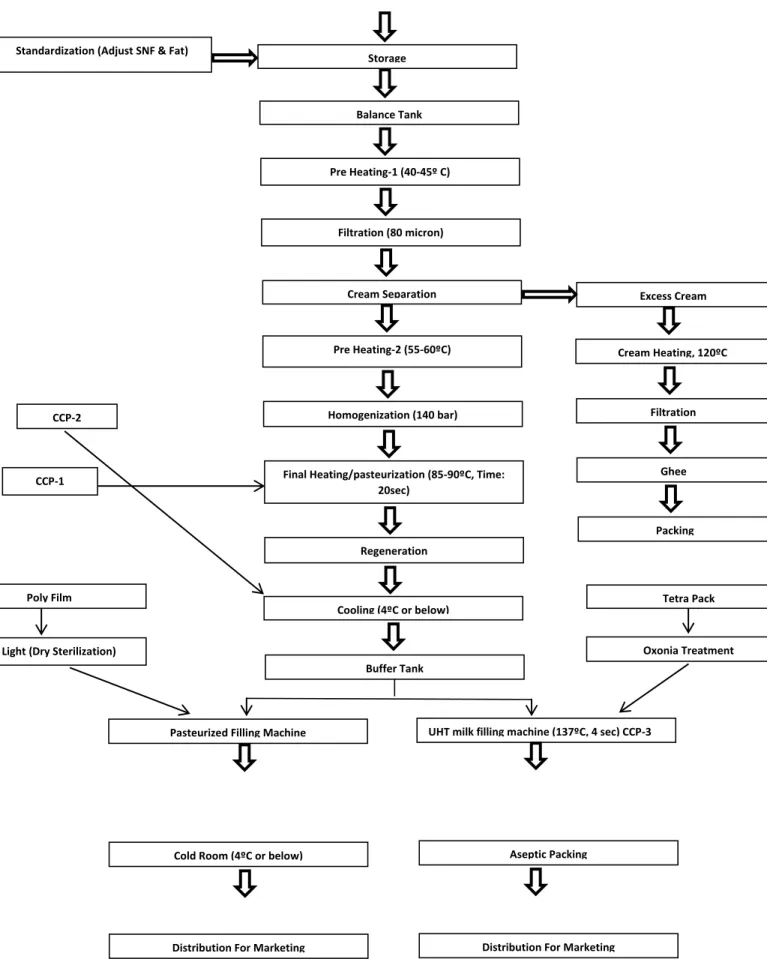
3.4: Milk Processing Flow chart:
Raw Milk Receive
Filtration
Cooling (below 4 ºC)
Storage
Balance Tank
Pre Heating-1 (40-45º C)
Filtration (80 micron)
Cream Separator Standardization (Adjust SNF & Fat)
Page | 7 “© Daffodil International University”
Figure 3.4 : Flow chart of Pasteurized milk & UHT milk
3.5: Mango Milk/Chocolate Milk Process:
Pre Heating-2 (55-60ºC)
Homogenization (140 bar)
Final Heating/pasteurization (85-90ºC, Time:20sec)
Tetra Pack Cooling (4ºC or below)
Regeneration
Pasteurized Filling Machine
Cold Room (4ºC or below)
Distribution For Marketing
UHT milk filling machine (137ºC, 4 sec) CCP-3
Aseptic Packing UV Light (Dry Sterilization)
Poly Film
Buffer Tank
Oxonia Treatment CCP-1
CCP-2
Distribution For Marketing
1. Raw Milk Receive
2.Filtration
3. Cooling (below 4 ºC)
Page | 8 “© Daffodil International University”
Figure 3.5: Flowchart of Mango Milk/Chocolate Milk
4. Storage tank 1+2
5.Balance Tank
6.Pre Heating-1 (40-45º C)
7. Filtration (80 micron)
8.Cream Separator
9. Pre Heating-2 (55-60ºC)
10. Homogenization (140 bar) Standardization (Adjust SNF & Fat)
11. Final Heating/pasteurization (85-90ºC, Time: 20sec)
16.Mixing All Ingredient
13.Cooling (4ºC or below) 12. Regeneration
26.Pasteurized Filling Machine
29.Cold Room (4ºC or below)
Distribution for Marketing
18. filteration (80 micron)
19. Pre Heating-1 (40-45º C)
28.UV Light (Dry Sterilization)
27.Poly Film 14. Recombine Tank
17.Balance Tank
CCP-1
CCP-2
21. Homogenization (140 bar) 20.Pre Heating-2 (55-60ºC)
22. Pasteurization (85-90ºC, Time:20sec)
23. Regeneration
24.Cooling (4ºC or below)
25.Buffer Tank
Page | 9 “© Daffodil International University”
3.6: Butter Process:
Figure 3.6: Flow chart of Butter
Cream SeparationCream Pasteurzation 80-85°c
Aging Tank 18 hrs
Churning Tank 35-40 Min
Butter Washing
Packing storage
-18°c
Page | 10 “© Daffodil International University”
3.7: Yoghurt Processing:
Figure:3.7:Flow chart of Yoghurt
3.8: Ghee Process:
Raw Milk Receive
Filtration
Cooling (below 4 ºC)
Pasteurized Milk
Heating
(Sour curd 2-3hrs&
Sweet curd 4-5hrs)
Cooling(45-46°c) Culture added Filling incubation
seating temp:45°c Cooling
packing
Storage &
Disturibation
Page | 11 “© Daffodil International University”
Figure 3.8 : Flowchart of Ghee
Storage
Balance Tank
Pre Heating-1 (40-45º C)
Filtration (80 micron)
Cream Separation
Pre Heating-2 (55-60ºC)
Homogenization (140 bar) Standardization (Adjust SNF & Fat)
Final Heating/pasteurization (85-90ºC, Time:
20sec)
Tetra Pack Cooling (4ºC or below)
Regeneration
Pasteurized Filling Machine
Cold Room (4ºC or below)
Distribution For Marketing
UHT milk filling machine (137ºC, 4 sec) CCP-3
Aseptic Packing UV Light (Dry Sterilization)
Poly Film
Buffer Tank
Oxonia Treatment CCP-1
CCP-2
Distribution For Marketing
Excess Cream
Cream Heating, 120ºC
Filtration
Ghee
Packing
Page | 12 “© Daffodil International University”
3.10: Carbonated Soft Drinks Items
1. Speed 250 ml
2. Mojo (250ml, 500ml, 1ltr, 2ltr) 3. Clemon (250ml,500ml,1ltr, 2 ltr) 4. Lemu (250ml)
5. Wild Brew(250ml) 6. Twing (250ml,500ml)
Shelf Life (PET)
Shelf Life (CAN)
Speed 9 months
Mojo 9 months
Clemon 9 months
Lemu 9 months
Speed 4 months
Mojo 4 months
Clemon 4 months
Lemu 4 months
Page | 13 “© Daffodil International University”
3.11: Carbonated Soft Drink Processing( PET)
Figure 3.6 :Flowchart of CSD (PET)
Blow mold
Bottle conveying to Filler
Bottle Rinsing
Filling (Filling Vulve-100)
Closure Application
QC Check
Warming at 30 ± 3º C
Labelling (glue tem 165c)
Shrinking
Band Roll Application (30mm)
Inter mixer Treated Water
Date Coding
Warehousing Wrapping (190-195c)
Visual Inspection
CO2 water
Final Syrup
Page | 14 “© Daffodil International University”
3.12: Carbonated Soft Drink Processing( CAN)
Figure 3.7: Flowchart of CSD (CAN)
Empty CAN In
CAN conveying to Filler
CAN Rinsing
Filling (28 filling valve)
Simmer Application (5piece)
QC Check
Warming at 30 ± 3º C
Labeling
Shrinking
Band Roll Application
Inter mixer Treated Water
Date Coding
Wrapping Visual Inspection
CO2 water
Final Syrup
Page | 15 “© Daffodil International University”
4.1: LAB WORKS
Equipment list of Lab 1. Micro oven
2. SST (Secure Seal Tester) 3. Co2 cylinder
4. Magnetic stirrer 5. Moisture meter 6. Gauge tester 7. Digital meter 8. Viscometer 9. Water bath
10. Gas volume analyzer 11. BOD tester
12. CO2 purity tester/ CO2 volume tester 13. Enamel tester
14. COD analyzer 15. Distilled water plant 16. Density meter 17. Shaker 18. Thermometer 19. pH meter 20. Filter paper 21. Microscope 22. Colony counter 23. Digital Autoclave 24. Digital sterilizer 25. Laminar air flow 26. Refrigerator
Chapter FOUR
Page | 16 “© Daffodil International University”
4.2:Making of Indicator
Phenolphthalein:
1. Take 0.5g dissolved in 50ml alcohol 2. Add 50ml distilled water
Mixed indicator:
1. 0.33g Bromocresol Green.
2. 0.66g methyl red.
3. Dissolve them in 100ml distilled water.
(0.1N) Sodium ThioSulphate:
1. Take 2.5g sodium thiosulphate.
2. Dissolve it into 100ml distilled water.
Irriochrom Black T (Hardness Indicator):
1. Take 6.1g sample.
2. Dissolve it into 100ml methanol.
Page | 17 “© Daffodil International University”
Microbiological Test
5.1: Name of the test: Total bacterial count
Method: Pour plate (For Water, Mango pulp, Fruit Drinks)
Purpose: The pour plate technique can be used to determine the number of microbes/ml or microbes/gram in a specimen.
Requirements:
• Sterile Petridis (90mm)
• Micropipette
• Alcohol (70%)
• Laminar Air Flow
• Autoclave
• Incubator
• Colony Counter
• Water bath
• Plate count Agar
Procedure:
1. Prepare the media and sterilized by autoclave at 121ºc for 15 minutes, 14.5 psi.
2. Take specific amount of sample in Petridis.
3. After autoclaving media allow to cool in 40ºc.
4. About 15-20ml of media is pour in Petridis and properly homogenized by clockwise &
anticlockwise and allows to solidify.
5. After solidification incubate the plate at 37ºc in inverted position for 24-48 hours.
6. After incubation count the colony by colony counter.
7. All the steps should be done under laminar air flow to maintain aseptic condition.
Results: count the result and record as cfu/ml or gm.
Chapter FIVE
Page | 18 “© Daffodil International University”
5.2: Name of the test: Total Yeast, mold count
Method: Pour plate (For Water, Mango pulp, Fruit Drinks)
Purpose: The pour plate technique can be used to determine the number of microbes/ml or microbes/gram in a specimen.
Requirements:
• Sterile Petridis (90mm)
• Micropipette
• Alcohol (70%)
• Laminar Air Flow
• Autoclave
• Incubator
• Colony Counter
• Water bath
• Orange serum agar
Procedure:
1. Prepare the media and sterilized by autoclave at 121ºc for 15 minutes, 14.5 psi.
2. Take specific amount of sample in Petridis.
3. After autoclaving media allow to cool in 40ºc.
4. About 15-20ml of media is pour in Petridis and properly homogenized by clockwise
&anticlockwise and allow to solidify.
5. After solidification incubate the plate at 37ºc in inverted position for 24-48 hours.
6. After incubation count the colony by colony counter.
7. All the steps should be done under laminar air flow to maintain aseptic condition.
Results: Count the result and record as cfu/ml or gm.
Page | 19 “© Daffodil International University”
5.3: Name of the test: Total Coliform count Method: Membrane Filtration (For Water)
Purpose: Use the membrane filter technique to determine the coli form bacteria from the specimen
Requirements:
• Sterile membrane filter apparatus
• Sterile 0.45-μm filters
• Forceps
• Alcohol (70%)
• 47-mm Petri plate containing Endo Agar
• Incubator
• Laminar Air Flow
Procedure
1. Sterilize the membrane filter unit including funnel
2. Keep it into laminar air flow & clean the holder with 70% alcohol.
3. Placed membrane filter paper on holder & fixed with funnel.
4. Pour the sample into funnel & switch vacuum pump on.
5. Sample passed through membrane due to negative pressure of vacuum pump & samples are collected in another vessel.
6. Carefully remove the filter from the filter holder using sterile forceps.
7. Carefully place the filter on the Endo agar. Do not bend the filter; place one edge down first, then carefully set the remainder down. Do not leave air spaces between the filter and agar.
8. Invert the plate and incubate it for 24 hours at 35-37°C.
9. Observe and count all colonies that are red and have a metallic sheen.
Results
Examine membrane filters for presence of colored colonies. All red colonies having the characteristic metallic sheen are coli forms.
Page | 20 “© Daffodil International University”
5.4:Tests of Dairy products
1. Sensory test 2. Alcohol test 3. Fat % of milk 4. pH test
5. COB (Clot On Boiling) 6. Acidity test
7. Specific gravity test 8. Sugar test
9. Salt test 10. SMP test 11. Formalin test 12. Soda test 13. Starch test
14. Hydrogen peroxide test
Sensory Test
Chemicals / Equipment Required:
No chemicals are required.
Procedure:
1. Milk is tested by physical/sensory method
2. This is done by using of eye, nose, and tongue.
Result:
If the milk is discolored, contain bad smell, and the test is not good so far, then the milk must be rejected.Page | 21 “© Daffodil International University”
Alcohol Test
Chemicals / Equipment Required:
1. Test tube 2. Ethyl alcohol
Procedure:
1. Take 2 ml of milk in a test tube
2. Add 2ml of ethyl alcohol and shake well
Result:
If the solution makes homogenous and not adsorb on the interior surface of the test tube then milk is Alcohol negative.
Clot on Boiling (COB) test
Chemicals / Equipment Required:
1. Test tube 2. Spirit Lamp
Procedure:
1. Take 5 ml milk in a test tube
2. Heat the test tube in spirit lamp for 2/5 minutes
Result:If the solution makes heterogeneous and adsorb on the interior surface of the test tube then the milk is COB positive.
PH Test
Chemicals / Equipment Required:
1. pH meter 2. beaker
Procedure:
1. take 100 ml milk in a beaker
2. deep the pH meter into it 3. note down the reading
Result:The collected pH meter reading is the pH of the sample
Page | 22 “© Daffodil International University”
Acidity Test
Chemicals / Equipment Required:
1. Beaker 2. Dropper
3. Phenolphthalein indicator 4. Sodium Hydroxide Solution
Procedure:
1. Take 9 ml milk in a beaker.
2. Add ½ drops Phenolphthalein indicator.
3. Titrate with 0.1 N Sodium Hydroxide Solution until the color changes to pink/rose.
Result: Burette reading is the acidity of milk.
Calculation:
Acidity- (Burette Reading× Normality of Alkali × Equivalent weight of Acid ×100) ÷ (Weight of Sample×1000)
Specific Gravity Test
Chemicals / Equipment Required:
1. Measuring cylinder 2. Hydrometer
Procedure:
1. Heat the sample at 20˚C
2. Fill the measuring cylinder by the sample 3. Now dip the hydrometer in the sample
Result: Hydrometer reading is the result.
Page | 23 “© Daffodil International University”
Fat % of milk
Chemicals / Equipment Required:
1. Sulfuric Acid 93%
2. Amyl Alcohol 75%
3. Butyrometer 4. Centrifuge machine Procedure:
1. Take 10 ml sulphuric acid in a butyrometer.
2. Add 10.75 ml milk in the butyrometer by using of 10.75 ml pipette.
3. Now add 1 ml amyl alcohol and shake well.
4. Then place the butyrometer in a centrifuge for 5 minutes.
Result: Fat reading shows in the butyrometer’s upper level scale.
Starch Test
Chemicals / Equipment Required:
1. Test tube 2. Spirit Lamp 3. Iodine Solution 4. Dropper
Procedure:
1. Take 3 ml of milk in a test tube.
2. Heat the test tube for 5 minutes
3. Then cold the test tube in room temperature 4. Add 2/3 drops of iodine solution
Result: If the color of the solution changes to violet then the milk is adulterated with starch.
Formalin Test
Chemicals / Equipment Required:
1. Test tube
2. Sulfuric acid (conc.)
Procedure:
1. Take 10 ml of milk in a test tube 2. Add 5 ml of sulfuric acid slowly
Result:If the violet color formed between two layers then milk is adulterated
with formalin.
Page | 24 “© Daffodil International University”
Soda Test
Chemicals / Equipment Required:
1. Test tube 2. Alizarin solution
Procedure:
1. Take 2 ml of milk in a test tube 2. Add 2 ml alizarin and shake well.
Result:If the color changes into light violet then the milk is soda positive.
Salt Test
Chemicals / Equipment Required:
1. Test tube
2. Silver Nitrate Solution
3. Potassium Dichromate Solution 4. Dropper
Procedure:
1. Take 1ml milk in a test tube.
2. Add 5 ml silver nitrate solution.
3. Add 2/3 drops potassium dichromate solution and shake well.
Result
:If the color changes into yellow then the milk is salt positive.
Sugar Test
Chemicals / Equipment Required:
1. Test tube
2. Conc. Hydrochloric acid 3. Resorcinol
4. water bath
Procedure:
1. Take 10 ml milk in a test tube.
2. Add 5 ml of conc. Hydrochloric acid 3. Add 1ml resorcinol and shake well
4. Then place the test tube in water bath for 5 minutes
Result:
If the color is changed into red then the solution is adulterated with sugar
Page | 25 “© Daffodil International University”
Hydrogen Peroxide Test
Chemicals / Equipment Required:
1. Test tube
2. Paraphenylene di amine Procedure:
1. Take 5 ml milk in a test tube
2. Add 5 drops of paraphenylene di-amine and shake well
Result:If the color changes into violet then the milk is hydrogen peroxide positive
SMP Test
Chemicals / Equipment Required:
1. Test tube 2. Pipette
Procedure:
1. Take 10 ml of milk in a test tube 2. Add drop by drop of nitric acid
Result:If the color of the solution changes to orange then the milk is adulterated with SMP.
Page | 26 “© Daffodil International University”
Methylene Blue Reduction Test:
Necessary Chemicals: Methylene Blue Solution
Necessary Equipment: a. Pipette 10ml b. pipette 1ml c. culture tube d. Water Bath e.Thermometer Chemical Preparation:
i. Methylene blue solution 0.1 gm. of methylene blue powder is taken in 200ml distill water .Filter the solution by & sterilization by autoclave. Then place the solution in Refrigerator before use.
Test Procedure:
I. 1ml Methylene blue solution is taken in a test tube.
II. Add 9ml of milk in the test tube and close the test tube by the cork III. Mix the solution 4 time and place in the water bath at 37°c
IV. After 5 min take the test tube from water bath and again mix and place in the water bath
V. Observe results after half an hour.
Results: Milk Sample Grading
Reduction time 0 - 30minit 30 - 120minit 2 - 6hrs 6 - 8hrs
Milk quality Very bad Bad Fair Good
Page | 27 “© Daffodil International University”
Tests of Carbonated Soft Drinks
1. Gas volume 2. pH
3. Acidity 4. Torque 5. °Brix 6. SST
Name of Test: Determination of Beverage Acidity.
Required Equipment’s:
Conical Flaks
Burette
Pipette with pipette filler
Beaker
Magnetic stirrer with magnet bar Required Chemicals:
NaOH 0.1N
Phenolphthalein (Indicator)
Test Procedure:
At first take beverage sample.
Removed CO2 properly from beverage.
Take 10ml sample into a conical flaks by pipette.
Add 2/3 drops phenolphthalein indicator into conical flask.
Titration against 0.1N NaOH until pink color appeared.
Take burette reading.
Calculate % Acidity by using bellow calculation.
Burette Reading x Normality of NaOH x Eq. Wt. of Acid x 100 Calculation: % Acidity =
Sample Wt. x 1000
Page | 28 “© Daffodil International University”
Name of Test: Determination of Beverage P
HRequired Equipment’s:
Beaker
Magnetic stirrer with magnet bar
PH Meter Test Procedure:
At first take beverage sample into a beaker.
Add magnetic bar into beaker and removed CO2 properly from beverage sample by using magnetic stirrer.
Removed magnetic bar from beaker.
Placed PH meter electrode into the beaker.
Take reading from PH meter which shown sample PH.
Name of Test: Determination of Beverage %Brix
Required Equipment’s:
Beaker
Magnetic stirrer with magnet bar
Digital refract meter Test Procedure:
At first take beverage sample into a beaker.
Add magnetic bar into beaker and removed CO2 properly from beverage sample by using magnetic stirrer and removed magnetic bar from beaker.
Or removed CO2 properly from beverage sample by shaking.
Open sample chamber of refract meter.
Take few drop sample into refract meter sample chamber.
Take reading from refract meter which shown sample brix as percentage.
Name of Test: Organoleptic Test (Taste, Odor, Appearance)
Required Equipment’s:
Beaker Test Procedure:
At first take beverage sample into a beaker.
See beverage appearance and compare with existing one.
Appearance should be complies.
Take odor and compare with existing one.
Must be not any bad odor and complies with existing one.
Taste beverage sample.
Compare with existing one.
Taste should be complies.
Page | 29 “© Daffodil International University”
Name of Test: Determination of Net Content.
Required Equipment’s:
Digital Balance Meter Test Procedure:
Take sample bottle from line just after filling according to number of filling valve.
Measure every bottle gross weight by using digital balance meter.
Measure net weight followed by given formulation.
Measure net content followed by given formulation.
Tare Weight = (Pack size in Ltr. X 1.856 X Gas Volume.) + Preform Wt. + Closure Wt. [For after filling bottle]
Net Weight = Gross Wt. – Tare Wt.
Net Weight Net Content =
Product Density
Name of Test: Determination of Beverage Bottle Opening Torque.
Required Equipment’s:
Torque Tester Test Procedure:
Take sample bottle from line just after filling according to number of capper head.
Placed bottle base on the torque tester and closed clump properly. This prevents the bottle rather than the cap rotating when torque is applied.
Set torque tester reading zero to cancel any torque detected during placement of the bottle.
Twists the cap in a counter-clockwise direction till open the closure.
Take opening torque reading as lbs.-Inch.
Page | 30 “© Daffodil International University”
Name of Test: Secure Seal Test (SST)
Required Equipment’s:
Secure Seal Tester Test Procedure:
Take sample bottle from line just after filling according to number of capper head.
Punched and adjust Pin with a sample bottle just in the gate point of closure.
Seal it with a special clamp provided.
Connect the sample with the measuring head. Put the sample into the water tank, and then close the machine cover. Please check whether the cover is locked well.
Turn selector to TEST and observed pressure gauge for testing pressure 150 psi.
After 150 psi pressure enter into the bottle then observe for bubble during test about 1/2 minutes.
If bubble observed then indicate failure and if not any bubble observed then indicate passed.
Turn selector to VENT and then removed bottle from tester.
Name of Test: Stress Cracking Test (SCT)
Required Equipment’s:
A testing bowl Required Chemical:
NaOH 0.2% Soln Test Procedure:
Take sample bottle from line just after filling according to number of blow mold cavity.
Prepared 0.2% NaOH soln in a testing bowl about 1/2 liter or as per requirement.
Immerge the base area of filled bottle into the 0.2% NaOH soln for 5 minutes.
Observed the base are of filled bottle after 5 minutes.
If any crack shows on the base area, it means stress cracking test is failed.
Page | 31 “© Daffodil International University”
Name of Test: Blown Bottle Performance Check.
Required Equipment’s:
Thickness Gage (Hall Effect)
Bottle Hot Ware Cutter
Working Procedure (Bottle wall thickness):
Take sample blown bottle from blow mold according to blow mold m/c cavity no.
Enter magnetic ball into the sample bottle.
Checked various points’ wall thickness (Shoulder, Label, and Base & Gate Area) by using Hall Effect thickness gage.
Recorded the wall thickness reading and compare with standard.
All values should be within standard.
Working Procedure (Sectional Weight of Bottle):
Take sample blown bottle from blow mold according to blow mold m/c cavity no.
Set bottle at hot ware cutter according to bottle wise provided standard range.
Cut at various points of bottle and separate bottle section (Base, Label & Shoulder)
Take various sectional weight of bottle by using digital balance meter.
Recorder measured weight and compare with standard.
All values should be within standard.
Name of Test: Determination of Gas Volume (GV).
Required Equipment’s:
CO2 Tester
Carbonation Calculator Working Procedure:
Take sample blown bottle from line after filler (Temp. about 40°F±3°F).
Equilibrate line samples by gently inverting 15 times in 30 seconds (do not shake).
Adjust bottle at CO2 Tester.
Removes excess air pressure in the headspace by opening snifting valve to ensure that only dissolved CO2 is measured
Shake it properly to a maximum constant pressure.
Take pressure gauge reading as psi and thermometer reading as °F.
Calculate CO2 volume by using carbonation calculator from pressure and temperature.
Page | 32 “© Daffodil International University”
Conclusion
Akij Food and Beverage Ltd. is one of the pioneers food company in Bangladesh. I feel proud for that I have got an opportunity to train myself in this company. Trainers are very sincere to us. They have given us enough time to try to give ideas about different sections of the production and quality control department completely. Hope this experience will be useful in our real life.