Internship report on overview of
Credit Rating Agency of Bangladesh (CRAB)
(with a sample case study)
United International University
Submitted to:
Zinnatun Nesa Assistant Professor
School of Business and Economics United International University
Submitted by:
Sharmi Deb Roy ID- 111 141 153 Department of BBA
United International University
Letter of Transmittal
30th October, 2018 Zinnatun Nesa
School of Business & Economics United International University
Subject: Submission of internship report on “Over view of Credit Rating Agency of Bangladesh (CRAB)(with a sample case study)”
Dear madam,
With due respect, I would like to state that I have completed internship report on the “overview of (CRAB)(with a sample case study)” at Credit Rating Agency of Bangladesh as a partial requirement of the BBA program.
To prepare this report, I have tried to my best effort and work to find out the study relevant materials. I, therefore, hope that this report will provide necessary information about the credit rating methodology of Credit Rating Agency of Bangladesh. I have tried my best to make this report with proper information and guidelines. I hope that you will consider if there is any mistake or error with an eligible way.
Finally, I hope that, you will enjoy going through this report as I have felt great pleasure to prepare it.
Sincerely yours,
………..
Sharmi Deb Roy
ACKNOWLEDGEMENT
First of all, I wish to express our gratitude to the Almighty for giving us the strength to perform our responsibilities and complete the report.
This internship is very helpful to bridge the gap between the theoretical knowledge and real-life experience as part of Bachelor of Business Administration (BBA) program. This report has been designed to have a practical experience through the theoretical understanding.
I also acknowledge our profound sense of gratitude to all the teachers who have been instrumental for providing me the basic knowledge and moral support to complete the internship with full understanding.
It is imperative to show my appreciation for the honorable faculty member Zinnatun Nesa for her undivided attention and help to achieve this milestone. Also, my gratefulness is divine to the United International University, BBA department for providing me a course such as in which I could really work on this internship and materialize it the way I have dreamt of.
I thank my friends and family for their moral support to carve out this internship and always extend their support.
Executive Summary
The terms Credit Rating accesses the credit value of account holder, corporate person, individual and legislature. It is an evaluation which made by the credit rating agency of the borrower’s capability to pay back the obligation and the probability of default
.
CRAB was established in 2009. Credit rating plays an important role in the financial markets, regulating the financial markets, estimating risk premium. However, there are also some disadvantage of the credit rating. These disadvantages are that credit rating can be biased, in absence of proper experience or skill by the credit rating companies can be changing the concerned analyst of a rating and credit ratings cannot be treated as a standalone measure to invest. In 2004, CRAB was first primary moved of the business. The Credit Rating Process of CRAB is procedure by the top management of the Chain command. Then a detail analysis is done on clients’ business model, financial condition, industry risk, operation risk, management, background, and credit facility an analysis on the financial variables of the AAA rated organizations has been regulated to oversee the currency related factors as well as it steady or not. The analysis compares the most important ratios- Quick ratio, Times Interest Earned Ratio, Days of Sales outstanding Ratio, P/E ratio, Sustainable growth rate and the z score of the AAA rated companies. Then analyst send an award letter and credit rating report have to be submitted mentioning the rating to its client.Table of content:
Chapters Topics Page No
Letter of transmittal Acknowledgement Executive summary
1 Introduction 1-3
1.2 Objectives of the report 3
1.3 Origin of Report 3
1.4 Scope of the Report 3
1.5 Methodology of the Report 4
1.5.1 Primary Data Collection 4
1.5.2 Secondary Data Collection 4
1.6 Limitations 5
2
CREDIT RATING AGENCY
as a Requirement
8-10
2.1 Credit Rating Definition 9
2.2 Credit Rating Agency of Bangladesh Ltd
9
2.3 Necessity of Credit rating 10
2.4 Requirement for Rating in
Bangladesh Bank
10
3.1 About CRAB 12
3.2 ECAI STATUS 12
3.3 Customer portfolio 13
3.3.1 Acceptability of bank and financial Institution
13
3.3.2 Agreements should be made with bank and its client
13
3.4 Types of companies will be rated by CRAB
13
3.5 Rating be validity 14
3.6 Rating service 14-15
3.7 Business types of CRAB 15
3.8 Role of financial institution in SME of Bangladesh
16
3.9 Current scenario of SME and
Corporate
16
3.10 Trend in growth 16-18
3.10.1 Trend of rating in CRAB 17
3.10.2 CRAB rating scales and definition 17 3.10.3 CRAB rating scales and definition
short-term
18-20
3.10.4 The daily newspaper 21
4 Credit rating process and Methodology
22-36
4.1 Credit rating process 23-24
4.2 My role in CRAB as intern 24-26
Corporate rating methodology 27-36
5 Ratio Performance 37-55
5.1 CRAB’s Ranking Method 56
5.1 Comparison to other company 57-59
5.2 Top 10 credit rating agency in the World
60-61
5.3 Limitation of credit rating agency 61
6 Conclusion
627 Reference
64-658 Appendix
67-98CHAPTER - ONE
INTRODUCTION
1.1
Introduction:
In order to pressure BBA Degree, one alone cannot acquire knowledge only by the classroom. He or she has to obtain realistic knowledge regarding subject by doing internship. Therefore, it is an opportunity for the students to know about
the real-life situation through this program.
The BBA Program of Department of Finance, UIU facilitates its students with internship which ensures practical work opportunity in different local and multinational organizations after the end of 12th Semester (i.e. after the completion of 4-year BBA Program). Internship exercises particular significance as it allows the students to get familiar with the practical organizational activities. This program enables a student to develop practical skills and knowledge because a student gets a chance to work in an organizational environment and learns about the function of the organization.
I am also pleased to get practical experiences from Credit Rating Agency of Bangladesh Ltd, one of the renowned rating agencies in Bangladesh. I’m working in this organization from last 3 months, assigned by my supervisor Zinnatun Nesa, Associate Professor, Department of Finance, United International University.
Basically, the study that I desire to do is conducted to reveal the crucial financial factor that may affect the rating of one particular company. In Bangladesh have numerous organizations like Banks, Corporate, and NBFIs for evaluating to oversee the credit value of these companies, organizations and business.
It’s a growing sector in Bangladesh now. For economic development credit ratings plays an important rule overall the worlds. This Rating are achieved the most priority from strategy creators because of their multi-dimensional commitment to the financial condition of a nation. Credit rating measures the value of an organization, individuals, debtors and legislatures performance. It is an evaluation made by a credit rating agency
eight rating companies currently operating in Bangladesh. This has led to tighter competition among the players and declining rating fees. So we can say that, credit rating is the reflection of account holder credit value, taking about the limit and the borrower eagerness. In any case, the adequacies of the rating inside Bangladesh are remarkable.
This report focuses on analyzing the financial indicators of the company. I try to find out if their lay any consistency or linkage between the major financial indicators of the companies and the rating provided to them.
1.2 Objectives of the report:
The aim of this report is to evaluate the critical factors affecting the performance of CRAB
To know about the credit rating process properly.
To know about the competitions and the opportunities of this sector.
To have a theoretical overview of scope and development of CRAB
To identify critical success factors of sustainable growth of CRAB
1.3 Origin of Report:
This report on “Over view of Credit Rating Agency in Bangladesh” has been prepared as an integral part of BBA program under department of Finance, United International University. I have completed my internship program with the help of my supervisor, honorable teacher Zinnatun Nesa, assistant professor, department of Finance, United International University.
1.4 Scope of the Report:
Academic course has two different value. One is connected with theory and another is connected with experience. Without experience or practical value, theoretical knowledge is incomplete. So, we need to gain proper knowledge of application, which we can be benefits in our real life.
Practical knowledge can be easy to gain. As an example. when any person works in a practically, they can easily connect their theory with application. On the other hand, theory is only course- based study. Internship is the one kind of practical application, which not only connected our life
to theoretical but also connect our life with experience. It is the best way to acquiring knowledge of the specific subject. In this way it can be applied in our life. This report especially covers corporate rating procedures and activities of the Credit Rating Agency of Bangladesh.
1.5 Methodology of the Report:
Research Methodology of a study reflects the important assumptions undertaken by the conductor of the report and these assumptions serve as base for the research strategy. Generally, research philosophy has a lot of branches related to a wide range of disciplines. But for conducting this report, I need to focus on mainly of a descriptive nature. Both primary and secondary data were selected as the basic research method.
1 .5.1 Primary Data Collection:
The primary data has been collected from:
Interviewing the key persons of the company.
Interviewing officers and staffs;
Going through files, books study provided by the officers concerned;
Discussing practical knowledge of officials
1.5.2 Secondary Data Collection:
Research Papers on Credit Rating Methodology
Web sites used of Credit Rating Agency of Bangladesh.
1.6 Limitations:
I went through different obstacles. list of them are
Secondary data may not also be that much representative as primary data those are used
Study may result in firm level observations only
Short span of time to collect and analyze data
CHAPTER-Two
CREDIT RATING as a Requirement
2.1 Credit Rating Definition:
A credit rating mainly evaluates the credit worthiness of a debtor, which is including company as well as government. It is ability reflecting a credit rating agency of debtor’s ability on they are ability to pay back their debt and the likelihood of default. It’s represented the both qualitative and quantitative information for a company or government. Besides credit rating agencies use their judgment and experience finding out what public and private information should be considered in giving a rating to a particular company or government. Rating system used by individuals and entities how they will purchase the bonds issued by companies and governments so that they can determine the likelihood that the government will pay its bond obligations.
List of CRAs:
Name of Company Daye of issuance of Registration Certificate Credit Rating Information and Service Ltd. 21 August, 2002
Credit Rating Agency of Bangladesh (CRAB) 24 October,2004
National credit Rating Ltd. 22 June, 2010
Emerging Credit Rating Ltd 22 June, 2010
ARGUS Credit Ratting Ltd 21 July, 2011
WASO Credit Rating Company(BD) Ltd 15 February, 2012
Alpha Credit Rating Ltd 20 February, 2012
The Bangladesh Raring Agency Limited 7 March, 2012
2.2 Credit Rating Agency of Bangladesh Ltd.
Credit Rating Agency of Bangladesh Ltd (CRAB) has started its journey with the mission to qualitative development of the money and capital markets and increase of the transparency of financial information and credibility of the corporate sector in Bangladesh to ensure the growth of investment
2.3 Credit Rating Necessary:
Credit Rating is an opinion expressed by an expert association, after investigation of every single pertinent factor. The conclusion will be incredible to financial specialists in settling on speculation choices. It also helps to the guarantors of financial obligations to create value accurately as well as to connect with new financial specialist.
Regulators like Bangladesh BANK, and Bangladesh Securities & Exchange Commission often used credit rating to determine eligibility criteria for some instruments. Credit Ratings are also used for determining of risk weights for calculation of Capital Adequacy for BANKS as per Basel II & III guidelines. In general credit rating is expressed to bridge information asymmetry in the market and establish, over a period, a more meaningful relationship between the quality of debt and the yield from it. Credit rating is also a profitable contribution to build up the business connections in different segments.
2.4 Requirement for Rating in Bangladesh Bank:
Bangladesh Bank is also regulating Credit Rating Companies through different Circular Letters, Regulation and Guidelines, Governor's Speeches, policies, Implementation and guidelines for Basel II of Capital Adequacy and Risk Management, Risk based Capital Adequacy for Bank, supervisory review evaluation process, Mapping of External Credit Assessment Institutions (ECAIs) rating scales with Bangladesh Bank (BB) rating Grade, Implementation of Basel-III in
CHAPTER-FOUR
Overview of CRAB
3.1 About CRAB:
Credit Rating Agency of Bangladesh Ltd (CRAB) is committed to providing the financial markets with reliable, timely and prospective credit options. Built on a foundation of standardized approach in credit rating incorporating international best practices and local dynamics, CRAB is recognized around the world and across all industrial sectors as a market leader in credit rating and research.
Credit Rating Agency of Bangladesh Ltd (CRAB) was established in 2003.CRAB was incorporate as a public limited company in 2003 and was granted license by the Bangladesh Securities &
Exchange Commission (BSEC) in2004. Within short span of time, CRAB has established its reputation as a reliable source of independent opinion on risks based on systematics and standardized analysis done by professionals.
CRAB is a member of the Association of Credit Rating Agencies. In Asia (ACRAA). ACRAA, established in 2001, is a federation of domestic rating agencies of the Asian Continent, formed with support and cooperation of the Asian Development Bank (ADB). As a member of the best practices committee of ACRA and actively participates in all its activities (web: www.acraa.com).
CRAB is also a founder member of Association of Credit Rating Agencies in Bangladesh (CRAB).
3.2 ECAI STATUS:
Bangladesh Bank accredited CRAB as an External Credit Assessment Institution (ECAI) in April 2009. Under the standardized approach for calculating risk weighted assets against credit risk, the credit rating is to be determined on the basic of risk profile assessed by the ECAIs. Bank will use the ratings of the EACIs and corresponding risk weight for calculating RWA for credit risk under the standardized approach. In 2013 CRAB’s SME rating was approved by Bangladesh Bank.
3.3 Product /Service offered:
Customer portfolio:
. The analysis rating of company's ownership strength, profitability, liquidity, operational and financial leverage, capital adequacy, and asset/Liability management CRAB has in its portfolio the leading banks, financial institutions, insurance companies, corporate leaders of different industrial segments including local and multinational organizations. CRAB is the most preferred rating agency because of its credibility among investors and stakeholders.
Acceptability of bank and financial institutions:
CRAB is of the Rating Agencies whose bank loan of Credit Rating are recognized by the Bangladesh Bank in the context of risk allocation against exposures. Given its back ground and the highest number of Rating assignment it has executed over the years. CRAB enjoys very high credibility among banks, financial institution, investors, the capital markets community and other users of its Rating services.
Agreements should Be Made with Banks or Its Client
The Rating deal must be made between Bank’s Client and Credit Rating Agency. The Rating must be solicited and accepted by a client for its used by bank for capital adequacy calculation purpose.
Banks may request and refer their clients for ratings.
3.4 Types of companies will be rated by CRAB:
CRAB will rate all types of company’s loans& working capital facilities of banks. The loan of credit rating includes project loans, corporate loans, general purpose loan, working capital demand loans, cash credit facilities and non-funded-based facilities like letters of credit and bank guarantees.
3.5 Rating be validity:
Usually Initial rating of a company’s will be valid for one year. In case of loan rating the long-term rating will be valid for one year, while the short-term rating validity will be for 6 months or shorter in-case of an exposure with shorter maturity.
3.6 Rating services
CRAB’s are not only doing the rates corporate (private & public) and SME sectors. They are also rating other sectors. Like-
Banking Rating sectors
Financial Institution sectors
General Life Insurance sectors
NGO sectors rating
Power project rating
Other organizations
Bank and Financial Institutions:
CRAB's assessing the creditworthiness of different financial institutions, like- Commercial and merchant banks, non-bank finance companies, housing finance companies etc.
General and Life Insurance:
CRAB ratings of Insurance Companies assess the ability of the insurers concerned to honor policy holder claims and obligations on time. Rating provides an opinion on the financial strength of the insurer from a policy- holder's perspective, which may act as important input influencing the consumer's choice of insurance companies and products method.
Corporate:
CRAB's corporate rating methodology is developed for analysis of nonfinancial organizations operating in manufacturing, assembling, service sector etc. The generic factors are common for all entities/issuers, while criterion specific for different industries are used for rating.
SME:
CRAB’s reflects the credit worthiness of the SME and relationship to the others SMEs. These rating are entity-specific. The SME sector has its own unique features. CRAB’s credit rating methodology for evaluating SMEs is comprehensive and covers risk in five broad categories 1.
Industry, 2. Business & Operation 3. Management 4. Financial 5. Project specific assessment.
CRAB’s unique SME rating service ensures direct interact of the analysts with the businesses and exchange of knowledge of the industry, investors, lenders, rating process and clients.
Project Rating:
CRAB’s assess the ability of paying timely interest and debt securities.
3.7 Business Types of CRAB
CRAB doing the rating three types of business category.
Category 1: Trading
Category 2: Service
Category 3: Manufacturing
3.8 Role of Financial Institution in SME of Bangladesh:
To diversify the loan portfolio, bank leading to SME is growing at an increasing rate over the very recent years because of their commitment to deploy their fund to this untapped SME market Majority of the PFLS have opened dedicated SME Banking Department already while some others have opened SME unit officers of SME centers. Bank that have a special interest in SME lending and demonstrated their urge through operational initiatives are found to be
3.9 Current Scenario of SME and Corporate Financing in Bangladesh:
In Bangladesh’s economy, Small and Medium Enterprise and corporate have already become the most powerful and sustainable pillars covering both non-traditional manufacturing and service sectors. It worth mentoring that the growth of SME and corporate loan disbursement recently witnessed upward trends as the central bank has strengthened further its monitoring and supervision over the SME Corporate loan disbursement activities of the bank and financial institution.
3.10 Trend and Growth
Credit Rating Agency of Bangladesh Ltd (CRAB) is committed to provide the financial markets of Bangladesh with reliable, timely and prospective credit ratings or symbols. CRAB is recognized
3.10.1 Trend of Rating in CRAB
In a broader perspective, CRAB has the trend of 2 types of rating. They are-
1. Corporate Rating
2. Small & Medium Enterprise (SME) Ratin
RATING SCALE of CRAB 1. corporate:
CRAB's corporate rating methodology is developed for analysis of nonfinancial organizations operating in manufacturing, assembling, service sector etc. The generic factors are common for all entities/issuers, while criterion specific for different industries are used for rating.
CRAB rating scales and definitions –Long Term (Corporate)
Corporate Entity/ Bank Loan Rating (long term) (Prefix LR is added to symbols for Loan Rating)
AAA (Triple A) Extremely strong capacity to meet financial commitments. Highest quality. Minimal credit risk.
AA₁, AA₂, AA₃ (Double A) Strong capacity to meet financial commitments.
Very high quality. Very low credit risk.
A₁, A₂, A₃ (Single A) Strong capacity to meet financial commitments.
High quality, low credit risk.
BBB₁, BBB₂, BBB₃ (Triple B) Adequate capacity to meet financial commitments.
Moderate credit risk. Speculative characteristics.
BB₁, BB₂, BB₃ (Double B) Inadequate capacity to meet financial
commitments. Speculative elements. Substantial Credit Risk.
B₁, B₂, B₃ (Single B) Weak capacity to meet financial commitments.
Speculative elements, High credit risk.
CCC₁, CCC₂, CCC₃ (Triple C) Very weak capacity to meet financial obligation.
Very Weak standing. Very high credit risk.
CC (Double C) Extremely weak capacity to meet financial
obligation. Highly speculative. Very near default.
C (Single C) Highly vulnerable to non-payment of obligations.
Payments may have been suspended in accordance with the instruments terms. Typically,
in de fault, with little prospect for recovery of principal or interest.
D (Default) Will also be upon the filling of a bankruptcy
petition or similar action if payments on an obligation are jeopardizes.
CRAB rating scales and definitions – Short Term (Corporate)
Corporate Entity/ Bank Loan Rating (Short term)
ST-1 Highest capacity for timely repayment of
obligations.
ST-2 Strong capacity for timely repayment of
obligations.
ST-3 Average capacity for timely repayment of
Obligations
ST-4 Below Average Capacity for timely repayment of
obligations.
ST-5 Inadequate capacity for timely repayment of
obligations.
ST-6 High risk of default or are currently in default.
SME (Small & Medium Enterprise) Rating:
CRAB’s reflects the credit worthiness of the SME and relationship to the others SMEs. These rating are entity-specific. The SME sector has its own unique features. CRAB’s credit rating methodology for evaluating SMEs is comprehensive and covers risk in five broad categories 1.
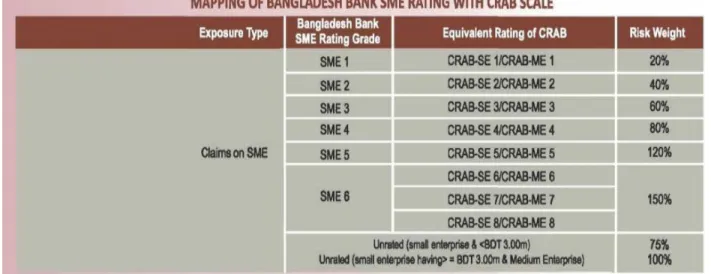
Ind Industry, 2. Business & Operation 3. Management 4. Financial 5. Project specific assessment. CRAB’s unique SME rating service ensures direct interact of the analysts with the businesses and exchange of knowledge of the industry, investors, lenders, rating process and clients.The rating scales and risk weights of CRAB’s SME ratings are shown in Figure 4.9.4 below
Figure CRAB rating scales for SME (Small & Medium Enterprise)
The Daily Star News Paper: Banks use expired credit ratings for lending
Many banks are adopting unfairness and unpoliced means to up a certain percentage of capital against their loans. As a result, Bd bank issued an order to instruct all the banks to calculate their capital requirement properly, under the BASEL III guidelines, according to the central Bank letter.
Now, there are eight credit rating agencies, in which giving Six notches. For example, CRAB’S highest rating is AAA and the lowest CD. The credit rating of a company will be downgraded if its business volume declines. Some bank adopt unfairness by using expired rating of business. It is to be followed that capital should be the major indicator to judge a bank’s financial health.
Hamaul Huq managing director of the credit Rating Agency of Bangladesh, told The Daily Star that banks might show reluctance in getting the latest rating to avoid additional cost. Banks should adopt updated rating even if sanctions loans. Name of some credit rating agencies are-1.
Credit Rating Agencies of bd 2. Emergency Credit Rating 3.; National Credit Rating 4. Argus Credit Rating Services. 5. Alpha Credit Rating, 5. WASO Credit Rating Company (BD) and 5. THE Bangladesh Rating Agency.
bank adopt unfairness by using
expired rating of business The Daily Star that
banks might show reluctance in getting
the latest rating to avoid additional cost Banks have to
maintain risk- weighted asset between 20pc and 150 pc for loans to business entities
CHAPTER-Four
PROCESS AND METHOLODY OF CREDIT
RATING in CRAB
4.1 Credit Rating Process:
CRAB’S ratings processes are introduced on a receipt of a formal request from the client. A rating consisting of Financial Analysts is related for conducting Rating assignment. The lead analyst is mainly concerned with the rating of relevant and material issued which may have an impact on the credit quality of the issuer Analysts Collected information from the client through documents, data meeting, site visits etc. CRAB is also count on secondary sources of information, including its own research division. Secondary Information are obtained mainly through meetings with the issuers bankers auditors, customers and suppliers After completing the analysis. Analysts prepare a Draft Rating Report, which is discussed in the internal Committee. Other meetings to get direct feedback from different stalk holder, CRAB organize meeting involving bankers, leaders, lawyers, trade union leaders, customers, suppliers, etc. The rating committee is the final authority for assigning Rating. The assigned Rating along with the key issues, is communication to the issuers top management for reception. Like Meeting with the issuer’s CEO/CFO to discuss various critical issues Rating team will discuss and come to a decision with the CEO/CFO. It is based on available information and possible interactions after giving the issuers adequacy notice requesting him to co-operative. The ratings are generally reviewed every year, unless the circumstance of the case warrant an earlier, review due to changes in circumstance or major development that was not factored in the rating decision. The rating may be in fluctuate like upgrade, downgrade or retained after the surveillance. CRAB are giving the time Line about one week after getting information and could be longer depending on the adequacy of the discussions with the management and the information provided by the client.
Figure-5.1 credit rating process
4.2
My role in CRAB as Intern:
Client & Factory Visit:
During my internship at CRAB I used to work under Mr. Atiqur Rahman and Mr. ArifBrilla ,who is the financial Analyst and Assistant Vice President& Co-Head (project) of Corporate Rating Unit.
CRAB a company that is concerned with rating of big corporate groups and companies has divided there financial year in four quarters namely. I started my internship from 12.02.2018 and ended on 13.5.2018.
Issuer permit rating assignment to CRAB
Analysis & Apprisal by CRAB analysts
Primary talk between issuer and rating team
of CRAB
Rating team introduced primary
rating report to internal committee
Issuer prepares&
submits required data requested by rating
team
Rating committee meeting
Additional information collected, visits, &
meeting with issuer &
management
Notification to issuer
Accept by issuer
Declaration of rating
Enunciation of credit analysis report
ongoing surveillance /formal annual review
I have been shifted to the rating teams of small and medium enterprise and corporates. I was selected from the members by the team leader to go for the factory visit. And as for this internship report I was also required to collect primary data of the small and medium Enterprises,
So, I grab this wonderful opportunity.
I went to visit the Gazipur factory. Here I have learnt how to collect primary data from a survey In my internship experience I learnt about the primary data collection and also collected the Required Primary data of few companies for the analytical part of this report.
Rating Report:
I learn about the procedures of preparing the rating reports for various clients like- individuals, small and medium enterprise corporates etc. of credit rating of Bangladesh (CRAB). The rating reports mainly varies based on the type of the client and industry. That is, SME and corporate rating standards are different as so does the individual client ratings. But the rating procedures of preparing the reports of different sorts of client. Actually, these reports are based on risk and other various factor analysis of the client or company. And these are compared to the flow of generating income or cash by the organization. And based on that comparison the clients or companies are given different sorts of ratings. So there is no fixed benchmark to provide rating in CRAB , rather it is comparative and intuitive.
Secondary Data Collection:
I Focused on collecting the data required for preparing the research paper in the secondary form.
CRAB has already more than 100 plus small and medium enterprise clients. So From their rating report if last year, I started collecting the personal, business and capital related information with the help of two of the research associates of CRAB Mr. Rawfoon Iqbal, Miss Tonya Roy and Miss Tabassum Taposhy assigned by Mr. Atiqur Rahman.
Team Work:
Since I have worked in different areas of CRAB. I have learned teamwork skills. I have received corporation with different staffs of CRAB so that I can gather sufficient experience in different areas of organization. I observed how the RCM played the leadership role in the monitoring the activities of different staffs of an organization. I learned from my experience at team member in rating department regarding efficient management skills needed to control the work activities of different department of all organization.
Strategic Management:
While working at Credit Rating Agency of Bangladesh, I also learned about how the organizational policy is fulfilled by different employees of an organization. I observed a chain of command maintained in CRAB. In which, the weekly rating committee’s meeting (RCM) provides relevant guidance to the respective team leaders. The team leaders of different teams then then provide necessary work regulations maintained by CRAB to the research associates and other staffs. In this regard, I have learned how strategically the activities are delegated to each staff in CRAB.
Operating Risk Analysis Corporate Governance CORORATE
RATING
Financial Strength Management Evaluation
Security Risk Analysis
General Rating Factors
Relationship Risk Analysis
4.3 Corporate Rating Methodology:
CRAB has developed highly standardized rating methodologies for different entities. The methodologies have been developed considering all the relevant factors affecting the future cash generation capacity of the issuers. Both qualitive and quantity factors should be considered in CRAB. These factors include industry characteristic competitive position of the issuer, operational efficiency, management quality, commitment to new projects and other associate companies, and future funding policies of the issuer.
CRAB rating methodology intends to assess the relative comfort level of the issuers to service the obligations and this is reflected in the rating of a debt instrument. In case of equity instruments, the rating reflects the future earning capabilities with reference to the resilience to perform in adverse situations.
Figure- 5.3 credit rating mythology
Operating Performance Business Risk Analysis
Industry Risk Analysis
Credit Risk Analysis
AJ FASHION COMPANY RARTING PROCESS:
AJ Fashion Company is one of the largest Manufacture of RMG (Woven Factory) company in Bangladesh. They make top and bottom woven garments for men and women, children. Today they have own embroidery unit like -Elastic, draw string, sewing thread, twill tape, Bunge cord , poly bag, etc. all produced by them. AJ fashion group wants to rating their company, that’s why they go to the credit rating company of Bangladesh. CRAB’S started to process their formal request from the AJ fashion group client. Before starting the rating, they gave checklist of the AJ Fashion company and AJ Fashion company fulfilled this checklist. The checklist is given the below- Information Checklist for the purpose of Credit Rating –
(Whichever Applicable)
[Please note that information requirement is not limited to the contents below]
1. Legal Documents – NID, TIN, Trade License, Export-Import License, Environment Clearance, Fire-Explosive-Narcotics NOCs and any other
2. Memorandum of Association, Article of Incorporation, Form X & XII, Directors’ Profile 3. Net worth Statement of the Proprietor/ Partners /Directors
4. All Sanction Letters (renewed/ proposal letter in case of renewal) from all bankers/Leasing Companies (in case multiple loan exists)
5. Outstanding Position (loan wise)
6. CA/CC/OD Statement for last 2 calendar years (Summary, Debit Sum-Credit Sum) 7. Past Performance Report for last 2 calendar years (loan wise interest/profit income) 8. Export-Import Performance for last 2 calendar years
9. Audited/Management Prepared Financial Statements of last 2 years at least 10. Stock, Receivable-Payable Report (any recent time)
11. Monthly Production and Sales Report for last 2 calendar years 12. List of Machinery and Equipment (latest)
15. Cover note of Insurance Policy paper
16. Group Profile – profile of associated concern, financial performance, loan limits and liability position (optional)
Than in order to rating AJ Fashion company it must obtain no refundable, no judicial 300- taka stamp paper before starting a rating assignment. As the rating fee is fixed by the Bangladesh bank there is no point bargain or arguing to reduce the rate. AJ Fashion company have paid without altering a single word for reducing the fees. For providing this service to their customers the main raw material is the overall information specifically the credit information about the client.
Factory visit:
The lead analyst went to visit their factories to collect all the detail information and they observed what are the proceeding to make clothes and also they collected information regarding like- the number of machineries, sales, During the current year some machineries item, raw materials, work environment, production process, price of the products, employees safety issue, payment of workers, internal process, salary of workers, cost efficiency, utility bills, providing their technical service, future capital expenditure, fire extinguisher system etc. Another thing they observed that they have well equipped medical clinic of their factory. Sometimes they give free treatment of the workers. AJ Fashion Company have arranged children care unit and they provide them with full meal food.
When they are all done to collect information then they go for own research division.
The lead analysts must be known about of AJ Fashion company’s current financial strength and as well as how the financial position may change in future.
Industry Risk Analysis:
Industry risk arises due to change in the market situation and from its own operation infrastructure. AJ Fashion company are focusing on the strength of industry prospects for growth.
Demand and supply of products Technology
Capital structure Market growth
Demand and supply of products: AJ Fashion company are fulfilling the customer's demand. They are trying to produce more varieties of products in a short time and always they are providing a large amount of some products. A consumer is willing to pay and purchasing the product at
15 million in knit garment factory yearly. They are exporting different kind of products like t- shirt, jeans, which Is very good for our country to earn remittances.
Market growth: The lead analysts look into the growth pattern of AJ Fashion company and also see their length and rate. They observed the growth rate, is it flat, accelerating and decline Technology: They are using modern technology- Kier Machine Boiler Compressor ETP, Opening section Dryer Hydro stators etc.
Control room MWM (Deutz) TCG2020V 16K:
MWM (Deutz) control room
Capital- AFC ( AJ FASHION COMPANY) is planning to go for raising capital through IPO worth BDT 1,500.0 million from capital market which is subject to the confirmation of BSEC. The Company estimated the use of IPO proceeds of which full amount is to be utilized to expand business. AJ Fashion Company several factors are considered, including the nature of its business environment and the principal fund flows from operations.
Industry outlook: Industry outlook risk vary from business to business.
The analysts are considering this thing-
Demand growth
Pricing flexibility
Business framework
Barriers entry
Capital intensity
Operation Analysis:
By analyzing CRAB finds out the existence of AJ Fashion Company’s strength which comes from the operation of the company. Several Factors have been considered here which are shown below-
Location of the production unit, Relationship with a customer, scale operation, Market Position, Cost Efficiency, Business Model.
Relationship Risk Analysis:
Client and Banking relationship is very important in the rating process. The analyst team visits the branch to meet with the bank professional to collect information about loan payment history, loan limit history, securities against a loan and related issues.
Management Evaluation:
A team of dedicated experienced managers carry out day to day business operations of the Company. The managers to perform day to day business of the Company competently.
Department heads from each division report to the board time to time with summary reports on the performance of the AJ Fashion Company. Major decisions regarding planning, procurement, sales, strategic and financials are taken by the Managing Director.
Financial Risk: When they are all done to collect of information, then they prepared a financial statement and ratio analysis. Which provide knowledge about how important is to know about
the company position as well as their rating. Aj Fashion company ratio analysis which is given below in the word and also showed in the excel file.
Financial flexibility- Primary source for financial flexibility is cash generated from operations. Cash flow analysis is more important to know the measurement of financial risk. AJ Fashion Company provides the cash flow because they want that their company has more secure credit protection to dependence on external sources.
Free Cash flow analysis: Free cash flow has to do firms operating decision and operating decision specifically excluding firm financing decision. Cash flow available for distinguishing all the securities holder of an organization.
Collateral Risk:
Collateral risk means risk associated with the collateral which has been given to the Bank or any financial institution for any debt taken by the company.
Key Ratios:
The operating cycle as well as cash conversion cycle prolonged a little bit in FY2016 due to marginal lingered inventory processing period of 88 days (2015: 85 days) and Receivable collection period of 117 days in 2017 (2015: 2705days). Payable payment period of 10 days in 2016 was almost at the same position compared to the previous year. Over the years’ trend history of cash conversion cycle indicates scope of improving working capital position for AFC.
The capital composition of the Company remained equity dominated with the increased equity portion of the Company to BDT 267.2 million as of 30 June 2016. Borrowed fund to equity of 0.4x times in 2016 indicated the Company’s dependence on equity financing. And level of leverage position.
A j Fashion company ratio analysis which is given below in the word and also showed in the excel file.
Financial ratios are used to make measurement of the financial performance of the AJ Fashion Company. I have done some specific ratio. CRAB rating seeks to understand the basis of management’s financial policies before drawing conclusions in this section of the credit analysis.
Several ratios are computed to measure debt leverage. The universal standard leverage measure is Total Debt/Equity, which considers all on-balance sheet debt obligations, including such short- term liabilities as bank overdrafts, relative to equity. Equity includes common and irredeemable preferred shares. Short term debt does expose a company to refinancing risk. When appropriate, off-balance sheet financial liabilities such as operating leases, joint venture debt, and guarantees, are considered through adjustments to the standard ratios
FCF/total debt- It indicates AJ fashion company capacity to pay debt with operating cash flow
Capital expenditures- a low ratio could indicate problem in the rate of replacement of plant, equipment. A strong ratio may indicate high-growth industries
FFO/ Capital expenditure- This ratio indicates AJ Fashion company’s intern flexibility to
meet its capital budget.
Debt ratio- Debt ratio indicates the leverage position of AJ Fashion Company. A debt ratio was less than .5 which is very less risk for the company.
Debt to equity: A relationship high debt to equity ratio company indicates an aggressive growth strategy by a company. A debt to equity ratio of 1.5 or lower is consider good. We can see the graph all ratio is below 1.5%., which is good for AJ Fashion company
Credit facility: A credit facility is a variety of different loan that a company brings on to meet its financial needs. If any business or corporate finance in need of operating capital they can loan extended by a bank. They can take several types of loan- short -term loan, long -term loan.
Process:
The Company has availed working capital facility from Eastern Bank Limited, Principal Branch, Dutch-Bangla Bank Limited, Local Office, Jamuna Bank Limited, Mohakhali Branch, IDLC Finance Limited and IPDC Finance Limited.
AFC has also availed a foreign term loan-II from DEG (Germany) of equivalent to BDT 578.6 million with quarterly instalment policy.
Detailed bank liability position of the Company is given in the appendix – 1.
CRAB has reaffirmed the ratings based on the past track record of the AJ Fashion company, operational performance, balance sheet performance, sanction letter of bank and Financial strength, of AJ Fashion Company. 2016 AJ Fashion company revenue 140 million which is better to previous year and net profit margin 5.0%. The Company reported operating profit margin of 135% where in bottom-line profit margin stood to 5% in the year 2016. It means it is Average for company. Ratio used by the company before awarding credit rating is that it can achieve AAA by following all these criteria Which includes If a company wants to have their sale above 1000 crore they should have leverage position around 1.5. If it’s above 2 or 3. It is estimated that a company can easily achieve AAA rating. The less receivable collection period inventories the organization will have a better rating and it will be easily awarded but all ratio varies from industry to industry.
If a partial industry has a higher receivable collection period, inventory period and cash conversion cycle and plenty of times the company can easily get a AAA and quick ratio definitely be greater than 1. But in this case AJ Fashion Company net profit is not up to the marks and Long- term loan above 17 core. The lead analysts observed everything’s then they gave the rating entity BBB3. Long-term rating BBB3 (CRAB considers Over Draft (OD) as long-term facility), and the ratings based on the past track record of the Company outlook stable of company. This rating is done by my perspective due to the lack of report of 2016 not provided by CRAB Company.
Analysts prepare a Draft Rating Report, which is discussed in the internal Committee. Next
meeting with the issuer’s CEO/CFO to discuss various critical issues Rating team will discuss and come to a decision with the CEO/CFO. It is based on available information and possible interactions after giving the issuers adequacy notice requesting him to co-operative. How they prepared Draft report it has been showed on the Appendix. As Draft report is very much confidential, company and the name of employees regarding it has been kept secret.
4.4. How CRAB does it survey by focusing on subject of crediting a company
CRAB’s mainly focusing on three particular things- Net profit, sales, sales growth. Prescribe that they also focus on weather net profit have been increased from the previous year. The amount of the loan borrowed limitation utilization of it. They also focused on credit sum as well as debit sum of loan amount.
Mainly it depends on the net amount not upon particular Ratio. As there is no regular range of it.
The more the best. As a result, they pickup same industry of different company’s ratio compare for their rating purpose
.
CHAPTER- Five
Ratio Analysis
Ratio Analysis
5 .1Liquidity Ratio:
Liquidity ratio describe how a company to pay debt obligation and his ability calculate metrics which include current ratio, quick ratio and how it will operate cash flow ratio.Current Ratio: Current ratio reflects a company ability to pay both short-long term obligation Formula: current asset/ current liability
Year 2014 2015 2016
Current Ratio 2.8496495 0.8973903 2.0401719
3
Current Ratio
2.5 2.849649452
2
2.04017194 1.5
1
0.5 0.897390289
0
Implication: In 2016 and 2014 the ratio was good with 2.04 but in other hand year 2015 the ratio dropped to 0.89 which is not good for AJ Fashion Company. Increase the ability to pay short-term and long-term Liability.
Quick Ratio: It reflects the ability of a company whether it has sufficient short-term asset to cover when it faces immediate liability.
Formula: (current asset – Inventory)/ Current Liability
Year 2014 2015 2016
Quick Ratio 2.8496495 1.3245392 1.2611307
Implication: Companies with an acid -test ratio of less than 1 it’s means do not have enough liquid asset to pay their current liabilities. The ratio was increased each year from 2014 to 2016.It is good sign for the company. The ratios remaining more than 1. So, the company has the capability to cover immediate liabilities.
Net Working Capital Turnover: It indicates company’s efficiency in using its working capital.
Formula: Net Sales/ Ang. Net W.C
2014 2015
2016 3
2.5 2 1.5 1 0.5 0
Quick Ratio
Net working capital turnover
12.761784 11.779768 13.390748
Implication: In 2014 and 2016 the ratio was good with 12.76 & 13.39 but in other year ratio was little bit dropped by 11.78. Lower net working capital indicates that AJ Fashion group less efficient to pay off its current liability.
Cash Ratio: It reflects how a company can quickly repay its short-term debt.
Formula: Cash/ Current liability.
Year 2014 2015 2016
Cash Ratio 0.0578589 0.6212967 0.5831049
2014 2015
2015 14
13.5 13 12.5 12 11.5 11 10.5
Net working Capital Turnover
Implication: AJ Fashion company cash ratio is less than 1; there are more current liability than cash and cash equivalents. In the situation, there is insufficient cash on hand to pay off short term debt.
Cash Conversion Cycle:
Formula: (inventory/cost of goods sold) *365+(account receivable/net sales)*365+(account payable/ cost of goods sold)*365)*
Year 2014 2015 2016
Cash Conversion Cycle
81.534295 85.766785 88.843016
Implication: Lower cash conversion are better. In 2014 cash conversion cycle is better than the
2014 2015
2016 0.7
0.6 0.5 0.4 0.3 0.2 0.1 0
Cash Ratio
3 2
1 90
88 86 84 82 80 78 76
Cash conversion cycle
Receivable Turnover: It reflects the ability to measure the effectiveness in extending credits and in collecting debt on according this credit.
Formula: credit sales/ avg. receivable
Year 2014 2015 2016
Receivable Turnover 1.2646927 1.7739811 3.0950865
Implication: In 2015 and 2014, Receivable ratio is 1.77 & 1.26 times and 2016 it is 3.095times which indicates credit sales in marketing effort. Increasing credit sales is not good for the company.
Receivable Collection Period: It is the period of time during which the debt and credit sales is made and the days when payment it received from credit sales.
Formula: 365/receivable turnover
Year 2014 2015 2016
Receivable collection period
288.60765 205.75191 117.92885
2014 2015
2016 3.5
3 2.5 2 1.5 1 0.5 0
Receivable Turnover Ratio
Implication: A lower average collection period is more favorable than a higher average collection period. A lower average collection period indicates that the organization is collecting payment faster. In 2016 collection period is 117 days which is better for company but 2015 and 2014 it increased 205days & 288 days which indicates that more days need to collect receivable.
Payable Turnover: It’s the ratio which it’s used to quantified the rate the companies pays off to its suppliers.
Formula: credit purchase/ Avg. payable
Year 2014 2015 2016
Credit purchase 1707.0689 718.76023 34.034924
2014 2015
2016 2016.5
2016 2015.5 2015 2014.5 2014 2013.5 2013
Average Receivable collection period
Implication: In 2016, Account payable turnover ratio is 34 and next two year it is 718.76
&1707.06, which indicates the more efficiency company can delay the payment.
Payable collection period: It is the number of bases taken by the company to pay its account payable.
Formula: 365/ payable turnover ratio:
Year 2014 2015 2016
Payable collection period
0.2138168 0.5078189 10.724278
Implication: The number of days has decreased in year 2014 & 2015 than the year in 2016 which shows higher capability of paying trade credit. This is a good sign of AJ Fashion company.
2014 2015
2016 2000
1500 1000 500 0
Payable Turnover Ratio
2014 2015
2016 12
10 8 6 4 2 0
Average payable collection period
Inventory Turnover: It reflects the ratio for period of time which show how efficiently inventory to manage by comparing cost of goods sold.
Formula: COGS/Avg. inventory
Year 2014 2015 2016
Inventory Turnover Nil 6.9570503 2.1690754
Implication: AJ Fashion company Ltd. In2015, Inventory Turnover ratio is 6.95 times which seems preferable in respect to 2016, decreased in 2.169 times. Over all AJ Fashion company, they are efficient to manage their inventory. In 2014 there is no inventory in this company. Don’t know how to they manage on that time.
Profitability:
Its analysis the difference public sector on their ability of profitability ratios.Return on Asset: It’s a percentage which reflects how efficiency management can be done generate earnings in a comparison among peers in the same industry.
Formula: Net Profit/ Total asset
Year 2014 2015 2016
ROA 0.0549394 0.1231691 0.1481233
2014 2015
2016 8
6 4 2 0
Inventory Turnover
Implication: Here we calculate AJ Fashion Company ROA by dividing Net income by total asset, we find net income from income statement which is reported on an annual report. So, In the graph we can that ROA is highest in the year 2016 like 14% & also in the 2015 like 12%. It means in the year of 2016 &2015 company used their asset more efficiently. More over in the year 2014 the ROA is look like 5% which indicates their management inefficiency.
Return on Equity: It indicates the ratio that we investors used to measure how a company income is returned as shareholder equity.
Formula: Net profit/ Shareholder Equity
Year 2014 2015 2016
ROE 0.0508758 0.2036147 0.2650059
2014 2015
2016 0.2
0.15 0.1 0.05 0
ROA
0.3 0.25 0.2 0.15 0.1 0.05 0
ROE
Implication: ROE AJ Fashion Company is highest at the year of 2016. It indicates at the year 2016 their investment was more effective than the other year.2016 highly drop down but at the year of 2015 ROE also increase.
Operating Profit Margin: It reflects the operational efficiency of the firm and its ability to cover the expenses in operating system.
Formula: operating income/ net sales
Year 2014 2015 2016
Operating profit Margin
4 1.5803319 1.3531913
Implication: In2014 the ration is higher and in 2015 & 2016 the ratio is lower. A higher operating margin is more favorable compare with a lower ratio because this shows that company is making enough money from its ongoing operation to pay for its variable cost as well as its fee cost.
Net profit margin: It reflects the overall efficiently in operating to the business and used to measure relationship between net profit and sales.
Formula: Net profit/ Sales
Year 2014 2015 2016
Net Profit Margin 0.0096738 0.0416322 0.0505991
2014 2015
2016 4
3 2 1 0
Operarting Profit Margin
Implication: In 2016 the result was 0.051 or 5.1%, on the other-hand in 2015 & 2014 the net profit was 0.041 or 4.1% and 0.9%. Between the years in 20106the company had a handsome profit margin in percentages and oppositely in 2015 net profit margin was better than the year 2014
Gross profit Margin: It indicates how to measure the percentage of gross profit in comparison to sales.
Formula: (revenue- cogs)/revenue
Year 2014 2015 2016
Gross profit margin 0.0932148 0.1203315 0.1143251
2014 2015
2015 0.06
0.05 0.04 0.03 0.02 0.01 0
Net Profit Margin
Implication: In 2015 & 2016 the ratio was 12% and 11% which means it’s a good for AJ fashion company. A higher gross profit means company did well manage its cost of sales. In 2014 gross profit margin little bit decrease than the other ratio.
Solvency Ratio:
It reflect ability of a company meet its debt and other obligations both short and long- term liabilitiesDebt to Equity: It indicates the ratio of amount of debt and equity to finance a company asset.
Formula: Total liabilities/ total shareholder.
Year 2014 2015 2016
Debt to equity 0.4246687 0.6531311 0.7890896
2014 2015
2016 0.15
0.1 0.05 0
Gross Profit Margin
Implication: A relationship high debt to equity ratio company indicates an aggressive growth strategy by a company. A debt to equity ratio of 1.5 or lower is consider good. We can see the graph all ratio is below 1.5%., which is good for AJ Fashion company.
Long term debt to asset: The long-term debt to total assets ratio is a measurement representing the percentage of a corporation’s assets finance with loans and other debt obligation lasting more than one year.
Formula: long- term debt/ total asset
Year 2014 2015 2016
Long Term debt to asset
0.4173226 0.6166713 0.6557061
Implication: In 2014 the ratio was 0.41 which means it’s a good for company. Less than 0.5 is
2014 2015
2016 1
0.8 0.6 0.4 0.2 0
Debt to Equity
2014 2015
2016 0.7
0.6 0.5 0.4 0.3 0.2 0.1 0
Long term debt to asset
Loan to asset ratio: It is calculated by dividing the amount of loans by the amount of total asset at a company.
Formula: total loan / total asset
Year 2014 2016 2016
Loan to asset ratio 0.29 0.37 0.37
Implication: This ratio measure AJ Fashion company long-term source of fund. In 2016 & 2015 this leverage ratio was 37% which means long term funds come from depositor deposit rather than the stockholder’s equity. On the other hand, in 2014 the long-term debt to equity ratio was 29% which was less than 2016 &2015.
Operation Cash flow: Free cash flow has to do firms operating decision and operating decision specifically excluding firm financing decision.
Formula- EBIT+ Depreciation- tax
Year 2014 2015 2016
Operation cash flow 81,271,957 114,105,490 93,598,030
2014 2015
2016 0.40
0.35 0.30 0.25 0.20 0.15 0.10 0.05 0.00
Loan to asset ratio
Implication: In 2015 the ratio was indicate that AJ Fashion company has generate more cash in this period
Total Debt:
Formula: total liabilities/ total asset
Year 2014 2015 2016
Total debt 0.29 0.39 0.44
Implication: A debt ratio of .5 is to be very less risky for the company. Compare to these three diagrams all of them were less than 0.5. which is good for company.
2014 2015
2016 120,000,000
100,000,000 80,000,000 60,000,000 40,000,000 20,000,000 0
Operating cash flow
2014 2015
2016 0.5
0.4 0.3 0.2 0.1 0
Total debt ratio
Formula-operating cashflow/ total debt
Year2014 2014 2015 2016
FCF/Debt 1.24 0.94 0.53
Implication: In 2014 the ratio was good because higher percentage ratio is better the company’s carry to ability and service its total debt.
FFO/Debt: To calculate the fund from operation to total debt ratio.
Formula- fund form operation/ total debt
Year 2014 2015 2016
FFO/Debt 0.26 0.85 0.43
FFO/ DEBT
1 0.8 0.6 0.4 0.2 0
2016 2015 2014
1.4 1.2 1 0.8 0.6 0.4 0.2 0
FCF/Debt
2016 2015 2014
Implication: 2015 ratio is higher than the previous ratio. High ratio means Aj fashion company carries less risk which is good for company.
Bank Financial strength Rating
Controls & Risk Management
Asset Quality Corporate Governance
Earnings & Volatility Earning Diversification
Liquidity and funding Sector Adjustment
5.4 CRAB’s BANK RATING METHOLOGY:
CRAB’s look into the current year efficiency level
Last five years Balance sheet trend
Asset Quality:
Future Earnings
Non-performing Loan status
Gross NPL Ratio
Liquidity Risk:
Liquidity risk of bank’s asset and liabilities
Input output
Capital Adequacy
Asset Quality & Provisioning