Vegetable Classification
BY
MD ATIKUR RAHMAN ID: 163-15-8410
AND
MD RAKIBUL HASAN ID: 162-15-7805
This Report Presented in Partial Fulfilments of the Requirements for the Degree of Bachelor of Science in Computer Science and Engineering
Supervised By MOST. HASNA HENA ASSISTANT PROFESSOR
Department of CSE
Daffodil International University Co-Supervised By
MR. AHMED AL MARUF LECTURER
Department of CSE
Daffodil International University
DAFFODIL INTERNATIONAL UNIVERSITY
, DHAKA, BANGLADESH
APPROVAL
This Project/internship titled “Vegetable Classification” submitted by Md Rakibul Hasan, Md Atikur Rahman, ID No: 162-15-7805, 163-15-8410 to the Department of Computer Science and Engineering, Daffodil International University has been accepted as satisfactory for the partial fulfilment of the requirements for the degree of B.Sc. in Computer Science and Engineering and approved as to its style and contents. The presentation has been held on 27 January 2021.
BOARD OF EXAMINERS
Dr. Touhid Bhuiyan Professor and Head
Department of Computer Science and Engineering Faculty of Science & Information Technology Daffodil International University
Chairman
Gazi Zahirul Islam Assistant Professor
Department of Computer Science and Engineering Faculty of Science & Information Technology Daffodil International University
Internal Examiner
iii
©Daffodil International University
Raja Tariqul Hasan Tusher Senior Lecturer
Department of Computer Science and Engineering Faculty of Science & Information Technology Daffodil International University
Internal Examiner
Dr. Dewan Md. Farid Associate Professor
Department of Computer Science and Engineering United International University
External Examiner
DECLARATION
We hereby declare that, this project has been done by us under the supervision of Most Hana Hena, Assistant Professor, Department of CSE Daffodil International University. We also declare that neither this project nor any part of this project has been submitted elsewhere for award of any degree or diploma.
Supervised by:
Name: Most Hasna Hena Assistant Professor
Department of CSE
Daffodil International University
Co-Supervised by:
Name : Mr Ahmed al Maruf Lecturer Department of CSE Daffodil International University
Submitted by:
Md Atikur Rahman ID: 163-15-8410 Department of CSE
Daffodil International University
Md Rakibul Hasan ID: 162-15-7805 Department of CSE
Daffodil International University
v
©Daffodil International University
ACKNOWLEDGEMENT
First, we express our heartiest thanks and gratefulness to almighty God for His divine blessing makes us possible to complete the final year project/internship successfully.
We really grateful and wish our profound our indebtedness to Supervisor Most Hasna Hena, Assistant Professor, Department of CSE Daffodil International University, Dhaka. Deep Knowledge & keen interest of our supervisor in the field of “Image Detection” to carry out this project. His endless patience, scholarly guidance, continual encouragement, constant and energetic supervision, constructive criticism, valuable advice, reading many inferior drafts and correcting them at all stage have made it possible to complete this project.
We would like to express our heartiest gratitude to Syed Akhter Hossain and Head, Department of CSE, for his kind help to finish our project and also to other faculty member and the staff of CSE department of Daffodil International University.
We would like to thank our entire course mate in Daffodil International University, who took part in this discuss while completing the course work.
Finally, we must acknowledge with due respect the constant support and patients of our parents.
ABSTRACT
Computer vision and example acknowledgement is an arising territory in perceiving objects in a picture. The advancements for perceiving objects in pictures have a wide reach of uses, for example, vegetable and natural product discovery frameworks, vehicle discovery, and different frameworks. Our examination work centers on the discovery of vegetable assortments into building up a proficient vegetable acknowledgement framework. The vegetables may show up the same by shading and different highlights, for instance, red tomato and red capsicum as similar tones so utilizing highlights for distinguishing vegetables may prompt bogus discovery so this exploration work proposes an intraclass vegetable acknowledgement framework utilizing profound learning. we used three types of vegetables: Cauliflower, Carrots, Tomato। Profound learning used to identify the vegetable class by removing and learning the pictures and investigated the convolution neural network (CNN). From the consequences of the assessment, intraclass vegetables perceived precisely with 95.50% and proficiently utilizing profound learning.
vi
©Daffodil International University i
TABLE OF CONTENTS
CONTENTS PAGE
Approval ii
Board of examiners iii
Declaration iii-iv
Acknowledgements v
Abstract vi
CHAPTER
CHAPTER 1: Introduction 1-5
1.1 introduction 1
1.2 Motivation 2
1.3. Rationale of Study 3
1.4. Research Questions 4
1.5. Expected Output 4
1.6. Report layout 5
CHAPTER 02: Related Work 6-19
2.1 Related Work 6
2.2 Challenges 19
Chapter 03: Research Methodology 20-25 3.1 Research Subject and Instrumentation 20
3.2. Dataset Utilized 22
3.3. Statistical Analysis 23
3.4. Proposed Methodology 24
3.5. Implementation Requirements 25
Chapter 04: Experimental Results and Discussion 27-30
4.1. Experimental Setup 27
4.2. Experimental Results & Analysis 30
CHAPTER 5 : Summary, Conclusion, 31-32 Recommendation and Implication
for Future Research
5.1 Summary of the Study 31
5.2 Conclusion 32
5. 3 Implication for Further Study 32
REFERENCES 33
ix
©Daffodil International University LIST OF FIGURES
FIGURES PAGE
NO Figure 2.1: Flow diagram of fruit and vegetable detection system [2] 7 Figure. 2.2: Proposed vegetable Identification system using CNN.[4] 9 Figure. 2.3: Sequences of vegetable classification.[8] 13
Figure. 2.4 Portrayal of the planned system [12] 17
Figure 3.1: Dataset structure 21
Figure 3.2: Data reading algorithm 22
Figure 3.3: Feature extraction algorithm 23
Figure 3.4: dataset distribution 24
Figure 3.5: Proposed Methodology 25
Figure 4.1: Summary of the model 27
Figure 4.2: Train accuracy 28
Figure 4.3: Train Loss 29
Figure 4.4: Validation Accuracy 29
Figure 4.5: Validation Loss 30
Figure 4.6: Confusion matrix. 31
Chapter 1
1.1 INTRODUCTION:
Vegetables are one of the most significant parts of our day to day life. It’s a necessity for all human beings and also for animals. There are around ten thousand of plant species in the world that are considered as vegetables.
Around 50 or so significant plant species are economically available of all these vegetables. It is necessary to identify vegetables in subclasses or groups so that they can be properly understood or addressed. Vegetables that have similar behaviour and characteristics should be put together. There are various kinds of classifications such as botanical classification which includes genus, species, family, class, subspecies and etc., categorization regarding life cycle, weather or temperature, culture, used plant part and many more. [13]
Vegetable Detection is a frequent feature of vision-based techniques for the identification of plants from videos or photographs. Nowadays deep learning methods are widely used to classify various types of fruits and vegetables. The recent detection and classification of vegetables are mostly focused on the use of convolutional neural networks (CNN) to establish a proper end-to-end recognition system of vegetables. In the field of vegetable identification and recognition system, some major techniques which are applied widely are: You Look Only Once (YOLO), faster CNN (F-RCNN), Tensor Flow, SVM, SSD, etc.[14].
1
There are so many automated systems among the world for vegetable classification and detection but for this research, we are going to analyse about Bangladeshi vegetables and their classifications. A large data collection of various vegetation has been included in this research. For feature extraction, we have converted the image into an array and for classification, we have applied the CNN algorithm to get the greatest output for this system.
1.2 MOTIVATION:
In this modern world, vegetation classification is one of the most vital sectors.
There are enormous advantages that can be accessed by vegetation identification. Many kinds of research have been executed with vegetable detection but those are not for our country. And the existing systems which have been developed before, those have a poor outcome. For this reason, we have decided to study on our indigenous vegetables with a comparatively better set of data collection.
As maximum people of Bangladesh somehow depend on vegetation, some people for their livelihood and some to meet their demand for food, we have chosen to work on our desi vegetables for this research. This digitized process can be beneficial in so many ways. The new generation of this terrain can be able to know about the desi vegetables and their groupings. Then they can easily identify which vegetable is to use for which purpose. This research is going to help thoroughly for the digitalization of vegetation.
3
©Daffodil International University
So, estimating the prospective result of the method we have taken a decision to build a system that can identify different vegetables and its subclasses properly. The main purpose of this study is to establish an efficient framework with a rich dataset that can generate a better identification system of vegetables for the common inhabitants of Bangladesh.
1.3 RATIONALE OF THE STUDY:
A lot of research has been conducted on vegetation categorization, but mostly they are foreign vegetation systems. There are almost 164 million people living in Bangladesh and most of them depend on vegetables for living. But there is no well-established system for classifying vegetables in our country.
As Bangladesh is a land of agriculture, many people just depend on it. And as it is a developing country, the Government wants the country to grow through agriculture. For that reason, there must be an automatic classification system for vegetables.
Vegetation classifying plays a remarkable role in this recent digital world. The application of this technology may be beneficial in multiple ways such as government organizations, medical sectors, agricultural departments of Bangladesh, automated categorization of supermarkets, and etc. To enhance the usage of this kind of identification technologies using Bengali vegetables for the common generation of this country we get inquisitive to study it.
1.4 RESEARCH QUESTION:
• How can we gather data on various vegetation types?
• For feature extraction which techniques will be more applicable?
• For classification which algorithms should be applied to get the best accurate result?
• Can this research be beneficial for people of all walks of life?
1.5 EXPECTED OUTCOME:
The prospective outcome of this research is to construct a system to digitize the classification system of different vegetables of Bangladesh for the new generations so that they can know better about it. This kind of system may collaborate in numerous ways:
• This system may help the salesmen of super shops to categorize various vegetables in different sections so that the consumers can find their desired items easily.
• This research can be applied in several ways in agriculture. Such as plant acclimatization, farming, pest control services, storing vegetables, sorting them for sale, etc. [15]. It may be useful for the farmers of Bangladesh and benefit the agricultural sector.
• This application may also be efficient for land surveying, observing and recording the total number of plants and classifying them into subclasses.
5
©Daffodil International University
• A better dataset had been provided in this work which is full of indigenous vegetables. This dataset may help the researchers to build a better system in the future.
1.6 REPORT LAYOUT:
In chapter 1, this paper mainly describes three things. What, why, and how we do this project. Basically, the reasonable reason behind this research with prospective results is discussed elaborately in this chapter.
In chapter 2, the literature review of related research of this sector has been presented here. Comparison between their works and essence also reported in this section. Here we consider the scope of our project and interpret the challenges.
In chapter 3, this report shows the methodology which has been applied in this work. Several theoretical issues regarding this research are also described. The data collection process, pre-processing of data, feature extraction, and the procedure of classification are narrated in this chapter.
In chapter 4, the outcome from the previous part has been shown and analysed in this chapter.
In chapter 5, a synopsis of this study is highlighted in this section.
Recommendations for further work, execution of the system, and some limitations of our proposed method are also narrated in the final portion of the report.
Chapter 2
2.1 RELATED WORK:
In 2018, Feeling, Olsson et. al [1] published a paper describing a method of vegetables and fruits recognition system using captured pictures and a system attached video camera in the retail shop. The goal of the system is to reduce the amount of human-computer intercommunications, quicken the process of recognition and increase the accessibility of the GUI relative to current manual processes. They used Raspberry Pi, an 800 by the 480-pixel display screen, an 8-megapixels resolution camera, a processor for running the system, and a method of activation to represent the scale for the system's hardware. They used a dataset from ImageNet which has been extracted with 400 pictures per class and for the camera used in this experiment, 30 photographs per class were also collected. They assigned 10 separate classes of fruits and vegetables in their analysis. For the classification, they used two CNN frameworks: Mobile Net and Inception, and assessed it by two phases of accuracy and propagation time. 97 percent accuracy has gotten from the Mobile Net top 3 testing’s and that’s quite faster. Nevertheless, the top 3 precision is outstanding, Mobile Net still has some trouble in forecasting kiwis and clementine’s. It can be developed by increasing the number of pictures in the dataset. Retraining data sets from the real-life environment may make the system more reliable. A positive outcome of the developed method was suggested by the heuristic evaluation. Some features were missing from their system and the users had given some helpful feedback that helped them
7
©Daffodil International University
enhance the architecture. Users reported that there were no usability defects after 3 successive sessions but they wished for a bigger screen for display. For future studies, they are interested to collect more pictures of fruits and vegetables so that they can divide the classes into subclasses.
In 2013, Dubey et. al [2] invented a method for the issue of classification of vegetable and fruit where the photos of vegetables and fruits are taken as input and the species and diversity are returned as output. They have used a dataset of fifteen distinct types of vegetables and fruits from a supermarket which contains a total of 2615 pictures. The system performs in three stages: image segmentation, extraction of features, and training and classification.
Fig. 2.1: Flow diagram of fruit and vegetable detection system [2]
In this preferred system, image segmentation is performed by applying the Kmeans clustering method and they measure the ISADH feature for each color image channel and merge it to create a single histogram. For training
and classification purposes, they used MCSVM. This paper also measured the efficiency of ISADH for the support vector machine and the nearest neighbor classifier and shows that the support vector machine is a superior option for training and classification. They have found through the experiment that the HSV color space is much better than the RGB color space. For getting better accuracy they have examined five features. The system was trained with forty pictures per class and got an average accuracy of 93.62% in GCH, 95.27% in CCV, 95.82% in BIC, 96.96% in UNSER, and 98.90% in ISADH feature.
They concluded that the suggested feature is verified for the problem of identification of vegetable and fruit and provides reasonably more consistent output compared to other features.
In 2017, Tippannavar et. al [3] introduced a method of vegetable plant detection and the classification of unusualness applying leaf texture exploration. For examination, they used 500 leaf pictures of six several kinds of vegetables. The total method was performed by using MATLAB. For the preprocessing of images median and trilateral filters were applied. The leaf portion was separated by the simplest threshold method and the morphological operation from the background, the color and texture features are extracted by the Color correlograms and Fractal (SFTA) features respectively. These features were trained for classification. Two Types of classification for the detection of vegetable and finding the unusualness of leaf: k-NN and PNN.
The accuracy of the k-nearest neighbor algorithm for vegetable identification was 86.39% and the unusualness of leaf was 75.04%, where the accuracy of the Probabilistic Neural Network algorithm for vegetable identification was 75.70% and the unusualness of leaf was 71.24%. For future experiments, they
9
©Daffodil International University
may include diseases of various seasons and on several lands in the dataset.
They also have a desire for improving the system by comprising some high- level features like shape features (counterlet transforms, higher-order statistics, Zernike moments, etc).
In 2020, Duth P et. al [4] researched a new method of vegetable intraclass identification system using deep learning instead of using. Different varieties of inter-class and intra-class vegetables were identified by the exploration of CNN (Convolution Neural Network) which reduced misclassification and appropriately identified inter and intraclass vegetables. The dataset contained 24 several types of vegetables with the intraclass of them. 3924 pictures were used in total, where 3210 pictures were applied to train data and 714 pictures were applied to test data.
For training the data, at first, pictures were read and then resized and normalized the picture for preprocessing. After completing the preprocessing they applied the CNN model using Keras.
Fig. 2.2: Proposed vegetable Identification system using CNN.[4]
Then the trained data was preserved in a hierarchical data format H5 file, which was later used for testing the data for detecting the class of vegetables.
They found 95.50% of accuracy with their proposed method (CNN) which was far better than the combined features and YOLO algorithm after a successful experiment. For future research, they want to improve the system by applying more deep learning techniques such as DNN and DBN and they have a plan for upgrading the identification system by using cameras in shops and markets.
In 2019, Bahia, Rani et. al [5] proposed a machine learning technique to identify vegetables and fruit. They had used the dataset of Dubey and Jalal (2015) which consisted of 2615 photos in total with a variety of 15 kinds of vegetables and fruits. The total system was organized into three steps:
Subtraction of the background, colour along with the texture feature, and finally classification. K-mean clustering was applied for the subtraction of the background. They had used both HSI and RGB colour spaces for extracting the colour features. Total 9 colour features were extracted: 3 using HSI and 6 using RGB. The texture was measured by an object’s outer portion which was applied to determine the coarseness, roughness, and smoothness of the picture.
7 textural features were extracted in the study: 5 features like correlation, energy, contrast, entropy, homogeneity were extracted by GLCM, and the other 2 features had been extracted with the support of the other 2 techniques LBP and HOG. They applied the SVM method to train the dataset and for classification. They also applied KNN to compare the performance of their proposed classifier. After the comparison, they found the precision of SVM
11
©Daffodil International University
was better than the KNN method. They got 94.3% of accuracy with their proposed method. They also showed that this research got a much better result than other existing methods. As the dataset contains multifarious fruits and vegetables in a single picture, they want to work with a single vegetable or fruit in a single photo. They also have the intention of including more photos of vegetables and fruits in their dataset and applying deep learning techniques to it.
In 2019, Sachin C, N Manasa et. al [6] described a technique for detecting and classifying three several green vegetables of various sizes. They used a dataset that was made up of 180 test photos which involved the combined settings of among all 3 vegetables. They had used the You Only Look Once algorithm and darknet for the implementation of the system which is known as a TensorFlow version. The OpenCV Python Library, named cv2, was applied there. Both CPU and GPU are run by TensorFlow. There they used GPU for their proposed algorithm as it is faster than CPU. For the accomplishment of the system at first, they manually removed the outliers of the pictures from their dataset. Then they drew boundary boxes around the vegetables in the training dataset. After that, they generated an XML document of every picture which contained the dimensions of the bounding boxes and the classes of vegetables. Then they loaded the XML documents as input to the YOLO network and stored the trained weights. Thereafter they fed the trained weights and test dataset into the network. The network predicted the boundary box dimensions and the vegetable’s classes. Then they applied OpenCV for drawing the boundary box and displaying the class level. Next, they updated the YOLO configuration file with the number of classes the network had used
to classify. Their model successfully identified and classified more than 50%
of photos and 70% of videos. And finally, they had got a 61.6% of precision with their research work. For further augmentation, they want to work with 3D pictures in place of 2D pictures and they also have a will to research an automatic harvest system.
In 2020, Ahmad, Minallah et. al [7] designed a machine learning technique for classifying vegetables based on remote susception. The goal of this study was to categorize vegetables into various types. The database they used in this system was free which was from a Copernicus platform. It contained satellite pictures from the world which was updated gradually. They also collected some data by field examinations using an app. Those ground truth data were for the details about the individual coordinates of available plants of those fields. The raw picture acquired from the Copernicus website was cut into a smaller picture that contained the concerned region after processing the ground truth data. The total process which was called stacking was done by SNAP software. For the preprocessing of this system, they applied both unsupervised and supervised algorithms using ENVI software. SVM and ANN were used as supervised learning algorithms while the K-Means Clustering algorithm was applied as an unsupervised learning algorithm to classify the vegetation process. Non-vegetation things were also categorized by the system. This research achieved a great precision of 92.46% with ANN, 90% precision with SVM, and a poor precision of 50.78% with K-Means Clustering. Many governments authorized companies and organizations could be helped by this research. The data could be used for much statistical analysis
13
©Daffodil International University
of crops and their position on the map. The places obtained from the map would also help for future urbanization.
In 2018, Patil et. al [8] constructed a model applying TensorFlow for edible herbs classification. The inquiry of this system was Inception-v3 based Tensor flow method, which used OpenCV as a primary library database. For hardware, they had used an HP pavilion sixth generation computer which contains 8GB memory and 64-bit WIndows-10 operating system. Sony Xperia X-Plus with 4GB RAM smartphone was used as testing hardware in this system. Four several types of edible herbs were used for making the dataset:
Tomatoes, Cucumbers, Carrots, and Onions. The constructing method of this vegetable pictures classification system was sorted into 4 separate steps:
Fig. 2.3: Sequences of vegetable classification.[8]
They had applied a supervised learning CNN to preprocess the pictures and labeled the data. Then they applied transfer learning on the Inception-V3 model. They retained the prior layer’s parameter, evacuated the last layer, and then input the dataset for retraining the latest final layer. Propagation
Algorithm was applied to train the final layer of the system and the weight parameter was adjusted by Cross-entropy Cost Function. The precision of this identification system was found 99% and that was more dependable for the users as a classification system of vegetables.
In 2010, Rocha, Hauagge et. al [9] had built an automated vegetable and fruit categorization method using pictures. They examined statistical color-texture features and also functional appearance descriptive terms for categorizing vegetables and fruits in a multi-class context. They also evaluated many states of the art features of Computer Vision in a variety of formats and organized the system with pretty good precision applying cross-validation based procedures which produced the incorporation of the best classifiers and features into a single cohesive method. For making the dataset they collected pictures from the local distribution centre of fruits and vegetables for five months which they named as a supermarket produced data collection. They used a Canon Powershot-P1 camera for taking pictures for their dataset. Their dataset was made up of fifteen several categories and had 2633 pictures in total. They had applied the k-means algorithm for the background subtraction of the pictures. This study investigated many appearances, colour, texture, and shape-based picture descriptors, and various machine learning strategies in the search for the right classification techniques and features for categorization.
They had applied LDA, SVM, K-NN, and classification tree classifiers and BIC, GCH, CCV, Unser features for the system’s classification. They didn’t narrate the accuracy rate in their article but they showed that their suggested method could decrease the error rate up to 15 percent regarding the baseline.
15
©Daffodil International University
In 2009, Seng et. al [10] had created a system for identifying fruits. Their proposed system had followed three techniques for analysis to raise the accuracy of detection. Those are color, shape, and sized based features. 50 photos of fruits had been gathered for the experiment’s training and testing purposes. They had trained 36 photos and the other 14 photos were applied for testing. The K-Nearest Neighbor algorithm was applied to the system to identify and classify the fruits. They followed some steps to conduct the classification process. Firstly they selected the picture of the fruit and then cut off the area of that fruit. After that, they calculated the mean value for RGB color elements, decreased noises, organized the geometrical values, and morphological operations. Then they applied KNN into the system for classifying the picture and determining the output. From this Fruit detection method, they had achieved an accuracy of 90%. This study would be very effective in several fields such as: retrieving pictures, educational and environmental science.
In 2019, Nosseir et. al [11] originated a method of an automated classification system for several fruit species and detection of putrid fruits applying SVM and KNN algorithms. The algorithms they had applied in this research regarding the features of color and texture of the pictures of the fruit. They used 4 types of fruits for their experiment: Apple, Banana, Mango, and Strawberry, and those were from Shutter-Stock, COFI-Lab, I- Stock, and some other origins. While preprocessing the photos at first they transformed the pictures into gray, then increased contrast for decreasing noises and enriched the picture quality. The median filtering method was also applied for elimination noises. FFT and GCLM were applied to extract colour and texture
features. A Non-parametric method named k-nearest neighbor had been applied for the classification of the system. 6 types of KNN classifiers were applied to get the accurate result: weighted KNN, medium KNN, cubic KNN, cosine KNN, fine KNN, and coarse KNN and the training outcome was 95%, 93.8%, 90%, 83.8%, 96.3%, and 25% respectively. They took forty-six photos of those four kinds of fruits for testing and got 100% accurate output. After that, they examined both fresh and putrid fruits to differentiate them. They had extracted the texture and color features and then they applied quadratic SVM and linear SVM algorithms. The accuracy of the quadratic SVM was better than the linear. For quadratic, the result was 98% accurate and for linear, the result was 96% accurate.
In 2019, PL. Chithra et. al [12] had prepared a model to classify the fruits applying processing methods of pictures. They used a total of 140 pictures for training and 50 for testing, where the training dataset contained 70 banana and 70 apple photos, and the testing dataset contained 25 banana and 25 apple photos. MATLAB was applied for executing the algorithms and Support Vector Machine (SVM) was used as a classifier for this fruit detection system.
17
©Daffodil International University
Fig. 2.4 Portrayal of the planned system[12]
Some steps were followers to execute the method. In the beginning, they loaded the RGB pictures and converted them into HSI. then they took the Hue component picture for subtracting the background of it. After that, they applied OTSU’s method for achieving the threshold and extracting ROI to fill up the holes. Then the ROI based picture was loaded. Next, they extracted the features exercising wavelet transformation applying Haar filters. Then they applied SVM to them for classifying Banana and apple pictures. While the experiment result was compared to KNN they had found that SVM delivered 100% of precision.
Vegetation detection may help in various ways. Sometimes it can assist the government organisations to gather information about different vegetable plants and their classes. They can use the data for different kinds of surveys and also for making reports about several plants or herbs. The new generation
of this country will recognize the vegetables from a new point of view. The botanic classification of several vegetables will introduce the people to multiple classes of the same piece of edible herbs. This application will also help in the field of agriculture in Bangladesh. It will help a lot for cultivating new vegetable categories, storing them by their groups and selling them to markets. The digitalized process of vegetable detection can increase the country’s economy. This system can be beneficial for supermarkets. The customers and shopkeepers both will be benefited from this. So obviously this application can help the general public for identifying the vegetation easily.
2.3 CHALLENGES:
1. Data Collection: Collecting data for any kind of research is the most usual challenge. Actually, it was more challenging for making a dataset only with desi vegetables as there is no systematic dataset for Bangladeshi edible herbs. Moreover, collecting images from different sources was also troublesome for us. We had to visit several places for gathering pictures because it was not feasible for us to gather all pictures from a fixed area.
2. Noise Removing: Reducing noises from a photograph was another big challenge for us. Capturing photos with higher ISOs in low light can introduce noise into the acquired pictures. Sometimes redundant noises become very excessive so that the quality of the photos can be ruined.
Certain high-end cameras manage noises better than prosumer versions,
19
©Daffodil International University
but some noise reduction techniques in post-production can enhance each High-ISO picture.
3. Same Vegetable Multiple Classes: For building up this application we have to use several vegetables and all of them are desi edible herbs. As there are multiple classes or groups for a single vegetable, we had to face many difficulties to read those same kinds of pictures as input. The machine sometimes considers the vegetables of different groups belong to the same class. For solving this problem we have to make a large dataset with lots of photos of various vegetables with their subclasses.
3. Model Selection: Although there are lots of researches with vegetation detection systems that have been executed before, it’s still very complex for us to work with only desi crops. The works that have been conducted before, most of them are for foreign countries with their native vegetables and their groups. It was really very hard for us to select a better model by which we would get the best results.
CHAPTER 3 Research Methodology
3.1 Research Subject and Instrumentation
In this section we will discuss our data collection techniques and instruments.
We collected mainly three types of vegetables. The collected vegetables are.
Cauliflower Carrots
Tomato
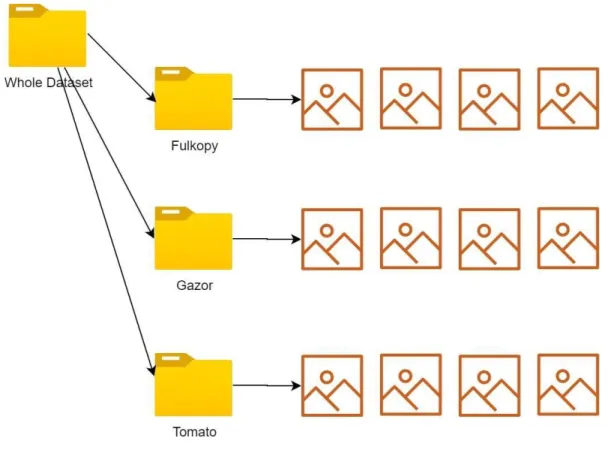
We collected around 700 images from different places.
Figure 3.1 will describe the data set structure
21
©Daffodil International University Figure 3.1: dataset structure
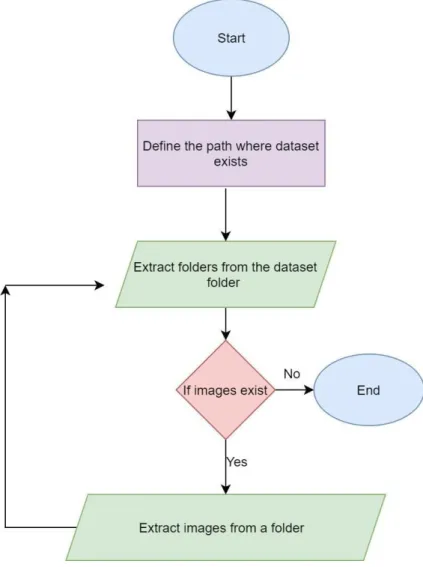
Figure 3.2 is the dataset reading algorithm. That means how we read images for extracting the features so that we can use them to feed into our model.
Figure 3.2: Data reading algorithm
3.2 Dataset Utilized
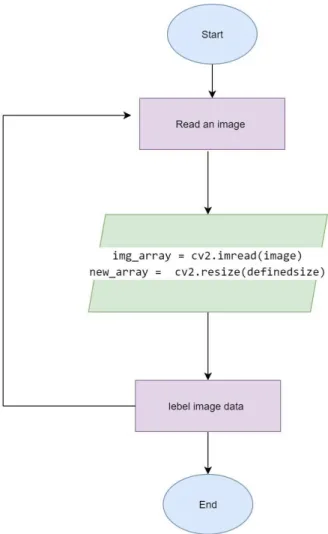
Collecting raw pictures is always challenging. We collected pictures of vegetables from different vegetable firms. Almost 700 images of three kinds of vegetables were found. By converting images into arrays we start our work and then let CNN do the rest of the work. In figure 3.3 the feature extraction process has been explained.
23
©Daffodil International University
Figure 3.3: Feature extraction algorithm 3.3 Statistical Analysis
In this section we will discuss our dataset in detail.
Table 3.1: Dataset information Name of
vegetable
Number of vegetables
Single vegetable image
Multiple vegetable in an image
Cauliflower 292 83% 17%
Carrots 261 77% 23%
Tomato 315 71% 29%
Mainly we collected 2 types of pictures of every vegetable those are:
• Single vegetable images
• Group images of vegetables
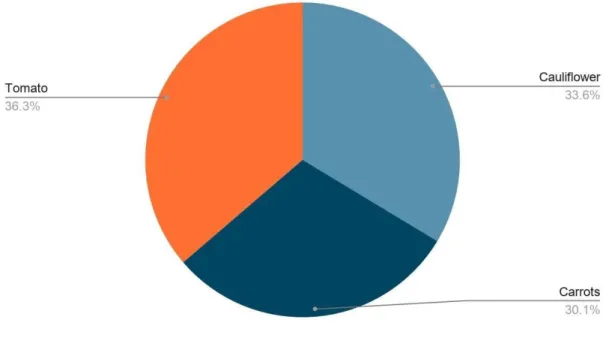
In figure 3.4 we tried to visualize our dataset distribution.
Figure 3.4: dataset distribution
3.4 Proposed Methodology
25
©Daffodil International University
This work followed a strategy or procedure for getting an extreme outcome.
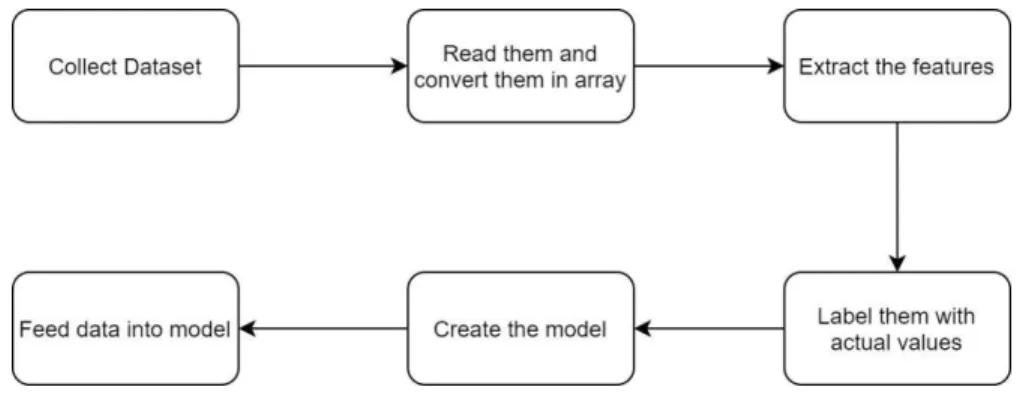
Figure 3.5 will examine our technique quickly.
Figure 3.5: Proposed Methodology
As indicated by the figure, our first work is gathering crude information and name them by putting away into organizers and afterward the most significant and complex work which is separating the highlights and name them as indicated by district name. What's more, finally train models utilizing that information.
3.5 Implementation Requirements
Python 3.8:
Python is a high-level programming language [16]. It can be used for desktop GUI and web applications but most importantly it has a rich resource in data science and machine learning. Which actually helps us to complete our work
easily. The less complexity and easiness of python programming language increases its acceptance to all the tech enthusiasts. And we used the 3.8+
version in our research work which is the updated version of the time.
Anaconda 4.5.12:
This the free and open source distribution of python [17]. This is also available for R programming language. This is actually a bundle installer. By installing a single thing it installs lots of necessary tools for data science. Even it comes with a concept of a virtual environment. We can isolate different projects from each other so that we can use different requirements for each of them. We used 4.5.12 version of anaconda, the updated version of the time.
Jupyter notebook:
We used a jupyter notebook for writing the code [18]. This is actually a web based open source which allows you to write codes, visualize the data, using equations and a lot more. We used the 6.0.3 version of the Jupyter notebook.
Keras: keras is a deep learning library which is written in python language [19]. This library actually makes the work easy. They already developed the calculation parts; we just use them in the proper place according to our necessary. In the backend, keras is using tensorflow. There are some other libraries which are using keras as backends but keras is most developed and rich. We used keras 2.3 with the tensorflow 2.0 version. This work used keras and tensorflow for experimenting the deep neural network on its dataset.
27
©Daffodil International University
Sickie learn: This is a python free library which features various classification, clustering and regression algorithms [20]. It makes it easy to use those algorithms. We used multiple algorithms on our work from the library. The used algorithms are listed below:
• Support vector machine
• Logistic regression
• K-nearest neighbour
• Random forest
CHAPTER 4
Experimental Results and Discussion
4.1 Experimental Setup
In the past section, we finished our information assortment, preprocessing, include extraction and set an approach to arrive at the objective. As per the strategy now we need to apply CNN shows better outcomes so we will examine these three methods in this part. We attempted arbitrary timberland in our dataset. We utilized 80% of the information for preparing reason and 20% for testing the model.
Below figure will describe the summary of the model.
Figure 4.1: Summary of the model
And below figures (4.2,4.3,4.4 4.5) will show us the training accuracy, train loss, validation accuracy, validation loss of the model according to epochs.
We used 15 epochs for this model.
29
©Daffodil International University Figure 4.2: Train accuracy
Figure 4.3: Train Loss
Figure 4.4: Validation Accuracy
Figure 4.5: Validation Loss
So from above figures we got train accuracy 95.50% and validation accuracy near 70%
4.2 Experimental Results & Analysis
The confusion matrix of validation has been given below
31
©Daffodil International University Figure 4.6: Confusion matrix.
CHAPTER 5
Summary, Conclusion, Recommendation and Implication for Future Research
5.1 Summary of the Study
This research project’s main goal is to recognize vegetables. To digitize the current world we need to give understanding to the machines. We extracted the images array with the help of opencv and used convolutional neural networks for extracting the features and training the model. And after all we
got 100% training accuracy and 65% validation accuracy for validation we used 20% of our dataset.
5.2 Conclusion
Vegetables are the most important food in our dining. If we can recognize the vegetables in future we may do further research on it. Every person has to go to a super shop to buy vegetables. If we can make a system where vegetables are detected and counted as other products we may reduce the waste of time.
So we are in the process now we are 65% accurate and in future we want to increase it.
5. 3 Implication for Further Study
We have to think about a better version of any existing things. Same as we have a plan of future work with this project.
• Increase the dataset as we have very few data.
• Increase the category
• Work with the improvement of the accuracy
• Detecting the vitamins and calories with the vegetables.
33
©Daffodil International University REFERENCES:
1. Femling, Frida & Olsson, Adam & Alonso-Fernandez, Fernando.
(2018). Fruit and Vegetable Identification Using Machine Learning for Retail Applications. 9-15. 10.1109/SITIS.2018.00013.
2. Dubey, Shiv & Jalal, Anand. (2013). Species and Variety Detection of Fruits and Vegetables from Images. International Journal of Applied Pattern Recognition. 1. 108 – 126. 10.1504/IJAPR.2013.052343.
3. Tippannavar, Sandhya & Soma, Shridevi. (2017). A Machine Learning System For Recognition Of Vegetable Plant And Classification Of Abnormality Using Leaf Texture Analysis. International Journal of Scientific & Engineering Research. 8. 1558-1563.
10.14299/ijser.2017.06.008.
4. Duth, Sudharshan & .K, Jayasimha. (2020). Intra Class Vegetable Recognition System using Deep Learning. 602-606.
10.1109/ICICCS48265.2020.9121164.
5. Bahia, Nimratveer & Rani, Rajneesh & Kamboj, Aman & Kakkar, Deepti. (2019). Hybrid Feature Extraction and Machine Learning Approach for Fruits and Vegetable Classification. Pertanika Journal of Science and Technology. 1693-1708.
6. C, Sachin & Manasa, N & Sharma, Vicky & A A, Nippun Kumaar.
(2019). Vegetable Classification Using You Only Look Once Algorithm. 101-107. 10.1109/ICon-CuTE47290.2019.8991457.
7. Ahmad, Arbab & Minallah, Nasru & Ahmed, Nasir & Ahmad, Arbab
& Fazal, Nouman. (2020). Remote Sensing Based Vegetation
Classification Using Machine Learning Algorithms.
1-6.
10.1109/AECT47998.2020.9194217.
8. Patil, Om. (2018). Classification of Vegetables using TensorFlow.
International Journal for Research in Applied Science and Engineering Technology. 6. 2926-2934. 10.22214/ijraset.2018.4488.
9. Rocha, Anderson & Hauagge, Daniel & Wainer, Jacques &
Goldenstein, Siome. (2010). Automatic fruit and vegetable classification from images. Computers and Electronics in Agriculture.
70. 96-104. 10.1016/j.compag.2009.09.002.
10. Seng, Woo & Mirisaee, Seyed. (2009). A new method for fruits
recognition system. Proceedings of the 2009 International Conference on Electrical Engineering and Informatics, ICEEI 2009. 1. 130 - 134.
10.1109/ICEEI.2009.5254804.
11. no, Ann & Ahmed, Seif. (2019). Automatic Classification for Fruits’
Types and Identification of Rotten Ones Using k-NN and SVM.
International Journal of Online and Biomedical Engineering (iJOE). 15.
47. 10.3991/ijoe.v15i03.9832.
12. Pl, Chithra & Henila, M. (2019). Fruits Classification Using Image Processing Techniques. 7. 131-135. 10.26438/ijcse/v7si5.
13. Dhaliwal, Major. (2017). Classification of Vegetable Crops.
14. La, Rajasekar & Sharmila, Dhulipalla & Rameshkumar, Madhumithaa
& Yuwaraj, Balram. (2021). Performance Analysis of Fruits Classification System Using Deep Learning Techniques.
10.1007/978981-15-5243-4_26.
35
©Daffodil International University
15. Rubatzky, Vincent & Yamaguchi, Mas. (1997). Vegetable Classification. 10.1007/978-1-4615-6015-9_3.
![Fig. 2.1: Flow diagram of fruit and vegetable detection system [2]](https://thumb-ap.123doks.com/thumbv2/filepdfnet/11090287.0/17.918.232.692.525.841/fig-2-1-flow-diagram-fruit-vegetable-detection.webp)
![Fig. 2.2: Proposed vegetable Identification system using CNN.[4]](https://thumb-ap.123doks.com/thumbv2/filepdfnet/11090287.0/19.918.211.715.706.1003/fig-2-2-proposed-vegetable-identification-using-cnn.webp)
![Fig. 2.3: Sequences of vegetable classification.[8]](https://thumb-ap.123doks.com/thumbv2/filepdfnet/11090287.0/23.918.315.606.561.832/fig-2-3-sequences-of-vegetable-classification-8.webp)
![Fig. 2.4 Portrayal of the planned system[12]](https://thumb-ap.123doks.com/thumbv2/filepdfnet/11090287.0/27.918.258.662.116.447/fig-2-portrayal-of-the-planned-system-12.webp)