JUNE, 2006
SHER-E-BANGLA AGRICULTURAL UNIVERSITY DHAKA-1207
DEPARTMENT OF AG RI CULTURAL EXTENSION AND INFORMATION SYSTEM
MD. ARSHADUZZAMAN KHAN
IMPACT OF GRAMEEN BANK MICRO-CREDIT PROGRAM TOW ARDS UPLIFTING THE SOCIO-
ECONOMIC CONDITION OF RURAL WOMEN
BENEFICIARIES
(Prof. Md. Shadat Ulla) Chairman
Examination Committee
(Mohammad Hossain Bhuiyan) Professor
Co-supervisor (Md. Shadat Ulla)
Professor Supervisor
Approved by
SEMESTER: JANUARY-JUNE, 2006
AGRICULTURAL EXTENSION AND INFORMATION SYSTEM IN
MASTER OF SCIENCE A Thesis
Submitted to the Faculty of Agriculture, Sher-e-Bangla Agricultural University, Dhaka, in partial fulfillment of the requirements for the degree of
REGISTRATION NO. : 25296/00399
BY
MD. ARSHADUZZAMAN KHAN
IMP ACT OF GRAMEEN BANK MICRO-CREDIT PROGRAM TOW ARDS UPLIFTING THE SOCIO-
ECONOMIC CONDITION OF RURAL WOMEN
BENEFICIARIES
(Md. Shadat Ulla) Professor Supervisor Dated:
Dhaka, Bangladesh
I further certify that such help or source of information, as has been availed of during the course of this investigation has duly been acknowledged.
This is to certify that thesis entitled "Impact of Grameen Bank Micro-credit Program towards Uplifting the Socio-economic Condition of Rural Women Beneficiaries" submitted
to
the Faculty of Agriculture, Sher-e- Bangla Agricultural University, Dhaka, in partial fulfillment of the requirements for the degree of MASTER OF SCIENCEIN
AGRICULTURAL EXTENSION AND INFORMATION SYSTEM,
embodies the result of a piece of
bona fide
research work carried out byMd.
Arshaduzzaman Khan, Roll No.00399, Registration No.
7.~.f.9.Q(.Q.Q~9..9.
under my supervision and guidance. No part of the thesis has been submitted for any other degree or diploma.OF/l{,rzIPICJ{PE
.-
.. , LJ
'
. ·' ···--
l
Heart-felt thanks and appreciations are also expressed to the Branch Managers and the Field Workers of Grameen Bank in the study area for their benevolent helps and co- operations in the time of data collection. Special thanks are to the rural women beneficiaries of Grarneen Bank in the study area who managed themselves to give their valuable time during interviews for the collection of data.The author is highly indebted to his parents, brothers, sisters, well-wishers especially friends for their blessings and inspirations, co-operations in all phases of this academic pursuit from the very beginning to the end.
June, 2006 The author
The author expresses his cordial thanks and sincere appreciations to the head of the department and all other respected teachers of 'Department of Agricultural Extension and Information System' for their valuable instructions and encouragements throughout the whole course of study. Deep sense of gratitude and profound regards are also expressed to other respectable teachers from other departments for providing proper guidelines and suggestions, which were helpful for developing the research study.
The author also desires to express his profound gratefulness to co-supervisor, Professor Mohammad Hossain Bhuiyan. He inspired the author to undertake such a study and assisted the author to build the foundation of the research project. He provided creative suggestions, proper guidelines, helpful comments and cordial co- operations throughout the period of this research program.
The author wishes to record his deep sense of gratitude and heartfelt thanks to his thesis supervisor Professor Md. Shadat Ulla for his noble guidance, constructive criticism, constant stimulation and encouragement throughout the study, without which this work might not have come to the present shape. His scholarly suggestions and affectionate behavior has been a fountain of great inspiration for the author.
All praises and appreciations are to almighty Allah who enabled the author in handling related issues at different stages of completion of this work.
ACKNOWL EDGEMENT
II
CHAPTER TITLE PAGE
NO.
ACKNOWLEDGEMENT I
LIST OF CONTENTS II-VII
LIST OF TABLES VIII-IX
LIST OF FIGURES
x
LIST OF APPENDICES XI
LIST OF ABBREVIATIONS XII
ABSTRACT XIII
CHAPTER 1: INTRODUCTION 1-9
1.1
General background
1.2 Statement of the problem
41.3 Objectives of the study 6
1.4
Justification of the study
71.5 Assumptions and
limitations of the study 81.5. l Assumptions of the study
81.5.2 Limitations of the study
91.6
Definition of important terms
1 lCHAPTER 2: REVIEW OF LITERATURE 14-26
2.1 Studies relating to concept of poverty, poverty
14alleviation, loan
disbursement condition2.1.1 Concept of poverty
142.1.2 Concept of relative and absolute poverty 16 2.1.3 Loan disbursement condition and
poverty 17alleviation efforts
2.1.4
Recent loan disbursement situation of Bangladesh 182.2 Studies Relating To Causes of Poverty
192.3 Studies Relating To
Reduction of Poverty and20
Impact of Micro-Credit
2.3.l How to reduce poverty: Reviews relating to socio- 20
economic development and impact of micro-creditLIST OF CONT ENT S
37 26 27-46
27
28
31 31 32 33 34 34 3434
34
35 35
35
37
25
24
24 24 25
25 25
22III
Education and
povertyalleviation Family size and poverty alleviation Farm size and poverty alleviation
Credit availability and poverty alleviation Cosmopoliteness and poverty alleviation
Duration of involvement and poverty alleviation
Attitude towards Grameen Bank micro-credit
program and poverty alleviation Conceptual framework of the study METHODOLOGY
Local and population Sampling procedure
Instruments for collection of data Data collection
Data processing and analysis
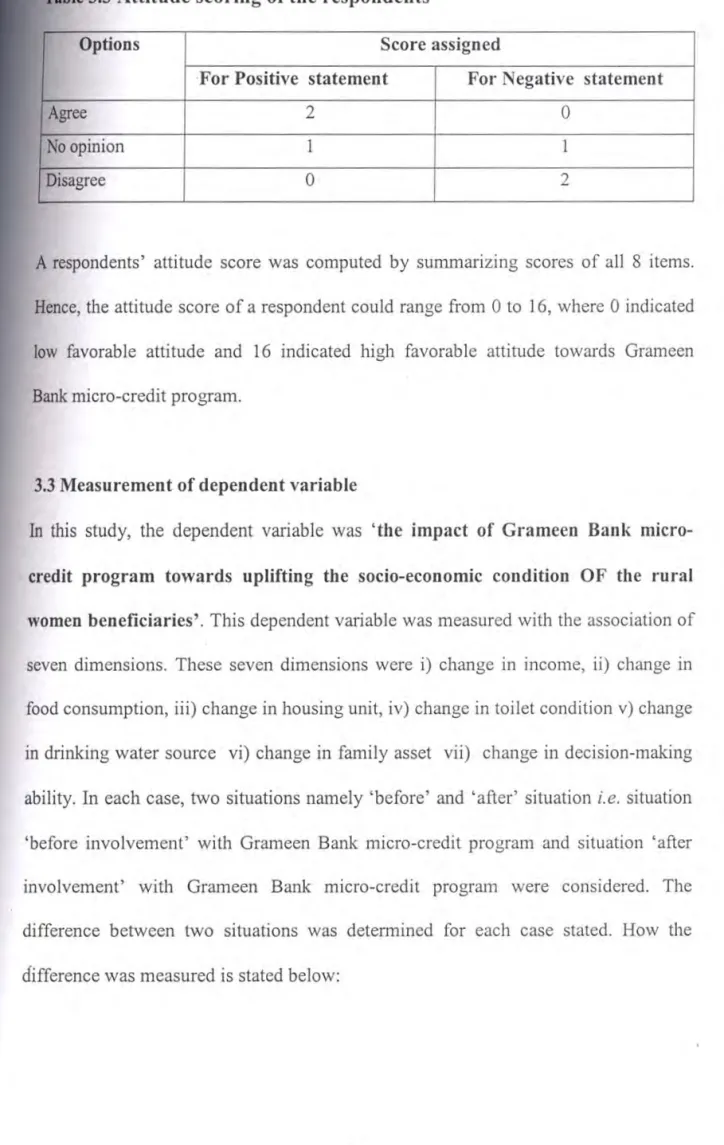
Hypothesis of the study Measurement of variables
Measurement of
independent variablesAge
Education Family size
Farmsize Credit received Cosmopoliteness
Duration of involvement
with Grarneen Bank micro-credit
programAttitude towards Grameen Bank micro-credit prog.
3.2.1.8 2.5 CHAPTER 3:
3.1. l
3.1.2
3.1.33.1.4 3.1.5
3.1.63.2 3.2.1 3.2.1.1
3.2.1.2
3.2.1.3 3.2. l.4 3.2.1.5 3.2.1.6 3.2.1.72.4.3 2.4.4 2.4.5 2.4.6 2.4.7 2.4.8 2.4.1 2.4.2
2.4 Relationship between poverty alleviation and selected characteristics of the rural women beneficiaries
Age and poverty alleviation C ont ent s (Co nt' d)
Studies relating to Impact of micro-credit
2.3.254 54 55 57 59 59 60
61
53 47 49
50 50 51 52 52
47-78
47
rv
4.2 4.2.1 4.2.2
4.2.3 4.2.4
4.2.5 4.2.6
4.2.7 4.1.8
4.1. l 4.1.2
4.1.3
4.1.4
4.1.5 4.1.6
4.1.7
Selected characteristics of the Grameen Bank women beneficiaries
Age Education Family size Fann size Credit received
CosmopolitenessDuration of involvement with Grameen Bank micro-credit program
Attitude towards Grameen Bank micro-credit Program
The extent of change in some dimensions Change in income
Change in food consumption Change in housing unit Change in toilet condition Change in drinking water source Change in family asset
Change in decision-making ability
4.1micro-credit program
CHAPTER
4: FINDINGS AND DISCUSSION Contents (Cont'd)
3.3 Measurement of dependent variables 38
3.3.1 Change in income 39
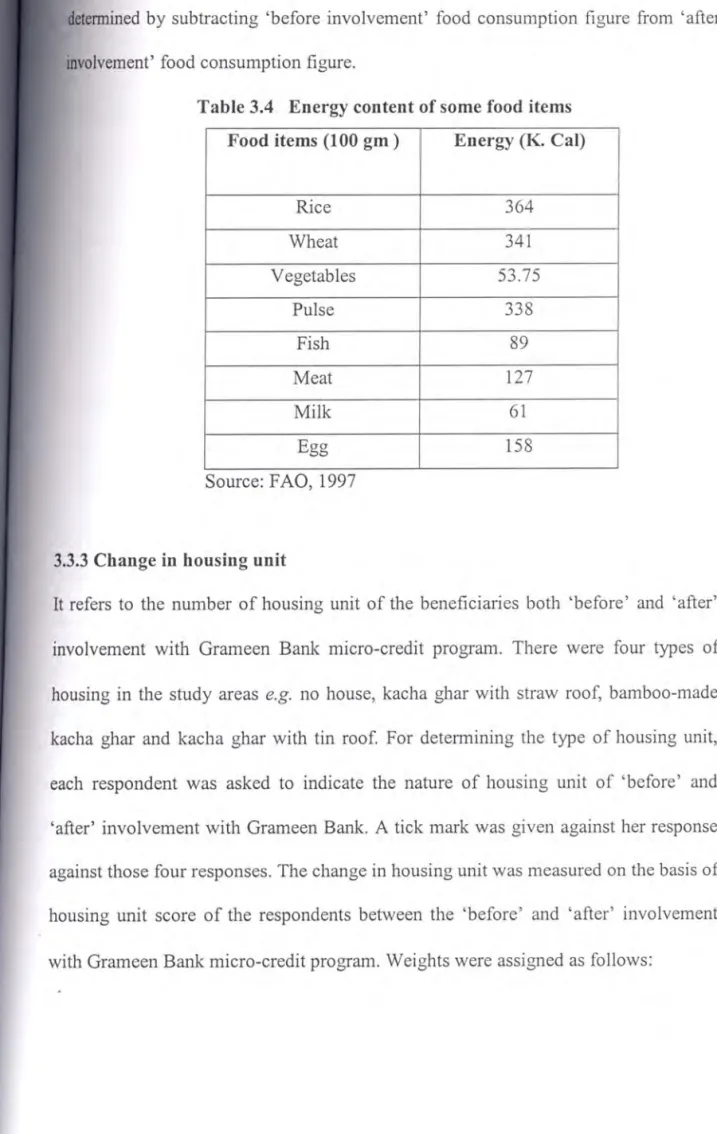
3.3.2 Change in food consumption 39
3.3.3 Change in housing unit 40
3.3.4 Change
in toilet condition41
3.3.5 Change in drinking water source 42
3.3.6 Change in family asset 43
3.3.7 Change in decision-making 44
3.4 Measurement of score of 'impact of Grameen Bank 45
76
75 73 72 71 7068 67 66
64 6362
v
Relationship between the respondents' selected characteristics and the impact of Grameen Bank micro-credit program
Relationship between age of the respondents and the impact of Grameen Bank micro-credit program Relationship between education of the respondents and the impact of Grameen Bank micro-credit program
Relationship between family size of the respondents and the impact of Grameen Bank micro-credit program
Relationship between farm size of the respondents and the impact of Grameen Bank micro-credit program
Relationship between credit received of the respondents and the impact of Grameen Bank micro-credit program
Relationship between cosmopoliteness of the respondents and the impact of Grameen Bank micro-credit program
Relationship between duration of involvement with impact of Grameen Bank micro-credit program Relationship between attitude of the respondents towards Grameen Bank micro-credit program and the impact of micro-credit program
Problem faced by the Grameen Bank women
beneficiaries 111 receiving and utilizing micro credit
Insufficient amount of credit as per demand Impact of Grameen Bank micro-credit program
Cont ents (Cont' d )
4.5.1 4.5 4.4.8 4.4.7.
4.4.6 4.4.5 4.4.4 4.4.3 4.4.2 4.4. l
4.3
4 . .4
82 82 83 83
84 8485
85 86 86 81 81
79 79
80 80 80 80 8179
VI
Credit received Cosmopoliteness
Duration of involvement with Grameen Bank micro-credit program
Attitude towards Grameen Bank micro-credit Program
Selected characteristics (dependent variable) of the respondents
Change in income
Change in food consumption Change in housing unit Change in toilet condition
Change in source in drinking water Change in family asset
Change in decision-making ability
Impact of Grameen Bank micro-credit program Summary of hypothesis testing
Relationship between the respondents selected Selected characteristics (independent variables) of the respondents
Age Education Family size Fann size
5.2.l
5.2.2 5.2.3 5.2.45.2.5 5.2.6
5.2.7 5.3
5.4 5.5 5.2 5.1.8
5.1.1 5.1.2 5.1.3 5.1.4 5.1.5 5.1.6 5.1.7 5.1
CHAPTER 5: SUMMARY OF FINDINGS, CONCLUSION AND 79-84 RECOMMENDATIONS
78 76 77
77 77 Contents (Cont'd)
Credit is not available in the time of need High rate of interest
Pay back period starts early
The misuse of credit for repayment of former loan
The misuse of credit for another activities 4.5.6
4.5.2 4.5.3 4.5.4 4.5.5
87 89 89 90
92-96
87
VII
5.7.2 Recommendations for further study
BIBLIO GRAPHY
characteristics and the impact of Gramccn Bank micro-credit program
Problem faced by the Grameen Bank women beneficiaries in receiving and utilizing the micro- credit
Conclusions Recommendations
Recommendations for policy implication 5.7
5.7 5.7.1
5.6
58 56 55
54 46
48 43
44
36 38
40
41 41 42
28
18 PAGE
NO.
17
VITI
Grameen Bank women beneficiaries
Salient features on the impact of Grameen Bank micro- credit program (in case of income)
Salient features on the impact of Grameen Bank micro- credit program (in case of food consumption)
Distribution of the respondents according to their calorie intake
A summary statement showing categories and salient features of some dimensions.
Categorizations of dimension
A summary statement showing categories and salient features of the selected characteristics of the
NGOs' disbursement of micro-credit showing the amount of credit as a part of poverty alleviation program Disbursement of micro-credit by GOs and NGOs in Bangladesh
Distribution of population and sample of the rural women beneficiaries in the villages under 11 Number Maricha Union
The scoring of cosmopoliteness Attitude scoring of the respondents Energy content of some food items Scoring of housing unit
Scoring of toilet condition Scoring of drinking water source Scoring of family asset
Scoring of change in decision-making ability TITLE
LIST O F TABLES
4.4 4.3.2 4.3.1 4.2 3.10
4.1
3.2
3.3
3.4
3.5
3.6
3.7 3.8 3.9 3.1 2.2 TABLE
NO.
2.1
76 64 62
61IX
Salient features on the impact of Gramecn Bank micro- credit program
Number and percentage distribution of the respondents according to their impact
Co-efficient of correlation showing relationship between the respondents selected characteristics and the impact of Grameen Bank micro- credit program
Major problems encountered by the respondents in connection with Grameen Bank micro-credit program
Ta bles
4.8 4.7 4.6 4.5
x
FIGURE TITLE PAGE
NO. NO.
2.1 The deprivation trap (Chambers, 1983) 15 2.2 A simple conceptual framework for the study 26 3.1 A map of Dinajpur District showing Birganj Upazila 29 3.2 A map ofBirganj Upazila showing the study area 30
LIST OF FIGURES
XIV
rx-xui
1-VIJI
PAGE NO.
XI
C Correlation matrix showing inter-correlations among all of the variables
B A glimpse of Grameen Bank
A An English version of the interview schedule
•
APPENDIX TITLE NO.
LIST OF APPENDICES
XII
= Asian Development Bank
= Adarsha Gram Project
= Association for Social Advancement
=Bangladesh Bureau of Statistics
= Bangladesh Rural Development Board
=Co-operative for American Relief Everywhere
=All Others
=Food and Agricultural Organization
= Grameen Bank
= Government Organization
=Government of Bangladesh
=International Fund for Agriculture Development
=Institute of Food and Nutrition and Food Science
=Kilo Calorie
= Mohila Bittahin Samabay Samity
=Non-government Organization
= Palli Daridra Bimochan Foundation
= Rangpur Dinajpur Rural Service
=Thousand
=Taka
= Thengamara Mohila Sabuj Sangha
=United Nations Development Program
=United States Dollar
=Page
ADB
AGP ASA
BBS
BRAC CARE et al.
FAO
GB GO GOB
IFAD
!NFS K. Cal.
MBBS
NGO
PDBF RDRS Th.
Tk.
TMSS
UNDP
US$
p.
FULLWORD ABBREVIATION
ABBREVIATION AND GLOSSARY
XIII
program 57 per cent beneficiaries' families used their own tube well for drinking water. Fifty (50) per cent beneficiaries were found to fall under the category of low asset possession 'before involvement' and that figure has decreased to 23 'after involvement' with Grameen Bank micro-credit program. Forty six percent respondents fell into low impact category where 47% and 7% of the respondents were found to be in medium impact and high impact category respectively. Age, farm size, credit received characteristics were found to have significant relationship at 1 % level of significance and attitude was significant relationship at 5% level of significance with the impact of Grameen Bank micro-credit program. Insufficient amount of credit as per demand ranked first as a problem faced by the beneficiaries.
The income, food consumption increased significantly after involvement with Grameen Bank. The average yearly income of the respondent's households increased to Tk. 33.32 thousands. from Tk 27.85 thousands. The average per capita daily calorie intake increased to 2319.08 K.Cal. from 2131.25 K.Cal. Nineteen (19) per cent of the beneficiaries were found to lie below under poverty line II (food consumption up to 1805 K. Cal.), but figure became of 10 per cent 'after involvement' with Grameen Bank micro-credit program. Seventy per cent of the beneficiaries had kacha ghar with straw roof type housing before involvement but the figure reduced to 32 after involvement. Fifty three (53) per cent of the respondents used to go to open places for toilet purpose 'before involvement' but 'after involvement' this figure turned to 24.
Thirty seven (37) per cent respondent's families had own tube well for drinking water 'before involvement' but 'after involvement' with Grameen Bank micro-credit
IMPACT OF GRAMEEN BANK MICRO-CREDIT PROGRAM TOWARDS UPLIFTING THE SOCIO-ECONOMIC CONDITION OF THE RURAL
WOMEN BENEFICIARIES By
MD. ARSHADUZZAMAN KHAN ABSTRACT
The focus of the study was to determine the impact of Gramecn Bank micro-credit program measured by computing change in income, change in food consumption, change in housing unit, change in toilet condition, change in drinking water source, change in family asset and change in decision-making ability of the women beneficiaries after their involvement with Grameen Bank micro-credit program.
Attempts were also made to determine and describe some of the selected characteristics of the women beneficiaries and their relationships with the impact of Grameen Bank micro-credit program.
Women in Bangladesh are disadvantaged in comparison to men even though they constitute almosl half of our population. In Bangladesh culture family activities are classified into two such as (a) economic activities performed by men and (b) household activities including home economics performed by women. Family education, child care, health care, fooding, nutrition, homestead gardening, back-yard poultry farming, cattle and goat rearing etc. are included in household and home economic activities. Traditionally women's activities are not measured in terms of money as like as economic activities of men. Women work from dawn to dusk. It is regrettable that their contributions are never included in the GNP (Gross National Product). In fact, women forces are not unemployed in the family, the problem is that
1.1 Gener al Back gr ound
It is evident that no society in the world provided or provides women equal status
with men (Giriappa, 1988). By social customs, Bangladeshi women are dominated by men in all spheres of their lives. In her work on poverty in Bangladesh Lovell ( 1991) stated that women are particularly affected by poverty. Poor women in rural areas have the least power. Traditionally women in Bangladeshi villages have few rights, little choice about the courses of their lives and almost no suitable opportunities to change their situations. Most of them have little or no access to positions of influence, as most of them are illiterate.
INTRODUCTION
CHAPTE R I
2
To fight poverty NGOs in Bangladesh have taken micro-credit as a medium of poverty alleviation. During mid-seventies, NGOs began their works with relief and charity aims and they were devoted to developing integrated community development programs and activities such as agriculture, livestock, health and family planning etc.
By the late seventies, most of the NGOs had given up the community level program and got involved in new approach known as 'target group' approach. This new approach emphasized on the cases of social groups, such as, landless and handicapped persons, slum dwellers, various categories of urban and rural population etc.
Itwas possible for NGOs to play their ambitious role
in developing sustainable deliveryAll rural families are in economic hardship. They cannot provide two square meals
and
education to their children. That is, cash
income by men is insufficient to run a family properly. In this situation if women's homestead gardening, back-yard poultry fanning, cow and goat rearing could be made commercial by giving them financial assistance then rural families could have a chance to be well off. Bangladesh is predominantly is a rural and agrarian country having a population of more than 140million. Bangladesh is faced with the problem of poverty,
which manifests itself
in landless, unemployment, illiteracy, malnutrition and vulnerability to frequent naturaldisaster. Considering
the importance of these problems, not only government organizations but also NGOs have given top most priority to poverty alleviation as well as rural developmental program.
they belong to the family but in most of the situations their contributions remain unacknowledged.
3
Grameen Bank has reversed conventional banking practice by removing the need for collateral and created a banking system based on mutual trust, accountability, participation and creativity. Gramcen Bank provides credit to the poorest of the poor in rural Bangladesh without any collateral. At Grameen Bank, credit is a cost- effective weapon to fight poverty and it serves as a catalyst in the overall development of socio-economic conditions of the poor who have been kept outside the banking orbit on the ground that they are poor and hence not bankable. Professor Muhammad Yunus (1983) the founder of 'Grameen Bank' and its Managing Director, reasoned that if financial resources can be made available to the poor people on terms and conditions that are appropriate and reasonable, "these millions of small people with their millions of small pursuits can add up to create the biggest development wonder."
The poor are not unproductive at all. In truth, they are the more productive segment of 1988).
Against this background, Grameen Bank along with other NGOs such as BRAC,
PROSHIKA, ASA, World Vision, KARlTAS, RDRS etc. and other development agencies have realized that true development cannot be achieved unless and until the women are made part of the development process. Grameen Bank is a specialized financial institution in Bangladesh which was established by government order in 1983 to provide credit to the rural poor for improving their economic condition. The
word 'Grameen' means village. But, the Grameen Bank is different from the agricultural development bank and commercial bank located in villages (Hossain,
systems with effective participation and greater employment of the poor including women in the poverty alleviation program.
4
reduced more by directing credit towards enterprises with small financial investment, short gestation period and the local market demand (Musharraf 1991)
1.2 Statement of the Problem
Grameen Bank is an NGO that mostly deals with landless people and the disadvantaged class of the society who is forced to live in exploited condition in the rural society. They are the target group of Grarneen Bank. Many activities like vegetable cultivation, poultry rearing, cattle rearing, fish cultivation, rice business, cow rearing, cloth business, small and cottage business etc are being conducted by the Grameen Bank for uplifting the socio-economic condition of the rural poor women.
International Fund for Agricultural Development (IF AD) recognizes that poor women have limited access to credit not only because of being poor, but also because of several of the constraints are gender-specific (Mohiuddin, 1991). Some projects of
!FAD have discovered that women's risk of failure and indebtedness would be But no research work has been found that determined the impact of Grameen Bank micro-credit. Keeping the fact in mind the present researcher felt necessity to conduct a research to find out the impact of Grameen Bank micro-credit towards uplifting the socio-economic condition of rural women beneficiaries.
the population. Access to credit is an important mechanism for the poor to improve and protect their food security and living of standards. In the long term, credit can enable the poor women to be able to be in the swim and can invest in productive sectors, adopt new technologies and farming methods to increase their production.
5
In consideration of the above facts stated, the researcher undertook a piece of study entitled "Impact of Grameen Bank micro-credit program towards uplifting the socio- economic condition of rural women beneficiaries."
The purpose of the study was to evaluate the "impact of Grameen Bank micro-credit
program towards uplifting the socio-economic condition of rural women beneficiaries". The study aimed to find out the answers to the following questions:
1. What are the personal characteristics of the rural poor women and who are involved with Grameen Bank micro-credit program?
2. What contributions to the target groups are made by Grameen Bank in relation to
income, food consumption, housing unit ctc.?
3. What are the relationships between the selected characteristics of the rural women beneficiaries and impact of Grameen Bank micro-credit program?
4. What are the problems that are faced by the rural women beneficiaries in receiving and utilizing the micro-credit?
However, credit is rarely available to the poor at reasonable rates of interest.
Commercial banks are already failed to give 'the opportunity of getting and utilizing of loans' to the poor for three main reasons. Firstly, these banks need collateral that
the poor find difficult to provide. Secondly, their procedure for filling in application forms and completing other formalities for obtaining loans are too cumbersome for the illiterate poor people. Thirdly, they prefer handling large amount loans rather than the petty loans suitable for the poor (Hossain, 1988).
6
2. To determine and describe the selected characteristics of rural women beneficiaries of Grameen Bank micro-credit program. These characteristics are age, education, family size, farm size, credit received, cosmopoliteness, duration of the involvement with Grameen Bank micro-credit program and attitude towards Grameen Bank micro-credit program
3. To find out the relationships between the selected characteristics of Grameen Bank women beneficiaries with the impact of Grameen Bank micro-credit program
4. To identify the problems faced by the Gramcen Bank women beneficiaries in receiving and utilizing the micro-credit
•
•
•
•
•
•
change in income
change in food consumption change in housing unit change in toilet condition change in drinking water source change in family asset
change in decision-making ability
•
1.3 Specific Objectives of the study
The main theme of the study was to evaluate the impact of Grameen Bank micro-
credit program attempting to uplift the socio-economic condition of the rural women beneficiaries. This is why, the following objectives were formulated in order to give proper direction to the study:
1. To find out the impact of Gramcen Bank micro-credit program towards uplifting the socio-economic condition of the rural women beneficiaries regarding their
7
Access to credit is an important mechanism for the poor people both men and women to improve socio-economic condition and their standard of living. Most of the NGOs Grameen Bank plays a very important role for alleviating poverty in rural areas and it is a successful model for uplifting the socio-economic condition of the rural people, Grameen Bank mainly provides credit in various agricultural and rural development programs and continues to remain a great source of hope for a new and better Ii fe for its women beneficiaries and their families. As of may, 2006, it has 6.39 million borrowers, 96 per cent of whom are women. With 2185 branches, Grameen Bank provides services in 69,140 villages, covering more than 100 per cent of the total villages in Bangladesh (Yunus, 2006).
l.4 Justification or Rationale of the Study (Research Work)
Increased productivity, income, consumption and participation of the beneficiaries in socio-economic development activities are some of the major pre-requisites for the
overall economic development of Bangladesh. Most of the NGOs arc believed to be working to meet up the above requirements as the pre-requisites for socio-economic development since the independence of Bangladesh. The NGOs were welcome in Bangladesh to improve the socio-economic condition of the poorest sections of the society. As they do not have sufficient employment opportunities and income earning sources to maintain their livelihood, they are vulnerable class of the society and
through their involvement with NGO activities, they are expected to uplift their personal, social and economic dimensions by increasing their access to and control over resources.
8 1.5 Assumptions and limitations of the study 1.5.J Assumptions of the study
An
assumption is the supposition that an apparent fact or principal is true in the light of the available evidence (Carter,1945).
The researcher cherished the following assumptions in mind while undertaking the study:1. The respondents were capable of furnishing proper responses to the questions
contained in the interview schedule.
11. The responses provided by the respondents were valid and reliable.
in. Information furnished by the beneficiaries included in U1e sample was the representative of the whole population of the study area.
So,
there needs to conduct study to see and realize the performance of poverty alleviation programs arranged by Grameen Bank. The researcher intended to take anattempt to know how the rural women beneficiaries could uplift their socio-economic
condition being in the vicinity of Gramcen Bank micro-credit program. To know why
and how different changes in varied aspects like change in income, change in food consumption, change in housing unit, change in family asset etc. arc taken place-
might be an aspect of the rationality of this study. The findings or this study also
might be expected to be useful to the researchers, planners and policy makers,
extension workers and beneficiaries of Grameen Bank and similar NGOs and to other
organizations and personnel.
are
working to improve the socio-economic condition. Gramccn Bank works at the grass root level for the poverty alleviation and employment generation.9
1.5.2
Limitations of the studyConsidering the time, money and other resources available to the researcher, the following limitations were taken into consideration.
1. The study was confined to one union namely 11 Number Maricha Union under Birgonj Upazila of Dinajpur District.
11. Characteristics of the rural women were many and varied, but only eight characteristics were selected for investigation in the study.
111. In a peasant-dependent economy like Bangladesh where women are mostly
illiterate, it is very difficult to get accurate information with respect to their activities on production, income and the like.
rv. There were many landless rural women in the study area, but only the rural women involved with Grameen Bank micro-credit program were considered for this study.
v. The women always remain very busy with household works and often they were not encouraged to provide household information without consulting their husbands or guardians. So, efforts were made to incorporate that information which was within their easy reach.
iv.
The researcher who personally collected data was well adjusted by himself to the social environment of the study area.v. The data collected from the respondents were free from interviewer bias.
vi.
The selected characteristics of the respondents and the 'impact of Grameen Bank micro-credit program' of this study were normally and independently distributed with their respective means and standard deviation.10
Findings of the study will be particularly applicable to the Grameen Bank
women beneficiaries of one union namely 11 Number Maricha Union. However, the findings may also have relevance to other areas of same physical, socio- economic and cultural conditions in Bangladesh where similar activities are going on. Thus, the findings are expected to be useful to the researchers, planners and policy makers, extension workers and beneficiaries of Grameen Bank and similar NGOs and other organizations and personnel.
For information about the study, the researcher had to depend on data as furnished by the selected rural women beneficiaries during data collection.
The researcher was a male and the respondents were females. Some initial difficulties were faced in interviewing the female respondents due to cultural
barriers. However, this gender problem was subsequently overcome by creating proper rapport with the beneficiaries in association with Grameen Bank staff.
11 Impact of micro-credit
The term referred to sustained desirable changes due to involvement in Grameen Bank micro-credit program as perceived by the involved beneficiaries. As the study was concerned with beneficiaries' involvement with selected activities, the impact was conceptualized as the after-effect of those selected activities in terms of extent of desirable changes occurred in seven dimensions.
Impact
Impact is a term that referred to sustained structural changes that have lasting effect.
Micro-credit
The word micro-credit did not exist before the seventies. Now it has become a buzz- word among the development practitioners. In the process, the word has been imputed to mean everything to everybody. No one now gets shocked if somebody uses the
term
micro-credit to mean agricultural credit, or rural credit, or cooperative credit, or consumer credit, credit from the savings and loan associations, or from credit unions or from money lenders. Professor Dr. M. Yun us of the Grameen Bank has initiated a system of credit delivery to the poor without collateral-popularly known as 'micro- credit'. Moreover, the system that provides small credit without collateral in group- based socio-economic development approach to the poor for creating self- employment with a view to alleviating poverty is called micro-credit.1.6 Definition of important terms
For clarity of understanding, certain frequently used terms arc defined and interpreted below:
12 Rural women
Rural women refers to the women who Jive in rural areas, aged in between 18 to 50 years and engaged in Grarneen Bank activities.
Women beneficiaries
Grameen Bank beneficiaries are those who get benefit from Grarneen Bank micro- credit program directly. Poor rural women involved in different activities under Grameen Bank micro-credit program may be termed as women beneficiaries. Women beneficiaries are also termed as respondents.
Problem
Problem means any difficult situation which requires some action to minimize the gap between 'what ought to be' and 'what is'.
Poverty line
Poverty line 1: It is defined as daily intake of 2122 K. cal. energy per person.
Poverty line 11: It is defined as daily intake of 1805 K. cal. energy per person.
Poverty line I and JI were used by BBS (2002). These two poverty lines also were used in this study as standard scale in terms of food consumption condition of the beneficiaries.
Cllange
It refers to the improvement or deterioration of the respondents in various aspects of
Gram een
Bank women beneficiaries.13 Bank activities (Rashid, 2000)
The term 'attitude towards Grameen Bank' of a respondent is, therefore, used to refer to her beliefs, feelings and action tendencies towards the various aspects of Grameen
Attitude towards Grameeo Bank micro-credit program
An
attitude may be defined as pre-disposition to act towards an object in a certain manner. It is an enduring psychological system consisting of three interacting components that may be classified as:The cognitive component- the beliefs about the objects.
The feeling component - the affect connected with the objects and
The pre-disposition or action tendency component-the pre-disposition to take action with respect to the object.
Cosmopoliteoess
The orientation of an individual external to her own social environmcnl.
Family size
It refers to the number of individuals in the participating beneficiary's family. In a joint family, the number of family member was higher than that of single family.
Education
It is defined as the development of desirable knowledge, skill and attitude in an individual through the experience of reading, writing and other related activities.
14
Chambers (1983) termed poverty as an interlinked and integrated concept which involves cluster of disadvantages. According to him poor people are perceived to suffer from many forms of deprivation which lead to lack of income and wealth but also social inferiority, physical weakness, disability and sickness, vulnerability,
2.1: Studies relating to concept of poverty, poverty alleviation, loan disbursement condition
2.1.1 Concept of poverty
Those who live in conditions of poverty lack a wide range of economic and other resources and may be described as 'poor' or 'impoverished'. Some sec the term as subjective and comparative, others see it as a moral and evaluative, while others consider that it is scientifically established. Poverty is understood in many senses.
The purpose of this section is to review literatures having relevance to the present study. This section deals with a brief review of previous research studies relating to the concept of poverty, causes of poverty, ways of reducing poverty and impact of micro-credit towards poverty alleviation and uplifting the socio-economic condition.
The researcher took an attempt to gather information related to the concepts of the poverty, causes of poverty, poverty alleviation etc. A few of the recent studies which are relevant to this research are briefly discussed in this chapter. However, the reviews are arranged under the following sections.
REVIEW OF LITERATURE
CHAPTER2
15
development and Co-operatives. According to PDBF (2001), the person whose family PDBF is an autonomous organization under the Ministry of Local Government, Rural Palli Daridra Bimochan Foundation (PDBF) has given a definition of 'poor' person.
survive.
estimated that about 8 million people die each year because they are too poor to economic poverty has fallen from 28 per cent in 1990 to 21 per cent in 2001. It is than $2 a day. The proportion of the developing world's population living in extreme billion people had consumption levels below $1 a day and 2. 7 billion lived on Jess 'moderate poverty' as Jess than $2 a day. It has been estimated that in 2001, 1.1 The World Bank defines 'extreme poverty' as living on less than US $1 per day, and
Figure 2.1 The deprivation trap (Chambers, 1983) Isolation
ysical and social isolation, powerlessness and humiliation. He termed all these as a
16
Absolute poverty is defined as the income level below which even
rmrumurn
standards of nutrition, shelter and personal amenities cannot be maintained. A measure of absolute poverty quantifies the number of people below a poverty line, and this poverty line is thought to be independent of time and place. For the measure Measure of relative poverty is almost the same as measuring inequality: if a society gets a more equal income distribution, relative poverty will fall. Following this, some argued that the term 'Relative Poverty' is itself misleading and that inequality should be used instead. They point out that if society changed in a way that hurt high earners more than low ones, then "relative poverty" would decrease but every citizen of the society would be worse off.2.1.2 Concept of relative and absolute poverty
Alam (1993) said relative poverty is considered as a relative deprivation of income emerging from unequal distribution of resources.
BBS
(2002) revealed that the number of poor people in urban areas was 52.5 per cent and in rural area, it was 42.3 per cent below absolute poverty line in 2000. At that same time the population below extremely poverty line was 25.0 per cent in urban area and 18.7 per cent in rural area in 2000, at the national level, the lower poverty line was 33.7 per cent and the upper poverty line was 49.8 per cent of 2000 estimation.e is lower than Tk.3000 per month, whose family farm size is not more than
D.50
acre and whose main source of income is physical labor, is termed as 'poor'.17 Source: CDF, 1999
Cumulative
Organization Active amount of credit Rate of
members disbursed realization
(million) (million Tk.) (Percent)
BRAC 2.7 34653 98.29
PROSHIKA
1.4 9643 97.03ASA
1.1 14429 99.93SWANIRVAR
0.7 1736 82.95BANGLADESHD
Others 2.8 16888 84.62
Total 8.7 77352 95.11
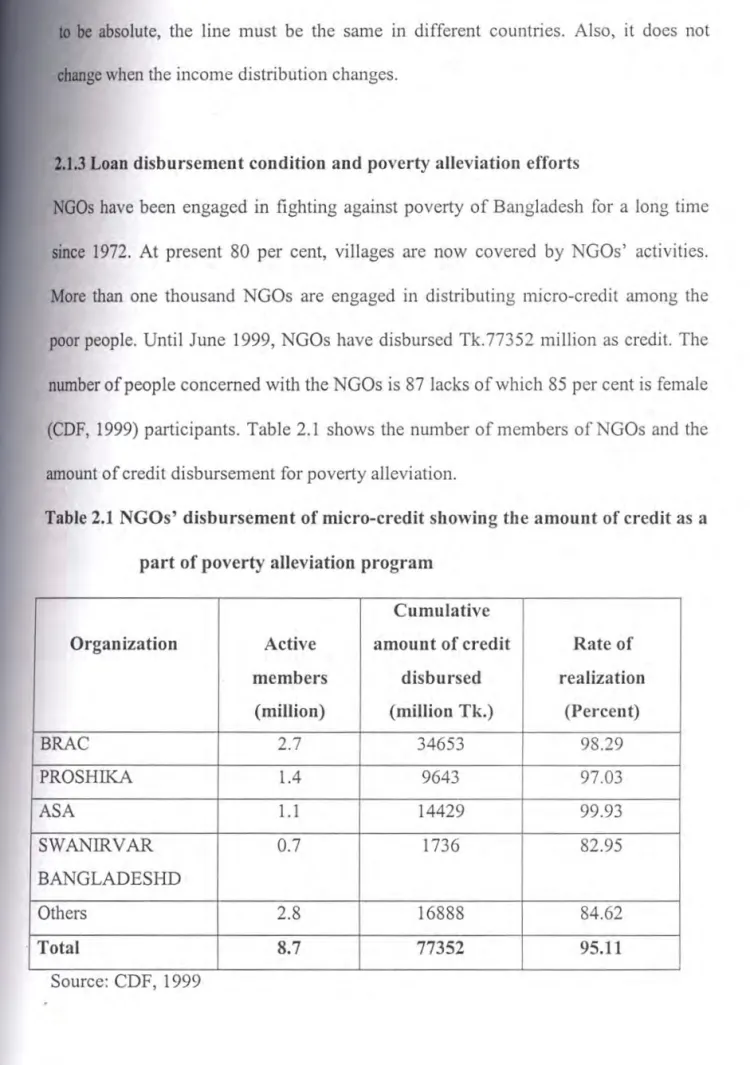
poor people. Until June 1999, NGOs have disbursed Tk. 77352 million as credit. The number of people concerned with the NGOs is 87 Jacks of which 85 per cent is female (CDF, 1999) participants. Table 2.1 shows the number of members of NGOs and the amount of credit disbursement for poverty alJeviation.
Table 2.1 NGOs' disbursement of micro-credit showing the amount of credit as a
part of poverty alleviation program
More than one thousand NGOs are engaged in distributing micro-credit among the 2.1.3 Loan disbursement condition and poverty alleviation efforts
NGOs
have been engaged in fighting against poverty of Bangladesh for a long time since 1972. At present 80 per cent, villages are now covered by NGOs' activities.to
be absolute, the line must be the same in different countries. Also, it docs not change when the income distribution changes.18
Chossudovsky (1997) argued that population groups in individual countries with per capita income in excess of US $1 a day are arbitrarily identified as 'non-poor'. He further argued that income and social inequalities between and within nations have b.een increasing, whereas the World Bank through the manipulation of income statistics shows that the poor are a minority group in developing countries. The World
lttefaq, 5 July, 2006).
Up to December 2003, there has been a disbursement of Tk. 487009.80 million among the poor people. Grameen bank is regarded as the pioneer of the introduction of micro-credit in the country as well as in rest of the world. From the very beginning up to July 2004, the total amount of disbursed loan is Tk.20, 553.25 crore among its beneficiaries. The repayment per cent is 98. Grameen bank has been working throughout the Bangladesh through 1,267 branches in 46,279 villages among 36,98,082 beneficiaries of which 35,36,347 beneficiaries are women (The Daily
Source: The Daily Ittefaq, 5 July, 2006
Government departments 8.77
17.86 Banking institutions
34.90 Grameen Bank
38.47 NGOs
Loan disbursed (percentage) Loan sources
J. 1.4
Recent loan disbursement situation of Bangladesh:OOs
&NGOs have been disbursing credit to the hardcore vulnerable peoplefor
thebettennenl
of living standard.Table 2.2 Disbursement of micro-credit by GOs and NGOs
19
Khan (2001) said that NGOs have already chosen their alternative programs like health and family planning, non-formal primary education, credit and savings, income generation, women issues, environmental problem, disaster management, human Halder (2001) said that the causes for becoming extreme poor includes river erosion, land redistribution and family break up, flood, bad habit of household heads and inherited poverty.
Nawaz (2000) said that the main causes of poverty in Bangladesh are scarcity of land, lack of skill, malnutrition, lack of access to the means of production and resources, with a resultant lack of scope for economic activity and employment, vulnerability to repeated natural disasters and unequal distribution of productive assets, especially land.
2.2: Studies Relating To Causes of Poverty
2.2.ICauses of poverty: Some past research findings and experts' opinions
According to the BBS (l 997), among the landless in rural areas, 57.9 per cent were very poor and 69 per cent were poor. Among the marginal landless (owning less than .50 acre), 6.31 per cent were very poor and 80 per cent were poor. Among large landowners (owning 7.5 acres and more), only 2.6 per cent were very poor and 9.1 per cent were poor. In rural areas, land ownership remains the key element of living standards because land is the most important income-earning asset.
lank
estimates that 33 per cent of third world population is poor and 18 per cent is20
Mayeux, et al. (1998) described that micro-finance programs for women are currently promoted not only as a strategy for alleviation of poverty but also for women's empowerment.
Khandaker ( 1995) based on extensive survey data from Bangladesh observed that micro-credit programs were an effective policy instrument for reducing poverty among poor people to become self-employed. Micro-credit programs were found to be particularly important for Bangladeshi women, many of whom are restricted by social customs from seeking wage employment
2.3: Studies Relating To Reduction of Poverty and Impact of Micro-Credit
2.3.l How to reduce poverty: Reviews relating to socio-economic development and impact of micro-credit
Paul (1996) conducted a study on the impact of livestock program of BRAC in sadar
Thana of Myrnensingh district. The results of the experiment revealed that a substantial positive change occurred in family income of the participants after their joining the milching cow rearing and beef-fattening program ofBRAC.
Muzzaffar (2001) said that why there is still so much poverty in the world when we have both the knowledge and the techniques to eliminate poverty forever from the face of the earth, it is not difficult to fathom. The misallocation of resources based on priority is undoubtedly one of the major causes of absolute poverty.
ts. All of the above arc the causes of insufficient food or nutrition, income or education, which may be responsible for poverty.
21
Khan (2001) pointed out that the credit and the savings are very effective tools of poverty alleviation. The essence of credit program in Bangladesh is the sole contribution ofNGOs like Grameen Bank, BRAC, ASA, PROSHIKA, KARITAS etc.
By the mid-nineties, the credit program turned as a pragmatic way. An increasing trend of credit program by mainstream NGOs has almost abandoned all other program except credit. Khan also said special credit activities of government agencies are yet to reach the majority of the rural poor. By taking the advantage of rural infrastructure,
Ali (2000) stated that available evidence is also suggestive of the synergies that exist among different growth projects (road, electricity, new technology, for instance) and between growth and social sector project and between growth and micro-credit. One
of the latter topic, we may only add that further expansion of credit for the poor should be seen in the broader context of infrastructure development. Such a packaging (along with rural and human development will not only enhance the return to micro- credit schemes and contribute to its viability but also accelerate the rate of poverty reduction.
Khan
(1999) carried out a study on micro-credit program in Bangladesh with special emphasis on underprivileged rural women. Women wage earners were found to valuepaid
work more than they valued credit. The study thus concluded that moreemployment opportunities should be created for women as these would help to promote economic and social empowerment including gender and human development
22
Robinson (1991) dealt with
the impact of NGOs in rural poverty alleviation in India.
Four case studies were
reportedin
his paper. The results of the four case studiesshowed that NGOs showed some successes in improving the income and the
Giriappa (1988), based on a study, observed that the role and status of women havebeen under a continuous change in recent years. In
both female and male-headed households, the participation of women in decision-making was found to have increased.
2.3.2 Studies relating to Impact of micro-credit
BBS (2002) found that after forming the groups of Grameen Bank,
the income of the
members increased by 70 per cent within 2 to 3 years.On an average, the income
increased from Tk 5806 to Tk.9166, which was 55 per cent higher than it was before.After forming
the groups, only 5 per cent of the members took loan from non- institutional sources.
Pallavi-Chavan, el al.
(2002)
stated that Non Governmental Organizations(NGOs)-
led micro-credit as an effective and financially viable alternative to theexisting
methods of addressing rural poverty through the provision of credit In India, it is alsorevealed
that micro-credit programs have been able to bring about a marginal
improvement in the beneficiaries income.few
renownedNGOs disbursed 91 per cent of that credit in the country. He also
-sued
that another very important input in the poverty alleviation ismicro-credit.
23
2.4 Studies relating to the relationship between poverty alleviation and selected characteristics of the rural women
The selected characteristics of the rural women under Grameen Bank were selected as independent variables of this study. No literature was found that dctennined the relationship between the selected characteristics of the beneficiaries with their impact
of micro-credit. Some literatures were available those determined the relationship between the selected characteristics of the beneficiaries with their poverty alleviation.
However, poverty alleviation must be a component of impact. These are
Harper (1998) stated that well-managed micro-finance could be profitable for both its customers and its providers; it is a business opportunity itself for bankers, and need not depend on donor's assistance.
Rahman and Khandaker (1994) carried out a study on impact of NGOs' activities in respect of employment and income especially for women. The findings indicated that credit programs of BRAC and BRDB was successful in expanding of self- employment opportunities among rural women.
Amin,
et al. (1994) conducted a study on Grameen Bank and they showed that the participation in income generating projects in support of Grameen Bank micro-creditby the poor rural women has led to an increased level of contraceptive use and to a decrease level of desire for additional children.
ption levels of the poor but encountered difficulties for a favorable local mvironment, especially, in economic and climatic factors.
24
Begum (1998) observed that family size of the rural
women had no significantrelationship with their poverty alleviation owing to participation in
ASA activities.2.4.3
Family size and poverty alleviation
Basak (1997) found that the family size of the rural
women underBRAC had
asignificant positive relationship
with their impact ofparticipation in BRAC rural development
activities.Begum (1998) in her study entitled "Poverty Alleviation of the Rural Women Organized by
Association for Social Advancement" observed that education of the rural women had
apositive significantly relationship with their poverty alleviation owing to participation in ASA activities.
2.4.2 Education and poverty alleviation
Devi (1995) found that education of women had a significant positive
impact on labor
force participation.2.4.J Age and poverty alleviation
Dickerson (1992) in
his study observed that
younger women were concerned almost primarily with productive activities while older women were involved morem
decision-making within their households and theyhad
toplay
extra domestic roles.25
2.4.8 Attitude towards Gramecn Bank micro-credit program and poverty alleviation
No relevant study was found.
2.4.7 Duration of involvement with Grameen Bank micro-credit program No relevant study was found.
2.4.6 Cosmopoliteness and poverty alleviation No relevant study was found.
2.4.5 Credit received and poverty alleviation
Khandaker (1995) observed a significant negative relationship between credit availability and impact in terms of improved well-being.
2.4.4
Farm size and poverty alleviationBegum (1998) observed that the homestead area of the rural women had no significant relationship with their poverty alleviation due to participation in ASA development activities.
26
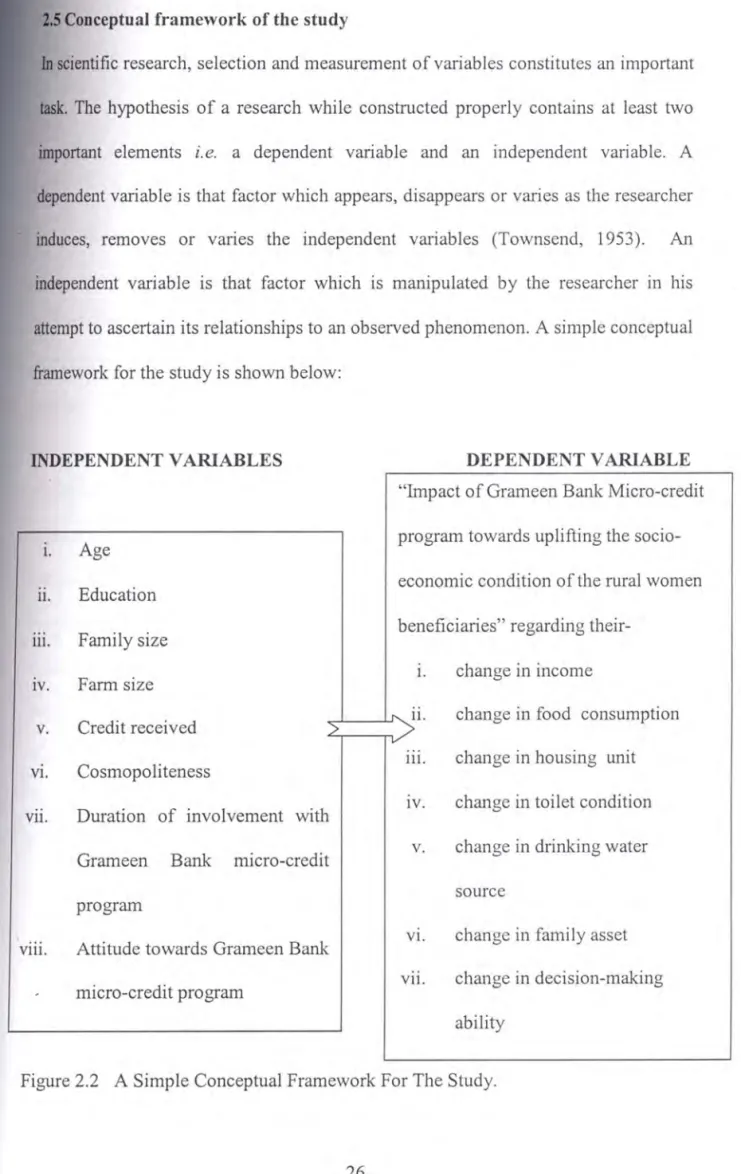
Figure 2.2 A Simple Conceptual Framework For The Study.
"Impact of Gramcen Bank Micro-credit
program towards uplifting the socio- Age
I.
Education economic condition of the rural women
11.
...
Family size beneficiaries" regarding their-ill.
I. change in income
IV. Farm size
>l.
change in food consumptionv.
Credit received>
... change in housing unit
111.
VI. Cosmo po Jiteness
of involvement with JV. change in toilet condition
Vil. Duration
V. change in drinking water Grameen Bank micro-credit
source program
Vl. change in family asset viii. Attitude towards Grameen Bank
Vil. change in decision-making
.
micro-credit programability
DEPENDENT VARIABLE INDEPENDENT V ARJABLES
framework for the study is shown below:
attempt to ascertain its relationships to an observed phenomenon. A simple conceptual independent variable is that factor which is manipulated by the researcher in his induces, removes or varies the independent variables (Townsend, 1953). An dependent variable is that factor which appears, disappears or varies as the researcher important elements i.e. a dependent variable and an independent variable. A task. The hypothesis of a research while constructed properly contains at least two In scientific research, selection and measurement of variables constitutes an important 2.5 Conceptual framework of the study
27 3.1.1 Locale and population
This study was conducted at 11 Number Mancha Union of Birgonj Upazila under Dinajpur
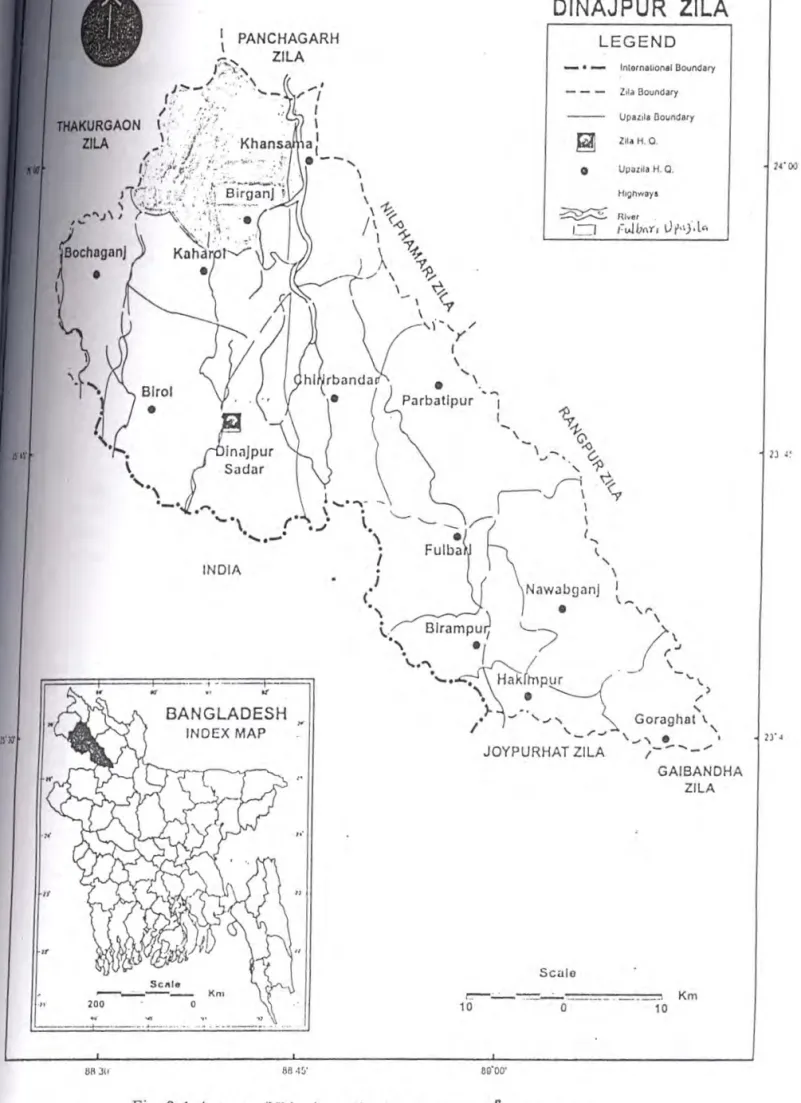
District where Grameen Bank was operating extensively. Six villages were selected as the study area because Grameen Bank activities were more concentrated in those villages in comparison to others. There were 674 women beneficiaries in those villages that constituted the population for this study. These beneficiaries were from 20 randomly selected centers spread over the said six villages. For clarity of understanding, one map of Dinajpur District and one map of Birgonj Upazila showing the study areas have been presented in figure 3 .1 (p.29) and figure 3 .2(p.30) respectively.
In any scientific research methodology plays an important role. To perform a research work systematically, careful consideration is a must. It should be such that it would enable the researcher to collect valid and reliable information to arrive at correct decisions. The methods and procedures followed in conducting this study have been described in this chapter.
METHODOLOGY
CHAPT E R3
28
3.1.2 Sampling procedure
An updated list of all the women beneficiaries of Grameen Bank micro-credit program of
the selected union was collected with the help of local Grameen Bank officials. The total number of union under Birgonj Upazila was 13 and the researcher selected one large
union. Data for this study were collected from a sample rather than the whole population.
Out of 674 beneficiaries a sample of 100 beneficiaries were selected by systematic random
sampling technique using a table of random numbers by taking 15% from each of six villages. A reserve list of 10 beneficiaries was also prepared for covering the positions in case of the absence of the selected respondents during interview. The distribution of the population and the sample size are presented in table 3.1
Name of the Total number Number of
union Name of the villages of beneficiaries beneficiaries interviewed
Kharnar kharikadam 117 18
11 Number Bhabanipur 115 17
Marich a Bochapukur 112 15
Union Nohail 105 16
Satkhamar 105 16
Mari cha 120 18
Total 674 100
Table 3.1 Distribution of population and sample of the rural women beneficiaries in the villages under 11 Number Maricha Union
1l ~·
Fig. 3. I A map
or
Dinajpur district showing J3~·4\n1 · upazilaeo·oo·
1111 )11
...
·-
·-
r---:---..1 Km
10 0 10
--- Km
200 0
Sea lo
"
If
" I•
BANGLADESH
INDEX MAP
llllf
-,-- .. .,
!NOIA
111gnw•r•
~Rl1i1er
11 r.Jvnro Ui•')·l"
0
IJpuJ1 OOllndary
~ Z~•H 0
lnlornal10111I Ooundlf'/
LEGEND
~ PANCHAGARH ZILA
DINAJPUR ZILA
30
Figure 3.2 A map ofBirganj UpaziJa showing the study area (11 Number Maricha Union)
2s·
as·42·
48' 88°38' Iss•34·
2s·
48'
as·30·
KAHAROLE
I
Paltapur • '
•
2s·
52'
~- .·
-,
Bhognagar :/#•: ... :
-,
25°
56'
.. · ..
;1\ Satair
e :
..
:·""Shibrampur THAKURGAON
SADAR
DEBIGANJ
0 2 4 km
2
26°
BIRGANJ UPAZILA
04'88°42' E 88°38'
88°34' 88'30'
31 3.1.4 Data collection
The researcher himself collected essential data through personal interview with the individual respondent. An introductory visit to the respondents' house was made in support of Grameen Bank field workers when the aims and objectives of the study were explained to most of the sample respondents. This helped the researcher to have a friendly orientation to the group members. Before going to the respondents for Interview, advanced information was taken with the help of branch manager and Grameen Bank field supervisors. Brief information regarding the nature and purpose of the study was given to the respondents before actual interview. The researcher also An English version of the interview schedule has been presented in appendix A. The interview schedule was pre-tested with 10 sample respondents from the study area during February 2006. Necessary corrections, changes and modifications were made in the interview schedule on the basis of the pre-testing information. The modified and corrected interview schedule was then printed in the form of final copy.
3.JJ Instrument for data collection
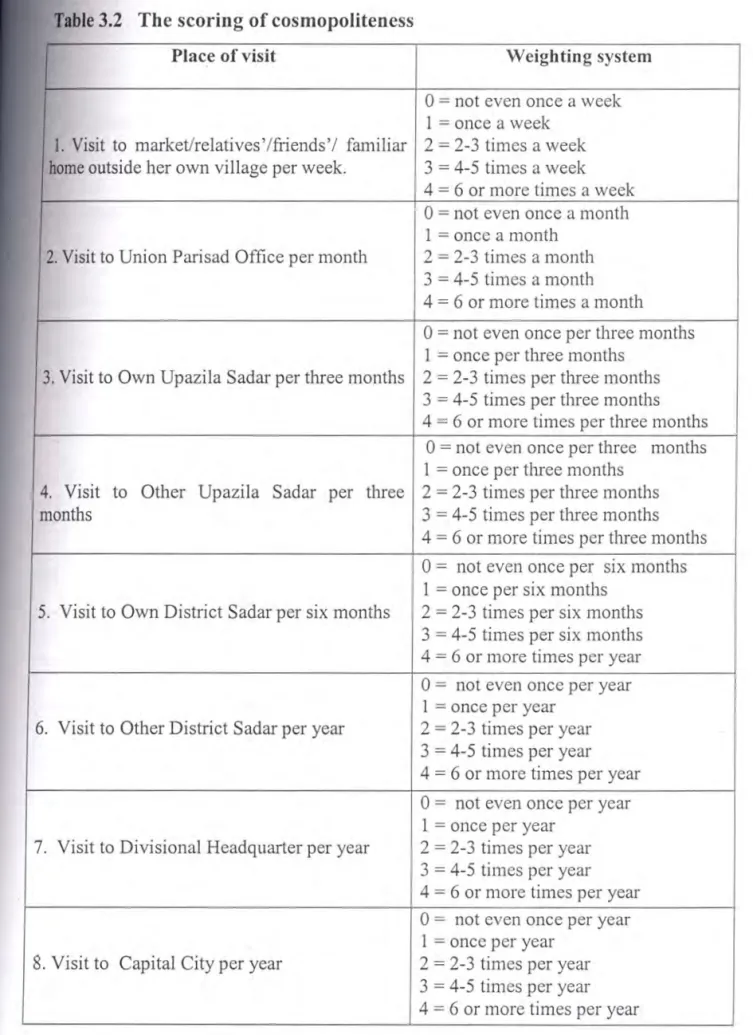
In order to collect valid and reliable information from the Gramecn Bank women beneficiaries, an interview schedule (questionnaire) was carefully designed keeping the objectives in mind. Simple and direct questions and different scales were used to obtain information. Direct questions were included to collect information about age, education family size etc. Scales were used to measure the cosmopoliteness, attitude towards Grameen Bank micro-credit program etc. Open form questions were designed to obtain information relating to qualitative variable, which was finally measured by ranking score.
32 3.1.5 Data processing and statistical analysis
All the collected data were checked and cross-checked before transplanting to the master table sheets. The data were coded, compiled, tabulated, and analyzed to
accomplish the specific objectives of the study. Qualitative data were converted into quantitative form by means of suitable scoring technique whenever applicable. Impact of Grameen Bank micro-credit program towards uplifting the socio-economic condition of the rural women beneficiaries was examined by drawing 'before' and 'after' comparison. Data were presented mostly in the tabular form, because it is simple in calculation, widely-used and easy to understand. Various statistical measures like number, percentage distribution, range, mean, standard deviation, etc were calculated for describing the selected characteristics of the respondents and the impact of Grameen Bank micro-credit program. To find out the relationships between
:established rapport with the respondents. Usually, the respondents kept records of annual or daily accounts of their data and researcher had to rely on those data and
memory of the respondents as well. Questions were asked systematically and explanations were made whenever it was felt necessary. The information was dully
checked in order to minimize errors. Some data were recorded in local unit. These were subsequently converted to appropriate standard units. The respondents were interviewed at their leisure time so that they could give accurate information in a cool
mind. The investigator faced no serious problems. Excellent co-operation was obtained from all of the respondents. Other group members, Grameen Bank workers and local leaders also rendered co-operation during the period of data collection. The data collection took near about 30 days from I" February to 4111 March • 2006.
33
However, for statistical advantage, each of the above research hypotheses was converted into null form which states that 'there is no relationships between the selected eight characteristics (age, education, family size, farm size, credit received, cosmopoliteness, duration of involvement with Grameen Bank micro-credit program and attitude towards Grameen Bank micro-credit program) of the beneficiaries with the impact of micro-credit.
3.1.6 Hypothesis of the study
The following research hypotheses were put forward to test the relationships between different characteristics considered. Each of eight selected characteristics (age, education, family size, farm size, credit received, cosmopoliteness, duration of involvement with Grameen Bank micro-credit pr