Parents’ Participation in School Management Shuras (SMS) In Afghanistan: Barriers And Opportunities For Parental Involvement
In The Public Schools Of Ishkshim
By
Ali Nazar Shaida 21157006
BRAC Institute of Educational Development BRAC University
October 2021
© 2021. Ali Nazar Shaida All rights reserved.
A thesis submitted to the BRAC Institute of Educational Development in partial fulfillment of the requirements for the degree of
Master of Education in Educational Leadership & School Improvement
i
Declaration
I hereby declared that
1. This thesis submitted is my own original wok while completing degree at Brac University.
2. This thesis does not contain any material previously published or written by a third party, except where this is appropriately cited through full and accurate referencing.
3. This thesis does not contain material which has been accepted, or submitted, for any other degree or diploma at a university or other institution.
4. I have acknowledged all main sources of help.
Student’s full name & signature
Signature
Ali Nazar Shaida 21157006
ii
Approval
The thesis titled “ Parents’ Participation In School Management Shura (SMS) In Afghanistan:
Barriers and Opportunities For Parental Involvement In The Public Schools Of Ishkashim”
submitted by
1. Ali Nazar Shaida (21157006)
Of Spring 2021 has been accepted as satisfactory in partial fulfillment of the requirement for the degree of Master of Education in Educational Leadership & School Improvement on 24th January 2022.
Examining Committee:
Supervisor:
(Member) _______________________________
Dr. Md Tariqul Islam
Assistant Professor, BRAC Institute of Educational Development
Program Coordinator:
(Member) _______________________________
Dr. Manjuma Akhtar Mousumi
Assistant Professor, BRAC Institute of Educational Development
External Expert Examiner:
(Member) _______________________________
Somnath Saha
Lecturer, BRAC Institute of Educational Development
Head of the Institute:
_______________________________
Dr. Erum Mariam
Executive Director, BRAC Institute of Educational Development
iii
Ethic Statement
My concern was about the participants’ identities and maintaining their personal information safely. For protecting the interviewee’s names I used anonymous names instead of their real names in the whole process of this study. In the meanwhile, I ensured their participation through both written consent letter and verbally by explaining the purpose and significance of the project which they willingly took part in the interview by signing the consent letter. So they had completely freedom and choice to either participate or not. However, I should acknowledge that sometimes the participants touched to the other questions and I asked the items in the disordered manner due to the circumstance. Though I recorded and analyzed the data without any personal judgment and interpretation. Similarly, I was very determined regarding ensuring the trustworthiness of this study. Therefore, I got the District Education Directorate (DED) approval which made this study more formal and authentic. In addition. I have submitted a comprehensive ethical form and received the approval from Brac University.
iv
Abstract
Mainly I focused on parents’ participation from the perspective of School Management Shuras (SMS) in this study, and the obstacles which parents are encountering in the three schools along with the solutions in Ishkashim, Badakhshan. Rising the current vice of parents in the targeted schools was the purpose of this study for better decision by authorities in terms of parents’
involvement in the research site since parents’ engagement has variety benefits to schools in terms of students’ outcomes, attendance and improvement. In this research, I used qualitative approach through interview guides for the investigation of participants’ thoughts and opinions. Meanwhile, for analysis of the participants’ perception I applied thematic approach. In total, I interviewed eight participants three of them were schools administrators and the rest of them were parents who were the member of SMSs. I have found in the study that currently parents are not participating in SMSs due to the pandemic and political changes in the country. However, they had their contribution before those two factors in the schools. In addition, poverty lack of unawareness, education background and the local traditions were the major challenges for parental involvement in the rural area. Hence, for ensuring their participation, it is suggested that awareness for parents, administrative changes in SMSs and more focus should be done by the authorities in the local level.
Key words: Parents participation; Parents contribution; SMS; Rural area; Afghanistan
v
Table of contents
Declaration... i
Approval ... ii
Ethic Statement ... iii
Abstract ... iv
Table of contents ... v
List of Table ... vii
List of figures ... viii
List of acronyms ... ix
Chapter 1 ... 1
Introduction and Background ... 1
1.1 Introduction ... 1
1.2 Research Topic and Title ... 2
1.3 Research Problem ... 3
1.4 Research Questions ... 4
1.5 Research Aim ... 4
1.6 Research Significance ... 4
Chapter 2 ... 6
Literature Review and Conceptual Framework ... 6
2.1 Shura in Afghanistan Context ... 6
2.2 Parents’ Participation in School Management Committee ... 7
2.3 The Importance of Parental Involvement in School ... 8
2.4 Parental Involvement and Student Attendance ... 9
2.5 Barriers for Parental Involvement in Rural Area ... 10
2.6 Conceptual Framework ... 11
Chapter 3 ... 14
Methodology ... 14
3.1 Research Approach ... 14
3.2 Research Site ... 15
3.3 Research Participants ... 16
3.4 Sampling ... 17
3.5 Data Collection Methods and Tools ... 17
vi
3.6 My Role as a Researcher... 18
3.7 Data Analysis ... 19
3.8 Ethical Issues and Concerns... 20
3.9 Trustworthiness and Rigor ... 20
3.10 Limitation of the Study ... 21
Chapter 4 ... 22
Results ... 22
4.1 SMS in the Afghan Public Schools ... 22
4.1.1 Parents’ Role in the SMS ... 22
4.2 Parents’ Involvement in SMS ... 23
4.2.2. Participation of the Members ... 23
4.2.3 Importance of Parental Involvement in the SMS ... 24
4.2.4 Contribution made by Parents in SMS... 26
4.2.4 Contribution for Students’ Attendance ... 27
4.2.5 Contribution for Students’ Learning Process ... 30
4.3 Barriers for the Parents to Play Role in SMS ... 31
4.4 Opportunities to Ensure More Parental Involvement ... 32
4.4.1 Principals’ Plan to Improve Parental Engagement in SMS ... 32
4.4.2 Parents’ Suggestions to Increase and Ensure Parental Involvement in SMS ... 33
Chapter 5 ... 35
Discussion and Conclusion ... 35
5.1 Discussion ... 35
5.1.1 SMS in the Afghan Public Schools ... 35
5.1.2 Parents’ Involvement in SMS ... 36
5.1.3 Barriers for the Parents to Play Role in SMS ... 37
5.1.4 Opportunities to Ensure More Parental Involvement ... 38
5.2 Conclusion ... 38
5.3 Recommendation ... 39
9. References ... 40
Appendices ... 45
Appendix 1. Consent Letter ... 45
Appendix A. Interview Guide for Principals ... 46
Interview Guides for Parents ... 47
vii
List of Table
Table 1: Number of schools and participants
viii
List of figures
Figure 1: Conceptual Framework for whole school improvement
ix
List of acronyms
SMS School Management Shura SMC School Management Committee MOE Ministry of Education
EQIP Educational Quality Improvement Program NESP National Education Strategic Plan
USED United States Department of Education PED Provincial Education Directorate DED District Education Directorate
1
Chapter 1
Introduction and Background
1.1 Introduction
Afghanistan is one of the West- central Asian countries known as a landlocked territory with its rich history that leads back to thousands of years. However, this country has experienced several conflicts which have delayed all advancement and progress. For instance, from 1996-2001, there was not enough progress during the period of Taliban, particularly in education, there were few schools with an only religious subject. After the fall of the Taliban in 2001, in the last two decades there was a huge improvement in schooling such as development of school infrastructure, providing textbooks, revision of curriculum, teachers’ capacity building, creating School Management Shuras (SMS), students’ enrollment and other relevant activities in the national and local levels. The improvement in education is evident in data as well. For example, the number of students has increased significantly from 900,000 to above 9.5 million for both girls and boys, above 39 of them are girls (MOE, 2020). This considerable access may credit the efforts of Ministry of Education (MOE); however, the grass roots-level requires the contribution of community and schooling for their children growth and access (Strand & Oleson, 2005); which leads to stockholders’ engagement in policy making and administration action (Nayak, 2009).
Several studies in different countries discussed about the importance of school committee. For example, Rajbongshi (2020) found that school management committee plays an important role in the decision making process for ensuring students’ school attendance and their learning improvement.
2
As the significance of committee and parents highlighted which were important for school improvement and students participation. Likewise, in Afghanistan, parents are involved through SMS for better improvement of schools around two decades. While the percentage of students’
absenteeism and drop out is higher than the urban places. In this context, I am going to investigate current parents’ participation, barriers and the way of forward in SMS particularly in the rural area of Badakhshan which would have advantages for policy makers for inclusiveness of their strategies as well as the findings of this study can generate new knowledge to the literature in terms of parental engagement.
1.2 Research Topic and Title
The topic of this study is “Parents’ participation in School Management of Shura” and the title of the research is “Parents’ participation in School Management Shura (SMS) in Afghanistan:
Barriers and opportunities for parental involvement in the public schools of Ishkashim”.
I have selected the above research topic and title as, there is a relationship between parents’
attitudes, behaviors, and action and learners, academic success (Hoover-Dempsey et al., 2005; in socioeconomic areas many researchers suggests enlarge effects of family (Domina, 2005); children in the most deprived are have shown more rapid disruptive behavior rather than the urban ones (O’Connor et al,. 2012). Furthermore, it has been demonstrated that rural families are disinterested on their children schooling (Prater, Bermudez, & Owens, 1997). The connection between parental involvement and students’ success, behavior and demotivation of family motivated me to see the current practice of parents in SMS and the barriers that parents encounter in entire school management in most disadvantages region, as well as finding the way of moving forward for ensuring more parental involvement from SMS member’s perspective.
3
1.3 Research Problem
Ministry of Education in Afghanistan created SMS by the financial supports of the World Bank through Education Quality Improvement Program (EQIP I & II) to reduce the gap between school and government and as well to observe and monitor the regular operations of the schools at the local level (The World Bank, 2004). In addition, National Education Strategies Plan sets out an objectives for school leaders to ensure parents and community engagement for increasing students’
enrollment, attendance, learning outcomes and also other activities such as participating in school infrastructure development, any decision making and overall greater effectiveness and efficiency (NESP III, 2017-2021). As it is pointed out that Community participation in educational management definitely leads to stakeholders’ involvement in policy making and administration of school activities (Nayak, 2009). Meanwhile, parents’ engagement is one of the powerful components in school for ensuring their children enrollment, attendance and performance, research found that when parents are involved either at home or school students’ attendance will be increased according to (Glen & Grepon, 2020). However, students’ performance, attendance and engagement are unsatisfied in the most socioeconomic areas because of many cases. For instance, a report in Afghanistan revealed that the rate of absenteeism and drop out is higher in low socioeconomic region rather than the urban DHS (2015, as cited in UNICEF, 2019). Hence, I would like investigate more about parents’ participation in SMS of Ishkashim district of Badakhshan province for better decision which can be made by the authorities for the betterment of the situation.
4
1.4 Research Questions
The research questions of the study are:
1- How do the parents involve and contribute in the public schools SMS of Ishkashim?
2- What are the barriers that parents face to be involved in decision-making process and the opportunities they have as the part of SMS?
3- How can the barriers be overcome for ensuring parental involvement in the public schools?
1.5 Research Aim
Through this research I aim to address few issues of the mentioned topic under investigation.
Firstly, I aim to generate a knowledge to the literature about parents practice and participation from SMS perspective in the context particularly in the most deprived areas of Afghanistan. Because there is not much research in this part. Secondly, I want to see the level of parents’ contribution in terms of infrastructure and students schooling in the local level of Ishkashim. My third purpose is that to find the current issues for parental engagement since the new radical changes has taken place in the government of Afghanistan. Finally, this study may find the way of moving forward for parental involvement from the view of SMS members.
1.6 Research Significance
There are considerable benefits of this research. First of all, generating new knowledge in the context of Afghanistan through this study that can improve the richness of literature for researchers in the rural area, which is the main significance of this study. Because I have encountered a big challenge due to lack of literature in the context of this place. Secondly, the result of this investigation may help the policy makers to reinforce parental involvement more serious in all
5
schooling especially in the most disadvantage regions for betterment of school and community ownership. Though parental involvement might be different from region to region but still parents’
participation may contextualize in the other rural area since Afghanistan is a mountainous country.
Lastly, local leaders, administrators, teachers, and community members may take parental involvement in consideration to grow parents’ engagement for their school improvement in the same context.
6
Chapter 2
Literature Review and Conceptual Framework
For highlighting the topic of this study, I sought a considerable literature from various sources such as journals, books, governmental and Non-Governmental Organization (NGO) reports, peer reviewed journals and also national and international articles. After all, I come up with five categories to present the reviewed literature for the study. At the beginning a brief information about SMS in Afghanistan context, secondly, parents’ participation in school management committee. In the third step, the importance of parents in school. The next one is parental involvement and students’ attendance and the last not least is barriers for parental involvement in rural area.
2.1 Shura in Afghanistan Context
Shura is an Arabic word which stands for the rule of the majority people. This word is taken from the Holy Quran in Shari’a law (Osman, 2001). Which refers to a serious and effective participation on any decision making.
Basically, the core objectives of SMSs are providing management and supervision support for the public schools which are leading by Ministry of Education (MOE) for ensuring community ownership their children future. This will enable the environment for equal opportunity in terms of education for both girls and boys for quality (Solotaroffi, Hashimi & Olesen, 2010). The SMS meetings are held on monthly basis and each shura has 15 members from both sides male and female (MOE, 2011). The participants are principals, teachers, religious leaders, parents, students’
representative and community elder. However, the responsibilities and accountabilities of shuras’
7
member are huge such as ensuring students access, effectiveness and efficiency of schooling as earlier illustrated in NESP III. Although, the concept of SMS may differ in the other nations but in Afghanistan this concept is added to schools within Ministry of Education under the project of Education Quality Improvement Program (EQIP) which is supported by The world Bank for empowering the community ownership in order to have better quality of education in the country (MOE, 2011).
2.2 Parents’ Participation in School Management Committee
With the passage of the Goals 2000: Educate in America Act, the commitment to improve the schooling of all students has become a national priority. Yet preparing learners for the challenges of the future is not the responsibility of schools alone. Discussions on how to enhance the quality of education in America have focused attention on the roles of family and community, it has said that high-quality education cannot be successfully accomplished without the active involvement of parents. Studies have shown that parent engagement in children's learning can have a positive impact on students' performance and reduce the school dropout rate (U.S. RE, 1994). So many nations established school committee for betterment of schools and students learning process. For example. A study in India demonstrated that school management committee plays a crucial role with improving infrastructure and other essential elements of school such as students’ enrollment and attendance (Duwarah, 2010; as revealed in Rajbongshi (2020). Similarly, in Afghanistan SMS is responsible for school infrastructure, students learning outcomes, interaction with teacher and overall whole school management (Karlsson & Mansory, 2007). Meanwhile, Article 48 of Afghan education law clearly explores parental involvement in education by emphasizing that, parents, teachers, community, religious leaders and principals should practice in the educational process to resolve learning problems, improving quality, prevent misuse and violation of legal and discipline of students, teachers, and
8
educators (Education Law, 2008). Hence, from the policy and literature it can be seen that parents are not only accountable for whole school improvement but also responsible for their children both at home and school. Specifically, parental involvement can increase the performance, achievement and attendance of pupils in the class. On the other side, family can influence on the development of school infrastructure by active participation and contribution.
2.3 The Importance of Parental Involvement in School
Parents’ engagement has a variety benefits for school improvement. One of the advantage of parents like other stakeholders is improving students’ success at school which has been considered as part of the shortcoming of the children’s education for decades (Hornby & Lafaele, 2011).
Various components of parental engagement have deferential influence on students’ academic outcome (Domina, 2005; Fan, 2001; Fan & Chen, 2001; Jeynes, 2005, referenced in Fan &
Williams, 2010). Meanwhile, Parental involvement cannot only improve students’ academic result but also give a broader understanding of their children condition and as well teacher. Which ultimately leads the teachers to find better way for their instructions (Nevski & Siibak, 2016;
Pineda et al., 2018). It is also characterized by active and meaningful participation in activities at behaviors at home and at school to benefit their children’s learning development (Fantuzzo, Tighe,
& Childs, 2000, pointed out in (O’Conner et al., 2021). Simultaneously, it is suggested that for guidance of a youth, parents’ engagement may be an inspiration for making their own decision (Hegna & Smette, 2017) along with aspiration for children’s academic achievement (Taken, 2011).
Which refers to active participation of parents in school management or other community support groups (Aghast, 2021).
Besides, parental involvement is the influential factor for children because of the following reasons, it can develop social knowledge of the children (Vygotsky, 1986, cited in Kabir, 2014);
9
it can improve students’ behaviors at school (LahBahn, 1995); it reinforces students’ motivation and creativity by reward with other community (Epstein, 1995, p. 702, Illustrated in Kabir and Akter, 2014). And as well it can boost students’ performance (Simweleba & Sepell, 2020). Finally, parental involvement can be seen a crucial aspect not only for learners but also for other involved people in educational sector such as school leaders, teachers and policy maker. When families visit school regularly it builds a ties among principles and community and the leaders can share any concerns, success and other achievement with them. Likewise, the teachers can update the progress of the students with their fathers and mothers on time while they are involved. The parental involvement even pave the way for policy makers to take an action according to the circumstance.
On the other side, students feel more focused on their activities whether it is at home or in school.
2.4 Parental Involvement and Student Attendance
Although absenteeism of students may be caused by many reasons which can be determined by economic issues, lake of interest, geographical barriers and etc. While, some scholars believe that less contribution of parents at school or house might change it. Indeed, this is a huge problem for schools in many nations (Teasly, 2004, cited in Glen & Grepon, 2020); Teasly (2004) pointed out that there are a lot of factors which are interlinked with absenteeism such as family, health, low income, poor school climate, drug and alcohol use, transportation problem, and community attitude toward education. While Miguel (2017) said that teaching strategies, anxiety at school, lack of interest, economic status, classroom environment, and finally, lack of parental involvement, who do not value education, could be a critical ingredient for this issue. Moreover, the cause of absenteeism can be teachers’ behavior those teachers who have a high expectative from student can effect on students’ attendance according to Wadesango and Machingambi (2011).
10
Green et al. (2007) stated that children education differs considerably when their parents actively participate or involve themselves in school activities compared to those children whose parents do not take part in school activities since there is a significant difference in students’ attendance.
Those parents who were involved at school activities their children showed better participation compared to their counter parts (Gren & Grepon, 2020). Meanwhile, Home environment and family support, family contribution to school provides the continuity of students (Wang et al., 1993). As the result, parents are not only the most important people for ensuring their children attendance but also crucial for children performance in both schools and home. There may be students who do not consider their school seriously than when parents are engaged in learning process they can monitor their children daily attendance and lessons which can enhance their outcomes at school.
2.5 Barriers for Parental Involvement in Rural Area
However, there are many elements for parental involvement in both developed and under developing countries. Firstly, Schools' satisfaction with parent involvement differ by low income and ethnicity group United States Department of Education (USDE, 1994). In America, schools are compromised in terms of parents’ engagement due to economic barriers and minority enrollment that parents may not contribute well as their counter parts. Similarly, in the most disadvantage area, economic barriers of the parents (from their childhood) were the huge obstacles for parental involvement (LaRocque et al., 2011). Secondly, Hornby et al. (2018) highlighted four types of barriers for the establishment of parental involvement in education individual parent and family barriers; child factors; parent- teacher factors; and social factors. Moreover, another research found that both parents and teacher are not much aware of the signification of parental engagement at school (Kabir, 2014).
11
In addition, parent’s educational background is another major barriers for parental involvement in school (Lee & Bowen, 2006 & Baek, 2010). Lee and Browen (2006) revealed that those parents who had college degree were more interested to be involved in school activities; while parents’
poor academic achievement was recognized as an obstacle for their children education. In other words, on the top of poverty, social norms, distance and unawareness of involvement, incompetency of education background was also one of the issues for parental involvement mostly in the disadvantage nations.
2.6 Conceptual Framework
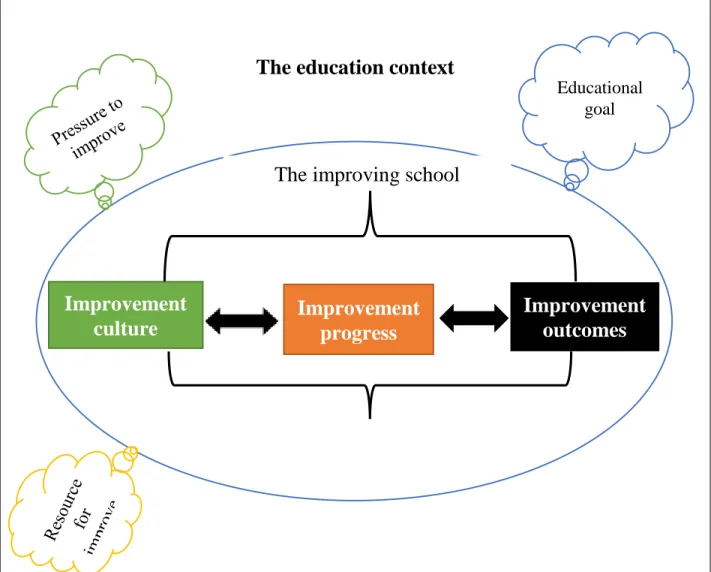
In this study I am using the conceptual framework of Reezigt and Creemers (2005) on whole school improvement which is contextualized based approach. In fact, there are two main factors for whole school improvement in this framework context factors and school factors. Context factors include three components such as pressure to improve, resource to improvement and educational goal.
Reezigt and Creemers believe that pressure to school improvement stands for marketing mechanism which is a controversial and much debated factor in some nations (Reezigt &
Creemers, 2005). While external evaluation and accountability is based on outcome of students which is not applicable in many countries. However, external agent is a remarkable elements in this study since two decades improvement and progress in Afghanistan is the efforts and attempts of both national and international charity organization like UNICEF, AKF, World Bank and etc.
Similarly, participation of society in education and social changes is an important aspect for school pressure to improvement. When people are engaged in education this contribution impact on different dimension of community according to their perspective. They do believe that parents represent the influence of the society in a more direct way. Besides, resource to improvement includes Autonomy grated to school which indicates from decentralized management system that
12
is not considerable in the many under developed countries and equally the financial resource.
However, apart from the other elements local support which include students’ parents are very effective for school improvement Reezigt and Creemers (2005). Therefore, in this study parents were chosen within SMS because of their contribution in terms of students’ attendance, performance and school infrastructure development along with provincial Educational Directorate (PED), District Education Directorate DED, community leaders, volunteers and other people in the society. Indeed, the importance of parents has already explored in the literature and it has been seen that parents were influential in students’ academic achievement, attendance, behavior and decisions while there are involved. In addition, the educational goal of a country which may be different in terms of procedures and policy nation to nation.
However, school improvement is not only related to context factors but also school factors are a crucial components. School factors, embrace improvement culture, process and outcome based on Effective School Improvement (ESI) of Reezigt project (2001) demonstrated in (Reezigt &
Creemers, 2005). These concepts are the central elements for effectiveness of a school and constantly interlinked and influence each other according to (ESI, 2005) project. Overall, for whole school improvement both ingredients are remarkable and essential which needs to be considered.
In the following conceptual framework all the interconnected elements are highlighted by (Reezigt
& Creemers, 2005).
13
Figure 1. Comprehensive framework for effective school improvement (Reezight & Creemers, 2005).
This conceptual framework was chosen because of being comprehended approach by considering local, agent and community supports including parents under the context factor for whole school improvement. In the under developed countries still parents are not involved properly. For instance, a study found in Bangladesh that schools need to build a relationship with parents for improvement of schools since their strategies of parental involvement were limited (Kabir &
Akter, 2014). Though the other elements of this framework is important as well for any progress in education.
The education context
Improvement culture
Improvement outcomes Improvement
progress
The improving school
Educational goal
14
Chapter 3
Methodology
There are ten subthemes in this chapter including: research approach, research site, research participants, sampling, data collection methods and tools, my role as a researcher, data analysis, ethical issues and concerns, trustworthiness and rigor and limitation of the study. Each of these themes will be explained in details respectively as below.
3.1 Research Approach
In general, there are three approaches qualitative, quantitative and mixed-method based on Creswell and Creswell (2017); they demonstrated that research method is a procedure which helps the researcher to do a study, however the choice and selection of these approaches depend on the researchers’ knowledge and ability.
The purpose of the study was to explore parents’ participation in SMS settings. Therefore, I considered qualitative approach for understanding research participants’ perception, beliefs and practice in the context, which is called “interpretative method” (Gay & Airasian, 2003); it is rooted in the disciplines of sociology and psychology; so “qualitative approach strive to capture the human meanings of social life as it is lived, experienced, and understood by the research participants” (Gray & Airasian, 2003, p. 163). Gary and Airasian emphasized that considering the culture of people is very crucial for the researchers, because in qualitative method the interaction of both researchers and participants is completely in discussion based which relies on researchers’
interpretation, and written tools. In this context, I choose qualitative approach for this research to address participants’ views, interpretation, practice and the obstacles which were associated with
15
parental involvement in rural area of the research site because I wanted to highlight the present situation of parents for educational leaders in context based decisions.
3.2 Research Site
Ishkashim a rural district which is located in the North-East of Afghanistan, in the province of Badakhshan. This district is situated on the river Panj (well known Amu River) border with Tajikistan, in a fertile valley, at altitude of 3037 m above the sea level. And the same name is allocated for the Tajik side for their district and the river isolated this two districts. The total population are over 12,120 people and most of these people are farmer since Ishkashim is an agricultural region and has enough land for growing crops. At the same time, there is a rich base for collecting medicinal plants. The Fauna of the Vulusvol is rich enough. Most of all, there are mountain goats, argali, Bukhara ram, lynx, snow leopard, etc. (Wikipedia Asian Month, 2021).
I selected three schools based on the access and availability in this district. These three schools had a hundred students and over fifty teachers who were teaching from grade one to 12. Moreover, all public schools in Afghanistan are free and having access to education is the right for every one according to Education Law (2008).
However, urban parents are more active in terms of participation, helping children, contribution and other activities in both school and home than the rural area Prater et al. (1997). Therefore, I want to investigate the parents’ participation in SMS of Ishkashim, which is one of the disadvantage regions in Badakhshan, to rise the most deprived community vice for better decisions of the authorities in terms of engagement parents in their schooling policy.
16
3.3 Research Participants
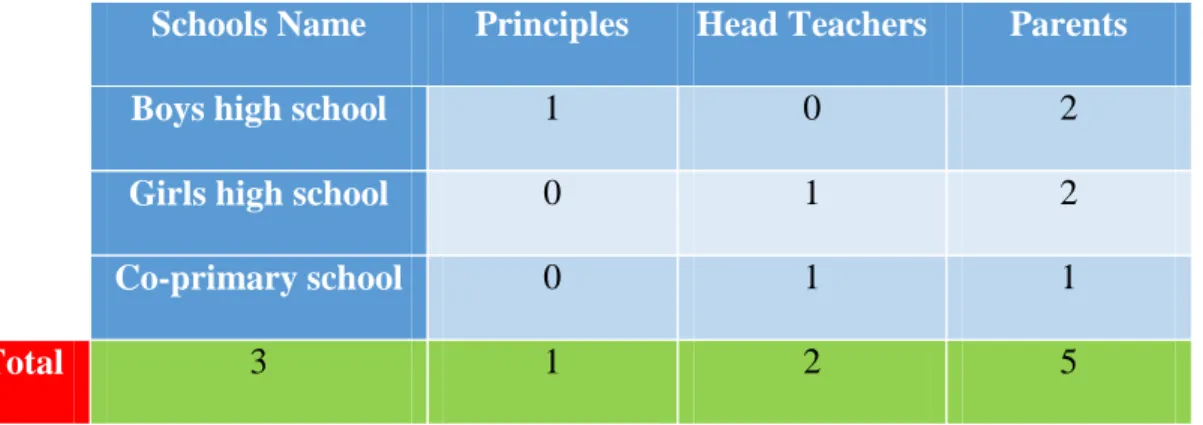
Generally, I choose three schools for the data collection of this study. At the beginning I proposed to interview three principals and 6 parents but while collecting data 8 people were ready to participate in the interview, five of the participants were males and three females who met the criteria. Overall, I interviewed eight people. A part from those people two of them were head teachers, one principal and 5 parents. The two head teachers were chosen because of their school structure. One of the schools had only students till grade 6 which did not have principal and the other because of being girls’ school and the head teacher was acting as a principal there. The responsible people had an average experience of working around 10 years. Similarly, I choose those parents who had over 4 years of membership with SMS. Though parents’ membership in SMS last long for 3 years but those parents who are active and eager to be as member they can rejoin with SMS for the next three years. The number of participants and schools are given as below.
Schools Name Principles Head Teachers Parents
Boys high school 1 0 2
Girls high school 0 1 2
Co-primary school 0 1 1
Total 3 1 2 5
Figure 2. The number of schools and participants.
17
3.4 Sampling
Sampling is defined as a method that used to select a given number of people or things from an entire population; and a researcher makes a decision regarding from whom data will be collected, who is included, how they are included and what is done to conceal or reveal identities in research (Mertens, 2010); However, there are two types of sampling probable and non-probable sampling according to the writers. In this investigation non- probable and purposive sampling was used because participants were not selected at random; a purposive sampling relies one’s judgment to select participants or “location” (Robson, 2002); in purposive sampling I intended to select the participants and site to discover about parents participation in SMS who are “information rich”
(Creswell, 2012). Hence. From all the targeted participants those parents who were currently Shura’s member at school and principals who have been working as a school principals more than 5 years were chosen by me.
3.5 Data Collection Methods and Tools
In this study I applied interview tools through the alignment of the research approach for understanding depth individual’s thoughts, beliefs, and interpretation in one to one discussion (Rogers, 2000). Because in qualitative approach interview is one of the tools which is “looking for depth and detail, vivid and nuanced answers with thematic material” (Rubin & Rubin, 2005, pp.
280-283). Since depth understanding and more clarification of the participants’ perception regarding parents’ participation in SMS was the goal of this study. Therefore, interview through telephone was more appropriate method based on the “geographical disappeared” which the participants had and “situation” that the new changes brought according to Creswell (2012); and also it allowed probing and posing follow up questions since it was assumed that may be the participants do not explore the expected data (Johnson & Christensen, 2004).
18
In the light of supporting literature, I developed semi-structured interview items for both schools authorities and parents according the research topic and main questions in order to get more information from the participants (Creswell, 2017). Before using the interview guides, I piloted the tools with my potential friends who had similar background knowledge in the same context because of the reliability and credibility of this study. After that I interviewed 5 parents, 2 head teachers and one principal through phone calls and their responses were recorded by tape recorder for the purpose of transcription and data analysis process. Although I tried to contact with Zoom or other online platform to see their body language but due to the instability of the internet I could not do it. So I interviewed all the participants by phone conversation.
3.6 My Role as a Researcher
I have worked as a teacher and coordinator with private and Non-Governmental Organizations (NGO) for more than 5 years in Ishakshim which helped me to do this study more precisely by understanding their culture and tradition. During my teaching I have found that those parents who had education background and felt responsible, their children were well prepared in terms of performance, attendance and the way of interacting with other was vary compared to their counter parts which inspired me to do my research in this field. Actually, during those days I considered that the communication of both parents and teachers is as usual compared to other community people. In other word, most of the parents do respect teachers commonly as other people in the rural area. But I attempted to convert my role as a teacher to a researcher for maintaining the principle of this research to avoid any biases in whole process of my project so the participants did not feel that they are in a formal interview because I continued the conversation in a friendly manner as I knew their way of interaction and making conversation.
19
3.7 Data Analysis
In qualitative approach, data analysis is defined as a process of understanding and making the data organized in a meaningful way which can response the research questions. Six steps can be taken in data analyzing process, data organization, coding, themes formation, data representation, data interpretation and accuracy of the result, although it is not necessary to use these steps in the order way (Creswell, 2012). Hence, I incorporated thematic analysis for categorizing and coding the data word by word under sub-themes based on the interpretation and discussion of the participants’
answers (Turner, 2020; Coyne & Cowley, 2006). By following these strategies the thick description of my data analysis process as given below
Overall, I translated all interviews transcription from Dari to English since the participants who were involved in this study their spoken language was Dari and the place where I was pursuing my degree the lessons were taught in English. After translation process, I coded all the translated data under sub-themes and omitted the irrelevant information without any significant changes for analyzing, organization, compression and assemble information for conclusion. Afterward, I found four main themes based on the screened data including SMS in the Afghan public schools, parents’
participation in SMS, barriers for parental involvement in SMS and opportunities for ensuring more parental involvement. Meanwhile, the themes had sub-themes which are as follow.
Parents’ role in the SMS, participation of the members, importance of parental involvement, in the SMS, contribution made by parents in SMS, contribution for students’ attendance, contribution for students’ learning process, principals plan to improve parental engagement in SMS and parents’
suggestion to increase and ensure parental involvement in SMS.
20
3.8 Ethical Issues and Concerns
Johnson and Christensen (2004) demonstrated that “ethic is the division in the field of philosophy that deals with values and morals” (P, 294). For considering those values, culture, and morals I received ethic approval from MEd research ethic committee of Brac University in order to protect the right of participants and avoid from any personal interpretation against the informants (Creswell, 2017). Equally, for maintaining the trustworthiness and confidentiality of this research I took the approval from the DED and the participants were informed officially through their respected office. After the confirmation, the informants were given consent letter through my representative in Afghanistan so they had absolutely freedom. After that they agreed to participate in the interview with me and even I recall the consent letter orally for individual interviewee while interviewing them. Consequently, I explained the purpose of the research and those who were ready for the study by signing the consent letter I conducted the interview through considering their availability of time and willingness.
3.9 Trustworthiness and Rigor
Rallis and Rossman (2003) defined trustworthiness as the degree of trust through reflexivity and credibility in data, analysis and procedure for ensuring the quality of the research. They do believe that what we hear, see physical space, clothing, their everyday activities and read in the real place of study via interview, observation or tradition; so the possibility of knowing people’s lives through interview requires the researcher understanding the component of human patterns of behaviors that appears in a certain cultural practice (Rogoff, 2005); However, being involved with people is a sensitive issue to explore the perception and experience of those population since they may feel uncomfortable in a single gathering pointed out in (Pessoa et at., 2019). In the light of the events I obtained the approval for ensuring the credibility of this study from (DED) of
21
Ishkashim because I did the proposed research in those schools which were under control of (DED) in this district. Equally, I sent the consent letters to my friend via email and he circulated them after their signature and returned to me which is one of the uplifts aspect of qualitative research according (Johnson & Christensen, 2004). Similarly, I used anonymous names for the participants in order to protect the privacy of their personal life except their data for the academic purposes. In the meanwhile, I kept my personal interpretation in this study as much it I could do. In addition the instruments of this research were piloted by knowledgeable scholars so if anyone do this research I would expect the same result. In the same time, I considered strongly their culture, values and way of speaking with them since I used to live in this place over 5 years. Therefore, all the mentioned steps will justify the trustworthiness of the research.
3.10 Limitation of the Study
There were many limitations for doing this research. The major problem was a radical changes which has been taken place in Afghanistan. This revolution created problem for me to be physical present in the ground to have walking and talking with participant since I was staying in Bangladesh at the period of time. So I had to collect data from the participants through phone call with those who were chosen. The second obstacle for me in this study was finding the contact number of participants. In this case, one of my close friends who was originally from the site where I was doing my research so he helped me in this regards. The last not the least. Translating the data from Dari to English was a bite time consuming for me. But I was commitment to my work and study I tried my best and managed the time properly for both data analyzing and transcription.
22
Chapter 4
Results
The soul goal of this chapter is analyzing the data that I received from the participant’s interviews.
I analyzed the data, coded and categorized them into four main themes along with subthemes. The main themes are; a) SMS in the Afghan public schools, b) parents’ involvement in SMS, c) barriers for parents to play a role in SMS, and d) opportunities to ensure parental involvement. Each of these themes are discussed with sub-themes in this chapter.
4.1 SMS in the Afghan Public Schools 4.1.1 Parents’ Role in the SMS
One principal and two head teachers of three schools discussed about the formation of their school Shuras. It was said that there are 15 members including principals, teachers, parents, community leader, religious person and other elderly people in Shura which are divided into sub committees such as procurement committee, finance committee, discipline committee, monitoring and teaching committee. The head teacher 1 expressed his thoughts regarding Shura structure as follow.
Our school has a Shura, there are 15 members and they are divided into subcommittees such as finance committee, procurement committee, monitoring and evaluation and so on, the participants of this Shura are principal, head teacher, teachers, parents, community leaders, religious person and other people (Narges. Phone conversation 9 November 2021).
Those members were working in a different positions such as chairperson of Shura, clerk, executive and other committees’ member in order to prevent from any harassment, observation of
23
teachers teaching and ensuring students attendance at schools. As one of the parents told her role as follow.
I am working as a member of monitoring committee to see students learning, to forbid from forced marriages, observing teachers teaching, do teachers come to class? Do they teach or not, do students come to school? Who is absent? Why? Do they make absent these issues are my responsibilities as a member (Khalida. Phone conversation 16 November 2021).
It was told that all the members are selected either by school administration or through transparency election which depends on schools. Two of the interviewed participants said that they select the members after three years if the members are eager to continue they can join again.
While one of the participants proposed that SMS members can be chosen via election those who get higher vote will be appointed. As Qader said “our school has parents Shura. Its members are selected through election from both sides Male and Female”. (Phone conversation 11 November 2021).
Generally, SMS is a concept with an adaptation approaches including community people for betterment of the whole school improvement who are working in a various committees. Their participation is voluntary which take place through either school administration or by voting.
4.2 Parents’ Involvement in SMS 4.2.2. Participation of the Members
The school responsible people were asked about parents’ participation in SMS. Their responses were similar in terms of their participation. Parents have participated in SMS before COVID-19 and the new government. Those days they supported their schools in terms of infrastructure,
24
ensuring students attendance, and solving some problems at the school level. As the principal highlighted his school SMS members’ participation in the following way.
In terms of parents’ meeting it should be said that they had their monthly meetings. In those days they had meetings for some issues such as students’ absenteeism, any things for construction at school level which was relevant to school they considered. For instance, for construction of toilet, green place and any ceremony they had their meetings (Shanba.
Phone conversation 9 November 2021).
However, after the pandemic and the political changes she has revealed that “when COVID -19 came and particularly the new changes which took place in our country then they do not have any meetings”.
Equally, the parents shared their interpretation in the interview. They expressed that they have not participated in any meetings due to the pandemic and current situation in the country. When Nasim was interviewed he told “Since COVID-19 and the new changes in our country we have not taken any meetings and the members are not attending (Phone conversation 9 November 2021)”.
Overall, it seems that currently parents are not active in SMS due to the pandemic and the new transformation of governance. Although the dates before the two factors they contributed for improvement of their schools.
4.2.3 Importance of Parental Involvement in the SMS
When I asked the participants why parents involvement is important in SMS. They demonstrated that parents are crucial for ensuring students attendance, monitoring their learning process, getting part for improvement of schools infrastructure and preventing from any harassments and violence against students and educators either at school environment or at home. Hence, their involvement
25
is very important for school in the most socioeconomic area. Take an example of the school head teacher 2 sayings in this regard.
Parents are important in many cases. For example, those students who were married by force or they were under harassment in the way for girls. As Afghanistan is clear for you some bully boys or other kind of boys who took the way of girls, so parents must be informed or the issue must share with principals or any member of Shura in order to delivered to the top responsible person in the local level. And all these challenges must be solved. In this cause parents play very important role at schools. Even they can help the school from some harassment, killing and other big issues (Qurban. Phone conversation 11 November 2021).
Turning to the parents’ conversation, they expressed their engagement in school since they told that they are a bridge between school and people. When they are in the society whatever they see and hear will share with school and the same with community. Consequently, they feel students like their children and work collaboratively with all school employees to tackle the unexpected events which may take place either inside school or outside. Moreover, they are helping school in terms of equipping and infrastructure by requesting founds and support from NGOs in the area.
These are the core pointe that are essential to be involved within Shura in school as they argued.
As it is told in the below by one of the parents.
Um, my participation is important in SMS because we are originally from the community as a responsible person we should take a part in any activities within school. When we are in school we can help the principals, teachers, and other staff in school for happening unexpected situation such as fighting, rude behavior of students towards teachers, and some sort of things (Nasrin. Phone conversation 9 November 2021).
26
To sum up. Their engagement has a lot of benefits to the school such as involving in monitoring, school development plan and encouraging the community people for betterment of school activities.
4.2.4 Contribution made by Parents in SMS
When parents were present at schools they held their monthly meetings according to the needs and problems of their schools. Those days they tried to support their school in terms of school infrastructure, students’ attendance, and their learning process. As one of the head teachers was interviewed about the importance parents in their schools he also added that parents made some contribution such as coordinating with organizations for founding and supporting their schools,
Honestly to say that those who are shuras members they contributed in any kind of improvement and progress of school. For example, they had good suggestion in finance to those NGOs which were always helping us such as AKF, OSK, they provided stationary or workshop, and seminars for teachers they have tried to facilitate these opportunities with the corporation of NOGs in the school level (Narges. Phone conversation 9 November 2021).
The interviews with parents have demonstrated their contribution within school for building classrooms, coordinating for providing stationaries, books, making water supply by NGOs, working for the green place of their school by planting, for solving some problems inside schools, all these activities were done by them while participating in schools. However, one of the parents pointed out about students’ absenteeism and the obstacles in front of them in his conversation (Malik. Phone conversation 16 November 2021). Meanwhile, for the other informant it seems that while seeing students attending, classes and overall monitoring them is a contribution in school.
27
Nasim was one of the interviewed parents who revealed his contribution within school in the coming lines.
When I observe and see teachers’ classes and their way of teaching and also if there is any needed and lack of something according our power and ability facilitate those by coordinating with other shura members. For instance. We suffered from lack of textbooks and this issue was discussed among us in shura and by official letter we requested books from district directorate and other NGOs (Phone conversation 9 November 2021).
In summary, parents contributed in terms of school construction improvement, equipment of schools, checking students’ attendance and other relevant tasks they have gone through.
4.2.4 Contribution for Students’ Attendance
As it is discussed earlier that parents contributed for improvement of schools in both aspects academic and non-academic activities. The parents illustrated that their involvement is effective for ensuring students attending in school. the participants highlighted that when they monitor students who is present and who is absent and take an action accordingly, this shows the importance of parents in their schools but it depends on the parents some of them are supportive while the rest have economic barriers, unaware of education importance and other difficulties. This can be seen obviously from the speech of the principal in the below.
Some parents are not educated and do not care about their children so it is difficult for us when we come across such a family. So it depends on them do they want to send their kids to school or not but Shura members were good for our school. Sometimes they took meetings about the absent pupils and to some extent they overcame this issue (Shanba.
Phone conversation 9 November 2021).
28
When parents were interviewed about their influence on students attending in the class. It is shared that their presence is very important in school. They think that student will be monitored by them in school which influences their participation in the class. One of the participant shared her experience while vising the student family in the below.
When we go to school we see who is absent or who is present. If someone is absent we see why this student is absent because of what? Then we go to their houses and discuss with both family and students. Than the students realize that there is someone who is monitoring me do I come or not so it has a lot impact on students’ attendance (Khalida. Phone conversation 16 November 2021).
However, for some of the participants it seems they could not convince both students and their families while visiting absent students’ houses due to some reasons. Although they expressed their own observation regarding the absenteeism. For more explanation take a look at one of the participants’ conversation.
I am honesty say that when I went to students houses their family said that we are saying to our children to study your lessons and go to school but they do not like to do it. But the students were dishearten and did not like to go to school and study. Then we researched it why these students do not like school what are the causes? Do teachers punish them? Do someone harass them in the way to school but they did not say anything themselves and even they did not say to their mothers and fathers.so we did not know why they do not like school. but in my opinion student are not learning the lessons well, their mind does not work in lesson and they think it is a shame for them among other students when they do not know so it may cause they left school (Qader. Phone conversation 11 November 2021).
29
While the other participant told that she could convince the assent’s student parents to send his/her childe to school for continuing their schooling. As it is elaborated in the coming sentences.
Personally, two of the girls in Khurmani did not come to school and were absent. One day I saw their attendance, one of them was 25 days absent and another 20 days. Then I went to their house and set with their family members. First I asked the girls that why you do not come to school what is the reason? They said that because we do not learn the lessons and we do not have notebook and pen. Then I encourage them and said that we will give pen and notebook at school and will ask your teacher to help you more in your lessons. I said that when you try you can learn your lessons. I said never make absence from school it does not have benefit for you. If you do not go to school then you will be a jobless person in the community if you go to school and study your lessons your will become influential person in the society. One of them were addicted to narcotic because of her family less attention she could not attend to school. Then I encouraged them and they came to school again so I think this is the importance of our involvement (Nasrin. Phone conversation 16 November 2021).
All things considered, I felt that sending back children to school depends on families. If their education background is good by corporation of SMSs members they could send their children.
While for the other people it is not the same. Though involved parents could monitor the students at school and tried to decrease their absenteeism.
30
4.2.5 Contribution for Students’ Learning Process
As the participants expressed their thoughts in terms of students’ attendance above. Similarly, they were supposed to share their opinion regarding learner learning. They were saying about parents’
importance in their school. They told that parents do some activities at schools while observing classes. The following extract is one of the school principal views.
When the members come to school and observed the classes those who are literate how teachers are teaching, do they come or not, and assess students level of understanding, do students study their lessons or not, and even they can help their children at home with their homework and other activities (Shanba. Phone conversation 9 November 2021).
In order to have the parents views regarding their contribution in pupils learning process. In this study the involved parents were interviewed. In their interviews, they covered a range of tasks which they do while vising schools and the most common was teacher observation. As Shah Mahmood shared his thoughts in the following way.
I think when we see what is the school doing? What are the teachers teaching? Are they on time in the class or not? Do students face any difficulty while studying? And do students do their given tasks properly or not all of these are important in students learning at school even when we go to students house we encourage families for helping their kids those who are educated they do but for other people is very difficult (Phone conversation 11 November 2021).
From the mentioned comments of the participants, it is found that in the most socioeconomic it is not easy to engage all parents for helping their kids neither at home nor at school.
31
4.3 Barriers for the Parents to Play Role in SMS
When the participants were asked what are the challenges that you face in SMS? they said we do not have any problem and rambling they touched the challenges which they faced, the first three participants revealed that while going to the field for ensuring students attendance they have encountered with families who cannot afford to provide the basic need of their children such as notebook, pen and clothes or their children have to stay at home for the chores. Simultaneously, there are parents who marry their daughters in a very small ages by forced. In addition, education incompetency is another challenges for parents for maintaining their tasks. One of the participants shared his opinion as follow.
Personally, I do not have any problem, and have not faced any challenges inside schools, but the problem is when we go to somewhere there are parents who do not have literacy or not educated, when you ask why you do not send your child to school? Why you marriage her by forced? They say it is not your business, you are not their mother and father. We have encountered such scenario a lot (Qurban. Phone conversation 11 November 2021).
However, the last two ones felt that when school is not fully equipped or standard. Consequently, in the new government in Afghanistan, teachers are not receiving their salaries and donors have been decreasing their support which affects both parents and students participation. See the extract of Khalida’s expressions in the direct quote.
As a member I do not have any problems in terms of participation but in terms of school needs we have for example. There is not sufficient books, and our school is not standard when there is a rain student’s encounter a lot of problems. And also we do not have toilet since our school is mixed we have both boys and girls so it is really hard to have toilet in the same time for both. In addition, we do not have stationary and materials in our school.
32
Therefore, students and even parents are not more likely to participate in school properly.
(Phone conversation 16 November 2021).
As the result, as their membership is voluntary they expressed that they do not have any challenges.
However, Poverty, Background of education and tradition are the issues for implementing their plan for most of the participants. While the rest two ones said that supporting and fulfilling all the schools needs may control and motivate both stockholders regarding participation.
4.4 Opportunities to Ensure More Parental Involvement
4.4.1 Principals’ Plan to Improve Parental Engagement in SMS
I interviewed three participants and they pointed out their ways of moving forward for ensuring parental involvement in their schools. Though their thoughts and views had kind of similarity. One of the head teacher has confessed the problems of community for ensuring parental involvement herself that people are facing economic challenges to provide the needs of their child and the distance. In addition, other people are remained unchanged toward education so she does not have any idea how to overcome these problems but she says that they will attempt hard to give awareness for those who do not value schooling through community and masque. Besides, she will try to inform parents in each progress at school but it depends on the situation. Just take a look the direct speech of her for more explanation.
Some challenges that are exist like poverty and long distance and other issue. Some parents cannot afford to provide notebook, cloth or other essential things then we do not know what to do with these issue? Since they have not valued knowledge in the past till now although the condition was good but now we really do not know to what do. We will try to overcome all those problems. For those who do not value schooling them we should have
33
awareness through mosque and community leaders for improvement of our school Meanwhile, will try to increase parents participation in school for every progress they should be informed. But all things depend on the condition in our country (Narges. Phone conversation 9 November 2021).
In summary, the educators looked dishearten due to the political situation and could not express their sustainable development plan by enthusiasm. Though they said that they will give awareness for people through some well know places. Encourage families for taking more responsibilities against their children.
4.4.2 Parents’ Suggestions to Increase and Ensure Parental Involvement in SMS
When I asked the first three parents what can be done more to increase and ensure their participation in SMS activities. They told that more work should be done in administration, Shura should have more meetings, getting more support from people which enable the family to encourage their children. And in addition of awareness principals should feel accountable and responsible against their people and homeland without feeling responsibility it is hard to engage parents. As Malik revealed for more engagement of parents on his comments.
From my perspective parents should be encouraged more, and more work should be done in administration of Shura for involvement of parents. School shura should sit with parents and aware them from any changes at school level. Meetings should be more since if they are encouraged they will encouraged their children to come to school. So they should know that school has advantage towards our children and forced marriage are not good for their daughters (Phone conversation 16 November 2021).
34
Surprisingly, the last two participants have demonstrated their views in a way that seems parents need to have workshop and fulfilling all the needs of school that motivate them to get a part in school activities.
In the past there were workshops and people had per dim and money so people came with enthusiastic. Therefore, if attention should be paid more in holding seminars and workshops people can participate more, and another things is that If all the needs of our school can fulfill so parents may come and at least to see their children what they are facing while attending school this is itself very important things. For instance, we face a lack of teacher, lack of books, lack of classroom, materials and similarly other problems. Another issue is that there are a lot of holidays in my opinion this demotivated students and parents particularly during the COVID-19 period (Nasrin. phone conversation 9 November 2021).
In spite of, participation of parents in SMS is voluntary so there is no need for any work to be done. But if parents are informed from any improvement at school it makes sense for him (Nasim.
Phone conversation 9 November 2021).
In conclusion, the participants suggested that revision of SMS strategies in terms of increasing meetings, having better plan for engagement of more families, and people. Giving awareness for the community members. Moreover, providing workshops and other training for the parents in order to be more involved.
35
Chapter 5
Discussion and Conclusion
In this section I will give a comprehensive arguments considered the key findings and the ways of moving forward. Generally, there are three sections in this chapter. At the first section, the discussion of the findings with sub tittles will be discussed. After that, the conclusion of the study will be explored more with alignment of the data analysis. And lastly, recommendation of the research is going to be highlighted according to the findings.
5.1 Discussion
5.1.1 SMS in the Afghan Public Schools
It is the responsibility of the schools to work closely with School Shura to deliver the actual education (MOE, 2010). Meanwhile, Shura’s members are responsible in assessing school environment, prioritizing school needs, preparing and implementing, school improvement plan and other strategies. Besides communicating school needs