QoS Provisioning Using Optimal Call Admission Control for Wireless Cellular Networks
by
Md. Asadur Rahman
A thesis submitted in partial fulfilment of the requirements for the degree of Master of Science in Electrical and Electronic Engineering
t1 W1'
DEPARTMENT OF ELECTRICAL AND ELECTRONIC
ENGINEERING
KHULNA UNIVERSITY OF ENGINEERING & TECHNOLOGY KHULNA-9203, BANGLADESH
DECEMBER, 2014
p
Declaration
This is to certify that the thesis work entitled 'QoS Provisioning Using Optimal Call Admission Controlfor Wireless Cellular Networks" has been carried out by Md. Asadur
Rahnian in the Department of Electrical and Electronic Engineering, Khulna University of Engineering & Technology (KUET), Khulna, Bangladesh. The above thesis work or any part of this work has not been submitted anywhere for the award of any degree or diploma.
V,
-J~ --- - — — 4 V --4 1 -,V-- ~ - ---
Signature of Supervisor Signature of Candidate
4
Approval
This is to certify that the thesis work submitted by Md. Asadur Rahnian entitled "QoS
Provisioning Using Optimal Call Admission Control for Wireless Cellular Networks" has been approved by the board of examiners for the partial fulfillment of the requirements for the degree of Masters of Science (M. Sc.) in the Department of Electrical and Electronic Engineering, Khulna University of Engineering & Technology (KUET), Khulna, Bangladesh in December 2014.
Thesis examination or oral examination committee
Dr. Mostafa Zaman Chowdhury Assistant Professor
Department of Electrical and Electronic Engineering Khulna University of Engineering & Technology (KUET) Khulna, Bangladesh.
2. 1w
Head of the Department
Department of Electrical and Electronic Engineering Khulna University of Engineering & Technology (KUET) Khulna, Bangladesh.
Chairman (Supervisor)
Member
Prof. Dr. Md. Nurunnabi Mollah
Department of Electrical and Electronic Engineering Khulna University of Engineering & Technology (KUET) Khulna, Bangladesh.
- -
Prof. Dr. Mohammad Shaifur Rahman
Department of Electrical and Electronic Engineering Khulna University of Engineering & Technology (KUET) Khulna, Bangladesh.
- - - -
Prof. Dr. S. M. Abdur Razzak
Department of Electrical and Electronic Engineering Raj shahi University of Engineering & Technology (RUET) Rajshahi, Bangladesh.
Member
Member
Member (External)
Dedicated to My Parents
Md. Anisur Rahman & Selina Rahman
Those who have chosen underprivileged life to continue my smile.
iv
Acknowledgements
First of all, 1 would like to bend myself to Almighty for giving me the strength and confidence to complete my thesis work; successfully.
Then I would like to acknowledge my deep gratitude to my graduation committee.
This thesis work marks an important period in my life during which many people have played an important role. Although the author's name is the only one to appear on the cover, it is the combined effort ofthese people that helped me to complete this research work There fore, I would like to take this opportunity to thank several individuals for their contributions, realizing that such a list can never be complete.
It is a great pleasure to express my deepest gratitude and profound respect to my honourable supervisor, Dr. Mostafa Zaman Chowdhury, Assistant Professor, Department of Electrical and Electronic Engineering, KUET, who fully gave many invaluable advices, proper guidance, constant encouragement, constructive suggestions, and kind co-operation throughout the entire progress of this research work Especially, our meetings during the last couple of months were of great support. During all those meetings, he talked with such enthusiasm about my research, presentation, publications, etc. those made it always very interesting. I enjoyed all our meetings and above all want to thank him again for all the good advices.
I am also so much grateful to Prof. Dr. Md. Nurunnabi Mollah, the honourable Dean, Faculty ofElectrical and Electronic Engineering, KUET, as well as the member ofthis thesis examination committee, for his loving and cordial advices to prepare my thesis proposal and final thesis paper. It is also a great opportunity for me to show my gratitude and thanks to my one of the most favourite teachers, Prof. Dr. Moliammad Shajfur Rahman, Department of Electrical and Electronic Engineering, KUET, and honourable member of this thesis examination committee, who encouraged me, a lot, to work about this topic, when I was so confused to choose my thesis issue.
I wish to complement to all teachers of the Department of Electrical and Electronic Engineering, KUET for their co-operations and relentless encouragements in various ways throughout this work
Finally, it is also my duty to express gratefulness and appreciations to my very loving friends Md. Azizur Rahman (Shawon) and Farzana Rahman, as well as obviously my family members for their unswerving inspirations to complete my work.
Md. Asadur Rahman December, 2014.
V
Abstract
It
The increasing demand for advanced services in wireless networks raises the problem for quality of service (QoS) provisioning with proper resource management. In this research, such a provisioning technique for wireless networks is performed by Call Admission Control (CAC). A new approach in CAC named by Uniform Fractional Band (UFB) is proposed in this work for the wireless networks for providing proper priority between new calls and handover calls. This UFB scheme is basically a new style of handover priority scheme. Handover priority is provided by two stages in this scheme which help the network to utilize more resources. The first priority stage is fractional priority and the second stage is integral priority. Fractional priority is provided by the uniform fractional acceptance factor that accepts new calls with the predefined acceptance ratio throughout the fractional priority stage (fractional band of channels). Integral priority is given to the handover calls by reserving some channels only for handover calls. In this work, it is shown that UFB scheme proofs itself as optimum call admission technique which is concerned about not only the QoS but also the proper channel utilization with respect to conventional guard channel and fractional channel schemes. In this thesis work, conventional fixed and fractional guard channel based CAC schemes are studied literally and presented in this paper in very easy mathematical method. In addition, the handover call rate estimation and its impact on QoS provisioning is discussed widely to attain the optimum QoS in proposed handover priority scheme. In multiple services providing wireless network, excessive call blocking of lower priority traffic is very often event at very high traffic rate which is a concerning issue for QoS provisioning. To attain such QoS provisioning for multiple services, another CAC scheme is proposed in this research work. This scheme is recognised by Uniform Band Thinning (UBT) scheme which is based on uniform thinning technique (UTT) and this is quite similar idea as UFB scheme. In this scheme, a set of channels experiences the fractionizing policy. This scheme reduces the call blocking probabilities (CBP) of lower priority traffic classes without notably increasing the CBP's of the higher priority traffic classes. The analytical functions of this scheme are deduced in general form which is useful to deduce for any number of traffic classes. In addition, numerical analysis of the proposed UBT scheme shows that the performances in terms of call blocking probability, overall call blocking probability, and channel utilization are improved and optimised compared to the conventional fixed guard channel scheme.
Keywords: Call admission control, call dropping probability, call blocking probability, quality of services, thinning schemes, acceptance factor, uniform fractional band, uniform band thinning, channel utilization, and traffic class.
vi
Contents
Declaration ii
Approval iii
Acknowledgement v
Abstract vi
List of Figures x
List ofAbbreviation xii
Chapter 1: Introduction
1.1 Motivation 2
1.2 Problem statements 3
1.3 Challenges 5
1.4 Contribution of this research 5
1.5 Thesis outline 7
Chapter 2: Contextual works
2.1 Introduction 8
2.2 Guard band based CAC schemes 8
2.2 Fractional channel schemes 9
2.3 Special purpose schemes 10
2.4 Summary 10
Chapter 3: Handover priority by UFB scheme
3.1 Introduction 12
3.2 Hypothesis on the rate of handover call 14
3.3 Fixed and Fractional channel schemes 15
3.4 Proposed handover priority scheme 21
3.5 Performance analysis 25
3.6 Summary 34
Chapter 4: UBT scheme for multiservice networks
4.1 Introduction 37
4.2 FGB scheme for multi-class 39
4.3 UBT scheme 40
4.4 Performance analysis 46
4.5 Summary 53
VH
Chapter 5: Condusions
5.1 Outcomes 55
5.2 Discussion 55
5.3 Future work 56
References 57
List of Publications 61
VIII
-p
List of Figures
Fig. 3.1 State transition rate diagram of FGB scheme 16
Fig. 3.2 Transition rate diagram of FGC scheme 18
Fig. 3.3 Transition rate diagram of LFC scheme 19
Fig. 3.4 State transition rate diagram of UFC scheme 20
Fig. 3.5 State transition rate diagram of UFB scheme 22
Fig. 3.6 Steps and conditions for call admission controlling of UFB scheme 23 Fig. 3.7 Comparison of new call blocking probabilities among the conventional 26
guard band CAC schemes with the proposed UFB scheme (new call: handover ca116:1)
Fig. 3.8 Comparison of handover call dropping probabilities among the 27 conventional guard band CAC scheme with the proposed UFB scheme
(new call: handover ca116: 1)
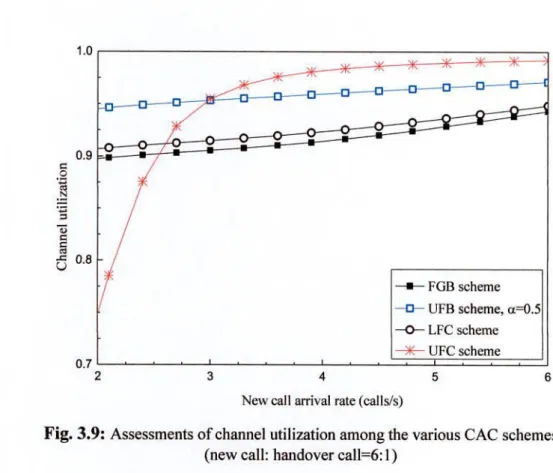
Fig. 3.9 Assessments of channel utilization among the various CAC schemes 28 (new call: handover call=6:1)
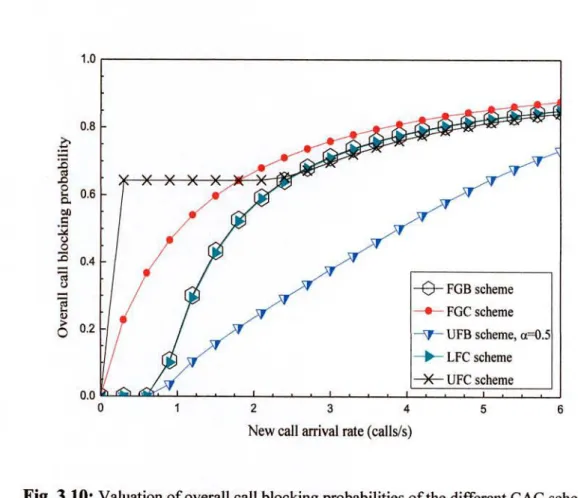
Fig. 3.10 Valuation of overall call blocking probabilities of the different 29 CAC schemes (new call: handover call=6:1)
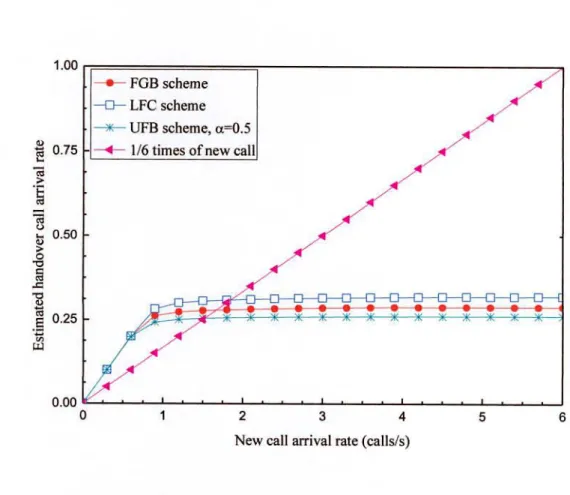
Fig. 3.11 Estimation of handover call arrival rate by statistical analysis 30
Fig. 3.12 Comparison of handover CDP between the proposed and 31
fixed call handover rate
Fig. 3.13 Comparison of new CBP between the proposed and fixed call handover rate 32 Fig. 3.14 Blocking pattern of new calls by the fractional blocking band and guard band 32 Fig. 3.15 New call blocking probabilities for different acceptance factors 33 Fig. 3.16 Handover call dropping probabilities for different acceptance factors 34 Fig. 4.1 Channel allocation for different classes of traffic in FGB scheme for multiclass 40
Fig. 4.2 State transition rate diagram of the proposed UBT scheme 41
Fig. 4.3 Functions of estimating the bands, acceptance factors, and blocking patterns of 42 different classes according to UBT scheme
Fig. 4.4 The proper set of acceptance factors finding procedure for different call arrival 44 rate to optimize the QoS
Fig. 4.5 State transition rate diagram of proposed UBT scheme for four traffic classes 46 Fig. 4.6 Call blocking probabilities of traffic class 4 for different acceptance factors 47 Fig. 4.7 Call blocking probabilities of traffic class 3 for different acceptance factors 48 Fig. 4.8 Call blocking probabilities of traffic class 2 for different acceptance factors 49 Fig. 4.9 Comparing the channel utilizations of UBT schemes at different sets of 49
acceptance factors with FGB scheme and NPS
Fig. 4.10 Comparison of CBP of four traffic classes among NPS, FGB, and UBT 50 scheme when aj0.2, a2=0.3, and a3=0.9
Fig. 4.11 Comparison of CBP of four traffic classes among NPS, FGB, and UBT 51 scheme when czj=0.3, a2=0.2, and a3=0.9
Y
ix
Fig. 4.12 Comparison of channel utilization among NPS, FOB, and UBT schemes with 52 respect to traffic load at proper acceptance factors
Fig. 4.13 Comparison of overall call blocking probabilities of NPS, UBT and FGB schemes 52
List of Abbreviation
-I
Base Station
Call Admission Control Call Blocking Probability Call Dropping Probability Fixed Guard Band
Fractional Guard Channel
- Limited Fractional Channel
Mobile Station Non-Priority Scheme Quality of Service Uniform Band Thinning Uniform Fractional Band Uniform Fractional Channel Uniform Thinning Technique I
BS CAC CBP CDP FGB FGC LFC MS NPS QoS UBT UFB UFC UTT
xi
g;(Nj
Introduction
Chapter Outlines
+ Motivation
+ Problem statements
•:• Challenges
+ Contribution of this research + Thesis outline
t
ii
Pe1.1 Motivation
Modern civilization has achieved unbelievable pace for the blessing of communication system.
The revolutionary communication systems are making the whole world closer day by day.
There exists a number of communicating ways in this modern era like telephone, fax, television, radio, email, mobile telephone, video conferencing, and many more. These communicating systems can be broadly classified into two categories— (1) wired and (ii) wireless. The cellular communication system is the latest member of wireless communication techniques but obviously the most effective communicating medium of the present generation where a number of communicating services converge effectively. These service facilities are generating enormous number of users with time. That is why, this system faces a huge traffic by reason of providing integrated services, such as the voice, data, and different types of multimedia.
The demand for multimedia services over the air is increasing drastically which leads to wide design consideration of wireless cellular network. These different types or classes of traffic are not equally important in the aspect of service priority. Traffic like security, healthcare, banking, handover calls (handover call initiates where an ongoing call moves from one macro-cell to another), etc. are more important where non-real-time calls like data, voice messaging, text messaging, etc. are comparatively less important [1]-[3]. So, different types of traffic are to divide into several classes. During the resource management, the important classes of traffic are prearranged higher priority and comparatively less important calls are considered as lower priority. Blocking a lower priority call is preferred over blocking a higher priority call for maintaining the quality of service (QoS).
There are two key objectives in cellular network design—(i) to maximize the resource utilization and (ii) to provide high QoS to users [4]. According to this statement along QoS management, it is also very important to utilize the radio resources from the service provider's point of view. Call admission control (CAC) is such a provisioning technique to maintain the QoS among the several traffic classes by limiting the number of call connections into networks that reduces the blocking probabilities of higher priority traffic classes and also optimizes the channel utilization [5], [6].
2 1 P a g e
1.2 Problem statements
There are a number of CAC schemes proposed by various researchers based on different aspects of service management. These CAC schemes are either fundamental or conditional.
The fundamental CAC schemes are applicable in any kind of wireless network but the conditional schemes are designed concerning special purposes.
There are some fundamental CAC schemes like new call bounding scheme [7], [8], non-priority scheme, cut-off priority scheme [5], [9], general form of cut-off priority scheme [10] etc. Due to provide priority to any special type of calls, it is necessary to reserve some channels dedicated for that calls. The reserved channels are not used for low priority calls. Since the radio resource is limited, this channel reservation decreases the proper channel utilization where non-priority scheme is able to utilize most of the radio resources but unable to ensure the satisfied level of QoS.
At peak hours, call arrival rate reaches very high. On the other hand, at off peak hour call arrival proportion goes down to very lower rate. Implementing a fixed guard band with a set of reserved channels for higher priority calls is the cause of unutilised resources at off peak hour.
This problem demands a dynamic channel reservation technique. Again the dynamic channel reservation or dynamic channel allocation can be implemented on the basis of statistical calls arrival rate or random call arrival rate or traffic awareness.
Another concerning issue to design a CAC scheme is the proper estimation of handover call rate. Otherwise the QoS optimization concept may be underestimated or overestimated. On the basis of a proper statistical modelling, the handover call rate should be taken in account to analyse the CAC scheme otherwise the numerical analysis of that scheme may deceive us to realize the appropriate network performances.
Some CAC schemes [3], [11], [12] are designed considering adaptive bandwidth utilization. In bandwidth utilization idea, the scheme is designed to overcome the problem of resource utilization. Though these schemes ensure to utilize the maximum radio resources arises problem to provide proper QoS. These schemes cannot provide priorities to the special classes of traffic. Sometimes, traffic priority does not depend upon revenue only. Some traffic like health service or fire brigade or police help demands priority on the basis of humanity. In these benchmarks, to optimize the QoS, adaptive bandwidth related schemes are to avoid.
3
J
P -Else, CAC scheme is designed for multiple classes of services on the basis of their priorities [1] where the total arrival calls are classified in different traffic classes. Such a CAC scheme gives different level of priorities to different classes of traffic to provide suitable QoS. In this case, the traffic division into several classes is also an important challenge. This problem can be solved considering the "maximum payee will get maximum priority" technique.
Nevertheless, this cannot be appropriate for all the moment, because of service importance, business tact, user quality and quantity, government ordinance etc. On the other hand, these realities may be hampering issues to attain maximum profit for the service provider companies.
This is why, considering all of these conditions, a CAC scheme is always designed at optimized form, not maximum.
Another important issue to design a CAC scheme is its operating algorithm. Sometimes the algorithm of the scheme becomes very complex that should be avoided. Otherwise, the network with complex algorithm may take more times to take decision at multifaceted call admission.
It is preferable that the admission controlling technique becomes stress-free.
CAC scheme based on adaptability of network is proposed in [3], [13] where resource is managed through the different calls on the basis of the networks adaptability functions. So, network adaptability is also a necessary step to design a CAC scheme.
On the basis of some novel CAC schemes, several authors proposed QoS optimization technique on the basis of traffic awareness [14], probabilistic call arrival rate [15], cost rate of holding time [16], mobility-awareness [17], [18] etc. These categories of CAC schemes are used in particular purposes. Generally, it can be said that all of these proposed schemes aim to reduce the call blocking probability of higher priority as well as improve the channel utilization for provisioning the optimum QoS of the networks for special purposes individually.
As a result, there arises scope to propose a CAC scheme so that it will be suitable to attain the desired QoS considering the previously mentioned important considerations such as reduced call blocking probability based on priority, optimum utilization of radio resources (bandwidth), reduced system cost, and easier algorithm in operation. Else, the CAC scheme contains an option to change its characteristic on the basis of network condition. The CAC scheme will also be capable to convert its scheme to another available scheme easily.
4 1
1.3 Challenges
Among the all existing CAC schemes, there are two major groups of mechanism. The first one is on the basis of new calls and handover calls. This type of CAC schemes are analysed in [4], [6], [12], [19], [21], [22]. The aspect of QoS depends upon these two types of calls where the handover calls get more priority over the new calls. The second groups are in case of multiple services oriented cellular network. There consider a number of service classes of different priorities in the network. In this case, about four or five classes are considered where the every type of services provided by the network is a subset of one of these service classes. This style of CAC schemes are proposed in [1], [5], [13]-[17], [20], [23] etc. These CAC schemes reserve channels for different classes in different manner.
In previous discussion, it is mentioned that some CAC schemes are novel upon which various special purpose dependent schemes are designed. According to the previous works, a new challenge is to accept that is optimum channel utilization with consciously compromise the QoS. Another challenge is to propose a mathematical model as call admission controlling scheme for multiservice network where any number of classes can be considered.
On the basis of these considerations, it is a challenge to propose new style of CAC schemes that can be able to optimize the QoS with proper channel utilization for aforementioned two types of CAC schemes. The schemes would be able to implement itself in special purposes too.
1.4 Contribution of this research
In this research work, basic CAC schemes are analysed and their limitations are identified.
Thereafter, the concepts to overcome the limitations are explained and deliberated.
Consequently, new style of fractional guard channel scheme are presented those are recognized as uniform fractional band (UFB) [24] to optimize the handover priority scheme and uniform band thinning (UBT) [25] scheme to reach challenges for multiclass traffic oriented networks.
The basic idea of these two schemes is suggested to place a set of uniform fractional channels (uniform fractional band) between two consecutive bands where the forbidden service class may access with a predefined uniform fractional acceptance rate.
In this scheme, only a set of channels are fractionized uniformly. The difference of this scheme from the fractional channel scheme [10] is that the fractionizing rate of the band is uniform
5 1 C
independent of channel occupancy. The proposed theories are classified for both handover
,. priority and multiservice admission control schemes. In this paper, the mathematical expressions are presented and explained very straightforwardly.
Besides, these schemes are able to cope itself for special purpose usage like traffic awareness, dynamic channel allocation, probabilistic call arrival rate on the basis of uniform acceptance factor. This factor can be varied according to the design of the network to get the desired performances.
The related algorithms of rudimentary CAC schemes are discussed briefly. The performances of the proposed schemes are analysed numerically as well as the other conventional CAC schemes are also scrutinized by the same process. The performances of the proposed schemes are compared with the existing CAC schemes graphically and elucidated the benefits as well as limitations of the proposed scheme.
1.5 Thesis outline
Chapter 2 contains the related works of this thesis and their limitations.
Chapter 3 comprehends the proposed handover priority CAC scheme and its performance comparisons with the other popular existing CAC schemes in the aspect of optimum QoS provisioning.
Chapter 4 describes the proposed uniform band thinning CAC scheme for multiservice wireless networks and the optimization process of its QoS.
Chapter 5 concludes the total work with clear explanation of applicability, benefits, and limitations of the proposed schemes. The scopes of future work are also mentioned in this chapter.
6 1 P a
L
ei
0I p(i l-lym U,
Contextual works
Chapter Outlines
•:• Introduction
+ Guard band based CAC schemes + Fractional channel schemes + Special purpose schemes + Summary
7 1 P a 1 1, a
2.1 Introduction
There are several kinds of CAC schemes proposed by different authors. Broadly these schemes can be divided into three categories. They are fixed guard band based schemes, fractional guard channel schemes and special purpose schemes. In this chapter, the concepts of these schemes are discussed shortly. These schemes are also divided into some subclasses. These subclasses are also discussed. Their operational facilities and limitations are also argued.
2.2 Guard band based CAC schemes
A number of guard band or guard channel based CAC schemes are available where the main concept is to reserve channels for handover calls. There are three different such schemes those are defined below in brief.
Cut-offpriority scheme: The cut-off priority scheme [9], [26] blocks a new call if the number of free channels is less than the number of guard band scheme reserved for handover calls. It is very easy technique to attain the desired QoS. This scheme is not concerned about proper channel or bandwidth utilization [27], [28].
Rigid division based scheme: The rigid division based scheme [29] divides all channels available in a cell into two groups: one for common use and the other exclusively for handover calls. This scheme is not concerned about proper channel utilization.
New call bounding scheme: The new call bounding scheme [22] limits the number of new calls admitted to the cell. It is a dynamic decision admitting process on the basis of call arrival rate. To attain the desired QoS this scheme blocks more new calls than cut-off priority scheme. To generalise this idea for multiple services is a complex task.
All of the above schemes deal only with homogeneous traffic (systems in which each type of traffic has the same bandwidth requirements and identically distributed channel holding time with the same average value). The aforementioned CAC schemes are unavailable for wireless networks supporting multimedia services with diverse QoS constraints [30]. These fixed guard band based CAC schemes cannot assure the proper channel utilization due to its channel reservation for handover calls. Such CAC scheme is not applicable in high traffic multimedia services oriented wireless network due to these aforementioned obstacles.
8 1 P p
2.3 Fractional guard channel schemes
This type of scheme admits call with certain probability on the basis of channel occupancy or arrival call rate or predefined acceptance factor. In the literature of fractional guard channel (FGC) scheme there are three types of fractional channel scheme. Basically, FGC scheme fractionizes the channels for a particular traffic class like new call that provides the priority to handover calls. Sometimes, the schemes are also known as thinning schemes [19], [22]. The fractional channel schemes are discussed below.
1) Thinning scheme I: Thinning scheme I admits a new call with certain probability which depends on the number of busy channels. This scheme was first proposed in [10] and shown to be more general than the cut-off priority scheme. A moderate version of thinning scheme is limited fractional channel (LFC) scheme which is better than thinning scheme 1 [31].
The idea of this scheme cannot be applicable for multiple services network.
Thinning scheme II: Thinning scheme II admits a new call with certain probability based on the number of new calls accepted into the cell. This scheme was first proposed in [19]
and shown to be more general than the new call bounding scheme. Thinning scheme II is not concerned about channel utilization.
Uniform fractional channel scheme: Uniform fractional channel (UFC) scheme is another type of thinning scheme. UFC scheme admits call with uniform acceptance factor regardless the channel occupancy or call arrival rate. This scheme is proposed in [32]-[34].
UFC scheme is only applicable in the network where the ratio of handover call and new call is very small [33].
Guard channel scheme or thinning scheme I reserves a number of resources (bandwidth/number of channels/transmission power/codes) for the exclusive use of handover attempts in cellular networks (this reduces the handover call dropping probability). However, due to the fact that an integer number of channels or bandwidth (basic units according to the network) are reserved in the conventional guard channel schemes, the blocking probabilities of the call types involved (i.e., new and handover calls) vary greatly as the number of reserved channels are changed. To overcome this problem, two schemes have been proposed: the LFC scheme [10], [31] and the UFC scheme [32]-[34]. Though the limitation of thinning scheme I is solved by LFC scheme but in this case, the authors in [10] do not discuss its channel utilization performance. The channel utilization problem can be solved by UFC scheme in
9 1 F :
higher traffic condition but it becomes the threat for QoS because UFC scheme can be
- applicable only in low handover and new call ratio oriented network [33].
Though thinning scheme is broadly discussed in [22] on the basis of handover call dropping probability and new call blocking probability, the optimized channel utilization is not confirmed by the authors. Else, thinning scheme I and II are generalized for multiservice network mathematically in [19] but its performances are not compared with the other fundamental CAC schemes.
2.3 Special purpose schemes
On the basis of novel CAC schemes, some authors proposed QoS optimization technique on the basis of some special purposes. In [14] the authors optimise the QoS of the network on the basis of traffic awareness but in this scheme fixed guard band scheme is used as a novel CAC scheme. On the concept of probabilistic call arrival rate, a CAC scheme is proposed in [15]
where as a novel CAC scheme, thinning scheme II is used. Else, on the basis of cost rate of holding time in [16] and mobility-awareness dependent CAC schemes [18], [21] are not fundamental CAC schemes. These types of CAC schemes are used in particular purposes for specific networks but not in general cases.
2.4 Summary
Detailed study of the different types CAC schemes reveals the following facts:
ril
> Guard band based schemes reduce the channel utilization.
> Thinning schemes are not concerned about channel utilization.
UFC scheme cannot assure the QoS in high traffic.
There exist a common complexity to approach a concept for two traffic and multiple traffic CAC scheme.
> Special purposes CAC schemes are not novel schemes.
Therefore, it is a burning challenge to a new of CAC scheme that can optimise the QoS with proper channel utilization and the scheme will be capable of network adaptability by its special characteristic that can help to convert itself into another form of CAC scheme.
10
Handover priority by UFB scheme
Chapter Outlines
.
Introduction
'.
Hypothesis on the rate of handover call + Fixed and Fractional guard channel schemes + Proposed handover priority scheme
+ Performance analysis + Summary
11
I
3.1 Introduction
The cellular communication is one of the favourite ways for worldwide communication. The number of users of cellular system throughout the world is increasing drastically day by day.
Due to incremental demand of the cellular networks, there has been tremendous interest and progress in this field. Cellular network provides services by dividing its physical area into different specific regions called cells. When a mobile user crosses the cell boundary or the quality of the wireless link between mobile station (MS) and base station (BS) is unacceptable, then the process of handover call is initiated [35]. In recent years, a remarkable tendency to design the cellular network is (1) decreasing the cell size and (ii) increasing the user mobility
[3].
These two factors result in more frequent handovers. In practice, it is observed that users are more sensitive with a view to dropping of an ongoing and handed over call than blocking a new call [36]. A proper management of channel allocation is necessary for this kind of provisional service.A CAC scheme is such a provisional technique to provide the QoS to the different calls at the target level by limiting the number of enduring calls in that system [36]. One major challenge in designing a CAC arises to provide service two major types of calls: new or originating calls and handover calls. The QoS perfonnances related to these two types of calls are generally measured by new call blocking probability and handover call dropping probability. Since blocking a new call is less serious than dropping a handover call, CAC schemes usually give a higher priority to handover calls. Besides, optimum resource utilization (channel utilization) is also a very important issue to design a CAC because the resource of a wireless system is limited.
There are a number of CAC schemes [1], [2], [19], [22], [35]-[39] where the authors consider the different parameter to analyse the performance of their proposed schemes. A very general and easiest CAC scheme is new call bounding scheme and this is based on FGB scheme. By this method, QoS can be achieved easily but the scheme cannot assure the proper channel utilization for reserving some channels only for handover calls. To improve the QoS and to get other important system facilities several guard band schemes are proposed. FGC scheme or thinning scheme-I and LFC scheme are proposed in [10]. In FGC scheme, new calls are accepted by the channels from starting state to end depending on the channel occupancy and the acceptance factors vary at degrading manner from 1 to 0. New call blocking probability (CBP) and handover call dropping probability (CDP) increases excessively with the increasing 12Jr:
call arrival rate in FGC scheme. Due to this characteristic, its channel utilization profile is very poor. In [10] the authors proposed LFC scheme for optimum QoS and with respect to fixed guard band (FGB) and FGC scheme but in this case channel utilization is not considered.
Thinning scheme-I1 is proposed in [19], [22]. According to the thinning scheme-I1 new calls are accepted by different channels depending on the traffic arrival rate. By this scheme any level of QoS can be achieved with compromising the CBP and so why it cannot assure the optimum channel utilization. UFC scheme is proposed in [32]-[34]. Authors of these papers conclude that the UFC scheme is better in the lower traffic than FGB scheme but at the higher traffic its performance is very poor. On the other hand, the channel utilization factor of the UFC scheme is more than FGB, LFC, and FGC schemes.
In this chapter, a new style of guard band CAC scheme is proposed which is basically a hybridization of non-priority scheme (NPS) [7], UFC scheme [32]-[34], and priority scheme.
This scheme is called in this work as UFB scheme. In this scheme, the total channels are divided into three bands. In first band, the new calls and handover calls get access with uniform acceptance factor, 1 (Acceptance factor is the measure of the call accepting ratio from the total arrival rate at a moment) and this band will show the non-priority characteristics. In second band, the new calls will be accepted by the existing channels with a predefined acceptance factor less than I which is the condition of fractionizing the band such a value may be any number within 0 to 1 and the handover calls will be accepted with unity acceptance factor. At last, the new calls will be accepted at the rate of void acceptance factor and the whole band channels accept only handover calls. In this scheme, handover calls get priority by two bands where in FGB scheme, there is only one band where handover calls get priority. For this reason, UFB scheme can accept some more new calls than the FGB scheme because there is a uniform fractional band inside the priority and non-priority bands. In this case, there is a trepidation fact to increase the CDP for decreasing the CBP. To overcome this obstacle, it is necessary to determine the proper value of acceptance factor of the middle band of this scheme. Moreover, UFB scheme ensures the more channel utilization than FGC, FGB, and LFC schemes.
Besides, the performances of the CAC schemes in [10], [19], [22], [32]-[34], [40] are analysed considering the handover calls as the fixed ratio of the new calls. In practice, the handover calls rate in a system cannot maintain a fixed ratio with new calls which is proposed in [3], [9].
Essentially, handover call estimation can be calculated by the equation of statistical hypothesis on handover calls and new calls which is explained at the next section in this chapter. The
13 1
difference between the fixed ratio handover call and the statistical modelling of call handover rate is also mentioned by the numerical results at the performance investigation section.
Because of using a uniform fractional band between the priority and non-priority band, some more new calls will get access which must reduce the CBP but it may increase the CDP than FGC due to extra traffic. To avoid such a problem, necessary steps are discussed with proper explanations. This scheme uses a short uniform band which can avoid the excessive computational complexity because the uniform acceptance factor does not depend on the channel occupancy or call arrival rate through this band. So, it is very easy to observe the impact of various acceptance factors on CBP and CDP. The novelty of the acceptance factor is to determine the lower CBP for lower and higher call arrival rate that means this scheme can solve the limitation of UFC scheme. Furthermore, a comparison is made between the proposed CAC scheme and other different CAC schemes on the basis of CBP, CDP, channel utilization, and overall call blocking probability. It is also explained that why and whether the performance of the proposed UFB scheme is applicable and beneficiary in the aspect of optimum QoS.
3.2 Hypothesis on the rate of handover call
In cellular networks, the rate of new call and handover call does not maintain the fixed ratio.
This is why a hypothesis is necessary to obtain the relation between them. The relation among the originating or new call arrival rate (2,,), the handover call arrival rate (A,,), and the average channel departure rate (,u) is essential to determine the probability of blocking new calls and dropping handover calls. Here, it is considered that P8 and PD represent the blocking probability of new calls and the dropping probability of handover calls, respectively. All calls arriving processes are assumed to be as Poisson's distributed.
A new call that arrives in the system may be either completed within the original cell or handed over to another cell before completing the call. The probability of a handover call depends on two factors - (i) the average dwell time (i/n) and (ii) the average call duration (1/1u,,). Again the average channel departure rate (u) also depends on the above two parameters. Since both the call duration and the cell dwell time are assumed to be exponential [3], [9], the handover probability, Ph of a call at a particular time is given by,
77
i l = (3.1)
/,,
141 P
Furthermore, the arrival rate of handover calls into a cell is evaluated as,
[l — ,(l — PD)]
(l—PB )P/,
(3.2)
The equation agrees from balancing the rates of handover calls into and out of a cell. When a call is originated in a cell, the call holds the channel until that call is completed in the cell or the mobile moves out of the cell. Therefore, the channel holding time, T is either dwell time, Th or the call length time, T [9]. The minimum value between dwell time and call length time is the channel holding time. Therefore, the relation among T, T,,, and T,, can be represented as,
T= min(T,,,T) (3.3)
3.3 Fixed and Fractional guard channel schemes
There exist a number of CAC schemes based on the notion of guard channel where reservation of total channel between new calls and handover calls are assigned in various manners. In every case, handover calls get priority over new calls. At first the fundamental idea of fixed guard band CAC scheme is analysed. Thereafter, the fractional guard channel schemes are also described on the basis of one dimensional Markov chain. These studies are presented in easiest mathematical way as well as their admission controlling algorithms are also discussed gradually with neat state transition rate diagram.
3.3.1 Fixed guard band scheme
Fixed guard band scheme is a general priority scheme for call admission. In this case, priority is given to handover calls by assigning guard channels (Gc) entirely for handover calls only among the total channels in a cell say, C. The rest M (= C - Gc) channels are shared by both new calls and handover calls. A new call is blocked if the progressive call is in state, Mor more than that. A handover call is blocked if no channel is accessible in the target cell that means the operating state is at C.
15 1 P a p e
[ Al
P(0)=I +2,,)' [=o i!p!
—1
+ 2,, )M
2n
1
i=M+I
j
(3.6)) fl +h A fl +1h A fl+Ah A n+2h
ØJ7T JJjT3JJ3
p 2p .3P M,u (M+1)p C,ii
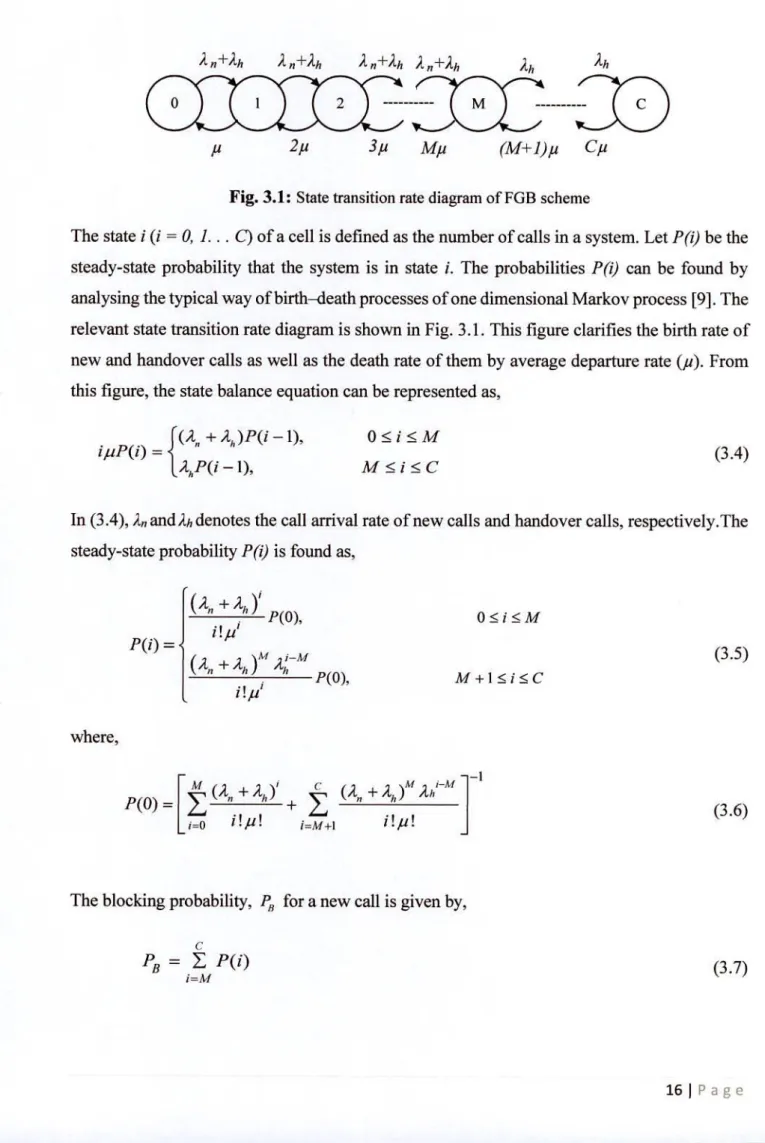
Fig. 3.1: State transition rate diagram of FOB scheme
The state i (i = 0, 1. . . C) of a cell is defined as the number of calls in a system. Let P(i) be the steady-state probability that the system is in state 1. The probabilities P(i) can be found by analysing the typical way of birth-death processes of one dimensional Markov process [9]. The relevant state transition rate diagram is shown in Fig. 3.1. This figure clarifies the birth rate of new and handover calls as well as the death rate of them by average departure rate (p). From this figure, the state balance equation can be represented as,
IR
+2,,) P(i -l), 0:5i:!~M M:5i<CIn (3.4), 2,, and Ah denotes the call arrival rate of new cal Is and handover calls, respectively. The steady-state probability P(z) is found as,
i!J
I i-Al
(2±)2 P(0),
M+1_<i<_C i!p'
(3.5)
where,
(3.4)
The blocking probability, I, for a new call is given by,
'3B P(i)
i=M (3.7)
16 I
According to (3.5) to (3.7), the blocking probability of handover request or handover call dropping probability, J is given by,
Af C-M
(2 2h ) 2h
= P(C) = P(0)
C ! (3.8)
Call accepting and rejecting strategies of FGB scheme are presented in Algorithm 1. Here, the accepting strategies of new calls and handover calls are classified in two different conditions.
Channels from M to C are the guard band that accepts only the handover calls.
Algorithm 1: The call accepting and blocking strategies of FGB scheme if (NEW CALL) then
if (Nun,, of occupied channels <M)
Accept call;
else
Block call;
end if end if
if (HANDOVER CALL) then
if (Num. of occupied channels < C)
Accept call;
else
Block call;
end if end if
3.3.2 Fractional guard channel scheme
In the FGC scheme, new calls are accepted with a certain probability that depends on the current channel occupancy which is also recognized as thinning scheme-I [19], [22]. This scheme is known as thinning scheme because the new call accepting factor becomes thinner as the channel occupancy increases. In this case, it is necessary to randomize a parameter which denotes the probability of acceptance of a new call. It should be bear in mind that both schemes accept handover calls as long as channels are available but for the new call accepting rate is limited by the acceptance factor.
40
17
1 11a,7
ea0 A,,+A,, a j 2+1,, a2)L P,+Ah am A n+2/7 ac..1A n+2,,
-- - --- D2)
p 2u 3p Mp (M+1)p C/i
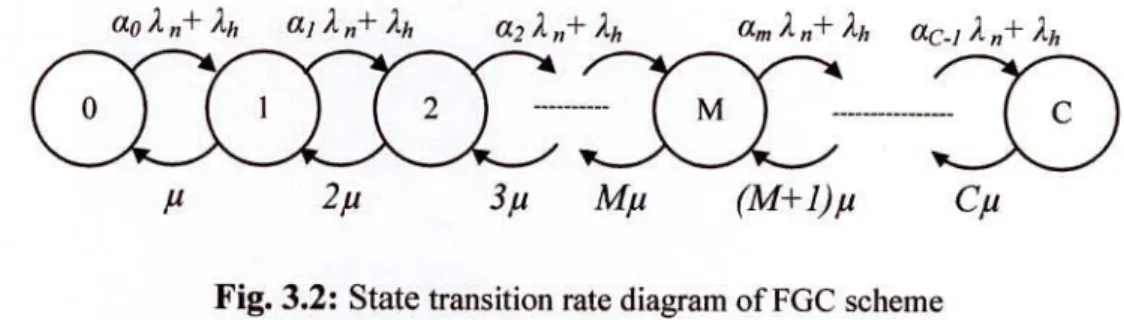
Fig. 3.2: State transition rate diagram of FGC scheme
The Markov process of FGC scheme is illustrated in Fig. 3.2. The state transition rate diagram of Fig. 3.2 demonstrates that form the starting state to Imal state the new call accepting factors are changing on the basis of channel occupancy. It starts from 1 and ends to 0. The probability of channel occupancy at any state, 1, P(i) by a new call or a handover call is given by [10], [19],
P(i) = Ll
i! P(0), 0 :!~ i :!~ C (39)
where,
C
(3.10)
1=0
The blocking probability of a new call, I is given by, (1—a 1 )fl (a +2h )
PB= I 1=0
P(0), (3.11)
1=0 i!
and dropping probability of a handover call, PD is given by, fl(aJ A fl +2h)
C! P(0) (3.12)
Here, a denotes the acceptance factor and j denotes the current state. So, a1 denotes the acceptance factor of the current state. In this scheme, a0 = 1, a( =0 and the others are fractional values those vary randomly between 1 and 0.
The arrived call accepting and rejecting strategies of FGC scheme are analysed in Algorithm 2.
In this algorithm, a function named rand (0,1) is initiated which can produce any rational number randomly between 0 and 1 on the basis of occupied channels those help to accept calls at that ratio and rest of the calls are rejected.
18 1 R e
Algorithm 2: The call accepting and blocking strategies of FGC scheme
& rand (0, 1) returns a uniformly generated random number in the interval [0,1]
if (NEW CALL) then
if (rand (0, 1) &i (Num of occupied channels))
Accept call;
else
Block call;
end if end if
if (HANDOVER CALL) then if (Nurn. of occupied channels <C)
Accept call;
else
Block call;
end if end if
3.3.3 Limited fractional channel scheme
The state transition rate diagram of a system with C channels is illustrated in Fig. 3.3. As the name suggests, the LFC scheme is a simplification of the more general FGC scheme about which is described earlier. In the LFC scheme, after the channel is occupied up to M, new calls are accepted with a probability a. From states M+1 to C, handover calls are accepted and in states 0 to M-1, both types of calls are accepted. Thus, the randomization in the LFC scheme is restricted to just one state as compared to the FGC scheme where randomization could potentially occur at every state. CBP and CDP of LFC scheme can be easily calculated using (3.9) -(3.11) by setting a,n+j=a, and the values ofa=1, 0 Si M, and a=0, M+J< i SC [10].
A fl +/th 2,7 +2h A +,Zh a2+ Ah
::= ---
p 2p .3p Mp (M+1)p (M+2)p C1u
Fig. 3.3: State transition rate diagram of LFC scheme
19
1
P a aThe arrived call accepting and rejecting strategies of FGC scheme are presented in Algorithm 3. This algorithm is quite same as FGC scheme but in LFC scheme the acceptance factor is previously assigned. From 0 to Mthis value is 1 and from M+1 to C this value is 0.
Algorithm 3: The call accepting and blocking strategies of LFC scheme rand (0, 1) returns a uniformly generated random number in the interval [0,1]
if (NEW CALL) then
if (rand (0, 1) a, (Num of occupied channels <M)) Accept call;
else if (Num of occupied channels = M)) AND (rand (0, 1):5a)
Accept call;
else
Block call;
end if end if
if (HANDOVER CALL) then if (Num. of occupied channels < C)
Accept call;
else
Block call;
end if end if
3.3.4 Uniform fractional channel scheme
The UFC scheme uses new call admission probability, a independent of channel occupancy to accept new calls. The state transition rate diagram of UFC scheme is shown in Fig. 3.4. This scheme accepts handover calls as long as channels are available. This policy can be obtained from FGC scheme by setting ak=a, (for k = 0, ... , C —1). UFC scheme reserves non-integral number of guard channels for handover calls by rejecting new calls with some probability.
According to the studies given in [32]-[34] show that the UFC scheme has a lower blocking probability for new calls in low handover and new calls traffic ratio.
2 + 2h a 2 ,,+ 2h a 2 ,,+ 2,, a A ,,+ 1h
(Z=--= ... - --- =
p 2u 31u Mp (M+1)p Cu
Fig. 3.4: State transition rate diagram of UFC scheme
20
1
PThe steady-state probability P(i) calculating function [32] is given as, (ci% +
Aj
P(i) = i!1u' P(0), 0 ~ i ~ C (3.13)
Here, P(0) can be calculated by the equation is given as,
P(0)
[
C= l+P(i)I (3.14
i=1
The handover CDP and new CBP of this scheme is calculated as,
PD=P(C) (3.15)
c-1(a2 +2h )
P(0)+P(C) (3.16)
i=o
The arrived call accepting and rejecting strategies of UFC scheme are presented in Algorithm 4. In this algorithm a function entitled rand (0, 1) is also initiated which produces a uniform acceptance factor randomly regardless the channel occupancy. By this technique it is different from thinning scheme I and thinning scheme II.
Algorithm 4: The call accepting strategy of UFC scheme
rand (0, 1) returns a uniformly generated random number in the interval [0,1]
if (NEW CALL) then
if (Num of occupied channels < C and rand (0, 1) <a) then Accept call;
else
Block call;
end if end if
if (HANDOVER CALL) then
if (Num of occupied channels < C) then Accept call;
else
Block call;
end if end if
211 r
3.4 Proposed handover priority scheme
The proposed scheme is decorated by hybridizing three set of bands. A uniform fractional band is assigned between the non-priority and priority bands of fixed guard band scheme. For this reason, this scheme is named by UFB scheme. UFB scheme can be illustrated by the given one dimensional Markov chain in Fig. 3.5.
The three bands, existed in this scheme, accept call with uniform acceptance factor by three different patterns. The first band is non-priority band where both the new calls and handover calls are accepted with same priority. In this non-priority band the acceptance factors for new calls and handover calls are I. The second band in UFB scheme is the fractional band. In this set of channels, the new calls are accepted by a predefined acceptance factor which is less than 1 and this acceptance factor throughout the band is uniform. In fractional band the handover calls are accepted by the acceptance factors, 1. The last band is the integral priority band where the channels are reserved only for handover calls. In this case, it can be said that the new calls are accepted by this band with void acceptance factors.
States from 0 to M in Fig. 3.5, new calls and handover calls have no priority to access. When the states up to M, are occupied, the new calls are accepted by the states from M+ 1 to N, with a uniform acceptance factor, a. This acceptance factor is independent of the channel occupancy through the band. This type of priority is termed as fractional priority. The states from N+1 to C are reserved only for handover calls like the FGB scheme. It means these states or the corresponding set of channels accept only handover calls. So, the acceptance factors throughout the band for new calls are void. The priority of handover calls given by this band is termed as integral priority.
A n+Ah n+Ah A n+Ah A n+Ah n 2h n 2h Ah Ah
p 2p 3p Mp (M+1)p (M+2)p Np (N+1)p (N+2)p Cp
Fig. 3.5: State transition rate diagram of UFB scheme
22 1
Arrival of new or handover call
Handover call
Analysis the
call type New call
No Isthe
available channel less than C? 11
Yes Yes Is the
available channel less than M?
No
Block the call
Accept the Accept the call I I call
Isthe •\
!!"vailable chanr No
'N?
M&<N?Accept the call with predefined
ratio, a
Block the call
Fig. 3.6: Steps and conditions for call admission controlling of UFB scheme
The ideas of call accepting and blocking the new calls and handover calls of UFB scheme are presented by Fig. 3.6. At first, the network identifies the call whether it is either new call or handover call. If the call is handover call and there is a free channel in the system, the handover call is accepted by this scheme. If there is no available channel to access, handover call will be blocked. From states 0 to M, all new calls are accepted but form states M to N, new calls are accepted by predefined acceptance ratio. The priority band, from states N to C, the channels are only reserved for handover calls which means all new calls are blocked by these states.
According to UFB scheme, priorities to the handover calls are provided by two steps. The steady state probability functions are classified into three conditions. First condition represents the non-priority characteristics, second condition presents the uniform fractional characteristics
23 1 P p
and the third condition is integral priority for the handover calls. That is why, the steady state probability, P(z) of UFB scheme is presented with aforesaid three conditions by,
I! p' O<- i -<M
(2,, + Ai,) aA, ~ 2,,
P(i) = M <- i -< N (3.17)
I! 1ti'
( (a +2,, )NM 2i-N
" N <- i <- C
1./i
According to the laws of probability we can write that,
C
i=o P(i) =1 (3.18)
To equate (3.18) we find the value of the state occupancy probability of null state, P(0) which is given as,
N-M i-N
M(A,,+2h)' N (A,+Ah)M (aA,+A
P(O=1
P(0) + P(0) + P(O ) +
i!p' i=N+l
ti (A,, + A,,)' N (A,, + A, )AI (aA,, + A, )IM (A, i-N
so, P(0)=[1+ . + + +) (a+)N-Al
,=i i!p' ii+i i!,u' i-+i ,,' i!p' (3.19)
According to the concept of UFB scheme, the new calls are started to block after the states up to Mare occupied and this blocking rate will be as (1 - acceptance factor). Such blocking pattern runs up to the channel occupancy of N state. Beyond the states N are occupied the new calls are blocked totally. This is why, the blocking probability of new calls can be calculated as,
N-I (2 + 2h)M (a2 + 2h)
P(0) +
21-N (2 + 2h)M (a2 + 2h)' Al
1. P(0) (3.20)
PB =(I-a)
i=M i!,u' i=N
The handover call blocking is known as handover CDP which is mentioned earlier. Since the handover calls are accepted by the total channels, a handover call will be dropped if the all channels are occupied which means all channels become busy in service. Here, if total channels are C, the state occupying probability of state C is the probability of blocking a handover call.
24
1
PSo, according to the third conditional function of state transition probability given in (3.17), the handover CDP can be computed as,
PD—P(C)
=
C!/.F P(0)
(3.21)
In Algorithm 5 call accepting and rejecting strategies of UFB scheme are given. In this algorithm the function named rand (0, 1) produces any rational number between 0 and 1.
Algorithm 5: The call accepting strategy of UFB scheme
rand (0, 1) returns a uniformly generated random number in the interval [0,1]
if (NEW CALL) then
if (Nuna. of occupied channels <M)) then Accept call;
else if (Num of occupied channels => M & <N and rand (0, 1) <a) then Accept call;
else
Block call;
end if end if
end if
if (HANDOVER CALL) then
if (Num of occupied channels <C) then Accept call;
else
Block call;
end if end if
3.5 Performance analysis
In this section, the simulation results are presented for assessment of proposed scheme with the others. These results show how much deviation may be caused by using the proposed scheme, and other traditional CAC schemes. On the other hand, the various features of the proposed scheme are also described gradually.
25 1 P
First of all, investigation of all the CAC schemes go on considering the total channels, C=iOO, the guard band for the FGB scheme and for the limited fractional channel scheme, M=90, and in the proposed scheme, N=94. The new call arrival rate is considered from 0 to 6 calls per second in every case. Since the authors of[10], [32]-[35], consider the handover call as a fixed ratio with new call arrival rate, to compare their results with the UFB scheme in every simulation the handover call is considered as 1/6 times of the new call arrival rate. Mean call life time, i/p is considered as for both new calls and handover calls as, 90 second and the mean dwell time, 1/,=360 second.
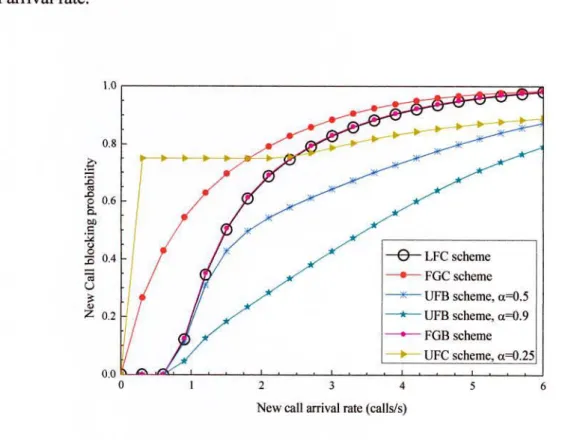
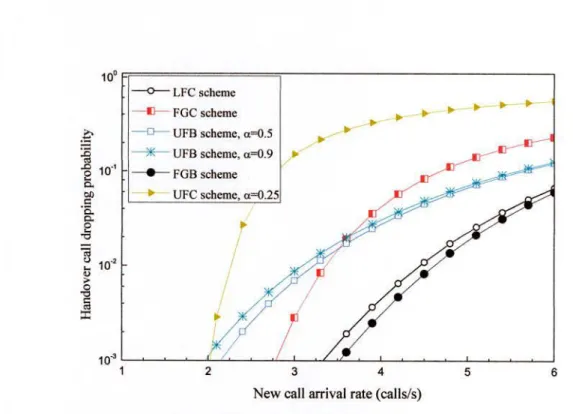
At first, in numerical results, the new CBP's and handover CDP's of the various CAC schemes are examined. Fig. 3.7 presents such a comparison among the various popular CAC schemes as well as the proposed scheme too. This figure shows that the proposed scheme confirms the lowest new call blocking probability than the others and the highest call blocking probability is occurred in case of the FGC scheme. UFC scheme has a lower CBP than LFC, FGC, and FGB schemes at the higher new call arrival rate but very poor performance in the lower new call arrival rate.
1.0
0.8
41 -. -
.0 .0 0.6
0.
U 0 .0 0.4 U Z 0.2 U
0 LFC scheme
-.- FGC scheme UFB scheme. a=0.5
* UFB scheme, a=0.9
• FGB scheme UFC scheme, z0.25
0 I 2 3 4 5 6
New call arrival rate (catls/s)
Fig. 3.7: Comparison of new call blocking probabilities among the conventional guard band CAC schemes with the proposed UFB scheme (new call: handover call=6: I)
26
1
P .- pThe handover CDP comparisons are presented in Fig. 3.8. Here, it is observed that the handover CDP of the UFB scheme increases slightly than the LFC and FGB schemes but much more less than the UFC and FGC schemes. It is also noteworthy information in this case that the values of call acceptance factors do not impact notably, on the handover CDP of the UFB scheme while the number of fractional channels are very few (here only 4 channels are used) with respect to total channel. In this figure, two different acceptance factors 0.5 and 0.9 are considered for accepting the new calls. For these two values, the handover CDP's of UFB scheme do not vary remarkably. According to Fig. 3.8, it is clear that UFC scheme is the worst CAC scheme for the QoS aspect because its handover call dropping probabilities are much