A REVIEW ON DRUG REPURPOSING FOR DIABETES EPIDEMIC
By
Sadia Raisa Lamia 17146029
A thesis submitted to the Department of Pharmacy in partial fulfillment of the requirements for the degree of
Bachelor of Pharmacy (Hons.)
Department of Pharmacy Brac University September, 2021
© 2021. Brac University All rights reserved.
Declaration
It is hereby declared that
1. The thesis submitted is my own original work while completing degree at Brac University.
2. The thesis does not contain material previously published or written by a third party, except where this is appropriately cited through full and accurate referencing.
3. The thesis does not contain material which has been accepted, or submitted, for any other degree or diploma at a university or other institution.
4. I have acknowledged all main sources of help.
Student’s Full Name &Signature:
Sadia Raisa Lamia 17146029
Approval
The project titled “A Review on Drug Repurposing for Diabetes Epidemic” submitted by Sadia Raisa Lamia (17146029) of Spring 2017has been accepted as satisfactory in partial fulfillment of the requirement for the degree of Bachelor of Pharmacy (Hons.) on 21-08-21.
Examining Committee:
Supervisor:
(Member) _______________________________
Dr. Eva Rahman Kabir
Professor, Department of Pharmacy Brac University
_______________________________
Dr. M.Zulfiquer Hossain
Associate Professor, Department of Pharmacy Brac University
Program Coordinator:
(Member)
Departmental Head:
(Chair)
_______________________________
Dr. Zara Sheikh
Senior Lecturer, Department of Pharmacy Brac University
_______________________________
Dr. Eva Rahman Kabir
Professor, Department of Pharmacy Brac University
25.09.2021
25.09.2021
March 24, 2022
Ethics Statement
This study does not involve any kind of human or animal trials.
Abstract
Repurposing of existing drugs to treat chronic, communicable and non-communicable diseases is becoming progressively important since it uses existing drug molecules or failed compounds by utilizing the available data. It uses several approaches, potentially decreasing the total development cost and shorter development timeframes. The traditional search for drugs for the treatment of diseases is a slow process, where significant expenses of new drug research and development are involved. This review discusses the drugs that are being approved for diabetes epidemic using drug repurposing approaches, as well as the challenges and future perspective.
Keywords: Drug repurposing, Diabetes, Antidiabetics, Clinical trials, Mechanism
Dedication
Dedicated to my parents
Acknowledgement
I would like to begin by expressing my gratitude towards Almighty Allah for providing me with strength during this whole period, I am indebted and would like to express my sincere gratefulness and gratitude to my supervisors Dr. Eva Rahman Kabir, Professor and Chairperson, Department of Pharmacy, Brac University & Dr. M. Zulfiquer Hossain, Associate Professor, Department of Pharmacy, Brac University for being a constant guiding spirit throughout my study and for being so supportive, kind and motivating throughout the journey.
Last but not the least, I would like to take this opportunity to thank all those personalities who have helped me for all my educational achievements.
Table of Contents
A REVIEW ON DRUG REPURPOSING FOR DIABETES EPIDEMIC ... i
Declaration... ii
Approval ... iii
Ethics Statement... v
Abstract ... vi
Dedication ... vii
Acknowledgement ... viii
Table of Contents ... ix
List of Figures ... xii
List of Acronyms ... xiii
Chapter 1 Introduction... 1
Chapter 2 Aim ... 3
Chapter 3 Methodology ... 4
Chapter 4 Diabetes ... 5
4.1 Treatment of Diabetes ... 6
Chapter 5 ... 12
Drug Repurposing for Diabetes ... 12
5.1 Steps in Drug Repurposing: ... 13
5.2Strategies of Drug Repurposing: ... 14
5.3Approaches of Drug Repurposing ... 15
Chapter 6 ... 33
Drugs for Treatment of Diabetes Epidemic... 33
6.1 Drugs Approved by FDA ... 33
6.2Drugs in the Pipeline for Approval ... 47
6.2.1Drug Repurposing Evidence Level ... 51
Chapter 7 Challenges ... 57
Chapter 8 Conclusion ... 60
List of Tables
Table 1: Commonly used antidiabetics ... 7
Table 2: FDA approved combined drugs for diabetes treatment ... 9
Table 3: Commonly used Database for drug repurposing ... 26
Table 4: Common tools and web-servers used in drug repurposing ... 29
Table 5: Clinical Trials of Colesevlam ... 35
Table 6 Clinical Trials of Bromocriptine ... 42
Table 7: Repurposing drugs for Diabetes ... 47
Table 8 Classification of Drug Repurposing Evidence Levels ... 52
List of Figures
Figure 1: A comparison between Traditional de Novo Drug Discovery and Development vs
Drug Repositioning. ... 14
Figure 2: Strategies of Drug repurposing. A) On target drug repurposing strategy and B) Off target drug repurposing strategy. ... 15
Figure 3: Computational Approaches of Drug Repurposing ... 15
Figure 4: Experimental Approaches of Drug Repurposing ... 25
Figure 5: Potential Mechanism of Action of Colesevelam for Diabetes. ... 34
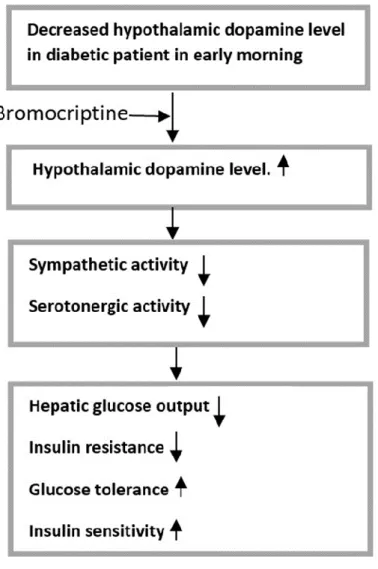
Figure 6: Potential Mechanism of Action of Bromocriptine for Diabetes………....41
List of Acronyms
T2D Type 2 diabetes
DR Drug Repurposing
CADD Computer Aided Drug Designing EMA European Medicines Agency FDA Food and Drug Administration WHO World Health Organization
PPARG Peroxisome Proliferator-Arouse Receptor Gamma vHTS Virtual High-Throughput Screening
HTS/HCS High-Throughput and/or High-Content Screening SRP Signature Reversion Principle
GPCR G-Protein-Coupled Receptors GWAS Genome Wide Association Studies EHRs Electronic Health Reports
FAERS FDA Adverse Event Reporting System CPRD Clinical Practice Research Datalink CCLs Cancer Cell Lines
LDL-C Low-Density Lipoprotein Cholesterol
FXR Farnesoid X Receptor
IR Insulin Resistance
VMH Ventromedial Hypothalamus
DREL Drug Repositioning Evidence Level SAE Serious Adverse Event
HR Hazard Ratio
QR Quick Release
MOU Method-of-Use
NDA New Drug Application
sNDA Supplemental New Drug Application
Chapter 1 Introduction
The global burden of chronic diseases, like cancer, heart diseases, type 2 diabetes, chronic lung disease, chronic kidney disease, Alzheimer’s is on the rise and as such, the search for affordable and alternate drugs for their treatment is of paramount (Centers for Disease Control and Prevention, 2019). Diabetes is considered to be one of the world’s fastest growing disease.
Roughly 463 million people have been suffering from this disease according to the International Diabetes Federation. Currently, 463 million individuals are living with diabetes in the world. By 2030, that number is projected at 578 million and by 2045 it would reach 700 million. The prevalence is greater in urban regions (10.8 percent) than in rural areas (7.2 percent). Similarly, the prevalence of this disease is higher in high-income nations (10.4 percent) than in low-income countries (4.0 percent). 50.1 percent of people with diabetes are found to be unaware that they have it. Impaired glucose tolerance was globally prevalent in 2019 and the percentage was 7.5 percent (374 million). It is anticipated to rise to 8.0 percent (454 million) by 2030 and 8.6 percent (548 million) by 2045 (Saeedi P et al., 2019).
Despite significant investments in traditional medicine pipelines by the different pharmaceutical firms, the development of new medications has failed to address the growing prevalence of Type 2 diabetes (T2D). Till date two drugs have been successfully repurposed for diabetes, and many more potential therapeutic molecules are still under investigation.
Nevertheless, there are some challenges associated with drug repurposing, which need to be tackled well for the progress of drug development by repurposing (Turner et al., 2016).
Drug repurposing, which is also known as drug repositioning is a method applied to identify novel indications and applications of existing drugs which are FDA approved and are in use
clinically. Drug candidates with new pharmacological activity or therapeutic characteristics can be developed using this method. Moreover, by drug-repurposing discontinued drugs, drugs which are in experiment or failed drugs at the time of development can be established for novel therapeutic indications (TT & KB, 2004a).
Drug repurposing (DR) is a novel way of identifying drug compounds and targets that have been de-risked at the time of development stages which helps to speed up the total process so that the production time, effort and costs are less. It has decreased the drug discovery failure rate, leading to therapeutic breakthroughs (Osakwe & Rizvi, 2016). The technique of drug repurposing is used to enhance the success rate of medication development since the traditional process of drug discovery is an expensive and time-consuming procedure. This process outperforms the standard drug discovery processes in terms of time needed for the drug development, cost, efficiency, and risk of failure and potential candidates has already been evaluated in a number of clinical trials.
DR is an efficient method for revealing new targets and pathways in a less costly and safer manner (Pushpakom et al., 2018). However, repurposing of drugs has recently gained popularity due to its high success rate. Drug development has progressed commercially after it was discovered to have an off-target impact or the newly discovered on-target effect. There are numerous examples of existing drugs to have shown alternate therapeutic indications.
Successful Computer Aided Drug Designing (CADD) techniques for the identification of repurpose able drug molecules are also being used (TT & KB, 2004a). This had led researchers to search for the identification of a number of potential drugs for a wide variety of diseases, such as diabetes.
Chapter 2 Aim
Understanding drug repurposing in the development of new anti-diabetic treatments.
Chapter 3 Methodology
Recent literature was extensively studied. Secondary data for the study was compiled from several journals endorsed by Nature, Elsevier, Springer and other distinguished journals. The different conventional therapies such as insulin and sulfonylureas, as well as the drugs repurposed or considered for repurposing have been discussed in this study. The study compiles the different computational approaches and the tools used in drug repurposing for an antidiabetic drug. It also outlines the challenges associated with drug repurposing. Specific topics of drug repurposing were omitted due to the vast quantity of research in this field. In an internet search engine, the search was done with specific exclusion criteria. The review did not include potentially relevant research results such as conference contributions, working papers, or books.
Chapter 4 Diabetes
Diabetes leads to micro and macro complications, including stroke, coronary artery disease, which leads to a short-ended life expectancy.
United Nations and WHO have thus focused on diabetes as a significant global health problem in light of the massive worldwide epidemic of this disease, which is arguably the most serious non-communicable global disease generated by an unhealthy contemporary lifestyle.
According to experts, diabetes and cardiovascular illness are like two sides of the same coin when it comes to cardiovascular risk. People with diabetes are more likely to die from heart disease than those without, and vice versa.
Estimation of diabetes prevalence for 2019 and forecast for 2030 and 2045 are found in the 9th edition of the IDF Diabetes Atlas. Adults aged 20 to 79 are included in the estimations, which include type 1 and type 2 diabetes, both diagnosed and undiagnosed There are 463 million individuals aged 20 to 79 globally who have diabetes (9.3 percent of all adults in this age range). 79.4 percent of people reside in low- and middle-income nations, according to estimates.
Diabetes is a result of abnormalities in insulin production or insulin activity, marked by persistent hyperglycemia. Carbohydrate, lipid, and protein metabolic irregularities are the outcome of insulin's role as an anabolic hormone. It is believed that these metabolic anomalies are caused by low insulin levels and/or insulin resistance in target tissues such as skeletal muscles, fat, and to a lesser degree liver, at the level of insulin receptors, the signal transduction system, and/or effector enzymes and genes. The intensity of the symptoms is determined by the kind and duration of the diabetes. In the early stages of diabetes, some individuals are
asymptomatic, though found later to be significantly hyperglycemic. This is found especially in children with total insulin insufficiency may suffer from polyuria, polydipsia, polyphagia, and weight loss.
Diabetes is classified into several types:
• Type 1 diabetes is an autoimmune disorder. Mainly occurs when the immune system attacks and kills pancreatic cells which are responsible for insulin production. It is estimated that 10 percent of the diabetic patient suffers from Type1 diabetes.
• Type 2 diabetes is mainly caused by insulin resistance when body is unable to use the insulin to transport sugar into the cell thus the sugar level in blood elevates and causes hyperglycemia.90 percent of the diabetic patient suffers from type 2 diabetes.
• Prediabetic is a state when sugar level of blood is higher than normal but not high enough to be diabetic. This state can be prevented and sugar level can be managed by managing healthy life style.
• Gestational diabetes. This type of diabetes occurs during pregnancy when the placenta produces hormones causing insulin resistance and the blood sugar level is elevated.
Diabetes insipidus, despite its similar name, is a rare illness that is unrelated to diabetes mellitus. Basically, in this disease condition kidneys excrete too much fluid from body
4.1 Treatment of Diabetes
In the case of type 1 diabetes, insulin is the major therapy. This helps to make the hormone;
the body doesn't generate. The four most widely used insulins are Type 1, insulin aspart, insulin detemir, and insulin glargine. Their levels of productivity are distinguished by the speed at which they begin working and the duration of their effects.
On the other hand, people having type 2 diabetes and gestational diabetes, the blood sugar can be controlled through diet and exercise. However, medication is required to reduce blood sugar when lifestyle changes aren't adequate.
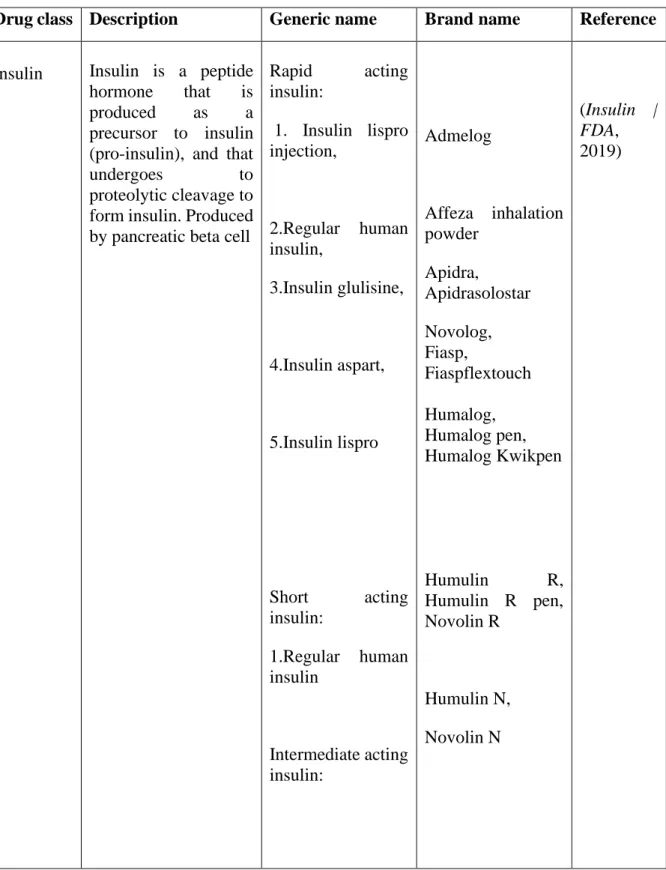
Table 1: Commonly used antidiabetics
Drug class Description Generic name Brand name Reference
Insulin Insulin is a peptide hormone that is produced as a precursor to insulin (pro-insulin), and that
undergoes to
proteolytic cleavage to form insulin. Produced by pancreatic beta cell
Rapid acting insulin:
1. Insulin lispro injection,
2.Regular human insulin,
3.Insulin glulisine,
4.Insulin aspart,
5.Insulin lispro
Short acting insulin:
1.Regular human insulin
Intermediate acting insulin:
Admelog
Affeza inhalation powder
Apidra,
Apidrasolostar Novolog, Fiasp,
Fiaspflextouch Humalog, Humalog pen, Humalog Kwikpen
Humulin R,
Humulin R pen, Novolin R
Humulin N, Novolin N
(Insulin | FDA, 2019)
Drug class Description Generic name Brand name Reference 1.NPH(Human
insulin isophane suspension)
Long-acting insulin:
1.Insulin Glargine,
2.Insulin Degludec
Levemir, Toujeo, Toujeo max
Tresiba Flextouch
Sulfonylur eas
These substances stimulate insulin secretion thus called insulin
secretagogues.
First generation:
1.Tolbutamide, 2.chlorpropamide, 3.Tolazamide Second generation:
1. Glyburide, 2.Glipizide 3. Glimepiride
Tol-tab Diabinese Tolinase
Diabeta, glynase Glucotrol, Glucotrol XL Amaryl
(Diabetes Medicines DIABETE S TIPS, 2018)
Glinides
These are known as Insulin secretagogues
1.Repaglinide 2. Nateglinide
Prandin Starlix
(Diabetes Medicines DIABETE S TIPS, 2018) Biguanide These are categorized
as an insulin sensitizer.
It helps to increase glucose absorption by decreasing insulin resistance
Metformin Fortamet, Glucophage, Glucophage XR, Glumetza, Riomet
(Diabetes Medicines DIABETE S TIPS, 2018)
Drug class Description Generic name Brand name Reference Thiazolidi
nediones
TZDs) are insulin sensitizers as well.
1. Pioglitazone 2. Rosiglitazone
Actos Avandia
(Diabetes Medicines DIABETE S TIPS, 2018)
α -
Glucosidas e
inhibitors
They are starch blockers, reduces post meal glucose level
1. Acarbose 2. Miglitol
Precose Glyset
(Diabetes Medicines DIABETE S TIPS, 2018)
DPP-4 inhibitor:
They inhibits the DPP- 4 enzyme and lowers blood glucose level
1.Sitagliptin 2.Saxagliptin 3.Alogliptin 4.Linagliptin
Januvia, Onglyza, Nesina, Tradjenta
(Informati on on Dipeptidyl Peptidase- 4 (DPP-4) Inhibitors
| FDA, 2016) Sodium
glucose co-
transporter 2 (SGLT2) inhibitor
This class of medicine reduces the blood sugar level by blocking the action of sodium glucose co- transporter2.
1.Dapagliflozin 2.Canagliflozin 3.Empagliflozin 4.Ertugliflozin
Farxiga, Invokana, Jardians Steglatro
(Sodium- Glucose Cotranspo rter-2 (SGLT2) Inhibitors
| FDA, 2018)
FDA Approved Combined Drugs
Table 2 lists some of the FDA approved combined drugs for the treatment of diabetes.
Table 2: FDA approved combined drugs for diabetes treatment (Adapted from (Diabetes Medicines DIABETES TIPS, 2018; Insulin | FDA, 2019)
Brand name Combination Humalog Mix 75/25,
Humalog Mix 75/25 KwikPen
75% insulin lispro protamine suspension+25% insulin lispro injection
Humalog 70/30 70% human insulin isophane suspension+30% human insulin injection
Humalog Mix 50/50,
Humalog Mix 50/50 KwikPen
50% insulin lispro protamine suspension+50% insulin lispro injection
NovoLog Mix 70/30,
NovoLog Mix 70/30 Flex Pen
70% Insulin Aspart Protamine Suspension+30% IsulinAspart Injection
Ryzodeg 70/30, FlexTouch 70% Insulin Degludec+30% Insulin Aspart
Humulin 70/30,
Humulin 70/30 KwikPen
70% NPH Human Insulin+30% Regular Human Insulin injection
Novolin 70/30 70% NPH Human Insulin+30% Regular Human Insulin Injection
ActoPlus Met, ActoPlus Met XR
Pioglitazone + Metformin
Avandamet Rosiglitazone + Metformin
Avandaryl Rosiglitazone + Glimepiride
Duetact Pioglitazone + Glimepiride
Glucovance Glyburide + Metformin
Glyxambi Empagliflozin and Linagliptin
Invokamet, Invokamet XR
Metformin + Canagliflozin Janumet,
Janumet XR
Metformin + Sitagliptin
Jentadueto Metformin + Linagliptin
Kazano Metformin + Alogliptin
Kombiglyze, Kombiglyze XR)
Metformin + Saxagliptin
Brand name Combination
Metaglip Metformin + Glipizide
Oseni Pioglitazone + Alogliptin
PrandiMet Metformin + Repaglinide
Xigduo XR Metformin + Dapagliflozin
Chapter 5
Drug Repurposing for Diabetes
As already mentioned, among the chronic diseases, diabetes is one of the rapidly growing disease of the world. It can lead to serious pathological complications such as cardiovascular disease, retinopathy, and nephropathy. Thus, there is an urgent need for new preventive and therapeutic approaches to combat this disease. Despite the large amount of investment of pharmaceutical companies in the traditional drug discovery pipelines, improvement of new drugs has failed to keep up with the rising incidence of many diseases, particularly type 2 diabetes (T2D). Moreover, drug development from traditional methods takes a lot of time, and the failure causes severe financial loss as well. Safety of anti-diabetics is also a major concern in the development stage of new drugs. In 2010, the European Medicines Agency (EMA) recommended suspending the use ofAvandiaof GSK since it was found to be a potential cause of heart attack. Similarly in 2013, Aleglitazar from Roche, was terminated in its Phase III clinical trial because of concerns for heart failure, bone fractures, and gastrointestinal bleeding.
Moreover, the new antidiabetic drugs that have passed the initial stages of clinical studies, are still under the observation of FDA and EMA for their safety and efficacy. The extensive time, effort, and investment required to develop and market new, safer, more effective and affordable antidiabetics has led to exploration of novel approaches with lower risk of failure and greater assurance of safety. Drug repurposing is one such promising approach (Turner et al., 2016).
5.1 Steps in Drug Repurposing:
The four main steps in drug repurposing are as follows:
1. Compound identification 2. Compound acquisition 3. Development
4. Registration
It is evident that drug repositioning takes less time to discover a new compound. Drug repurposing takes approximately 3-12 years and costs approximately 300 million dollars (Pushpakom et al., 2018). On the other hand, the traditional discovery of a new molecule to be commercially marketed as a drug usually requires a longer time to get the safety and efficacy profile of a new drug (Hughes et al., 2011). It costs around 12 billion dollars, and takes approximately 10-17 years to identify and develop a therapeutic molecule, with the clinical trials being time consuming and costly (Parvathaneni et al., 2019). The advanced science and technology and available data regarding the candidate drugs help to accelerate the DR process.
Moreover, the chance of failure is very less in this process of getting a new compound once the
DR process is completed with diligence (Allarakhia, 2013; G. Jin & Wong, 2014). Moreover, the development of repositioned drugs saves time and money.
Figure 1: A Comparison between Traditional de Novo Drug Discovery and Development vs Drug Repositioning.
Adapted from (TT & KB, 2004b).
5.2Strategies of Drug Repurposing:
On-target strategy and Off-target strategy are the main two Drug repurposing strategy. In On- target strategy, by using the existing mechanism of a therapeutic molecule novel indications are identified. The biological target of the therapeutic molecule stays same in this strategy but the disease is different (Ferreira & Andricopulo, 2016; Rudrapal et al., 2020). The pharmacological mechanism in the Off-target strategy, remains unknown. Drug and drug candidates act on novel targets and new therapeutic indications that were not previously considered. As a result, the targets and the indications both are new (Ashburn & Thor, 2004;
Rudrapal et al., 2020).
.
Figure 2: Strategies of Drug repurposing. A) On Target Drug Repurposing Strategy and B) Off Target Drug Repurposing Strategy. Adapted from (Vogrinc & Kunej, 2017)
5.3Approaches of Drug Repurposing
According to the availability of information relating to pharmacological, toxicological, and biological activity, in terms of quantity and quality the methods of DR can be divided into three major categories. These are:
i. Drug-oriented. In this process, properties of drug molecules such as adverse effects, structural characteristics, toxicities and biological activities are evaluated.
Identification of molecules with biological effects that are based on animal or cell assays are done through this. In order to establish the biological efficacy of drugs, this methodology utilizes traditional pharmacology and drug discovery principles without the information of their biological targets. Such types of drug repurposing has been successful In this process, properties such as adverse effects, structural characteristics of drug molecules, toxicities and biological activities are evaluated. Identification of
molecules with biological effects that are based on animal or cell assays are done through this. In order to establish the biological efficacy of drugs, this methodology utilizes traditional pharmacology and drug discovery principles without the information of their biological targets. Such types drug repurposing has been successful
ii. Target-oriented. This category of repurposing approach involves the in silico screening or virtual high-throughput screening (vHTS) of drugs or compounds derived from drug libraries or databases of compounds such as molecular docking. This is followed by the in vitro (ligand-based screening) and in vivo (high-throughput and/or high-content screening (HTS/HCS) of drugs) steps against a selective protein molecule ora biomarker of interest. As opposed to a drug-oriented method, this method has a higher rate of success in drug discovery, because the disease pathways/mechanisms are directly represented by most of the biological targets.
iii. Disease/therapy-oriented: The availability of more information on disease model makes the application of the approaches relevant in drug repositioning. This category includes use of information such as genomics (disease specific genetic data), proteomics (disease specific target proteins), phenotypic data (pharmacological targets, off-target mechanism, pathological conditions, disease pathways, adverse and side effects etc.) and metabolomics (disease specific metabolic pathways/profile) regarding the disease process. Thus, it necessitates building of specific disease networks, recognition of expression of genetic profiles, consideration of key targets, identification of protein molecules that causes disease in the cell and metabolic pathways of the disease model.
5.3.1 Computational Approaches
In silico repositioning screens publicly available databases of huge chemical or drug libraries virtually by using tools such as bioinformatics or cheminformatics and computational biology
tools. This method identifies bioactive molecules which have the potential to be repurposed depending on the molecular interaction between the drug and protein target.
The computational approach has become very popular with a remarkable rate of success in drug discovery programs over the past few decades. Due to the abundance of information on chemical structures of bioactive compounds, proteins and pharmacophores in the public domain, a large number of drug discovery research laboratories and pharmaceutical companies have integrated the computational techniques and tools.
Computational approaches are mostly driven by data. They systematically analyze data of any type such as proteomic data, gene expression, chemical structure genotype or electronic health records (EHRs). These analyzed data can then pave the path to the formulation of repurposing hypotheses (Hurle et al., 2013). Computational approaches that are frequently used in drug repurposing are as follows.
• Signature Matching: This approach compares the distinctive or "signature" features of a drug with the unique qualities of another disease, drug or clinical phenotype (H. H et al., 2006; MJ et al., 2009). Three forms of data might be used to derive characteristics of a drug: proteomic, metabolomic or transcriptomic data proteomic, chemical structures; or profiles of adverse events. Comparison of drugs with disease (estimation of drug similarity – similarities with disease) and comparison of other drugs (drug similarity – drug similarity) is used for matching transcriptome signatures. In the first example, a particular drug having the transcriptomic signature might result from a comparison between the genetic profile of biomaterial, such as cell or tissue, before and after effect comparison of the therapy (F et al., 2013; JT, T, et al., 2011). Disease association gene expression is analyzed by the analysis of diseased condition against healthy condition then this is compared with the molecular signature of the drug. If the drug down regulates the upregulated gene in the disease condition, then the drug would be
considered as potential treatment of the disease. The degree of medication-related genes regulated up in the disease (i.e. a negative connection between the gene expression and medication's signature and that of the disease) would therefore enable us to determine whether or not this medicine may be a cure for the disease (JT, M, et al., 2011; S. M et al., 2011). This computational approach is based on the principle of signature reversion principle (SRP), when a drug reverses the expression motif of a certain set of genes characterized by a particular phenotype of the disease which is close to the healthy phenotype then the drug possibly could reverse the diseased phenotype itself. Even if this theory is simple, this principle is used for metabolic conditions and has been successful and has shown considerable effectiveness in the new drug repurposing prospects in a variety of therapeutic areas (S. E et al., 2015). By drug- drug similarity approach, similarity of pathways and mechanism of different pharmacological classes drugs can be identified and novel mode of action of a particular drug can be identified too. Moreover, by this principle, novel targets of existing drugs and off target therapeutic indications can be identified too. If two drugs show similarity of transcriptome signatures, they also have a therapeutic indication, even though the chemical structures differ (F et al., 2010).
Both methods of drug-disease similarity or drug-drug similarities include combining transcriptomic markers and relying significantly on data on gene expression that is accessible to the public. Nonetheless, another form of signature matching employed in the repurposing of drugs compares one drug with the other in order to recognize the existence of chemical similarities between drugs, therefore implying a common biological activity between these two drugs (TI et al., 2007). There are drawbacks of approaches to chemical similarity: physiological and chemical structures may have errors (JT, T, et al., 2011).
Last but not least, any drug's adverse effects profile may be utilized as a proxy for its phenotype.
It is hypothesized that if these two drugs have the same adverse effects, they may operate in the same target or protein, or in the same pathway (JT, T, et al., 2011). The adverse effect phenotype of a specific drug can also be similar to the phenotype of a disease. This would imply that the physiology and pathway for this drug and disease are common (Pushpakom et al., 2018).
• Computational Docking: Molecular docking is a computational method based on structure that anticipates the interaction between a ligand such as a drug and a target like a receptor (DB et al., 2004). If information is available on a receptor target, various drugs can be explored for that target. This is called conventional docking. On the other hand, drug libraries can be utilized to identify a ligand for numerous targets. This is called inverse docking. Even with the advantages, this approach has some inconvenience. First, as pharmacological targets generally consist of several proteins, such as G-protein-coupled (GPCR) receptors, it is not always possible to achieve their 3D structures, although significant progress was achieved in GPCR crystallography (RM et al., 2015).
Second, there is a challenge of getting correct structural information due to the lack of well- curated macromolecular target database sources (PS et al., 2014). Even though this can be overcome by the passing time and improvement (GL et al., 2006). Finally, it has been questioned about the efficacy of docking methods to predict binding affinity yet, although it’s improving, differences may still be found across various software packages, and some prediction constraints are still there (NS et al., 2017; Pushpakom et al., 2018).
• GWAS: GWAS (Genome wide association studies) identify genetic variants of common diseases. These data further are used to identify disease biology, disease phenotype, novel targets which helps in drug repurposing (Sanseau P et al., 2012). But the use of GWAS
information for repositioning drugs is challenged, and its usefulness is now unclear. In gene- rich regions GWAS findings with high linkage imbalances can make In GWAS studies it can be challenging to identify causal and/or gene variants because GWAS signals in gene-rich regions with strong and might cause disequilibrium (Sanseau P et al., 2012). Another problem is the absence of data on the gene variant's direction of action; functional tests will need to be carried out to determine if the disease is controlled by an activator or suppressor. GWAS data do not provide comprehensive pathophysiological information, and therefore, before repurposing targets, doing a rational use of GWAS data is necessary (ZY & HY, 2013). It should also be mentioned that the human genome's present knowledge is not definitive, and many more novel genes might be found (W. C, 2018).
• Pathway or Network Mapping: Pathway based methods or network-based approaches have been utilized to discover drugs or pharmacological targets that might perhaps be repurposed (SB et al., 2012). As mentioned, while certain prospective targets identified by GWAS or by other methods may be immediately accessible, these genes might not be the ideal targets for pharmaceutical drug use. In certain instances, a pathway-based method might give information about genes downstream or upstream of the GWAS-related target which can be used for repurposing opportunity (CS & BF, 2016). On the other hand, network analysis includes building networks of drug/disease based on patterns of gene expression, disease pathology, protein interactions and GWAS data to help identify potential drug repurposing applicant. To efficiently identify potential drug repurposing candidate network-based approach and GWAS are combinedly done in some experiments and shows better result (Pushpakom et al., 2018).
• Ligand Based Approaches: The idea that similar compounds have similar biological features is used for ligand-based methods. These approaches are widely utilized in the field of drug repurposing to assess and predict ligands' activities for new targets. Bioactive public databases
like DrugBank, ChEMBL and PubChem contain information that has been collected from literary data (G. A et al., 2017; DS et al., 2006; W. Y et al., 2017). These databases contain an enormous and ever-growing stock of biological and chemical data, such as binding affinity, cellular function, and Absorption, Distribution, Metabolism, Excretion and Toxicity (ADMET) properties. This information is used for comparing similarity and the activity of potential drugs for repurposing. Moreover, recent progress in drug repurposing has included the publication of repurposed pharmaceuticals, failed drugs, and therapeutic indications of these treatments and data on bioactivity (AS & CJ, 2017b; S. K et al., 2018). One benefit of the use of these drug repurposing techniques is the fact that the number of compounds that are publicly available (more than 100 million supplied alone by PubChem) is far higher than the number of placed protein crystal structures (under 150,000 now in Protein Data Bank) (HM et al., 2000; W. Y et al., 2017). Ligand-based approaches, on the other hand, plainly depend on the chemical space coverage of the known compounds. Moreover, the great overall similarity does not always ensure activities on a secondary target (Stumpfe D & J, 2012). However, the rise in structural variety in biological databases will ultimately overcome this limitation (March-Vila et al., 2017; H. Y & J, 2013).
• Retrospective Clinical Analysis: A systemic strategy is now widely advocated for clinical data analysis to discover potential for drug repurposing (PB et al., 2012). Different sources, including clinical data, post marketing surveillance, Electronic Health Reports (EHRs), can be used to provide retrospective clinical evidence. EHRs include a vast number of structured and unstructured patient outcome data. The pathophysiological and diagnostic information, including the results of laboratory tests, and the prescription of medicinal products, is more structured. However, there are significant amounts of unstructured information such as clinical descriptions and imagery of patient symptoms that is important to define the phenotype of
(Karaman & Sippl, 2018). The vast number of EHR data also gives high statistical power. The United Kingdom Clinical Practice Research Datalink (CPRD), the European Medicines Agency (EMA) yellow card, the FDA Adverse Event Reporting System (FAERS), and the World Health Organization (WHO), global adverse drug reaction database (VigiBase) are important sources of data which can be used for further potential drug repurposing analyses. However, there are still considerable problems in obtaining and utilizing EHR data, including ethical and regulatory constraints limiting data access and making it difficult to extract unstructured information from the databases. The development of greater research capabilities in EHR databases can increase their usefulness for different downstream applications such as drug repurposing. Two additional major large data sources are post market surveillance data and clinical trial data. However access to these data might be restricted for commercial or confidential purposes. However, it is becoming increasingly clear that opening up access to this wealth of knowledge might contribute to future research into drug development and repurposing. In October 2016, the EMA started to provide direct public access to data from pharmaceutical firms provided by the clinical trials. This data may be utilized by academics and researchers for independent reanalysis and drug repurposing guidelines (Pushpakom et al., 2018).
• Novel sources of data: Cancer cell lines (CCLs) were utilized to assess their effects on cell survival in high-performance drug screens for hundreds of (both authorized and experimental) compounds (JN, 2012; YH & CR, 2016). Several studies have combined the pharmacological data sets produced by these screens with an extensive genomic characterization for the CCLs tested so that interactions between the molecular characteristics of cell and drug response may be identified (B. A et al., 2013; S.-L. B et al., 2015; F et al., 2016). It is a new resource to discover drug repurposing possibilities by using these data sets that are accessible to public combining linked genome and pharmacological data available on large panels of CCLs.
Naturally, CCLs are imperfect models: they might contain molecular changes that offer the in vitro culture selection advantages and could be biased towards specific molecular subtypes.
However, despite these constraints, studies have demonstrated that assessing and identifying pharmacogenomic interaction helps to reiterate biomarkers which already exist in clinical use and by combining these data with clinical data will help to identify therapeutic genomic indicators. CCL studies also investigate genomic alterations of primary tumors based on clinical prevalence, and these vast data can be used further for drug repurposing (F et al., 2016).
Of note, several of the novel pharmacogenomic interactions found were specific for tissue-type malignancies and involved medicines currently in clinical use in other diseases as well as in other tissue-type cancers. So, it is evident that data from such studies might be utilized in order to discover potential for repurposing drugs. Another frontier in speeding the repurposing research on drugs might be EHR-linked big DNA biobanks. Advances in sequencing technology allow enormous amounts of extensive genetic data from many people to be collected that might be beneficial for the repurposing of drugs, particularly for diabetes.
However, the nature of large-scale data from these initiatives and from the usage of other high- performance technologies offers significant analytical problems as well as successful application, both in the discovery and repositioning of novel drugs (Pushpakom et al., 2018).
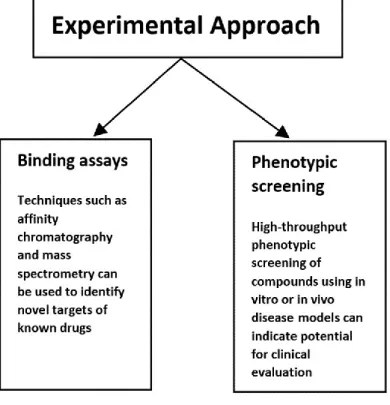
Experimental Approach
The experimental approach is sometimes called activity-based repositioning referring to the screening of original drugs on the basis of tests and experimental assays for new pharmacological indications. This includes cell/organism-based and protein target- based screens in in-vivo or in-vitro models of diseases, without the need for any structural knowledge on objective of target proteins. Many experimental repositioning techniques are animal model, clinical approach, cell assay and target screening.
• Binding Assay
Binding assay is used to identify target interactions. Usually, proteomic techniques like mass chromatography and affinity chromatography are used. With this approach, binding targets and binding affinities of numerous drugs are identified. The drug-target stability is also assessed with this approach. For instance, when a compound binds with a target at its highest affinity, the thermal stability of the targeted protein can be determined by cellular thermostability assay (M. M. D et al., 2013). Moreover, by using chemical genetics, it gets easier to understand the relationship between therapeutic compound’s binding and efficacy with their target and off- targets (DA et al., 2010; Pushpakom et al., 2018).
• Phenotypic Screening
Phenotypic screening can discover related to disease in model systems having no former understanding of the targets (JG et al., 2017). Phenotypic assays are tests that include cells or tissue collected from an experimental animal or people. Clinical observations and in-vitro–in- vivo models can be used to identify new drugs and new indications of approved drugs (Kim, 2015). For instance, it may include screening a chemical library against cell lines to observe cellular response; and identifying the compounds that effectively change the phenotype
followed by disease condition and mechanism of action (Lage et al., 2018). Robotic screening platforms and extremely sensitive detection devices are utilized to swiftly screen huge chemical libraries to discover new indications for approved drugs. The evaluation of a series of drugs in a variety of separate models with the goal of determining effectiveness in one or more of the evaluated models demonstrates the critical requirements for successful drug repurposing (Reaume, 2011; V et al., 2019).
.
Figure 4: Experimental Approaches of Drug Repurposing
Nonetheless, in silico repositioning provides several advantages over the experimental-based approach, such as decreased development time and cost, as well as a low chance of failure.
Currently discovery scientists and researchers have used a hybrid strategy that combines in silico and experimental approaches to uncover novel therapeutic indications for existing drugs.
The results of computational techniques are confirmed by pre-clinical biological investigations
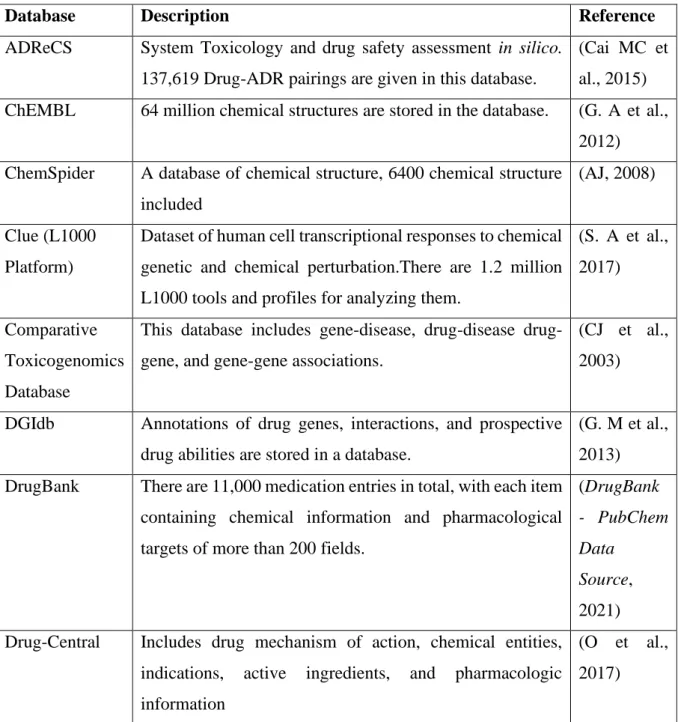
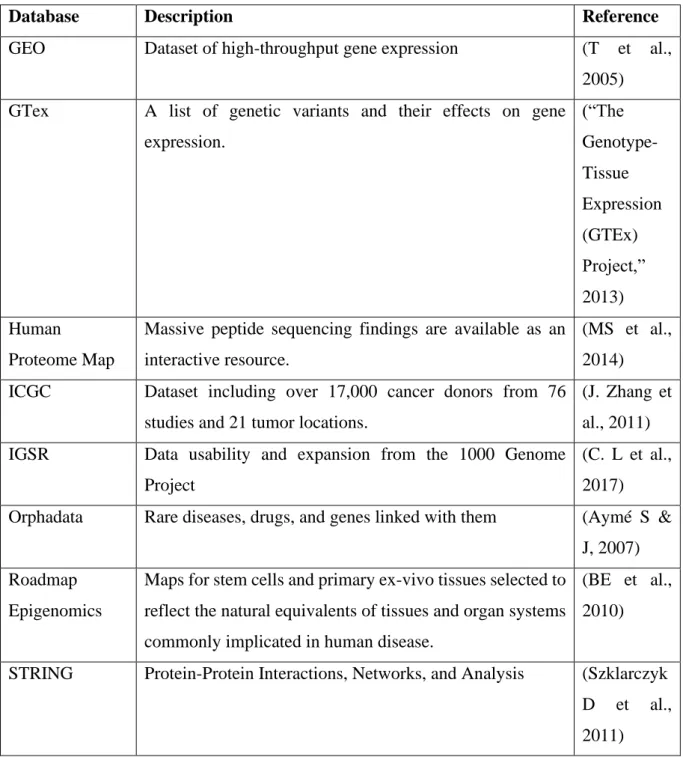
(in vivo and in vitro trials) and clinical studies in the combined approach. The systematic use of computational and experimental techniques offers a rigorous and rational approach to the identification of novel indications, exhibiting better efficiency than serendipity-based discovery. Furthermore, the mixed approach allows for the development of repurposed drugs in a more efficient and timely manner. This method is both credible and reliable. Table 3 contains some of the commonly used disease and drug centric databases for drug repurposing.
Table 3: Commonly used Database for Drug Repurposing
Database Description Reference
ADReCS System Toxicology and drug safety assessment in silico.
137,619 Drug-ADR pairings are given in this database.
(Cai MC et al., 2015) ChEMBL 64 million chemical structures are stored in the database. (G. A et al.,
2012) ChemSpider A database of chemical structure, 6400 chemical structure
included
(AJ, 2008) Clue (L1000
Platform)
Dataset of human cell transcriptional responses to chemical genetic and chemical perturbation.There are 1.2 million L1000 tools and profiles for analyzing them.
(S. A et al., 2017) Comparative
Toxicogenomics Database
This database includes gene-disease, drug-disease drug- gene, and gene-gene associations.
(CJ et al., 2003) DGIdb Annotations of drug genes, interactions, and prospective
drug abilities are stored in a database.
(G. M et al., 2013) DrugBank There are 11,000 medication entries in total, with each item
containing chemical information and pharmacological targets of more than 200 fields.
(DrugBank - PubChem Data
Source, 2021) Drug-Central Includes drug mechanism of action, chemical entities,
indications, active ingredients, and pharmacologic information
(O et al., 2017)
Database Description Reference e-Drug3D e-Drug3D allows users to investigate FDA-approved
medicines and active metabolites.
(P. E et al., 2012) GDSC-
Genomics of Drug Sensitivity in Cancer
Includes anti-cancer drugs screenings >1000 genetically defined human cancer cell lines
(Y. W et al., 2013)
Open Targets Platform
Includes robust and comprehensive data integration allowing access to and display of possible disease-related pharmacological targets
(K. G et al., 2017) PharmGKB A collection of genetic variations on curates’ drug response (H. M et al.,
2002) pkCSM Prediction of small-molecule pharmacokinetic (ADMET)
characteristics using SMILE data
(DE et al., 2015) Project Achilles A genome-wide database of tumor dependenciesto identify
vulnerabilities linked with genetic and epigenetic changes.
(GS et al., 2014) Promiscuous The database includes three categories of entities - drugs,
proteins, and the side effects and relationships between them.
( von E. J et al., 2011) PubChem PubChem includes the chemical information for over 90
million chemicals, as well as their bioactivities, protein targets and gene
(Kim S et al., 2016) SIDER Information about marketed medications and adverse drug
reactions
(K. M et al., 2016) STITCH 68,000 compounds, interactions, and over 1.5 million
proteins in 373 species are recorded.
(K. M et al., 2008) SuperPred A website that predicts ATC codes and compound targets. (D. M et al.,
2008) Therapeutic
Target Database (TTD)
A dataset that gives the known and investigated therapeutic protein and nucleic acid targets, disease and pathway information, and the drugs directed at each of these targets.
(C. X et al., 2002)
Toxin and
Toxin-Target
A database of 3673 toxins, that includedrugs, pollutants, pesticides, and food toxins, characterized by 41,733
(W. D et al., 2015)
Database Description Reference Database
(T3DB)
synonyms and connected to 2087 related toxin target records.
Human Protein Atlas
It is composed of three parts, showing the distribution of proteins in all major organs and tissues of the human body.The Cell Atlas shows the subcellular localization of proteins in single cells, whereas the Pathology Atlas indicates the impact of protein levels on cancer patient survival rates.
(U. M et al., 2015)
KEGG Medicus Database collection including information on genomes, chemical compounds, disease drugs and biological pathways.
(O. H et al., 1999) Allen Brain
Atlas
Maps of gene expression in the mouse and human brains (S. SM et al., 2013) ArrayExpress Data about microarray gene expression at the EBI. (P. H et al.,
2005) CCLE Over 1100 cancer cell lines' mRNA expression and
mutation data are stored in the database.
(B. J et al., 2012) COSMIC Catalogue of cancer-causing somatic mutations (SA et al.,
2015) dbGAP Catalogue of cancer-causing somatic mutations (MD et al.,
2007) dbSNP Single nucleotide polymorphism database (ST et al.,
2001) dbVar Public archives for genomic structural variation (I et al.,
2013) DisGeNET Human disease-associated genes and variants database (P. J et al.,
2015) ENCODE A comprehensive list of functional components in the
human genome, consisting database.
(E. D et al., 2013) Genomics Data
Commons
Cancer Datasets Harmonized with 40 cancer mutated gene projects, 22,147 genes, and 3 million mutations
(RL et al., 2016)
Database Description Reference GEO Dataset of high-throughput gene expression (T et al.,
2005) GTex A list of genetic variants and their effects on gene
expression.
(“The Genotype- Tissue Expression (GTEx) Project,”
2013) Human
Proteome Map
Massive peptide sequencing findings are available as an interactive resource.
(MS et al., 2014) ICGC Dataset including over 17,000 cancer donors from 76
studies and 21 tumor locations.
(J. Zhang et al., 2011) IGSR Data usability and expansion from the 1000 Genome
Project
(C. L et al., 2017) Orphadata Rare diseases, drugs, and genes linked with them (Aymé S &
J, 2007) Roadmap
Epigenomics
Maps for stem cells and primary ex-vivo tissues selected to reflect the natural equivalents of tissues and organ systems commonly implicated in human disease.
(BE et al., 2010) STRING Protein-Protein Interactions, Networks, and Analysis (Szklarczyk
D et al., 2011)
Some commonly used tools and web-servers used in drug repurposing are listed in Table 4.
Table 4: Common tools and web-servers used in drug repurposing
Tool Description Reference
Clue Used for searching for perturbagens (small chemicals or genes), L1000 cohorts, and heatmap display of gene expression
(S. A et al., 2017)
Tool Description Reference Clue Repurposing
Tool
Annotations on authorized and pre-clinical drugs can be accessed using an interactive application with this too.
(C. SM et al., 2017)
COGENA Gene expression profile analysis, visualization, and grouping tool
(Z et al., 2016) DeepChem Toolkit for drug discovery and cheminformatics
based on deep-learning
(A.-T. H et al., 2017)
DR.PRODIS Used for predicting drug-protein interactions and adverse reactions
(Z. H et al., 2015) e-LEA3D Tools for computer-aided drug design (D. D, 2010) Frog2 Small compound 3D creation from 1D/2D input
using a chemo-informatics toolbox
(MA et al., 2010)
GIFT Gives drug-target interactions, infer
chemogenomic characteristics
(Z. S et al., 2015) GoPredict Used for breast and ovarian cancer drug target
prioritization
(R et al., 2016) JOELib/JOELib2 A toolkit for converting chemical file formats,
descriptor calculation classes, and substructure searching
(S. C et al., 2003)
ksRepo Using gene expression drug datasets from diverse platforms, a method for repositioning drugs
(AS et al., 2016) L1000CDS Search engine for gene expression signatures based
on the L1000 dataset
(D. Q et al., 2016) MANTRA Analysis and prediction of pharmacological
mechanism of action in the context of repositioning
(C. D et al., 2014) NFFinder Used to identify genes that are up- or down-
regulated can be used to find medications that are comparable.
(S. J et al., 2015)
Open babel A chemical toolkit available for free (NM et al., 2011) Open PHACTS An RDF-based data model for semantic integration
of pharmaceutical data has been sponsored by the European Union.
(AJ et al., 2012)
Tool Description Reference Biovista Framework for discovering gene-protein
interactions.
(A. C et al., 2011) Alibaba A tool for fitting a PubMed search as a graphical
network.
(P. C et al., 2006) ChemMapper 3D similarity (chemotype characteristics and
molecular shape) calculating software.
(Gong et al., 2013)
ChemProt 3.0 Tool for identifying 2D similarity (Taboureau et al., 2011)
HitPick Tool used for 1NN similarity search (Liu et al., 2013) iDrug-Target Tool that uses Fingerprint-based approach with
machine learning
(Xiao et al., 2015) Polypharmacology
Browser (PPB)
Tool that uses multi fingerprint-based approach.
Ten different fingerprints
(Awale &
Reymond, 2019) Similarity
ensemble approach (SEA)
Tool that uses 2D similarity-based approach (MJ et al., 2007)
SwissTarget- Prediction
Combination of 2D and 3D similarity approach (G. D et al., 2014) TarPred KNN-based data fusion with 2D fingerprint-based
similarity
(L. X et al., 2015) TargetHunter Tool that uses 2D similarity-based approach (W. L et al., 2013) idTarget Divide-and-conquer-based docking approach (JC et al., 2012) PDID Predictions generated using ILbind, SMAP and
eFindSite
(K. A et al., 2006) TarFisDock Reverse ligand-protein docking approach (L. H et al., 2006)
Balestraweb PMF method (Cobanoglu MC
et al., 2015) CSNAP Tool that uses CSN-based approach (Y. Y et al., 2010) DASPfind Tool that uses Network-based approach (B.-A. W et al.,
2016)
DT-Web Tool that uses Recommendation-based approach (Alaimo S et al., 2015)
Tool Description Reference PROMISCUOUS This tool has a new network-based approach to
target–target and drug–target interactions as well as side effects in the works.
( von E. J et al., 2011)
SLAP Tool for prediction using Semantic Link Association
(Chen B et al., 2012)
ProBis The Fast Maximum Clique Algorithm tool. (K. J & D, 2012) PoSSuM All-pairs similarity finding tool (I. J et al., 2015) DrugE-Rank Tool that uses feature-based and similarity-based
approach
(Y. Q et al., 2016) SPiDER Self-organizing map-based prediction tool (R. D et al., 2014) MeSHDD Tool to find drug– drug similarity (AS & CJ, 2017a) RE:fine drugs Tool to findgene disease interaction and drug–
protein interaction
(M. S et al., 2016) CMap Tool for identification of gene expression profiles
that are associated with drug sensitivity
(S. A et al., 2017) DeSigN Global baseline DEGs to drug response (BK et al., 2017) PDOD Tool to predict drugs with opposing effects on
disease genes
(Y. H et al., 2016)
Chapter 6
Drugs for Treatment of Diabetes Epidemic
6.1 Drugs Approved by FDA
The following section discusses the two FDA approved repurposed drugs that can be usedin the treatment of diabetes.
1. Colesevelam (Brand name Welchol)
It is a bile sequestering agent. It was mainly used for hyperlipidemia to decrease the increased level of low-density lipoprotein cholesterol (LDL-C). Colesevelam is now repurposed for type- 2 diabetes mellitus. It got FDA approval in 2008 as anti-diabetic.
The mechanism of colesevelam to decreases blood glucose levels in patients with T2DM is unknown. However, there is growing evidence that bile acid sequestrants' glycemic effects are mediated by fibroblast growth factor-19, liver X receptor, farnesoid X receptor (FXR/bile acid receptor), and TGR5-mediated effects on intestinal glucose absorption and/or hepatic glucose metabolism, as well as effects on peripheral insulin sensitivity, incretin effects, and energy homeostasis. The gene expressions required in gluconeogenesis, such as phosphoenolpyruvate carboxy kinase and glucose-6-phosphatase, has been demonstrated to be reduced when FXR is activated by bile acids. FXR may also influence hepatic glucose synthesis while fasting and hepatic glucose utilization postprandially (D.-S. D et al., 2005; Y. K et al., 2004; L. P et al., 2009). The effects of changes in the bile acid pool in T2DM on FXR activation are still being studied. Emerging evidence suggests that FXR modulators play a partial regulatory role in peripheral insulin sensitivity, implying that FXR may have a future role in the treatment of insulin resistance and T2DM (Cariou B et al., 2006; M. K et al., 2006; Z. Y et al., 2006). Bile
acids have been demonstrated to increase glucagon-like peptide-1 (GLP-1) secretion via the G- protein-coupled receptor TGR5 activation, suggesting that they may influence incretin release (T. C et al., 2008; Katsuma S et al., 2005). Despite these gains, more research is needed to establish the exact mechanism underlying bile acid sequestrants influence on glucose metabolism in T2DM patients (Fonseca et al., 2010).
Figure 5: Potential Mechanism of Action of Colesevelam for Diabetes. Adapted from (Ramírez-Pérez et al., 2017).
Signature matching (Drug-drug) were used in the early development stage for repurposing colesevelam. Colesevelam was compared with first generation bile acid sequestrants.
Afterwards, clinical trials and other experimental approaches were used in the process of repurposing.
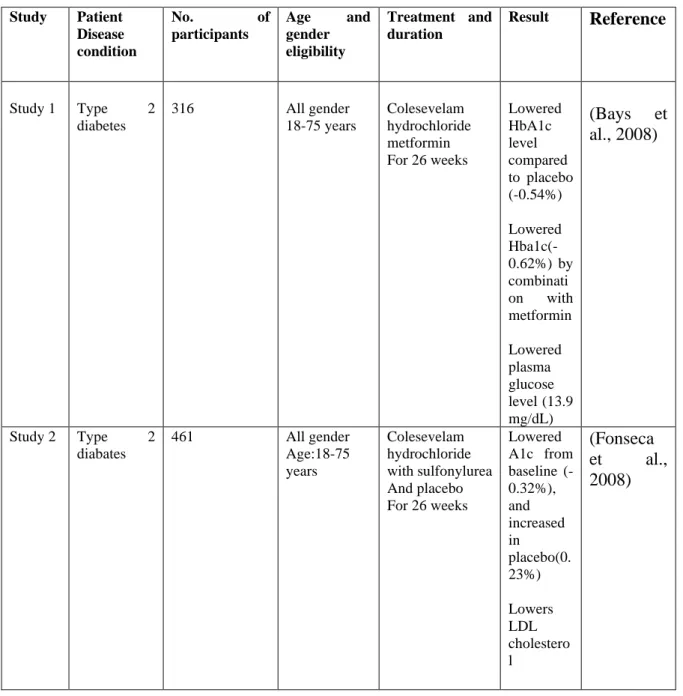
Table 5 contains the summary of all the clinical trials of colesevelam carried out to date.
Table 5: Clinical trials of Colesevlam Study Patient
Disease condition
No. of
participants
Age and gender eligibility
Treatment and duration
Result Reference
Study 1 Type 2 diabetes
316 All gender
18-75 years
Colesevelam hydrochloride metformin For 26 weeks
Lowered HbA1c level compared to placebo (-0.54%)
Lowered Hba1c(- 0.62%) by combinati on with metformin
Lowered plasma glucose level (13.9 mg/dL)
(Bays et al., 2008)
Study 2 Type 2 diabates
461 All gender
Age:18-75 years
Colesevelam hydrochloride with sulfonylurea And placebo For 26 weeks
Lowered A1c from baseline (- 0.32%), and increased in placebo(0.
23%)
Lowers LDL cholestero l
(Fonseca et al., 2008)
Study Patient Disease condition
No. of
participants
Age and gender eligibility
Treatment and duration
Result Reference
Study 3 Type 2 diabetes
287 All gender
Age 18-75 years
Colesevelam and placebo
For 16 weeks
Glycated hemoglobi n level from baseline to week 16 was found to be - 0.41%
(0.07%) for the colesevela m-treated group, and 0.09%
(0.07%) for the placebo group
Reduced fating glucose level
Reduced LDL cholestero l
(Goldberg et al., 2008)
Study 4 Type 2 diabetes
236 All gender
Age:10 to 17 years
-Colesevelam in high dose -Colesevelam low dose For 52 weeks
HbA1c
≥0.7% or
≥0.5%
from baseline, and/or reduction in FPG
≥30 mg/dL from baseline
(Colesevel am for Children With Type 2 Diabetes - Full Text View - ClinicalTr ials.Gov, 2011)
Study Patient Disease condition
No. of
participants
Age and gender eligibility
Treatment and duration
Result Reference
Study 5 Type 2 diabetes
61 All gender
Age:18-80 years
Drug:
Colesevelam Drug:Sitagliptin For 12 weeks
Fasting glucose level reduced (- .8%
mol/l)) for colesevela m treated patients and (- 0.6%mol/l ) reduced in
combined therapy
Fasting gluconeog enesis in colesevela m treated patient (0.2uol/kg )
And (- 0.3%
umol/kg) in combined therapy
Postprandi al Endogeno us Glucose Productio
n in
colesevela m treated patient (- 0.1) and (- 0.2) for combined therapy
Reduced post prandial insulin, glucagon, postprandi al GLP-1, fasting insulin
(FJ et al., 2007)
Study Patient Disease condition
No. of
participants
Age and gender eligibility
Treatment and duration
Result Reference
to the combined therapy with sitagliptin
Study 6 Type 2 diabetes
38 All gender
Age: 35-70 years
Drug:
Colesevelam, Placebo Metformin For 12 weeks
Increased Glp-1 in colesevela m treated group than placebo
Decreased plasma glucose concentrat ion, HbA1c level, insulin concentrat ion in colesevela m treated
(S. G et al., 2013)