Working Paper No. 28
Shaking Embedded Gender Roles and Relations: An Impact Assessment of
Gender Quality Action Learning Programme
Md. Abdul Alim
December 2011
Research and Evaluation Division, BRAC, 75 Mohakhali, Dhaka 1212, Bangladesh Telephone: (88-02) 9881265-72, 8824180-7 (PABX) Fax: (88-02) 8823542 E-mail: [email protected], Website: www.brac.net/research
Working Paper No. 28
Copyright © 2011 BRAC December 2011
Published by:
BRAC 75 Mohakhali Dhaka 1212 Bangladesh
Telephone: (88-02) 9881265-72, 8824180-7 (PABX) Fax: (88-02) 8823542
Website: www.brac.net/research
Printing and Publication Altamas Pasha
Cover design
Md. Abdur Razzaque Design and layout Md. Akram Hossain
BRAC/RED publishes research reports, scientific papers, monographs, working papers, research compendium in Bangla (Nirjash), proceedings, manuals, and other publications on subjects relating to poverty, social development and human rights,
Acknowledgements
The author is grateful to Sheepa Hafiza, Director, Gender Justice and Diversity and Advocacy for her kind cooperation in conducting the study. Other colleagues especially Hasneara Dalia, Senior Manager, GJD, Md. Rafiqul Islam, Md. Mojibur Rahman Patwary, Tahmina Yasmin, Manager from the same programme provided active support during preparation of the instruments and documents such as list of the households during designing and implementing the study. The author is thankful to Semeen Mahmud, Senior Research Fellow, BIDS for her valuable feedback on the instruments. The author is also indebted to Dr. Mohammad Rafi, Head of Research, Social Development and Human Rights, who as a Coordinator of the unit constantly gave his comments, suggestions and edited carefully to improve the quality of the report. Author is also gratified to Romana Ali, Research Associate, RED, for her careful review of the report. Data management team of RED also deserves special thanks for their exhausting job. Sincere thanks to Hasan Shareef Ahmed for editing on the manuscript. Finally, Altamas Pasha, Manager of Knowledge Management Unit also deserves special thanks for his taking care of rest of the work of this working paper.
RED is supported by BRAC's core fund and funds from donor agencies, organizations and governments worldwide. Current donors of BRAC and RED include Aga Khan Foundation Canada, AusAID, Australian High Commission, Bill and Melinda Gates Foundation, NIKE Foundation, Campaign for Popular Education, Canadian International Development Agency, Charities Aid Foundation-America, Columbia University (USA), Department for International Development (DFID) of UK, European Commission, Fidelis France, The Global Fund, GTZ (GTZ is now GIZ) (Germany), Government of Bangladesh, The Hospital for Sick Children, ICDDR,B Centre for Health and Population Research, Institute of Development Studies (Sussex, UK), Inter-cooperation Bangladesh, International Committee of the Red Cross, International Research and Exchange Board, Manusher Jonno Foundation, Micro-Nutrient Initiative, NOVIB, OXFAM America, Plan Bangladesh, Embassy of the Kingdom of the Netherlands, Royal Norwegian Embassy, SIDA, Stanford University, Swiss Development Cooperation, UNICEF, University of Leeds, World Bank, World Food Programme, Winrock International USA, Save the Children USA, Save the Children UK, Safer World, The Rotary Foundation, Rockefeller Foundation, BRAC UK, BRAC USA, Oxford University, Karolinska University, International Union for Conservation of Nature and Natural Resources (IUCN), Emory University, Agricultural Innovation in Dryland Africa Project (AIDA), AED ARTS, United Nations Development Programme, United Nations Democracy Fund, Family Health International, The Global Alliance for Improved Nutrition (GAIN), The Islamic Development Bank, Sight Saver (UK), Engender Health (USA) and International Food Policy Research Institute (IFPRI).
Abstract
The Gender Quality Action Learning programme initiated a village level intervention in 2007 in 10 districts to increase knowledge, change perception, attitudes, and practice/behaviour of the villagers on discrimination and violence against women. A benchmark survey was conducted before the intervention was initiated. To measure the changes that have taken place due to intervention a midline survey was conducted in 2009-10. The comparison between the surveys show that knowledge, perception and attitudes of the respondents on selected gender issues changed remarkably after the intervention. Results also show that along with increase in knowledge and changes in perception and attitudes of the respondents on gender roles and relations positively changes in the likelihood of male’s participation in household activity would increase and the incidence of domestic violence against women would decrease.
Introduction
The word ‘gender’ refers to the roles and responsibilities of women and men that are socially determined (WHO 1998). Like race and ethnicity, gender is a social construct which defines and differentiates the roles, rights, responsibilities, and obligations of women and men. The innate biological differences between the sexes form the basis of social norms that define appropriate behaviour for them and determine the differences in social, economic, and political power between them. Although the specific nature and degree of these norms vary across societies and over time, at the beginning of the twenty-first century men and boys are still typically favoured and receiving more resources and opportunities than do women and girls – factors important for the enjoyment of social, economic and political power, and well-being (Alim 2009).
In most underdeveloped countries men exercise control over women’s labour, their sexuality, their choice of spouse, their access to labour and other markets, and their income and assets through local decision-making and legal bodies (Baden et al.
1994). In other words, men mediate women’s access to social, economic, political, and legal institutions. Women are dependent on men throughout their lives, from father through husband to son. State legislation and institutions underpin this gender subordination and dependence, in spite of constitutional affirmations of sex equality.
Socio-cultural environment of Bangladesh contains pervasive gender discrimination against girls and women regarding gender roles and relations. This discrimination begins from the time of a girl’s birth. They are often considered to be financial burdens on their family, and they receive less investment in their health, care and education. At puberty, their mobility is often restricted, which limits their access to livelihood, learning, and recreational and social activities (UNICEF 2010).
The patriarchal deprivation of women socially, legally, politically and technologically aggravates their positions and they are subordinated as a production unit for bearing and rearing children (Ahmad 2001), although they constitute about half of the total population (BBS 2001). Their status has been ranked the lowest in the world in terms of health, education, and employment (NCBP 2000). In terms of employment, 65% of women aged 15-49 were found unemployed in the demographic survey 2007 (NIPORT 2009). Women have ascribed this lower status as men who have the sovereign power to control households and society as a whole (Balk 1997). Women at home have limited role in decision-making process. They have limited access and control over household resources (physical and financial assets), low level of individual assets, heavy domestic workload, restricted mobility and inadequate knowledge and skills that leading to women’s vulnerability (Sebstad and Cohen 2002). With regard to taking decision about health, UNICEF (2010) mentioned in its findings that a little less than half of Bangladeshi women (48%) stated that their
husbands alone made decisions about their health, while 35% said that their husbands alone made decisions regarding visits to family and friends.
Gender discrimination is also associated with violence against women which is considered another major impediment to bring gender equality. Jahan (1988) relates that ‘gender discrimination leading to gender violence is deeply embedded in Bangladeshi social structure; all Bangladeshi social institutions permit, even encourage the demonstration of unequal power relations between the sexes. In other words, violence against women in Bangladesh is culturally accepted, tolerated and ‘in certain prescribed forms and given contexts’ it is legitimized (Marcus 1993). Lack of women’s autonomy in their household as well as in the community is also associated with domestic violence (Koenig et al. 2003).
Overcoming such tremendous gender imbalance and violence against women will require a range of interventions to bring gender equality. Awareness through education is essential to reduce discrimination and violence against women. In other words, gender equality is achievable when there is increased awareness, a transformation in perception, attitude, and removal of discriminatory practices that are often deeply rooted in societies (CIDA 2003). An increase in gender awareness means increased sensitization, and the recognition of a need to incorporate women into the development process as active participants. Gender awareness positively contributes to changes in the attitude and the behaviour of individual people, and of groups (Ibid). Gender awareness is increasingly being recognized as of paramount importance in the development process of Bangladesh. An external force like non- government organizations (NGO) may work as catalyst in affecting the patriarchal norms and ideologies prevailing in the society, thus improving the relationship between men and women, and enhancing the status of women in the different spheres through awareness building (Mahmud 1994).
Objective and intervention tools of Gender Quality Action Learning Programme
BRAC, as an NGO, is involved in promoting poverty alleviation practices and women’s empowerment. Since women are adversely affected by poverty more, BRAC puts emphasis on gender equality in its development programmes. In the process of implementing these programmes, the need was felt to develop a positive attitude in the society about improving gender relations and enhancing gender equity and equality. Thus, in 1994, BRAC initiated the Gender Quality Action Learning (GQAL) Programme for its staff to improve gender relations. This training programme was expanded to include the members of its Village Organizations (VO)1 on a pilot basis in 2001. Though the goals were similar, it focused more on fostering gender equality and equity among the villagers. The main purpose of this programme was to
create a positive attitude in rural areas for women’s empowerment and for improving gender relations in the family, society, and organization at village level.
After successful completion of the VO-based GQAL programme in four rural areas in Kurigram district, BRAC decided to expand it in two more districts on a pilot basis in 2005 and 2006 and ultimately, in 11 more districts in 2007. The tools and implementing methods was same throughout the period. The aim of this programme currently is to build a platform to identify the gender-based discrimination and to facilitate a community movement to end violence against women and children, especially in terms of domestic violence. A total of 3,000 men and women were given GQAL training who were selected from the specially targeted ultra poor2 (STUP), Palli Shamaj (PS)3 (combination of two or more VOs), VOs, Gram Daridra Bimochon Committee (GDBC)4 (members of the village elites), union parishad (UP) (The lowest administrative unit of the government) members, and Shasthaya Shebikas (SS) (community health volunteers). These trainees worked as educators and conducted 18,000 Uthan baithaks (courtyard meetings) for educating community members.
People living in the vicinity of these educators participated in the courtyard meetings.
Besides Uthan baithak, additional learning tools such as videos on gender-based violence and discrimination, and popular theatres on gender equity were organized to deliver message to the community members.
To measure the impact of this intervention pertaining to gender discrimination and violence against women a midline survey was conducted. The specific objective of this survey was to assess the changes in (1) knowledge, (2) perception, (3) attitudes and (4) practices/behaviour after the intervention.
2 The ultra-poor is the poorest section among the population with a few or no asset base, highly vulnerable to any shocks and mainly depending on wage labour.
3 Palli shamaj is a ward level organization consists of representatives from several village organization (VO) and external poor. The main objective of the palli shamaj is to give a political voice to poor, and therefore ensure their interest. It also mobilizes government services such as vulnerable group development (VGD), vulnerable group feeding (VGF), old age pension cards, roads and embankments, etc.
4 To create an enabling environment for the ultra poor, a forum of the local elites called Gram Daridro Bimochon Committee-GDBC (Village Poverty Alleviation Committee) was formed in every intervention village. The main roles of these village committees were to support the ultra poor members in emergencies and to provide them guidance. This effort can also be viewed as a counteraction to the possibility that STUP support crowded out informal insurance for the ultra poor.
Materials and methods
The study used quantitative method to measure the changes in knowledge, perception, attitude, and practices of the respondents on four themes and various issues after the intervention (Matrix 1). GQAL programme has selected the issues, as those often take place in the family as well as in society in rural Bangladesh. To bring gender equality the programme intervened to increase knowledge, and to change perception, attitudes and practices/behaviour of the people related to those themes.
Matrix 1. Themes and issues considered
Themes Issues Division of labour Social difference in man and woman, household and income
generating activity
Discrimination Inequity in education, food intake, and rights
Empowerment Division of property, decision-making power on household items and assets, and women mobility
Violence against women Dowry, domestic violence, marriage related violence
Study area and sample size
The benchmark survey was conducted in the catchment of 50 area offices in 10 districts where GQAL programme was initiated in 2007. The programme in essence intended to focus ultra poor people to raise their voices against gender discrimination and violence against women and thus bring gender equality. Along with ultra poor the other classes of the society would also be addressed in this process. Study areas were selected with a consideration of the ultra poor region.
The GQAL programme selected four spots5 in each branch office maintaining similar socio-demographic characteristics. Two out of four spots from each area were selected randomly as intervention spots and the rest as control spots. The programme made a list of households from each spot, which consisted of around three hundred households.
The number of respondents from selected households of each cluster was determined by cluster randomized control trial (Raudenbush and Spybrook, Liu,
5 Among other steps for targeting ultra poor selecting village is bit final stage of this process. Once the villages are selected, several participatory wealth-ranking exercises are conducted to cover all possible
Congdon (2005). It was found that 30 respondents selected randomly from each spot was representative. Thus, the total number of respondents was 5,999 in which 3,008 were in intervention areas and the rest were in control areas during baseline. A midline survey was conducted in November 2009 with similar sample size and areas to the baseline but with different respondents in the study areas. The number of respondents selected from each spot was similar to the baseline. In other words, it was a repeated cross-sectional design.
After selecting the households, the household heads and their wives were selected randomly from those households. Both men and women respondents were selected randomly from different households.
Definition of the concepts
Four main concepts - knowledge, perception, attitudes, and behaviour - were used in this study. Knowledge means the information, understanding, skills people gain through education or experience; or the state of knowing about a particular fact or situation. Gender knowledge does not mean what someone knows about gender in a factual way, thus knowledge is not understood as being something objective. It refers to the social construction of meaning and to explicit and implicit negotiations in society. The analysis of gender knowledge can be embedded in a broader post- structuralist perspective in which the generation of knowledge and the relations between knowledge, power, policies and gender are in the centre.
Perception is the way people notice things, especially with the senses, for example our perception of reality/colour is visual perception. In other words, an idea or belief people have as a result of how they see or understand something for example gender. Attitude is that the way people think and feel about somebody or something;
the way people behave towards something or somebody that shows how people feel and think is attitude. Ashmore et al. (1995) have conceptualized gender attitude as thoughts and feelings about sex, gender, and relationships between men and women. On the other hand, the reflection of knowledge, perception, and attitudes is behaviour. The behaviour of people about gender relations is expressed in their action and practices. The concepts mentioned are all inter-related and one may or may not induce to make other happen.
Data collection techniques, tools and data analysis
Data were collected through survey. Socio-demographic and other attributes of the respondents included in the survey were considered as important factor influencing the knowledge, perception, attitudes and practices related to gender roles and relations.
GQAL programme strived to change knowledge of the community people regarding the issues under different themes as mentioned. Issues related to the themes that are deliberately and sometimes involuntarily practiced in the household or in the community were selected by the programme to measure the changes in
respondents’ knowledge level. The respondent answering the issues correctly scored 1 and 0 for wrong. The cumulative scores reveal the status of knowledge of the respondents.
The perception of the respondents was measured by what should and should not be done by men and women, both within the family and outside. There are embedded norms, customs and values regarding gender roles and relations in the community of Bangladesh. To change those traditional norms, values and customs GQAL programme intervened and the extent of changes in respondents’ perception after the intervention were measured in this study.
To measure the attitude of the respondent four statements for each of the themes were selected on which the respondents expressed their attitudes. The statements reflected situations with which the respondents were asked to agree or disagree.
Respondents’ attitude on each of the statements were captured in four point Likert scale –completely agreed, partially agreed, partially disagreed, and completely disagreed. Both positive and negative statements were considered for getting balanced attitudes of the respondents. Each of the statements was given numerical weight – four to one – starting with four for completely agreeing with the statements and one for completely disagreeing. This in fact reflected respondents’ attitudes towards gender equality. This variation emerges depending on the nature of the statements. Higher score from a statement related to themes meant more favourable attitude and the opposite meant less favourable attitude toward gender roles and relations.
Total score for each respondent was computed by summing the responses against each statement. Cumulative scores of the different themes represented respondents’
attitude towards the theme. In the case of attitude towards gender roles and relations possible scores for a respondent ranged from 4 to 16 of each theme.
The practice/behaviour related to the issues as mentioned was measured by looking at the actions of the respondents in family and community. Change in the practices of respondents was expressed by the proportion of the respondents who after the intervention changed their actions.
Difference-in-difference or ‘impact’ difference or double difference (in brief, Diff in diff) (Slaughter 2001, Ahmed 2006) method was used to analyze the findings in most cases. This is also called a simple model in which there are participant and non- participant groups, and year of intervention. There is interaction term which derives by multiplying with participants and the midline year. Then the significance of the impact is derived from the coefficient of ordinary least square (OLS) regression. For more detailed description of this model is in Slaguhter (2001).
Findings
Knowledge on gender roles and relation
Change in knowledge of the respondents about selected issues mentioned in the Matrix 2 was measured in this section. There is a traditional view of the people towards the importance of man and woman’s work in the family and society. Most of the rural women are engaged in household activities. People consider these women’s work as less important as it does not generate income while men’s work is considered valuable as they earn and run the family. With regard to this, the respondents were asked about whose work is important. The answer was considered as correct if the respondent mentioned that both men and women’s work is important. In the baseline, 15% of them had correct knowledge while after the intervention an additional 77% of the respondents had been able to answer correctly (Appendix 1).
On the other hand, change in the knowledge of respondents about the requirement of nutrition both for man and woman was observed lower after the intervention, as 56% of them already had knowledge on the issue before the intervention. The difference in changing knowledge level of the respondents about each issue was statistically significant between baseline and midline.
Matrix 2. Issues related to knowledge considered
• Social view on differences (except biological) between man and woman
• The importance of man and woman’s work
• Persons’ view on the ability to perform work by man and woman
• Compulsory education for boy and girl
• Distinction between man and woman made by family and society in receiving treatment, nutrition intake, getting educated, in work, enjoying leisure time etc.
• Requirement of nutrition for man and woman
• Division of property
• Rights to have access to treatment
• Rights to have access to leisure
• Demerits of discrimination in nutrition intake
• Control over purchase and sale household assets
• Legal age of marriage for girl
• Ownership of household assets
• Rules of divorce
• Rules of multiple marriage
• Legal age of marriage for boy
Moreover, significant difference was observed in changes of the respondents’
average knowledge level after the intervention. The respondents who scored on average 3.89 in the baseline obtained 13.49 in the midline.
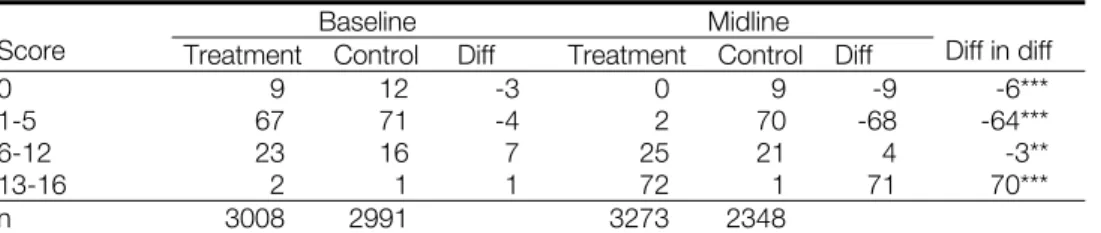
Knowledge scores of the respondents were grouped into four: 0, 1-5, 6-12 and 13- 16 for further analysis. Zero score meant that there was no knowledge about any issues, while 1 indicated that respondents had knowledge about an issue. It was observed that there was none who scored 0 after the intervention but the respondents being scored 13 to16 increased by 70% after the intervention (Table 1).
Table 1. Changes in respondents’ knowledge (%)
Baseline Midline Score Treatment Control Diff Treatment Control Diff Diff in diff
0 9 12 -3 0 9 -9 -6***
1-5 67 71 -4 2 70 -68 -64***
6-12 23 16 7 25 21 4 -3**
13-16 2 1 1 72 1 71 70***
n 3008 2991 3273 2348
Diff=Difference; ***, ** denotes significant at 1% and 5% level respectively
Statistically significant difference was also observed between baseline and midline in changing knowledge level of the respondents in each of the themes (Appendix 2).
The maximum scores for each of the themes were 4 and 0 for no scores. More than half of the respondents (54%) obtained highest scores about division of labour, and 57% about empowerment in the midline against 2% and 4% respectively in the baseline. On the other hand, the number of respondents scoring 4 increased by 59%
after the intervention about discrimination and violence against women.
Change in knowledge of the respondents on each issue varied significantly between baseline and the midline among the districts (Appendix 3). Around 90% of the respondents in Madaripur district became knowledgeable after the intervention against around 22% in the baseline. In terms of changes in knowledge the number of the respondents were slightly higher in Gopalganj, Rajbari, Netrakona, Kishoreganj than the northern districts - Rangpur, Lalmonirhat, Nilphamari, and Gaibandha.
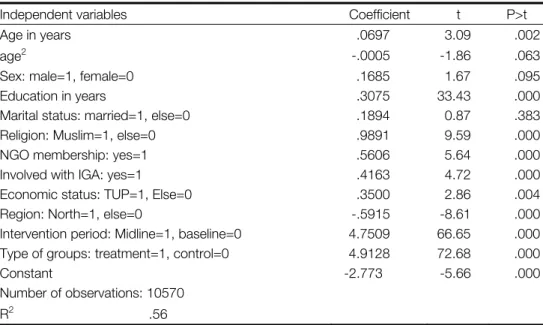
Knowledge scores of the respondents were also regressed on the selected independent variables (Table 2). The regression indicates that the age of the respondents and their years of schooling were associated with the changes of knowledge after the intervention. In other words, changes in respondents’ knowledge level were likely to be higher with one unit changes of their age after the intervention.
This regression model was effective in explaining 56% of the causes leading to the change in knowledge level.
Table 2. Linear regression on the respondents’ knowledge level
Independent variables Coefficient t P>t
Age in years .0697 3.09 .002
age2 -.0005 -1.86 .063
Sex: male=1, female=0 .1685 1.67 .095 Education in years .3075 33.43 .000 Marital status: married=1, else=0 .1894 0.87 .383 Religion: Muslim=1, else=0 .9891 9.59 .000 NGO membership: yes=1 .5606 5.64 .000 Involved with IGA: yes=1 .4163 4.72 .000 Economic status: TUP=1, Else=0 .3500 2.86 .004 Region: North=1, else=0 -.5915 -8.61 .000 Intervention period: Midline=1, baseline=0 4.7509 66.65 .000 Type of groups: treatment=1, control=0 4.9128 72.68 .000
Constant -2.773 -5.66 .000
Number of observations: 10570 R2 .56
Perception on gender roles and relations
The changing status of the respondents’ perception was described on the selected issues (Matrix 3). Men and women perform different types of roles in the family and the society. By and large there is a conventional perception that women should take care of household activities such as cooking, managing household belongings, and caring for family members; while men should deal with productive activities (i.e., activities that economists can count) outside home, shopping, etc. The intervention tried to change this perception to create gender equality.
Matrix 3. Issues related to the respondents’ perception
• Activities within and outside home
• Food intake, boy and girl’s education, access to treatment and rest
• Buying and selling household assets
• Spatial mobility of women
• Opinion in marriage for boy and girl
• Perception on violence against women and punishment of the perpetrator
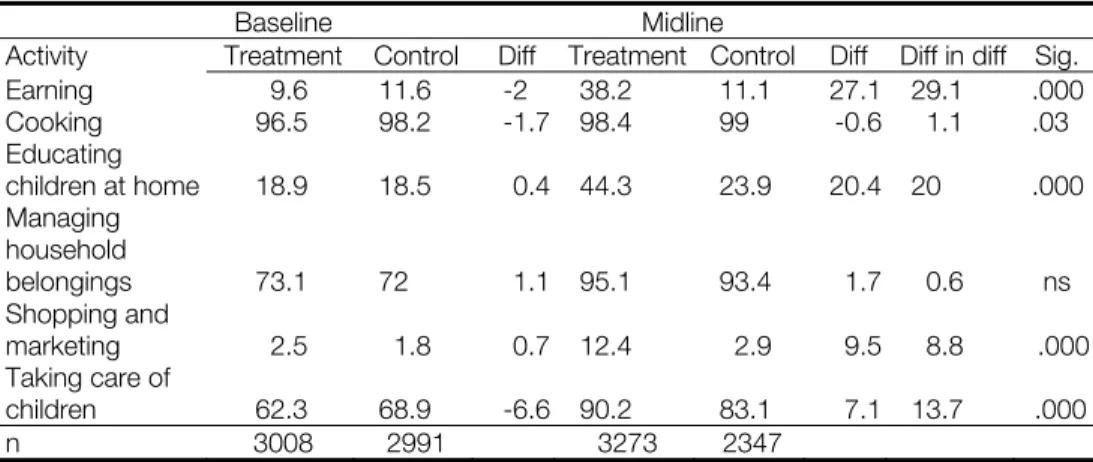
Findings show that a little change took place in respondents’ perceptions of earning (remunerated work), shopping and marketing (Table 3). But there was no effect in changing the perceptions of the respondents on the subject of cooking: both continued to believe that this was job for women only even after the intervention.
Similar perception was shown on what kind of activity in the family male should do as well (Appendix 4).
Table 3. Changes in respondents’ perception on activities that female should do (%)
Baseline Midline
Activity Treatment Control Diff Treatment Control Diff Diff in diff Sig.
Earning 9.6 11.6 -2 38.2 11.1 27.1 29.1 .000 Cooking 96.5 98.2 -1.7 98.4 99 -0.6 1.1 .03 Educating
children at home 18.9 18.5 0.4 44.3 23.9 20.4 20 .000 Managing
household
belongings 73.1 72 1.1 95.1 93.4 1.7 0.6 ns Shopping and
marketing 2.5 1.8 0.7 12.4 2.9 9.5 8.8 .000 Taking care of
children 62.3 68.9 -6.6 90.2 83.1 7.1 13.7 .000
n 3008 2991 3273 2347
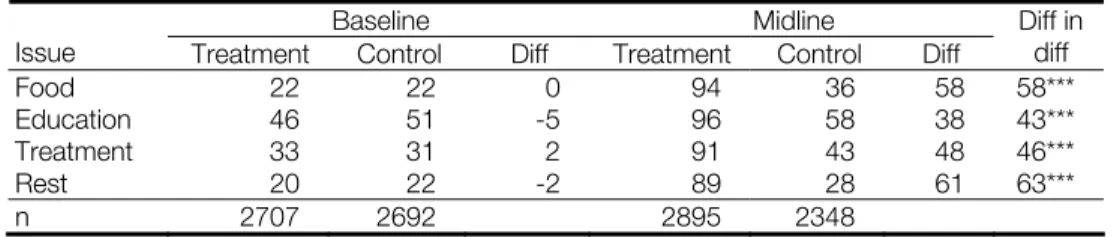
Respondents’ perception on food requirement for man and woman changed after the intervention. An extra 72% of the respondents in the midline compared to the baseline stated that women have the same nutritional needs as men (Table 4). With regard to necessity of education for boys and girls 96% of the respondents in the midline mentioned that both boy and girl should be given priority in education uniformly, against the 46% in the baseline. Besides, statistically significant changes from baseline to midline were also made in the perception of treatment and rest.
Table 4. Changes in perception on selected issues (%)
Baseline Midline Issue Treatment Control Diff Treatment Control Diff
Diff in diff
Food 22 22 0 94 36 58 58***
Education 46 51 -5 96 58 38 43***
Treatment 33 31 2 91 43 48 46***
Rest 20 22 -2 89 28 61 63***
n 2707 2692 2895 2348
*** Significant at the 1% level
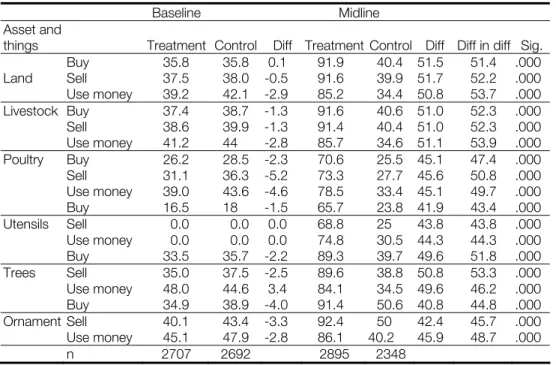
Table 5. Changes in respondents’ perception on buying, selling assets and things, and using sale proceeds (%)
Baseline Midline
Asset and
things Treatment Control Diff Treatment Control Diff Diff in diff Sig.
Buy 35.8 35.8 0.1 91.9 40.4 51.5 51.4 .000 Land Sell 37.5 38.0 -0.5 91.6 39.9 51.7 52.2 .000 Use money 39.2 42.1 -2.9 85.2 34.4 50.8 53.7 .000 Livestock Buy 37.4 38.7 -1.3 91.6 40.6 51.0 52.3 .000 Sell 38.6 39.9 -1.3 91.4 40.4 51.0 52.3 .000 Use money 41.2 44 -2.8 85.7 34.6 51.1 53.9 .000 Poultry Buy 26.2 28.5 -2.3 70.6 25.5 45.1 47.4 .000 Sell 31.1 36.3 -5.2 73.3 27.7 45.6 50.8 .000 Use money 39.0 43.6 -4.6 78.5 33.4 45.1 49.7 .000 Buy 16.5 18 -1.5 65.7 23.8 41.9 43.4 .000 Utensils Sell 0.0 0.0 0.0 68.8 25 43.8 43.8 .000 Use money 0.0 0.0 0.0 74.8 30.5 44.3 44.3 .000 Buy 33.5 35.7 -2.2 89.3 39.7 49.6 51.8 .000 Trees Sell 35.0 37.5 -2.5 89.6 38.8 50.8 53.3 .000 Use money 48.0 44.6 3.4 84.1 34.5 49.6 46.2 .000 Buy 34.9 38.9 -4.0 91.4 50.6 40.8 44.8 .000 Ornament Sell 40.1 43.4 -3.3 92.4 50 42.4 45.7 .000 Use money 45.1 47.9 -2.8 86.1 40.2 45.9 48.7 .000 n 2707 2692 2895 2348 Within the districts there was much variation in the changes of respondents’
perception after the intervention (Appendix 5). In the Northern region there was an increase of 72% among the respondents who after the intervention emphasized that both men and women should have equal amount of food. The increasing rate of the respondents in this regard was far more (75%) in the eastern part of Bangladesh.
Household members own different types of assets and things, and the belief persist that men should have exclusive control over them. This perception of the respondents changed after the intervention. Around 35% of the respondents in the baseline perceived that both husband and wife together should take decision to buy land, livestock, trees and ornaments, while in the midline around 90% of them believed the same, meaning that a positive change took place due to the intervention (Table 5). Similar changes were also observed in respondents’ perception in selling the household assets and using money derived from sale.
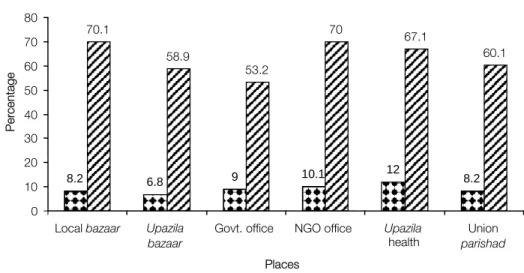
Figure 1. Changes in respondents’ perception on women’s mobility (%)
People belief that women should stay at home, and if they want to or need to go outside home they should not go alone, and should take permission from husband or in-laws. This belief of the respondents, especially whether women should go alone changed due to intervention (Fig. 1). Before the intervention 10% of the respondents believed that women should go alone to NGO office, 70% had changed their view on this issue after intervention. Similar percentage of the respondents (70.1%) also changed their view regarding going to local bazaar alone by women. The difference between baseline and midline was statistically significant. On the other hand, there was little difference (but statistically significant) between the percentages of respondents who said that women should take permission to go the places mentioned in Fig. 1 in the baseline and in the midline (Appendix 6).
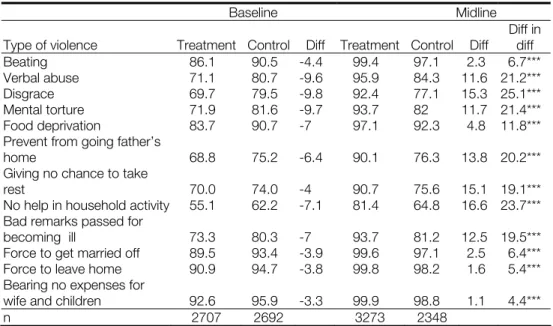
The perception about what constitutes violence against women was explored in relation to common types of violence mentioned in Table 6. Perceptions of the respondents on most of these issues changed a little after the intervention. Similarly changes in their perception that perpetrators should be punished were also observed (Appendix 7).
There is a kind of violence related to marriage, whereby a girl or boy is married without being consulted: in other words, the parents decide, and their daughter’s opinion is not thought to matter. The intervention brought about changes in relation to the need to respect the girl’s own decision. Seventy percent of the respondents also changed their views on the perception that both boy and girl should take
8.2 6.8 9 10.1 12
8.2 70.1
58.9 53.2
70 67.1
60.1
0 10 20 30 40 50 60 70 80
Local bazaar Upazila bazaar
Govt. office NGO office Upazila
health Union parishad Places
Percentage
Baseline Midline
Table 6. Perceived changes on violence against women (%)
Baseline Midline
Type of violence Treatment Control Diff Treatment Control Diff Diff in diff Beating 86.1 90.5 -4.4 99.4 97.1 2.3 6.7***
Verbal abuse 71.1 80.7 -9.6 95.9 84.3 11.6 21.2***
Disgrace 69.7 79.5 -9.8 92.4 77.1 15.3 25.1***
Mental torture 71.9 81.6 -9.7 93.7 82 11.7 21.4***
Food deprivation 83.7 90.7 -7 97.1 92.3 4.8 11.8***
Prevent from going father’s
home 68.8 75.2 -6.4 90.1 76.3 13.8 20.2***
Giving no chance to take
rest 70.0 74.0 -4 90.7 75.6 15.1 19.1***
No help in household activity 55.1 62.2 -7.1 81.4 64.8 16.6 23.7***
Bad remarks passed for
becoming ill 73.3 80.3 -7 93.7 81.2 12.5 19.5***
Force to get married off 89.5 93.4 -3.9 99.6 97.1 2.5 6.4***
Force to leave home 90.9 94.7 -3.8 99.8 98.2 1.6 5.4***
Bearing no expenses for
wife and children 92.6 95.9 -3.3 99.9 98.8 1.1 4.4***
n 2707 2692 3273 2348
*** denotes significant difference at the 1% level
Attitudes towards gender roles and relation
Changes in attitudes of the respondents towards selected issues mentioned in Matrix 4 were assessed. Findings show that there was an increase of 55% of the respondents who, after the intervention, changed their attitudes towards man and woman who have equal responsibility to bring up the children and to run the family by earning through economic activity (Appendix 8). Additional 51% of among the respondents changed their attitudes positively towards the issue of there is no difference between man and woman in terms of wisdom and intelligence. A small increase of among the respondents from 77% to 92% who after the intervention changed their attitudes towards the wage discrimination between man and woman was observed.
Statistically significant difference between baseline and midline in different districts were also observed in changing respondents’ attitudes towards different issues as mentioned. Changes in the proportion of respondents showing the positive attitudes towards each of the issues after the intervention were almost similar in various districts (Appendix 9).
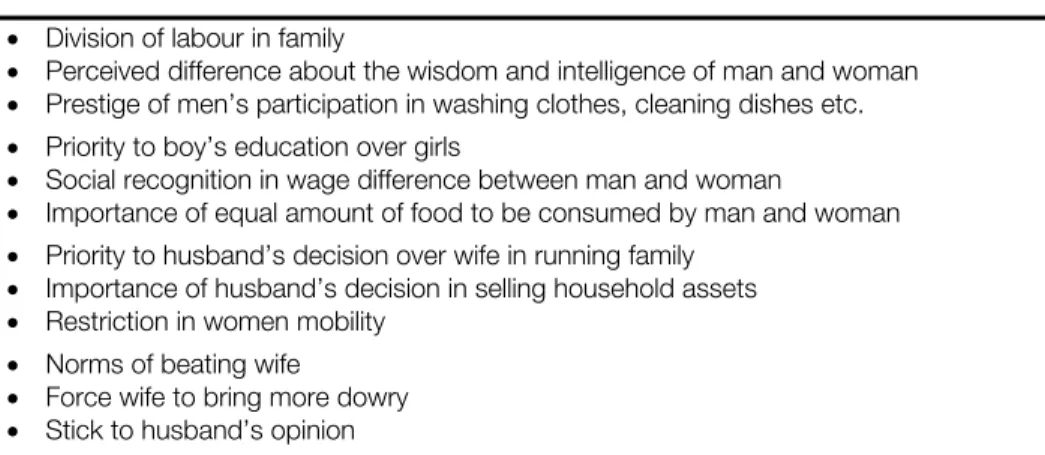
Matrix 4. Issues related to attitudes of the respondents
• Division of labour in family
• Perceived difference about the wisdom and intelligence of man and woman
• Prestige of men’s participation in washing clothes, cleaning dishes etc.
• Priority to boy’s education over girls
• Social recognition in wage difference between man and woman
• Importance of equal amount of food to be consumed by man and woman
• Priority to husband’s decision over wife in running family
• Importance of husband’s decision in selling household assets
• Restriction in women mobility
• Norms of beating wife
• Force wife to bring more dowry
• Stick to husband’s opinion
Cumulative scores obtained by the respondents against the issues represented the attitudes of the respondents. The score of a respondent ranged from 12 to 48.
Higher scores indicate positive attitude and lower score less positive attitudes towards the issues. Median scores were used to divide the scores into three: less favourable, neutral and more favourable attitudes, meaning that respondents who scored less than median scores treated less favourable and the scores more than median considered more favourable attitudes. Findings show that less favourable attitudes declined significantly from 50 to 2% in the midline and there was corresponding increase in the proportion of respondents from 47 to 97% who after the intervention showed more favourable attitudes towards gender roles and relations (Table 7). The difference in changing respondents’ attitudes towards the gender roles and relations after the intervention was also statistically significant (Appendix 10).
Percentage of respondents declined from 50 to 4% who after the intervention showed less favourable attitudes towards division of labour, while the proportion of respondents increased from 24 to 91% who showed more favourable attitudes towards the same. Similar attitudinal changes towards violence against women were also observed, and significant difference in the changes of the respondents’ attitudes towards gender discrimination and empowerment of women was also observed after the intervention.
Table 7. Changes in respondents’ attitude (%)
Baseline Midline Treatment Control diff Treatment Control diff Diff in diff Level of attitude 1 2 3=1-2 4 5 6=4-5 7=6-3 Less favourable 66 63 3 5 60 -55 -58***
Neither less nor
more favourable 7 6 0 2 10 -9 -9***
More favourable 28 31 -3 93 29 64 67***
Average attitude scores of the respondents on the themes – division of labour, discrimination, empowerment and violence against women - increased from baseline to midline and the difference was statistically significant. On division of labour the respondents obtained on average 5.5 scores in the baseline and 10.47 after the intervention. Similarly their average attitude scores increased from 5.65 to 9.36 on violence against women after the intervention. Significant changes in average scores regarding empowerment and discrimination against women were also observed after the intervention.
Table 8. Linear regression on the respondents’ attitude
Independent variables Coefficient t P>t
Age in years .0484 1.24 .216
age2 -.0004 -0.84 .399
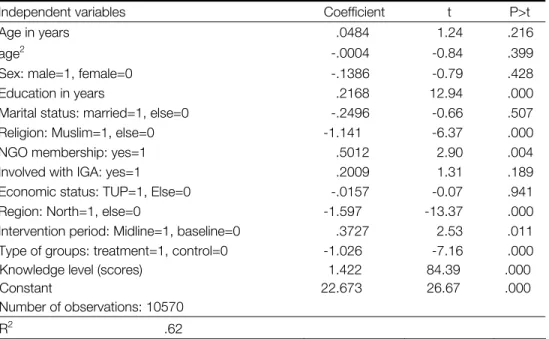
Sex: male=1, female=0 -.1386 -0.79 .428 Education in years .2168 12.94 .000 Marital status: married=1, else=0 -.2496 -0.66 .507 Religion: Muslim=1, else=0 -1.141 -6.37 .000 NGO membership: yes=1 .5012 2.90 .004 Involved with IGA: yes=1 .2009 1.31 .189 Economic status: TUP=1, Else=0 -.0157 -0.07 .941 Region: North=1, else=0 -1.597 -13.37 .000 Intervention period: Midline=1, baseline=0 .3727 2.53 .011 Type of groups: treatment=1, control=0 -1.026 -7.16 .000 Knowledge level (scores) 1.422 84.39 .000
Constant 22.673 26.67 .000
Number of observations: 10570
R2 .62
Attitude scores were regressed on the independent variables listed in the Table 8. It shows that one-year change in years of schooling of the respondents changes in attitudes towards gender roles and relations were likely to be more favourable after the intervention. The respondents having NGO membership were likely to have changed attitudes more positively than those who were not. This regression model was effective in explaining 62% of the variance in respondents’ attitudinal level by independent variables.
Gender related practice/behaviour
This section investigates the changes in respondents’ gender-related practice/
behaviour on the issues under themes mentioned in the Matrix 5 after the intervention.
Matrix 5. Issues on gender related practice/behaviour
• Participation of husband in taking care of children, cooking etc.
• Disparity in son’s and daughter’s mobility
• Practice in access to treatment
• Inequity in nutrition intake
• Prejudice in educating children
• Difference between husband and wife in decision-making in buying and selling household assets
• Status of women mobility
• Opinion in marriage
• Incidence of different types of violence and protesting violence
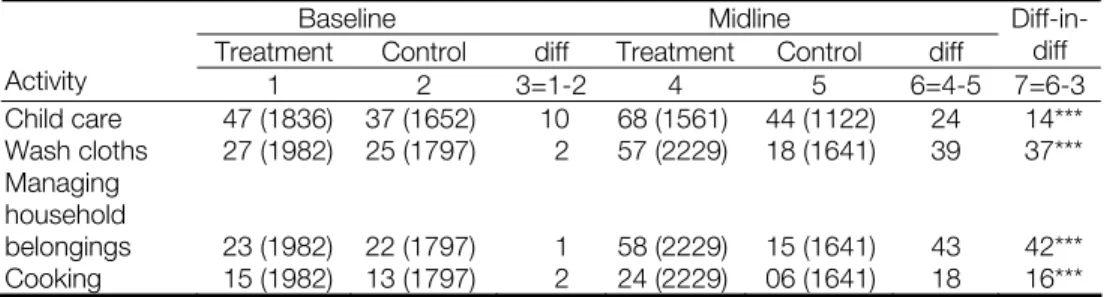
Findings show that a significant increase of the respondents who took part in household activity was observed after the intervention (Table 9). The participation of husband in child care increased after the intervention. An additional 42% of the respondents reported that husband participated in managing household belongings.
Table 9. Changes in husband participation in household activity (%)
Baseline Midline Treatment Control diff Treatment Control diff
Diff-in- diff
Activity 1 2 3=1-2 4 5 6=4-5 7=6-3
Child care 47 (1836) 37 (1652) 10 68 (1561) 44 (1122) 24 14***
Wash cloths 27 (1982) 25 (1797) 2 57 (2229) 18 (1641) 39 37***
Managing household
belongings 23 (1982) 22 (1797) 1 58 (2229) 15 (1641) 43 42***
Cooking 15 (1982) 13 (1797) 2 24 (2229) 06 (1641) 18 16***
*** denotes statistically significant at the 1% level, In the parenthesis indicates number
Statistically significant difference in husband’s participation in the household activities among the districts was observed after the intervention. A significant increase, i.e.
27% of the husbands participated in cooking in the southern region after the intervention (Appendix 11).
Table 10. Logistic regression predicting husband’s participation in household activity
Independent variable Odds Ratio P>z 95% Confidence interval Knowledge score 1.17 .000 1.10 1.24
Attitude score 1.24 .000 1.20 1.27
Perception toward female (score) 1.14 .001 1.06 1.24 Age in years 0.98 .000 0.97 0.99
Years of schooling 1.01 .292 0.99 1.03
NGO membership: Yes=1, No=0 0.48 .000 0.41 0.55
Economic status: Poor=1, else=0 0.86 .026 0.76 0.98 Regions
North=1, else=0 1.27 .003 1.08 1.48 South=1, else=0 1.64 .000 1.39 1.93 Number of observation 4958
LR chi2(9) 823.23
Prob > chi2 0.0000
Pseudo R2 0.1199
Log likelihood -3022.2983
A logistic regression was run on the husband’s participation in any of the household activities mentioned in Table 9 (Table 10). The regression was done to see whether increased knowledge on gender role and changed perception and attitudes positively towards female work had an association with increased husband’s participation in household activity. Results show that all independent variables except years of schooling were statistically associated with the dependent variable i.e. husband’s participation in household activity. In other words, one unit change of knowledge, perception and attitude of husband towards female in the midline the likelihood of changes of husband’s participation in household activity would be 1.17, 1.24 and 1.14 times higher respectively.
Table 11 shows the extent of changes in gender-related discrimination against women in seeking treatment and in amount of money spent after the intervention.
The proportion of both man and woman increased after the intervention in seeking treatment from clinic and decreased from pharmacy. The proportion of male and female who ate 1 to 2 eggs per week increased after the intervention although the difference between male and female was insignificant (Table 12).
Table 11. Changes in gender discrimination in sources of treatment and nature of expenditure for that (%)
Baseline Midline
Treatment source Treatment Control Diff Treatment Control Diff Diff in
diff Sig MBBS Male 30.4 31.2 -0.8 25.7 23.9 1.8 2.6 ns Female 33.1 31.1 2.0 25.6 24.5 1.1 -0.9 ns
Kabiraj Male 1.3 1.0 0.3 1.8 1.1 0.6 0.3 ns
Female 1.7 1.6 0.2 2.0 0.4 1.5 1.4 .03 Homeopath Male 3.2 6.3 -3.2 2.8 4.1 -1.2 1.9 .07 Female 3.5 7.5 -3.9 3.5 4.2 -0.7 3.3 .003 Pharmacy Male 43.5 31.5 12.0 68.3 69.6 -1.3 -13.3 .000 Female 41.7 32.5 9.2 68.0 69.3 -1.3 -10.5 .000 No treat Male 1.7 2.5 -0.8 0.8 1.0 -0.1 0.6 ns
Female 3.4 3.8 -0.4 0.5 1.1 -0.7 -0.3 ns Clinic Male 19.9 27.5 -7.6 0.5 0.3 0.2 7.8 .000
Female 16.5 23.6 -7.1 0.4 0.4 0.0 7.1 .000 Money spent for treatment (Tk.)
Not spent Male 3.4 3.5 -0.2 1.1 1.0 0.1 0.3 ns Female 5.0 4.0 1.0 0.9 1.4 -0.5 -1.5 .08 2 to 100 Male 29.5 31.9 -2.4 33.0 33.3 -0.3 2.2 ns Female 29.9 32.7 -2.9 34.1 32.7 1.4 4.2 .09 101-1000 Male 54.3 51.1 3.3 53.6 54.4 -0.8 -4.1 ns Female 51.8 49.8 2.0 52.8 55.4 -2.6 -4.6 .08 1001 plus Male 12.8 13.5 -0.7 12.3 11.3 0.9 1.6 ns Female 13.4 13.5 -0.1 12.2 10.5 1.8 1.9 ns Table 12. Changes in gender discrimination in nutrition intake (%)
Baseline Midline
Egg eaten Sex Treatment Control Diff Treatment Control Diff Diff in diff Sig No egg
eaten Male 59.9 56.8 3.1 37.9 43.4 -5.5 -8.6 .000 Female 61.5 58.3 3.2 39.3 44.8 -5.5 -8.7 .000 1 to 3 Male 33.7 35.1 -1.5 53.2 48.1 5.1 6.6 .000 Female 33.4 35.9 -2.5 53.2 48.0 5.2 7.7 .060 4 to 7 Male 6.0 7.6 -1.6 8.8 8.4 0.4 2.0 .002 Female 4.6 5.5 -0.8 7.4 7.1 0.3 1.2 .000 8 plus Male 0.4 0.4 0.0 0.2 0.1 0.0 0.0 ns Female 0.4 0.3 0.1 0.1 0.1 0.0 -0.1 ns Table 13 shows the changes in wife’s participation in decision-making process in selling household assets, and using sale proceeds after the intervention. Changes were observed in the proportion of wives who after the intervention were consulted to sell household assets and used the money derived from selling those. A little difference was observed about whether husband discussed with wife to sell assets
Table 13. Changes in consultation with wife to sell household assets and uses of sale proceeds (%)
Baseline Midline
Asset Treatment Control diff Treatment Control diff diff in diff Sig Duck-chick 93.1 91.6 1.5 99.0 91.3 7.7 6.2 0.000 Cow-goat 92.6 91.4 1.2 99.4 95.2 4.3 3.1 ns Land 90.7 93.9 -3.2 98.5 100.0 -1.5 1.7 ns Ornaments 85.7 92.3 -6.6 100.0 95.0 5.0 11.6 ns
n 2707 2692 2895 2348
Uses of sale proceeds
Duck-chick 30.8 29.8 1.1 62.4 36.3 26.0 25.0 .000 Cow-goat 34.0 32.2 1.9 62.9 30.4 32.5 30.6 .000 Land 38.4 30.6 7.8 47.8 29.6 18.1 10.4 ns Ornaments 57.1 61.5 -4.4 53.3 20.0 33.3 37.7 ns
n 808 642 1097 826 271
Figure 2. Changes in boys and girls’ mobility (%)
33.1
54.9
17.5 43.2 41
33
68.5
49.2
18.9
5.1 4.6
4.3 6.5 1.4
2.1 6.3
0.6 0.5
7.6
2.1 0
10 20 30 40 50 60 70 80
Boy Girl Boy Girl
Baseline Follow up
Percentage
Not sent Shop Bazar Relative Others
An overwhelming number of female respondents (around 90%) mentioned that during selling assets their husbands discussed with them both in baseline and midline (Table 12). Almost similar findings were observed in buying assets (Appendix 13). On the other hand, there was a significant increase from 31 to 62% in respondents who after the intervention reported that both husband and wife used the sale proceeds (Table 12).
Midline
Girls are not appreciated to go outside home in rural Bangladesh and thus discriminatory practice/behaviour was observed with regard to girls’ mobility. A little change was observed in this practice after the intervention (Fig. 2). In the baseline 55% of the girls were not sent to any of the places as mentioned but after the intervention this proportion slightly decreased. Moreover, changes in whether women went alone to some selected places and whether they took permission from their husbands or from in-laws was also investigated. Findings show that there was an increase in proportion of women who after the intervention went alone to local bazaar (Table 14). On the other hand, proportion of women who sought permission to go alone in the baseline to the places as mentioned declined after the intervention.
Table 14. Changes in women mobility in selected places (%)
Baseline Midline
Place Treatment Control diff Treatment Control diff diff in diff sig Father's home 31.2 21.1 10.1 28.9 20.4 8.5 -1.6 ns Local bazaar 37.3 34.6 2.7 51.7 34.6 17.1 14.4 .000 Upazila bazaar 26.2 20.2 6.0 30.3 20.9 9.4 3.4 ns Govt office 47.9 41.7 6.1 56.3 35.6 20.7 14.6 ns NGO office 24.4 18.6 5.8 21.4 13.6 7.8 2.0 ns Health complex 24.8 17.5 7.3 23.4 11.6 11.8 4.5 ns Changes in taking permission
Father's home 63.1 51.8 11.3 51.6 49.0 2.6 -8.7 .000 Local bazaar 60.9 46.7 14.1 41.5 47.4 -5.9 -20.0 .000
Upazila bazaar 51.5 37.8 13.7 36.6 35.7 0.9 -12.8 .000
Govt office 60.0 48.5 11.5 48.0 50.7 -2.6 -14.1 ns NGO office 52.0 42.0 9.9 27.3 27.8 -0.5 -10.4 ns Health complex 61.8 46.3 15.6 45.9 43.9 2.0 -13.5 .000 Different study shows that discrimination against daughter begins when parents send them to school in their childhood (Alim 2009). Similar findings were also found in this study which shows that parents had different ambition to educate their son and daughter (Appendix 14). Changes in discrimination between boy and girl for their education were also observed. Findings show that discrimination against girls in providing private tutor and school bag continued even after the intervention (Table 15).
Changes in the practice of giving opinion by boys and girls during their marriage were observed in this study. A significant increase, from 7.3 to 31.5%, of boys and girls who after the intervention had been able to give opinion in their marriage, was observed.
Table 15. Changing status of the selected issues of boys’ and girls’
education (%)
Baseline Midline
Issue Sex Treatment Control Diff Treatment Control Diff diff
in diff Sig.
Boy 65.7 70.2 -4.5 79.7 78.9 0.8 5.4 .002 Go to school Girl 74.9 79.6 -4.7 85.3 85.1 0.2 4.9 .006 Boy 41.4 37.1 4.3 49.4 47.1 2.3 -2 ns Given private
tutor Girl 35.9 33 2.9 38.1 34.4 3.7 0.8 ns Boy 29.2 25.8 3.4 42.1 35.6 6.5 3.1 ns Have school
bag Girl 27.5 25.9 1.6 32.7 27 5.7 4.1 .07 A significant change was also observed after the intervention that no dowry was received and given during their marriage that took place in the last two years of data collection (Table 16). Percentage of giving and receiving money as dowry decreased due to intervention but the negative changes were observed for giving and receiving things (e.g. furniture, electronic goods etc.) and ornaments as dowry.
Table 16. Changes in practices of dowry (%)
Baseline Midline
Type of dowry Treatment Control Diff Treatment Control Diff Diff in
diff Sig.
No dowry
transacted 31.4 42.3 -10.9 0.0 0.0 0.0 0.0 Things/ornaments 1.1 0.4 0.7 37.8 28.8 9.0 8.3 .03 All expenses 0.5 0.0 0.5 15.4 11.3 4.1 3.5 ns Taka
1000-12000 20.3 11.8 8.4 6.6 6.6 0.0 -8.4 .03 13000-20000 18.1 17.2 0.9 8.4 9.0 -0.6 -1.5 ns 21000-40000 18.6 17.2 1.4 11.9 21.7 -9.8 -11.3 .01 41000 and above 10.0 11.1 -1.1 19.9 22.6 -2.7 -1.6 ns
n 370 279 286 212
A significant reduction of violence against women especially regarding ‘prevent from going father’s home, outside, and doing job’ was observed after the intervention (Table 17). But the use of slang language and rebuking was not declined after the intervention.
Table 17. Changes in the incidence of violence against women within household (%)
Baseline Midline
Type of violence Treatment Control Diff Treatment Control Diff diff in
diff Sig.
Take away income 9.7 7.3 2.4 12 15.6 -3.6 -6 .000 Sell household
asset 3.1 1.7 1.4 0.6 1.1 -0.5 -1.9 .000 Prevent from going
father’s home 7 5.2 1.8 3.2 7.4 -4.2 -6 .000 Prevent from going
outside 13.6 8.7 4.9 2.6 6.5 -3.9 -8.8 .000 Prevent from doing
job 12.2 4.5 7.7 0.7 1.3 -0.6 -8.3 .000 Medical support is
not given during
pregnancy 17.6 13.7 3.9 1.5 2.4 -0.9 -4.8 ns Give threat to
divorce 7.4 6.2 1.2 0.5 1.7 -1.2 -2.4 .001 Stop verbal
communication 21.1 23.5 -2.4 20.1 32.6 -12.5 -10.1 .000 Use slang
language 63 82 -19 81.9 88.6 -6.7 12.3 .000 Rebuke 8.1 4.2 3.9 0.3 0.7 -0.4 -4.3 ns
n 2632 2624 2890 2339
Significant difference was observed among the regions regarding the changes in the incidence of violence. The incidence of violence such as ‘Take away income’
increased in the northern region but decreased in the southern and eastern region after the intervention (Appendix 13). The threat to divorce significantly decreased in all of the regions after the intervention.
Wives reported that verbal abuse was the most common behaviour against them when the husbands got angry. Beating was reported as second highest violence against them. Due to proper intervention the incidence of verbal abuse decreased by 14% and beating by 25% after the intervention. There was a significant variation in the reduction of beating and verbal abuse in different regions (Appendix 16). The incidence of wife-beating was decreased by 30% in northern region and verbal abuse by 19% in southern region.