SIRT6 and Cancer Stem Cells: Is There Any Implication?
Submitted By Tanosi Sarker
17346038
A thesis submitted to the School of Pharmacy in partial fulfillment of the requirements for the degree of
Bachelor of Pharmacy (Hons.)
School of Pharmacy Brac University
February 2022
© 2022. Brac University All rights reserved.
Declaration
It is hereby declared that
1. The thesis submitted is my original work while completing my degree at Brac University.
2. The thesis does not contain material previously published or written by a third party, except where this is appropriately cited through full and accurate referencing.
3. The thesis does not contain material that has been accepted or submitted, for any other degree or diploma at a university or other institution.
4. I have acknowledged all main sources of help.
Student’s Full Name & Signature:
Tanosi Sarker 17346038
Approval
The thesis title “SIRT6 and Cancer Stem Cells: Is There Any Implication?” submitted by Tanosi Sarker (17346038) of Summer 2017 has been accepted as satisfactory in partial fulfillment of the requirement for the degree of Bachelor of Pharmacy (Hons.) on February 2022.
Examining Committee Supervisor:
(Member)
Dr. Raushanara Akter
Associate Professor, School of Pharmacy Brac University
Program Coordinator:
(Member)
Namara Mariam Chowdhury Lecturer, School of Pharmacy
Brac University Deputy Chairperson:
(Member)
Dr. Hasina Yasmin
Professor and Deputy Chairperson, School of Pharmacy Brac University
Departmental Head:
(Dean)
Dr. Eva Rahman Kabir
Professor and Dean, School of Pharmacy Brac University
Ethics Statement
The study does not involve any kind of animal and human trial
Abstract
Cancer resembles a genetic disease that develops due to the uncontrollable growth of cells in the host body. The most prominent cause of this fatal disease development is the presence of cancer stem cells (CSCs) arise either from normal progeny or present in cancer cells which trigger cancer progression eventually metastasis due to the influence of over-expressive cell surface markers, mutated transcription factors, and dysregulated signaling pathways, etc. Besides, this progression is also modulated by an epigenetic enzyme known as SIRT6 which is closely associated with the cancer stem cells and functionally involved in cancer regulation due to its dichotomous nature. This project paper highlights the implication between cancer stem cells and Sirtuin 6 (SIRT6) in cancer progression as well as suppression along with a demonstration of the activity of several pharmacological modulators on SIRT6 in cancer regulation for the implementation of personalized medicines that can eradicate this fatal disease.
Keywords: Cancer stem cells, metastasis, cell surface markers, signaling pathways, SIRT6, molecular target.
Dedication
Dedicated to my parents
Acknowledgment
First, I would like to express my deepest gratitude to the Almighty for giving me the blessing, strength, patience, and the ability to carry out my project. I am truly fortunate that I had the amiable and supportive superintendence of Dr. Raushanara Akter (Associate Professor in the Department of Pharmacy, Brac University). Her constant encouragement and careful observance have driven me to do my project work properly. She was very helpful to me whenever I faced any kind of problems and helped me to resolve my queries regarding any content of my project work as well as suggested to me how I can improve my write-up. Moreover, I would like to especially thank Dr. Hasina Yasmin (Professor and Deputy Chairperson of the Department of Pharmacy, Brac University) and Dr. Eva Rahman Kabir (Chairperson and Professor of the Department of Pharmacy, Brac University) who allowed me to do my project work. Finally, I would like to extend my sincere thanks to my parents, friends, and seniors, for their constant support and faith in my capabilities throughout the whole journey.
Table of Contents
Declaration... II Approval ... III Examining Committee ... III Ethics Statement... IV Abstract ... V Dedication ... VI Acknowledgment ... VIII List of Tables ... XI List of Figures ... XII List of Acronyms ... XIII Glossary ... XV
Chapter 1: Introduction ... 1
1.1 Cancer, cancer stem cells, and SIRT6 ... 1
1.2 Rationale of the study ... 2
1.3 Aim of the project ... 2
1.4 Objectives of this study ... 2
Chapter 2: Methodology ... 3
Chapter 3: An overview on cancer and cancer stem cells ... 4
3.1 Hallmark of Cancer ... 4
3.2 Cancer stem cells and their features ... 6
3.3 Theoretical approach of cancer stem cell: CSCs model and tumorigenic capability .. 6
3.4 Role of cancer stem cells in cancer progression and metastasis ... 7
3.5 An overview of SIRT6 ... 9
3.6 Biological role of SIRT6 ... 9
3.7 SIRT6 in cancer development ... 11
3.8 Significance of SIRT6 on cancer regulation ... 13
Chapter 4: Association of SIRT6 with cancer stem cells ... 14
4.1 Bimodal role of SIRT6 on cancer stem cells (CSC) ... 14
4.1.1 Tumor promoting implication between SIRT6 and Cancer stem cells ... 16
4.1.1.1 Impacts of SIRT6 on breast cancer stem cells (BCSCs) in breast cancer progression ... 18
4.1.1.2 Role of SIRT6 on liver cancer stem cells (LCSCs) in hepatocellular carcinoma progression ... 19
4.1.1.3 Impacts of SIRT6 on skin cancers stem cells (SCSCs) and skin cancer progression ... 20
4.1.1.4 Impacts of SIRT6 on cancer stem cell and diffuse large B cell lymphoma (DLBCL) progression ... 21
4.1.1.5 Role of SIRT6 on cancer stem cells (CSCs) in acute myeloid lymphoma development ... 22
4.2 Tumor Suppressive implication between SIRT6 and Cancer stem cells ... 22
4.2.1 Ovarian Cancer stem cells (OCSCs) and SIRT6 in ovarian cancer suppression ... 24
4.2.2 Non- small cell lung cancer stem cells (NCSCs) and SIRT6 implication in non-small cell lung cancer suppression ... 24
4.2.3 Implication of SIRT6 on pancreatic and colorectal cancer stem cells (CSCs) and cancer suppression ... 25
4.2.4 Gastrointestinal cancer stem cells (GCSCs) and SIRT6 implication ...27
4.2.5 Connection of endometrial cancer stem cells (ECSCs) and SIRT6 in endometrium cancer suppression ... 27
Chapter 5: Modulation of SIRT6 ... 30
5.1 Modulation of SIRT6 by Activators and Inhibitors ... 30
Chapter 6: Findings and Discussion ... 34
Chapter 7: Conclusion and Future Prospect ... 36
Conclusion ... 36
References ... 37
List of Tables
Table 1: Biological role of SIRT6 ... 11
Table 2: Effects of CSCs due to SIRT6 and the drug resistance nature of various cancers ... 29
Table 3: Structure and mechanism of activation of SIR6 activators ... 31
Table 4: Structure and mechanism of inhibition of SIR6 inhibitors ... 32
List of Figures
Figure 1: Hallmarks of cancer ... 5
Figure 2: Cancer stem cells model ... 7
Figure 3: Role of cancer stem cells in cancer progression and metastasis ... 8
Figure 4: Bimodal role of SIRT6 ... 12
Figure 5: The bimodal role of SIRT6 on cancer stem cells (CSCs) ... 15
Figure 6: Role of SIRT6 as a tumor promoter ... 17
Figure 7: Impacts of SIRT6 on cancer stem cells (CSCs) and several cancer progressions ... 21
Figure 8: Role of SIRT6 as a tumor suppressor ... 23
Figure 9: Impacts of SIRT6 on cancer stem cells (CSCs) and some cancer suppression ... 26
Figure 10: SIRT6 Activators and Inhibitors ... 33
List of Acronyms
CSC Cancer Stem Cells
TIC Tumor initiating CELL SIR Silent Information Regulator EMT Epithelial-Mesenchymal Transition PARP1 Poly [ADP-ribose] Polymerase 1 TNF-α Tumor Necrosis Factor-α
NFκβ Nuclear Factor Kappa Light Chain Enhancer of Activated Beta Cells
IL Inter Leukin
CXCR4 C-X-C Chemokine Receptor Type 4 TNBC Triple-Negative Breast Cancer CD Cluster of Differentiation ALDH1 Aldehyde Dehydrogenase 1
EpCAM Epithelial Cell Adhesion Molecule TAM Tumor-Associated Macrophages CAF Cancer-Associated Fibroblasts
ZEB 1 / 2 Zinc Finger E-Box-Binding Homeobox 1 and 2 TGFβ Transforming Growth Factor of Beta Cell MMP9 Matrix Metalloproteinase
CSKN2 Two Citrus KNAT- like Genes- 2
Wnt Wingless –related Integration Site Wingless–related STAT Signal Transducer and Activation of Transcription 3 ABCG2 ATP-Binding Cassette Superfamily G Member 2 AMPK AMP-Activated Protein Kinase
LGR5 Leucine-Rich Repeat Containing G-Protein Coupled Receptor 5 ERK Extracellular Signal Regulated Kinase Protein
NANONG North American Network Operations Group Home box protein
FOXO3a Forkhead BOX O 3a
PI3K Phosphatidylinositol-3-Kinase Akt AK Strain Transforming
mTOR Mammalian Target of Rapamycin
JAK-STAT Janus Kinase and Signal Transducer Activator of Transcription MAPK Mitogen-Activated Protein Kinase
OCT-4 Octamer-Binding Transcription Factor 4 SOX-2 Sex Determining Region Y-Box 2
PTEN Phosphate and TENsin Homolog deleted on chromosome 10 VCAM Vascular Cell Adhesion Molecule
Hh Hedgehog
EGFR Epithelial Growth Factor GLUT1 Glucose Transporter 1 BMP Bone Morphogenic Protein EMP2 Epithelial Membrane Protein-2 YBX2 Y-Box Binding Protein
Glossary
EMT Epithelial-Mesenchymal Transition one of the stages before cancer development involves cancer cell mobility and migration.
Wnt Signaling Pathway
This is one kind of signaling pathway mainly secreted Wnt which is one kind of glycoprotein that acts as a ligand that works on the maintenance and regulation of the cytoskeleton, control transcription, involves in normal and cancer stem cell proliferation along with differentiation hence involve in cancer development.
NOTCH Signaling Pathway
Notch Signals are triggered by canonical Notch ligands that are involved in cell fate decisions and involved in the regulation of tissue homeostasis.
NANONG
Nanong is one kind of transcription factor that contains homeodomain that is regulated by the insulin-like growth factor (IGF1R) signaling pathways plays a pivotal role in tissue development, stem cells, cancer stem-like trait maintenance, and tumor development.
TGF-β
It is a highly pleiotropic cytokine significantly involved in wound healing, immunoregulation, angiogenesis as well as involved in both cancer
suppression and cancer progression.
Interleukin (IL)
These are modulators that modulate cellular behavior, involve the retention of cancer stem-like traits, cancer cell migration comprises a larger subset of cellular messenger molecules named cytokine.
NF-κβ This is a protein complex that helps in transcription, produces cytokines, is involved in cell survival, and is closely associated with cancer development.
PTEN
This is a tumor suppressor gene that works by blocking the PI3K pathway and helps to inhibit cancer cell proliferation as well as triggers cell cycle arrest.
TWIST1
It is a basic helix-loop-helix transcription factor encoded by the TWIST1 gene in humans involves in cancer stem cell maintenance and promotes chemoresistance properties of cancer cells.
Cell Surface Markers
These are special types of proteins present on the surface of cells that serve as an identifier of specific cell types.
Chapter 1: Introduction
1.1 Cancer, cancer stem cells, and SIRT6
The term “cancer” represents an incurable disease that reflects the divergent growth of malfunctioned cells in the body is the secondary cause of death after cardiovascular diseases and this disease is becoming increasingly threatening globally as per the GLOBOCAN estimation (Jemal et al., 2011; Siegel & Miller, 2019). Due to physiological factors, epigenetic and genetic metamorphosis, viral pathogenesis, and exposure to carcinogenic elements are the chief cause for the evolution of today’s most deadly diseases (Hendriks et al., 2004; Totsuka et al., 2021).
Among these diverse causes, the existence of cancer stem cells (CSCs) is one of the most significant ones which have unique tumorigenesis potentiality, potent self-renewing and extreme multiplicative ability thus can strongly involved in cancer initiation, progression, metastasis, and relapse (Gaál & Csernoch, 2020; Lobo et al., 2007). Several typical treatment options become unable to address CSCs because of their special traits (Pisco & Huang, 2015). For these reasons, several research is carried out for the identification of therapeutic biomarkers in terms of evaluating the prognostic role of CSCs where the most promising molecular target named Sirtuin 6 (SIRT6) is found that shows a dual role in the regulation of cancer and cancer stem cells by showing cancer types and location dependency (Fiorentino et al., 2021; Lobo et al., 2007).
In this review paper, the role of SIRT6 in the regulation of cancer stem cells followed by several dimensions of the mechanism of SIRT6 will be delineated. Along with this, the most relevant SIRT6 activators and SIRT6 inhibitors are discussed to investigate the physiological role of SIRT6. Finally, by focusing on all those significant points, this project paper will address
‘SIRT6’ as a novel molecular therapeutic target for malignancy management in the future.
1.2 Rationale of the study
Cancer cells are most predominantly stimulated by cancer stem cells that have a high proliferative capability (Abdollahi et al., 2019). Via doing several analyses a close relationship between SIRT6 and cancer stem cells are observed that show a dual role in both cancer stem cell and cancer regulation. By manifesting context-dependency, SIRT6 either activates cancer stem cell’s self-renewal ability through alteration of cell surface markers, designated pathways or can inhibit their tumorigenic capability via prohibiting such pathways, therefore, set up a close implication with cancer stem cells in several types of cancer formation and minimization may contribute as an effective therapeutic target in future (Ioris et al., 2017; Sima et al., 2015).
Therefore, this project was undertaken to reveal the implication of SIRT6 with CSCs.
1.3 Aim of the project
This project aims to identify the implication between cancer stem cells and SIRT6 in terms of cancer initiation, progression, and relapse to find new and effective targets for cancer therapy.
1.4 Objectives of this study
To gather the information about the definite implication between cancer stem cells and SIRT6
To collect information on the relative pathways and regulatory factors of both CSCs and SIRT6 that are interconnected in the initiation, progression, and relapse of cancers.
To compile interesting information on SIRT6 that can control cancer progression in different types of cancer.
To establish SIRT6 as a promising therapeutic target for the eradication of cancer stem cells and thus, to treat and cure different types of cancers.
Chapter 2: Methodology
The current study was focused to determine an implication between SIRT6 and Cancer stem cells to identify the most promising target for complete and fruitful eradication of several types of cancers. The information from this review paper was collected from various primary sources such as Google Scholar, Research Gate, Nature, NCBI, Science Direct, Elsevier and Springer, etc. Information is also collected from secondary research articles such as The American Cancer Society, PubMed, Frontiers, and Medline, etc. After scrutinizing necessary information from all the articles an outline was created to present the information sequentially. First, it was important to discuss the origin of cancer stem cells, their features, and impacts on cancer progression, metastasis, and relapse together with the contribution of SIRT6 in cancer progression and suppression. Later, a further literature search was performed to gather information on the significant implication between SIRT6 and cancer stem cells by demonstrating several mechanisms of action of SIRT6 on cancer stem cells and several types of cancers. Finally, by considering the regulative pathways of both SIRT6 and cancer stem cells, an effective therapeutic target was established for the fruitful eradication of cancer stem cells and cancers.
For conducting the whole write-up, a piece of valid information was collected, and an accurate citation was done with careful consideration.
Chapter 3: An overview on cancer and cancer stem cells
Cancer represents a multidimensional disorder that involves complicated genomic mutations that result in aberrant cell growth because of the malfunction of controlled mechanisms of cell division (Wang et al., 2020). The reasons behind this abrupt growth are errors in DNA replication, enzymatic dysregulation, and apoptotic evasion that help cancerous cells to replicate irregularly. The development and extravasation of cancerous cells are carried out by undergoing hyperplasia, dysplasia to anaplasia which eventually create metastasis (Deberardinis et al., 2008).
Several factors lie down behind this cancer development from which special types of cells that possess cancer stem-like entities, popularly known as cancer stem cells play a crucial role in the malignant tumor, progression, and deterioration (Walcher et al., 2020). The capability of retaining unique features of cancer stem cells (CSCs) and the high tendency to promote heterogeneous tumors in several organs are harbored by the influence of cancer stem cell surface markers which help CSCs to be overexpressed in cancerous cells ultimately results in malignant formation throughout the body (Kim & Ryu, 2017). Along with this the external factors including several signaling cascades, mutation, and epigenetic alteration accelerate the plasticity of cancer stem cells and make the pathway quite easier in terms of malignant tumor formation.
3.1 Hallmark of Cancer
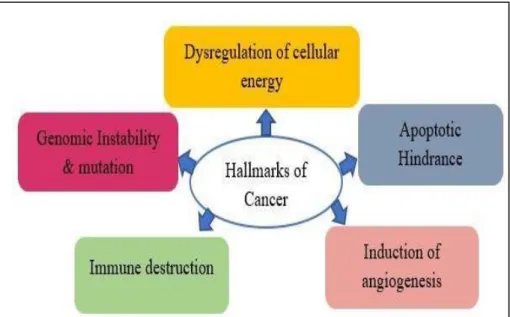
Despite having inherited and non-inherited genetic mutation, cancer cells show some phenotypic changes terminally known as “Hallmark of cancer” (Figure 1) (Hanahan &Weinberg, 2011).
I. Dysregulation of cellular energy: Due to the influence of the Warburg effect on cancer cells, energy metabolism is occurred by following excessive glycolysis and lactate
formation in aerobic conditions hence, the cellular energetic pathway is altered in the host body (Walenkamp et al., 2014).
II. Genomic instability and mutation: Genomic instability and mutation occur due to defects of cellular mechanism and DNA formation that can not control the cell augmentation finally initiates malignancy thus considered as one of the significant hallmarks of cancer (Arnold et al., 2007).
III. Apoptotic hindrance: Cancer cells tend to evade regular apoptosis as they have the potential to act over several signaling pathways like Akt/mTOR pathways that made the cells resistant against chemotherapies and ensure sustainability (Ciuffreda et al., 2010).
Figure 1: Hallmarks of cancer ((Walenkamp et al., 2014).
IV. Immune destruction and angiogenesis: Distinctive microenvironmental nature and the activation of the angiogenic switch with the influence of VEGF makes cancer cells
immune resistant against any vaccine and gradually form angiogenesis respectively (Hanahan & Weinberg, 2011).
3.2 Cancer stem cells and their features
It was all known that there are diverse factors that direct the cells to develop cancers however, one of the most significant causes of cancer development is the presence of cancer stem cells which is a small assembly of cells that arise either the normal progeny or tumor cell exhibit extreme self-regenerative, and proliferative nature due to high sufficiency of telomeric binding that shows invasiveness, and make themselves proof against apoptosis, chemotherapeutic agents thus grown to be an immortal cell inside the host body like human embryonic cells, therefore, become crucially accountable for cancer instigation, expansion, and metastasis (Jin et al., 2017;
Mohr et al., 2015).
3.3 Theoretical approach of cancer stem cell: CSCs model and tumorigenic capability
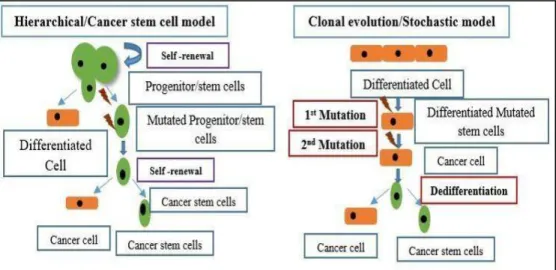
To understand the origin of tumor-initiating or cancer stem cells, several theories have come out where the Hierarchical model portrays that, CSCs emerge from the normal progenitor cell and due to the mutation normal stem cells turn into cancer stem cells (Butti et al., 2018; Dalerba et al., 2007). On the other hand, stochastic models postulate that CSCs derived from differentiated progeny and via the several levels of mutation and self-renewal repeatability sustain their existence.
Figure 2: Cancer stem cells model (Butti et al. 2018; Dalerba et al., 2007)
Several articles focus on the tumorigenic capability of CSCs describe that approximately 100 cancer stem cells require to generate malignant tumors and cancer generally appeared after the 10-12 years of formation illustrated by Figure 2 (Hoffmann et al., 2018; Scheel & Weinberg, 2012; Zhu & Fan, 2018).
3.4 Role of cancer stem cells in cancer progression and metastasis
Cancer stem cells (CSCs) are the collection of stem cells that exhibit extreme self-renewing capability and are highly prone to proliferate therefore, they act as a mediator in terms of creating anomalous growth of the solid and heterogeneous malignant tumor (Pisco & Huang, 2015). Several cell surface markers like CD24, CD29, CD144, CD136, ALDH1 and inflammatory factors like reactive oxygen species (ROS), reactive nitrogen species (RNS) with the influence of several oncogenes, and EMT transcription factors like SOX2, SNAIL, TWIST1, and ZEB1 enhance CSCs to become overexpressed, maintain the CSC niche and provoke them to initiate and progress cancers in several parts of host body (Beck & Blanpain, 2013). Moreover,
this progression also accelerated by the interaction between several regulatory proteins such as TNFα, TGF-β1, NF-κβ, H1fα and many cellular components like CAF, T-cells, NK cells under the interference of various signaling pathways like ERK1/2, Wnt/β catenin, NOTCH, and Akt/mTOR pathways demonstrated by (Figure 3) (Ayob & Ramasamy, 2018; Fu et al., 2020).
Upon the cancer initiation and progression, CSCs are extensively involved in cancer metastasis as well. Metastasis is a complicated process dependent on lots of molecular alteration systems (Luo et al., 2014).
Figure 3: Role of cancer stem cells in cancer progression and metastasis (Ayob & Ramasamy, 2018)
The intrusion of malignant cells into the distant organs formulated by CSCs has happened after the creation of pre-metastatic niche and this facilitation from the pre-metastatic site is done due to the interference of some over-expressive cell-surface indicators as well as several transcription factors named VEGF, TNF-α, and so on (Kaplan et al., 2010; Liu & Cao, 2016). All those factors maintain CSCs colony and evoke them to form exosome-mediated metastasis. During metastasis, cancer cells migrate from the primary site into all distant areas resulting in intravasation that is
promoted by EMT. Finally, it was observed that the involvement of regulatory proteins and the relative pathways maintain CSCs dormancy in the overall metastasis in the host body illustrated by (Figure 3) (Scheel & Weinberg, 2012).
3.5 An overview of SIRT6
SIRT6 belongs to the Sirtuin family isolated from a yeast named saccharomyces cerevisiae is a highly conserved element and known as NAD+- dependent protein deacetylase enzyme (Michishita et al., 2008; Pan et al., 2011). From previous research, it was found that SIRT6 accounts for ADP ribosylation however, some recent studies revealed that SIRT6 mainly works by deacetylating histone proteins. SIRT6 possesses unique features consisting of two globular domains with eight alpha helices and nine beta-sheets. One is Rossmann fold can anchor the NAD+- cofactor, and another is small folded domain helps zinc for attachment into the respective site. Moreover, like other Sirtuins, SIRT6 has no highly pliable NAD+- binding loop rather it contains a fixed single helix (Pan et al., 2011). Due to these special features, it can be assumed that SIRT6 may be able to bind with NAD+- without the presence of acetylated substrate and can exert its pharmacological activity in the human body (Schuetz et al., 2007).
3.6 Biological role of SIRT6
SIRT6 is a chromatin regulating protein that belongs to the sirtuin family exhibits enzymatic function by mono-ADP ribosylation, deacetylase prior to targeting several genes, and transcriptional factors, like PARP1, TNF-α, H3k17, H3K27, H3K9, H3K56, TRF-2, etc. Here is the discussion about the biological role of SIRT6 given below:
I. Repair of DNA and genomic maintenance: SIRT6 shows an enzymatic activity involved in DNA repairmen and genomic maintenance by phosphorylating H2AX, activating PARP1 pathways, and deacetylating H3K9, H3K56 shown in Table 1 (Zhong et al., 2010).
II. Metabolic and energy regulation: SIRT6 is significantly involved in metabolic regulation.
By repressing HIF-1α, and activating several glycolytic genes such as GLUT1, PDK1 it regulates the glucose homeostasis process. Moreover, to store the cellular energy, SIRT6 becomes depleted and generates lipid accumulation by activating PPARγ genes shown in Table 1(Khan et al., 2021).
III. Aging: Upon showing multitasking abilities SIRT6 is significantly involved in aging regulation as well. Additionally, it also activates NF-κβ, altering IGF1 signaling pathways, therefore, positively regulating the cellular stress, and senescence properties observed in Table 1 (Kawahara et al., 2011).
IV. Cancer regulation: SIRT6 reveals bimodal role in cancer regulation. For some cancers, SIRT6 is observed as downregulated and it can control tumor formation by hindering cancer stem cells like capacity, inhibiting the glycolytic process, rendering the activity of regulatory genes and signaling pathways helps in the suppression of malignant growth (Biserova et al., 2021; Langan et al., 2013). Alternatively, for other types of cancers, it is highly expressed since involved in the activation of signaling and regulatory factors as a consequence extend tumor growth and progression in the hypoxic condition shown in Table 1 (Biddle et al., 2011; Gandhi et al., 2017; Zimmerer et al., 2013).
Table 1: Biological role of SIRT6
Cellular Function
Biological role of SIRT6 Reference
Repair of DNA and genomic maintenance
SIRT6 interacts with TRF and deacetylates proteins, ADP-ribosylate PARP1 (Onn et al., 2020), and works on telomeric chromatin thus stabilized genome and involved in DNA damage repairmen that observed in H3K9, H3K56 cell lines.
(Onn et al., 2020)
Metabolic regulation
Via following glycolysis and gluconeogenesis process, SIRT6 controls glucose metabolism as well as contributes also in lipid regulation by activating PPARγ genes.
(Khan et al., 2021)
Aging Highly expressed SIRT6 regulates caloric restriction and induced NF-κβ mainly involved in age regulation by deacetylating H3K9, H3K56.
(Kawahara et al., 2011)
Cancer Regulation
SIRT6 shows dual functionality in terms of cancer regulation since serves either as tumor promoter and suppressor via changing several signaling pathways, regulatory factors according to context.
(Biserova et al., 2021)
3.7 SIRT6 in cancer development
By analyzing the cancer biology, it was evident that malfunction in DNA replication, as well as genetic mutation, are significantly involved in cancer initiation, progression and ultimately lead to metastasis (Mohr et al., 2015). SIRT6 is such a kind of enzyme crucially involved in cancer regulation as it manifests dual role in both tumor promotion and suppression based on the respective location from where cancer is initiated (Chang et al., 2021). Additionally,
evolutionary data flagging out that SIRT6 can display both apoptotic and anti- apoptotic nature due to its bimodal role in cancer regulation not only ensures longevity but also increase the destruction of cancerous cells (Fukuda et al., 2015).
Figure 4: Bimodal role of SIRT6 (Chang et al., 2021)
In normal health conditions, SIRT6 is effectively involved in repairing faulty DNA, helps to sustain stem cells’ phenotypic characteristics, and maintains cellular homeostasis followed by genomic stabilization. When any dysregulated DNA is found in a malignant cell, it induces apoptosis through the ribosylation of mono ADP of P53 and P73 tumor suppressor genes that is why the suppressive activity of SIRT6 is observed in ovarian, pancreatic, colorectal, gastric, and endometrium cancer (Chen et al., 2017). Whereas, for some cancers like breast, liver, skin cancers, and some lymphoma, SIRT6 is found to be highly expressed due to SUMOylation and it triggers cancer stem cells, and some regulatory pathways to develop cancer at a rapid rate, therefore, served as an oncogene for those types of cancers (Figure 4) (Cai et al., 2016).
3.8 Significance of SIRT6 on cancer regulation
For the maintenance of several physiological activities in the human body, the role of SIRT6 is noteworthy. SIRT6 significantly plays a pivotal role in cancer regulation by showing a dichotomous nature in various types of cancers (Desantis et al., 2017). From several papers, it was observed that SIRT6 is highly expressed in some cancers and promotes several pathways like AKT, ERK1/2, and Wnt pathways along with taking a part in the stimulation of reactive oxygen, several transcription factors such as TGF-α1, NFκβ, and suppressed p53 oncogene finally inaugurates tumorigenesis (Wu et al., 2015; Zhang & Qin, 2014). From the evaluation of the overexpression of SIRT6 and the associated pathway activation, it can easily identify the context of cancers where SIRT6 serves as an oncogene (Wu et al., 2015).
Whereas, for some cancers like ovarian, nasopharyngeal, pancreatic, and colorectal cancers, the SIRT6 role is found to be repressive hence it promotes apoptosis and cell death by terminating HIF1-α results in the cancer cell proliferation hindrance and ultimately prevents the spreadability of such cancers (Desantis et al., 2017). Besides, as a suppressor, SIRT6 is also involved in the alteration of some specific cancer-promoting genes and transcription factors named c-JUN/c- FOS, NANONG, and Twist 1, etc., therefore, helps in tumor prevention in some types of cancers (Cai et al., 2020; Han et al., 2014; Min et al., 2012; Zwaans et al., 2012).
Since SIRT6 either acts as a tumor promoter or tumor suppressor, based on the upregulation and downregulation of SIRT6, the detection of cancer escalation is possible to find out. Additionally, several inhibitory pathways identification may also be feasible for the proper prevention of cancers (Desantis et al., 2017). Apart from this, from the overexpression of SIRT6, the survival rate of cancer patients can also be dictated thus SIRT6 acts as a novel diagnostic tool in cancer
Chapter 4: Association of SIRT6 with cancer stem cells
4.1 Bimodal role of SIRT6 on cancer stem cells (CSC)
Sirtuin 6 (SIRT6) is considered as one of the most significant physiological enzymes among seven classes of the sirtuin family plays a crucial role in cancer stem cells (CSCs) by regulating their self-renewing capability and high breeding nature (Jin et al., 2017). Scientists are trying to investigate the influence of the SIRT6 enzyme on Cancer stem cells that may help to retain their plasticity and act as a promising marker in several types of cancer regulation. Though direct data about the impacts of SIRT6 on CSCs are yet to be investigated further, however, through analyzing some mechanistic signaling pathways and by observing the activity of several transcription factors, dual implication between SIRT6 and CSCs can be explicated. There are several pathways that are closely associated with both cancer stem cells and SIRT6 where the most significant one is PI3K/Akt/mTOR are involved in the propagation of cancer stem cells and cancer cells as well (Ioris et al., 2017). Involvement of over-expressive SIRT6 disturbed the normal activity of this signaling cascade as well as mutated several transcription factors like TNF-α, TGF-β, and TRF2 therefore, an abnormal self-amplification of cancer stem cells take place which finally enhances cancer cell proliferation (Jiang et al., 2013; Rizzo et al., 2017).
Besides this, the apoptotic factor IGF-AKT are observed in an inactivated form due to the obtrusion of SIRT6 for this reason, cancer stem cells which act as a booster for cancer development become highly efficacious and develop an amorphous mass of malignant tumor (Wang et al., 2018). Apart from this, an altered mechanism is also observed in ERK1/2 pathways due to the involvement of SIRT6 that finally facilitates cancer stem cells to undergo instantaneous proliferation. Therefore, SIRT6 mediated dysregulated signaling cascades inaugurate tumor propagating cells to create more angiogenesis, and gradually this CSCs become
the prime cause of invasiveness of malignant cells which ultimately acts as a key inciter for the metastatic stage of several carcinomas demonstrated by Figure 5 (Zhang et al., 2019).
Intriguingly, from the several data, an immense impact of SIRT6 on cancer stem cell surface markers are spotted where SIRT6 can accelerate some surface markers like CD24, CD44, CD200, EpCAM, and ALDH1 expression in some CSCs most commonly located in breast, liver, prostate, skin, and blood cancer cell (Biddle et al., 2011; Gandhi et al., 2017; Zimmerer et al., 2013). Hence, by evaluating the possible consequences between CSCs and SIRT6 it can be stated that SIRT6 showing a tumor-promoting nature positively act on cancer stem cell differentiation in some specific cancer in a context relative manner.
Figure 5: The bimodal role of SIRT6 on cancer stem cells (CSCs) (Liu et al., 2018)
Despite displaying the boosting nature of CSCs, Sirtuin 6 can also impede the self-rejuvenate capacity of cancer stem cells as well. Through both In vivo and In vitro analysis, it was remarked that SIRT6 is downregulated in some kinds of cancers. Upon investigating the impacts of SIRT6 on cancer stem cells some promising information is found where it was shown that SIRT6 can inhibit MAPK, PI3K, Akt, and mTOR signals too and altered the uneven division of both
cancerous and cancer stem cells, on that account, can efficiently prevent the quiescence, abrupt self-proliferation of CSCs which are predominantly observed in B cells, colorectal, breast, and hepatocellular cancer stem cell lines as well (Ioris et al., 2017; Liu et al., 2018; Wang et al., 2010). Additionally, SIRT6 also anticipates the expression of certain markers like CD44, CD90, CD117, CD133, CXCR4, and ALDH1, therefore, prevents the tumor-initiating cells (TICs) differentiation in some types of cancers commonly noticed in the ovary, pancreas, colon, GI tract, and endometrium (Muinao et al., 2017; Lee et al., 2021; Xiao & Zhou, 2020). Knock out of SIRT6 alters the function of cancer stem cells which are observed in transgenic mice during in vivo tests. However, a positive correlation between Wnt/β catenin and SIRT6 is also found where a reactive SIRT6 can regulate mutated Wnt/β and helped in cancer stem cells harmonization depicted by (Figure 5) (Oncol et al., 2020; Wang et al., 2016). Finally, SIRT6 as a tumor suppressor can negatively regulate CSCs as well. Thus, from the above information, it can be stated that there is a both positive and a negative correlation between SIRT6 and cancer stem cells in cancer regulation.
4.1.1 Tumor promoting implication between SIRT6 and Cancer stem cells
Sirtuin 6 is an endogenous protein that plays a crucial role in cancer stem cells and cancer cells regulation. Based on the cancer types and location, the activity of SIRT6 varies. The tumor- promoting activity of SIRT6 is observed in breast, hepatocellular, head and neck, prostate, skin, and blood cancers like acute myeloid lymphoma where SIRT6 found to be highly prompted and may also activate cancer stem cells as well (Gandhi et al., 2017).
Figure 6: Role of SIRT6 as a tumor promoter (Gandhi et al., 2017; Biddle et al., 2011)
CSCs are known as small clusters of cells possessed with extreme self-renewal activity and aberrant differentiation potentiality act like an engine in cancer cells amplification, invasiveness, and metastasis. The overall activity of cancer stem cells in cancer progression is assumed to be elevated by the involvement of SIRT6. Based on the different types of cancers, the cell surface markers of CSCs are overexpressed. In breast, hepatocellular, skin, prostate, and several blood cancers, CD133+, CD24+, CD29+, and CD44+ are commonly shown as over activated where these expressions are increased at a higher rate due to the interference of SIRT6 (Biddle et al., 2011; Gandhi et al., 2017; Zimmerer et al., 2013). Additionally, SIRT6 can also inhibit some tumor-suppressive transcription factors like p53, and FOXO3a therefore, created a suitable condition of cancer cells’ atypical proliferation. As from the stem cell biology, it was discovered CSCs are incorporated within cancer cells therefore SIRT6 is considered as a possible helper to retain the CSCs plasticity as well (Khongkow et al., 2013). In addition, the cooperation of over- expressive SIRT6 is observed in some regulatory pathways that are PI3k/Akt/mTOR, MAPK, NANONG, NOTCH, Sonic hedgehog in terms of elevation of CSCs in cancer progression (Ioris
increase the role of cancer stem cells of those particular cancers and accelerate tumor progression. Therefore, positive regulation of SIRT6 on cancer stem cells (CSCs) is found which has a notable contribution in cancer formation (Figure 6) (Gandhi et al., 2017; Biddle et al., 2011; Zimmerer et al., 2013).
4.1.1.1 Impacts of SIRT6 on breast cancer stem cells (BCSCs) in breast cancer progression Breast cancer is one of the deadliest diseases nowadays. Despite having several causes, the presence of breast cancer stem cells (BCSCS) is one of the leading causes of breast cancer development (Velasco et al., 2011). BCSCs are observed in TNBC, BRCA-1 cell lines and provoke osseous and pleural breast cancer metastasis due to over-expression of several major and some minor cell markers like CD44+, CD24+, ESA+, ALDH1, CD133+, EpCAM+, CD61, PCOR respectively that finally activate IL-6, CXCR4, MMP-1 genes help in metastatic cancer progression (Zhang et al., 2020). Along with this, the connection of some dysregulated pathways like Wnt/β catenin, NOTCH, and hedgehog are also noticed in breast cancer and BCSCs
development. The activity of breast cancer stem cells in breast cancer initiation, expansion, and metastasis is accelerated by the influence of CSNK2 phosphorylate mediated SIRT6 as well (Bae et al., 2016). Several analytical experiments were done followed by applying immunohistochemical, quantitative real-time pCR, bioluminescence test on using xenographic mice model where it was detected that SIRT6 is highly expressed in breast cancer cell lines and can highly activate cell surface markers of cancer stem cells and involved in OXPHOS
phosphorylation which is also crucial for cancer cells proliferation (Becherini et al., 2021). Apart from this, SIRT6 activates EMT formation, some transcription factors, and oncogenes named NK-kβ, TGF-β1, MMP9, JUN, and mRNA-83 induced ZEB1/ZEB2 genes that help CSCs in their self-renovation as well (Becherini et al., 2021; May et al., 2011). Thus, united cooperation
of highly activated CSCs and SIRT6 increase breast cancer progression and can establish positive implications between themselves observed in (Figure 7).
4.1.1.2 Role of SIRT6 on liver cancer stem cells (LCSCs) in hepatocellular carcinoma progression
Liver cancer stem cells are exhibited with extreme self-proliferative nature present inside the hepatocytes mostly involved in liver cancer establishment. Generally, hepatocellular carcinoma is produced due to Hepatitis B and Hepatitis C viral infection (Schulte et al., 2020). However, the tendency of hepatoma development is governed by the existence of LCSCs. Lots of cell surface markers like CD24, CD44, CD90, CD133, EpCAM, and ALDH1 as well as cell signaling cascades help cancer stem cells to retain their special characteristics (Yamashita, 2020; Wang et al., 2018). Moreover, several microenvironmental alterations and incorporation of tumor- promoting factors such as VEGF, SDF1, and CXCLs (Chemokine [C-X-C Motif] Ligands) ensure the longevity of CSCs and serve as a vital mediator in hepatocellular cancer promotion (Schulte et al., 2020; Wang et al., 2018). To investigate the exact correlation between liver cancer stem cells and SIRT6, various cell-based assays were done where it was observed that SIRT6 is supremely expressed in cancerous cells that help in EMT formation via inhibiting E cadherin, deacetylating Beclin-1, N cadherin, FOXO3a genes which are extremely essential for liver cancer stem cells and cancer cell colony formation where SIRT6 acts as a fuel for liver cancer stem cells overexpression (Figure 7) (Han et al., 2019). Also, in terms of ERK1/2 pathway activation, a very close relation between SIRT6 and cancer stem cells was observed that helps SIRT6 and CSCs to proliferate and metastasize cancerous cells (Zhang et al., 2019). In such a way, Cancer stem cells and SIRT6 are corporately involved in liver cancer amelioration.
4.1.1.3 Impacts of SIRT6 on skin cancers stem cells (SCSCs) and skin cancer progression Skin cancer is one of the most common cancers by which people are affected frequently. In terms of highlighting the most prominent cause of SC development, it was found the existence of skin cancer stem cells which is crucially involved in several types of skin cancer development.
Their self-renewing, differentiated ability is triggered by some cell surface markers like CD34, CD200, CD49f, and ALDH1(Jian et al., 2017). Moreover, over-activated SOX-2, OCT4, MYC, coupled with ATP binding cassette and dysregulated Wnt/β catenin pathway act as an initiator of malignant formation in skin cells which help in cancer stem cell survival too (Bose & Shenoy, 2014; Chen & Wang, 2019; Wuebben & Rizzino, 2017). The extreme tumorigenesis skill of CSCs is extended by the interference of the SIRT6 enzyme which is overexpressed in
keratinocytes-derived skin cells due to UV exposure. Nevertheless, SIRT6 activates the AKT pathway through COX-2 activation which suppressed the AMPK pathway ultimately creates a favorable condition for skin cancer cell invasion and development (Ming et al., 2014).
Additionally, from the western blot and immunohistochemical inspection followed by in vivo test in transgenic mice it was observed that by invigorating those cell surface markers, transcription factors, and dysregulated pathways with the prohibition of 3’ UTR PTEN signals, both cancer stem cells, and SIRT6 can equally contribute in EMT formation and play a major role in skin cancer development illustrated by (Figure 7) (Biddle et al., 2011; Desantis et al., 2017).
Figure 7: Impacts of SIRT6 on cancer stem cells (CSCs) and several cancer progressions (Han et al., 2019; Shong et al., 2020)
4.1.1.4 Impacts of SIRT6 on cancer stem cell and diffuse large B cell lymphoma (DLBCL) progression
Diffuse large B cell lymphoma is an aggressive hemophagocytic syndrome that generally existed in bone marrow, spleen, and liver (Chang et al., 2020). From the gene microarray and flow cytometry analysis, several biomarkers like HOXA9, CCR6, S100A8, ALDH high are found to be overexpressed which resembles the presence of cancer stem cells in DLBCL where the markers are highly facilitated by the interference of SIRT6 strongly responsible for the initiation of DLBCL (Shong et al., 2020; Chang et al., 2020). SIRT6 brings the dynamic result in terms of CSCs and diffuse large B cell lymphoma formation through activating FOXO4, NANONG genes, and PI3k/Akt/mTOR signaling pathways (Figure 7) (Chang et al., 2020; Ryu et al., 2017).
Knockdown of both CSCs and SIRT6 expression exchange malignant function by showing the
susceptibility of several antineoplastic agents (Guzmán et al., 2020; Yang et al., 2020).
Therefore, close reciprocity between CSCs and SIRT6 in DLBCL development has been observed through this evaluation.
4.1.1.5 Role of SIRT6 on cancer stem cells (CSCs) in acute myeloid lymphoma development The presence of cancer stem cells was first discovered in acute myeloid leukemia (AML) which possess self-renewing proficiency and influence neoplastic cells to proliferate asymmetrically which finally leads to cancer (Villatoro et al., 2020). In this case, AML occurs due to the collaboration of CSCs niche and the enrichment of leukemic stem cell (LSC) characterized by several activated markers like Lin CD34+ CD38-, CD123+, Lin C0038 conciliated by the upregulation of MYC, CXCL12, CXCR7, NF-kβ along with some adhesion molecule like Integrin-VL4, Eph receptors, CD98, CD44 that aid to express LSCs and protect them from degradation thus helps to retain their stemness in AML observed via flow cytometric analysis (Hope et al., 2004; Villatoro et al., 2020). Besides, Wnt, NOTCH, and Hedgehog are equally accountable for LSC progression (Horton et al., 2012). To hasten the CSCs activity, a mutated SIRT6 that becomes unable to maintain DNA stability is involved in AML progression produced via DNA-PKCs, and CtIP deacetylation. Besides activating such pathways especially in the leukemic hematopoietic CD34+ cell, it can exaggerate LSC and form acute myeloid lymphoma in the host body proved a positive implication with CSCs (Cagnetta et al., 2018).
4.2 Tumor Suppressive implication between SIRT6 and Cancer stem cells
Either overexpression or downregulation of SIRT6 is evidenced in some cancers like ovarian cancer, glioma, nasopharyngeal, non-small cell lung cancer, pancreatic cancers, colorectal, gastric carcinoma as well as endometrial cancers where it suppresses cancer proliferation in such types of cancers (Figure 8) (Ahmed et al., 2013; Biserova et al., 2021; Diehn & Majeti, 2010;
Pasca et al., 2011). The tumor spherical formation and the metastatic ability is harbored by the involvement of cancer stem cells (CSCs) that are accelerated due to the activated specific cell markers like CD44+, CD24+, CD87+, CD44+, CD133+ required for cancer development in such kind of cancers (Gao et al., 2019).
Figure 8: Role of SIRT6 as a tumor suppressor (Ahmed et al., 2013; Biserova et al., 2021)
SIRT6 acts as a tumor suppressor on those cancers that can hinder stem cells plasticity and ubiquitous nature by prohibiting such indicators as well as inhibiting signaling pathways like NOTCH3, ERK1/2, JAK2/STAT3, NANOG, and Akt/mTOR. Moreover, cancer spreadability is also inhibited by the inactivation of several transcription factors and oncogenes like TGFβ1, NFκβ, OCT-4, SNAIL1, and TWIST1 by Sirtuin 6 (Ahmed et al., 2013; Biserova et al., 2021;
Herreros et al., 2019). Therefore, a negative correlation of SIRT6 is observed in terms of maintaining the stemness of CSCs that ultimately can take a part in malignant prevention in such types of cancers illustrated by (Figure 8).
4.2.1 Ovarian Cancer stem cells (OCSCs) and SIRT6 in ovarian cancer suppression
Ovarian cancer is one of the deadliest gynecological disorders occurring frequently nowadays (Keyvani et al., 2019; Singomat et al., 2018). Cancer stem cells accompanied with high differentiated capability and decisive tumorigenesis are crucially responsible for ovarian cancer development. Their special features are retained due to the influence of tumor microenvironmental alteration, over-expression of designated cellular markers such as CD24+, CD44+, ALDH1A1, ALDH2A2, CD133+, and CD117+ (Jr et al., 2010; Muinao et al., 2017).
Along with this, the most important transcription factor known as NOTCH 3 helps cancer stem cells to create extreme formation and invasion of malignant cells and shows poor prognostic manner against all possible therapies (Ahmed et al., 2013; Jung et al., 2010). Upon analyzing the connection between cancer stem cells and SIRT6 in ovarian cancer regulation many laboratory tests are conducted by using SKOV3/OVCR3 cell lines where an over-expressive SIRT6 is observed which can help to deteriorate the stemness of tumor propagating cells through hindering the NOTCH 3 signals may help to eradicate both ovarian cancer stem cells and ovarian cancer (OCa) progression (Figure 9) (Jung et al., 2010).
4.2.2 Non- small cell lung cancer stem cells (NCSCs) and SIRT6 implication in non-small cell lung cancer suppression
Lung cancer is one of the most threatening ones that expand globally nowadays. Generally, there are two types of lung cancer from which the majority of people have been affected by non-small cell lung cancer which arises from peripheral tissues (Prabavathy et al., 2018). Like other types of cancers, the expansion of malignancy inside the non-small cells of lungs is stimulated by the small subpopulation of cells popularly known as CSCs which are characterized by its specific cell markers named LGR5, CD87, CD133, and CD117, etc. (Gao et al., 2019; Janikova et al.,
2010; Shao et al., 2014). From various experiments, it was presumed that SIRT6 is present in a downregulated form to eradicate CSCs plasticity by rendering the marker expression. Highly activated cell markers due to the influence of some transcription factors SOX-2, OCT4, SNAIL1, and activated regulatory signals like Wnt/β catenin, hedgehog, NOTCH, NANONG, PI3k/Akt govern the CSCs tumorigenesis ability in the absence of SIRT6 thus, provokes cancer cells to show angiogenesis, helps cancer cells to evade from apoptosis, therefore, ensures the durability of cancer cells (Herreros et al., 2019; Zakaria et al., 2015). To suppress this abnormal cell proliferation of both CSCs and cancer cells, SIRT6 is involved which become downregulated and helps to EMT prevention via blocking SNAIL1 and TWIST1 factors along with preventing such signals, and CSCs surface marker expression, therefore, can inactivate cancer stem cells and prevent non-small lung cancer cells from abrupt proliferation serves ultimately as a tumor suppressor (Figure 9) (Han et al., 2014).
4.2.3 Implication of SIRT6 on pancreatic and colorectal cancer stem cells (CSCs) and cancer suppression
In order to find out the possible implication of both pancreatic and colorectal cancer stem cells with SIRT6, it was discerned that there have some similarities in both types of cancer stem cells nature. The retaining tendency of CSCs plasticity and pervasive nature is facilitated by hepatocyte growth factor-mediated c-met, CD24, CD133, EpCAM, and CXCR4 surface markers observed in the pancreas (Lee et al., 2021; Pasca et al., 2011). Likewise, almost the same surface markers’ existence is observed in colorectal cancer stem cells that are EpCAM, CD24, CD29, from which CD133+ is the most dominant markers help in the self-renovation of colorectal stem cells, and facilitates the highest degree of proliferation of malignant cells finally mitigate metastasis (Diehn & Majeti, 2010; Langan et al., 2013). Moreover, for both types of cancer stem cells, there is a significant influence of several signaling pathways that are Wnt/β catenin,
NOTCH, Hedgehog, PI3K/Akt/mTOR, JAK2/STAT3 that gradually influence cells to undergo metastasis through-provoking CSCs (Kemper et al., 2010; Shirmohamadi & Hajiasgharzadeh, 2019; Wong, 2011). Apart from this, several transcription factors, ZEB1, SNAIL1, and TWIST1 facilitate pancreatic cells to produce a solid mass of tumor whereas ABCG2, PARP1, Beclin-1 are other types of transcription factors that insist colorectal cancer cells to metastasize into distant organs (Manic et al., 2021; Yin et al., 2007; Zhang et al., 2019; Zhu et al., 2021). For fruitful eradication, SIRT6 is considered as a promising target that can act as a tumor suppressor by inhibiting the following markers, a regulatory signal named Akt cascade, and corresponding transcriptional factors in presence of the FOXO3a gene (Figure 9) (Kugel et al., 2017; Tian &
Yuan, 2018; Zhang et al., 2019). Lastly, SIRT6, a tumor preventer shown as the decreased amount in the cancerous cell lines thus helps to eradicate not only cancer stem cells aggressive proliferation but also malignant cell formation in both pancreas and colorectal site observed by in vivo and in vitro tests.
Figure 9: Impacts of SIRT6 on cancer stem cells (CSCs) and some cancer suppression (Fu et al.,
4.2.4 Gastrointestinal cancer stem cells (GCSCs) and SIRT6 implication
Gastrointestinal cancer is developed also because of the presence of gastrointestinal cancer stem cells which are already incorporated inside the cancer cells and serve as a prominent driver for malignant formation in the GI tract (Fu et al., 2020). Due to sharing of the same entities, gastrointestinal cancer stem cells also show self-renewing capability, possessed with differentiation potentiality expressed by specific markers like CD24, CD44, CD90, CD171, and EpCAM. Furthermore, the incorporation of poorly regulated NOTCH, Wnt, JAK2/STAT3, even Hedgehog signaling pathways that alter normal cellular fate and can promote malignancies in the GI tract observed via expression of the CDX2 gene driven the cells to form metastatic gastrointestinal cancers which show poor recovery, and remittance properties over the time (Lizárraga et al., 2020; Xiao & Zhou, 2020; Zhang & Que, 2020). To minimize this extensive proliferative nature of malignancy, SIRT6 are mechanistically involved since it becomes able to restraint malignancy by hindering several signaling cascade regulation that are Wnt, NOTCH, Hedgehog, JAK2/STAT3 and surpassing the designated markers of CSCs, therefore, can negatively regulate cancer stem cells eventually involved in GI cancer prohibition (Figure 9) (Zhou et al., 2017).
4.2.5 Connection of endometrial cancer stem cells (ECSCs) and SIRT6 in endometrium cancer suppression
Endometrial cancer is one of the most frequent gynecological disorders comprised of two types that are type-I which is known as estrogen-dependent-endometrioid and type–II estrogen- independent-endometrioid endometrial cancer (Giannone et al., 2019). Disruption of lots of regulatory and transcriptional protein namely OCT4, NANONG, SOX2, several ECSCs markers include CD44, CD55, CD133, CD177, most significantly ALDH1 as well as the involvement of
some microRNA and the mutant pathways such as Wnt, Notch, Hedgehog are the promoter of endometrial cancer progression as all of these factors provide the self-proliferative capacity of stem cells, very prone to influence differentiation and involved in cancer progression and metastasis. By undergoing cell-based assay and overviewing laboratory data it was speculated that SIRT6 also contributes to EC suppression via repressing the self-renewing capability of cancer stem cells through blocking several biomarker expression of CSCs, and corresponding regulatory signals conclusively promote cell cycle arrest laterally influenced malignant cells to undergo apoptosis which results in cancerous cell growth inhibition ultimately acts as a prognostic marker for endometrial cancer stem cell and endometrial cancer repression (Figure 9) (Fukuda et al., 2015).
Table 2: Effects of CSCs due to SIRT6 and the drug resistance nature of various cancers
Cancer Types SIRT6
regulation
Resistant drugs References
Breast cancer Doxorubicin, 5-flurouracil,
Methotrexate
(Faria et al., 2020) Hepatocellular
carcinoma
5-FU, doxorubicin, sorafenib (Wen et al., 2016)
Skin Cancer Cisplatin, Platinum-based therapy,
Antifolate, methotrexate
(Capalbo et al., 2018)
Diffuse large B cell lymphoma
Rituximab, doxorubicin, vincristine (Klener, 2020) Acute Myeloid
leukemia
Darubicin, daunorubicin, arabinoside
(Chen, 2019)
Ovarian cancer Paclitaxel, Cyclophosphamide (Chen et al., 2017)
Non-small cell lung cancer
Paclitaxel, cisplatin, vinca alkaloids (Olivero et al., 2013)
Pancreatic carcinoma
5-FU, gemcitabine (Shi & Kleeff, 2002)
Colorectal carcinoma
Oxaliplatin,5-FU, leucovorin (Jeught et al., 2018) Gastrointestinal
cancer
Cisplatin, 5-FU (Huang et al., 2016)
Endometrial cancer
Paclitaxel, cisplatin, docetaxel (Moxley et al., 2010)
= Down-regulation = Up-regulation
Chapter 5: Modulation of SIRT6
5.1 Modulation of SIRT6 by Activators and Inhibitors
SIRT6 is an endogenous enzymatic protein that plays a crucial role in cancer regulation. Via analyzing several reports, it was observed that there are several natural modulators are present which have a great impact on the pharmacological function of SIRT6 where the efficacy of modulators is varied from compound to compound (Fiorentino et al., 2021). The deacetylating activity of SIRT6 is increased by the influence of Free Fatty Acid (FFA), Quercetin, Cyanidin, and UBCS039 and they all can enhance the SIRT6 activity up to specific EC50 ranges shown in Table 3 (Fiorentino et al., 2021). The binding affinity of several activators like UBCS039, myristic acid, Quercetin, and Cyanidin are modulated by attaching to the hydrophobic site, Zn2+
domain binding site respectively followed by certain specificity that causes allosteric changes of SIRT6 and accelerate its activity hence can hasten the aberrant proliferation of both cancer stem cells and cancer cells in many types of cancers (Fiorentino et al., 2021; Rahnasto-rilla et al., 2018).
On the other hand, there are several types of natural polyphenols are found which can decrease the SIRT6 cellular activity that are nicotinamide, ADP ribose, Nε-thioacyl-lysine containing peptide, and OSS_12816 shown in Table 4 (Bolívar & Welch, 2017; Fatkins et al., 2006;
Fiorentino et al., 2021). These modulators prevent the tumor-promoting nature of SIRT6 by targeting a specific site of SIRT6 and create allosteric modulation that diminishes the pharmacological activity of SIRT6 (Fiorentino et al., 2021). Through binding into the hydrophobic pocket, they irreversibly minimize SIRT6 activity at several extents of IC50 ranges.
For this reason, SIRT6 becomes unable to trigger cell proliferation help in CSCs and cancer cell
Table 3: Structure and mechanism of activation of SIR6 activators
Name Mechanism of Action Result Reference
Myristic Acid
Myristic acid belongs to the class of free fatty acid binds with the same hydrophobic site of SIRT6 brings conformational changes in SIRT6 thus altering activity and can reversibly demyristoylated H3 peptide (Figure 10).
Catalytic efficacy (Kcat/Km) = 35-fold at 400μm
EC50= 246μm
(Fiorentino et al., 2021)
Cyanidin Cyanidin binds into the allosteric site of SIRT6 and exerts the activity. The modulation of SIRT6 is also regulated by the activation of FOXO3a as well as the inactivation of TWIST1 and GLUT1 during the binding of cyanidin in SIRT6 site (Figure 10).
It shows dose- dependency and deacetylation enhancement when EC50= 460μm
(Rahnasto-rilla et al., 2016)
UBCS039 This is the first synthetic derivative that binds with SIRT6 benzene moiety and interacts with several amino acids finally extending SIRT6 deacetylating activity (Figure 10).
It increases SIRT6 activity up to 3.5- fold at EC50 level = 38μm
(Fiorentino et al., 2021)
Table 4: Structure and mechanism of inhibition of SIR6 inhibitors
Name Mechanism of Inhibition Result Reference
Nicotinamide Nicotinamide is a weak non- competitive inhibitor produced during deacylation of SIRT6
and also creates a
conformational change of SIRT6 through attaching the allosteric domain site of that enzyme (Figure 10).
IC50 value = 153 μm (HPLC assay) and in fluorogenic assay shows IC50 value =184 μm
(Bolívar &
Welch, 2017)
Nε-thioacyl- lysine containing peptide
This SIRT6 inhibitor restraints catalytic activity of SIRT6 via nucleophilic reaction which occurs at the carbonyl position of the acyl group, therefore, able to block the catalytic activity of SIRT6 and hindered cell proliferation at the initial step (Figure 10).
For BJHJ_TM1 IC50=2.8 μm
For BJHJ_TM2 IC50=8.1 μm
For BJHJ_TM3 IC50=1.7 μm
(Fatkins et al., 2006)
Oss_128167 It can extend the TNF-α secretion and enhance glucose uptake followed by expressing GLUT-1 pathways in BxPC3 cells consequently contributing in several cancer inhibitions (Figure 10).
It shows IC50 level = 89μm
(Fiorentino et al., 2021)
Figure 10: SIRT6 Activators
Figure 10: SIRT6 Activators and Inhibitors (Fiorentino et al., 2021)
SIRT6 Activators
Myristic Acid Cyanidin UBCS039
SIRT6 Inhibitors
Nicotinamide Nε thioacyl-lysine containing peptide Oss_128167
Chapter 6: Findings and Discussion
Cancer is the uncontrollable division of an abnormal cell that makes the cell vulnerable and gradually attenuates the patient’s life span. Though there is a massive cause of the development of cancer, however, the most prominent cause of this terrible disease is found, the presence of cancer stem cells which appears either from the normal progeny or from the cancer cell crucially responsible for the development of heterogenous tumors (Dalerba et al., 2007; Ayob &
Ramasamy, 2018).
This project paper emphasizes the tumor-forming capability of CSCs, diverse biological role of SIRT6 as well as illustrates the correlation of CSCs with the endogenous protein SIRT6 which is dichotomous in nature and involved in the regulation of malignancy based on the cancer state and location (Chang et al., 2021; Sima et al., 2015). Upon highlighting the role of CSCs and SIRT6 in cancer regulation it was observed that there are several pathways like PI3K/Akt/mTOR, JAK2/STAT3, ERK1/2, and Wnt-β catenin which are common for both cancer stem cells and SIRT6 on which SIRT6 either promotes or suppresses cancer noticed in breast, liver, skin, ovary, lungs, gastric, pancreas, colon, and endometrium respectively that were discussed above (Abdollahi et al., 2019).
In addition, this paper also demonstrates the contribution of SIRT6 on CSCs self-renovative nature coupled with tumorigenic potentiality which is mediated by several cell surface markers including CD24, CD26, CD44, CD133, CD166, and ALDH1, several transcription factors-like TGF-β, NF-κβ, ZEB1, and ZEB2, etc. together with the involvement of several activated oncogenes such as SOX2, OCT4, SNAIL, TWIST1 as well that collectively provoke CSCs to develop a mass of malignant tumor via performing uncontrolled cell division of cancerous cells
help CSCs to persist hence play a significant role in cancer progression and make cancer cell resistant against all possible chemotherapies that are mainly detected in breast, liver, skin and blood cancers named AML (Abdollahi et al., 2019; Sima et al., 2015).
Along with this, an interesting approach of SIRT6 on CSCs suppression is also the significant point of this project paper which highlights the specific types of cancers like cancers from human ovary, GI tract where SIRT6 can prohibit the cell surface markers of cancer stem cells like CD24+, CD200+, Lin CD 24+, Lin CD 38- and so on along with equally take a part of some pathway prohibition like Akt/mTOR, Wnt/β cassettes and activation of PTEN, AMPK tumor suppressor signals which finally can hinder cancer abnormal differentiation inside the host results in natural tumor degradation (Xiao & Zhou, 2020; Manic et al., 2021).
Therefore, several SIRT6 activators and inhibitors are also the highlighted points discussed in this project paper where it was focused that activators extend SIRT6 activity by following specific EC50 ranges, on the other hand, SIRT6 inhibitors attenuate the activity of this enormous enzyme at several IC50 levels (Fiorentino et al., 2021).
Despite having several common pathways of CSCs and SIRT6 in cancer management, the exact implication between CSCs and SIRT6 are still being questioned due to lack of definite data. So, to establish a valid implication, more confirmatory studies are necessary for better identification and productive diagnosis of cancer.