The aim of the study was to investigate the role of social media in reducing social isolation among older people. Dissertation: The role of social media in reducing social isolation among the elderly in Dhaka.

Background of the Study
Social media has some positive effects on older people; impact on well-being, impact on health and disability, social networks with relatives and friends. For example: disabled people, women (mostly in Pakistan who are not allowed to use mobile phone and internet), people with low education, low income, ethnic minorities, young people (if parents don't allow) and elderly people.

Problem Statement
The reach of mass media has gradually increased over the last two decades in Bangladesh. Television continues to emerge as the most powerful mass medium; followed by the radio.
Study Objectives
Significance of the Study
Scope
Limitations
Literature Review
However, this is of great concern to us as this ICT policy (2009) has excluded the elderly in Bangladesh and no action plan for this large segment of the total population. From the above discussion, it is clear that the elderly need help to be a part of ICTs.
Study Framework
NGOs, development partners, donor agencies, civil society and corporate bodies should also come forward and play an active role to improve the situation of the elderly in Bangladesh. Mancinelli (2007) explained that it is a multi-faceted concept that refers to a range of factors that influence lack of access to and inadequate use of ICT, such as gender, age, ethnic groups, and insecurity of living and financial conditions, job insecurity and social insecurity. The consequences of this exclusion are academic failure, social isolation, increased unemployment, lower productivity and competitiveness, and exclusion from social and political spheres (Parsons and Hick, 2008). Since discrimination against the elderly in the sector can be considered digital exclusion, the Study identified different types of digital inclusion/exclusion.
According to him, the summary of the four digital divides is: those who are rich, educated and powerful, and those who are not; those who know English and those who cannot;. This study is conducted to find out the role of social media among elderly people in reducing social isolation in Dhaka city.
Research Design and Method
This study investigated attitude, behavior and experiences of social media use by the elderly and sought to investigate the state of the elderly in accessing and using social media and how they benefit and reduce their social isolation. Descriptive research methods are used when the researcher wants to describe specific behavior as it occurs in the environment (Wimmer and Dominick, 1999).
Variables of the Study
Population
Research Instruments
Sampling
Most developed countries have accepted the chronological age of 65 years as the definition of the elderly. In addition, the MDG6 project has set the old definition as starting at 50 years (WHO, 2015). The sample size was 20 elderly people (according to the definition described above).
This study sought to find out the role of social media in reducing social isolation among elderly people in Dhaka city. The results have emerged in the in-depth interviews conducted by the elderly.
Profile of the Respondents
Some sections are further divided into several sub-sections to provide an in-depth analysis of the role of social media among respondents. In terms of previous occupation, ten respondents were in government service out of twenty respondents. Three widowed respondents lived with their son and two separated respondents lived alone at home.
The study represented the situation of Dhaka city, all the respondents lived in different areas in Dhaka. Seven respondents lived in Dhanmondi, five respondents lived in Shamoly, two respondents lived in Mirpur, two respondents lived in Moghbazar, two respondents lived in Tejgaon, one respondent in Mohammadpur and one respondent in Panthapath.
Social Isolation
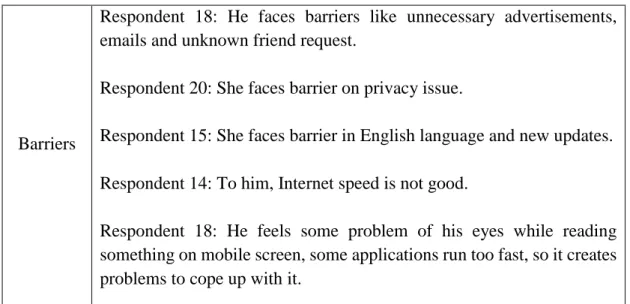
Weiss (1973) defined: "Social isolation can be characterized by feelings of boredom and marginality or exclusion". Social isolation occurs when an individual's demand for social contacts or communication exceeds the human or situational ability of others (Birodi and Nicholson, 1995). In the issue of social isolation in old age, all the respondents (except one respondent) believed that people become socially isolated and lonely as they grow older, due to health illnesses, mental illness, children and family members becoming busy with their own lives and work.
Another said: "In modernity social isolation and loneliness in inevitability as people age, which was the case in those countries that were already modernized." One of the respondents said: “At a young age, regardless of the age limit since then, people remain busy with their daily work, and social isolation may not be such a concern for them.
Digital Exclusion/Inclusion
It creates depression and frustration.” They expect that in future the elderly will use social media the most, and they can easily communicate with their family members. In relation to digital exclusion/inclusion and elderly citizens in Bangladesh, most of the respondents said that the elderly are digitally excluded because they do not personally use the internet, it is run by someone else. Another two respondents stated that not all elderly are digitally excluded in Bangladesh.
However, in rural areas, the elderly may be digitally excluded, but this situation will change within one or two years. She believes that well-educated and active older people are interested in using new technology and the Internet.
Information Communication Technology (ICT), Social Media & Mass Media Usage
Information Communication Technology (ICT)
These activities were pleasant for us, but technology and the Internet are new to us.” Because of this, women are not comfortable using technology, they are afraid to use it. They also face some problems to adopt, for example: new phenomenon, discomfort in using the Internet, less adaptability, lack of interest in learning new things, fear of technology, hesitation, etc. At first she had some problems using it, but now she is very happy with her iPad.
Two respondents said that they had started using the Internet three years earlier when their children went abroad. Another ten respondents said that they started accessing the Internet at home and also at the office for ten years.
Social Media
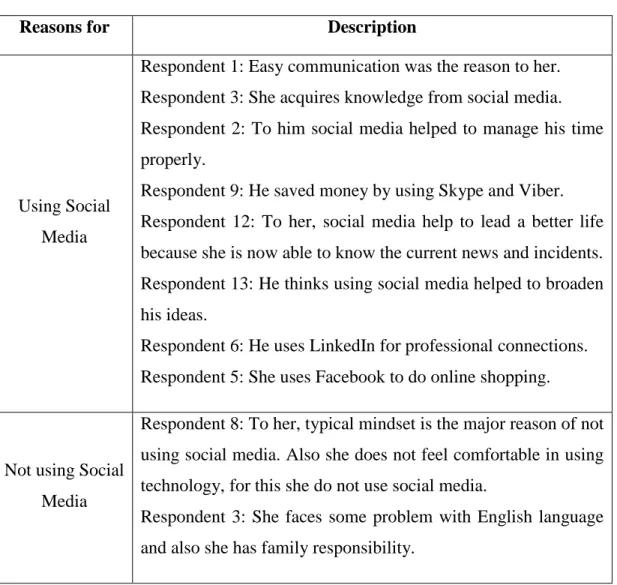
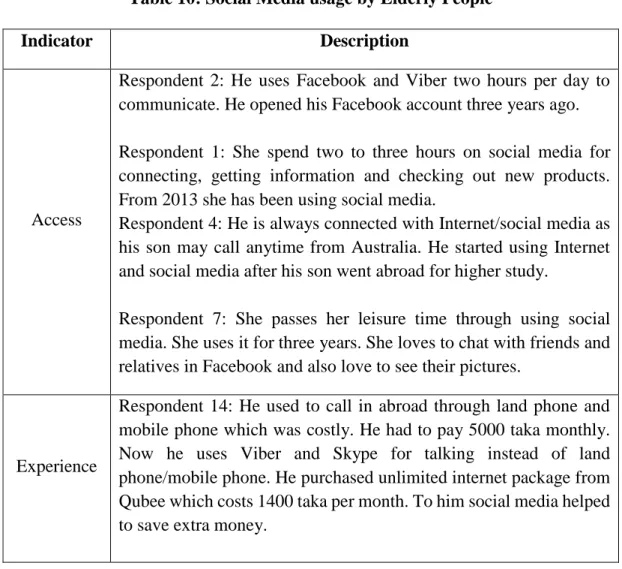
One said: "Social media has helped me save money." Another respondent said, "I can communicate with friends and family using social media." The other two respondents, who do not use social media personally, also expressed their opinion by not using social media. One respondent said, "I don't feel comfortable using social media, although my friends use social media actively."
She also does not feel comfortable using technology, for this she does not use social media. They believe that people usually do not feel comfortable using social media and are always dependent on other people.
Role of Social Media in Reducing Social Isolation
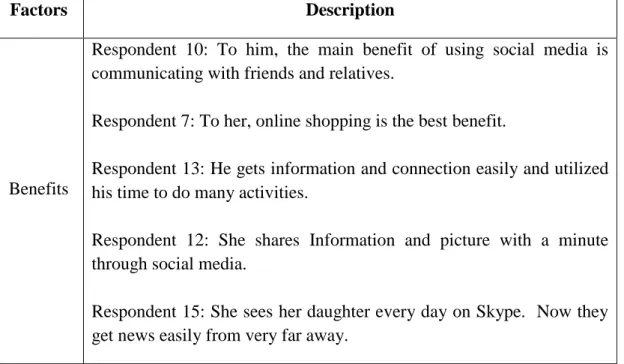
Regarding the role of social media in reducing social isolation, all respondents explained that they accessed and used social media. One respondent said: “Using social media is very important for us (elderly people) so we don't feel cut off from society and the world. Female respondents also use social networks, but they have some family obligations and household chores.
In relation to using social media to reduce social isolation, most of the older respondents said that social media is very useful for communication, acquisition of information and pastime. He stated: "Mainly family ties, strong social relationships and friendships help reduce social isolation, not social media."
Mass Media Usages
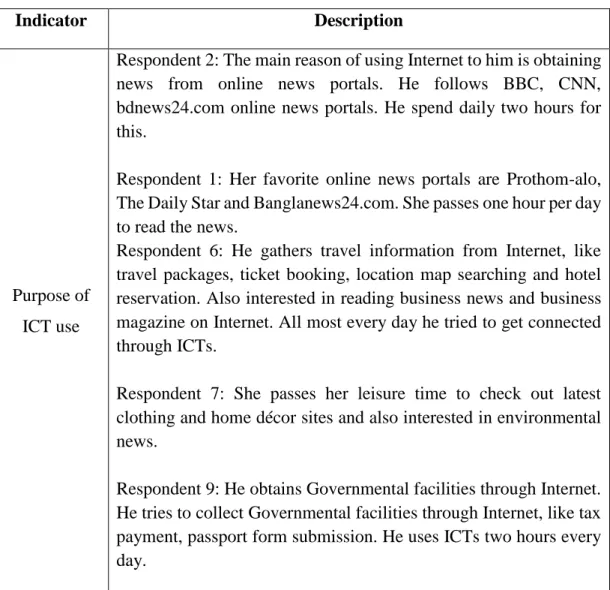
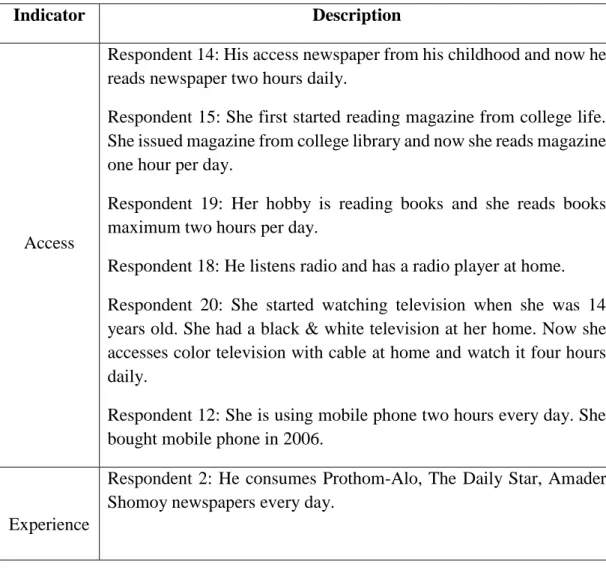
They also said that they find mobile phone convenient to communicate with family, relatives and friends and also for business purposes. She issued magazine from university library and now she reads magazine one hour a day. Now she has access to color television with cable at home and watches it four hours a day.
He has internet connection at home and uses Qubee internet connection with Wi-Fi router. He mainly reads religious, political and life history books for entertainment, social awareness and developing his knowledge.
Summary
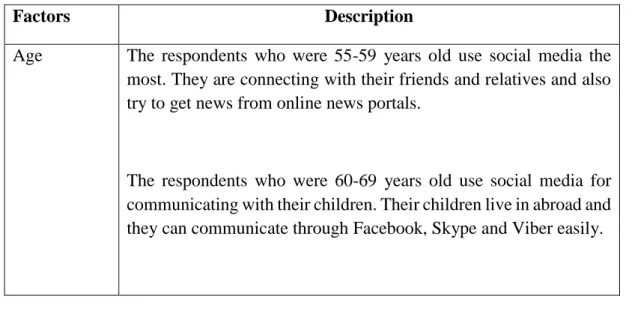
They regularly use social media sites and mobile phone apps such as Facebook, Skype, Viber, Line, Tango, We chat and Whatsapp; but no one uses Twitter. They mainly use social media for communication and try to keep in touch with family, relatives and friends. This article also examined the impact of social media use among older adults to reduce social isolation;
All respondents believe that social media helps to reduce social isolation, as it is very useful for communication, obtaining information and passing time. According to them, social media has become a part of life, they cannot think of a single day without using it.
Conclusion
However, after analyzing the research findings, it is evident that the elderly are digitally included, for their accessibility and usability of internet and social media sites.
Recommendations
The Role of Social Networks in Helping to Alleviate Social Isolation and Isolation for Senior Citizens”, Business Lab (December, 2008). 2013), "Helping seniors get connected through technology", Tech World Bd (online).
Socialnetworkingsitesandolderusersasystem_ger.pdf>[accessed March 5 Social media can reduce #elderlyisolation, Luxembourg researchers report”, a publication of the Medill School, Medill Reports, Chicago: Northwestern Towards Digital inclusion–engaging older adults in the 'digital world '”, in Accessible Design at the Digital World Conference. I am conducting a dissertation titled "The Role of Social Media in Reducing Social Isolation Among the Elderly in Dhaka".