Measuring the performance of government officials is challenging because performance is a product of socioeconomic, cultural, psychological, and environmental factors. The question is, what is the status of the service of personnel officers.
Statement of the problem
Women civil servants are surrounded by various kinds of problems which primarily come from their family and also from the wider spectrum of society. As a result, the policy does not reflect grassroots needs as well as gender sensitivity.
Rationale of the study
This study is an attempt to examine the relationship between the factors and the performance of women officials. The performance of female officers can be improved by integrating and minimizing various interrelated factors.
Scope of the study
Objective of the study General Objective
Specific objectives
- Research question
- Operational definitions
- Limitation of the study
- Layout of the study
Many things have been considered in designing the structure of the study; gives readers a clear overview and creates a strong link between the chapters with a sequential order. This study is composed of five chapters, which have been presented in the following sections.
Introductory Discussion
The data are quantitative in nature; under these circumstances, evidence-based qualitative data in this study are sparse.
Chapter II: Literature Review
Chapter IV: Findings and Discussion
Chapter V: Conclusion and Policy Implications
LITERA TURE REVIEW
Training need for women civil servant
The researcher pointed out the temperament of the society in Bangladesh and mentioned the subordinate status of women in the family and society in the patriarchal society. She suggested special training in the art of public speaking to remove shyness and reluctance inherited from the society's culture and training courses for personality development, leadership quality and physical fitness to make them competent and professional for civil service.
Associated factors and performance
Organizational policy and culture
Although female civil servants are part of very powerful, respected and sometimes feared organisations; because of their gender identity, they have to bear most of the problems that other women experience in society (Jahan, 2010). Female civil servants expressed their opinion that there are many factors that persuade them not to remain in the cadre service.
METHODOLOGY
- The study site
- Sources of data
- Study Population
- Sampling and sample size
- Data collection tools
- Data analysis
- Reliability
The data was collected using the questionnaires keeping in mind the objectives of the study. The questionnaires were administered together with the female cadre officers, supervisors of the concerned female cadre officer and service recipients. Considering the rank and status, respondents were divided into different strata and the researchers have
In simple random sampling, each member of the population has an equal and independent chance of being selected for the sample. Thirty-one supervising officers have been purposively selected and are responsible for writing the Annual Confidential Report (ACR) of the female officers in the sample. In order to achieve the stated objectives of the study, both structured and semi-structured questionnaires have been developed as a tool for primary data collection.
In order to obtain reliable and authentic data, three types of closed-ended and open-ended questionnaires were developed. In addition, descriptive statistics were followed in the quantitative analysis to describe the general characteristics of the data. To achieve reliability, the study has included various ranks and positions of female cadre officers working in Bangladesh secretariat up to field level considering different age, group and work experience of the respondents.
FINDINGS AND DISCUSSION
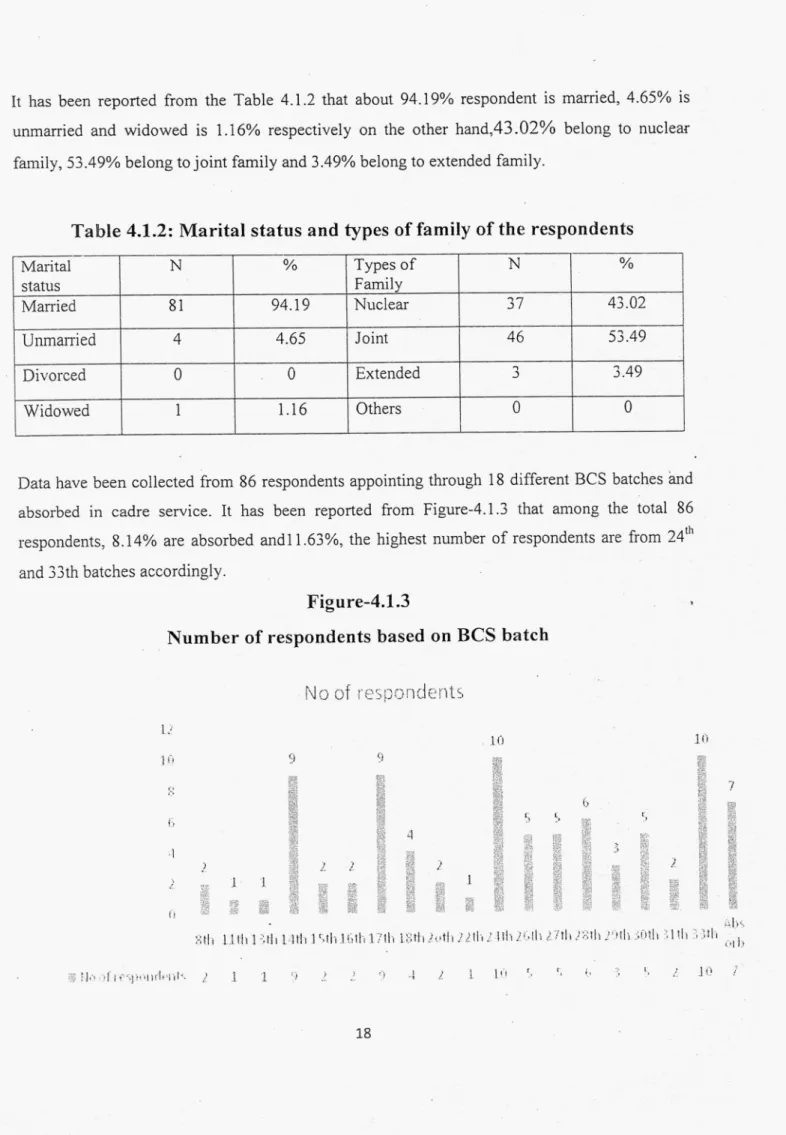
Data has been collected from women cadre officers, concerned supervisors and service beneficiaries belonging to BCS Administration, Education, Economic, Health and Police. Data has been collected from 86 respondents who appointed through 18 different BCS batches and absorbed in cadre service.
Number of respondents based on BCS batch
It is clear from figure 4.2 that socio-economic and cultural factors influence the job performance of female cadre officers. About 0.45% respondents gave the opinion that socio-economic and cultural factors have an effect on job performance and the degree of this is very high, 50.75%.
Dual responsibility at home and office and its effect on performance
Ta ble-4.2.2
Family comes first then service career and family pressure on performance
Many social factors are directly and indirectly related to the performance of female executives. Table 4.3 shows that based on the five-point Likert scale, the mean of abuse is 4.55, child rearing is 4.47 and harassment is 4.3. The average of the gender discrimination behavior of the boss is 3.51 and the attitude of the male colleagues is 3.02. The boss's undue influence is 3.
9, lack of means of transport 2.85, lack of day care center is 2.36, lack of separate toilet 2.68. It shows · that these social factors create a negative impact on the performance of female employees. Justice and equality Attitude of male colleagues 3.02 0.86 Gender discriminatory behavior of the boss in office 3.51 1.04 Social values and attitude of family members 2.12 0.70. 90% are of the opinion about the gender discriminatory behavior of the boss, 44.19% the attitude of the family members, 30.23% the opinion of the neighbor, 27.05%.
Social factors associated with performance and significance
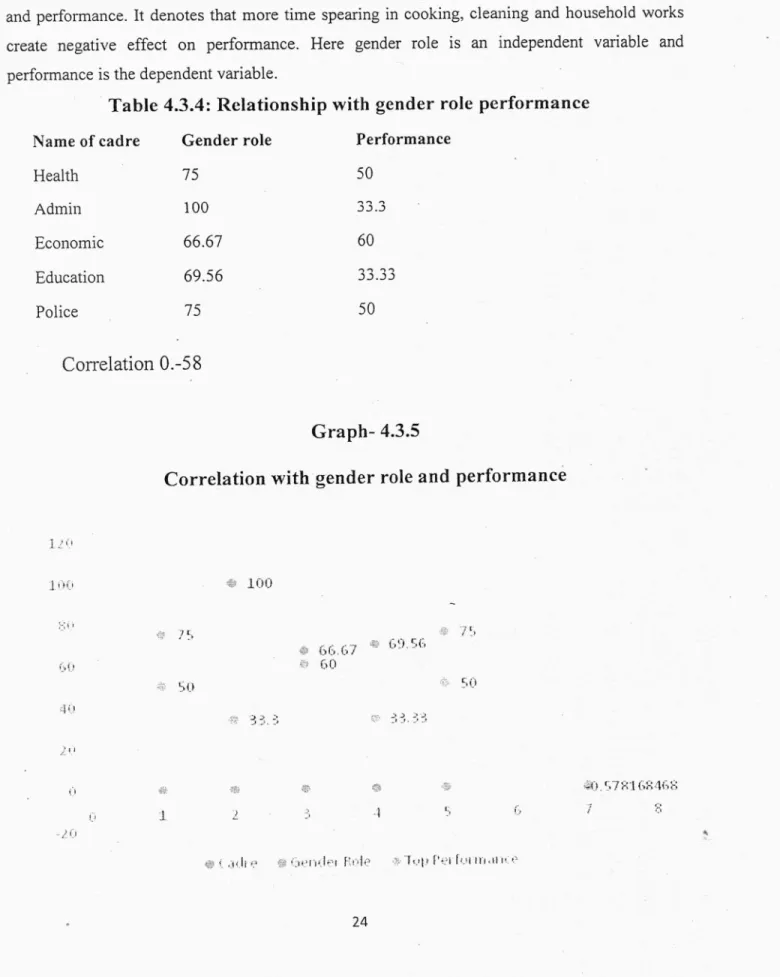
In table-4.3.2 it is found that there is a high negative correlation (-0.70) between the dry performance of childcare. In table 4.3.4 it is noticed that there is a negative correlation (0.-58) between gender role and performance. It shows that spending more time on cooking, cleaning and housework has a negative effect on performance.
Correlation with gender role and performance
Social factors associated with performance and its significance
Table 4.4.1 shows that there is a moderately high positive correlation (0.51) between the availability of daycare centers and performance. Here, the availability of a daycare center is an independent variable and performance is the dependent variable.
Relationship between availability of daycare center and performance
Correlation graph between availability of daycare center and performance
It has been noticed from table-4.5 that the mean of lack of positive behavior of male colleagues is 3.64, workplace insecurity is 3.45 and sensible approach of the male colleagues is 3.32, movement is 3.01, societal lagging is 2.93. . It has been noticed in Table 4.6 that about 16.05% of the respondents have given opinion respectively lowest importance and minor importance, 33.33% thought medium, 23.46% thought high and 11.11% thought maximum importance in attitude of male colleagues, 44.19% thought the highest.
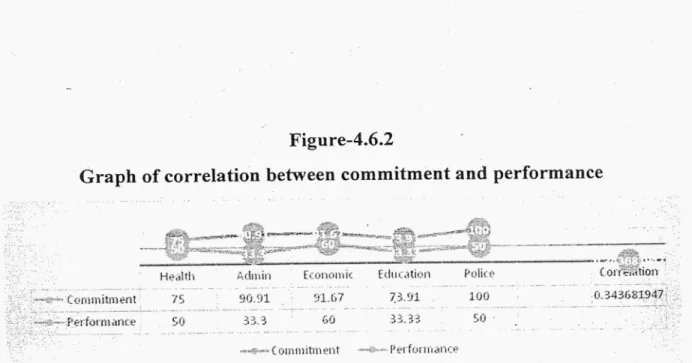
Relationship between commitment and performance
It is revealed in Table-4.8 that about ;ll,88% of the respondents opined IT is the first and 13,04% opined English proficiency is second top rated performance areas. It was observed that 42.86% of the respondents · gave opinion following rules and regulation is the most used strategy to solve problem and 28.57% was of opinion that positive behavior to the stakeholders is the strategy to solve problem.
Performance areas need to develop and identified strategies to solve problem
The female officers were asked how they perform related tasks, as well as some general main tasks related to their work, based on a number of identified indicators. It also appears that the participants themselves claim that they perform the most important tasks perfectly, apart from the integration of ICT in their work.
Self-analysis matrix for measuring performance
Figure 4.10 shows that supervisors consider ICT (25%) and decision-making (25%) to be the most important performance gap for female executives, and the same applies to the other gaps. Figure 4.10.1 shows that about 46.46% of the respondents expressed the opinion of setting up a day care center and transportation facilities respectively. 33.33% suggested improving cooperation between families, 20% recommended a secure working environment, 13.33% believed that training should be provided, 6.66%. Figure 4.11 shows that among the total 113 service recipients, 20 are from the health care framework, 93 from the education framework, 10 from the adm.ini.str.atin framework, 5 from the police framework and 5 from the economic framework.
The figure shows that the beneficiaries of the services scored a very good 10% in the administration, 15% in the health framework, 68.8.8% in the educational framework and 20% in the economic framework. On the other hand, they scored as bad performers 25% in health, 0% in education, 20% in administration, 10.
Cadre wise performance assessed by service recipients
At the end of the study, it should be determined whether the research objectives have been answered correctly or not. It was found that the research objectives and research findings are related in the following table. 1. To study the demographic, socio- The working life of approximately 44.19% of respondents is under the economic and cultural background of 10 years.
About education, marital status and experience were reported to belong to science at 30.23%. It is revealed that about 69.62%. To identify important factors revealed in this study that include socio-economic and cultural · child rearing and care, factors that influence job performance to varying degrees. On the other hand, most socio-economic factors hinder the performance of female officers such as gender role in family, child education,.
3.To find out the service performance Service recipients marked that 10% women officers are very responsible for women in cadre good in administration cadre, 15% in health cadre, 68.88%. On the other hand, they marked as poor performers 25% in health cadres, 0% in education cadres, 20% in administration, 10% in police cadres and -0% in economic cadres. 4. To explore its impact on the society A large number of female cadre officials are not rendering the desired service to the stakeholders.
CHAPTERV
Conclusions and Policy Implications
Concerned supervisors of the female officers noted that the female officers cannot do well in the area of ICT and decision making. Female officers should improve their quality and win the unfavorable situation through personal capacity. The following policies should be adopted for better performance of women cadre officers working in different services in Bangladesh.
The gender role from the male part should be shared meaningfully with a focus on household work, cooking, cleaning and looking after children and the sick. Societal patriarchal thinking should be through motivation and sensitization using mass media and campaigns. Women in Public Administration: Problems and Prospects of the Women Officers of the BCS Administration Cadre.
Training needs and facilities for women in the civil service, women in politics and bureaucracy. 2011).Rejl.ection of structural and cultural mindsets in women's representation in the civil service of Bangladesh. Improving Performance through Motivation: A Study on Civil Service of Bangladesh, MAGD Dissertation, Institute of Governance Studies, Dhaka.: BRAC University,.
Questionnaire for Women Cadre Officer
Place of Residence
Socio-economic and cultural factors affect the job performance of female civil servants - do you agree? 34;Dual responsibilities at home and office hinder the performance of women officials" how much. 34;Family pressure can create obstacles in the performance of official duty" How far is this true for you.
Factors associated with job performance and its level of significance
Showing respect Does he show respect to customers 3. Improvement Does he try to develop. What is the status of your desired service from the female officers you have met?