SOFTWARE PROJECT FAILURE IN BANGLADESH
By
Abdirahman Yusuf Abdihafid ID NO: 181-44-165
A thesis submitted in partial fulfillment of the requirement for the degree of Master of Science in Software Engineering
Department of Software Engineering
DAFFODIL INTERNATIONAL UNIVERSITY
Spring – 2019
ii
© Daffodil International University Approval
This thesis titled “Software project failure In Bangladesh”, submitted by Abdirahman Yusuf Abdihafid, ID 181-44-165 to the Department of Software Engineering, Daffodil International University has been accepted as satisfactory for the partial fulfillment of the requirements for the degree of M.Sc in Software Engineering and approved as to its style and contents.
BOARD OF EXAMINERS
--- Dr. Touhid Bhuiyan
Professor and Head Department of Software Engineering
Faculty of Science and Information Technology Daffodil International University
Chairman
--- Dr. Md. Asraf Ali
Associate Professor Department of Software Engineering
Faculty of Science and Information Technology Daffodil International University
Internal Examiner 1
--- Md. Khaled Sohel
Assistant Professor Department of Software Engineering
Faculty of Science and Information Technology Daffodil International University
Internal Examiner 2
--- Dr. Md. Nasim Akhtar
Professor Department of Computer Science and Engineering
Faculty of Electrical and Electronic Engineering
Dhaka University of Engineering & Technology, Gazipur
External Examiner
Jahangirnagar University
iii
© Daffodil International University
iv
© Daffodil International University ACKNOWLEDGEMENT
Foremost, I am very grateful to Almighty Allah for spearing my life and seeing me through my years of education. I dedicate this work to God Almighty. He has been the wind beneath my wings. His Grace and Mercy has brought me thus far and I am proud and grateful. My deepest appreciation and thanks go to my respected guide and supervisor Dr. Md. Asraf Ali Associate Professor Department of Software Engineering Faculty of Science and Information Technology Daffodil International University , great helping during writing this thesis, really, he is the one who gave me the encouragement to become really what I am today. Would not have been made possible without him. It was his persistency and consistency which kept me on track. Thank for your guidance and remarkable efforts. I am highly indebted to Mr.
Md. Khaled Sohel, Assistant Professor for his guidance, encouragement and utmost support throughout my program to see me successful.
My regards go to Dr. Touhid Bhuiyan, Associate Professor and Head of Department of Software Engineering Daffodil International University, for his guidance and encouragement..
My deepest appreciation goes to my beloved families, and in particular to my father Yusuf abdihafid Omar and my mother Hayaad Abdilaahi Warsame and my uncle Shaakir Abdihafid Omar and my uncle Abdiqani Abdihafid Omar , who have given me very supportive, patient, and understanding and material in all aspects of my live and my other things that I cannot mention here And I want thank my Best friend Juweria Ahmed Omar for her big support and help me always supporting me with positive words and encourage me to keep going everyday forward. Lastly, this wish of thanks is dedicated by Mohamed Abdihafid Omar. I also want to thank and appreciate my siblings: Salama Yusuf Abdihafid, Sowda Yusuf Abdihafid, Najma Yusuf Abdihafid, Nadiira Yusuf Abdihfid, Mohamed yususf Abdihafid, Abdirisaaq Yusuf Abdihafid with their support and encouragements.
v
© Daffodil International University Contents
Approval ... ii
CHAPTER 1- INTRODUCTION ... 1
1.1. Background ... 1
1.2. Research Motivation ... 2
1.3. Problem Statement ... 3
Research Questions ... 4
Objectives of the Research ... 4
1.6 Research Scope ... 4
1.7 Thesis Organization ... 5
CHAPTER TWO - LITERATURE REVIEW ... 6
Chapter 2 Overview ... 6
2.1 Background of The Software Project Failure ... 6
2.2.0 Common causes of software project failures ... 7
2.2.1 Lack of User Input ... 7
2.2.2 Incomplete Requirements and Specifications ... 7
2.2.3 Changing Requirements & Specifications ... 8
2.2.4 Lack of Executive Support ... 9
2.2.5 New Technology, Technology Incompetence / Illiteracy ... 9
2.2.6 Lack of Resources ... 9
2.2.7 Unrealistic Expectations ... 10
2.2.8 Does not need IT Anymore ... 10
2.2.9 Lack of IT Management ... 11
2.2.10 Lack of Planning ... 12
2.2.11 Poor communication ... 12
2.2.12 Poor Risk Management ... 13
3 CHAPTER THREE ... 15
RESEARCH DESIGN AND METHODOLOGY ... 15
3.1 Introduction ... 15
3.2 Research Subject and Instrumentation ... 15
3.3 Data Collection Procedure ... 16
3.4 Statistical Analysis ... 16
3.5 Reliability and validity ... 16
vi
© Daffodil International University
3.6 Research design ... 17
4 CHAPTER FOUR ... 18
EXPERIMENTAL RESULTS AND DISCUSSION... 18
4.1 Introduction ... 18
4.2 Experimental Results ... 18
4.3 Descriptive Analysis ... 18
4.3.1 Sex Response ... 18
4.3.5 Participants Experiences in Terms of Role respondents ... 19
Table 4. 5 Participants Experiences in Terms of Role respondents ... 20
4.3.6 Do you have any failure software project in your company? ... 20
4.3.7 Title of Software project Failure? ... 21
4.3.8 Starting and Dead line month and year of failure software project for the Development? .. 22
Table 4.3.8 above shows the starting date for software project failure and date between 2010 and ... 23
4.3.9 Completing Month and Year? ... 23
This Table above shows completing year and month and the date between 2011 and 2018 ... 23
4.3.10 did the failure software project was delivered to any client and Month Year? ... 24
4.3.11 is the failure software project stop from clients? ... 25
The following figure 4.3.11 shows the graph of table 4.3.11 ... 25
4.3.12 Reason for stopping the failure software project with stopping date month and year? ... 25
4.3.13 did the failure software projects was analyzed by any system analyst? ... 26
4.3.14 How many year experiences had system analyst? ... 26
4.3.14 Educational and qualification of the system analyst? ... 27
4.3.15 Educational and qualification of the system analyst? ... 27
The following figure 4.4.15 shows the graph of table 4.4.15 ... 28
4.3.16 did the failure software project was gathered the requirements by any Requirement analysts? ... 28
The following figure 4.3.16 shows the graph of table 4.3.16 ... 28
4.3.17 How many year experiences had requirement analyst? ... 28
4.3.18 Educational Qualification of the requirement analyst? ... 29
4.3.19 Major of Education Qualification of Requirement Analyst? ... 29
4.3.20 did the failure software project was developed by programmer? ... 30
The following figure 4.3.20 shows the graph of table 4.3.20 ... 30
vii
© Daffodil International University
4.3.21 How many year experiences had programmer? ... 30
4.3.21 Educational Qualification of programmer? ... 31
4.3.21 Major of education Qualification programmer? ... 31
4.3.21 did the failure software project was tasted by any taster? ... 32
4.3.23 How many year experiences had Taster? ... 32
4.3.25 Educational Qualification of the Tester? ... 33
The following figure 4.3.25 shows the graph of table 4.3.25 ... 33
4.3.26 Major of Education Qualification Tester? ... 33
5 CHAPTER FIVE ... 40
SUMMARY OF THE STUDY, CONCLUSION ANDRECOMMENDATIONS ... 40
5.1 Introduction ... 40
5.2 Summary of the Study ... 40
5.2.1 Participants Experiences in Terms of Role respondents? ... 40
5.2.2 did the failure software projects was analyzed by any system analyst? ... 40
5.2.3 Did the failure software project was gathered the requirements by any requirement analysts? ... 40
5.2.4 Did the failure software project was developed by programmer? ... 41
5.1.5 Did the failure software project was tasted by any taster? ... 41
5.3 Conclusion ... 41
5.4 Recommendations ... 41
5.5: To reduce software project failure? ... 41
5.5: To reduce software project failure? ... 42
References ... 43
viii
© Daffodil International University LIST OF TABLES
Table 2.1: Literature Review ...12
Table 4.3.1: Demographic information...18
Table 4.3.5: Participants Experiences in Terms of Role respondents...19
Table 4.3.6: Do you have any failure software project in your company...20
Table 4.3.7: Title of Software project Failure...21
Table 4.3.8: Starting and Dead line month and year of failure software project for the Development…..22
Table 4.3.9 Completing Month and Year...23
Table 4.3.10 did the failure software project was delivered to any client and Month Year...24
Table 4.3.11 is the failure software project stop from clients...25
Table 4.3.12 Reason for stopping the failure software project with stopping date month and year...26
Table 4.3.13 4.3.14 how many year experiences had system analyst ...27
Table 4.3.14 Educational and qualification of the system analyst ...28
Table 4.3.15 Educational and qualification of the system analyst ...29
Table 4.3.16 did the failure software project was gathered the requirements by any requirement……....30
Table 4.3.17 how many year experiences had requirement analyst...31
Table 4.3.18 Educational Qualification of the Requirement analyst ...32
Table 4.3.19 Major of Education Qualification of Requirement Analyst ...33
Table 4.3.20 did the failure software project was developed by programmer ...34
Table 4.3.21 how many year experiences had programmer... ...35
Table 4.3.21 Educational Qualification of programmer ... ...36
Table 4.3.23 did the failure software project was tasted by any taster ...37
Table 4.3.24 how many year experiences had Taster ... ...38
Table 4.3.25 Educational Qualification of the Tester ...39
Table 4.3.26 Major of Education Qualification Tester ...40
ix
© Daffodil International University ABSTRACT
This study examined the problem of software project failure in Bangladesh it also explored the causes of software project failure and t how to reduce the software project failure in Bangladesh Addiction we made the correlation in our variables to know the relationships between them . A sample of Sample of 80 Questionnaire. The results show that software project failure in Bangladesh is caused lack of experiences and knowledge of requirement analyst system analyst programmer and software taster .with respect to reducing the software project failure in Bangladesh and how to prevent that problem were described. I selected Bangladesh because it is my second county and for me it is easy to communicate with the participants and can reach them easily
KEY WORDS
Software project failure in Bangladesh
1
© Daffodil International University CHAPTER 1- INTRODUCTION
1.1. Background
Undertaking disappointment is a typical heard issue in the Software Industry lately. It has been seen that practically half of the activities in the Industry flop because of numerous to it. The Standish Group [2003], found in their study that of the considerable number of activities just 1/6 of the undertakings were finished on schedule and inside the predefined spending plan. They additionally discovered that 1/3 of the ventures were dropped and more than ½ of them were considered tested. Components adding to extend achievement are to finished it on schedule, ought to be under spending plan and should meet the necessities totally, yet by and large these don't meet the desires which results in undertaking disappointments. The most well-known purposes behind task disappointments are absence of client contribution, improbable time scale, ineffectively characterized necessities, poor testing, miscommunication and distinction of sentiment between colleagues, and so on. Since now the majority of the organizations use programming for different tasks, it is an absolute necessity for each organization to dodge venture disappointments. A colossal measure of cash is spent on making programming, in this manner it is imperative to break down and comprehend the explanations for the different purposes for undertaking disappointments. The chart beneath shows different explanations behind disappointment and the rate to which each factor contributes
The above diagram and the level of disappointments demonstrate that it is typical for a product task to bomb because of different reasons. Yet, the fact of the matter is the thing that we can do
2
© Daffodil International University
to keep away from it. For that we have to comprehend the different purposes behind disappointment and the means to maintain a strategic distance from the
1.2. Research Motivation
Fir why we need programming venture Development of PC based data frameworks started during the 1950s. From that point forward, advancement condition and procedure has profoundly changed, basically due to changing authoritative requirements and mechanical improvement.
During the 1950s, focal point of advancement was on the procedure the product performed and the objective was to build effectiveness of handling. Since handling intensity of PC was a basic asset, accentuation was given on the mechanization of the current procedure. However at this point the situation has changed. The ideas of business process improvement and reengineering have appeared with increment in handling power and other innovative upgrades. Associations are currently changing their business procedures to profit and utilize better innovation to determine higher effectiveness. Business associations are currently quick to mechanize their frameworks with the goal that they can do their undertakings rapidly and effectively. Be that as it may, even after such extreme changes in business forms, needs, mechanical advancement and forcefulness of the business condition, loads of data framework ventures
This precisely our examination roused us to do this work, so to take care of the issue proposed paper of programming venture inability to decrease the undertaking disappointment in Bangladesh
3
© Daffodil International University 1.3. Problem Statement
Advancement of PC based data frameworks started during the 1950s. From that point forward, improvement condition and procedure has fundamentally changed, primarily on account of changing hierarchical requirements and mechanical advancement. During the 1950s, focal point of advancement was on the procedure the product performed and the objective was to expand effectiveness of preparing. Since preparing intensity of PC was a basic asset, accentuation was given on the robotization of the current procedure. However at this point the situation has changed. The ideas of business process improvement and reengineering have appeared with increment in preparing power and other innovative upgrades. Associations are currently changing their business procedures to benefit and utilize better innovation to determine higher effectiveness. Business associations are presently quick to computerize their frameworks with the goal that they can do their assignments rapidly and effectively. However, even after such extreme changes in business forms, needs, innovative improvement and forcefulness of the business condition, heaps of data framework ventures fall flat or are in a quandary. From an investigation it was discovered that the rate of programming venture disappointment is between half to 80%. This rate incorporates both little and extensive programming ventures. In an audit of 13,522 ventures done by the Standish Group in the year 2003, it was discovered that about
1. 66% of all software projects fail
2. 82% of the projects experience time overruns and
3. 48% of the projects do not have the required features on product release
We focus on our Research the problem that caused the project failure in Bangladesh
4
© Daffodil International University Research Questions
Our research Questions is to reveal perceived causal relationship and inter connections between process areas, and evaluate the importance of analyzing software project failure
QI. What are the causes for software project failure in Bangladesh?
Q2. How to reduce the causes of software project failure in Bangladesh?
Objectives of the Research
In order to satisfy the aim of the research project the follow objectives will need to accomplish:
1. To Investigate Really Lead To Failure Software Project In Bangladesh
2. To Ascertain Bangladesh It Software Project Failure Statistics and Reasons by Means by questionnaire?
3. To Investigate Types Of Software Project Failure?
4. To Discuss How To Prevent The Software Project Failure In Bangladesh?
1.6 Research Scope
This study reflects the causes and consequences of finding the software project failure in Bangladesh. The research techniques are mainly content analysis and limited number of respondents’ view that are responsible for project . Therefore the findings of this study do not
5
© Daffodil International University
hold enough for the generalization but this provide us the trend and common problem of causes the software project failure and its remedies for better achievement
1.7 Thesis Organization
This thesis consists of five chapters which will cover the finding and the developing the project failure in Bangladesh
. Here is an overview of the content of each presented chapter:
Chapter One: This Chapter Introduce the Introduction Of Software Project Failure Also The Background of Software Projects. The Causes Of Projects Failure
Chapter Two: This Chapter Covers The Literature Review Which Is The Previous Related Works That Been Done Before. Moreover, This Chapter Represents Relevant Information For Understanding The Study More.
Chapter Three: This Chapter Explains the Details Of The Selected Methodology That We Are Going To Use In The Thesis
Chapter Four: This Chapter Discusses About The Finding And Discussion Of Software Project Failure
Chapter Five: This Chapter Introduces The Conclusions And Recommendation Of Thesis
6
© Daffodil International University CHAPTER TWO - LITERATURE REVIEW
Chapter 2 Overview
This chapter explains the literature review to software project failure and present of Background of software project Failure also we identify the causes of software project failure
2.1 Background of The Software Project Failure
Creating programming frameworks is a costly, and regularly a troublesome procedure as
programming improvement ventures are influenced by a progression of issues, for example, poor task the board, cost and timetable invades, low quality programming and under-spurred
engineers ''disappointment'' is either legitimately identified with the result of the advancement procedure or it is multi-dimensional covering specialized, monetary, conduct, mental, political, emotional, challenged/arranged, and fleeting elucidations. Ahmad et al. Guarantee that (2006) it might be practically difficult to discover understanding about whether a task succeeded or fizzled''. It has happened that the engineers see the undertaking as a complete achievement and different partners see it as a sensational disappointment. Agarwal and rathod (2009 ) express that a triumph and a disappointment are identified with the view of task individuals. They reason that the recognitions about a triumph or a disappointment are frequently identified with satisfying the task objectives .comparable cases are exhibited by procaccino et (2007. a product venture
disappointment implies an unmistakable Failure To Succeed In The Cost, Schedule, Scope, Or
7
© Daffodil International University
Quality Goals Of The Project. The ''unmistakable'' alludes to a task disappointment saw as extreme enough to be averted in the forthcoming venture
2.2.0 Common causes of software project failures
In this section, we discuss the common causes of software project
2.2.1 Lack of User Input
The Standish Group (2013) overview inferred that absence of client input was appraised by 12.8% of respondents as the number 1 explanation behind ventures being tested, for example the venture is finished and operational however over spending plan, over the time gauge, and offers less highlights and capacities than initially indicated. A further 12.4% of respondents finished up absence of client contribution was the number 2 explanation behind undertakings being
weakened, for example the task is dropped sooner or later amid the advancement cycle. In a report on the best way to maintain a strategic distance from Information Technology venture disappointment, the Gartner Group (2012) states that one reason for task disappointment is absence of unequivocal Involvement of business specialists. A befuddle between the desires for specialty Units and the IT office's answer regularly happens in light of the fact that the specialty units surrender their duties of issue possession to the IT office
2.2.2 Incomplete Requirements and Specifications
Rodgers (2000) takes note of that one of its underlying drivers venture disappointment isn't appropriately characterizing the task at the absolute starting point. All clients will introduce various perspectives about what they need a framework to do or how they would utilize another framework. An old undertaking the board maxim expresses: "a client will disclose to you anything you get some information about and nothing more"and clients ought to in this manner be examined regarding everything. He infers that a venture definition can't contain everything
8
© Daffodil International University
that each and every client needs and along these lines the clients ought to support a particular and nitty gritty undertaking definition to guarantee the task is all around characterized. In a study led by the standish gathering (1995), deficient necessities was appraised as the number 1 explanation behind tasks being disabled, for example the task is dropped sooner or later amid the
advancement cycle. Deficient prerequisites and determinations were evaluated as the number 2 purpose behind activities being tested
2.2.3 Changing Requirements & Specifications
Changing prerequisites and determinations happen when the clients leave from the Requirements and particulars initially indicated toward the beginning of the task. The accessible research was dissected to figure out what are the effect and explanations behind changing prerequisites and details According to moad (1998), 76% of a gathering of 500 IT supervisors in both UK and the USA refered to changing client necessities as the fundamental driver of venture disappointment.
The Standish Group (1995) overview presumed that changing prerequisites were appraised as the number 3 purpose behind activities being tested, and absence of client inclusion as the number 6 explanation behind undertakings being weakened. The Gartner Group (2009), state s that scope creep is the fundamental motivation behind why enormous tasks fall flat,. Degree creep is the steady expansion of new necessities to the first detail. As the prerequisites list builds, venture multifaceted nature increments much more. In spite of the fact that it is required because of fundamental changes, it is all the more frequently the aftereffect of poor administration and checking.
9
© Daffodil International University 2.2.4 Lack of Executive Support
At the point when administrators are not seen or are not effectively supporting an undertaking, a resulting absence of official help happens. The accessible research was broke down to figure out what the effect and explanations behind absence of official help are. As indicated by a report distributed by Cable and Wireless (2007), very regularly IT destinations are missed through absence of senior administration support and an inability to make the correct condition to augment its effect. The Standish Group (2001) overview inferred that 7.5% of respondents demonstrated absence of official help as the number 4 purpose behind activities being impeded.
Absence of official help was evaluated as the number 5 purpose behind ventures being tested by 9.3% of respondents.
2.2.5 New Technology, Technology Incompetence / Illiteracy
New innovation, innovation ineptitude/l ack of education happen when the association does not have the fundamental abilities to manage innovation. The accessible research was investigated to figure out what the effect and explanations behind new innovation, innovation ineptitude/lack of education are. The Standish Group (1995) overview presumed that innovation inadequacy was evaluated by 7.0% of respondents as the number 5 purpose behind activities being tested. A further 4.3% of respondents finished up innovation lack of education as the number 10 explanation behind ventures being debilitated.
2.2.6 Lack of Resources
Undertakings may likewise flop because of an absence of assets. The absence of assets could be interior or outside. The accessible research was examined to figure out what the effect and purposes behind absence of assets are. Duncan (1996), in the PMBOK, characterizes staff
10
© Daffodil International University
obtaining as including getting the HR required (people or gatherings) doled out to and taking a shot at the task. In many situations, the best assets may not be accessible, and the task supervisory group must take care to guarantee that the assets, which are accessible, will meet undertaking necessities. The Standish Group (1995) review presumed that absence of assets was appraised by 6.4% of respondents as the number 6 purpose behind activities being tested. A further 10.6% of respondents finished up absence of assets as the number 3 purpose behind undertakings being weakened. A Gartner Group (1997 report on frameworks executions evaluates that there are eight Information Technology experts to fill each ten vacant positions.
Data and innovation assets are winding up progressively rare, making it hard to supplant staff individuals who let alone for disappointment after an especially (and most likely superfluously) difficult usage
2.2.7 Unrealistic Expectations
Desires that are set too high outcome in the customer not getting the normal item, bringing about the undertaking being ordered a disappointment. The accessible research was dissected to figure out what
Are the effect and purposes behind doubtful desires?
2.2.8 Does not need IT Anymore
This identifies with ventures being dropped anytime of the undertaking life cycle on the grounds that the organization administrators choose that the IT anticipate isn't required any longer. The accessible research was examined to figure out what the effect and reasons are for activities not being required any longer. The Standish Group (2009) overview presumed that the clients did not require the arrangement were appraised by 7.5% of respondents as the number 8 purpose
11
© Daffodil International University
behind ventures being debilitated. Terblanche (1999) states that one of the results recently conveyance that is experienced is that the product could be obsolete, and is never executed
2.2.9 Lack of IT Management
The accessibility of IT the board to guarantee venture achievement is talked about in this area.
Without the nearness and backing of IT the board, ventures are bound to disappointment. The accessible research was broke down to figure out what the effect and purposes behind absence of IT the executives are.
The Standish Group (1995) overview inferred that absence of Information Technology the executives was evaluated by 6.2% of respondents as the number 9 explanation behind undertakings being debilitated. Another explanation behind Chief Information Officers not being accessible could be that they are inaccessible. Doorman (2000) references a Business Week article in 1990 that detailed that Chief official officer (CEO) were being terminated at almost double the rate of 1988, and half more oftentimes than other senior administrators. (CEO) become normal substitutes for PC related fiascos notwithstanding when different supervisors might be more to blame.
12
© Daffodil International University 2.2.10 Lack of Planning
Absence of arranging could result in venture disappointment. An arrangement is a guide that controls the undertaking group to definite task fruition. Without an arrangement the task resembles a rudderless vessel. The accessible research was investigated to figure out what the effect and explanations behind absence of arranging are. The Standish Group (1995) overview inferred that absence of arranging was evaluated by 8.7% of respondents as the number 7 explanation behind undertakings being impeded. The 1997 KPMG think about titled "Overview of
Fruitless Information Technology Projects" uncovered that one of the normal reasons for venture disappointment was poor undertaking arranging, explicitly lacking danger the executives and a feeble task plan (2012). As indicated by the investigation of 500 IT administrators in the US and UK, 76% of the chiefs reviewed detailed having a venture totally come up short. Lack of
common sense was recorded as the number 2 explanation behind undertakings falling flat (Moad, 2007)
2.2.11 Poor communication
With poor correspondence ventures are bound for disappointment. The accessible research was dissected to figure out what the effect and purposes behind poor correspondence are. Goldstein (2001) references the exploration of Taylor who had his examination of in excess of a thousand Information Technology ventures distributed by the British Computer Society. The overview found that poor correspondence was one of the reasons for venture disappointment. This is affirmed in an article in Computing SA (1998), where Jim Johnson, the director of the Standish Group, expresses that one of the primary reasons ventures come up short is an absence of correspondence The Gartner Group (1998), in the article titled "Is your IT anticipate damned?",
13
© Daffodil International University
found that sound undertakings have basic, short chains of correspondence and faceto-face interchanges wherever conceivable. Then again, bound undertakings have long complex correspondence channels, with nitty gritty reminders, messages and reports. Additional time is spent on destined undertakings attempting to impart than taking every necessary step. The seeds of disappointment with most pained Information Technology ventures are typically sown at the task's begin in light of the fact that there isn't sufficient correspondence with clients, and insufficient business-side purchase in at the correct administration levels (Wilder et al, 1998).
2.2.12 Poor Risk Management
Poor hazard the board resembles the Titanic without radar, bringing about the venture sinking.
Hazard the executives empowers the task group to recognize risks and foresee and make restorative move in an opportune way. The accessible research was investigated to figure out what the effect and purposes behind poor hazard the executives are. The 1997 KPMG think about titled "Study of Unsuccessful Information Technology Projects" uncovered that one of the basic reasons for task disappointment was poor venture arranging, explicitly lacking danger the executives and a frail undertaking plan (Porter: 2000).
In his book on Rapid Development, McConnell (1996) found that inability to oversee dangers is a standout amongst the most well-known exemplary slip-ups. He expresses that if dangers are not overseen effectively, just a single thing needs to turn out badly to change your undertaking from a quick advancement task to a moderate improvement one. Moad (1998) in an article in PC Week on the web, gives an account of a study of 500
14
© Daffodil International University
Data Technology administrators in the United States and the United Kingdom. The review found that the danger of Information Technology venture disappointment is expanding, as is hands on worry for IT supervisors. 63% said dangers associated with ventures have expanded since they ended up engaged with tasks, while 43% said they have expanded essentially A Gartner Group article (2001) on overseeing hazard in substantial undertaking ventures found that in the past overseeing hazard was not viewed as an esteemed undertaking action, since it didn't
straightforwardly result in the culmination of undertaking expectations. Since hazard the
executives was given almost no need on big business asset arranging (ERP) ventures, every now and again nobody was allocated to oversee and screen dangers and start restorative activities when chance variables changed from low-to high-affect. The subsequent asset issues, missed deadlines, cost invades and different injuries could have been maintained a strategic distance from, or possibly limited, in the event that somebody had focused on the pointers (hazard factors) and made changes before minor issues ended up difficult issues
15
© Daffodil International University 3 CHAPTER THREE
RESEARCH DESIGN AND METHODOLOGY
3.1 Introduction
This chapter discusses the methodology that was Software project Failure in Bangladesh. The discussion will include the design of the research, Research Subject and Instrumentation, Data Collection Procedure, Statistical Analysis.
3.2 Research Subject and Instrumentation
Calls attention to that an overview is just on a par with an inquiry it pose, subsequently the poll is a basic stage in the review examine process, the survey must be important and exact in endeavoring to catch the pith of the examination objective. To accomplish these finishes, a scientist will be required to settle on a few choices
How should be asked?
How should each question be phrased?
In what sequence should the questions be arranged?
What questionnaire layout will best serve the researcher objectives?
How should the questionnaire be pre-tested?
Does the questionnaire need to be revised?
16
© Daffodil International University 3.3 Data Collection Procedure
The data collection instrument is a questionnaire. It contains questions formulated based on the research questions (main and sub-questions), literature review and the theoretical positioning presented in this study. The questions were set in a way that examines and . Collected data were quantified,
3.4 Statistical Analysis
The Statistical Package for Social Scientists (SPSS) was used for data entry and analysis.
Pearson’s correlation tool was used to establish applicable relationships among the identified variables.
3.5 Reliability and validity
Ensuring these two aspects of a study are very important. While reliability shows the need that a study produces results that will be affirmed consistently by subsequent similar studies, validity or trustworthiness of a study requires that the instrument applied correctly obtains the type of data that it is meant to be gathered. The researcher was committed to work objectively and diligently to ensure the actuality of these two aspects of research by following applicable scientific method.
Initially, the tool was pre-tested with up to ten randomly selected Software project failure In Bangladesh. Doing this was viewed as a way of helping the researcher to ascertain the validity of the tool.
17
© Daffodil International University 3.6 Research design
The research design for the study is quantitative. The survey method of data collection was implemented using a structured questionnaire. The criteria provided by Software project failure (2017) on when surveys becomes a suitable choice are instructive in choosing the survey method.
The authors listed the following as the criteria.
(2017) indicated that the approach is best when…
Data are best obtained directory from the respondents.
Data can be obtained by brief answers to structured questions.
Respondents are expected to give reliable information.
How to use the answers is known.
An adequate response rate is expected.
The questionnaire was determined by the literature reviewed, the aims and the research questions of this study as well as by the theoretical positions. Data were collected based on the structured questionnaire made available to the undergraduate students selected as sample. The data collected were managed using the Statistical Package for Social Science (SPSS). The data from the study were analyzed using Pearson’s formula for correlational co-efficient. This analytical formula was selected for this study because Pearson’s correlation co-efficient or Pearson’s product moment correlation is an analytic measure used to determine the linear dependence (correlation) between sets of data (variables). It is generally used within the pursuit of quantitative approach to research [9].
18
© Daffodil International University 4 CHAPTER FOUR
EXPERIMENTAL RESULTS AND DISCUSSION
4.1 Introduction
This part will cover the exhibit of information investigation and elucidation of overview results.
The information examination and understanding depended on the exploration destinations.
Introduction and examination of the gathered information was registered utilizing recurrence and rates.
4.2 Experimental Results
So as to demonstrate the conveyance of the respondents on the different inquiry things Tables and diagrams were utilized in the introduction of information. The respondents have same survey given them the example size of the investigation populace was 80 respondents, while the
objective populace is 90.
4.3 Descriptive Analysis 4.3.1 Sex Response
What is your gender?
Frequency Percent Valid Percent Cumulative Percent
Valid
Male 52 65.0 65.0 65.0
Female 28 35.0 35.0 100.0
Total 80 100.0 100.0
The above Table 4.1 indicates that the sex distribution were 52 (65.0%) male and 28(35.0%) female. this indicates the majority of respondents are male.
19
© Daffodil International University
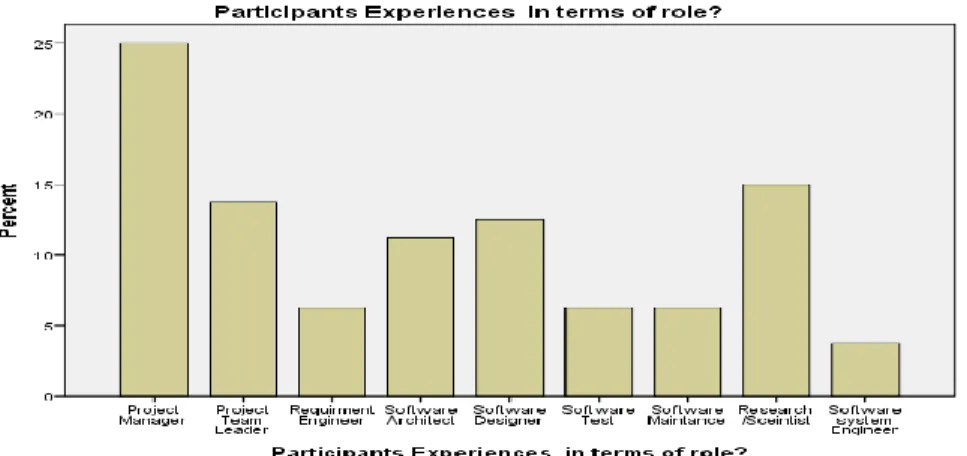
4.3.5 Participants Experiences in Terms of Role respondents
Participants Experiences in terms of role?
Frequency Percent Valid Percent Cumulative Percent
Valid
Project Manager 20 25.0 25.0 25.0
Project Team Leader 11 13.8 13.8 38.8
Requirement Engineer 5 6.3 6.3 45.0
Software Architect 9 11.3 11.3 56.3
Software Designer 10 12.5 12.5 68.8
Software Tester 5 6.3 6.3 75.0
Software Maintaince 5 6.3 6.3 81.3
Research /Scientists 12 15.0 15.0 96.3
Software system Engineer 3 3.8 3.8 100.0
Total 80 100.0 100.0
20
© Daffodil International University Table 4. 5 Participants Experiences in Terms of Role respondents
Table 4.5 shows 20(25.0%) respondents Are Project Manager, 11(13.8%) Project Team Leader and Requirement Engineer 5(6.3%) this indicates the majority of respondents are Project Manager.
4.3.6 Do you have any failure software project in your company?
Do you have any failure software project in your company?
Frequency Percent Valid Percent Cumulative Percent
Valid YES 80 100.0 100.0 100.0
Table 4.3.6 shows 80(100%) are respondent are response Yes
21
© Daffodil International University 4.3.7 Title of Software project Failure?
DDM ACCOUNTING SOFTWARE E-COMMERCE
1 1.3
1.3
1.3 16.3
1 1.3 17.5
EDUCATION APP 1 1.3 1.3 18.8
ERP 2 2.5 2.5 21.3
FILLING STATION SOFTWARE FOOD COURT
3 3.8
3.8
3.8 25.0
3 3.8 28.8
HOSTEL MANAGEMENT 8 10.0 10.0 38.8
HOTELS BOOKING 3 3.8 3.8 42.5
HR SOFTWARE 3 3.8 3.8 46.3
INVENTORY 8 10.0 10.0 56.3
JOB TRACKING SYSTEM 3 3.8 3.8 60.0
LAB MANEGMENT
SYSTEM 3 3.8 3.8 63.8
LIBRARY MANAGEMENT
SYSTEM 3 3.8 3.8 67.5
NEWS WEBSITE 3 3.8 3.8 71.3
ONLINE EXAM SYSTEM 3 3.8 3.8 75.0
ONLINE-PAYMENT
INTEGRATION 1 1.3 1.3 76.3
ORDER SYSTEM 1 1.3 1.3 77.5
PHARMACY SOFWARE 3 3.8 3.8 81.3
PROCUREMENT
Title of software Project Failure?
Frequency Percent Valid Percent Cumulative Percent
Valid
ACCOUNTING SOFTWARE 3 3.8 3.8 3.8
BOOKSTORE POS
SYSTEM 3 3.8 3.8 7.5
BUS TICKETING
SOFTWARE 3 3.8 3.8 11.3
CMS 3 3.8 3.8 15.0
22
© Daffodil International University
SOFTWARE 2 2.5 2.5 83.8
SALES DESTRUBATION
SOFTWARE 2 2.5 2.5 86.3
SCHOOL MANAGEMENT
SYSTEM 3 3.8 3.8 90.0
SURVEY SYSTEM 3 3.8 3.8 93.8
UNIVERSITY
MANAGEMENT SYSTEM 3 3.8 3.8 97.5
VEHICLE MANAGEMENT
SYSTEM 2 2.5 2.5 100.0
Total 80 100.0 100.0
This table above shows title of software project failure that respondent response during collected our questionnaire
4.3.8 Starting and Dead line month and year of failure software project for the Development?
Starting And Dead line Month and Year of Failure software project for the Development?
Year Frequency Percent Valid Percent Cumulative
Percent
Valid
01/04/2010 3 3.8 3.8 3.8
02/04/2011 4 5.0 5.0 8.8
01/07/2015 8 10.0 10.0 18.8
01/02/2016 8 10.0 10.0 28.8
01/17/2016 7 8.8 8.8 37.5
12/10/2016 8 10.0 10.0 47.5
01/04/2017 10 12.5 12.5 60.0
01/17/2017 8 10.0 10.0 70.0
04/02/2017 4 5.0 5.0 75.0
01/02/2018 4 5.0 5.0 80.0
01/10/2018 4 5.0 5.0 85.0
01/17/2018 8 10.0 10.0 95.0
04/02/2018 4 5.0 5.0 100.0
Total 80 100.0 100.0
23
© Daffodil International University Table 4.3.8 above shows the starting date for software project failure and date
between 2010 and 2018 this indicate the
The following figure 4.3.8 shows the graph of table 4.3.8
4.3.9 Completing Month and Year?
Completing Month And Year?
Year Frequency Percent Valid Percent Cumulative
Percent
Valid
03/03/2011 4 5.0 5.0 5.0
04/07/2011 3 3.8 3.8 8.8
09/15/2015 8 10.0 10.0 18.8
03/22/2016 7 8.8 8.8 27.5
01/01/2017 8 10.0 10.0 37.5
01/03/2017 8 10.0 10.0 47.5
02/01/2017 8 10.0 10.0 57.5
02/07/2017 10 12.5 12.5 70.0
04/07/2017 4 5.0 5.0 75.0
02/04/2018 12 15.0 15.0 90.0
04/11/2018 4 5.0 5.0 95.0
07/03/2018 4 5.0 5.0 100.0
Total 80 100.0 100.0
This Table above shows completing year and month and the date between 2011 and 2018
The following figure 4.3.9 shows the graph of table 4.3..9
24 |
© Daffodil International University
4.3.10 did the failure software project was delivered to any client and Month Year?
Did the failure software project was delivered to any client and Month Year?
Year Frequency Percent Valid Percent Cumulative
Percent
Valid
02/04/2011 4 5.0 5.0 5.0
09/07/2011 3 3.8 3.8 8.8
04/01/2016 8 10.0 10.0 18.8
11/13/2016 7 8.8 8.8 27.5
02/07/2017 8 10.0 10.0 37.5
07/14/2017 8 10.0 10.0 47.5
11/11/2017 10 12.5 12.5 60.0
01/02/2018 4 5.0 5.0 65.0
02/03/2018 8 10.0 10.0 75.0
04/24/2018 4 5.0 5.0 80.0
05/05/2018 4 5.0 5.0 85.0
07/07/2018 8 10.0 10.0 95.0
07/09/2018 4 5.0 5.0 100.0
Total 80 100.0 100.0
This Table above shows is there any software project was delivered to any clients
25 |
© Daffodil International University 4.3.11 is the failure software project stop from clients?
Is the failure software project stop from clients?
Frequency Percent Valid Percent
Cumulative Percent
Valid
YES 72 90.0 90.0 90.0
NO 8 10.0 10.0 100.0
Total 80 100.0 100.0
This Table above shows the respondents 72(90%) are response YES and 8(10%) response No
The following figure 4.3.11 shows the graph of table 4.3.11
4.3.12 Reason for stopping the failure software project with stopping date month and year?
Reason for stopping the failure software project with stopping date Month and
02/05/2018 4 5.0 5.0 42.5
03/01/2018 8 10.0 10.0 52.5
03/17/2018 8 10.0 10.0 62.5
09/11/2018 8 10.0 10.0 72.5
10/01/2018 10 12.5 12.5 85.0
11/07/2018 4 5.0 5.0 90.0
12/11/2018 4 5.0 5.0 95.0
05/02/2019 4 5.0 5.0 100.0
Total 80 100.0 100.0
26 |
© Daffodil International University
This table above shows reason for stopping software project with date and the date between 2010 and 2019
4.3.13 did the failure software projects was analyzed by any system analyst?
Did the failure software project was analyzed by any system analyst?
Frequency Percent Valid Percent
Cumulative Percent
Valid
YES 47 58.8 58.8 58.8
NO Total
33 41.3 41.3 100.0
80 100.0 100.0
This Table Above shows 47(58.8%) respondent are Said the YES and 33(41.3%) respondents said No
The following figure 4.3.13 shows the graph of table 4.3.13
4.3.14 How many year experiences had system analyst?
How many year experiences had system analyst?
Frequency Percent Valid Percent
Cumulative Percent
Valid
0 Years 12 15.0 15.0 15.0
1 Years 49 61.3 61.3 76.3
3 Years 12 15.0 15.0 91.3
4Years 4 5.0 5.0 96.3
None 3 3.8 3.8 100.0
Total 80 100.0 100.0
This Table above shows The experiences of system analyst 1 years experiences shows
49(61.3%) and 0 years is 12(15.0%) and the last one is 3 years 12(15.0%) this table also shows system analyst had no experiences 3(3.8%)
The following figure 4.3.14 shows the graph of table 4.3.14
27 |
© Daffodil International University 4.3.14 Educational and qualification of the system analyst?
Educational Qualification of the system Analyst?
Frequency Percent Valid Percent
Cumulative Percent
Valid
Undergraduate Bachelor Degree Master Degree
14 17.5 18.2 18.2
46 57.5 59.7 77.9
8 10.0 10.4 88.3
Missing Total
PHD 3 3.8 3.9 92.2
None 6 7.5 7.8 100.0
Total System
77 96.3 100.0
3
80
3.8 100.0
The above table shows 46 (57.5%) respondents have bachelor degree (BSC) 14(17.5%) respondents are the Undergraduate, and 8(10.0%) are Master Degree 3(3.8%) have PHD The majorities are the bachelor Degree
The following figure 4.3.14 shows the graph of table 4.3.14
4.3.15 Educational and qualification of the system analyst?
Major of Education Qualification?
Frequency Percent Valid Percent
Cumulative Percent
Valid
Computer Science And Engineering
Software Engineering
18 22.5
23.4 10.4
23.4
8 10.0 33.8
Information Technology Other
45 56.3 58.4
7.8
92.2
6 7.5 100.0
28 |
© Daffodil International University
Total 77 96.3 100.0
Missing Total
System 3 3.8
80 100.0
The above table shows 45 (56.3%) respondents are major education is Information Technology 18(22.5%) the respondents are Computer Sciences 8(10.0%) the respondents are software engineering 6(7.5%) the respondents are Other
The following figure 4.4.15 shows the graph of table 4.4.15
4.3.16 did the failure software project was gathered the requirements by any Requirement analysts?
Did the failure software project was gathered the requirements by any requirement analysts?
Frequency Percent Valid Percent
Cumulative Percent
Valid
YES 42 52.5 52.5 52.5
NO 38 47.5 47.5 100.0
Total 80 100.0 100.0
This Table above shows the respondents of 42(52.5%) respondents respond YES and the 38(47.5%) respondents response NO
The following figure 4.3.16 shows the graph of table 4.3.16
4.3.17 How many year experiences had requirement analyst?
How many year experiences had requirement analyst?
Frequency Percent Valid Percent
Cumulative Percent
Valid
0 Years 1 Years
32 40.0 40.0 40.0
4 5.0 5.0 45.0
3 Years 29 36.3 36.3 81.3
29 |
© Daffodil International University
4Years 4 5.0 5.0 86.3
More than 5 Years 11 13.8 13.8 100.0
Total 80 100.0 100.0
This table above shows 32(40.0%) had 0 year and 29(36.3%) had 1 year experiences 11(13.8%) had more than 5 years
4.3.18 Educational Qualification of the requirement analyst?
Educational Qualification of the Requirement analyst?
Frequency Percent Valid Percent Cumulative Percent
Valid
High school Diploma Undergraduate Bachelor Degree
8 10.0 10.0 10.0
8 10.0 10.0 20.0
53 66.3 66.3 86.3
Master Degree 8 10.0 10.0 96.3
None 3 3.8 3.8 100.0
Total 80 100.0 100.0
The above table shows 53 (66.3%) respondents have bachelor degree (BSC) 8(10.0%) respondents are the Undergraduate, and 8(10.0%) are Master Degree the majorities are the bachelor Degree
4.3.19 Major of Education Qualification of Requirement Analyst?
Major of Education Qualification?
Frequency Percent Valid Percent Cumulative Percent
Valid
Computer Science And Engineering
Software Engineering
18 22.5
23.4 10.4
23.4
8 10.0 33.8
Missing Information Technology 45 56.3 58.4 92.2